Jawline Filler for Men: What to Expect, How It Works & Who It Suits
Jawline filler for men has grown significantly in popularity as a non-surgical option for improving jaw definition, correcting mild asymmetry, and restoring volume lost with age. Unlike surgical jaw implants, dermal filler can be placed in a single appointment, adjusted over time, and — depending on the product used — reversed if needed. This guide covers how the procedure works, what makes male jawline treatment distinct from female treatment, which fillers are typically used, realistic results, risks, costs, and how to decide whether it may be worth discussing with a qualified practitioner.
Key Takeaways
- Jawline filler for men uses injectable dermal filler to sharpen the mandibular border, define the gonial angle, and improve lower-face balance without surgery.
- Male anatomy — including thicker skin, denser subcutaneous tissue, and stronger bone structure — affects product choice, injection depth, and the volume of filler typically required.
- FDA-approved options for jawline contouring include Juvederm Volux XC (hyaluronic acid) and RADIESSE (calcium hydroxylapatite); results generally last 12–18 months.
- Men usually require more product than women to achieve visible definition, and the aesthetic goal differs: a squared, angular shape rather than a softened contour.
- Filler cannot correct significant skin laxity, heavy jowls, or major skeletal deficiency — understanding these limitations before treatment is essential.
What Is Jawline Filler and How Does It Work?
Jawline filler is a form of non-surgical jawline enhancement in which a practitioner injects a dermal filler product along the lower third of the face — typically along the mandibular border, at the jaw angle (gonial angle), and sometimes at the chin — to create a more defined, structured appearance. The filler adds volume in precise locations, effectively projecting and sharpening the jaw’s outline without altering the underlying bone.
Most products used for this purpose are either hyaluronic acid (HA) fillers or calcium hydroxylapatite (CaHA) fillers. HA fillers work by attracting and retaining water molecules within the tissue, providing immediate volume and structure. CaHA fillers, such as RADIESSE, contain microspheres suspended in a gel carrier; once injected, the gel provides immediate volume while the microspheres stimulate the body’s own collagen production over time — a biostimulatory effect that can extend the duration of results. Both categories are injected beneath the skin, typically at or near the periosteum (the tissue layer covering the bone), to create a firm, well-defined result along the jaw.
Why Male Jawline Treatment Is Different
Treating a man’s jawline is not simply a matter of using more product than would be used for a woman. Male and female facial anatomy differ in ways that directly affect how filler behaves and how much is needed. Men generally have thicker skin and denser subcutaneous tissue, which means filler must be placed at greater depth to produce a visible surface effect. The stronger bone structure of the male mandible also means that the injector is working against a firmer foundation, which influences both technique and product selection.
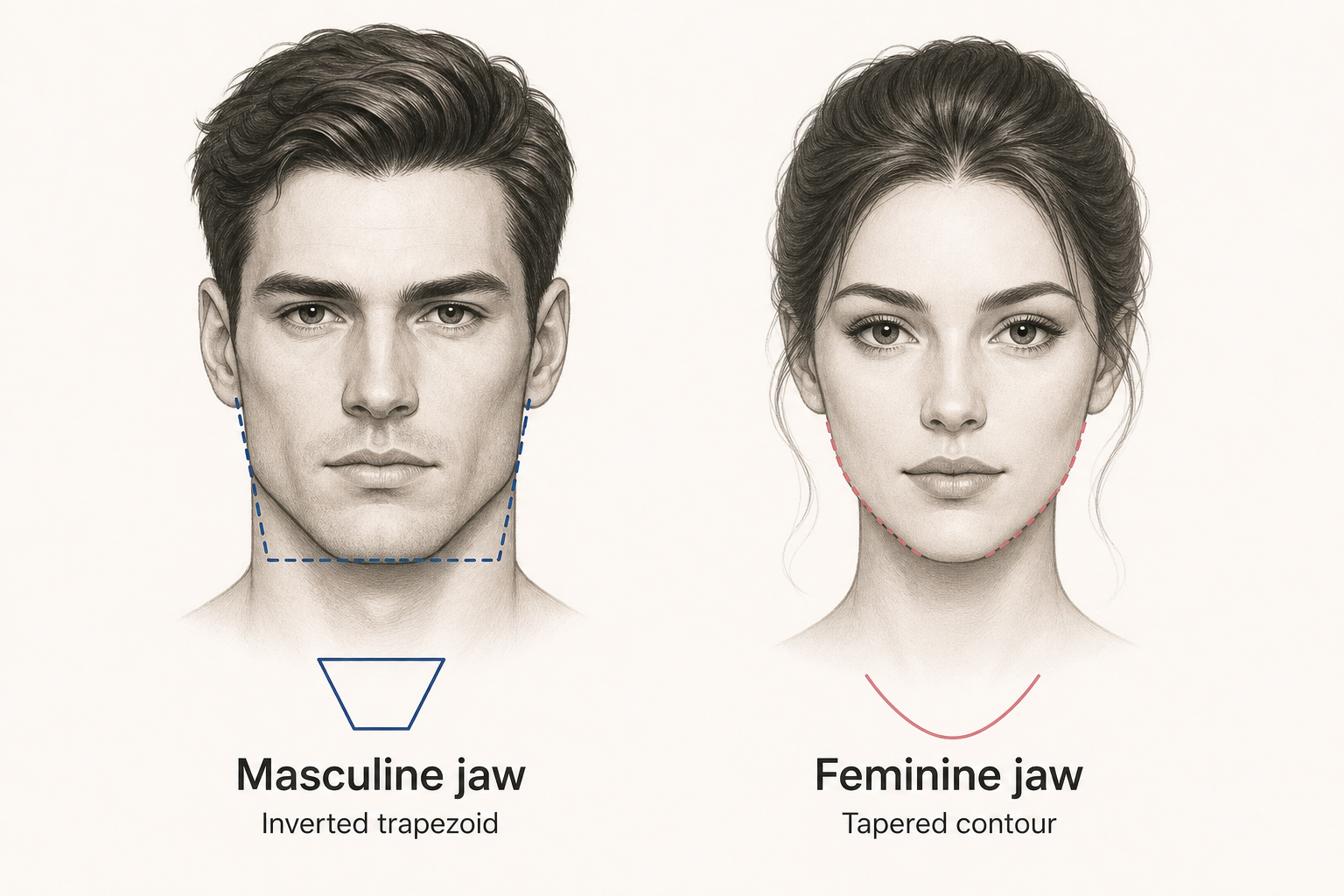
The aesthetic goal also differs fundamentally. The ideal masculine jawline is often described as an inverted trapezoid shape — wide, angular, and squared at the corners — rather than the softer, tapered contour typically sought in female facial contouring. Achieving this requires precise placement at the gonial angle to widen and project the jaw corners, combined with definition along the mandibular border to create a clean, sharp lower-face outline. Overfilling or placing product in the wrong anatomical location can soften masculine facial proportions rather than enhance them, which is one reason experience with male patients specifically matters when choosing a provider.
Men also tend to require more syringes than women to achieve a meaningful result. While a woman might see noticeable improvement with one to two syringes, men commonly need two to four syringes for a moderate result, and some cases — particularly where significant volume restoration is needed — may require more. This has a direct impact on cost and should be factored into treatment planning from the outset.
Which Fillers Are Used for Men’s Jawlines?
Several filler products are used for jawline contouring in men, and the choice depends on the patient’s anatomy, the degree of definition desired, and the practitioner’s clinical judgement.
Juvederm Volux XC is a hyaluronic acid filler specifically FDA-approved for improving jawline definition. It has a high degree of cohesivity and lift capacity, making it well suited to the structural demands of the lower face. Because it is an HA filler, it can be dissolved with hyaluronidase if correction or reversal is needed — an important safety consideration.
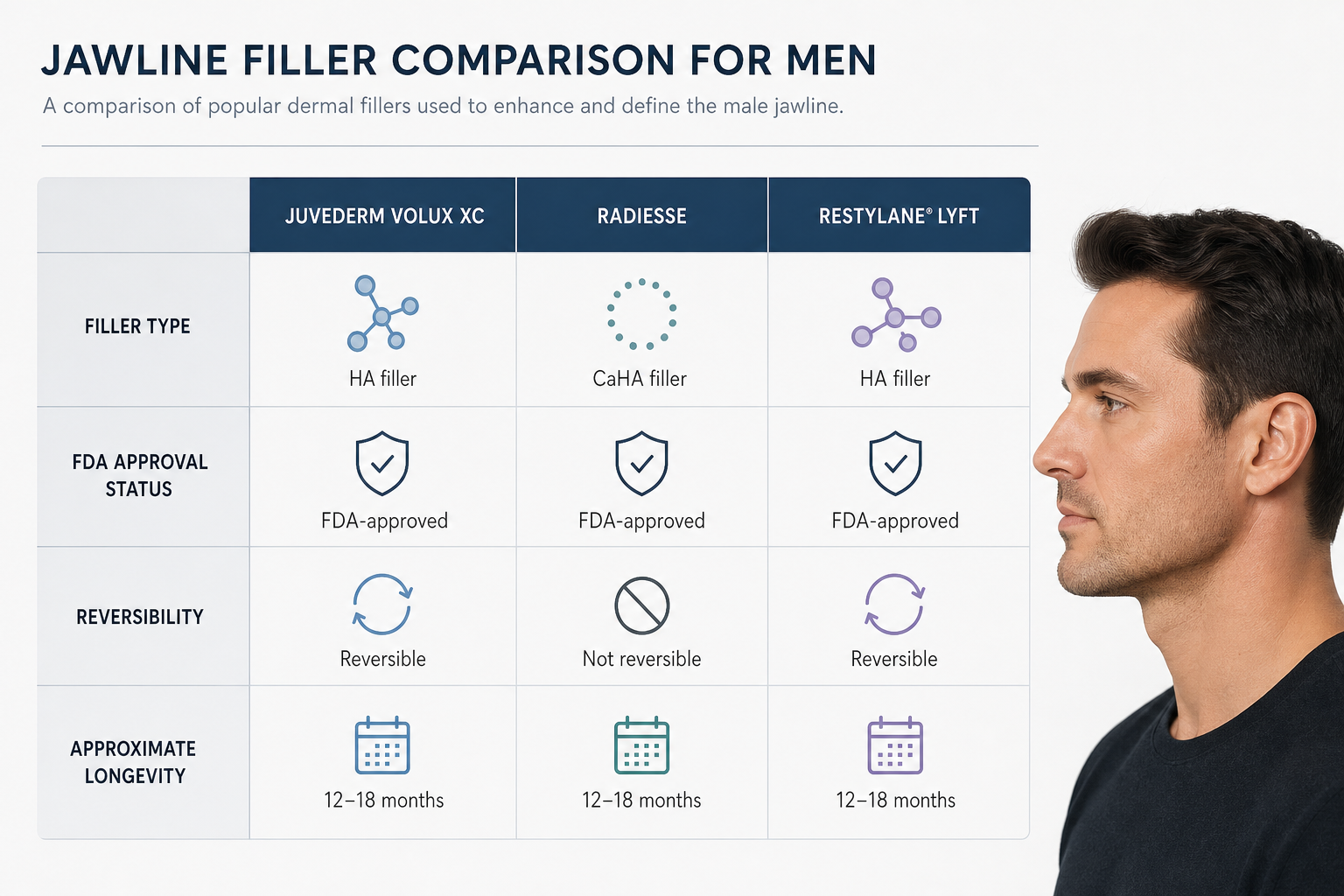
Juvederm Voluma XC is another HA filler sometimes used off-label for jaw contouring. It offers strong lift and projection and is widely available, though it is not specifically approved for the jawline indication.
Restylane Lyft and other Restylane-family products such as Restylane Defyne and Restylane Contour are HA fillers that practitioners may select depending on the specific area being treated and the degree of flexibility or firmness required.
RADIESSE is a calcium hydroxylapatite filler that received FDA approval for jawline contour in 2021. Its firmer consistency and collagen-stimulating properties make it a popular choice for men who want a structured, long-lasting result. One important distinction: RADIESSE is not reversible with hyaluronidase, so precise placement by an experienced injector is particularly important when this product is used.
Sculptra and RHA 4 are occasionally used in this area, though they are less commonly the primary choice for jawline definition in men. Sculptra is a biostimulatory filler that works gradually over several months and may be considered when a more diffuse volumising effect is the goal.
The Procedure: What Happens at Your Appointment
A jawline filler appointment for men typically begins with a detailed consultation, during which the practitioner assesses facial anatomy, discusses aesthetic goals, reviews medical history, and takes standardised photographs. This planning stage is important: the practitioner needs to evaluate skin quality, the degree of existing jaw definition, the position of the mandibular border, and whether any asymmetry is present before deciding on product choice, injection sites, and volume.
On the day of treatment, the skin is cleansed and the injection sites are marked. A topical numbing cream is usually applied and left for 20–30 minutes before the procedure begins. Many filler products also contain pre-mixed lidocaine, which provides additional comfort during injection. The treatment itself typically takes between 15 and 30 minutes, depending on the number of areas being treated and the volume of product used.
Practitioners may use a fine needle or a blunt-tipped cannula technique, or a combination of both. The cannula technique involves inserting a flexible, blunt-tipped instrument through a small entry point and threading it along the tissue plane to deposit filler in a linear threading pattern. This approach may reduce bruising and allows the practitioner to work along the mandibular border with a degree of precision. Needle injections may be used for more targeted placement, particularly at the gonial angle where a periosteal bolus technique — depositing a small amount of filler directly against the bone — can create angular projection. After injection, the practitioner may gently massage the area to distribute the product evenly.
Results are visible immediately, though the treated area will typically appear slightly swollen for several days. The final settled result is usually assessed at around two weeks post-treatment, once swelling has fully resolved.
Beard and Facial Hair: A Consideration Unique to Men
Facial hair presents a practical consideration that is rarely discussed in detail but is relevant for male patients. On the positive side, beard growth can conceal bruising in the days following treatment, which may reduce visible downtime. However, facial hair also makes it harder for a practitioner — and for the patient — to detect early signs of vascular compromise in the treated area. Vascular occlusion, while rare, is a serious complication in which filler inadvertently enters or compresses a blood vessel, restricting blood flow to surrounding tissue. Early warning signs include unusual blanching (whitening) of the skin, mottled discolouration, or disproportionate pain — signs that can be obscured by dense beard growth. Men with significant facial hair should ensure their practitioner is aware of this and examines the skin carefully throughout the procedure.
Results: What You Can Realistically Expect
Jawline filler can produce a meaningful improvement in jaw definition for men who have a mildly undefined or asymmetric jawline, age-related volume loss along the lower face, or a naturally less angular jaw structure. The improvement is visible immediately and becomes clearer once post-treatment swelling resolves at around two weeks. A well-executed treatment can sharpen the mandibular border, add angular projection at the jaw corners, and improve the overall balance of the lower third of the face.
It is equally important to understand what jawline filler cannot achieve. Filler adds volume and creates the appearance of structure, but it does not move bone. Men with significant skeletal deficiency — where the jaw is substantially set back or underdeveloped — are unlikely to achieve the degree of change they may be hoping for with filler alone. Filler also cannot tighten loose skin or lift heavy jowls; in men with significant skin laxity or excess submental fat (a double chin), the result may be less defined than expected, and alternative or additional treatments may be more appropriate. Being honest about these limitations before treatment is a sign of a responsible practitioner.
HA fillers typically last 12–18 months in the jawline area, with some patients reporting results up to two years. RADIESSE results are generally quoted at 12–18 months, with clinical data suggesting that approximately two-thirds of patients show continued improvement at 48 weeks. Scheduling a touch-up appointment before the filler has fully dissolved — rather than waiting until results have completely faded — can help maintain definition with a smaller volume of product at each session.
Risks and Side Effects
Common side effects of jawline filler include swelling, bruising, tenderness, and redness at the injection sites. These effects are expected and typically resolve within a few days to two weeks. Swelling is often more pronounced in the first 24–48 hours and may temporarily make the treated area appear uneven before settling.
Less common complications include asymmetry, nodule formation, filler migration (where product shifts from the intended location), and infection. Filler migration is more likely when a product that is too soft or too fluid is used in a structural area, or when excessive product is placed superficially — another reason that product selection and technique matter significantly in this region.
The most serious risk associated with any facial filler procedure is vascular occlusion — the inadvertent injection of filler into or around a blood vessel, which can restrict blood supply to surrounding tissue. In the jawline area, the facial artery and its branches run in close proximity to common injection sites. If vascular occlusion is not identified and treated promptly with hyaluronidase (for HA fillers), it can progress to tissue necrosis. In extremely rare cases, filler entering the vascular system can travel to the ophthalmic artery and cause vision loss. These serious complications are rare but not negligible, and they underscore the importance of choosing a practitioner with thorough knowledge of facial vascular anatomy and emergency protocols.
A male-specific aesthetic risk worth noting is overfilling. Using too much product — or placing it incorrectly — can create a heavy, rounded lower face rather than a chiseled jawline, and in some cases can inadvertently soften masculine facial proportions. This is particularly relevant when treating men who are seeking a very angular result: more product is not always better, and a staged approach with conservative initial volumes is often preferable.
Who May Be a Suitable Candidate
Men who tend to respond well to jawline filler are those with a mildly undefined or naturally soft jaw structure, mild facial asymmetry, or age-related volume loss along the lower face. Good candidates are generally in reasonable overall health, have realistic expectations about what filler can achieve, and are not seeking a result that would require surgical intervention.
Men who may not be well suited to jawline filler include those with significant skin laxity or heavy jowling, where filler alone is unlikely to produce a satisfying result. Excess submental fat (a double chin) can also limit the visual impact of jawline filler, as the definition created along the mandibular border may be obscured by the surrounding soft tissue. Active skin infection in the treatment area, known allergy to filler ingredients, and pregnancy or breastfeeding are contraindications. Men with unrealistic expectations — for example, expecting filler to replicate the result of jaw implants or to dramatically alter bone structure — are also unlikely to be satisfied with the outcome.
Masseter Botox and Combination Treatments
Jawline filler is frequently discussed alongside masseter muscle treatment with botulinum toxin (neuromodulator), and the combination is popular in female facial contouring. For men, however, this pairing requires more careful consideration. Masseter Botox reduces the bulk of the chewing muscle at the jaw angle, which can slim the lower face — an effect that may be desirable in women but can work against the goal of a wider, more angular jaw in men. For men who already have a naturally slim or narrow lower face, masseter Botox alongside jawline filler may undermine the result.
That said, masseter Botox may be appropriate for men who have significant masseter hypertrophy (an enlarged chewing muscle) that creates an overly square or bulky appearance rather than a defined one, or for men who experience jaw clenching or bruxism. The decision should be made on an individual basis, with the practitioner clearly explaining how each treatment will interact with the other in the context of the patient’s specific anatomy and goals.
Chin filler is the most common pairing with jawline filler and is often recommended in the same session. Balancing the chin projection with the jaw width creates a more harmonious lower-face profile and can enhance the overall effect of jawline treatment. Other combination options include Kybella or similar fat-dissolving treatments for submental fat, PDO threads for mild skin laxity, and radiofrequency or ultrasound skin tightening — though these are typically considered when filler alone is insufficient.
Cost and Long-Term Financial Considerations
The cost of jawline filler for men varies depending on the number of syringes used, the product selected, the practitioner’s experience, and the clinic’s location. Individual syringes typically range from approximately £400 to £900 in the UK, or $600 to $1,500 in the US. Because men generally require more product than women — commonly two to four syringes for an initial treatment, and sometimes more — the total cost of a single session can range from around £800 to £3,500 or more.
Maintenance is an ongoing cost that is worth factoring into the decision. If results last 12–18 months and a touch-up appointment is needed annually or every 18 months, the cumulative cost over five years can be substantial — potentially exceeding the one-time cost of surgical jaw implants in some cases. Men who are considering jawline filler as a long-term solution should discuss the expected maintenance schedule and total cost of ownership with their practitioner, and compare this honestly against surgical alternatives if a permanent result is the ultimate goal.
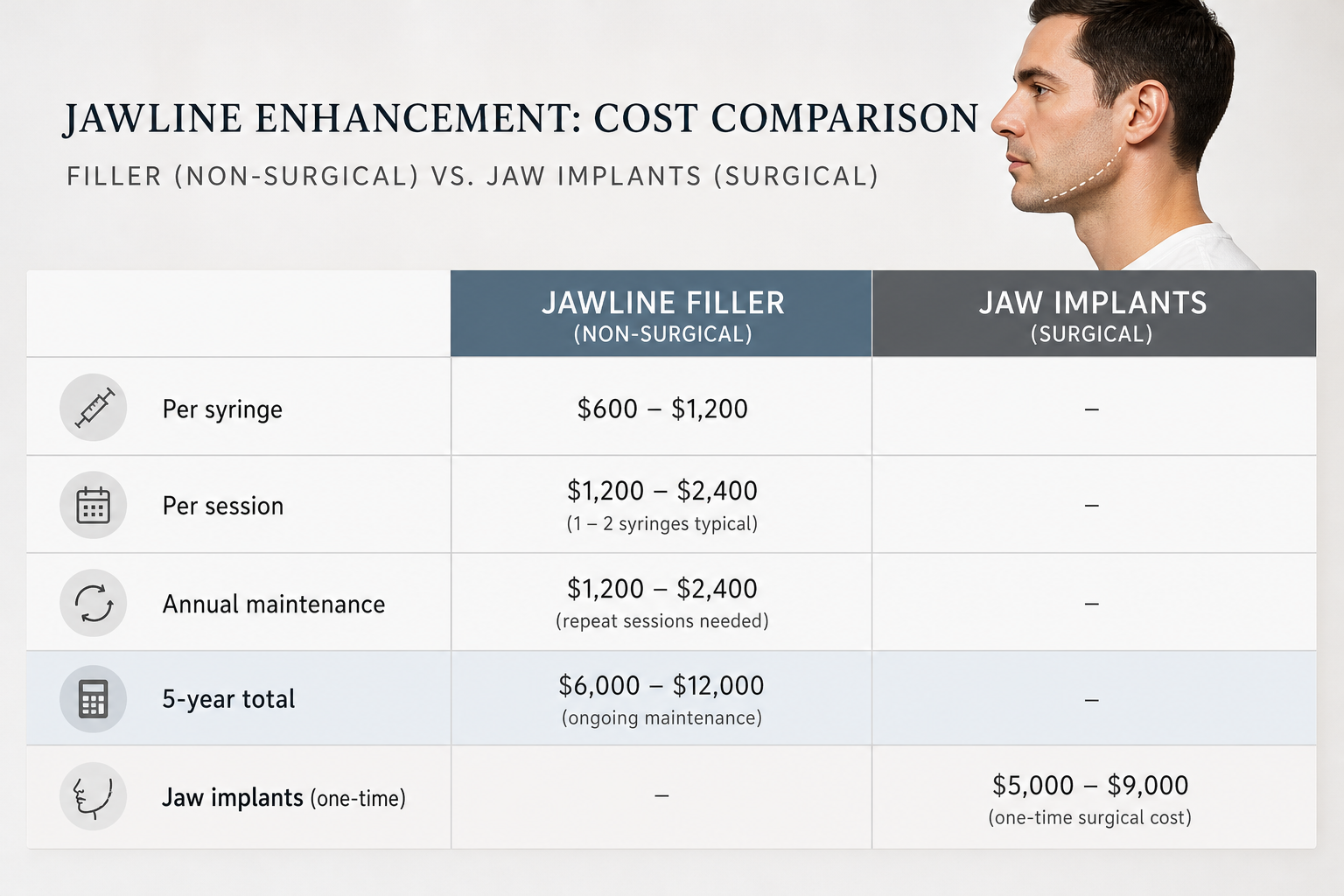
Jawline filler is not covered by health insurance, as it is a cosmetic procedure.
Jawline Filler vs. Jaw Implants
Surgical jaw implants — typically gonial angle implants placed at the jaw corners — offer a permanent structural change that filler cannot replicate. For men with significant skeletal deficiency or those seeking a dramatic, lasting result, implants may ultimately be the more appropriate option. The trade-off is that implants involve surgery, general or sedation anaesthesia, a recovery period of several weeks, and the risks associated with any surgical procedure, including infection, implant displacement, and nerve injury.
Jawline filler can serve a useful role as a trial run before committing to implants. By temporarily adding volume and projection in the areas where implants would be placed, filler allows a man to experience an approximation of the surgical result before making a permanent decision. If the result is satisfying, he may choose to continue with filler maintenance; if he wants more, he can proceed to surgery with a clearer sense of what he is looking for. This staged approach is worth discussing with a practitioner who has experience in both non-surgical and surgical facial contouring.
Choosing the Right Practitioner
The jawline is a vascular and anatomically complex area, and the quality of the outcome depends heavily on the practitioner’s skill, product knowledge, and understanding of male facial anatomy. Beyond verifying that a provider holds appropriate medical qualifications and is registered with a relevant regulatory body, men should look specifically for evidence of experience treating male patients. Reviewing a portfolio of before-and-after photographs of male jawline cases — not just female cases — gives a clearer indication of whether the practitioner understands masculine facial proportions and the inverted trapezoid aesthetic goal.
When evaluating before-and-after images, it is worth being aware that lighting, angle, and camera settings can significantly affect how results appear. Photographs taken from different angles or under different lighting conditions between the before and after shots can exaggerate or minimise the apparent change. Consistent lighting, angle, and distance between comparison images are signs of a more reliable portfolio.
A practitioner who takes time during the consultation to discuss realistic limitations, explain which areas they plan to treat and why, and outline what the procedure cannot achieve is generally a more trustworthy choice than one who focuses primarily on the potential upside without acknowledging the constraints.
Lifestyle Factors That May Affect How Long Results Last
Several lifestyle factors can influence how quickly the body metabolises dermal filler, though individual variation is significant and the evidence in this area is largely observational. High-intensity exercise increases metabolic rate and circulation, which may accelerate filler breakdown — a relevant consideration for men who train frequently. Sun exposure and smoking are associated with faster collagen degradation and may reduce the longevity of results. Staying well hydrated supports HA filler performance, as hyaluronic acid binds water. None of these factors should be considered absolute predictors of how long results will last, but they are worth discussing with a practitioner when planning a maintenance schedule.
Frequently Asked Questions
Does jawline filler hurt?
Most patients describe the procedure as mildly uncomfortable rather than painful. Topical numbing cream is applied beforehand, and many filler products contain pre-mixed lidocaine that further reduces discomfort during injection. The gonial angle area can be more sensitive than other parts of the jaw, but the treatment is generally well tolerated.
How many syringes will I need?
This depends on your anatomy, the degree of definition you are starting with, and your aesthetic goal. Men typically require more product than women — commonly two to four syringes for an initial treatment, though some cases may require more. Your practitioner should give you a realistic estimate during the consultation based on your specific facial structure.
Can jawline filler be reversed?
Hyaluronic acid fillers such as Juvederm Volux and Restylane Lyft can be dissolved using hyaluronidase, an enzyme that breaks down HA. RADIESSE (calcium hydroxylapatite) is not reversible in this way, which makes precise placement particularly important when this product is used.
How soon can I return to normal activities?
Most men return to work and daily activities the same day or the following day. Strenuous exercise is usually advised against for 24–48 hours. Swelling and bruising, if present, typically resolve within one to two weeks. Beard growth can help conceal any visible bruising during this period.
Will jawline filler make my face look feminine?
When performed by a practitioner experienced with male anatomy and masculine facial proportions, jawline filler should enhance rather than feminise the face. The risk of an undesirable result increases with overfilling or incorrect product placement, which is why choosing a provider with a demonstrable track record in male facial contouring is important.
Is jawline filler suitable if I have a beard?
Yes, though your practitioner should be aware that dense facial hair can make it harder to monitor the skin during and after treatment. Inform your practitioner about your beard growth pattern so they can examine the skin carefully throughout the procedure.
Is Jawline Filler the Right Choice for You?
Jawline filler for men can be a well-suited option for those seeking a more defined, angular lower face without surgery, provided expectations are realistic and the treatment is performed by a practitioner with genuine experience in male facial anatomy. The procedure offers meaningful improvement for men with a mildly undefined jaw, mild asymmetry, or age-related volume loss — and the ability to adjust or dissolve HA filler over time provides a degree of flexibility that surgical options do not.
The treatment has clear limitations. It cannot correct significant skin laxity, heavy jowling, or major skeletal deficiency, and it requires ongoing maintenance to sustain results. The cumulative cost over several years is worth comparing honestly against surgical alternatives for men who are considering a long-term solution. For those who are uncertain, using filler as a trial run before committing to jaw implants is a practical approach worth discussing with a qualified practitioner.
If you are considering jawline filler, a thorough consultation with an experienced injector who has a portfolio of male patients and a clear understanding of masculine facial proportions is the most important first step. A good consultation should leave you with a realistic picture of what the treatment can and cannot achieve for your specific anatomy — and the confidence to make an informed decision.