How Long Between Laser Hair Removal Sessions: A Body-Area Guide
The time you wait between laser hair removal sessions is one of the most important factors in whether your treatment works. Go too soon and the laser targets hairs that are not yet in the right growth phase. Wait too long and you may miss the window when follicles are most vulnerable. Most people need to space appointments between four and eight weeks apart, but the right interval depends on which body area you are treating, your hair type, and where you are in your overall treatment plan.
Key Takeaways
- Session spacing varies by body area: faster-cycling areas like the face and bikini line typically need four to six weeks between appointments, while slower-cycling areas like the legs and back need six to eight weeks.
- Laser hair removal only works on hairs in the active growth phase (anagen phase), which is why multiple sessions spaced correctly are essential.
- Hormonal conditions such as PCOS can affect how quickly hair regrows and may require adjusted treatment intervals or more sessions overall.
- Spacing tends to lengthen progressively as treatment advances — early sessions are closer together, later sessions further apart.
- After completing an initial course, most people transition to occasional maintenance sessions rather than stopping treatment entirely.
Why the Hair Growth Cycle Determines Your Schedule
Laser hair removal works by targeting melanin — the pigment — inside the hair follicle. The laser energy converts to heat, which damages the follicle and inhibits future growth. This process, known as selective photothermolysis, is only effective when the hair is in the anagen phase, the active growth stage when the follicle is fully connected to the hair shaft and melanin concentration is highest.
The challenge is that not all hairs are in the anagen phase at the same time. At any given moment, only around 15 to 20 percent of hairs in a treatment area are actively growing. The remaining hairs are either in the catagen phase (a brief transitional stage) or the telogen phase (a resting and shedding stage), during which laser energy has little effect on the follicle. This is why a single session cannot eliminate all unwanted hair, and why consistent session spacing across multiple appointments is necessary to catch each follicle during its active phase.
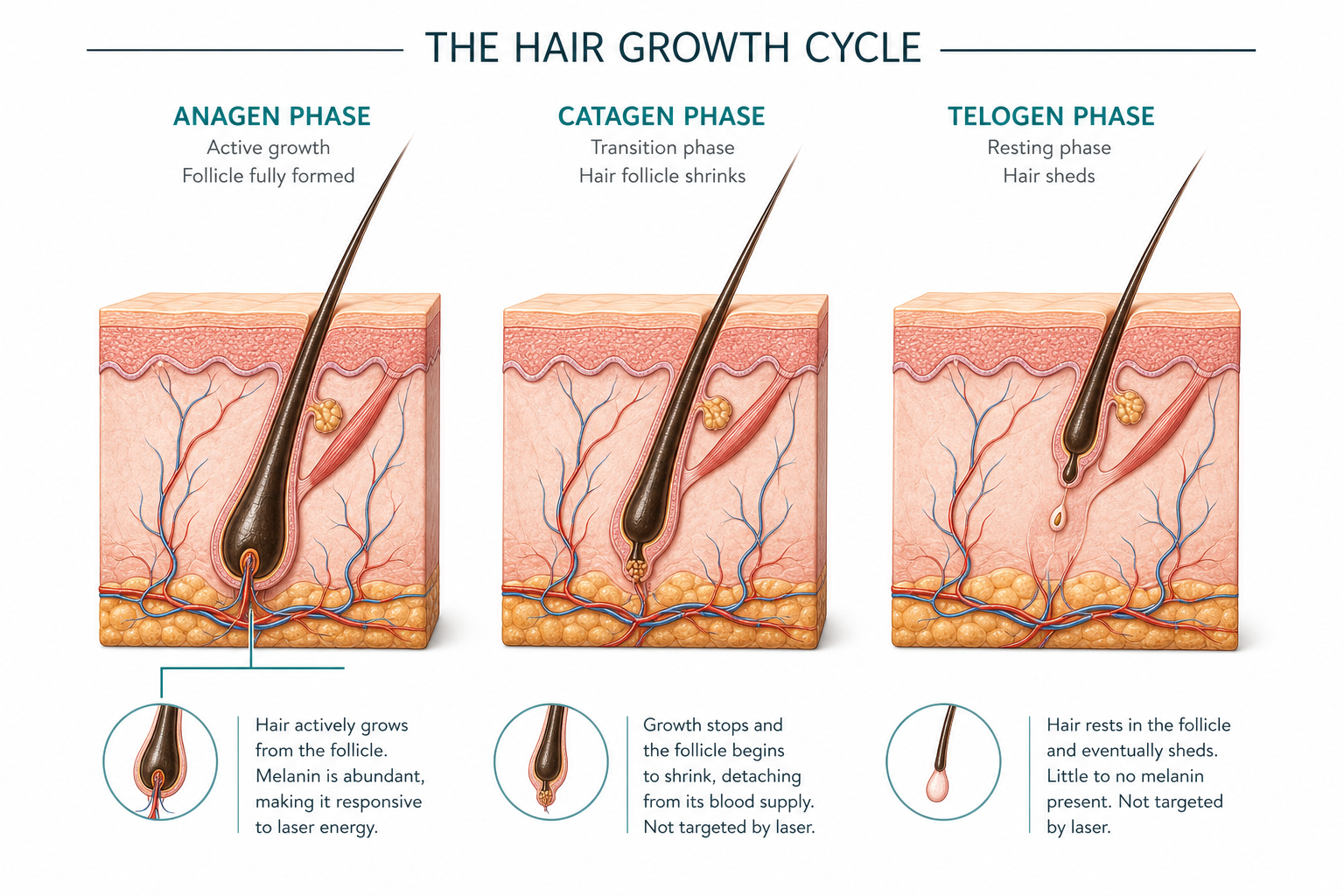
The length of the hair growth cycle varies considerably by body area, which is the primary reason treatment intervals differ depending on where you are being treated. Facial hair cycles faster than leg hair, so the face needs more frequent appointments to stay aligned with the anagen window.
Recommended Session Spacing by Body Area
The following table summarises typical treatment intervals, approximate session counts, and general maintenance frequency by body area. These are general clinical guidelines; your practitioner may adjust your schedule based on your individual response to treatment.
| Body Area | Typical Interval | Approximate Sessions | Maintenance Interval |
|---|---|---|---|
| Upper lip / chin | 4–6 weeks | 6–10 | Every 3–6 months |
| Face (general) | 4–6 weeks | 6–8 | Every 3–6 months |
| Underarms | 4–8 weeks | 6–8 | Every 6–12 months |
| Bikini / Brazilian | 4–6 weeks | 6–10 | Every 3–6 months |
| Arms / forearms | 6–8 weeks | 6–8 | Every 6–12 months |
| Legs (lower) | 6–8 weeks | 6–8 | Every 6–12 months |
| Legs (full) | 6–8 weeks | 6–8 | Every 6–12 months |
| Back / shoulders | 6–8 weeks | 6–10 | Every 6–12 months |
| Chest / abdomen | 6–8 weeks | 6–8 | Every 6–12 months |
Face, Upper Lip, and Chin
Facial hair, particularly on the upper lip and chin, has one of the fastest hair growth cycles of any body area. This means the anagen phase recurs more frequently, and sessions are typically scheduled every four to six weeks. Hormonal influences are also strongest on the face, which is why people with conditions such as PCOS or hormonal fluctuations related to perimenopause often find that facial hair regrows more quickly and may need more sessions overall. The upper lip in particular tends to require consistent treatment and more frequent maintenance appointments compared with non-hormonal areas.
Underarms
Underarm hair tends to be coarse and dark, which makes it a good candidate for laser treatment. The hair growth cycle in this area is moderately fast, and most practitioners recommend four to eight weeks between sessions. Because the treatment area is small and hair density is relatively high, underarms often show noticeable results after just a few sessions, though a full course of six to eight treatments is still typically needed for lasting reduction.
Bikini and Brazilian
The bikini and Brazilian area is classified as a hormonal area, meaning hair growth here is influenced by hormones and tends to cycle more quickly than on the legs or back. A four-to-six-week interval is standard. Like the face, this area may require more sessions and more frequent maintenance treatments in people with hormonal imbalances. Hair in this region is often coarse and dark, which generally responds well to laser energy, but the sensitivity of the skin means treatment parameters need careful calibration.
Legs, Back, and Arms
Non-hormonal areas such as the legs, back, chest, and arms have slower hair growth cycles, which is why the recommended treatment interval extends to six to eight weeks. Treating these areas too soon — before enough follicles have re-entered the anagen phase — wastes a session and slows overall progress. For the back and legs in particular, some practitioners extend intervals to ten weeks or more in the later stages of a treatment course, once hair density has already been significantly reduced. This progressive spacing approach is discussed further below.
Progressive Spacing: How Intervals Change as Treatment Advances
One aspect of laser hair removal scheduling that is rarely explained clearly is that session spacing is not fixed throughout a treatment course. In the early phase of treatment — typically the first three to four sessions — intervals are kept shorter to catch as many follicles as possible during their anagen phase while hair density is still high. As treatment progresses and hair density decreases, the remaining follicles take longer to cycle back into the anagen phase, and intervals can be extended without losing effectiveness.
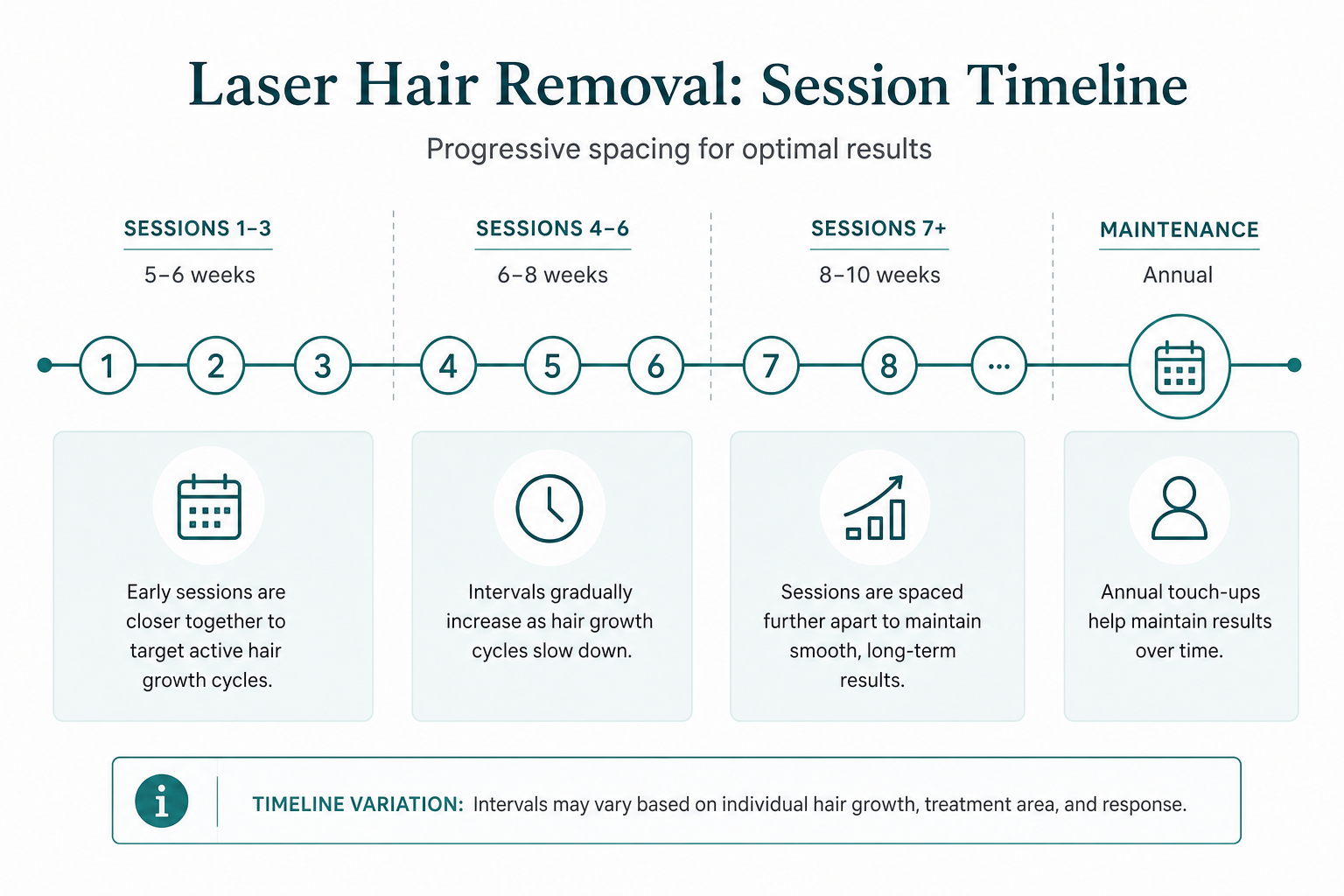
In practical terms, this means a patient treating their legs might start with six-week intervals for the first few sessions, then extend to eight or even ten weeks for later sessions. This progressive spacing approach reflects the biology of the treatment rather than a scheduling convenience. Your practitioner should review your response at each appointment and adjust your interval accordingly. If you are being given the same fixed interval throughout your entire course without any reassessment, it is worth asking whether your schedule should be reviewed.
Factors That Affect Your Treatment Interval
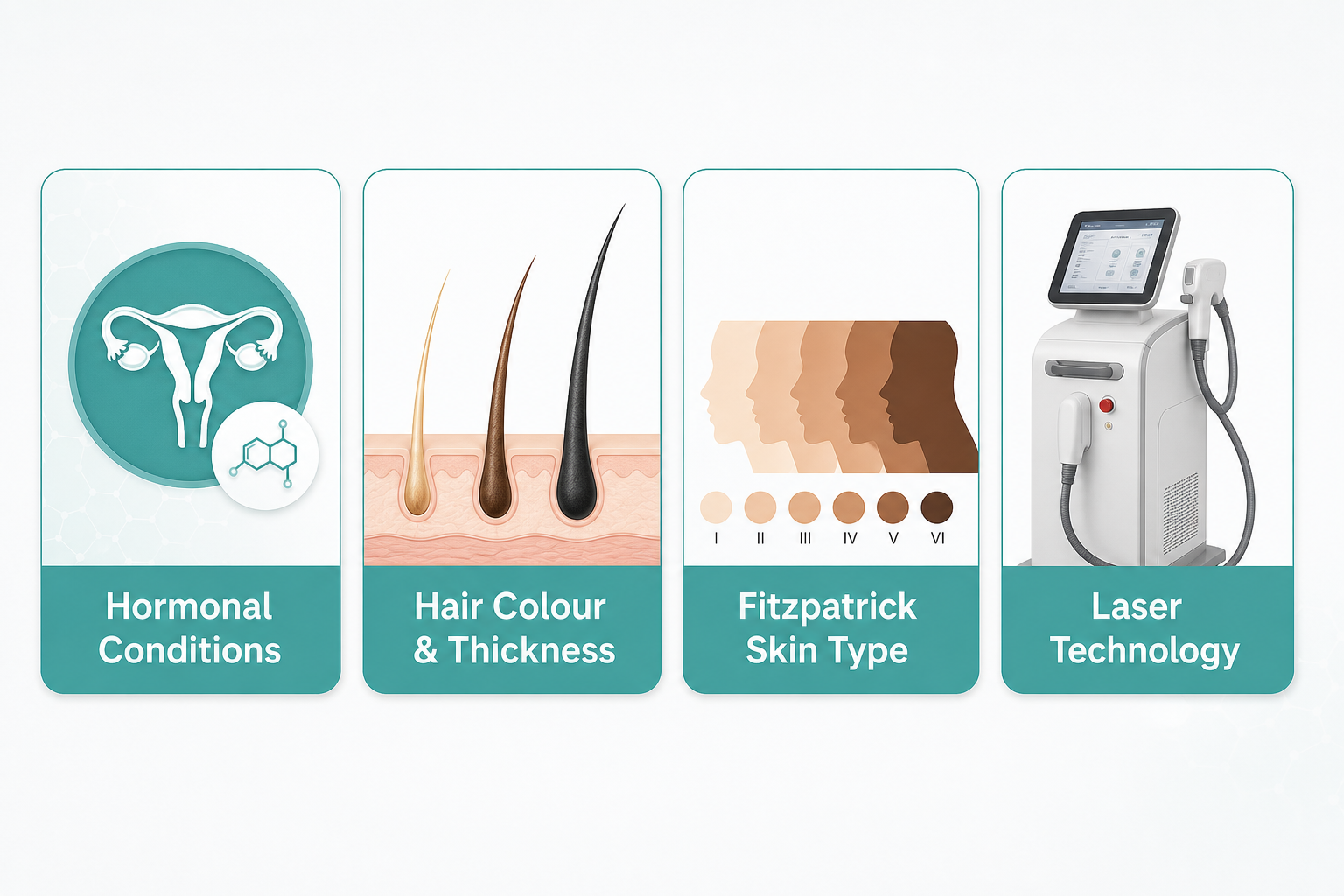
While the body-area breakdown above provides a reliable starting point, several individual factors can shift the recommended interval in either direction.
Hormonal Conditions
PCOS and laser hair removal is a combination that requires careful planning. Polycystic ovary syndrome causes elevated androgen levels, which stimulate hair follicles and can accelerate regrowth even after effective laser treatment. People with PCOS often need more sessions than average, may need shorter intervals between appointments, and typically require more frequent maintenance sessions long-term. Thyroid disorders and perimenopause can have similar effects on hair growth patterns. If you have a hormonal condition, discussing this with your practitioner before starting treatment allows for a more realistic treatment plan from the outset. In some cases, combining laser treatment with hormonal management under medical supervision may improve long-term outcomes.
Hair Colour and Thickness
Laser hair removal works best on dark, coarse terminal hair because melanin absorbs laser energy efficiently. People with this hair type often see faster results and may be able to extend intervals sooner. Very fine or light-coloured hair — including vellus hair — contains less melanin and responds less predictably to laser energy. In some cases, electrolysis may be a more appropriate alternative for very fine or light hair that does not respond adequately to laser treatment.
Fitzpatrick Skin Type
Fitzpatrick skin type affects both the laser technology used and the energy settings applied during treatment. Darker skin tones require lasers such as the Nd:YAG, which targets the follicle with less risk of affecting surrounding skin pigment. The laser type and settings used can influence how the skin recovers between sessions and may affect the recommended interval. Your practitioner should assess your Fitzpatrick skin type during consultation and select the appropriate device and parameters for your skin.
Laser Technology
Different laser platforms — including diode lasers, alexandrite lasers, and Nd:YAG lasers — have different wavelengths and penetration depths, which affect how efficiently they target follicles at various skin depths. While the fundamental biology of the hair growth cycle does not change based on the device used, the energy delivered per session and the skin’s recovery time can vary. Some advanced diode systems allow slightly more flexibility in scheduling, but this should always be guided by your practitioner rather than assumed.
Hair Density and Individual Growth Rate
People with very dense hair may need more sessions before intervals can be extended, because there are simply more follicles cycling through the anagen phase at any given time. Individual variation in hair growth rate — influenced by genetics, age, and overall health — also plays a role. Two people treating the same body area with the same laser may have noticeably different optimal intervals.
What Happens If You Go Too Soon Between Sessions
Booking a session too soon between treatments is one of the most common scheduling mistakes. If you return before enough follicles have re-entered the anagen phase, the laser will treat hairs that are in the catagen or telogen phase — stages during which the follicle is not actively connected to the hair shaft and is largely unresponsive to laser energy. The session is not entirely wasted, as some hairs will always be in anagen, but the proportion is lower than it would be at the correct interval, reducing the effectiveness of that appointment.
Repeated early sessions can also increase the risk of skin irritation without delivering proportionally better results. If you feel your hair is growing back quickly and are tempted to book sooner, it is worth discussing this with your practitioner rather than shortening the interval independently. What appears to be rapid regrowth is often shedding of treated hairs — a normal part of the process that can look like new growth in the weeks following a session.
What Happens If You Wait Too Long Between Treatments
Waiting too long between sessions carries its own risks. If the interval extends significantly beyond the recommended window, follicles that were damaged but not fully destroyed during the previous session may have time to partially recover. Hair that was in the telogen phase during your last appointment will have cycled back through anagen and potentially into telogen again, meaning you have missed the optimal treatment window for those follicles.
Consistently over-spacing sessions tends to slow overall progress, may increase the total number of sessions needed, and can produce uneven results across the treatment area. For hormonal areas such as the face and bikini line, extended gaps are particularly problematic because hair in these areas cycles quickly and new terminal hairs can be stimulated by ongoing hormonal activity during the gap.
That said, occasional delays of one or two weeks beyond the recommended interval are unlikely to cause significant setbacks. Life happens, and a slightly extended gap is far less damaging than skipping a session entirely or stopping treatment prematurely.
What to Do If You Missed a Session
Missing a session is more common than practitioners often acknowledge, and the practical guidance on how to get back on track is rarely provided. If you have missed one appointment, the most straightforward approach is to book as soon as possible and resume your original schedule from that point. You do not need to restart your course from the beginning.
If you have missed multiple sessions or taken an extended break of several months, some hair follicles that were previously damaged may have partially recovered, and you may see more regrowth than expected. In this case, your practitioner may recommend treating the area as if you are earlier in your course — using shorter intervals temporarily — before returning to the standard schedule. A brief reassessment appointment can help determine the best path forward rather than guessing.
Stopping treatment entirely before completing the recommended number of sessions is the scenario most likely to result in disappointing long-term outcomes. Partial courses can leave a significant proportion of follicles intact, and regrowth may return to near-original density over time, particularly in hormonal areas.
Maintenance Sessions and Long-Term Results
After completing an initial course of typically six to eight sessions, most people achieve a significant and lasting reduction in hair density — often described as 80 to 90 percent permanent hair reduction across the treated area. The term used clinically is permanent hair reduction rather than permanent removal, because some follicles may remain active or become reactivated over time, particularly in hormonally sensitive areas.
Transitioning to maintenance sessions after the initial course helps preserve results. For non-hormonal areas such as the legs and back, annual or semi-annual touch-up treatments are often sufficient. For hormonal areas such as the face and bikini line, maintenance may be needed every three to six months, particularly if hormonal fluctuations continue to stimulate new hair growth.
The timeline for seeing meaningful results typically follows a predictable pattern: a 20 to 30 percent reduction in hair density is often noticeable after the first session, with more significant changes becoming apparent after sessions three to six. Full results from an initial course are usually visible within six to twelve months of starting treatment, depending on the body area and individual response.
Seasonal Timing and Practical Planning
One practical consideration that is often overlooked is when to start a treatment course. Laser hair removal requires avoiding significant sun exposure before and after each session, as tanned or sun-damaged skin increases the risk of adverse effects including pigmentation changes. Starting a course in autumn or winter — when sun exposure is naturally lower — makes it easier to protect the treatment area between sessions and reduces the likelihood of having to postpone appointments due to recent sun exposure.
If you are planning to treat an area that will be exposed during summer, beginning treatment in the preceding autumn gives you the best chance of completing the majority of your initial course before the season changes. Your practitioner can help you plan a realistic schedule that accounts for your lifestyle and any planned holidays.
Frequently Asked Questions
Is eight weeks too long between laser hair removal sessions?
For non-hormonal areas such as the legs, back, and arms, eight weeks is within the standard recommended range and is not too long. For faster-cycling hormonal areas such as the face and bikini line, eight weeks may be slightly extended, and a four-to-six-week interval is generally preferred. If you are in the later stages of treatment and hair density has already reduced significantly, eight weeks or slightly longer may be appropriate even for faster-cycling areas — your practitioner can advise based on your progress.
Can I speed up my sessions to finish faster?
Shortening intervals below the recommended minimum is unlikely to improve results and may reduce the effectiveness of individual sessions. The limiting factor is the hair growth cycle, not the number of appointments on a calendar. Treating too soon between sessions means targeting fewer hairs in the anagen phase, which reduces the return from each session. Sticking to the recommended interval gives each session the best chance of being effective.
Why do I still see hair growing after a session?
What appears to be regrowth in the two to four weeks following a session is usually shedding — treated hairs being pushed out of the follicle as the follicle sheds the damaged hair shaft. This is a normal and expected part of the process. True regrowth from untreated follicles will become more apparent after this shedding phase. If hair appears to be growing back at the same density as before treatment after several sessions, it is worth discussing this with your practitioner to assess whether your treatment parameters or schedule need adjustment.
Does laser hair removal work differently for men?
The underlying biology is the same for men and women, but men often have denser, coarser hair — particularly on the back, chest, and beard area — which can mean more sessions are needed to achieve comparable reduction. The beard area is a particularly complex treatment zone because hair density is very high and hormonal influence is strong. Some practitioners are cautious about treating the beard area in men due to the risk of paradoxical hypertrichosis — a rare phenomenon where laser treatment stimulates rather than reduces hair growth in certain individuals. This should be discussed during consultation.
What is the difference between professional laser and at-home IPL devices?
At-home IPL (intense pulsed light) devices use a broader spectrum of light rather than a single laser wavelength, and they operate at lower energy levels than professional equipment for safety reasons. Most at-home devices recommend more frequent use — often every one to two weeks initially — because the energy delivered per session is lower. Results from at-home devices are generally less dramatic and take longer to achieve than professional laser treatment. They may be a reasonable option for maintenance between professional sessions or for people with mild hair concerns, but they are not a direct substitute for clinical laser treatment in terms of efficacy.
How many total sessions will I need?
Most people require six to eight sessions for the initial course, though this varies by body area, hair type, skin tone, and hormonal status. Hormonal areas and people with conditions such as PCOS may need eight to ten or more sessions. The total number of sessions needed is best estimated after the first two or three appointments, when your practitioner can assess how your hair and skin are responding to treatment.
Planning Your Laser Hair Removal Schedule Realistically
Getting the session spacing right is as important as choosing the right laser or the right clinic. The hair growth cycle is the biological framework that determines your schedule, and working with it — rather than around it — is what produces lasting results. For most people, this means committing to a course of six to eight sessions spaced four to eight weeks apart depending on the body area, followed by periodic maintenance sessions to preserve the outcome.
If you have a hormonal condition, unusual hair growth patterns, or a history of inconsistent results from previous laser treatment, a thorough consultation before starting is particularly valuable. A practitioner who takes time to assess your Fitzpatrick skin type, hair characteristics, and medical history — and who explains a personalised treatment plan rather than a one-size-fits-all schedule — is more likely to deliver results that meet your expectations. Laser hair removal can achieve significant, long-lasting hair reduction for suitable candidates, but realistic expectations and consistent attendance are essential parts of the process.