Smokers Line Filler: Perioral Lines Treatment Options Explained
Smokers lines — the fine vertical creases that form above the upper lip — are one of the more challenging areas to treat in aesthetic medicine. Despite the name, these perioral rhytids affect non-smokers just as commonly, developing through a combination of repetitive muscle movement, collagen loss, sun damage, and hormonal changes. Filler remains one of the most widely used options for softening these lines, but choosing the right product, technique, and approach requires a clear understanding of what filler can and cannot achieve in this area.
Key Takeaways
- Smokers lines (perioral rhytids) are caused by orbicularis oris muscle activity, collagen loss, and photoaging — not exclusively by smoking.
- Three hyaluronic acid fillers carry specific FDA approval for perioral lines: RHA Redensity, Juvéderm Volbella XC, and Restylane Silk.
- Filler works best for static perioral lines; dynamic lip lines often benefit from a combination treatment approach that includes a neuromodulator.
- The perioral area metabolises filler faster than most other zones, so results typically last 6–12 months rather than the 12–18 months seen in areas with less muscle activity.
- A conservative volume placement strategy reduces the risk of an overfilled or unnatural appearance, which is a common patient concern in this area.
What Are Smokers Lines and Why Do They Form?
Smokers lines are the fine vertical lines that radiate upward from the vermillion border — the defined edge where the lip meets the surrounding skin. Clinically referred to as perioral rhytids or perioral wrinkles, they are also sometimes called barcode lines or lipstick lines because of the way lip colour can bleed into them. They can appear as shallow surface creases or, in more advanced cases, as deeper grooves that are visible even when the face is at rest.
The orbicularis oris muscle encircles the mouth and controls lip pursing, speaking, and drinking. Decades of repetitive contraction gradually break down the collagen and elastin fibres in the overlying skin, thinning the dermis and allowing creases to form. Over time, what begins as dynamic lip lines — wrinkles that appear only during movement — can become static perioral lines that remain visible at rest. This progression from dynamic to static is an important distinction when selecting a treatment, because different interventions target each type differently.
Collagen loss accelerates with age, UV exposure, and declining oestrogen levels, all of which reduce the skin’s structural support. Smoking does worsen this process by impairing collagen production and reducing blood flow to the skin, but the same lines develop in people who have never smoked. Understanding this helps set realistic expectations: treating the lines effectively requires addressing both the structural deficit in the skin and, where relevant, the underlying muscle activity.
How Does Smokers Line Filler Work?
Hyaluronic acid filler works by physically filling the space beneath a line or crease, lifting the skin from below and reducing its visible depth. Hyaluronic acid (HA) is a naturally occurring molecule in the skin that attracts and retains water, so HA filler also adds hydration and a degree of plumpness to the treated tissue. When placed correctly in the perioral area, a soft hyaluronic acid filler can smooth the surface of the skin and restore some of the volume lost through collagen degradation.
Filler does not stop the orbicularis oris muscle from contracting, which is why it addresses static perioral lines more effectively than purely dynamic ones. For lines that are only visible during movement, a neuromodulator such as botulinum toxin is often a more appropriate first-line option, or is used alongside filler as part of a combination treatment approach. The filler fills; the neuromodulator reduces the muscle activity that creates the line in the first place.
An important physiological consideration is that the perioral area is highly mobile. Constant muscle movement means the body metabolises filler in this zone faster than in less active areas such as the cheeks or temples. This is why results in the perioral region typically last 6–12 months, compared with 12–18 months or longer in lower-movement zones. Patients should factor this into their maintenance planning from the outset.
Which Fillers Are Used for Perioral Lines?
Not all hyaluronic acid fillers are suitable for the delicate skin above the lip. Thicker, more viscous products designed for deep volume restoration in the cheeks or jawline are generally inappropriate here — they can create visible lumps, an unnatural texture, or an overfilled upper lip. The perioral area requires soft, low-viscosity fillers that integrate smoothly into superficial skin layers without adding bulk.
Three HA fillers have received specific FDA approval for use in the perioral region, which is a meaningful distinction that many patients are unaware of:
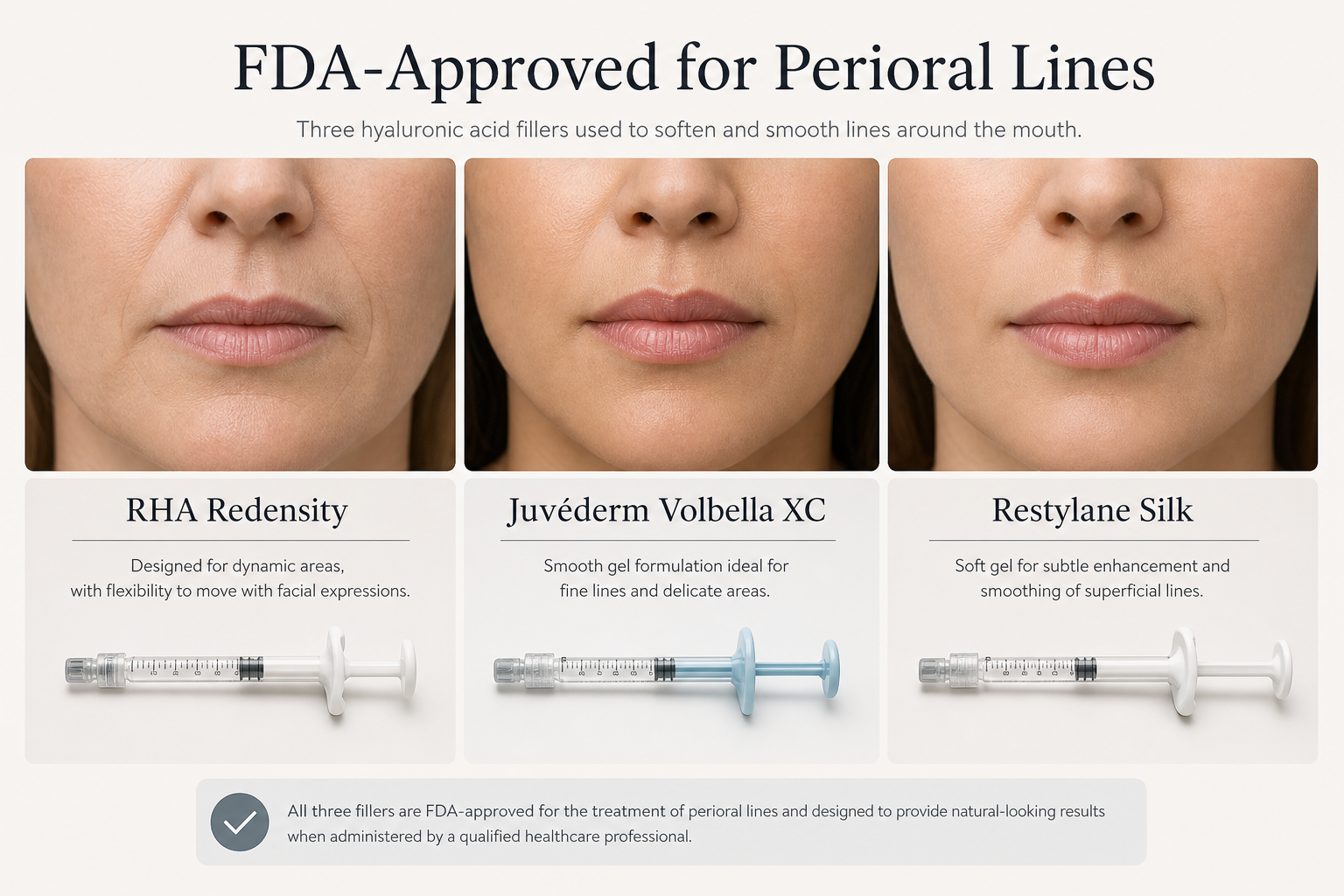
- RHA Redensity — the only filler with FDA approval specifically for dynamic superficial perioral rhytids. A 52-week clinical study demonstrated sustained improvement in dynamic lip lines, making it a clinically supported option for lines that are still partly movement-related. Its resilient hyaluronic acid (RHA) technology is designed to move with facial expressions rather than resist them.
- Juvéderm Volbella XC — FDA-approved for perioral rhytids and lip augmentation. Volbella XC uses Allergan’s VYCROSS technology to produce a smooth, low-lift gel that integrates well into fine lines without creating visible product.
- Restylane Silk — FDA-approved for perioral lines and lip enhancement. Restylane Silk is formulated with smaller HA particles than most Restylane products, making it well-suited to superficial placement in thin perioral skin.
Other products are used off-label in this area by experienced practitioners. Belotero Balance is frequently cited for its ability to integrate into the most superficial skin layers, reducing the risk of the Tyndall effect (a bluish discolouration sometimes seen when filler is placed too close to the surface). Restylane Kysse, while primarily indicated for lip augmentation, is occasionally used near the lip border. The choice of product should be guided by the depth and character of the lines, the patient’s skin thickness, and the injector’s clinical experience with each formulation.
Dynamic vs. Static Perioral Lines: Why the Distinction Matters
Before any treatment is planned, it is worth understanding whether the lines present are dynamic, static, or a combination of both. A simple self-assessment can help: look in a mirror with your face completely relaxed. If the lines are still clearly visible at rest, they are static perioral lines — meaning the skin has lost enough structural support that the creases remain even without muscle contraction. If the lines only appear when you speak, purse your lips, or drink through a straw, they are predominantly dynamic lip lines driven by orbicularis oris muscle movement.
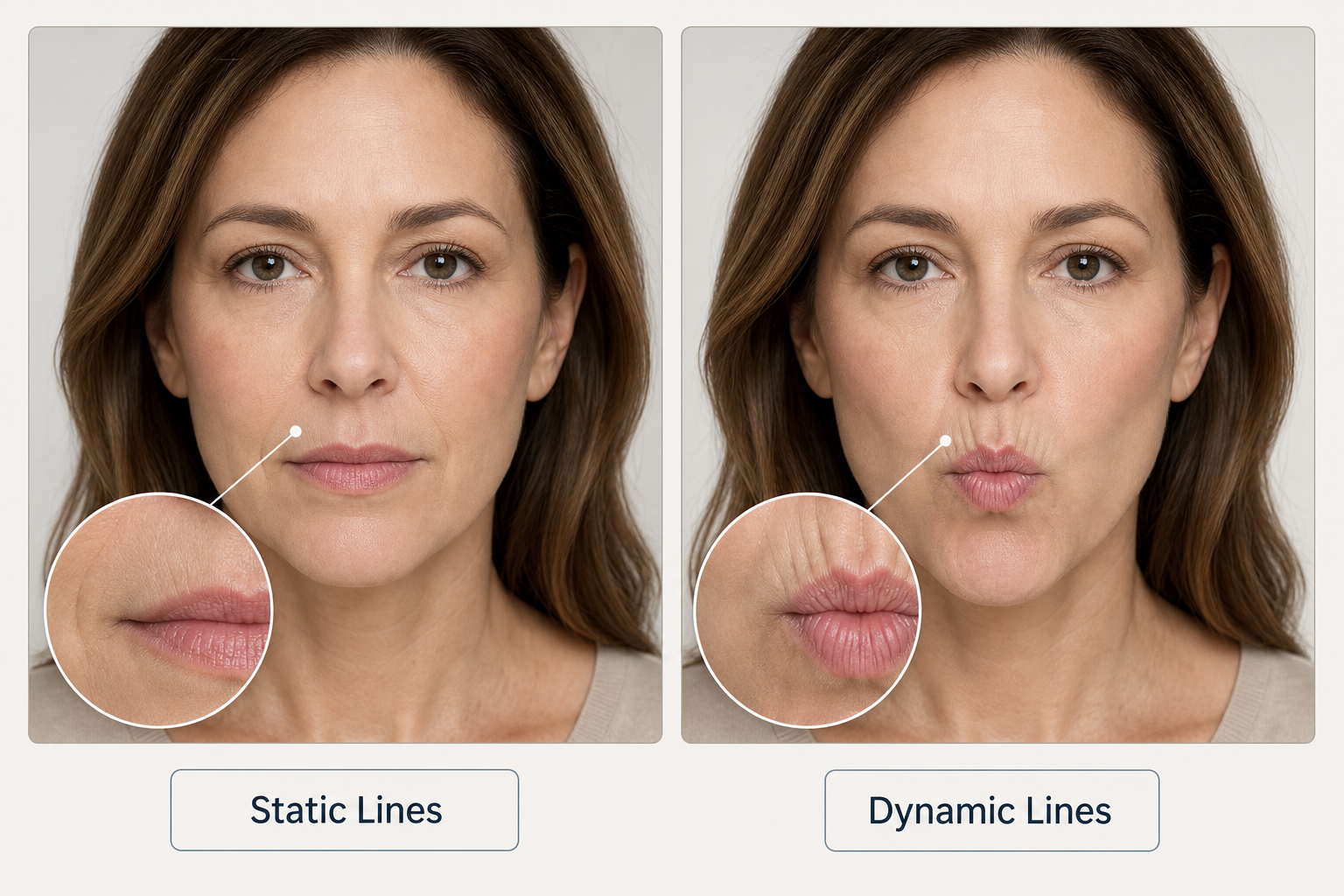
Static lines respond well to filler because the primary problem is a structural deficit in the skin. Dynamic lines, by contrast, are driven by muscle activity, and filler alone will not prevent the muscle from re-creating the crease. For dynamic lines, botulinum toxin — used off-label in the perioral area — is often the more logical starting point. A small amount of neuromodulator placed into the orbicularis oris can reduce the frequency and force of lip pursing, softening the lines that form during movement. This is sometimes combined with a lip flip technique, where botulinum toxin is used to gently evert the upper lip border.
Most patients presenting with perioral rhytids have a mixture of both line types, which is why a combination treatment approach — filler for the static component, neuromodulator for the dynamic component — often produces the most balanced outcome. It is worth noting that botulinum toxin use in the perioral area is considered off-label use in most regulatory frameworks, meaning it is not specifically licensed for this indication, though it is widely practised by experienced aesthetic clinicians.
Injection Techniques for Perioral Filler
The technique used to place filler in the perioral area significantly influences both the result and the safety profile. Two main approaches are used: needle injection and cannula injection. Each has practical trade-offs.
Needle injection allows precise, targeted placement directly into individual lines. The retrograde linear thread technique — where filler is deposited as the needle is slowly withdrawn along the line — is commonly used for perioral rhytids, as it distributes product evenly along the crease. A fan technique, where multiple passes are made from a single entry point, can cover a broader area with fewer punctures. Needle injection requires careful attention to depth, as the perioral skin is thin and superficial placement errors are more visible here than in other areas.
Cannula injection uses a blunt-tipped flexible tube rather than a sharp needle, which reduces the risk of inadvertently puncturing a blood vessel. This is particularly relevant in the perioral area, where small vessels run close to the surface. The trade-off is that cannulas offer less precision for treating individual fine lines compared with needles. Many experienced practitioners use a combination of both approaches depending on the specific lines being treated.
Regardless of technique, conservative volume placement is essential in this area. Small amounts of filler — often less than 0.5 ml in total — are typically used across the entire perioral region. Overfilling is a genuine risk: too much product can create a shelf-like appearance above the lip, distort the natural lip border, or produce visible lumps. A staged approach, where a small volume is placed initially and reviewed at a follow-up appointment before any additional product is added, is considered best practice by most experienced injectors.
Most perioral filler treatments include topical numbing cream applied before the procedure, and many of the named HA fillers contain lidocaine within the formulation itself, which helps manage discomfort during injection.
Alternatives and Combination Treatments
Filler is not the only option for perioral rejuvenation, and for some patients it may not be the most appropriate starting point. Understanding the alternatives helps in making a well-informed decision.
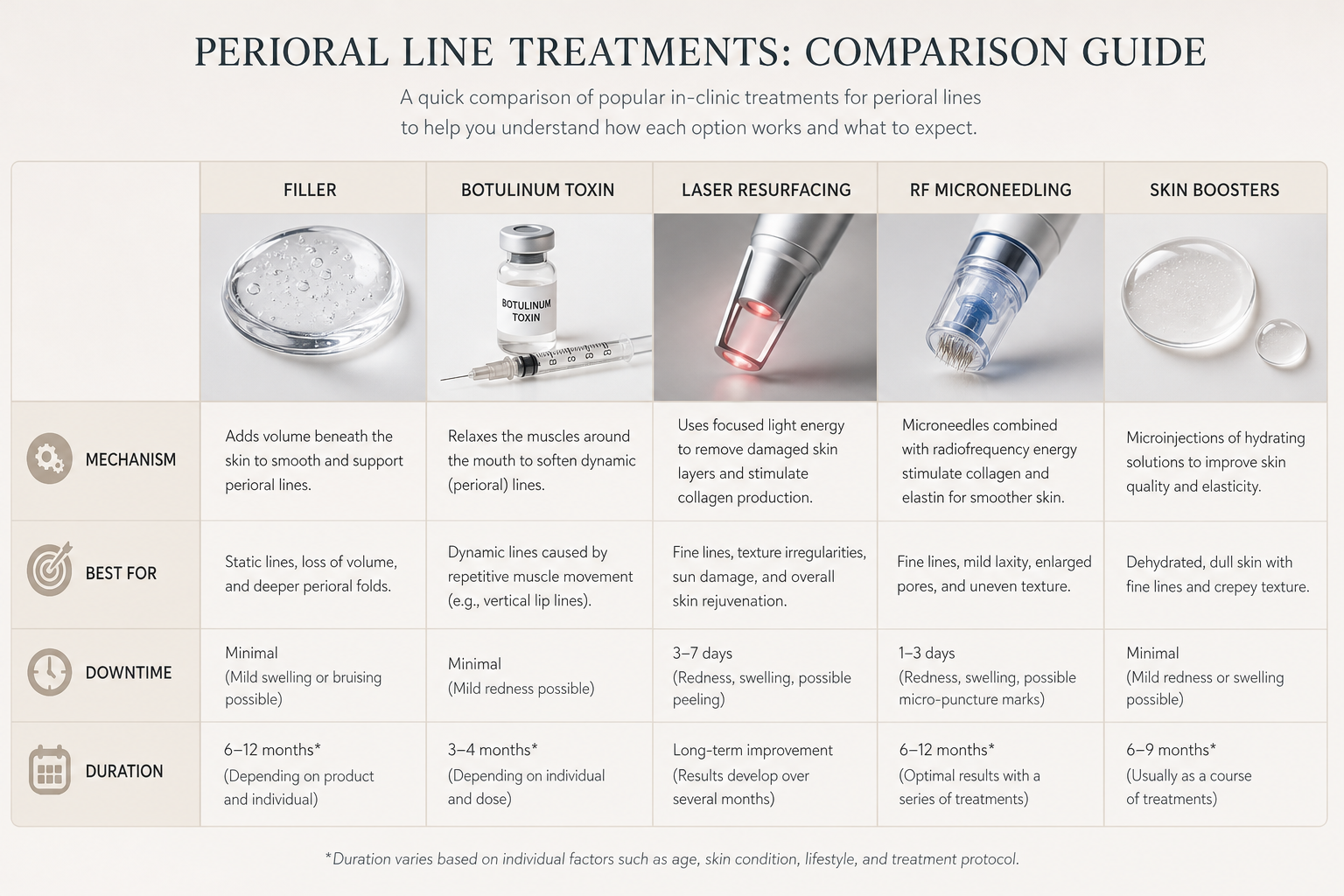
Botulinum Toxin (Neuromodulator)
As discussed, botulinum toxin used off-label in the orbicularis oris muscle can reduce dynamic lip lines and is often combined with filler for a more complete result. The lip flip — a specific technique using a small amount of botulinum toxin along the upper lip border — can also create a subtle eversion of the lip that reduces the appearance of fine lines without adding volume. Results from botulinum toxin in this area typically last 2–4 months, shorter than in less mobile areas.
Laser Resurfacing
Fractional CO2 laser and Er:YAG laser resurfacing can significantly improve perioral skin texture by stimulating collagen remodelling and removing damaged superficial skin layers. Laser resurfacing is particularly effective for fine surface lines and skin quality changes that filler cannot address. It does involve meaningful downtime — typically 5–10 days of redness and peeling for ablative treatments — and is not suitable for all skin tones. Patients with medium-to-dark Fitzpatrick skin types face a higher risk of post-inflammatory hyperpigmentation from ablative laser, making filler and biostimulator-based pathways a more appropriate first approach for these individuals.
Chemical Peels
Medium-depth chemical peels, including TCA and phenol-croton oil formulations, can improve perioral skin texture and fine lines by promoting controlled skin renewal. Like laser, they carry downtime and are not universally suitable across all skin types.
RF Microneedling
Radiofrequency microneedling combines mechanical skin needling with radiofrequency energy to stimulate collagen production in the deeper dermis. It is generally better tolerated across a wider range of skin tones than ablative laser and can improve skin quality and fine line depth over a course of treatments, though results are typically more gradual.
Skin Boosters and Biostimulators
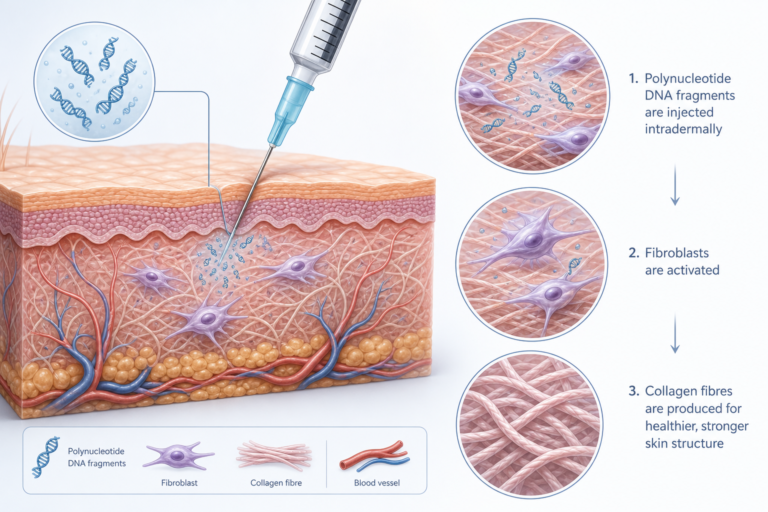
Skin boosters such as Profhilo and polynucleotide (PDRN) treatments work differently from traditional filler. Rather than physically filling a line, these injectable treatments stimulate collagen remodelling and improve overall skin hydration and quality. They are increasingly used as a complement to filler — or as a standalone option for patients with early, fine perioral lines and good skin elasticity — because they address the underlying skin quality deficit rather than just the visible crease. Polynucleotides in particular are growing in clinical use for perioral rejuvenation, though the evidence base is still developing compared with established HA fillers.
Who May Be Suitable for Perioral Filler?
Perioral filler tends to produce the most satisfying outcomes in patients with fine-to-moderate static perioral lines, reasonable skin elasticity, and realistic expectations about the degree of improvement achievable. Filler can soften lines and restore some structural support, but it cannot completely erase deep-set creases or reverse significant skin texture changes — particularly where the skin surface itself has become rough or crepey.
Patients who may be less suitable for filler as a standalone treatment include those with predominantly dynamic lines (where a neuromodulator may be more appropriate first), those with very deep lines accompanied by significant skin laxity (where laser or a combination approach may be needed), and those with very thin or fragile perioral skin where product visibility is a concern.
Standard contraindications apply: active infection or cold sores in the treatment area, known allergy to hyaluronic acid or lidocaine, pregnancy or breastfeeding, and certain autoimmune or bleeding conditions. A thorough consultation and medical history review is essential before treatment.
Risks and Side Effects
Common side effects of perioral filler are temporary and typically resolve within a few days. These include swelling, bruising, redness, and tenderness at the injection sites. The perioral area tends to swell more noticeably than some other zones, and patients should expect some degree of post-treatment puffiness that may temporarily make the result look more pronounced than the final outcome.
Less common but more significant risks include vascular occlusion — where filler inadvertently enters or compresses a blood vessel, potentially compromising blood supply to the surrounding tissue. The perioral area has a complex vascular anatomy, and this risk underscores the importance of treatment by a qualified and experienced practitioner using appropriate technique, including aspiration where relevant. Nodule formation, asymmetry, and product migration are also possible, particularly if inappropriate products or excessive volumes are used.
One of the important safety features of hyaluronic acid filler is its reversibility. Hyaluronidase is an enzyme that can dissolve HA filler if a complication occurs or if the patient is unhappy with the result. This reversibility with hyaluronidase is a meaningful safety advantage over non-HA fillers and is one reason HA products remain the standard of care for perioral treatment.
What to Expect: Procedure, Downtime, and Results
A perioral filler appointment typically begins with a consultation to assess the lines, discuss goals, and agree on a treatment plan. Topical numbing cream is applied and left for 15–30 minutes before injection. The injection itself usually takes 15–30 minutes depending on the area being treated. Most patients experience mild discomfort rather than significant pain, particularly with lidocaine-containing fillers.
Immediately after treatment, some swelling and redness is normal. Most patients can return to normal activities the same day, though strenuous exercise, excessive heat (saunas, hot baths), alcohol, and blood-thinning medications or supplements are generally advised against for 24–48 hours to minimise bruising and swelling. Visible bruising, if it occurs, typically resolves within 7–10 days.
Results are visible immediately, though the final outcome is best assessed after any swelling has fully settled — usually within 1–2 weeks. In the perioral area, results typically last 6–12 months. The reason for this shorter duration compared with other areas is the constant movement of the orbicularis oris muscle, which accelerates the breakdown of the filler. Patients who combine filler with botulinum toxin may find their filler lasts slightly longer, as reducing muscle activity slows the metabolic breakdown of the product.
A realistic maintenance plan for perioral rejuvenation might involve filler at the initial appointment, a botulinum toxin review at 3–4 months, a skin booster course to address ongoing skin quality, and consideration of laser resurfacing when lines have a significant surface texture component. This staged, combination approach tends to produce more durable and natural-looking outcomes than any single treatment in isolation.
Frequently Asked Questions
Can filler completely remove smokers lines?
Filler can significantly soften perioral lines and reduce their visible depth, but complete removal is rarely achievable, particularly for deep-set or long-standing static lines. Realistic expectations are important: the goal is meaningful improvement, not perfection. Very fine lines may respond more completely than deeper grooves, which may require a combination of filler, neuromodulator, and a resurfacing treatment for the best outcome.
Do I need to be a smoker to get smokers lines?
No. Despite the name, smokers lines affect non-smokers just as commonly. They develop primarily through repetitive orbicularis oris muscle movement, age-related collagen loss, UV exposure, and hormonal changes. Smoking accelerates the process by impairing collagen production, but it is not a prerequisite for developing these lines.
Is Botox or filler better for perioral lines?
The answer depends on whether the lines are predominantly dynamic or static. Dynamic lip lines — visible mainly during movement — respond better to botulinum toxin, which reduces muscle activity. Static perioral lines — visible at rest — respond better to filler, which physically fills the structural deficit. Many patients benefit from both, used together as a combination treatment approach.
How much filler is typically used for perioral lines?
The perioral area generally requires small volumes — often 0.5 ml or less across the entire region. Conservative volume placement is important to avoid an overfilled or unnatural appearance. A staged approach, where a small amount is placed initially and reviewed before adding more, is considered best practice.
Is perioral filler reversible?
Yes. All three FDA-approved fillers for perioral lines — RHA Redensity, Juvéderm Volbella XC, and Restylane Silk — are hyaluronic acid-based and can be dissolved with hyaluronidase if needed. This reversibility is an important safety feature and one reason HA fillers are preferred for this delicate area.
How long does perioral filler last?
Results in the perioral area typically last 6–12 months, which is shorter than in less mobile areas. The constant movement of the orbicularis oris muscle accelerates filler breakdown. Combining filler with botulinum toxin may extend the duration slightly by reducing muscle activity.
What is the risk of an unnatural result?
Overfilling is a genuine concern in the perioral area. Using too much product, or a product that is too thick for this zone, can create a shelf-like appearance above the lip or distort the natural lip border. Choosing an experienced practitioner who uses appropriate soft hyaluronic acid filler in conservative volumes significantly reduces this risk.
Deciding Whether Perioral Filler Is the Right Approach for You
Smokers line filler can be an effective, well-tolerated option for softening perioral rhytids, particularly when the right product is matched to the right line type and placed with appropriate technique and volume. The three FDA-approved HA fillers — RHA Redensity, Juvéderm Volbella XC, and Restylane Silk — offer a meaningful evidence base for this indication, and the reversibility of hyaluronic acid filler with hyaluronidase provides an important safety net.
The most important factor in achieving a natural, satisfying result is accurate assessment of whether the lines are static, dynamic, or mixed — because this determines whether filler alone is appropriate or whether a combination treatment approach involving a neuromodulator, skin booster, or resurfacing treatment is likely to produce a better outcome. Patients with significant skin texture changes or very deep lines may find that filler is one component of a broader perioral rejuvenation plan rather than a standalone solution.
If you are considering treatment for perioral lines, a consultation with a qualified aesthetic practitioner who can assess your specific anatomy, line type, and skin quality is the most reliable way to determine which options are appropriate for your situation and what realistic improvement you can expect.