Facial Botox Areas: A Zone-by-Zone Guide to Treatable Regions
Botulinum toxin injections can address a wide range of facial concerns, from deep forehead creases to a softened jawline, but not every area of the face responds in the same way or carries the same risk profile. Understanding which facial Botox areas are available, what each zone can realistically achieve, and where extra caution is needed helps you arrive at a consultation with informed expectations rather than assumptions shaped by social media.
Key Takeaways
- Three facial zones — the forehead, glabella, and crow’s feet — hold FDA-approved status for cosmetic botulinum toxin treatment; most other areas are used off-label based on established clinical practice.
- Botox works on dynamic wrinkles caused by repeated muscle movement; it cannot correct volume loss, skin laxity, or lines that are present at rest without any muscle activity.
- Forehead and glabella treatment are best planned together to maintain frontalis–glabella balance and reduce the risk of brow ptosis.
- Results typically begin to appear within three to seven days and reach their full effect at around two weeks, with duration varying by zone and individual factors.
- A qualified injector with detailed knowledge of facial anatomy is the single most important factor in achieving natural-looking, safe outcomes.
How Botulinum Toxin Works on the Face
Botulinum toxin — the active ingredient in products such as Botox — is a neuromodulator that temporarily interrupts the nerve signal telling a muscle to contract. When injected into a specific facial muscle, it produces facial muscle relaxation in that targeted area, softening the overlying skin crease that forms each time the muscle fires. This mechanism is why botulinum toxin is effective for dynamic wrinkles — lines that appear during expression — but has limited impact on static lines that are visible even when the face is completely at rest. Static wrinkles, volume loss, and skin laxity require different approaches, such as dermal fillers or biostimulators, and a practitioner will assess which concern is actually driving the appearance you want to address.
The distinction between static vs. dynamic lines matters practically. A deep forehead line that is visible at rest may soften with botulinum toxin treatment but is unlikely to disappear entirely, because the skin has already been remodelled by years of repeated folding. Setting realistic expectations around this point prevents disappointment and helps you understand when a combination approach might be more appropriate.
FDA-Approved vs. Off-Label Botox Areas
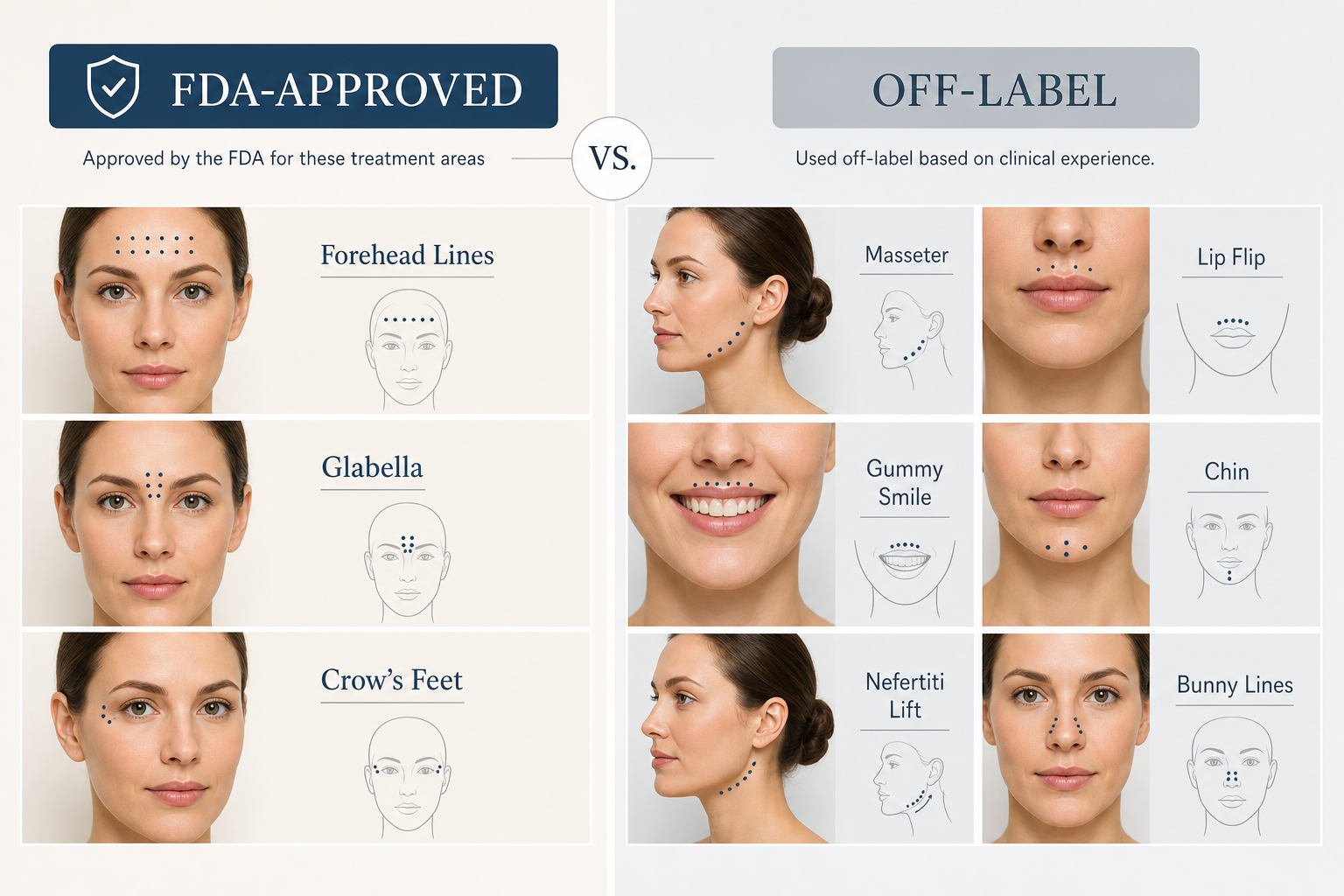
In the United States, the FDA has approved cosmetic botulinum toxin for three specific facial zones: glabellar lines (the vertical frown lines between the brows), lateral canthal lines (crow’s feet at the outer corners of the eyes), and forehead lines. These are the FDA-approved treatment areas with the most robust clinical evidence behind them. Regulatory approval in other countries follows different pathways, so approved indications may vary depending on where you are treated.
Beyond these three zones, practitioners routinely use botulinum toxin in many other facial areas as off-label Botox applications. Off-label does not mean unsafe or experimental — it means the treatment is used outside its formally approved indication, typically based on a substantial body of clinical experience, published case series, and anatomical research. Areas such as the masseter muscle, platysmal bands, and perioral region are widely treated off-label by experienced injectors worldwide. What matters most is that the practitioner understands the relevant facial anatomy, the depth and placement required, and the specific risks associated with each zone.
Upper Face: The Core Treatment Zones
Forehead Lines
Horizontal forehead lines form when the frontalis muscle — a broad, thin muscle that runs across the forehead — contracts to raise the brows. These are among the most commonly treated facial Botox areas and respond well to botulinum toxin. However, the frontalis is also the primary brow elevator, which means that over-relaxing it can cause the brows to drop, a complication known as brow ptosis. This is why forehead treatment should always be planned alongside glabella treatment: if the corrugator muscles pulling the brows down are not also relaxed, weakening the frontalis alone can worsen brow heaviness rather than improve it. This principle of frontalis–glabella balance is one of the most clinically important concepts in upper-face treatment and is something a skilled injector will assess before deciding on dosing and injection placement.
Typical onset for forehead treatment is three to seven days, with full effect visible at around two weeks. Duration is generally three to four months, though this varies with individual muscle strength, metabolism, and lifestyle factors such as exercise intensity.
Glabellar Lines (Frown Lines / “11s”)
The glabellar complex — comprising the corrugator supercilii, procerus, and depressor supercilii muscles — produces the vertical frown lines between the brows, commonly called the “11 lines” or “11s”. This is one of the most requested treatment zones and one of the three FDA-approved cosmetic indications. Relaxing these muscles reduces the appearance of a permanently furrowed or stern expression and is often the first area patients choose to treat.
Men typically have stronger glabellar muscles than women and may require a higher number of units of Botox to achieve comparable relaxation — a gender-specific dosing difference that is worth discussing with your practitioner. Undertreating this zone is a common reason patients feel their results were insufficient, while overtreating can flatten the natural brow movement entirely. An experienced injector will calibrate the dose to preserve some natural expressiveness.
Crow’s Feet
Crow’s feet — also called lateral canthal lines — are the fan-shaped lines that radiate from the outer corners of the eyes when smiling or squinting. They form through repeated contraction of the orbicularis oculi muscle, which encircles the eye. This is the third FDA-approved cosmetic zone and typically responds very well to botulinum toxin, with results that many patients find among the most noticeable of any facial area. Some evidence suggests crow’s feet results may last slightly longer than forehead or glabella results in certain patients, though individual variation is significant. Injection placement here requires precision to avoid affecting the lower eyelid or causing an unnatural appearance when smiling.
Mid-Face: Advanced and Off-Label Applications
Brow Lift
A non-surgical brow lift using botulinum toxin works by selectively relaxing the muscles that pull the brow downward — particularly the lateral portion of the orbicularis oculi — while preserving the frontalis muscle’s upward pull. This creates a subtle elevation of the outer brow, which can reduce the appearance of hooded eyelids and open the eye area. The effect is modest compared with a surgical brow lift and suits patients with mild brow descent rather than significant skin laxity. Precise injection placement is essential; incorrect technique can worsen brow position rather than improve it.
Bunny Lines
Bunny lines are the diagonal wrinkles that appear across the nasal bridge when scrunching the nose, caused by contraction of the nasalis muscle. They are an off-label treatment area and are often addressed alongside glabella treatment, since glabella injections can sometimes cause compensatory bunny line activity. Treatment here requires small amounts of botulinum toxin and careful placement to avoid affecting the muscles that lift the upper lip.
Lower Face: Off-Label Zones Requiring Precision
Lip Flip and Perioral Lines
The lip flip involves injecting small amounts of botulinum toxin into the orbicularis oris muscle just above the upper lip border. This causes the lip edge to roll slightly outward, creating the appearance of a fuller upper lip without adding volume. It is a subtle effect and suits patients who want a modest change rather than the projection that a dermal filler provides. Perioral lines — sometimes called smoker’s lines — are the fine vertical creases above and below the lips. These are off-label applications that can soften with botulinum toxin, though very deep static lines may also benefit from a combination approach with filler. Dosing in this area must be conservative; too much relaxation of the orbicularis oris can affect speech, eating, and the ability to use a straw.
Gummy Smile
A gummy smile — where a significant amount of gum tissue is visible above the upper teeth when smiling — can be addressed by injecting botulinum toxin into the levator labii superioris alaeque nasi muscle, which elevates the upper lip. Relaxing this muscle reduces how high the lip rises during a smile, limiting gum exposure. This is an off-label application that requires precise anatomical knowledge; incorrect placement can cause asymmetry or an unnatural smile. Results are typically subtle and temporary, lasting around three months.
Chin Dimpling
The mentalis muscle controls chin movement and, when overactive, can create a dimpled or “orange peel” texture on the chin surface. Botulinum toxin injected into the mentalis can smooth this texture and is a relatively straightforward off-label application. It is sometimes combined with a small amount of dermal filler to address any underlying volume deficit contributing to chin projection or shape concerns.
Mouth Corners and Marionette Lines
The depressor anguli oris muscle pulls the corners of the mouth downward, contributing to a downturned or sad resting expression and deepening the marionette lines that run from the mouth corners toward the chin. Relaxing this muscle with botulinum toxin can subtly lift the mouth corners and soften the downturned appearance. This is an off-label application where the margin between effective treatment and over-relaxation is narrow, making injector experience particularly important. Deeper marionette lines with a significant volume component may respond better to dermal filler, either alone or in combination.
Masseter Slimming and Bruxism
Masseter slimming — also called jaw slimming — involves injecting botulinum toxin into the masseter muscle, the large chewing muscle at the angle of the jaw. Repeated injections cause the muscle to reduce in bulk over time, creating a slimmer, more oval lower face profile. The same treatment is used therapeutically for bruxism (teeth grinding) and TMJ-related jaw tension, where it reduces the force of involuntary clenching. This is one of the more durable off-label applications; with regular treatment, some patients find the masseter gradually requires fewer units to maintain the effect as the muscle adapts. Results for aesthetic jaw slimming typically take six to eight weeks to become fully apparent, as muscle reduction is a gradual process.
Neck and Jawline: The Nefertiti Lift and Platysmal Bands
The platysma is a broad, thin muscle that runs from the lower face down the front of the neck. With age, the platysma can develop visible vertical cords — platysmal bands — and its downward pull can contribute to lower face descent and jowling. Botulinum toxin injected along these bands relaxes the downward pull, which can subtly improve jawline definition and soften the appearance of neck cords. This approach is sometimes called the Nefertiti lift, named for the Egyptian queen’s famously defined jawline and neck. Peer-reviewed research, including studies examining platysma anatomy and motor nerve distribution, supports the clinical rationale for this technique, though results are more modest than surgical alternatives and require maintenance every three to four months.
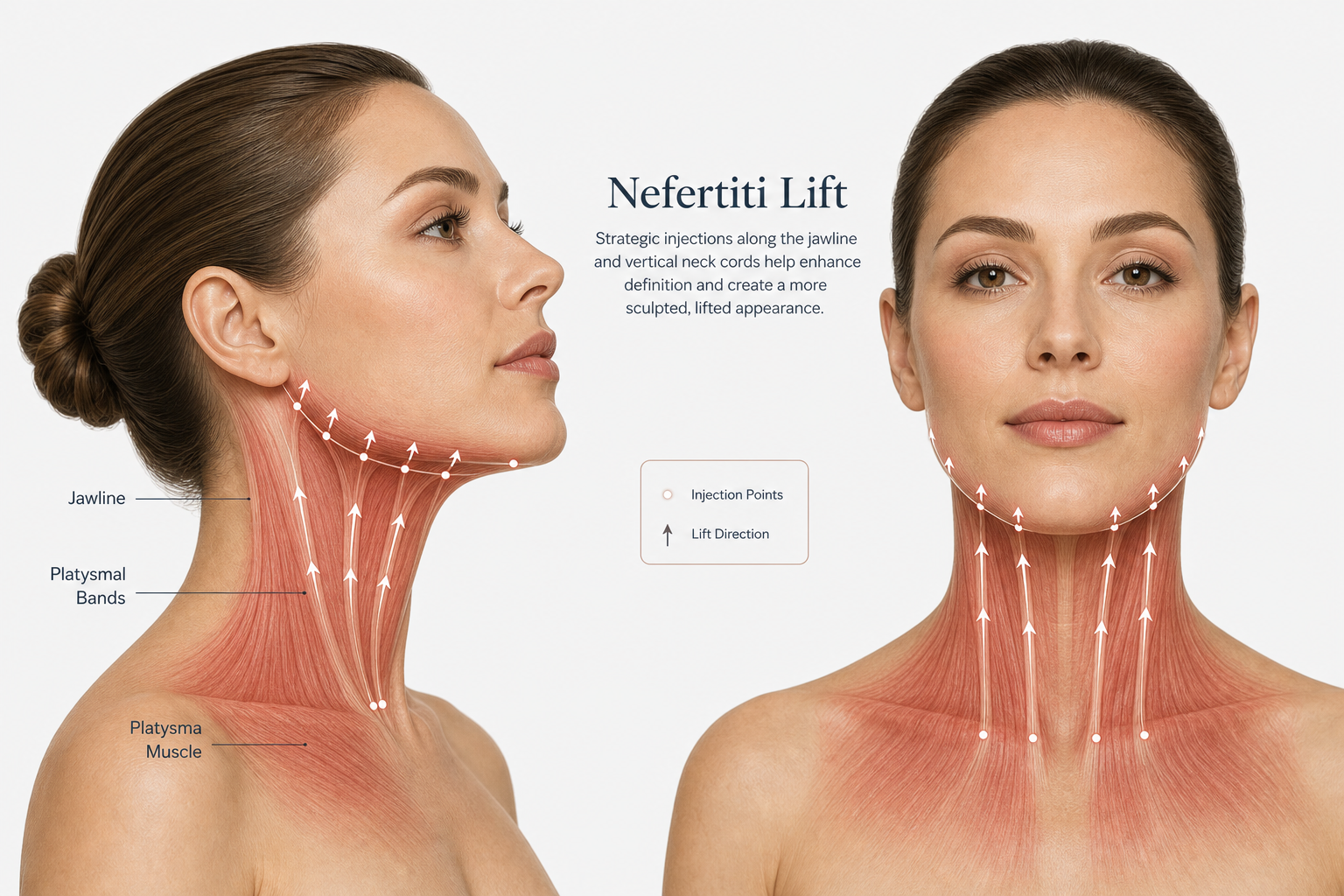
Neck Botox treatment requires careful assessment of platysma anatomy, as the muscle’s thickness and the distribution of its motor nerves vary between individuals. Injecting too deeply or in the wrong location carries a risk of affecting swallowing muscles, which is why this zone should only be approached by practitioners with specific training in neck anatomy and injection technique.
Botox Treatment Areas at a Glance
| Zone | Primary Muscle(s) | Approval Status | Typical Onset | Approximate Duration |
|---|---|---|---|---|
| Forehead lines | Frontalis | FDA-approved | 3–7 days | 3–4 months |
| Glabellar lines (“11s”) | Corrugator supercilii, procerus | FDA-approved | 3–7 days | 3–4 months |
| Crow’s feet | Orbicularis oculi | FDA-approved | 3–7 days | 3–4+ months |
| Brow lift | Lateral orbicularis oculi | Off-label | 3–7 days | 3–4 months |
| Bunny lines | Nasalis | Off-label | 3–7 days | 3–4 months |
| Lip flip / perioral lines | Orbicularis oris | Off-label | 3–5 days | 2–3 months |
| Gummy smile | Levator labii superioris alaeque nasi | Off-label | 3–7 days | 3 months |
| Chin dimpling | Mentalis | Off-label | 3–7 days | 3–4 months |
| Mouth corners / marionette | Depressor anguli oris | Off-label | 3–7 days | 3–4 months |
| Masseter slimming / bruxism | Masseter | Off-label | 4–6 weeks (bulk reduction) | 4–6 months |
| Platysmal bands / Nefertiti lift | Platysma | Off-label | 1–2 weeks | 3–4 months |
What Botox Cannot Treat
Understanding the limits of botulinum toxin is as important as knowing what it can address. Botox works on muscles; it does not add volume, tighten loose skin, or improve skin texture and quality. Deep static wrinkles that are present at rest — particularly nasolabial folds, which are driven largely by volume loss and gravitational descent rather than muscle activity — respond poorly to botulinum toxin alone. Similarly, jowling caused by skin laxity and fat redistribution requires a different approach, such as dermal fillers, thread lifts, or surgical intervention depending on severity. Patients who expect botulinum toxin to address these concerns are likely to be disappointed, and a responsible practitioner will explain this clearly at consultation rather than proceed with a treatment unlikely to meet the patient’s actual goal.
Safety Considerations and Danger Zones
Every facial zone carries some degree of risk, and the concept of “danger zones” in botulinum toxin treatment does not mean areas that should never be treated — it means areas where the margin for error is narrower and where the consequences of incorrect placement are more significant. The most clinically important risks include:
- Brow ptosis: Drooping of the brow caused by over-relaxation of the frontalis or incorrect placement near the brow. Most commonly associated with forehead treatment when the glabella is not treated simultaneously.
- Eyelid ptosis: Drooping of the upper eyelid caused by migration of botulinum toxin to the levator palpebrae superioris muscle. More likely with glabella injections placed too close to the orbital rim.
- Asymmetry: Uneven muscle relaxation producing different levels of movement on each side of the face. Often related to natural anatomical asymmetry that was not accounted for in dosing.
- Lip dysfunction: Difficulty with speech, eating, or fine lip movements following perioral injections that over-relax the orbicularis oris.
- Swallowing difficulty: A rare but serious risk associated with neck injections placed too deeply or in incorrect locations.
All of these risks are significantly reduced — though not eliminated — by choosing a practitioner with formal training in facial anatomy and a track record of treating the specific zones you are considering. Asking about a practitioner’s qualifications, training, and experience with a particular area before proceeding is entirely reasonable and appropriate.
Who May Not Be Suitable for Botulinum Toxin Treatment
Botulinum toxin is contraindicated in patients with known hypersensitivity to any component of the formulation, active infection at the intended injection site, or neuromuscular disorders such as myasthenia gravis or Lambert-Eaton syndrome, which can amplify the effects of the toxin unpredictably. Pregnancy and breastfeeding are generally considered contraindications due to the absence of safety data, not because harm has been demonstrated. Certain medications — including aminoglycoside antibiotics and some muscle relaxants — may interact with botulinum toxin and should be disclosed at consultation. Patients with very thin skin, significant skin laxity, or concerns driven primarily by volume loss rather than muscle activity may find that botulinum toxin alone does not adequately address their goals.
Where to Start: Guidance for First-Time Patients
For patients considering botulinum toxin for the first time, the glabella and forehead together represent a logical starting point. These are the FDA-approved zones with the most clinical evidence, they address the concerns most patients prioritise, and treating them together supports the frontalis–glabella balance that reduces the risk of brow heaviness. Crow’s feet are often added at the same appointment, as the three upper-face zones complement each other and the combined treatment gives a coherent result rather than isolated improvement in one area.
Lower-face and neck treatments are generally better suited to patients who have some experience with botulinum toxin and understand how their face responds, or who have a specific concern — such as bruxism or platysmal bands — that clearly warrants treatment in those zones. Starting conservatively and building on results over subsequent appointments is a more reliable strategy than attempting to treat every possible area at once, and a practitioner who recommends a staged approach is demonstrating clinical judgement rather than limiting your options.
Treatment Longevity and Long-Term Muscle Adaptation
Most facial zones show results lasting approximately three to four months, though this varies meaningfully between individuals. Factors that tend to shorten duration include a fast metabolism, high-intensity exercise, strong facial muscles, and sun exposure. Micro-areas such as the lip flip and perioral lines may wear off in two to three months, while masseter treatment for jaw slimming can last four to six months and may extend further with regular treatment as the muscle gradually reduces in bulk.
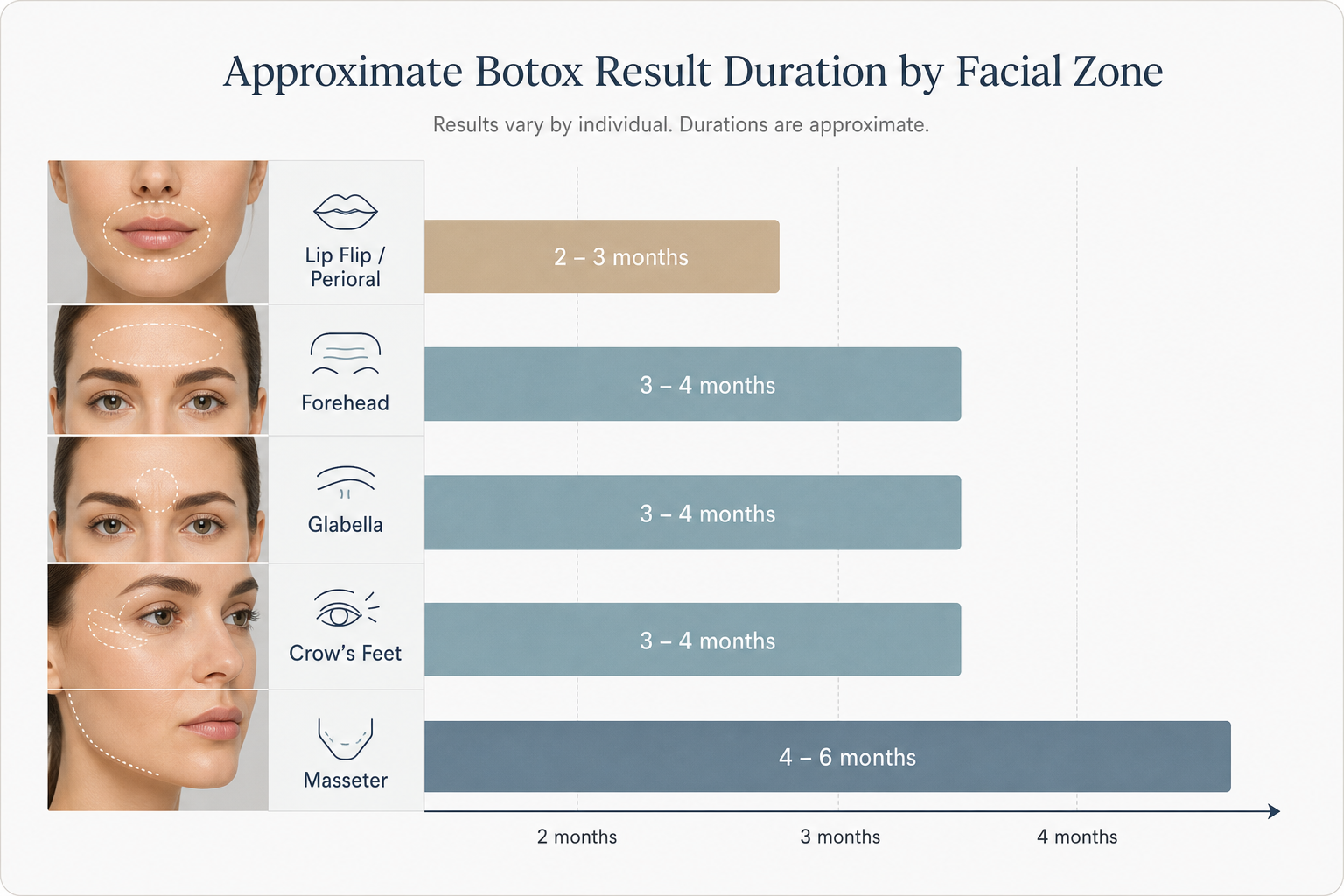
An important and often overlooked aspect of long-term botulinum toxin use is muscle adaptation. With consistent treatment over time, repeatedly relaxed muscles can become less active even between appointments, meaning some patients find they need fewer units of Botox to maintain the same result after several years of regular treatment. This does not happen universally, but it is a genuine phenomenon supported by clinical observation and is worth discussing with your practitioner when planning a maintenance schedule.
Frequently Asked Questions
How many units of Botox does each facial area typically need?
Unit requirements vary by zone, muscle strength, gender, and individual anatomy. As a general guide, the glabella typically requires more units than the crow’s feet, and men often need higher doses than women for equivalent results. Your practitioner will assess your muscle activity at consultation and recommend a dose appropriate for your anatomy rather than applying a fixed number. Providing specific unit figures here would not be appropriate, as dosing decisions require a clinical assessment.
Can Botox treat static wrinkles?
Botulinum toxin is most effective for dynamic wrinkles — lines that appear during facial movement. Static wrinkles that are visible at rest may soften slightly with treatment, but deep static lines are better addressed with dermal fillers, skin resurfacing, or a combination approach. A practitioner can assess which type of wrinkle is driving your concern and recommend the most appropriate treatment.
Is it safe to treat multiple facial areas in one session?
Treating several zones in a single appointment is common and generally well tolerated. The total dose used across all areas is a relevant consideration, and a practitioner will plan the session to stay within a safe and effective range. There is no universal rule against treating multiple areas at once, but a staged approach may be recommended for first-time patients or when treating more complex zones.
How long before I see results after facial Botox treatment?
Most patients notice the first signs of muscle relaxation within three to seven days of treatment. Full results are typically visible at around two weeks, which is why follow-up assessments are usually scheduled at this point. Masseter slimming is an exception — the aesthetic reduction in jaw bulk develops gradually over four to eight weeks as the muscle reduces in size.
What is the difference between cosmetic and medical Botox?
The active ingredient — botulinum toxin — is the same in both applications. Cosmetic Botox targets aesthetic concerns such as wrinkles, jaw slimming, and the Nefertiti lift. Medical Botox is used for conditions including hyperhidrosis (excessive sweating), chronic migraine, and bruxism. Some applications, such as masseter treatment, serve both cosmetic and therapeutic purposes simultaneously.
Can Botox be combined with dermal fillers?
Yes, and combination treatment is common for patients whose concerns involve both muscle activity and volume loss. For example, botulinum toxin may address dynamic forehead lines while a filler addresses volume loss in the temples or cheeks. In the lower face, botulinum toxin for the depressor anguli oris can be paired with filler for deeper marionette lines. A practitioner will assess which concerns are best addressed by each modality and plan accordingly.
Choosing the Right Facial Botox Areas for Your Goals
The range of treatable facial Botox areas is broader than many patients realise, extending well beyond the three FDA-approved zones to include the jawline, neck, perioral region, and mid-face. Each zone has a distinct anatomical basis, a specific set of achievable outcomes, and its own risk considerations. The most important factor in navigating these options is not the number of areas treated but the quality of the clinical assessment that precedes treatment.
A consultation with a qualified injector who understands your facial anatomy, your skin’s current condition, and the realistic limits of botulinum toxin will give you a clearer picture of which zones are genuinely relevant to your concerns and which might be better addressed through a different approach. If you are considering botulinum toxin for the first time, starting with the upper face and building from there is a practical and evidence-supported strategy. If you have specific concerns — jaw tension, neck cords, or a gummy smile — those can be discussed as part of a broader treatment plan. The goal is a result that looks natural, suits your face, and meets your actual expectations rather than a checklist of every possible injection site.