Sunbed After Filler: Heat Exposure Risks, Wait Times & Aftercare Advice
Using a sunbed after filler is one of the most common aftercare questions practitioners hear — and for good reason. Heat and UV exposure can affect how your filler heals, how long it lasts, and how comfortable the treated area feels in the days following your appointment. This article explains the science behind those risks, gives clear guidance on wait times for different treatment areas, addresses the persistent myth that heat dissolves filler, and offers practical alternatives for anyone who wants a tan without compromising their results.
Key Takeaways
- Most practitioners recommend waiting at least 10–14 days before using a sunbed after any dermal filler treatment.
- The primary risks are not filler dissolution but rather increased swelling, vasodilation, UV-induced degradation over time, and a heightened cold sore risk for lip filler patients.
- Heat does not meaningfully dissolve hyaluronic acid filler at the temperatures a sunbed produces — only hyaluronidase, an enzyme, can reliably break down HA filler.
- Saunas, steam rooms, hot yoga, and hot baths carry comparable risks to sunbeds during the healing period and should also be avoided.
- Self-tanning products are a practical, low-risk alternative for patients who want colour while their filler settles.
Why Sunbeds Are a Concern After Filler Treatment
Dermal fillers — particularly those based on hyaluronic acid (HA), such as Juvederm, Restylane, Revolax, and Belotero — are injected into living tissue that needs time to integrate and stabilise. In the days immediately after treatment, the injection site is in an active healing phase: small blood vessels are recovering, localised swelling and bruising may be present, and the filler product itself is still settling into its final position. Introducing intense heat exposure during this window creates several overlapping problems.
First, heat causes vasodilation — the widening of blood vessels — which increases circulation to the treated area. This can worsen existing swelling and bruising, prolong the healing period, and make the treated area more uncomfortable. Second, the UV radiation emitted by tanning beds penetrates the skin and, with repeated exposure over time, contributes to the breakdown of collagen and the extracellular matrix that surrounds and supports the filler. This does not dissolve filler acutely, but it can reduce filler longevity over a course of months. Third, the concentrated UV output of a sunbed is considerably higher than ambient sunlight, meaning the cumulative effect on skin and filler is accelerated compared with incidental outdoor exposure.
Does Heat Dissolve Filler? The Evidence-Based Answer
This is one of the most searched questions in dermal filler aftercare, and the answer requires some nuance. The short answer is: no, not meaningfully — at least not at the temperatures a sunbed or sauna produces.
Hyaluronic acid is a polysaccharide that can undergo thermal degradation at very high temperatures in laboratory conditions. However, the temperatures required to cause significant depolymerisation of cross-linked HA gel are far above what any external heat source — including a sunbed, sauna, or hot bath — can deliver to the depth at which filler sits within the skin. Research published in the Journal of Cosmetic Dermatology (2024), including a cadaveric study examining thermal effects on HA fillers, supports the position that clinically relevant filler breakdown from external heat is unlikely under normal circumstances. The filler’s cross-linked gel structure provides additional thermal stability compared with non-cross-linked HA.
The only agent that reliably dissolves hyaluronic acid filler is hyaluronidase — an enzyme injected directly into the filler by a trained practitioner. This is used intentionally to reverse or adjust filler placement, and it works through enzymatic action, not heat.
Where heat does cause a real problem is not through direct dissolution but through its effects on the surrounding tissue: increased inflammation, vasodilation, and — with UV specifically — accelerated degradation of the skin environment that supports the filler over time. So while a single sunbed session is unlikely to dissolve your filler, repeated UV exposure can reduce filler longevity and affect the quality of your skin in the treated area.
How Long Should You Wait Before Using a Sunbed After Filler?
The widely cited recommendation across clinical guidance is to avoid sunbeds for a minimum of 10–14 days after dermal filler treatment. This timeframe reflects the typical healing period during which swelling and bruising resolve, the injection site closes and stabilises, and the filler product settles into its intended position. Using a sunbed before this window has closed increases the risk of prolonged swelling, uneven filler distribution, and discomfort at the injection site.
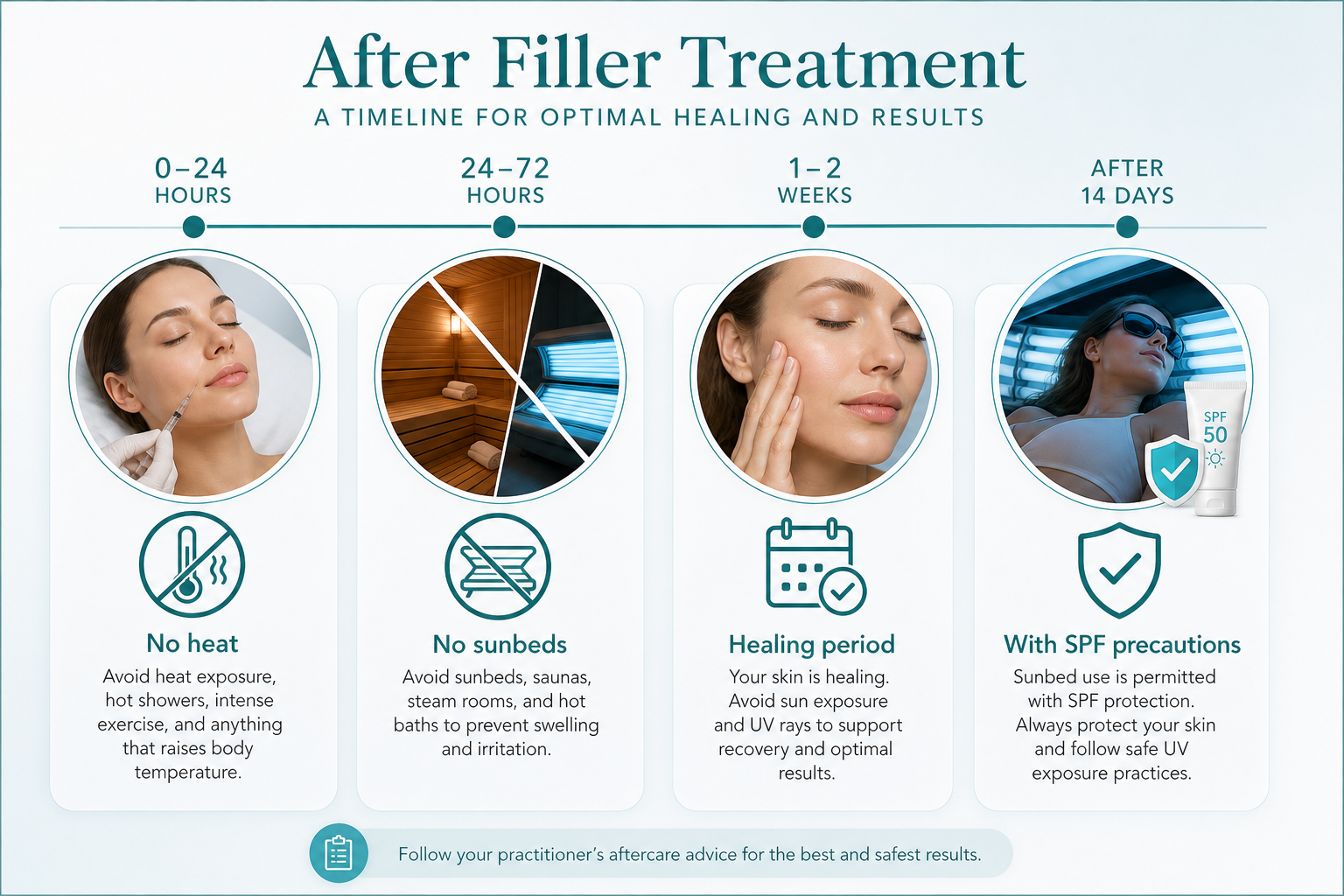
Some practitioners recommend a longer wait of up to four weeks, particularly for patients who bruised significantly, for those who received larger volumes of filler, or for treatment areas that are more vascular and slower to settle — such as the tear trough or temple. Always follow the specific aftercare advice given by your own practitioner, as individual factors including your skin type, the filler product used, and the treatment area may influence the appropriate wait time.
Wait Time by Treatment Area
Most aftercare guidance focuses on lip filler, but the same principles apply across all filler treatment areas. The table below summarises general guidance; individual recommendations from your practitioner take precedence.
| Treatment Area | Minimum Recommended Wait | Notes |
|---|---|---|
| Lip filler | 10–14 days | Cold sore risk adds additional consideration; see below |
| Cheek filler | 10–14 days | Larger volumes may warrant a longer wait |
| Jawline filler | 10–14 days | Generally lower vascularity; standard wait usually sufficient |
| Tear trough filler | 14–28 days | Highly vascular area; swelling can persist longer |
| Temple filler | 14–28 days | Proximity to temporal artery warrants caution |
| Chin filler | 10–14 days | Standard healing period usually applies |
The Cold Sore Risk: A Specific Concern for Lip Filler Patients
For patients who have a history of cold sores caused by the herpes simplex virus (HSV-1), UV exposure from a sunbed is a recognised trigger for an outbreak. This is relevant after lip filler for two reasons. First, the lip injection itself can trigger a cold sore in susceptible individuals, as the trauma of needling activates dormant HSV-1. Second, UV radiation from a sunbed can independently trigger the same response. The combination of a recent lip filler treatment and early sunbed use therefore creates a compounded cold sore risk during the healing period.
An active cold sore at or near an injection site is not only uncomfortable — it introduces infection risk and can affect how the filler heals. Patients with a known history of cold sores should discuss antiviral prophylaxis with their practitioner before lip filler treatment, and should be especially cautious about sunbed use in the weeks following their appointment. Using an SPF lip balm when outdoors or in UV-emitting environments is a simple protective measure once the healing period has passed.
What Are the Real Risks of Sunbed Use After Filler?
Understanding the specific risks helps patients make informed decisions rather than following aftercare rules without context. The main concerns are:
- Worsened swelling and bruising: Vasodilation from heat increases blood flow to the treated area, which can intensify and prolong post-treatment swelling and bruising at the injection site.
- Filler migration: While not definitively proven in clinical literature, increased tissue swelling and fluid movement during the filler settling period may theoretically contribute to uneven filler distribution. Keeping the treated area calm and cool during the first two weeks supports optimal filler placement.
- Reduced filler longevity: Repeated UV exposure accelerates the breakdown of collagen and the extracellular matrix surrounding the filler. Over time, this can reduce how long your filler results last, even if individual sessions do not cause acute changes.
- Pigmentation changes: UV exposure to recently treated skin — which may still have minor trauma from needling — can increase the risk of post-inflammatory hyperpigmentation, particularly in patients with medium to darker skin tones.
- Cold sore activation: As described above, a specific and clinically relevant risk for lip filler patients with HSV-1 history.
- Skin discolouration at the injection site: Bruised or healing skin is more photosensitive than unaffected skin, and UV exposure during this period can cause uneven tanning or lasting discolouration around the treated area.
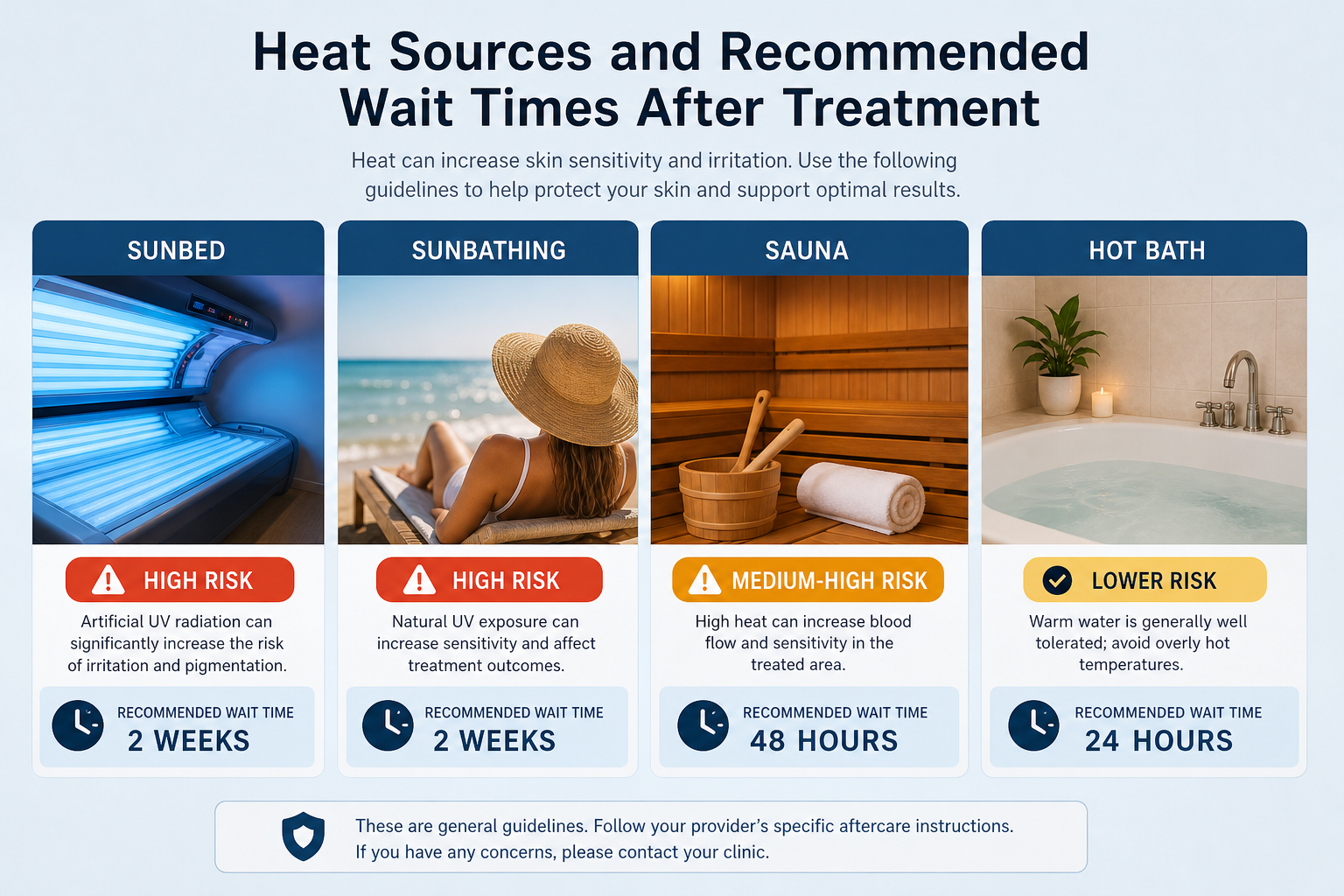
Sunbed vs. Natural Sun vs. Other Heat Sources: How Do the Risks Compare?
Patients sometimes ask whether natural sunlight is safer than a sunbed after filler, or whether a hot bath carries the same risks as a sauna. The table below provides a practical comparison.
| Heat or UV Source | Primary Risk After Filler | Recommended Wait Time |
|---|---|---|
| Sunbed (tanning bed) | Concentrated UV + heat; vasodilation; UV-induced degradation; cold sore trigger | Minimum 10–14 days |
| Direct sunbathing | UV exposure; heat; cumulative skin damage; similar risks at lower intensity | Minimum 10–14 days; use SPF 50+ |
| Sauna or steam room | Intense heat; vasodilation; prolonged swelling; no UV but comparable thermal risk | Minimum 10–14 days |
| Hot yoga | Elevated ambient temperature; vasodilation; physical exertion increases circulation | Minimum 10–14 days |
| Hot bath or shower | Localised heat; mild vasodilation; lower risk than sauna but still inadvisable early on | Avoid very hot water for 48–72 hours; warm is acceptable |
| Infrared facial or heat pack | Direct heat to treated area; vasodilation; avoid near injection sites | Minimum 10–14 days near treated area |
A sunbed emits concentrated UVA and UVB radiation alongside heat, making it a higher-risk combination than most other heat sources. Natural sunlight carries similar UV risks but at lower intensity and with more variability depending on season, latitude, and duration of exposure. The key distinction is that sunbeds deliver a predictable, high-intensity UV dose in a short time — which is why they warrant the same or greater caution as direct sunbathing.
The First 48 Hours: The Most Critical Window
The first 24 to 48 hours after dermal filler treatment represent the period of greatest vulnerability. During this window, the injection sites are still open at a microscopic level, swelling and bruising are at their peak, and the filler product has not yet begun to integrate with the surrounding tissue. Any source of intense heat exposure during this period — including hot showers, saunas, sunbeds, or even vigorous exercise — can significantly worsen swelling and discomfort.
Most practitioners advise keeping the treated area cool and avoiding any activity that raises core body temperature or increases facial blood flow for at least the first 24 to 48 hours. After this initial period, the risk does not disappear, but it does reduce. The 10–14 day rule reflects the time needed for the filler settling process to complete and for the skin to return to its baseline state before introducing stressors like UV radiation or intense heat.
Protecting Your Filler If You Use a Sunbed After the Recommended Wait
Once the recommended healing period has passed, using a sunbed occasionally is unlikely to cause acute harm to established filler. However, ongoing UV exposure does contribute to cumulative skin ageing and may reduce filler longevity over time. If you choose to use a sunbed after your filler has fully settled, the following precautions are worth considering:
- Apply a broad-spectrum SPF 50 sunscreen to all treated areas before UV exposure, including the lips if you have had lip filler.
- Use an SPF lip balm with broad-spectrum UV protection specifically formulated for the lips.
- Keep sessions short and avoid the maximum intensity settings on tanning beds.
- Avoid sunbeds entirely if you have a history of cold sores and have recently had lip filler.
- Stay well hydrated, as UV exposure and heat can dehydrate the skin and may affect the hydration properties of hyaluronic acid filler over time.
- Follow up with your practitioner if you notice any unusual changes in the treated area after UV exposure, including unexpected swelling, asymmetry, or discomfort.
Safe Tanning Alternatives During the Healing Period
For patients who want a tan while their filler settles, self-tanning products — including gradual tanning moisturisers, mousse formulations, and professional spray tans — are a practical alternative. These products work through a chemical reaction with the outermost layer of dead skin cells (using dihydroxyacetone, or DHA) and do not involve UV radiation or heat. They carry no known risk to dermal filler and can be used once any surface healing at the injection site is complete, typically after 48 to 72 hours.
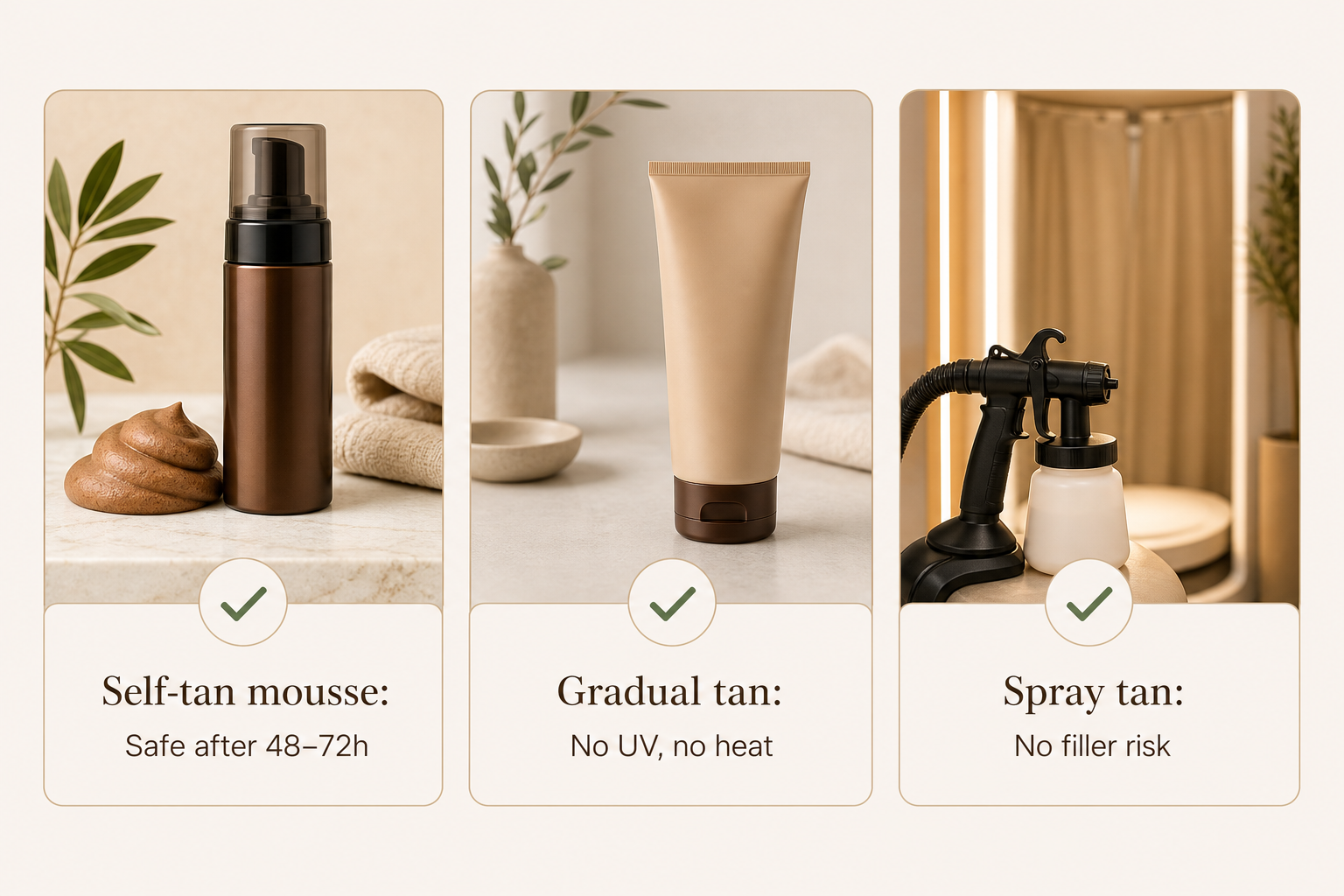
It is worth noting that self-tanning products should not be applied directly over areas that are still bruised, broken, or actively healing, as DHA can interact with damaged skin and produce uneven colour. Once the skin surface has fully healed, fake tan is a safe and effective way to achieve colour without compromising your filler results or extending your healing period.
What to Do If You Used a Sunbed Too Soon After Filler
If you used a sunbed before the recommended healing period had passed, the most important step is to monitor the treated area carefully over the following days. In many cases, the main consequence will be increased swelling or prolonged bruising rather than any lasting damage to the filler itself. Apply a cool (not ice-cold) compress to the area if swelling worsens, keep the skin moisturised, and avoid further heat exposure until the area has fully settled.
Contact your practitioner if you notice any of the following after heat exposure during the healing period:
- Swelling that is worsening rather than improving after 48 hours
- Unusual pallor, greyness, or mottling of the skin around the treated area
- Increasing pain or a cold sensation at the injection site
- Spreading redness that extends beyond the immediate treatment area
- The appearance of a cold sore or blistering near the lip injection site
- Visible asymmetry or changes in filler shape that were not present immediately after treatment
Most of these symptoms are unlikely to result from a single sunbed session after filler, but they warrant professional assessment if they occur. Your practitioner can evaluate the treated area and advise on whether any intervention is needed.
Pre-Treatment Sunbed Use: An Often-Overlooked Consideration
While most aftercare guidance focuses on the period after filler treatment, it is worth noting that using a sunbed immediately before a filler appointment also carries some risk. Sunburned or UV-stressed skin is more sensitive, more prone to bruising, and may respond differently to injection than healthy, unaffected skin. Some practitioners advise avoiding sunbeds for at least 24 hours before treatment as well as after. If your skin is visibly red, irritated, or sunburned on the day of your appointment, it is worth discussing this with your practitioner before proceeding.
Frequently Asked Questions
Can I use a sunbed the day after lip filler?
No. The first 24 to 48 hours after lip filler are the most critical part of the healing period. Using a sunbed this soon after treatment is very likely to worsen swelling and bruising, and the UV exposure increases the risk of triggering a cold sore in susceptible patients. Wait a minimum of 10–14 days before using a sunbed after lip filler.
Will a sunbed dissolve my filler?
No — not in any meaningful way. The temperatures produced by a sunbed do not penetrate deeply enough to cause significant thermal degradation of cross-linked hyaluronic acid filler. The only agent that reliably dissolves HA filler is hyaluronidase, an enzyme injected by a practitioner. However, repeated UV exposure over time can reduce filler longevity by degrading the surrounding skin environment.
Is a sauna after filler as risky as a sunbed?
A sauna carries comparable risks in terms of heat and vasodilation, but without the UV component. Both should be avoided for at least 10–14 days after filler treatment. The intense heat from a sauna or steam room can worsen swelling and prolong the healing period in the same way that a sunbed can.
Does the type of filler affect how long I should wait before using a sunbed?
The recommended wait time of 10–14 days applies broadly to hyaluronic acid fillers regardless of brand. Fillers with higher cross-linking density — such as those used for structural areas like the jawline or cheeks — may have slightly greater thermal stability, but this does not meaningfully change the aftercare recommendation. The primary concern during the healing period is the effect of heat on the surrounding tissue, not the filler product itself.
Can I use fake tan instead of a sunbed while my filler heals?
Yes. Self-tanning products do not involve UV radiation or heat and are a safe alternative during the filler healing period. Wait until any surface healing at the injection site is complete — typically 48 to 72 hours — before applying self-tanner, and avoid applying it directly over any area that is still bruised or broken.
Do I need to use SPF on my filler areas even after the healing period?
Yes. Broad-spectrum sun protection is advisable on all treated areas whenever you are exposed to UV radiation, whether from a sunbed or natural sunlight. Using an SPF lip balm and a broad-spectrum SPF 50 sunscreen on filler treatment areas helps protect both the skin and the longevity of your filler results over time.
What if I have cheek or jawline filler — does the same advice apply?
Yes. The same 10–14 day minimum wait applies to cheek filler, jawline filler, chin filler, and other facial areas. Tear trough and temple filler may warrant a longer wait of up to four weeks due to the higher vascularity of those areas and the tendency for swelling to persist longer. Follow your practitioner’s specific aftercare instructions for your treatment area.
When Can You Safely Return to Sunbed Use After Filler?
The practical answer for most patients is: after a minimum of 10–14 days, once swelling and bruising have fully resolved and the filler has settled. For more vascular treatment areas such as the tear trough or temples, waiting up to four weeks is a more cautious and often advisable approach. Once you do return to sunbed use, applying broad-spectrum SPF 50 to all treated areas and keeping sessions moderate in length will help protect both your skin and your filler results over the longer term. If you are unsure whether your filler has fully settled or whether it is safe to resume sunbed use, a brief follow-up with your practitioner is the most reliable way to get personalised guidance. Protecting your investment in filler treatment is straightforward — it simply requires a short, well-timed pause.