Tear Trough Filler Bruising: How Long It Lasts and What to Expect
Tear trough filler bruising is one of the most common concerns patients raise before and after under-eye filler treatment. The periorbital area has thin skin and a dense network of superficial blood vessels, which makes bruising more likely here than in most other injection sites. For the majority of patients, bruising is temporary and resolves on its own within one to two weeks — but understanding the recovery timeline, what drives bruising, and how to manage it can make the experience significantly less stressful.
Key Takeaways
- Bruising after tear trough filler is common and usually resolves within 7–14 days, though mild discolouration can persist slightly longer in some patients.
- Bruising peaks at 48–72 hours after treatment, then gradually fades through a predictable colour progression from red or purple through green to yellow before clearing.
- A blunt-tipped cannula is associated with a lower bruising rate than a sharp needle, though the entry-point puncture still carries some risk.
- Avoiding blood-thinning medications and alcohol before treatment, and following aftercare guidance carefully, can meaningfully reduce both the severity and duration of bruising.
- Sudden severe pain, blanching, mottled skin, or any change in vision after filler are warning signs that require immediate clinical attention — these are distinct from ordinary bruising.
Why the Under-Eye Area Bruises So Easily
The tear trough sits in the infraorbital region, where the skin is among the thinnest on the face — often less than one millimetre in depth. Beneath this delicate surface lies a network of small blood vessels that supply the orbicularis oculi muscle and surrounding tissue. When a needle or cannula passes through this tissue, even with precise technique, it can nick one of these vessels and allow a small amount of blood to leak into the surrounding tissue. That escaped blood is what produces the visible bruise.
The periorbital area is also subject to natural movement — blinking, squinting, and facial expression — which can slightly displace blood before it is reabsorbed, sometimes making a bruise appear larger in the first day or two than the original injury would suggest. Gravity also plays a role: blood can track downward along tissue planes, occasionally producing discolouration slightly below the injection site itself.
Hyaluronic acid (HA) filler, the type most commonly used in tear trough treatment, is injected in small volumes into a precise plane beneath the skin. The filler itself does not cause bruising, but the mechanical act of placing it does. This is why injection technique, the choice of instrument, and patient anatomy all influence how much bruising occurs.
Day-by-Day Recovery Timeline
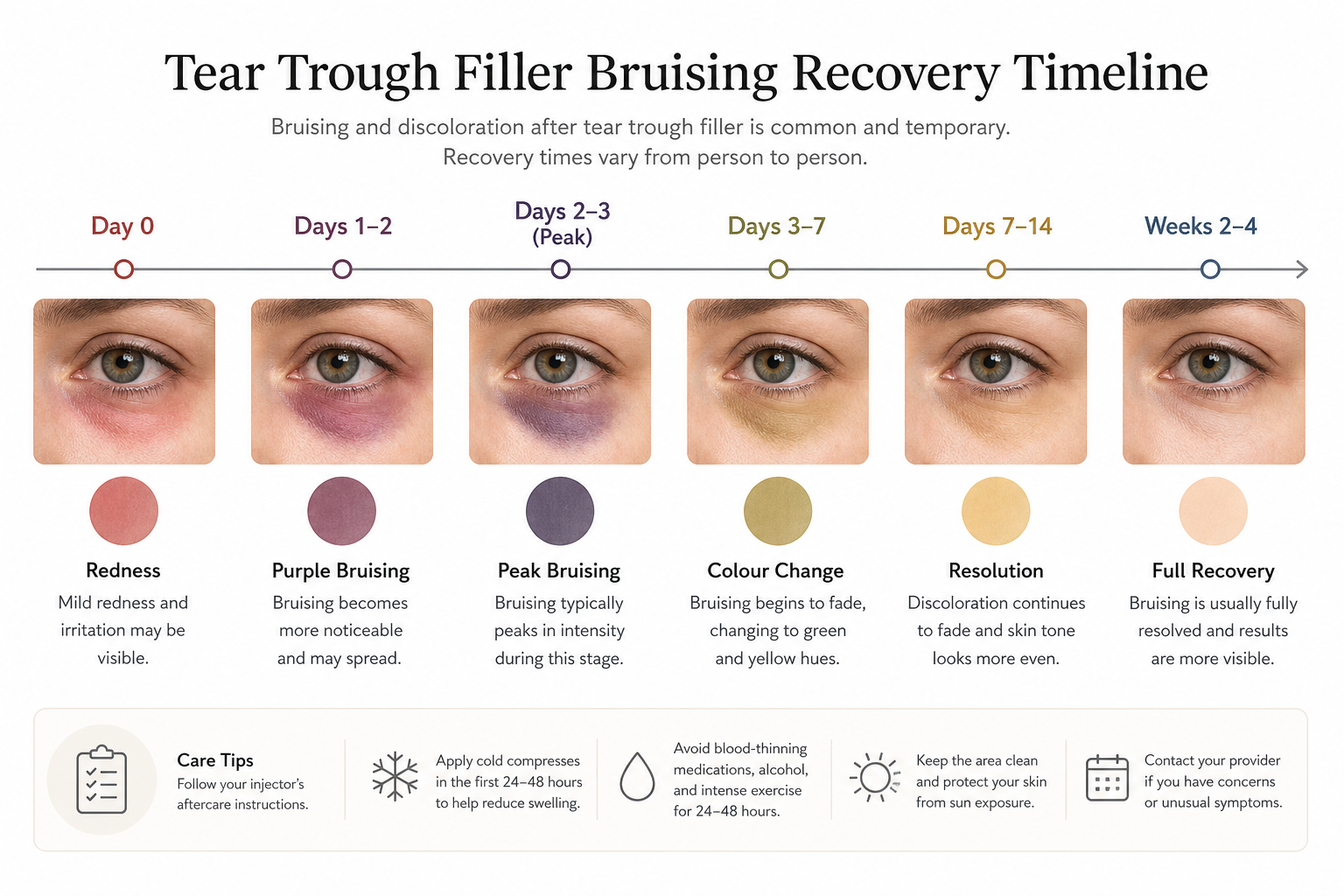
Tear trough filler bruising follows a broadly predictable pattern, though the exact pace varies between individuals. The following timeline reflects what most patients experience, and understanding each stage can help distinguish normal healing from anything that warrants clinical review.
| Time After Treatment | What to Expect |
|---|---|
| Day 0 (treatment day) | Mild redness, possible immediate bruising at the injection site, swelling beginning to develop. The area may look slightly uneven as filler settles into position. |
| Days 1–2 | Bruising becomes more visible as blood disperses under the skin. Swelling often peaks alongside bruising. Discolouration is typically red to dark purple. Cold compress use is most effective during this window. |
| Days 2–3 | Bruising peaks at 48–72 hours. This is usually the most visually prominent stage. Swelling may also be at its highest point. Patients often find this stage most alarming, but it is a normal part of healing. |
| Days 3–7 | Colour begins to shift from purple toward green and then yellow as haemoglobin breaks down. Swelling gradually reduces. The area may still look uneven as filler continues to settle. |
| Days 7–14 | Most bruising has resolved or faded to faint yellow discolouration. Swelling is largely gone. The filler settles more fully and results become clearer. |
| Weeks 2–4 | Any residual discolouration has typically cleared. Filler has fully integrated with surrounding tissue and final results are visible. |
The Science Behind Colour Progression
The colour change that bruises undergo — from red or purple through green to yellow — reflects the breakdown of haemoglobin, the oxygen-carrying protein in red blood cells. When blood leaks into tissue, haemoglobin is broken down by enzymes into biliverdin, which produces the green hue, and then into bilirubin, which gives the yellow colour. This is a normal metabolic process and is a reliable sign that the body is clearing the bruise. A bruise that remains dark purple or red without progressing through these stages after several days may warrant a clinical review, as it could indicate a small haematoma (a localised collection of blood) rather than simple bruising.
Cannula vs Needle: Does Technique Affect Bruising?
The choice between a sharp needle and a blunt-tipped cannula is one of the most clinically relevant factors in tear trough filler bruising. A blunt-tipped cannula is designed to push blood vessels aside rather than pierce them, which reduces the likelihood of vessel injury during filler placement. A prospective study comparing the two approaches found ecchymosis (bruising) rates of approximately 7% with cannula technique versus approximately 17% with a sharp needle — a meaningful difference that supports cannula use in this delicate area.
However, it is important to understand that cannula technique does not eliminate bruising entirely. The cannula still requires an entry-point puncture made with a sharp needle before it is introduced, and this initial puncture carries its own bruising risk. The overall reduction in bruising with cannula technique reflects the reduced trauma during filler placement itself, not the complete absence of vessel contact. Practitioner skill and familiarity with the chosen instrument also influence outcomes significantly — an experienced injector using a needle may produce less bruising than a less experienced practitioner using a cannula.
When discussing your treatment, it is reasonable to ask your practitioner which instrument they plan to use and why, and to understand their experience with both approaches in the tear trough region specifically.
Factors That Increase Bruising Risk
Some patients bruise more readily than others, and several modifiable and non-modifiable factors influence both the likelihood and the duration of under-eye bruising after filler.
Medications and Supplements to Avoid Before Treatment
Blood-thinning medications and supplements reduce the blood’s ability to clot, which means that even minor vessel injury during injection can result in more significant bruising. Patients are typically advised to avoid the following for at least 7–10 days before treatment, where medically safe to do so:
- Aspirin — inhibits platelet function and significantly increases bruising risk
- Ibuprofen and other NSAIDs (such as naproxen) — reduce platelet aggregation
- Fish oil and omega-3 supplements — have mild anticoagulant effects
- Vitamin E supplements — can impair platelet function at higher doses
- Alcohol — causes vasodilation and reduces clotting efficiency; avoid for at least 24–48 hours before treatment
- Retinol and strong topical exfoliants — can thin the skin and increase sensitivity, though their direct effect on bruising is less established
Never stop prescribed medications without consulting your prescribing doctor first. If you take anticoagulants such as warfarin or direct oral anticoagulants for a medical condition, discuss this with both your prescriber and your aesthetic practitioner before proceeding with filler treatment.
Other Contributing Factors
Beyond medications, several other factors can influence bruising severity. Patients with naturally thin skin or prominent superficial blood vessels in the periorbital area are at higher baseline risk. Skin tone also plays a role: in patients with darker Fitzpatrick skin types, bruising may be less immediately visible but can sometimes persist as post-inflammatory discolouration for longer than in lighter skin tones, and the colour progression may appear differently. Anatomical variation in vessel position means that even with identical technique, bruising outcomes differ between patients. Anxiety-related muscle tension during the procedure can also make injection slightly more difficult and increase the chance of vessel contact.
Aftercare: What Helps Bruising Resolve Faster
Following post-treatment care instructions carefully can meaningfully shorten the duration and reduce the visibility of tear trough filler bruising. The most effective measures are those taken in the first 24–72 hours, when the bruise is still forming.
Cold Compress
Applying a cold compress or ice pack wrapped in a clean cloth to the treated area for 10–15 minutes at a time during the first 24–48 hours helps constrict blood vessels and limit the spread of any leaked blood. Do not apply ice directly to the skin, and avoid pressing firmly on the injection site. Cold therapy is most useful in the immediate post-treatment period; once a bruise has fully formed, cold has limited additional benefit.
Arnica Gel and Arnica Cream
Topical arnica gel or arnica cream is widely used to support bruise resolution. Arnica montana contains compounds that are thought to reduce inflammation and support the reabsorption of blood from tissue. While the clinical evidence for arnica is not conclusive, it is generally well tolerated and is a reasonable option for patients who wish to use a topical remedy. Apply gently around — not directly on — any broken skin or puncture sites.
Head Elevation and Sleep Position
Keeping the head elevated, particularly during sleep, reduces fluid pooling in the periorbital area and can help limit swelling and bruising spread. Sleeping on your back with an extra pillow for the first few nights after treatment is generally recommended. Avoid sleeping face-down, which can place pressure on the treated area and potentially displace filler in the early settling period.
What to Avoid During Recovery
- Strenuous exercise for at least 24–48 hours — increased heart rate and blood pressure can worsen bruising
- Alcohol for at least 24 hours post-treatment — causes vasodilation and impairs healing
- Heat exposure (saunas, hot showers, steam rooms) for 48 hours — heat dilates blood vessels and can worsen bruising and swelling
- Touching or massaging the treated area unless specifically instructed by your practitioner
- Blood-thinning medications or supplements in the immediate post-treatment period, unless medically necessary
Concealing Bruising with Makeup
Most practitioners advise waiting at least 24 hours before applying makeup to the treated area, and some recommend 48 hours to allow puncture sites to close fully. When bruising is in the purple or blue stage, a peach or orange colour-correcting concealer applied before a skin-tone concealer can neutralise the discolouration effectively. Green concealer is better suited to reddish bruises. Apply with a clean brush or sponge rather than fingers to avoid pressure on the injection site, and choose non-comedogenic, fragrance-free products where possible.
What Makes Bruising Last Longer Than Usual
Most tear trough filler bruising resolves within 7–14 days, but some patients find that discolouration persists beyond this window. Several factors can prolong the healing process. A larger haematoma — a localised pocket of blood rather than diffuse bruising — takes longer to reabsorb and may feel firm or slightly raised. Continuing to take blood-thinning medications or supplements during recovery can slow clot resolution. Poor lymphatic drainage in the periorbital area, which can be related to anatomy or prior procedures, may also delay clearance. In some cases, the volume of filler placed means the tissue is under slightly more tension, which can affect how quickly bruising disperses.
For bruising that has not meaningfully improved after two weeks, a clinical review is appropriate. In persistent cases, pulsed-dye laser or KTP laser therapy can be used to accelerate the breakdown of haemoglobin in the skin, reducing the appearance of stubborn bruising more quickly than the body would manage alone. This is a genuine clinical option that is rarely discussed in patient-facing information but is available at some specialist clinics.
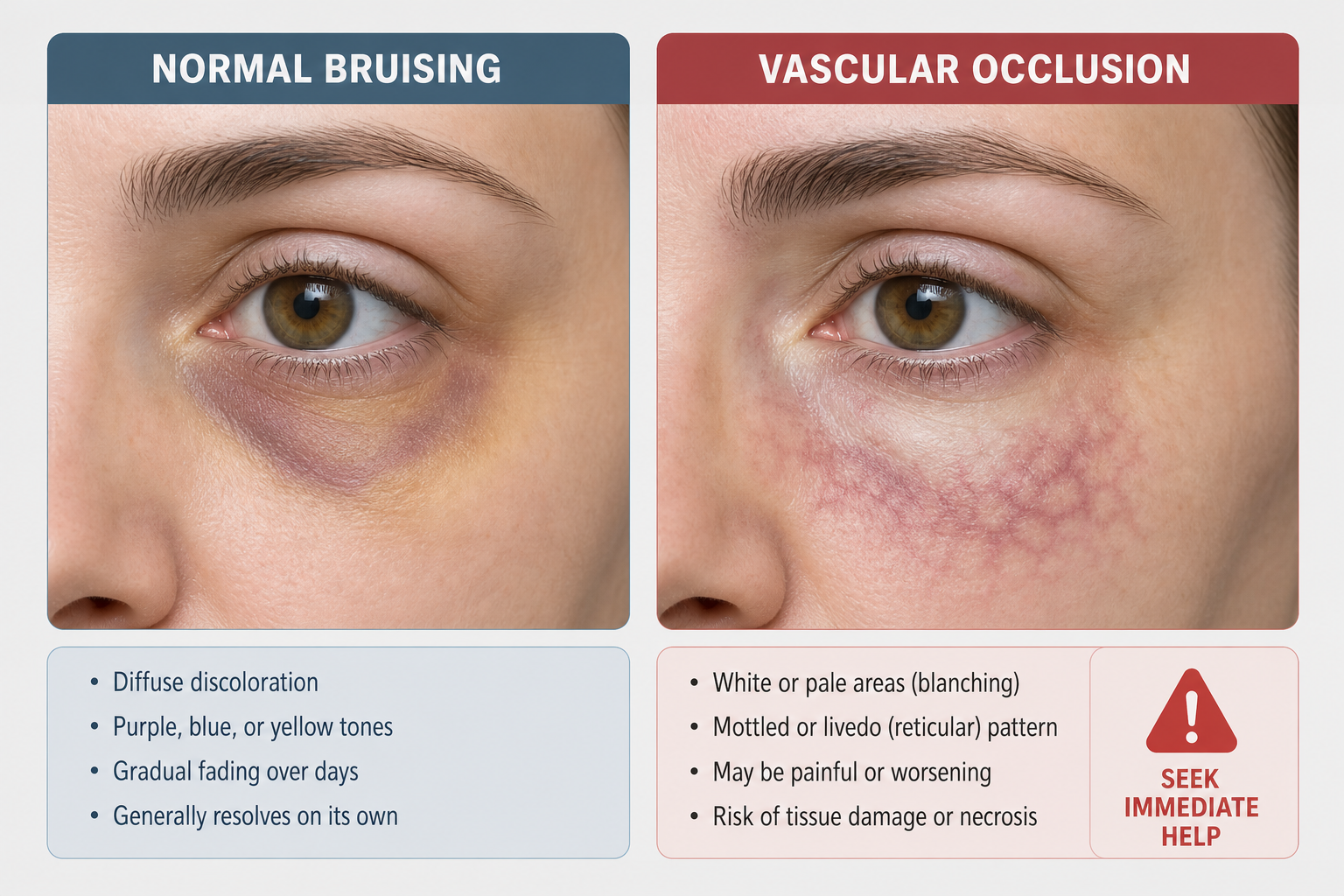
Normal Bruising vs Vascular Occlusion: Knowing the Difference
Vascular occlusion is a rare but serious complication of filler treatment in which filler material partially or completely blocks a blood vessel, cutting off blood supply to surrounding tissue. It is not the same as bruising, and distinguishing between the two is important for patient safety. The table below outlines the key differences.
| Feature | Normal Bruising | Vascular Occlusion — Seek Immediate Help |
|---|---|---|
| Appearance | Purple, green, or yellow discolouration; diffuse | White blanching or mottled, livedo reticularis pattern (net-like) |
| Pain | Mild tenderness at injection site | Severe, disproportionate, or worsening pain |
| Onset | Develops over hours to days | Often immediate or within minutes of injection |
| Progression | Gradually fades over days | Skin may darken or develop blistering if untreated |
| Vision | Unaffected | Any visual disturbance is a medical emergency |
| Action required | Standard aftercare; monitor | Contact your practitioner or emergency services immediately |
Vascular occlusion requires urgent treatment with hyaluronidase, an enzyme that dissolves hyaluronic acid filler, to restore blood flow. Time is critical — the sooner hyaluronidase is administered, the better the outcome. Any patient who experiences blanching, severe pain, a mottled skin pattern, or any change in vision after tear trough filler should contact their practitioner immediately or attend an emergency department without delay.
Myth-Busting: Common Misconceptions About Under-Eye Bruising
“Bruising means something went wrong.” This is not accurate. Bruising after tear trough filler is a recognised and common side effect, not an indicator of error. The periorbital area is inherently vascular, and even highly experienced practitioners working with optimal technique will encounter bruising in some patients. What matters is that the practitioner is using appropriate technique, monitoring for complications, and providing clear aftercare guidance.
“A cannula prevents all bruising.” A blunt-tipped cannula reduces bruising risk compared to a sharp needle, but it does not eliminate it. The entry-point puncture still requires a sharp needle, and bruising can occur at this site. Cannula technique is a meaningful risk-reduction strategy, not a guarantee of bruise-free treatment.
“Bruising means the filler was placed incorrectly.” Bruising reflects vessel injury during injection, not filler misplacement. Filler placement accuracy is assessed by the clinical result once swelling and bruising have resolved — typically at a two-week review appointment.
“The Tyndall effect is bruising.” The Tyndall effect is a bluish or greyish hue that can appear when hyaluronic acid filler is placed too superficially in the skin. Unlike bruising, it does not fade over days and is not related to vessel injury. If a bluish tint persists well beyond the expected bruising timeline, it may indicate the Tyndall effect rather than residual bruising, and a clinical assessment is needed. Treatment with hyaluronidase can correct this.
Planning Around Social Events and Return to Work
Most patients find that tear trough filler bruising is manageable with makeup after the first 24–48 hours, and many return to desk-based work within a day or two of treatment. However, for important social events, professional engagements, or occasions where you would prefer to look your best, it is sensible to allow a buffer of at least 7–10 days after treatment. This accounts for the peak bruising and swelling period and gives time for the filler to begin settling.
The phrase “minimal downtime” is commonly used to describe tear trough filler, and while it is broadly accurate — most patients are not incapacitated — it can understate the social visibility of bruising in the first week. A more realistic expectation is that most patients are socially presentable within 3–7 days with the help of colour-correcting concealer, and that the treated area looks close to its final result by the two-week mark.
Frequently Asked Questions
How long does bruising last after tear trough filler?
For most patients, bruising resolves within 7–14 days. Mild yellow discolouration may linger slightly beyond this in some cases. Bruising that has not improved meaningfully after two weeks warrants a clinical review.
Is it normal for bruising to look worse on day 2 or 3?
Yes. Bruising peaks at 48–72 hours after treatment as blood disperses through the tissue. This is a normal part of the healing process and does not indicate that anything has gone wrong. The bruise should begin to change colour and fade after this point.
Can I wear makeup to cover the bruising?
Most practitioners advise waiting 24–48 hours before applying makeup to allow puncture sites to close. A peach or orange colour-correcting concealer is effective for neutralising purple or blue bruising before applying a skin-tone concealer on top.
Will arnica gel help my bruise heal faster?
Topical arnica gel is widely used for this purpose and is generally well tolerated. The clinical evidence is not conclusive, but many patients find it helpful. Apply gently around the area, avoiding any open puncture sites.
Does a blunt-tipped cannula mean I won’t bruise?
A cannula significantly reduces bruising risk compared to a sharp needle, but does not eliminate it entirely. The entry-point puncture still requires a sharp needle, and individual anatomy also plays a role. Some bruising remains possible even with cannula technique.
When should I be worried about bruising after tear trough filler?
Seek immediate clinical attention if you experience blanching (white patches), a mottled or net-like skin pattern, severe or worsening pain, or any change in vision. These may indicate vascular occlusion, which requires urgent treatment with hyaluronidase. Ordinary bruising, by contrast, is diffuse, gradually changes colour, and is not associated with severe pain or visual symptoms.
What if my bruising hasn’t gone after two weeks?
Prolonged bruising beyond two weeks is less common but does occur, particularly in patients with larger haematomas or those who continued blood-thinning supplements during recovery. A clinical review is appropriate. In persistent cases, pulsed-dye laser or KTP laser treatment can accelerate resolution.
Planning Your Recovery Realistically
Tear trough filler bruising is a predictable and manageable side effect for most patients. Understanding the day-by-day recovery timeline, the colour progression that signals normal healing, and the aftercare steps that support faster resolution can make the experience considerably less stressful. The majority of patients see bruising resolve within one to two weeks, with the treated area looking close to its final result by the two-week review.
Preparation matters: discussing your medication and supplement history with your practitioner before treatment, avoiding alcohol and blood-thinning supplements in the days beforehand, and planning your social calendar around the likely recovery window all contribute to a smoother experience. If you have concerns about bruising that is not following the expected pattern, or if you notice any of the warning signs described above, contact your practitioner promptly. A qualified, experienced injector will be able to assess whether what you are experiencing is within the normal range or requires further attention.