Chin Filler for Round Faces: How It Works, What to Expect, and When It Helps
A round face is characterised by soft angles, fuller cheeks, and a shorter lower third that can make the chin appear less defined than the upper and mid-face. Chin filler — a non-surgical chin augmentation technique using injectable dermal filler — is one of the most requested treatments for improving facial proportion in people with this face shape. Done well, it can add forward projection and vertical chin height, creating the visual impression of a more balanced, oval-shaped face. Done poorly, or in the wrong candidate, it can add unwanted width and worsen the very imbalance it was meant to correct. This guide explains how chin filler works for round faces, who is likely to benefit, what realistic results look like, and when a different approach may serve you better.
Key Takeaways
- Chin filler adds forward projection and vertical length to the lower third of the face, which can visually elongate a round face shape without surgery.
- The treatment works by creating the illusion of better facial proportion — it does not reduce cheek volume or remove fat from the face.
- Technique matters as much as volume: over-filling or placing filler too wide can increase apparent face width, which is counterproductive for a round face.
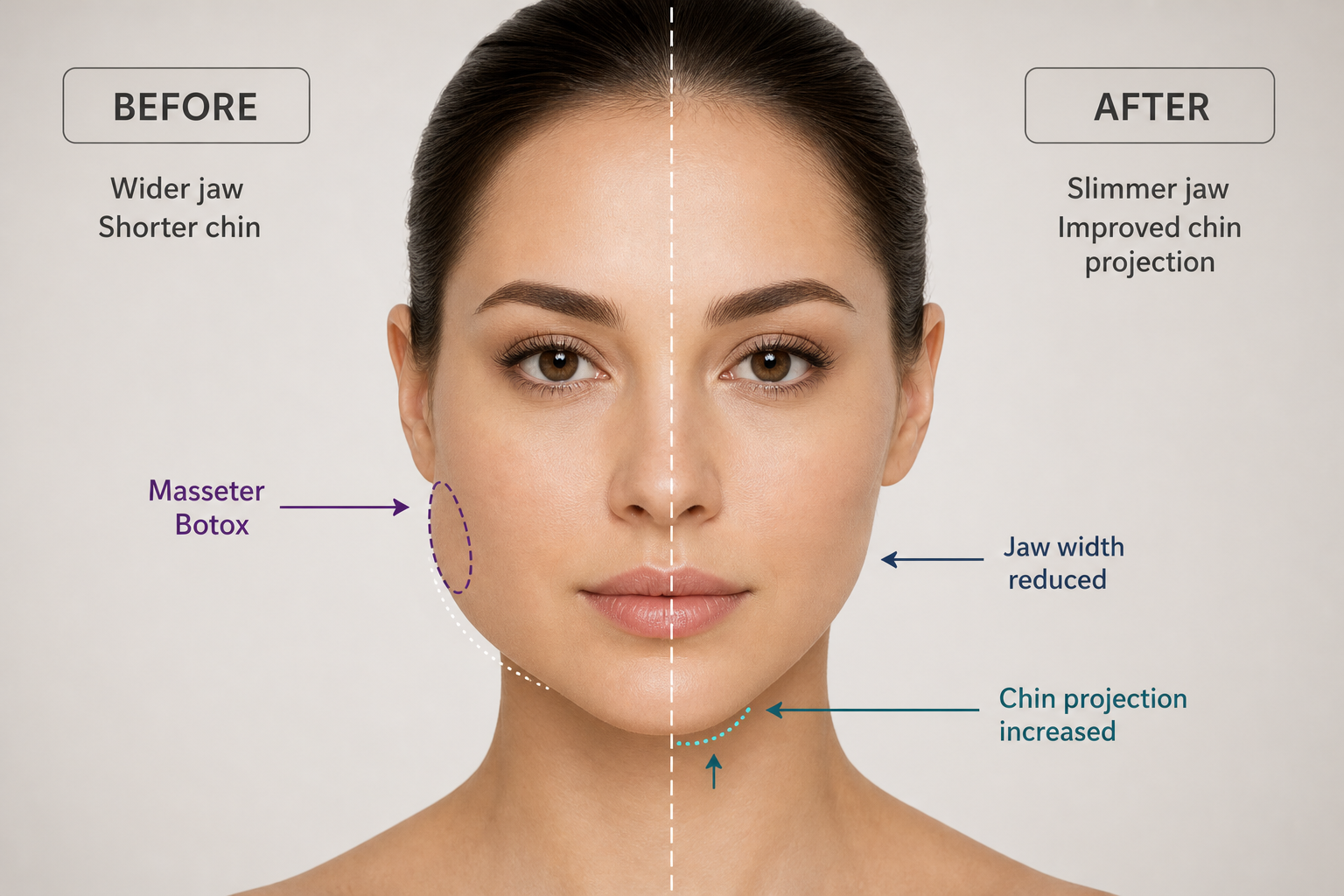
- Combining chin filler with masseter Botox is a common approach for round faces, addressing both chin definition and jaw width in a single treatment plan.
- Results with hyaluronic acid filler are reversible and typically last 9–18 months; a clinical assessment is essential to determine whether chin filler is appropriate for your anatomy.
What Chin Filler Actually Does — and What It Does Not
Chin filler is an injectable treatment in which a dermal filler — most commonly a hyaluronic acid (HA) filler — is placed into the soft tissue of the chin to alter its shape, size, and projection. The filler adds physical volume in a targeted location, which changes how the chin appears in relation to the rest of the face. For a round face, the primary goals are usually to increase chin projection (forward movement of the chin tip when viewed from the side) and to add vertical chin height, making the lower third of the face appear longer and more proportionate.
What chin filler does not do is equally important to understand. It does not reduce the volume of the cheeks, slim the face structurally, or remove fat from anywhere. If you have a round face partly because of fuller cheeks or a wider jaw, chin filler alone will not address those features. It works by redirecting visual attention — a more prominent chin draws the eye downward and forward, making the face appear less wide by comparison. This is a perceptual shift, not a structural one, and managing that expectation honestly is central to a good outcome.
Why Round Faces Benefit from Chin Projection
The rule of thirds is a foundational concept in facial proportion assessment. It divides the face into three roughly equal horizontal zones: the upper third (hairline to brow), the middle third (brow to base of nose), and the lower third (base of nose to chin). In an ideally proportioned face, these three zones are approximately equal in height. In a round face, the lower third is often shorter relative to the upper two, and the bizygomatic width (the distance across the cheekbones) tends to be similar to or greater than the vertical height of the face. This combination produces the characteristic circular silhouette.
A recessed chin or weak chin — where the chin sits behind the vertical line dropped from the lips — further compresses the apparent length of the lower face. By adding forward projection and vertical chin height through filler, a practitioner can visually lengthen the lower third, bringing it closer to the proportions associated with an oval-shaped face. From the side profile, improved chin projection also balances the chin-to-nose relationship, which is a key marker of profile balance in both aesthetic and cephalometric assessment.
How the Treatment Is Planned for a Round Face
Planning chin filler for a round face requires a different approach than planning it for a longer or more angular face. The primary concern is avoiding any increase in apparent face width. Filler placed too laterally — towards the sides of the chin rather than centrally — can widen the lower face, which is the opposite of what most round-faced patients want. A skilled injector will assess the face from the front, side, and at rest before deciding on placement, volume, and technique.
Most practitioners use a midline or central depot approach for round faces, concentrating filler along the central axis of the chin to maximise forward projection and vertical elongation without adding lateral width. The injection plane is typically supraperiosteal — meaning the filler is placed close to the bone — which provides structural support and reduces the risk of migration. High G-prime fillers (those with greater firmness and lift capacity) are generally preferred for chin augmentation because they maintain their shape under the mechanical forces of the lower face. Products such as Juvederm Volux and Restylane Defyne are among those with clinical data supporting their use in the chin and jawline area, though product availability varies by country and clinical context.
Volume is another planning consideration. Most chin augmentation treatments use between 1 and 3 mL of filler, though the appropriate amount depends entirely on the individual’s anatomy and goals. For a round face, a conservative approach is often wise at first — adding too much volume in a single session increases the risk of an unnatural result or unwanted width. A touch-up appointment after the initial swelling has settled (usually two to four weeks later) allows for precise refinement.
Feminine and Masculine Chin Goals in Round Faces
The ideal chin shape differs between patients, and gender-specific goals are an important part of treatment planning that is often underexplored in patient-facing information. For patients seeking a more feminine result, the goal is typically a tapered, slightly pointed chin with a smooth, refined contour — this creates the visual impression of a heart-shaped or oval-shaped face. Filler is concentrated centrally and the overall volume is kept modest to avoid a heavy or squared appearance.
For patients seeking a more masculine result, the chin is generally planned to be broader, squarer, and more projected. A stronger chin with a flatter base reads as more defined and angular, which suits a masculine aesthetic even on a round face. The volume used may be slightly higher, and lateral placement may be more appropriate than in a feminisation plan. Discussing these goals explicitly with your practitioner before treatment is essential, as the same anatomical starting point can be treated in meaningfully different ways depending on the desired outcome.
Combining Chin Filler with Masseter Botox
For many people with round faces, the most effective approach is not chin filler alone but a combination of chin filler and masseter Botox. The masseter muscles sit at the angle of the jaw on each side of the face. When these muscles are enlarged — a condition called masseter hypertrophy, which can be caused by teeth grinding, jaw clenching, or simply genetics — they contribute to a wider, squarer lower face. Botulinum toxin injected into the masseter causes the muscle to gradually reduce in bulk over several weeks, which can narrow the apparent width of the lower jaw.
When masseter Botox is combined with chin filler, the effect is complementary: the jaw narrows from the sides while the chin projects forward and downward. Together, these changes can significantly improve facial proportion for a round face, creating a more tapered lower face shape without surgery. This combination is one of the most commonly recommended approaches in full-face contouring plans for round faces, and the results of both treatments can be assessed and adjusted over time. It is worth noting that masseter Botox takes four to six weeks to show its full effect, so the two treatments are sometimes staggered to allow for accurate assessment.
What to Expect: The Treatment Process
A chin filler appointment typically begins with a consultation or pre-treatment assessment in which the practitioner evaluates your facial anatomy, discusses your goals, and explains what is and is not achievable. Photographs are usually taken from multiple angles. If you are proceeding on the same day, a topical anaesthetic cream is applied to the chin area and left for around 20 to 30 minutes to reduce discomfort. Most hyaluronic acid fillers also contain lidocaine, a local anaesthetic, within the formulation, which further reduces sensation during injection.
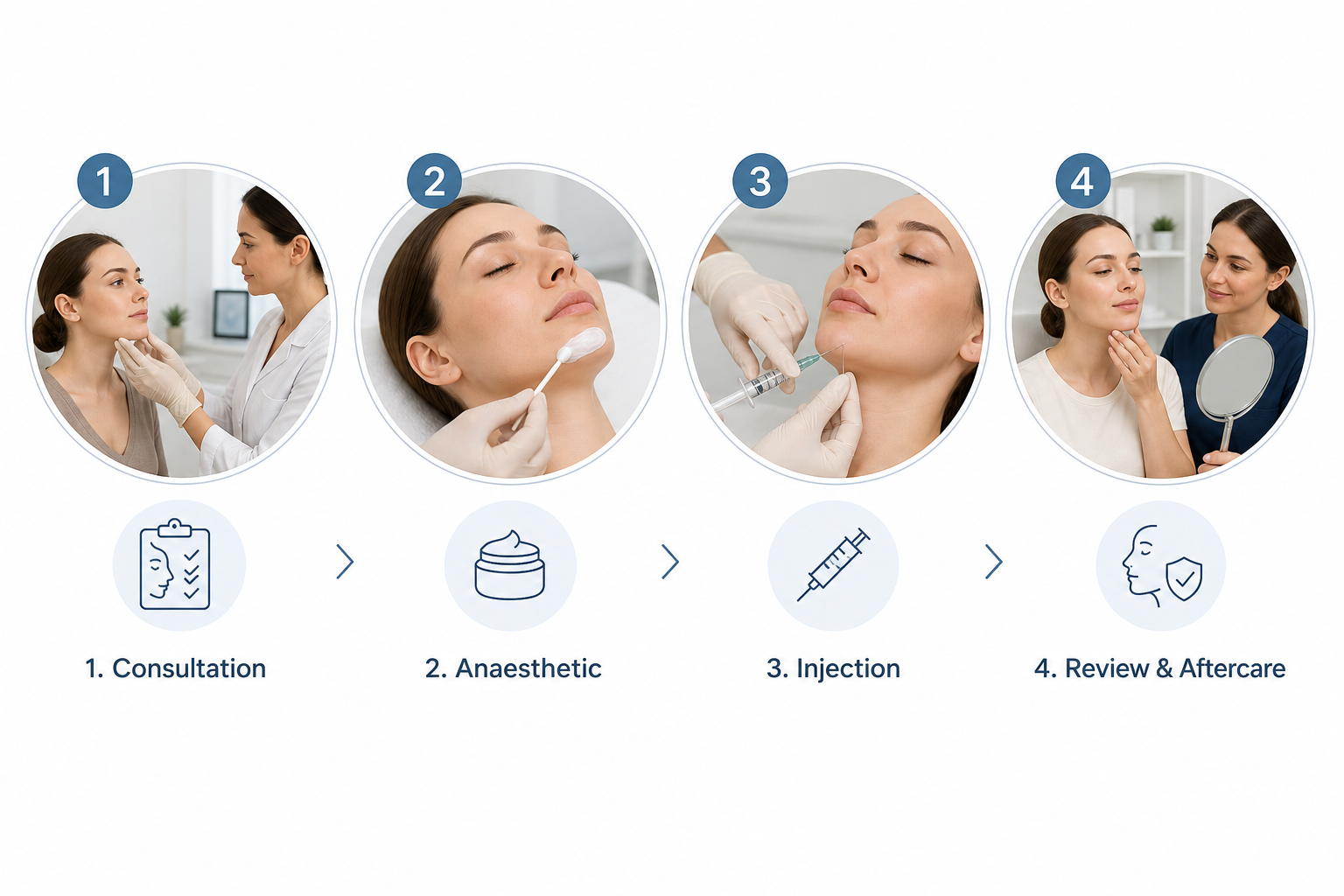
The injection itself takes around 15 to 30 minutes. The practitioner may use a fine needle, a blunt-tipped cannula, or a combination of both, depending on their technique and your anatomy. A cannula technique involves a single entry point and allows the filler to be threaded into position with reduced bruising risk, while a needle technique allows more precise depot placement. After injection, the practitioner will typically mould the filler gently to ensure even distribution and assess the result from multiple angles before you leave.
Immediately after treatment, the chin area will appear slightly swollen and may feel tender to the touch. Some bruising is possible, particularly around needle entry points. Most patients can return to normal daily activities immediately, though strenuous exercise, alcohol, and excessive heat (such as saunas or hot baths) are generally advised against for 48 hours. The filler will settle and integrate with the surrounding tissue over one to two weeks, and the final result is usually assessed at a follow-up appointment around two to four weeks after treatment.
How Long Results Last
The longevity of chin filler depends on the type of filler used, the volume placed, the individual’s metabolism, and the mechanical environment of the treatment area. Hyaluronic acid fillers in the chin typically last between 9 and 18 months, with many patients choosing a maintenance treatment every 12 months. The chin is a relatively low-movement area compared to the lips or nasolabial folds, which tends to support longer filler longevity.
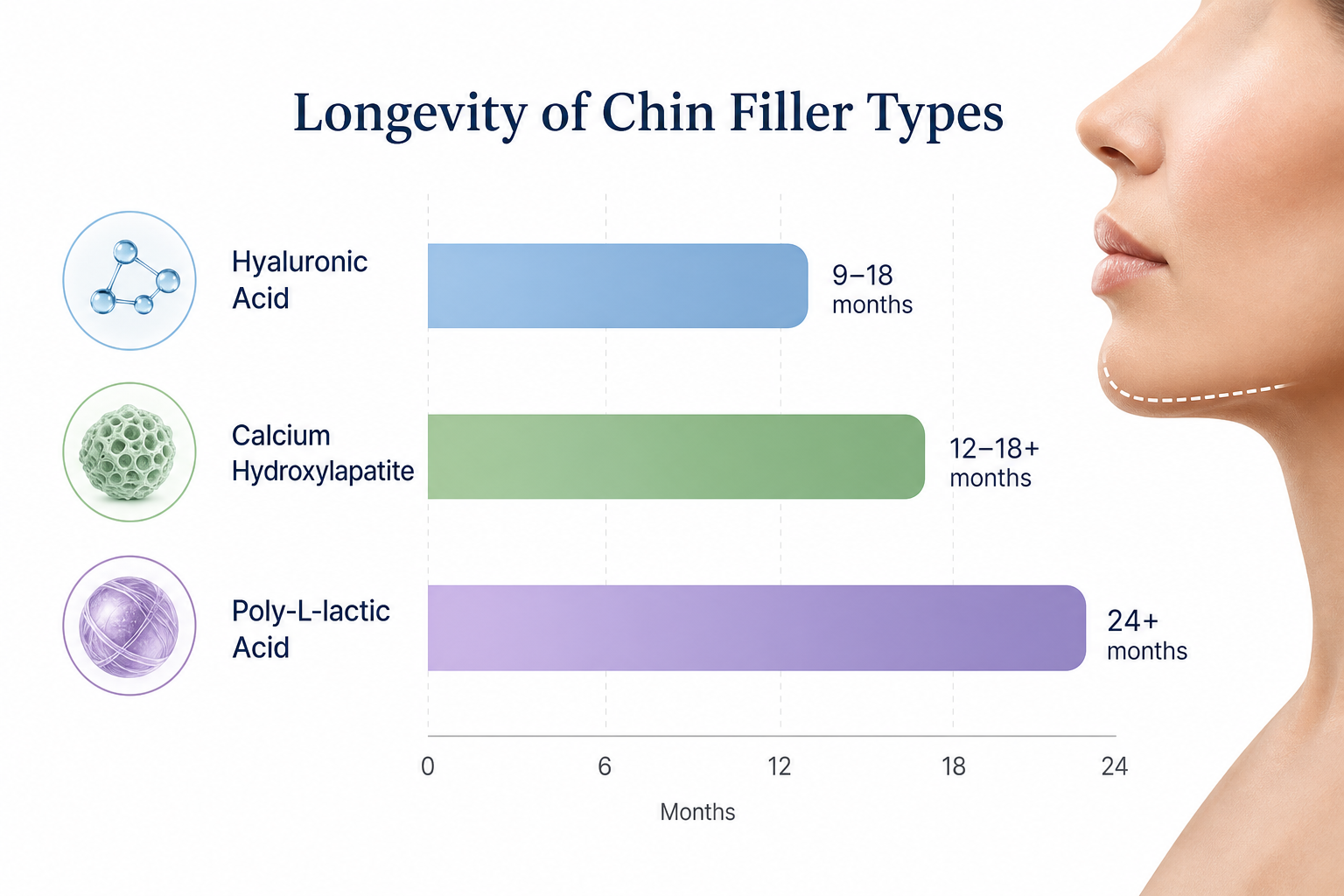
Calcium hydroxylapatite (CaHA) fillers, such as Radiesse, may last longer than HA fillers in some patients — often 12 to 18 months or more — but they are not reversible with hyaluronidase in the way that HA fillers are. Poly-L-lactic acid (PLLA) fillers work differently, stimulating collagen production over time rather than providing immediate volume, and their effects may last two years or longer. For most patients new to chin filler, a hyaluronic acid filler is the preferred starting point because it is reversible — if the result is not as expected, the filler can be dissolved with hyaluronidase enzyme, which is an important safety consideration.
The Risk of Over-Filling a Round Face
One of the most important and underreported risks specific to chin filler on a round face is over-filling. Adding too much volume — or placing filler in the wrong location — can make the chin appear bulky, unnatural, or wider than before. For a round face, where the goal is to create the illusion of length and definition, a heavy or overly wide chin result is counterproductive and can make the face appear more circular rather than less.
This is why conservative volume, precise placement, and an experienced injector are particularly important for this face shape. A practitioner who understands the specific proportional goals for a round face will prioritise forward projection over volume, and will avoid lateral placement that adds width. If you are concerned about a previous result or feel that too much filler has been used, hyaluronic acid filler can be partially or fully dissolved — this is one of the key advantages of HA over non-reversible alternatives.
Risks and Side Effects
Chin filler carries the same general risks as other injectable filler treatments. Common and expected side effects include swelling, bruising, tenderness, and redness at the injection site. These typically resolve within a few days to two weeks. Less common side effects include asymmetry, nodule formation, and filler migration, where the product shifts slightly from its original placement over time.
The most serious risk associated with any dermal filler is vascular occlusion — where filler inadvertently enters or compresses a blood vessel, potentially restricting blood flow to surrounding tissue. In the chin area, this risk exists but is lower than in higher-risk zones such as the nose or glabella. Choosing a qualified, medically trained injector who understands the vascular anatomy of the lower face and has access to hyaluronidase for emergency reversal is the most important safety measure a patient can take. Bone resorption beneath long-standing filler has been discussed in the literature, though this remains a relatively rare and debated concern with current evidence.
Who May Be a Good Candidate
Chin filler for a round face may be worth discussing with a practitioner if you have a short or recessed chin that contributes to a less defined lower face, if your lower third appears shorter than your upper and middle thirds, and if you have realistic expectations about what a non-surgical treatment can achieve. Patients who respond well tend to have mild to moderate chin retrusion rather than a significant skeletal deficiency, and they understand that the treatment improves proportion rather than fundamentally restructuring the face.
Chin filler is generally not recommended during pregnancy or breastfeeding, in the presence of active skin infection or inflammation near the treatment area, or in patients with certain autoimmune conditions or bleeding disorders. Patients taking blood-thinning medications may have a higher risk of bruising. A thorough medical history review at consultation will identify any factors that affect suitability.
When Chin Filler Is Not the Right Answer
Chin filler has meaningful limitations, and there are situations where it is not the most appropriate solution. Patients with significant skeletal chin deficiency — where the chin is substantially set back due to bone structure rather than soft tissue — may achieve better long-term results with a surgical chin implant (genioplasty) or orthognathic surgery, particularly if there is also a bite or jaw alignment issue. A non-surgical treatment cannot replicate the structural correction that surgery provides in these cases.
Similarly, if the primary concern is submental fat (a double chin appearance beneath the jawline), chin filler alone will not address this. Treatments such as Kybella (deoxycholic acid injections) or surgical liposuction target submental fat directly. In some cases, a combination of chin projection and submental fat reduction produces the most balanced result, but these are separate concerns requiring separate treatment approaches. A practitioner who is honest about these limitations — and who refers patients to surgical colleagues when appropriate — is demonstrating the kind of clinical judgement that builds genuine trust.
Questions to Ask at Your Consultation
- What specific changes in chin projection and vertical height are you planning for my face shape?
- How much filler volume do you recommend, and why?
- Which filler product will you use, and what is its longevity and reversibility profile?
- Will you use a needle, a cannula, or both — and what is your reasoning?
- Would masseter Botox or any other treatment complement chin filler for my face shape?
- What does the result look like if I decide I want the filler dissolved?
- What are the specific risks I should be aware of given my anatomy and medical history?
Chin Filler vs. Chin Implant: Key Differences
| Factor | Chin Filler (HA) | Surgical Chin Implant |
|---|---|---|
| Procedure type | Non-surgical, injectable | Surgical, general or local anaesthesia |
| Reversibility | Reversible with hyaluronidase | Permanent unless surgically removed |
| Downtime | Minimal; most return to daily activities same day | 1–2 weeks recovery; swelling for several weeks |
| Longevity | 9–18 months (maintenance required) | Permanent (with surgical risks) |
| Degree of correction | Mild to moderate chin retrusion | Moderate to significant skeletal deficiency |
| Adjustability | Can be refined at touch-up or dissolved | Revision requires further surgery |
| Risk profile | Bruising, swelling, vascular risk (rare) | Infection, implant displacement, nerve effects |
| Cost (general) | Lower upfront; ongoing maintenance cost | Higher upfront; no ongoing maintenance |
Frequently Asked Questions
Will chin filler make my round face look slimmer?
Chin filler does not slim the face directly — it does not reduce cheek volume or remove fat. However, by adding forward projection and vertical length to the lower third, it can create the visual impression of a more elongated, less circular face shape. The slimming effect is perceptual rather than structural. For patients who also have a wide jaw due to masseter muscle bulk, combining chin filler with masseter Botox tends to produce a more noticeable improvement in overall face shape.
How much filler is typically needed for a round face?
Most chin augmentation treatments use between 1 and 3 mL of filler, though the right amount depends on your anatomy, the degree of chin retrusion, and your goals. For a round face, starting conservatively — often 1 to 1.5 mL — and reviewing the result before adding more is a sensible approach. Over-filling is a specific risk for round faces because excess volume can add unwanted width rather than the desired length and projection.
Does chin filler hurt?
Most patients describe the discomfort as mild to moderate. Topical anaesthetic cream is applied before treatment, and most hyaluronic acid fillers contain lidocaine within the formulation. The chin area is generally less sensitive than the lips. Some patients experience a pressure sensation during injection, particularly with supraperiosteal placement near the bone, but this is usually brief.
Can chin filler migrate or move over time?
Filler migration in the chin is uncommon, particularly when a high G-prime filler is placed in the supraperiosteal plane by an experienced injector. The chin is a relatively stable area with less dynamic movement than the lips. However, no filler is entirely immune to migration, and this is one reason why follow-up appointments and periodic reassessment are recommended.
How soon will I see results, and when will they be final?
Results from chin filler are visible immediately after treatment, though initial swelling can make the chin appear larger than the final outcome. As swelling resolves over one to two weeks, the result becomes more refined. Most practitioners consider the result final at around two to four weeks post-treatment, which is also when a touch-up appointment is typically scheduled if needed.
Is chin filler suitable if I have a double chin?
Chin filler addresses the projection and shape of the chin itself, not submental fat beneath the jawline. If a double chin appearance is a concern, this is a separate issue that may benefit from fat-reduction treatments such as deoxycholic acid injections or liposuction. In some cases, improving chin projection can make the jawline appear more defined and reduce the visual prominence of submental fullness, but it does not treat the underlying fat directly.
Is Chin Filler the Right Choice for Your Round Face?
Chin filler can be a genuinely effective non-surgical option for improving facial proportion in a round face — but its value depends heavily on the right candidate, the right technique, and realistic expectations. If your lower third is shorter than your upper face, your chin lacks forward projection, and you are looking for a subtle but meaningful improvement in profile balance and facial harmony, chin filler is worth a detailed consultation. The treatment is reversible, requires no downtime, and can be combined with masseter Botox for a more comprehensive lower-face contouring result.
If your concern is primarily cheek volume, significant skeletal deficiency, or submental fat, chin filler alone is unlikely to deliver the outcome you are hoping for, and a practitioner who is honest about this is one worth trusting. The best outcomes come from a thorough assessment of your individual anatomy, a clear discussion of goals, and a conservative, proportionally guided approach — not from simply adding volume and hoping for the best. A consultation with a qualified medical injector who has specific experience in lower-face contouring for round faces is the most useful next step.