Baby Botox Under Eyes: Preventative Treatment, Risks & Realistic Results
Baby Botox under eyes has become one of the most searched aesthetic treatments among people in their mid-twenties to early forties who want to address fine lines and crow’s feet before they become permanently etched into the skin. The concept is straightforward — smaller doses of botulinum toxin, placed with precision around the eye area, to soften dynamic wrinkles while preserving natural facial movement. But the reality is more nuanced than the marketing term suggests, and understanding what this treatment can and cannot do is essential before booking a consultation.
Key Takeaways
- Baby Botox is not a separate product — it refers to conservative dosing of standard botulinum toxin type A, applied in smaller amounts than a conventional treatment session.
- It is most effective for dynamic wrinkles such as crow’s feet and fine lines under the eyes that appear with expression but fade at rest; it does not address volume loss, dark circles, or under-eye bags caused by fat prolapse.
- Results typically last 6 to 12 weeks with micro-dosing, compared to 3 to 4 months with standard Botox doses, meaning more frequent maintenance appointments are required.
- In October 2024, the FDA updated botulinum toxin product labels to include dry eye as a recognised side effect — an important consideration for anyone treating the eye area.
- Choosing a qualified, experienced injector is the single most important factor in achieving natural-looking results and minimising risk around the delicate eye region.
What Is Baby Botox and How Does It Differ from Standard Treatment?
Baby Botox — also referred to as micro-Botox, Microtox, or Botox light — is a colloquial term, not an FDA-recognised protocol or a distinct product. The active ingredient is the same botulinum toxin type A used in standard neuromodulator injections, available under brand names such as Botox (Allergan), Dysport, and Xeomin. What distinguishes baby Botox is the approach: lower units per injection point, shallower placement (often intradermal rather than intramuscular), and a conservative overall dose across the treatment session.
In a standard crow’s feet treatment, a practitioner might use 10 to 15 units per side. With a baby Botox approach, the total dose may be considerably lower, with micro-droplets distributed across more superficial injection points. This technique aims to reduce muscle activity partially rather than fully, allowing some natural movement to remain. The goal is a softened, refreshed appearance rather than the complete muscle relaxation that can produce a frozen appearance when overdone.
It is worth being transparent: because baby Botox is a marketing and colloquial term rather than a standardised clinical protocol, dosing and technique vary significantly between practitioners. There is no universally agreed definition of how many units constitute a baby Botox treatment, which makes it important to discuss specific dosing goals with your injector rather than relying on the label alone.
The Anatomy Behind Eye-Area Wrinkles
Most wrinkles around the eye area originate from repeated contraction of the orbicularis oculi muscle — a circular muscle that surrounds the entire eye socket and controls blinking, squinting, and many subtle facial expressions. Every time you smile, squint in sunlight, or concentrate, this muscle contracts and the overlying skin folds. Over years, these repeated folds gradually transition from dynamic wrinkles (lines that appear with expression and disappear at rest) into static wrinkles (lines that remain visible even when the face is relaxed).
Crow’s feet, formally known as lateral canthal lines, are the most common target for botulinum toxin around the eyes. These radiate outward from the outer corner of the eye and are almost entirely driven by orbicularis oculi contraction. Fine lines under the eyes — along the lower eyelid — are also caused by this same muscle, though the lower eyelid is a more technically demanding area to treat because the orbicularis oculi fibres here are thinner and closer to structures that affect eyelid function and tear drainage.
A separate but related concern is the jelly roll under eye — a term used to describe the bunching or rolling of the lower eyelid orbicularis oculi that creates a small ridge beneath the lash line when smiling. Some practitioners treat this with very small doses of botulinum toxin to relax the lower lid muscle slightly, which can also have a mild eye-widening effect. However, this is a technically sensitive area: too much relaxation of the lower lid can impair the blink reflex, affect tear film stability, and increase the risk of dry eye or incomplete lid closure.
What Preventative Botox Is Actually Trying to Achieve
Preventative Botox — sometimes called prejuvenation — is based on the principle that reducing repetitive muscle movement before wrinkles become static may slow the rate at which dynamic lines become permanently visible. The idea is to intervene before wrinkles set in, rather than waiting until deeper lines require higher doses to treat.
There is a reasonable biological rationale here. Botulinum toxin works by blocking the release of acetylcholine at the neuromuscular junction, temporarily preventing the muscle from contracting. When the orbicularis oculi contracts less frequently over time, the overlying skin experiences fewer repeated folds. Some practitioners and researchers suggest this may reduce the cumulative mechanical stress on collagen fibres, potentially slowing the formation of static wrinkles. However, the clinical evidence specifically supporting long-term preventative outcomes from early botulinum toxin use remains limited. Most studies focus on treating existing wrinkles rather than preventing future ones, and the muscle-training effect — the idea that muscles learn to contract less even between treatment cycles — is plausible but not yet robustly proven in long-term controlled trials.
What is well established is that botulinum toxin reliably reduces the appearance of dynamic wrinkles during the period it is active. For someone in their mid-twenties whose crow’s feet are visible only during expression, conservative dosing can effectively soften those lines while maintaining natural movement — which is a meaningful cosmetic benefit regardless of whether the long-term preventative effect is fully proven.
Baby Botox vs. Standard Botox: A Comparison
| Characteristic | Baby Botox (Micro-Dose) | Standard Botox |
|---|---|---|
| Active ingredient | Botulinum toxin type A (same product) | Botulinum toxin type A |
| Dose per session | Lower units; conservative dosing | Standard therapeutic units |
| Injection technique | Often intradermal microdroplets; shallower placement | Typically intramuscular or subdermal |
| Muscle relaxation | Partial; preserves some movement | More complete relaxation of target muscle |
| Results duration | Approximately 6–12 weeks | Approximately 3–4 months |
| Maintenance frequency | More frequent (every 6–12 weeks) | Typically every 3–4 months |
| Ideal candidate | Early dynamic lines; prejuvenation; those wanting subtle results | Moderate to deeper dynamic wrinkles; established lines |
| Frozen appearance risk | Lower with correct dosing | Higher if overdosed |
| Annual cost consideration | Lower per session; higher annual frequency increases total cost | Higher per session; fewer sessions per year |
What Baby Botox Under the Eyes Can and Cannot Treat
Understanding the distinction between dynamic wrinkles and static wrinkles is essential for setting realistic expectations. Baby Botox under eyes is most effective for dynamic wrinkles — lines that appear when you smile, squint, or animate your face but are not visible when your face is at rest. Crow’s feet and fine lines along the lower eyelid that fall into this category are appropriate targets for a neuromodulator injection approach.
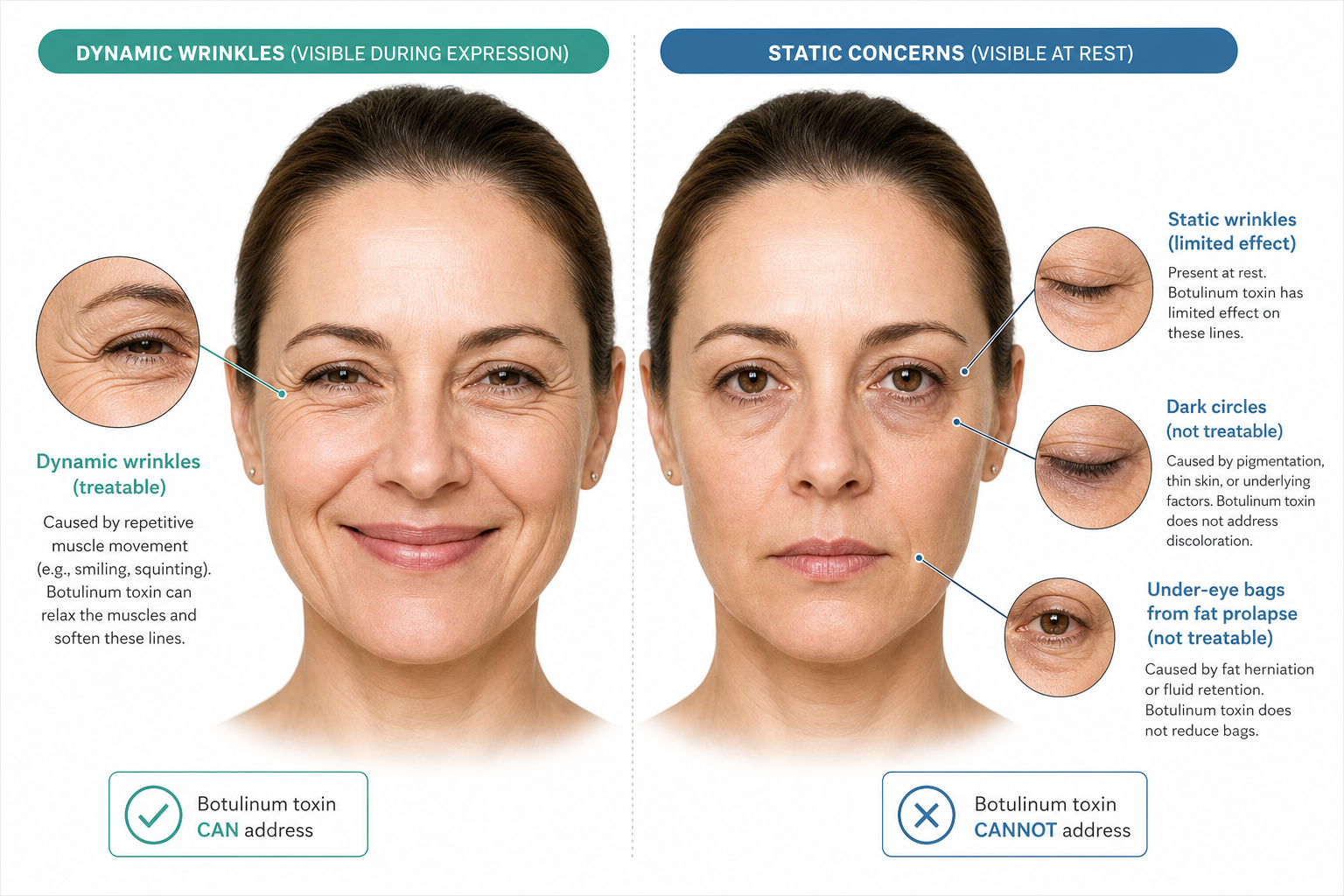
Baby Botox under the eyes is not an appropriate treatment for several common under-eye concerns. Volume loss and hollowness beneath the eye — often described as tear trough deformity — are caused by fat redistribution and structural changes, not muscle movement, and are better addressed with dermal fillers or tear trough filler if a patient is suitable. Dark circles caused by pigmentation or visible blood vessels beneath thin skin will not respond to botulinum toxin. Under-eye bags resulting from fat prolapse (where the orbital fat pad pushes forward) may actually appear worse if the lower eyelid muscle is over-relaxed, because the muscle normally provides some structural support to the lower lid.
Static wrinkles — lines that are visible at rest and do not disappear when the face is relaxed — are also unlikely to resolve fully with botulinum toxin alone, though reducing ongoing muscle movement may prevent them from deepening further. Skin texture concerns, crepiness, and pigmentation are better addressed with treatments such as RF microneedling, PRF (platelet-rich fibrin), laser resurfacing, or a targeted skincare regimen including retinoids and SPF.
Who May Be a Suitable Candidate
Baby Botox under eyes may be worth discussing with a qualified practitioner if you have dynamic crow’s feet or lower eyelid fine lines that are noticeable during expression, you are in good general health, and you have realistic expectations about the degree of improvement and the need for ongoing maintenance. Many practitioners consider the mid-twenties to early thirties an appropriate window to begin a preventative approach, particularly for individuals with fair or thin skin, a history of significant sun exposure, or strong squinting habits — all factors that can accelerate the formation of lateral canthal lines.
Skin type, lifestyle, and genetics all influence how quickly dynamic wrinkles progress to static ones. Someone who spends significant time outdoors without adequate sun protection, or who has naturally thinner periorbital skin, may develop crow’s feet earlier and may benefit from earlier conservative treatment. Conversely, someone with thicker skin and minimal expression lines in their twenties may have no meaningful indication for treatment at that stage.
Candidacy should always be assessed in person by a qualified practitioner who can evaluate your anatomy, skin quality, muscle activity, and overall facial structure before recommending any treatment.
Who Should Avoid Baby Botox Around the Eyes
Several factors may make botulinum toxin treatment around the eye area unsuitable or inadvisable. Pre-existing dry eye is a particularly important contraindication in the context of eye-area injections. In October 2024, the FDA updated the labelling for botulinum toxin products to formally include dry eye as a recognised side effect. For patients who already have compromised tear film or reduced blink reflex, even small doses near the orbicularis oculi can worsen symptoms and potentially affect corneal health. Anyone with a history of dry eye, Sjögren’s syndrome, or other conditions affecting tear production should discuss this risk carefully with both their injector and their eye care provider before proceeding.
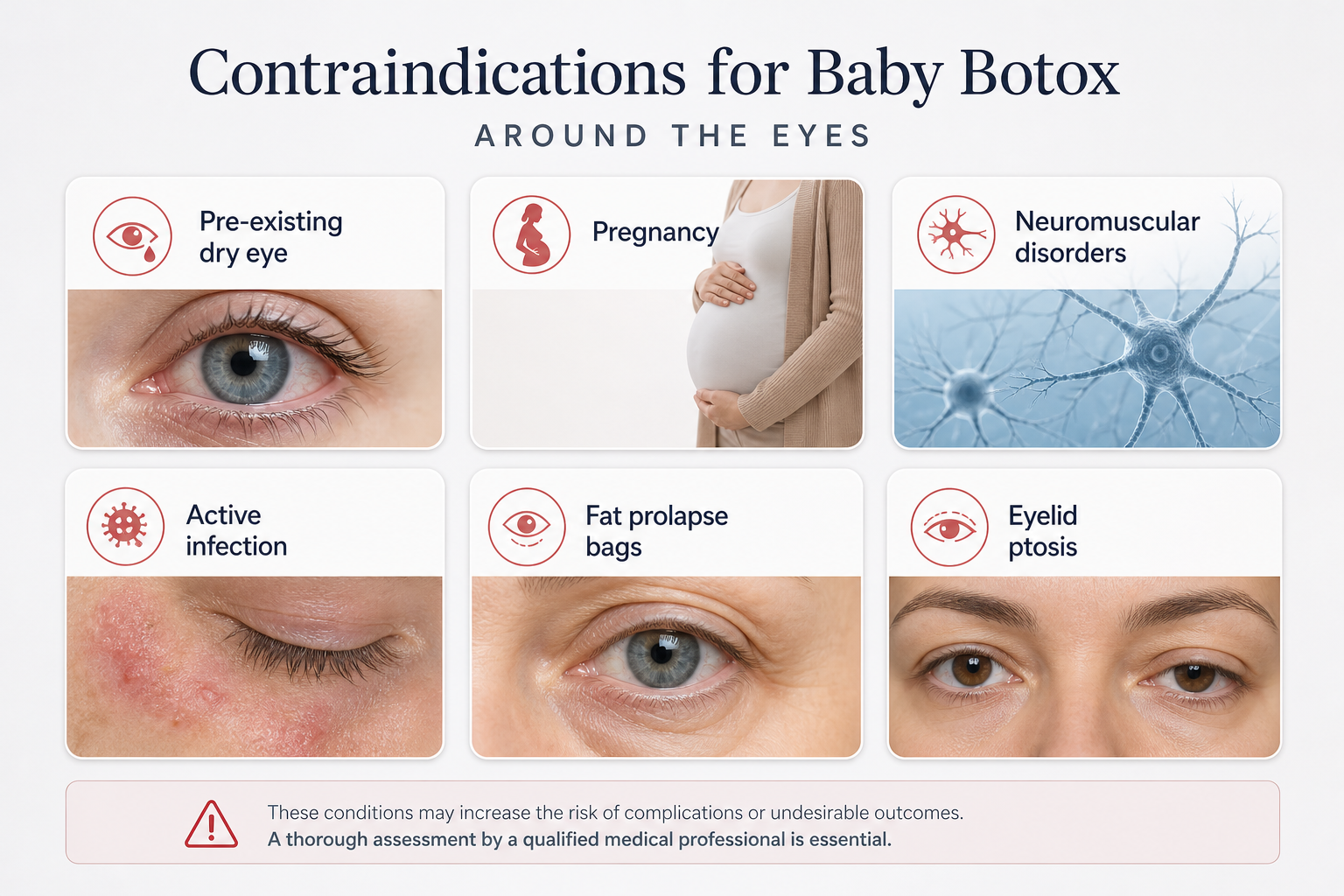
Other contraindications and caution factors include pregnancy and breastfeeding, known allergy to botulinum toxin or any product component, active infection or skin disease in the treatment area, neuromuscular disorders such as myasthenia gravis or Lambert-Eaton syndrome, and certain medications that may interact with neuromuscular blockade. Patients with significant under-eye bags from fat prolapse, or with pre-existing eyelid ptosis (drooping), are generally not suitable candidates for lower eyelid botulinum toxin treatment.
Risks and Side Effects Specific to the Eye Area
The eye area carries a higher risk profile for botulinum toxin treatment than many other facial zones, and this is especially true for lower eyelid and under-eye injections. The most commonly reported side effects include bruising, temporary swelling, and mild asymmetry, which typically resolve within one to two weeks. These are generally manageable and expected with any injectable treatment in this region.
More significant risks include eyelid ptosis — drooping of the upper eyelid caused by unintended spread of the toxin to the levator palpebrae superioris muscle, which is responsible for lifting the upper lid. This is uncommon when treatment is performed by an experienced injector using appropriate technique and conservative dosing, but it can occur and may last several weeks. Toxin migration or spread beyond the intended injection site is more likely with higher doses, aggressive massage of the area post-treatment, or injections placed too close to the orbital rim.
Dry eye is a recognised risk, now formally acknowledged in the updated FDA labelling. Incomplete lid closure (lagophthalmos) is a rarer but more serious complication that can occur if the orbicularis oculi is over-relaxed, preventing the eyelid from fully closing during sleep and potentially causing corneal exposure. Worsening of under-eye bags is possible if the lower lid loses muscular support. A pinched or uneven appearance can result from asymmetric relaxation of the lower eyelid muscle. These risks underscore why the eye area demands a conservative, technically precise approach and an injector with specific experience in periorbital anatomy.
What to Expect: The Treatment Experience
A baby Botox session for the eye area is typically brief, often completed within 15 to 20 minutes. Most clinics apply a topical numbing cream to the treatment area beforehand to minimise discomfort, though many patients find the injections tolerable without it given the fine needles used. A 30-gauge or finer needle is standard for periorbital injections, and the practitioner will use precise placement to deliver micro-dose botulinum toxin at carefully selected points around the lateral canthal region and, where appropriate, along the lower eyelid.
After treatment, mild redness, small bumps at injection sites, and minor swelling are normal and usually resolve within a few hours to a day. Bruising is possible and may take up to two weeks to fully resolve. Most practitioners advise avoiding rubbing or massaging the treated area, strenuous exercise, and lying flat for several hours post-treatment to reduce the risk of toxin migration.
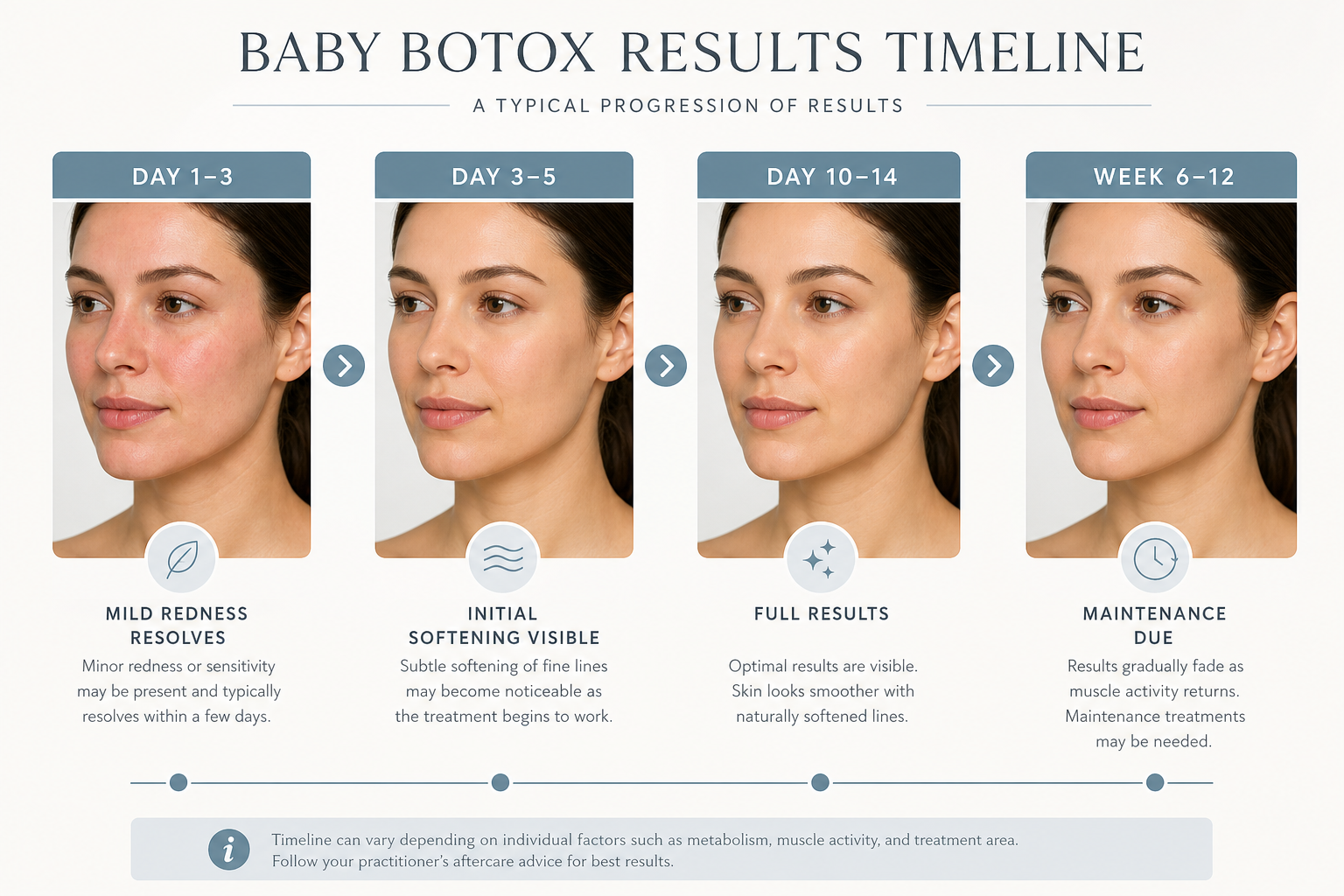
Results timeline with baby Botox follows a predictable pattern. Initial softening of dynamic wrinkles may become noticeable within three to five days as the neurotoxin begins to take effect. Full results are generally visible at 10 to 14 days. Because micro-dose botulinum toxin involves lower units, the duration of effect is shorter than standard dosing — typically 6 to 12 weeks rather than the 3 to 4 months associated with conventional treatment. This means maintenance treatment every 6 to 12 weeks is required to sustain results, compared to a maintenance treatment every 3 months or so with standard dosing.
The Long-Term Cost Reality
Baby Botox is often perceived as a more affordable option because the per-session cost is lower, reflecting the smaller number of units used. A session targeting crow’s feet and under-eye fine lines with a micro-dose approach might cost between £150 and £400 in the UK, or roughly $200 to $600 in the US, depending on the clinic, practitioner, and geographic location. Individual units of botulinum toxin typically range from $10 to $25 per unit.
However, the shorter duration of micro-dose results means more frequent appointments. A patient maintaining baby Botox results on a 6 to 8 week cycle could require six to eight sessions per year, compared to three to four sessions annually with standard dosing. Over a full year, the cumulative cost of baby Botox may equal or exceed that of standard treatment, despite the lower per-session price. Anyone considering this approach should factor annual maintenance cost into their decision, not just the headline session price.
Combining Baby Botox with Other Treatments
Baby Botox under eyes is often most effective as part of a broader approach to periorbital rejuvenation rather than as a standalone solution. For patients with both dynamic wrinkles and volume loss beneath the eye, combining conservative botulinum toxin for muscle relaxation in the eye area with tear trough filler to restore lost volume can address two distinct concerns that neither treatment resolves alone. These combinations require careful planning and should only be performed by practitioners experienced in both modalities, as the lower eyelid is an anatomically complex area where multiple treatments can interact.
For patients with skin texture concerns, crepiness, or early static wrinkles that do not respond fully to neuromodulator treatment, RF microneedling or PRF injections may complement botulinum toxin by improving skin quality and stimulating collagen production. Laser resurfacing and chemical peels can address pigmentation and surface texture around the eye area. A well-structured skincare routine — particularly consistent use of a broad-spectrum SPF and a retinoid — remains one of the most evidence-supported long-term strategies for slowing periorbital ageing and should underpin any in-clinic treatment plan.
What Happens If You Stop Treatment
A common concern is whether stopping baby Botox causes wrinkles to return worse than before. The evidence does not support this. When botulinum toxin wears off, the orbicularis oculi gradually regains its normal function and dynamic wrinkles return to approximately the level they would have been without treatment. There is no rebound effect that accelerates ageing beyond the natural baseline. However, if treatment is discontinued after several years, any static wrinkles that were prevented or delayed from forming may eventually develop as normal ageing continues — the benefit simply stops accruing rather than reversing dramatically.
Choosing the Right Practitioner for Eye-Area Injections
Provider selection is arguably the most important decision in this process. The periorbital area is one of the highest-risk zones for botulinum toxin injection due to its proximity to structures governing vision, eyelid function, and tear production. A practitioner treating this area should have formal training in facial anatomy, demonstrable experience with periorbital injections specifically, and the clinical judgement to recognise when a patient is not a suitable candidate.
Relevant qualifications vary by country, but in general, look for practitioners with medical, dental, or nursing backgrounds who have completed accredited aesthetic medicine training. Oculoplastic surgeons, consultant dermatologists, and plastic surgeons with specific aesthetic training have the deepest anatomical knowledge of the eye region. At a minimum, ask about the practitioner’s specific experience with under-eye and crow’s feet injections, how they manage complications, and whether they have access to hyaluronidase (for filler reversal) and appropriate emergency protocols. A reputable clinic will welcome these questions rather than deflect them.
Frequently Asked Questions
Is baby Botox under the eyes safe?
When performed by a qualified and experienced injector using conservative dosing and appropriate technique, baby Botox around the eye area carries a manageable risk profile for most suitable candidates. However, the eye area is anatomically complex and carries specific risks including dry eye, eyelid ptosis, and effects on tear film that are not present with injections in other facial zones. The October 2024 FDA label update formally recognising dry eye as a botulinum toxin side effect is an important reminder that this risk should be discussed before treatment, particularly for anyone with pre-existing eye conditions.
How many units of Botox are used under the eyes?
The number of units of Botox under eyes varies depending on the specific area being treated, the individual’s muscle strength, and the practitioner’s technique. For crow’s feet, a baby Botox approach might use 4 to 8 units per side rather than the 10 to 15 units used in a standard treatment. For lower eyelid fine lines or jelly roll treatment, doses are typically very small — often 1 to 3 units per side — because the lower lid is sensitive and over-relaxation carries meaningful risks. Exact dosing should be determined by your practitioner based on your individual anatomy.
At what age should you start preventative Botox for the eye area?
There is no universally correct age. Most practitioners consider the mid-twenties to early thirties a reasonable window to begin discussing preventative Botox if dynamic crow’s feet are already visible during expression. Starting earlier than this is rarely indicated unless there is a specific clinical reason. The decision should be based on the presence of dynamic wrinkles, individual skin characteristics, and a realistic assessment of goals — not age alone.
Will baby Botox help with dark circles or under-eye bags?
No. Baby Botox addresses dynamic wrinkles caused by muscle movement. Dark circles caused by pigmentation or vascular visibility, and under-eye bags caused by fat prolapse, are entirely different concerns that require different treatments. Attempting to treat fat-related under-eye bags with botulinum toxin may actually worsen their appearance by reducing the muscular support of the lower lid.
How long do baby Botox results last under the eyes?
Results from micro-dose botulinum toxin typically last 6 to 12 weeks in the eye area, which is shorter than the 3 to 4 months associated with standard dosing. This shorter duration is a trade-off for the more natural movement and subtler effect that conservative dosing provides. Regular maintenance appointments are necessary to sustain results.
Can baby Botox cause a frozen appearance?
A frozen appearance results from over-relaxation of facial muscles, typically from too many units rather than from the toxin itself. Baby Botox, by definition, uses lower doses and aims to preserve natural movement. When performed correctly with conservative dosing and precise placement, the risk of a frozen appearance is lower than with standard dosing. However, even micro-doses can cause over-relaxation if placed incorrectly or if the patient has particularly sensitive muscle response, which is why practitioner skill and conservative technique matter.
Is Baby Botox Under the Eyes Right for You?
Baby Botox under eyes can be a genuinely useful option for the right candidate — someone with early dynamic crow’s feet or lower eyelid fine lines, realistic expectations, and no contraindications such as pre-existing dry eye or lower lid laxity. The treatment offers a way to soften expression lines while maintaining natural facial movement, and when started before wrinkles become static, it may contribute to a slower rate of visible ageing in the periorbital area. The evidence for long-term preventative outcomes is still developing, but the short-term benefit for dynamic wrinkles is well established.
The limitations are equally important to understand. Baby Botox does not address volume loss, dark circles, or structural under-eye concerns. It requires more frequent maintenance than standard dosing, which affects the annual cost. The eye area carries specific risks — including the newly FDA-labelled dry eye side effect — that make practitioner selection and a thorough pre-treatment assessment non-negotiable. Anyone with a history of eye conditions should discuss the treatment with their eye care provider as well as their aesthetic practitioner before proceeding.
If you are considering this treatment, a consultation with a qualified, experienced injector who can assess your specific anatomy, discuss realistic outcomes, and explain the risks in the context of your individual health history is the essential first step. The decision about whether baby Botox is appropriate for your eye area should always be made on an individual basis, not on the basis of a trend or a marketing term.