Cannula Lip Filler: The Blunt Cannula Technique Explained
The blunt cannula technique has become an increasingly common approach to lip augmentation, offering a different risk and comfort profile compared to traditional sharp needles.
Key Takeaways
- A blunt-tipped cannula is a flexible tube with a rounded end that is inserted through a small pilot hole to deliver dermal filler beneath the lip tissue, reducing the likelihood of piercing blood vessels compared to a sharp needle.
- Research published in JAMA Dermatology found that cannula use was associated with 77.1% lower odds of vascular occlusion compared to needle injection, though the risk is not eliminated entirely.
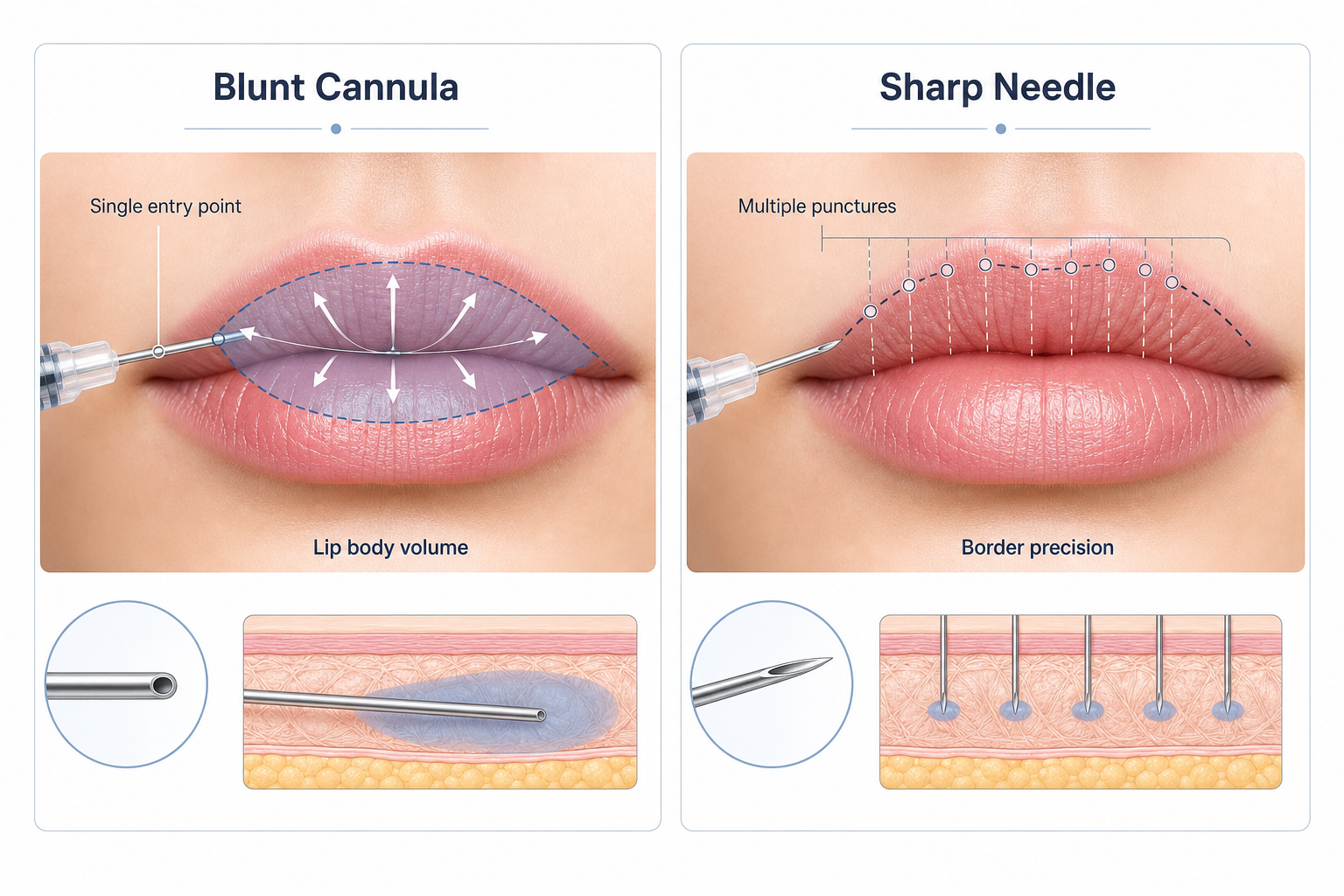
- The cannula technique typically results in less bruising (ecchymosis) and swelling than needle-based injection, but it is less precise for fine border definition work such as shaping the Cupid’s bow or vermilion border.
- Many experienced practitioners use a hybrid approach — cannula for body volume and a needle for detailed border work — to balance safety and aesthetic precision.
- Results from hyaluronic acid lip filler typically last 9–12 months, and the technique used does not significantly alter longevity.
What Is a Blunt Cannula and How Does It Differ from a Needle?
A cannula is a thin, flexible tube used to deliver dermal filler beneath the skin. Unlike a sharp injection needle, a blunt-tipped cannula has a rounded, closed tip with a side-opening port through which the filler is expressed. This design means the cannula pushes tissue aside rather than cutting through it, which is the fundamental reason it carries a different safety profile for lip augmentation.
To insert a cannula, the practitioner first creates a small entry point — called a pilot hole or introducer needle puncture — using a sharp needle of the same or slightly smaller gauge. The cannula is then threaded through this opening and advanced beneath the lip tissue to the target area. Because the cannula is flexible, it can travel a meaningful distance from a single entry point, allowing filler to be deposited across a wider area without multiple punctures.
Cannulas used for lip filler are typically described by their gauge (diameter) and length. For lip augmentation, a 25G or 27G cannula at approximately 38mm in length is commonly selected, though gauge choice depends on the filler’s viscosity and the practitioner’s technique. Thicker fillers with higher resistance require a wider-bore cannula to allow adequate flow without excessive extrusion force. Filler rheology — the physical properties of how a filler flows and behaves under pressure — directly influences which cannula gauge is appropriate for a given product.
How the Blunt Cannula Lip Filler Technique Works
The blunt cannula technique for lip filler follows a structured sequence that differs meaningfully from needle injection. Understanding each stage helps set realistic expectations about the appointment experience.
Preparation and Anaesthesia
Before treatment begins, a topical anesthetic or numbing cream is applied to the lip area and left for a defined period — typically 20 to 30 minutes — to reduce discomfort. Most hyaluronic acid fillers used for lip augmentation also contain lidocaine within the formulation, which provides additional comfort once injection begins. The practitioner will assess the lip anatomy, discuss the desired outcome, and agree on filler volume before proceeding.
Creating the Entry Point
A sharp introducer needle is used to create one or two small pilot holes, usually positioned at the oral commissure (the corner of the mouth) or along the vermilion border. The number and location of entry points vary by practitioner preference and the areas being treated. One of the practical advantages of the cannula approach is that a single entry point can often serve an entire lip segment, reducing the total number of punctures compared to multi-point needle injection.
Blunt Dissection and Cannula Advancement
Once the pilot hole is created, the blunt-tipped cannula is inserted and advanced through the submucosal plane — the layer of tissue just beneath the inner lining of the lip. Some practitioners perform a brief blunt dissection step before depositing filler, using the cannula itself to gently separate any fibrotic tissue within the lip. This pre-injection dissection, documented in peer-reviewed literature, may improve filler distribution, enhance volume, and further reduce vascular risk by creating a defined channel before the product is expressed.
Retrograde Injection
Filler is deposited using a retrograde linear threading technique: the cannula is advanced to the target depth and position, and the filler is expressed slowly as the cannula is withdrawn. This retrograde approach — injecting during retraction rather than advancement — is considered safer because it reduces the chance of depositing filler under pressure into a vessel. The fanning technique may also be used, where the cannula is redirected from the same entry point to cover a broader area, allowing volume to be distributed across the lip body without additional punctures.
Moulding and Assessment
After filler is placed, the practitioner gently moulds the lip to distribute the product evenly and assess symmetry. The upper-to-lower lip ratio is a key aesthetic reference point: a commonly cited guideline suggests the lower lip should be approximately twice the volume of the upper lip for a natural-looking result, though individual anatomy and patient preference guide the final approach. Typical volumes used are approximately 0.4mL for the upper lip and 0.6mL for the lower lip, though these figures vary based on the starting anatomy and the degree of enhancement requested.
Cannula vs. Needle for Lip Filler: A Practical Comparison
Both cannulas and sharp needles are legitimate tools for lip augmentation, and each has genuine strengths and limitations. The choice between them — or the decision to use both — depends on the treatment goals, the anatomy of the individual patient, and the practitioner’s training and experience.
| Characteristic | Blunt Cannula | Sharp Needle |
|---|---|---|
| Tip design | Rounded, blunt tip with side port | Sharp bevelled tip |
| Entry points required | Typically 1–2 per lip segment | Multiple (often 4–8 or more) |
| Vascular occlusion risk | Lower (but not eliminated) | Higher relative risk |
| Bruising and swelling | Generally less ecchymosis and swelling | More common bruising and swelling |
| Precision for border work | Limited — less suited to fine detail | High — preferred for vermilion border, Cupid’s bow |
| Pain during treatment | Often reported as more comfortable | More discomfort at multiple puncture sites |
| Downtime | Typically shorter | Typically slightly longer |
| Best suited for | Lip body volume, overall augmentation | Border definition, philtral columns, precise shaping |
| Practitioner learning curve | Steeper — requires anatomical knowledge and technique | More widely taught in foundational training |
A key point that is often underrepresented in patient-facing information is that needles remain the preferred tool for precise vermilion border definition, Cupid’s bow shaping, and philtral column work. The cannula’s flexibility, which makes it safer for traversing the lip body, also makes it less controllable for fine structural detail. For this reason, many experienced injectors use a hybrid approach: cannula for the bulk of the lip volume and a needle for detailed border refinement.
Safety Profile: What the Evidence Actually Shows
The lips are considered one of the highest-risk areas for dermal filler injection. The labial artery — a branch of the facial artery — runs through the lip tissue at a depth of approximately 3.3 to 3.9mm beneath the vermilion border. Inadvertent injection into this vessel can cause vascular occlusion, a serious complication that can lead to tissue ischaemia and, in severe cases, skin necrosis if not treated promptly.
A study published in JAMA Dermatology found that cannula use was associated with 77.1% lower odds of vascular occlusion compared to needle injection. This is a clinically meaningful difference, and it reflects the blunt tip’s reduced ability to penetrate vessel walls. However, this reduction in risk does not mean the cannula technique is without vascular risk. Cannulas can still enter vessels, particularly if advanced with excessive force or if the anatomy is unusual. Staying in the superficial submucosal plane — the 1 to 2mm layer closest to the mucosal surface — is critical for keeping the cannula tip away from the deeper-running labial artery.
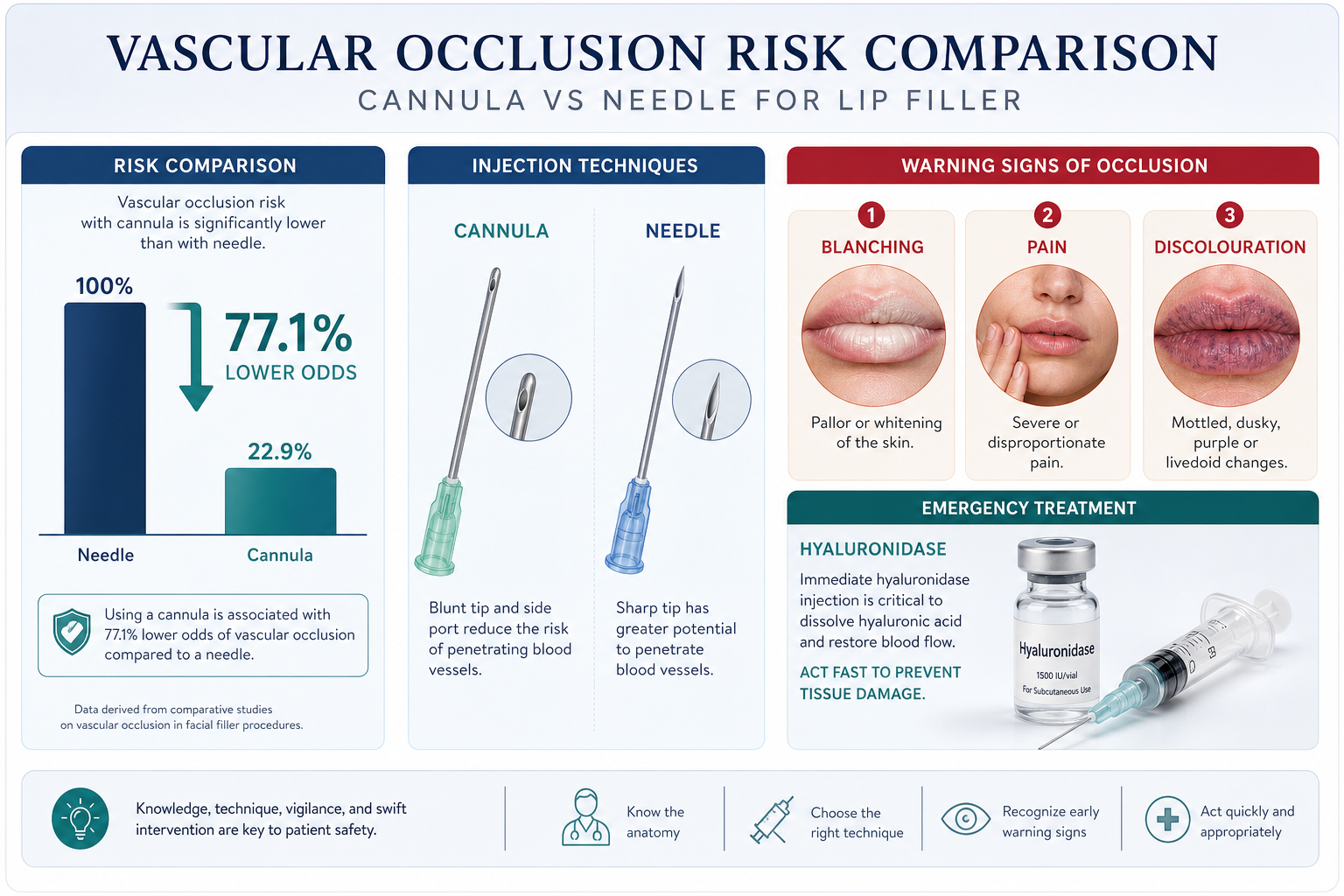
Warning signs of vascular occlusion include immediate blanching of the skin or lip tissue, escalating pain that seems disproportionate to the procedure, and a dusky or mottled discolouration developing in the treated area. These signs require immediate intervention. The standard emergency response involves prompt injection of hyaluronidase — an enzyme that dissolves hyaluronic acid filler — to restore blood flow. The urgency of this response is significant: delayed treatment increases the risk of permanent tissue damage. Any practitioner performing lip filler should have hyaluronidase immediately available and be trained in its use.
Beyond vascular risk, the cannula technique is associated with a lower incidence of ecchymosis (bruising) and haematoma formation compared to needle injection, largely because fewer vessel walls are disrupted during the procedure. Swelling is also typically less pronounced, which can shorten the visible recovery period.
Benefits of the Cannula Technique for Lip Augmentation
- Reduced vascular occlusion risk: The blunt tip is less likely to penetrate blood vessel walls, lowering the risk of the most serious filler complication in the lip area.
- Less bruising and swelling: Fewer punctures and less tissue trauma typically result in less ecchymosis and post-treatment swelling.
- Fewer entry points: A single entry point can often serve an entire lip segment, reducing discomfort and recovery time.
- More comfortable treatment experience: Patients frequently report the cannula technique as less painful than multi-point needle injection, particularly once the numbing cream and lidocaine-containing filler take effect.
- Smoother filler distribution: Retrograde linear threading through the submucosal plane can produce an even distribution of product across the lip body.
- Reversibility: Hyaluronic acid fillers placed with a cannula can be dissolved with hyaluronidase if the result is unsatisfactory or a complication occurs, just as with needle-placed filler.
Limitations and Honest Considerations
- Reduced precision for fine detail: The cannula is not well suited to precise work along the vermilion border, Cupid’s bow, or philtral columns. Patients seeking highly defined lip borders may require a needle for that element of the treatment.
- Vascular risk is reduced, not eliminated: The cannula technique does not make lip filler risk-free. Vascular occlusion remains possible, and the practitioner must still have full anatomical knowledge and emergency protocols in place.
- Steeper learning curve: Effective cannula technique requires a thorough understanding of lip anatomy, injection planes, and filler behaviour. In less experienced hands, the technique may not deliver its theoretical safety advantages.
- Not universally appropriate: Patients with significant lip asymmetry, very thin lips, or specific structural goals may be better served by a needle-based or hybrid approach.
- Cannula quality varies: Differences in cannula design — including exit port size, inner wall smoothness, and silicone coating — affect how smoothly filler flows and how much tissue trauma occurs during advancement. Not all cannulas perform equally, and practitioner choice of equipment matters.
What to Expect: Recovery and Results
Immediately after cannula lip filler treatment, some swelling and mild tenderness at the entry point sites is normal. Because the blunt cannula technique involves less tissue trauma than multi-point needle injection, swelling tends to be less pronounced and resolves more quickly — often within 3 to 5 days for the majority of visible swelling, though some residual puffiness may persist for up to two weeks. Bruising, when it occurs, is typically minor and concentrated around the entry point rather than distributed across the lip.
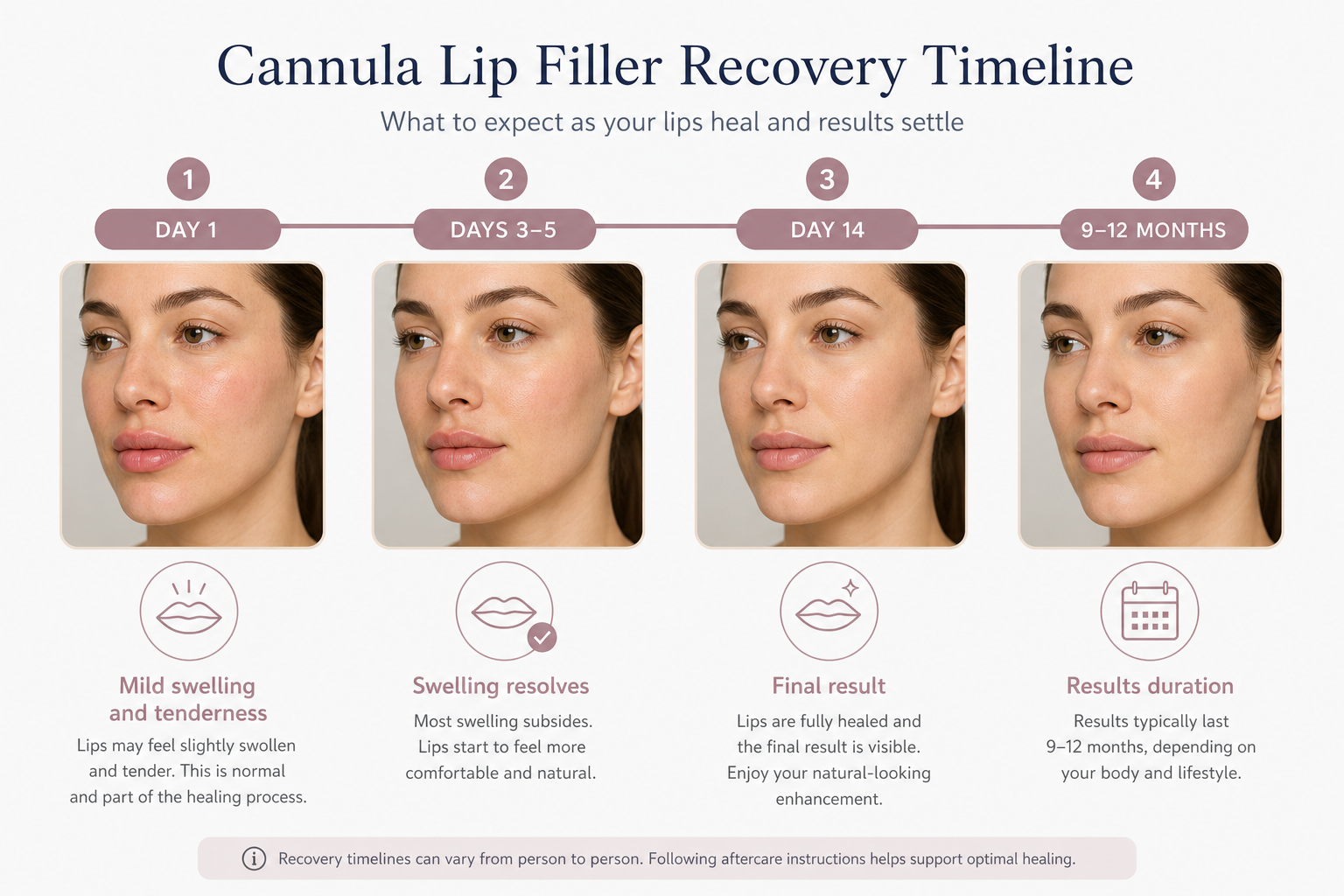
The final result becomes clearer once swelling has fully resolved. Patients are generally advised to avoid strenuous exercise, alcohol, and significant heat exposure (such as saunas or hot baths) for 24 to 48 hours after treatment to minimise swelling and reduce the risk of filler migration in the early post-treatment period.
Hyaluronic acid lip filler results typically last between 9 and 12 months, though this varies depending on the specific filler product used, the injection plane, individual metabolism, lifestyle factors such as sun exposure and smoking, and the volume placed. Lips are a high-movement area, which means filler tends to break down somewhat faster here than in lower-movement zones. Maintenance sessions are usually recommended once results have noticeably diminished rather than on a fixed schedule.
Who May Be Suitable — and Who May Not
Cannula lip filler may be worth discussing with a practitioner if you are in good general health, have realistic expectations about the degree of enhancement achievable, and are seeking natural-looking lip enhancement with a focus on minimising downtime and bruising. It may be particularly relevant if you have a history of significant bruising with previous needle-based treatments.
Cannula lip filler is generally not appropriate — or requires careful clinical assessment — in the following situations:
- Active infection, cold sore (herpes labialis), or inflammation in or around the lip area — treatment should be postponed until fully resolved, and antiviral prophylaxis may be recommended for those with a history of cold sores
- Use of blood-thinning medications such as warfarin, aspirin (unless medically essential), or certain supplements including high-dose fish oil and vitamin E, which increase bruising risk
- Pregnancy or breastfeeding — dermal filler is not recommended during these periods
- Known allergy to hyaluronic acid filler components or lidocaine
- Autoimmune conditions or active inflammatory skin disease affecting the treatment area
- Unrealistic expectations — the cannula technique cannot replicate surgical lip augmentation results, and very large volume increases carry greater risk regardless of technique
- Previous permanent filler in the lips — this significantly complicates safe cannula placement and requires specialist assessment
Questions to Ask Your Practitioner
Before proceeding with cannula lip filler, it is reasonable to ask your practitioner the following:
- What is your training and experience specifically with the cannula technique for lips?
- Do you carry hyaluronidase on-site, and are you trained to manage vascular occlusion?
- Which filler product will you use, and why is it appropriate for my lip anatomy?
- Will you use a cannula only, or a hybrid approach with a needle for border work?
- What volume do you recommend, and what is the rationale?
- What are the realistic risks for someone with my anatomy and medical history?
- What does the aftercare involve, and when should I contact you if I have concerns?
Frequently Asked Questions
Is cannula lip filler safer than needle lip filler?
Evidence suggests the blunt cannula technique is associated with a meaningfully lower risk of vascular occlusion compared to sharp needle injection — one study found 77.1% lower odds. However, the cannula technique does not eliminate vascular risk, and safety depends heavily on the practitioner’s anatomical knowledge, technique, and emergency preparedness. Neither approach is risk-free.
Does cannula lip filler hurt less?
Most patients report that cannula lip filler is more comfortable than multi-point needle injection, partly because fewer entry points are required and partly because the blunt tip causes less tissue disruption. Topical numbing cream and lidocaine-containing filler further reduce discomfort. Individual pain tolerance varies, and some sensitivity at the pilot hole entry points is normal.
How long does cannula lip filler last?
Hyaluronic acid lip filler placed with a cannula typically lasts between 9 and 12 months. The technique used does not significantly alter longevity — duration is more influenced by the filler product, the volume placed, individual metabolism, and lifestyle factors. The lips are a high-movement area, so filler tends to break down faster here than in less mobile zones.
Can cannula lip filler be dissolved?
Yes. Hyaluronic acid fillers — whether placed by cannula or needle — can be dissolved using hyaluronidase. This enzyme breaks down the crosslinked HA, allowing the filler to be partially or fully removed. Hyaluronidase is also the emergency treatment for vascular occlusion caused by HA filler, which is why it must be available at any clinic performing lip filler.
What size cannula is used for lip filler?
For lip augmentation, a 25G or 27G cannula at approximately 38mm in length is commonly used. The appropriate gauge depends on the viscosity of the filler being used — thicker fillers require a wider bore to flow adequately. Some practitioners prefer a 22G cannula for certain applications. Gauge selection is a clinical decision based on filler rheology and the specific areas being treated.
Will I bruise after cannula lip filler?
Bruising (ecchymosis) is possible but is generally less common and less extensive with the cannula technique compared to needle injection, because fewer vessel walls are disrupted. When bruising does occur, it tends to be localised around the entry point. Avoiding blood-thinning medications and supplements before treatment (where medically safe to do so) can help reduce bruising risk.
Can a cannula be used for the entire lip, including the border?
A cannula can treat the lip body effectively, but it is less precise for fine border definition work such as shaping the vermilion border or Cupid’s bow. Many practitioners use a hybrid approach — cannula for overall volume and a needle for detailed border refinement — to achieve both safety and aesthetic precision.
Is the Cannula Technique the Right Choice for Your Lip Filler?
The blunt cannula technique offers a genuinely different risk and comfort profile for lip augmentation, with meaningful evidence supporting its lower association with vascular occlusion compared to sharp needle injection. For patients prioritising reduced bruising, fewer punctures, and a more comfortable treatment experience, it is a reasonable option to discuss with a qualified practitioner.
At the same time, the cannula technique is not universally superior. It requires a practitioner with specific training and anatomical expertise to deliver its safety advantages reliably. It is less suited to precise border shaping, and it does not eliminate the risks inherent to lip filler in a high-vascularity area. The most clinically appropriate approach — cannula alone, needle alone, or a hybrid — depends on your individual anatomy, aesthetic goals, and the practitioner’s assessment.
If you are considering cannula lip filler, a thorough consultation with an experienced, medically qualified injector is the essential first step. Ask about their specific training in cannula technique, their emergency protocols, and their honest assessment of which approach best suits your lip anatomy and the result you are hoping to achieve.