Tattoo Removal on Dark Skin: Safe Lasers, Risks & What to Expect
Tattoo removal on dark skin is safe and achievable — but it requires the right laser technology, conservative treatment settings, and a provider with genuine experience treating melanin-rich skin. For decades, people with Fitzpatrick skin types IV through VI were told that laser removal was too risky or simply not possible for them. That is no longer accurate. Advances in laser technology, particularly the 1064nm Nd:YAG and picosecond platforms, have made effective tattoo removal accessible to a much wider range of skin tones. This guide explains which lasers are appropriate, why certain wavelengths carry higher risk, what side effects are realistic, and how to approach treatment safely.
Key Takeaways
- The 1064nm Nd:YAG laser — especially in its Q-switched and picosecond forms — is the most widely recommended option for darker skin tones because its longer wavelength is less absorbed by epidermal melanin.
- Shorter-wavelength lasers such as the 532nm, 694nm ruby, and 755nm alexandrite carry a significantly higher risk of burns, hypopigmentation, and post-inflammatory hyperpigmentation (PIH) on Fitzpatrick types IV–VI.
- Risks including PIH, hypopigmentation, and keloid formation are real but manageable with conservative settings, proper session spacing, and experienced clinical oversight.
- Colored tattoos present additional challenges on dark skin because the wavelengths needed to target certain ink colors are not safe for melanin-rich skin.
- Choosing a medically supervised clinic with documented experience in skin of color is one of the most important decisions you will make before starting treatment.
Why Skin Tone Matters in Laser Tattoo Removal
Laser tattoo removal works through a principle called selective photothermolysis: a laser emits a specific wavelength of light that is preferentially absorbed by the tattoo ink (the target chromophore) while leaving surrounding tissue relatively unaffected. The ink particles absorb the energy, shatter into smaller fragments, and are gradually cleared by the body’s immune system via macrophages and the lymphatic system. This process is why multiple sessions are always required — the body needs time between appointments to flush fragmented ink particles away.
The complication for darker skin tones is that melanin — the pigment responsible for skin colour — is also a chromophore. When a laser wavelength is strongly absorbed by both the tattoo ink and the melanin in the surrounding skin, the energy intended for the ink is partially captured by the skin itself. This can cause thermal damage to melanocytes (the cells that produce melanin), leading to unwanted pigment changes. The higher the melanin concentration in the skin, the greater this competing absorption becomes. This is why laser selection and treatment settings are not one-size-fits-all.
Understanding the Fitzpatrick Scale
The Fitzpatrick Scale classifies skin into six types based on melanin content and how the skin responds to UV exposure. Types I and II describe very fair skin that burns easily; Types III and IV describe medium to olive skin tones; Types V and VI describe brown to deeply pigmented skin. In the context of tattoo removal, Fitzpatrick types IV through VI carry the highest risk of laser-induced pigment complications because their skin contains significantly more epidermal melanin.
A thorough Fitzpatrick assessment at your initial consultation is not a formality — it directly determines which laser wavelength is appropriate, what energy level (fluence) is safe to use, and how many sessions may be needed. If a clinic does not perform this assessment before treatment, that is a meaningful warning sign.
Which Lasers Are Safe for Darker Skin Tones?
The single most important variable in laser tattoo removal for darker skin is wavelength. Longer wavelengths penetrate deeper into the skin and are absorbed less by epidermal melanin, which means they can target dermal ink particles with less risk of damaging the surrounding pigmented skin. Shorter wavelengths are absorbed more aggressively by melanin and carry a substantially higher risk of burns and pigment disruption on darker skin tones.
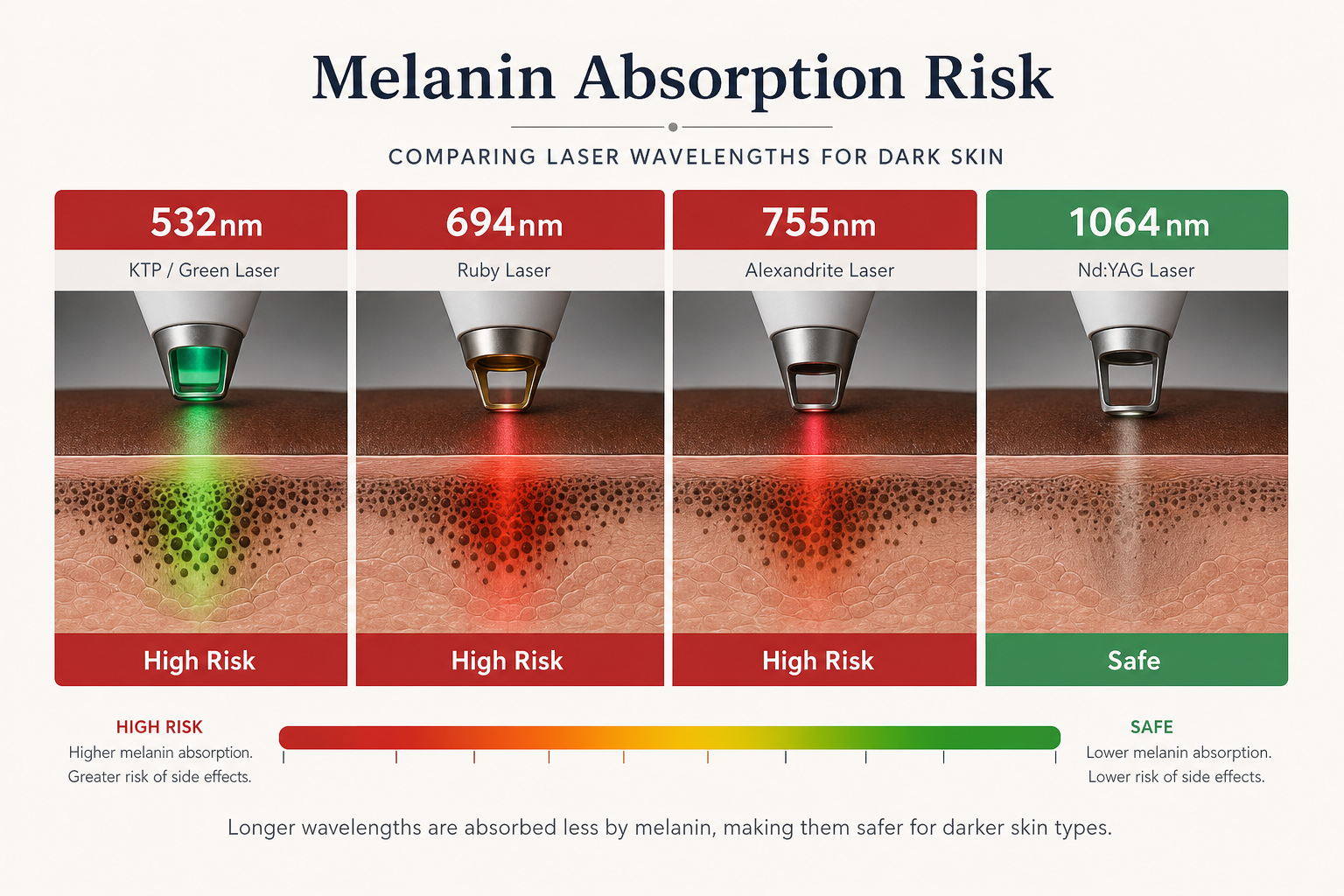
| Laser Type | Wavelength | Safe for Fitzpatrick IV–VI? | Best For |
|---|---|---|---|
| Nd:YAG (Q-switched or picosecond) | 1064nm | Yes — preferred choice | Black and dark blue ink |
| Picosecond Nd:YAG | 1064nm | Yes — with conservative settings | Black ink; some multi-colour with attachments |
| Alexandrite | 755nm | No — high PIH and burn risk | Not recommended for dark skin |
| Ruby | 694nm | No — high melanin absorption | Not recommended for dark skin |
| KTP / Nd:YAG frequency-doubled | 532nm | No — significant risk of pigment damage | Not recommended for dark skin |
The 1064nm Nd:YAG Laser
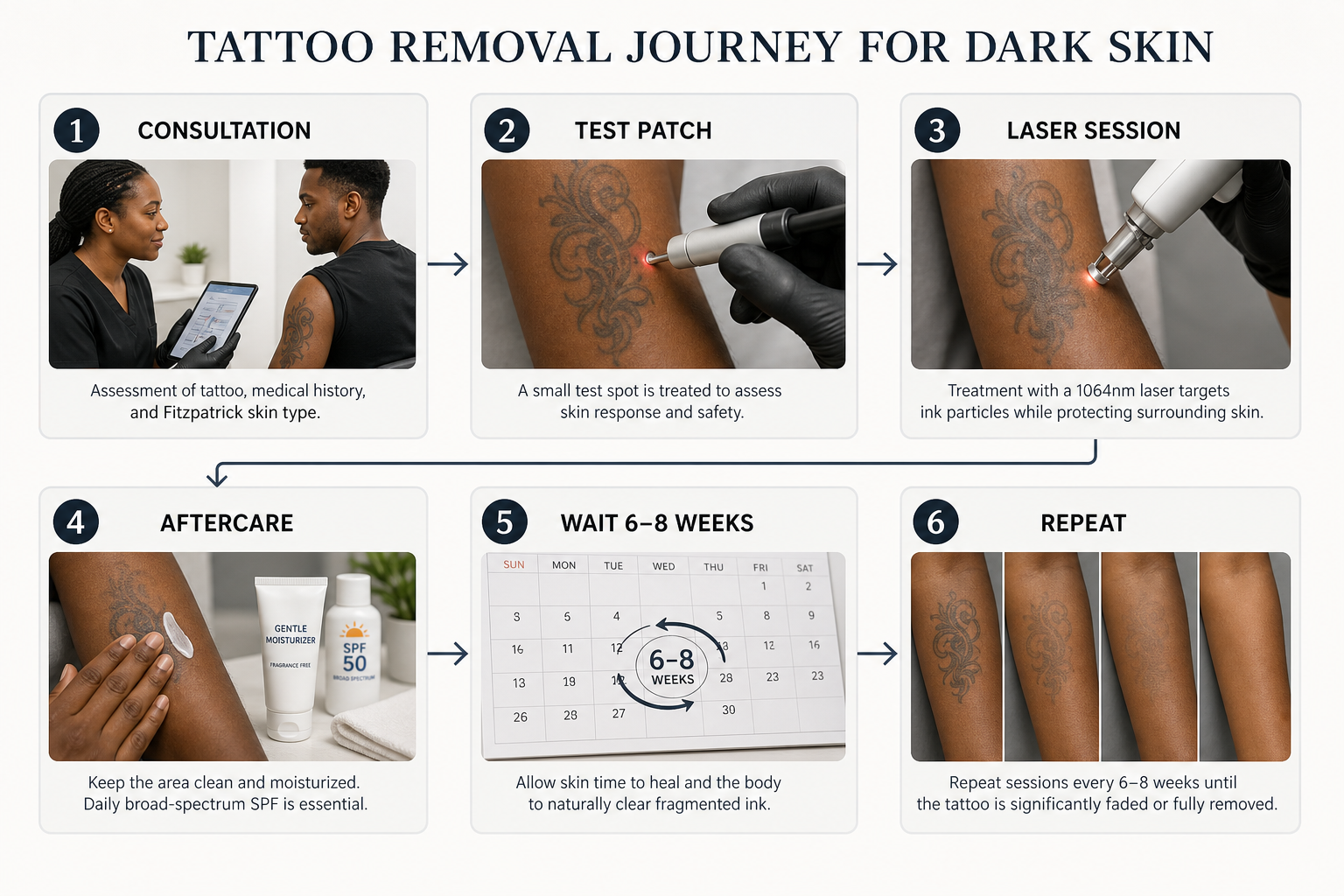
The 1064nm Nd:YAG laser is the clinical standard for tattoo removal on darker skin. At this longer wavelength, melanin absorption is relatively low compared to shorter wavelengths, which means the laser energy passes through the epidermis with less risk of damaging melanocytes. The energy is then absorbed by the darker ink particles in the dermis. Both Q-switched (nanosecond pulse duration) and picosecond versions of the 1064nm Nd:YAG are used, though they work through slightly different mechanisms.
Picosecond vs. Nanosecond Lasers: Why the Difference Matters
Q-switched lasers deliver energy in nanosecond pulses and have been the workhorse of tattoo removal for many years. They work primarily through a photothermal mechanism — the ink absorbs heat and shatters. Picosecond lasers (such as PicoWay and PicoSure) deliver energy in much shorter pulses, measured in trillionths of a second. This ultra-short pulse duration creates a predominantly photoacoustic effect: the ink is shattered by pressure waves rather than heat alone. Because less thermal energy is deposited into the surrounding tissue, picosecond lasers may produce less heat buildup in the skin — a meaningful advantage for melanin-rich skin where thermal damage is the primary driver of post-inflammatory hyperpigmentation and other side effects.
Clinical evidence, including peer-reviewed research on picosecond Nd:YAG use in Fitzpatrick type IV skin, suggests that picosecond platforms can achieve effective ink fragmentation with a potentially lower risk of PIH compared to nanosecond Q-switched devices, particularly when used at conservative fluences. However, the picosecond advantage is not absolute — operator experience, treatment settings, and appropriate session spacing remain equally important factors. Neither platform eliminates risk entirely on darker skin tones.
Risks and Side Effects on Darker Skin
Understanding the realistic risks of tattoo removal on darker skin allows you to make an informed decision and to recognise early warning signs during treatment. The risks below are real but are substantially reduced when treatment is performed by an experienced practitioner using appropriate technology and conservative settings.
Post-Inflammatory Hyperpigmentation (PIH)
Post-inflammatory hyperpigmentation is the most common side effect in skin of color following laser treatment. It occurs when the skin’s inflammatory response to laser energy triggers excess melanin production, leaving darker patches at the treatment site. PIH is usually temporary and fades over weeks to months, but it can be prolonged if the area is exposed to UV light during recovery or if treatment settings were too aggressive. Strict sun avoidance and broad-spectrum SPF 50+ sunscreen are essential throughout the entire course of treatment.
Hypopigmentation
Hypopigmentation — a lightening or loss of pigment at the treatment site — occurs when laser energy damages melanocytes. On darker skin, hypopigmented patches can be visually prominent and, in some cases, may be long-lasting or permanent. This risk is significantly higher with shorter-wavelength lasers and with excessive fluence. Using lower fluence and longer wavelengths, combined with adequate session spacing, reduces but does not eliminate this risk.
Keloid and Hypertrophic Scarring
People with Fitzpatrick types IV through VI have a statistically higher predisposition to keloid and hypertrophic scarring — raised, thickened scar tissue that can extend beyond the original wound boundary. A personal or family history of keloid formation is an important factor to discuss with your provider before beginning treatment, as it may represent a relative contraindication. A provider experienced in skin of color will ask about this history during the consultation and may recommend a test patch in a discreet area before proceeding.
Paradoxical Darkening
Paradoxical darkening is a less commonly discussed but clinically important risk, particularly relevant to tattoos containing iron oxide-based inks — often found in cosmetic tattoos such as permanent eyebrows or lip liner, but occasionally present in decorative tattoos as well. When laser energy interacts with certain iron oxide pigments, it can convert them to a darker, more stable compound rather than fragmenting them. The result is ink that appears darker immediately after treatment. This effect can sometimes be reversed with further laser sessions, but it is not always predictable. Disclosing the type of tattoo and any known ink composition to your provider is important.
Thermal Damage and Blistering
Excessive fluence or inappropriate wavelength selection can cause thermal damage to the epidermis, resulting in blistering, crusting, and potential scarring. On melanin-rich skin, the risk of thermal injury is higher because the epidermis itself absorbs more laser energy. Conservative settings and adequate cooling of the skin surface during treatment are standard precautions in experienced clinics.
Can All Tattoo Colors Be Removed from Dark Skin?
Black and very dark blue ink are the most straightforward to treat on darker skin tones because they absorb the 1064nm wavelength effectively. The challenge arises with colored tattoos. Different ink colors require different laser wavelengths to be absorbed efficiently — green ink, for example, responds best to wavelengths around 694nm or 755nm, and red ink responds to 532nm. These shorter wavelengths are precisely the ones that carry the highest risk of pigment damage on darker skin.
This means that multicolor tattoos on Fitzpatrick types V and VI may not be fully removable with currently available technology without accepting a meaningful risk of skin discoloration. Some providers use specialized handpieces or wavelength-switching capabilities on picosecond platforms to address a broader color range, but the safety profile for each wavelength on darker skin must still be assessed individually. A realistic consultation will address which colors in your specific tattoo can be safely targeted and which may need to be left partially treated or approached with extreme caution.
How Many Sessions Will You Need?
Tattoo removal always requires multiple sessions, and darker skin tones typically require more sessions than lighter skin tones for the same tattoo. This is because conservative lower fluence settings are used to protect the skin, which means less ink is fragmented per session. Session spacing of at least 6–8 weeks between appointments is standard, and many providers recommend longer intervals for darker skin to allow full healing and immune clearance before the next treatment.
| Tattoo Size | Fitzpatrick I–III (Estimated Sessions) | Fitzpatrick IV–VI (Estimated Sessions) |
|---|---|---|
| Small (under 5cm) | 4–6 | 6–10 |
| Medium (5–15cm) | 6–10 | 8–14 |
| Large (over 15cm) | 8–15+ | 12–20+ |
These figures are estimates only. The actual number of sessions depends on ink density, ink depth, tattoo age, whether the tattoo was applied professionally or by an amateur, and how well your immune system clears fragmented ink particles. Amateur tattoos are often deposited more superficially and inconsistently, which can make them easier to remove. Professional tattoos with dense, deeply deposited ink typically require more sessions regardless of skin type.
Preparing for Your First Session
Preparation before laser tattoo removal is often overlooked but meaningfully affects both safety and outcome. For at least two weeks before each session, avoid sun exposure and tanning — including self-tanning products — on the treatment area. Tanned skin has temporarily elevated melanin levels, which increases the risk of pigment complications even on skin types that would otherwise be treated safely. Inform your provider of any photosensitizing medications, including certain antibiotics and retinoids, as these can increase skin sensitivity to laser energy. Do not attend a session if the skin at the treatment site has an active infection, open wound, or inflammatory skin condition.
At your initial consultation, a reputable provider will perform a Fitzpatrick skin type assessment, review your medical history including any history of keloid scarring, discuss the specific inks in your tattoo, and offer a test patch — a small trial treatment in an inconspicuous area to assess how your skin responds before committing to full treatment. A test patch is particularly important for darker skin tones and should be considered standard practice, not optional.
Aftercare for Darker Skin Tones
Aftercare following each session is critical for minimizing the risk of PIH and other complications on melanin-rich skin. The treated area will typically be red, swollen, and sensitive for several days. Keep the area clean with gentle, fragrance-free cleansing and apply a recommended moisturizer or healing ointment as directed. Do not pick, scratch, or rub any crusting or blistering that forms, as this significantly increases the risk of scarring and pigment disruption.
Sun protection is non-negotiable throughout the entire treatment course and for several weeks after each session. Apply a broad-spectrum SPF 50+ sunscreen — ideally containing zinc oxide — to the treated area whenever it may be exposed to daylight, even on overcast days. UV exposure is one of the most preventable triggers of post-inflammatory hyperpigmentation, and consistent sun protection can meaningfully reduce the severity and duration of any pigment changes that do occur.
Choosing the Right Provider: Red Flags to Watch For
The provider you choose has as much influence on your outcome as the laser technology itself. Skin of color requires specific expertise, and not every laser clinic has it. Look for a medically supervised clinic where treatments are performed or directly overseen by a board-certified dermatologist or trained specialist with documented experience treating Fitzpatrick types IV through VI.
- No Fitzpatrick assessment offered: If a clinic does not assess your skin type before treatment, they cannot safely determine appropriate settings.
- No test patch recommended: Skipping a test patch on darker skin is a meaningful clinical shortcut that increases risk.
- Only one laser available: A clinic with only a single device may not have the right technology for your skin type.
- Aggressive overlapping passes in a single session: Multiple passes over the same area in one session significantly increases thermal damage risk on darker skin.
- Generic aftercare instructions: Aftercare for darker skin tones should be specific, not a standard printed sheet handed to every patient.
- No discussion of realistic outcomes for your skin tone: A trustworthy provider will discuss limitations honestly, including which ink colors may not be fully treatable.
Frequently Asked Questions
Will laser tattoo removal lighten my natural skin colour?
Laser tattoo removal carries a risk of hypopigmentation — lightening of the skin at the treatment site — particularly on darker skin tones. This risk is substantially reduced when appropriate wavelengths and conservative fluence settings are used by an experienced provider. In most cases, any pigment changes are temporary, but in some instances they may be prolonged. This is one of the most important risks to discuss in detail during your consultation.
Is any skin tone too dark for laser tattoo removal?
No skin tone is categorically excluded from laser tattoo removal. Even deeply pigmented Fitzpatrick type VI skin can be treated with the 1064nm Nd:YAG laser using conservative settings and appropriate session spacing. The treatment approach must be carefully tailored, and expectations around the number of sessions and treatable ink colors should be realistic, but treatment is not impossible.
How long should I wait between sessions?
A minimum of 6–8 weeks between sessions is standard, and many providers recommend 8–12 weeks for darker skin tones. This interval allows the skin to heal fully and gives the immune system time to clear fragmented ink particles via the lymphatic system. Rushing sessions increases the risk of cumulative thermal damage and pigment complications.
Can green or red ink be removed from dark skin?
Green and red inks require shorter laser wavelengths (around 694nm and 532nm respectively) that carry a high risk of pigment damage on darker skin. Removing these colors safely on Fitzpatrick types V and VI is significantly more challenging, and in some cases may not be advisable. A specialist with experience in skin of color can assess your specific tattoo and advise on what is realistically achievable.
Does laser tattoo removal hurt more on darker skin?
The sensation of laser tattoo removal — often described as a rubber band snapping against the skin — is similar across skin types. Darker skin tones do not inherently experience more pain, though individual pain tolerance varies. Topical anaesthetic cream is commonly applied before treatment to reduce discomfort, and cooling devices are typically used during the session.
What should I do if I notice unusual darkening after a session?
Some redness and temporary darkening of the treated area in the days immediately following a session is normal. However, if you notice significant darkening of the skin around the tattoo that persists beyond two to three weeks, contact your provider. This may indicate post-inflammatory hyperpigmentation or, in rare cases involving iron oxide inks, paradoxical darkening. Early assessment allows for appropriate management before the next session.
Making an Informed Decision About Tattoo Removal on Darker Skin
Tattoo removal on darker skin is a realistic goal, not a compromise. The 1064nm Nd:YAG laser — particularly in its picosecond form — has a well-established safety profile for melanin-rich skin when used by a provider who understands the specific demands of Fitzpatrick types IV through VI. The key variables are wavelength selection, conservative fluence, adequate session spacing, and rigorous aftercare including consistent broad-spectrum sun protection.
The limitations are also real and worth understanding before you begin. Colored tattoos may not be fully treatable on darker skin tones. More sessions will likely be needed compared to lighter skin types. Risks including PIH, hypopigmentation, and keloid formation require honest discussion, not dismissal. A personalized treatment plan developed after a thorough consultation — including a Fitzpatrick assessment and a test patch — is the foundation of safe, effective treatment.
If you are considering tattoo removal and have a darker skin tone, prioritize finding a medically supervised clinic with specific experience in skin of color. Ask directly about the laser technology available, the provider’s experience with your Fitzpatrick type, and what realistic outcomes look like for your specific tattoo. That conversation, more than any single technology, is where safe and effective treatment begins.