What Are Jowls and What Causes Them? A Complete Explanation
Jowls are the soft tissue folds that develop along the lower jawline, typically appearing as a sagging or drooping contour below the chin and jaw. They are one of the most recognisable signs of lower facial aging, and understanding why they form — not just that they form — can help you make more informed decisions about prevention and treatment. This article explains the anatomy behind jowls, the multiple overlapping causes, and why some people develop them earlier than others.
Key Takeaways
- Jowls form when skin laxity, facial fat pad descent, weakened retaining ligaments, and bone resorption occur simultaneously — often beginning in the mid-30s to 40s.
- Collagen and elastin loss is the primary biological driver, but structural changes in the face’s deeper layers play an equally important role.
- Genetics, sun exposure, smoking, weight fluctuations, and lifestyle factors all influence how early and how prominently jowls develop.
- Emerging causes such as rapid weight loss from GLP-1 medications and habitual posture (tech neck) are increasingly recognised contributors.
- Early-onset jowls in people in their 20s and 30s are possible and are often linked to genetic predisposition, significant weight changes, or lifestyle factors.
What Are Jowls? Anatomy and Definition
Jowls refer to the excess skin and soft tissue that sags below the mandible (lower jawbone) on either side of the chin. In a youthful face, the jawline presents a clean, defined border between the face and neck. As the structural support of the face changes with age, tissue descends and accumulates just below the jaw, creating the characteristic rounded or drooping appearance associated with jowling.
The lower face is composed of multiple layers: skin, subcutaneous fat, the SMAS (superficial musculoaponeurotic system), deeper fat compartments, muscle, and bone. Jowls are not caused by a single layer failing — they result from simultaneous changes across all of these layers. The SMAS is a fibromuscular sheet that connects facial muscles to the overlying skin; when it loses tone and descends, the skin above it follows. The platysma muscle, which runs from the chest up through the neck and lower face, also plays a role: as it weakens and separates with age, it contributes to neck and jawline laxity.
Retaining ligaments are fibrous structures that anchor the skin and soft tissue to the underlying bone and muscle at specific points. The mandibular ligament, located at the corner of the jaw, is particularly relevant to jowl formation. Tissue that descends due to gravity and volume loss is physically stopped at this fixed attachment point, causing it to pool and bunch just above and below the ligament — which is precisely where jowls appear. This anatomical detail explains why jowls form in a predictable location rather than spreading evenly across the lower face.
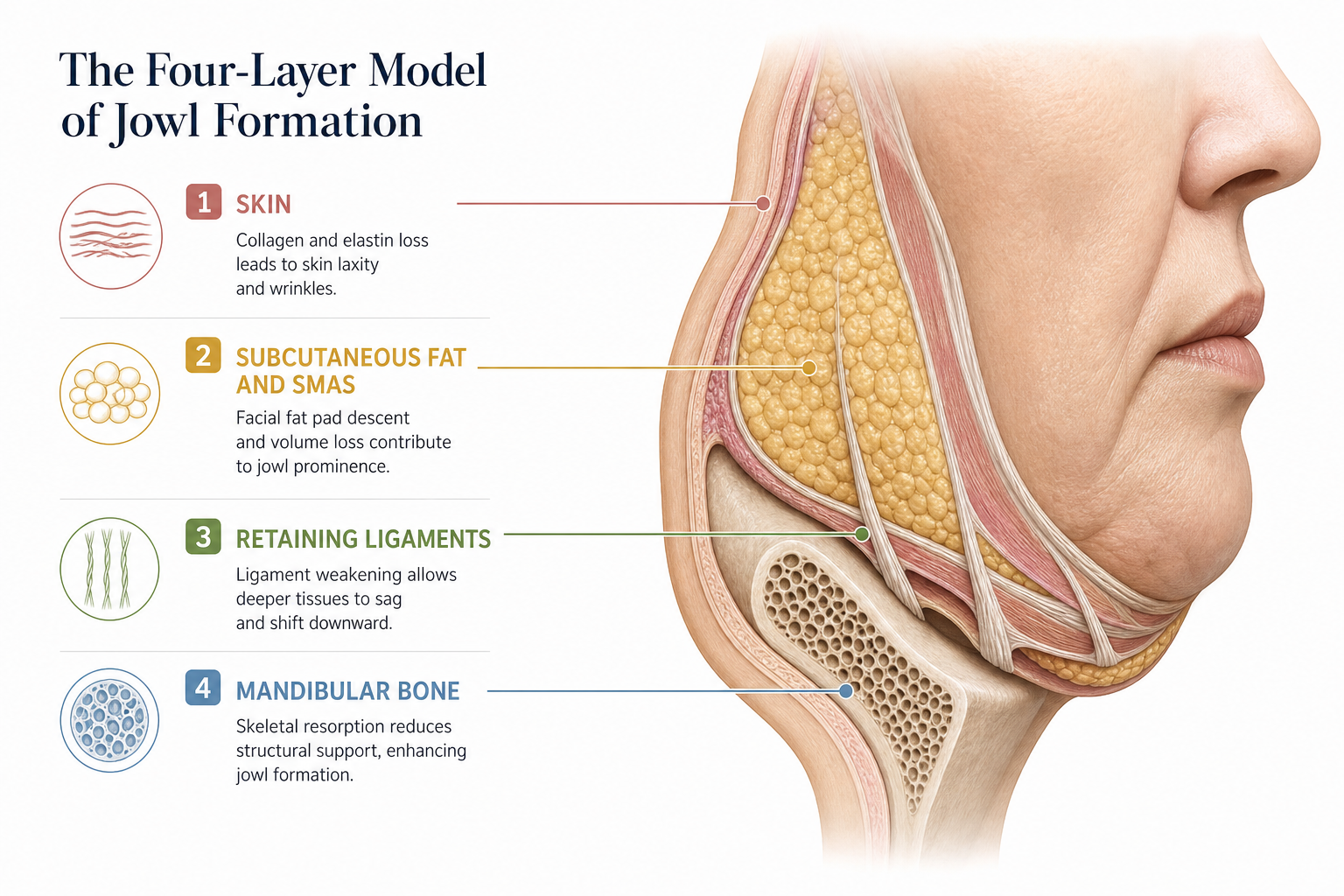
The Four-Layer Model of Jowl Formation
Most explanations of jowls focus on one or two causes, but jowl formation is better understood as a convergence of four simultaneous processes. Recognising all four helps explain why jowls can be difficult to address with a single treatment approach.
1. Collagen and Elastin Loss
Collagen and elastin are the structural proteins that give skin its firmness and ability to spring back after movement. Collagen provides tensile strength; elastin provides flexibility. From the mid-20s onwards, the body’s fibroblasts — the cells responsible for producing these proteins — become progressively less active. Collagen production declines by roughly 1% per year after this point, and the existing collagen fibres become thinner and more disorganised. The result is a gradual reduction in skin laxity and skin elasticity, meaning the skin no longer holds its position against the pull of gravity. In the lower face, this manifests as sagging skin along the jawline.
2. Facial Fat Pad Descent and Volume Loss
The face contains multiple discrete fat compartments arranged in both superficial and deep layers. These fat pads are not fixed in place — they shift position over time as the connective tissue holding them weakens. Midface volume loss, particularly in the cheek fat pads, is a key driver of jowl formation: as volume diminishes in the mid-face, the overlying skin loses its scaffolding and descends toward the lower face. This facial fat pad descent adds bulk to the jowl area while simultaneously creating hollowness higher up. The buccal fat pad, located in the cheek, also repositions with age, contributing to the flattening of the midface and the heaviness of the lower face.
3. Retaining Ligament Weakening
As described above, retaining ligaments anchor facial tissue to bone. With age, these ligaments — including the mandibular, masseteric, and zygomatic ligaments — elongate and weaken. When they lose their holding capacity, the tissue they were supporting becomes mobile and descends under gravity. The mandibular ligament’s fixed position at the jawline creates the characteristic pooling of tissue that defines a jowl. This is why jowls have a relatively sharp upper border: tissue descends freely above the ligament and then accumulates at the point where the ligament holds firm.
4. Skeletal Resorption
Bone is not static. Skeletal resorption — the gradual loss of bone density and volume in the facial skeleton — occurs throughout adulthood and accelerates after middle age. The mandible (jawbone) loses height and projection over time, reducing the bony support that the overlying soft tissue relies on. As the mandibular border recedes, the skin and fat that once draped over a more prominent jaw have more excess relative to the underlying structure, contributing to the appearance of sagging. This is sometimes called the prejowl area — a subtle depression that develops along the mandibular border as bone volume decreases, making adjacent soft tissue appear more prominent by comparison.
Biological and Hormonal Causes
Beyond the structural model above, several biological processes accelerate or amplify jowl formation at the cellular level.
Age-Related Protein Decline
Declining fibroblast activity reduces not only collagen and elastin production but also hyaluronic acid — a molecule that retains water within the dermis and contributes to skin turgor (the plumpness and resilience of skin). As hyaluronic acid levels fall, the dermis thins and becomes less able to resist deformation. Dermal thinning also makes the skin more susceptible to the effects of gravity and repeated facial movement.
Hormonal Changes, Particularly in Women
Oestrogen plays a significant role in maintaining collagen density and skin thickness. After menopause, oestrogen levels decline sharply, and research suggests that women may lose up to 30% of dermal collagen in the first five years following menopause. This accelerated collagen loss disproportionately affects the lower face, where skin is already thinner and more subject to gravitational pull. This hormonal factor helps explain why many women notice a marked change in jawline definition in their late 40s and 50s, even if they have maintained a stable weight and healthy lifestyle. Men experience a more gradual decline in testosterone, which also supports skin thickness, but the effect is generally less abrupt than the post-menopausal oestrogen drop in women.
Genetic Predisposition and Early-Onset Jowls
Genetic predisposition is one of the strongest predictors of when and how prominently jowls will develop. Inherited factors influence the thickness and strength of the SMAS, the elasticity of retaining ligaments, the distribution of facial fat compartments, and the rate of collagen decline. If close relatives developed jowls in their 30s or early 40s, there is a meaningful likelihood that you may follow a similar timeline.
Early-onset jowls — visible jowling in people in their 20s or 30s — are more common than many assume. They are not simply a sign of premature aging; they often reflect an inherited facial structure with naturally thinner skin, less robust ligamentous support, or a facial fat distribution that makes tissue descent more visible at an earlier age. Significant weight fluctuations, sun damage accumulated in youth, or smoking can also bring forward the timeline considerably. For younger patients noticing early jawline changes, a consultation with a qualified aesthetic practitioner can help identify contributing factors and appropriate options.
Sun Damage and Photoaging
UV-induced collagen breakdown — known as photoaging — is one of the most preventable contributors to jowl formation. Ultraviolet radiation, particularly UVA, penetrates the dermis and activates enzymes called matrix metalloproteinases (MMPs) that degrade collagen and elastin fibres. Chronic sun exposure also impairs fibroblast function, reducing the skin’s capacity to repair and regenerate these proteins. The cumulative effect is a significant acceleration of skin laxity that compounds the natural aging process.
Photoaging tends to be most pronounced on areas with high lifetime sun exposure — the face, neck, and décolletage — which are precisely the areas most affected by jowling. People who have spent significant time outdoors without adequate sun protection, or who have used sunbeds, often show earlier and more pronounced lower facial aging than those with equivalent chronological age but lower UV exposure. Daily broad-spectrum SPF use is consistently cited in dermatological literature as one of the most effective long-term strategies for slowing collagen degradation.
Smoking and Its Effect on Facial Structure
Smoking accelerates jowl formation through several mechanisms. Nicotine causes vasoconstriction — narrowing of blood vessels — which reduces oxygen and nutrient delivery to skin cells, impairing collagen synthesis and cellular repair. The chemicals in cigarette smoke also directly damage collagen and elastin fibres and generate free radicals that accelerate oxidative stress in the dermis. Additionally, the repetitive facial movements involved in smoking (pursing the lips, squinting) contribute to dynamic line formation around the mouth and eyes, which can compound the appearance of lower facial aging.
Studies consistently show that smokers develop visible signs of facial aging — including skin laxity and loss of jawline definition — earlier than non-smokers of the same age. The effect is dose-dependent: longer duration and higher frequency of smoking correlate with more pronounced skin changes.
Weight Fluctuations and GLP-1 Medications
Weight fluctuations have a complex relationship with jowl formation. Significant weight gain can stretch the skin of the lower face, and if that weight is subsequently lost, the skin may not fully retract — particularly in older individuals whose skin elasticity is already reduced. Rapid weight loss is especially problematic because it does not allow time for the skin to adapt gradually.
This issue has become increasingly relevant with the widespread use of GLP-1 receptor agonist medications such as semaglutide (Ozempic, Wegovy). Rapid and substantial weight loss achieved through these medications can result in what practitioners have informally termed “Ozempic face” — a hollowing of the midface and cheeks combined with increased skin laxity in the lower face and neck. The speed of fat loss outpaces the skin’s ability to contract, and the reduction in facial fat volume removes the structural support that was previously holding the skin in position. The result can be more pronounced jowling and nasolabial folds, even in relatively young patients. This is an emerging area of aesthetic concern, and practitioners are increasingly seeing patients who have achieved significant weight loss but are now seeking advice on managing the facial consequences.
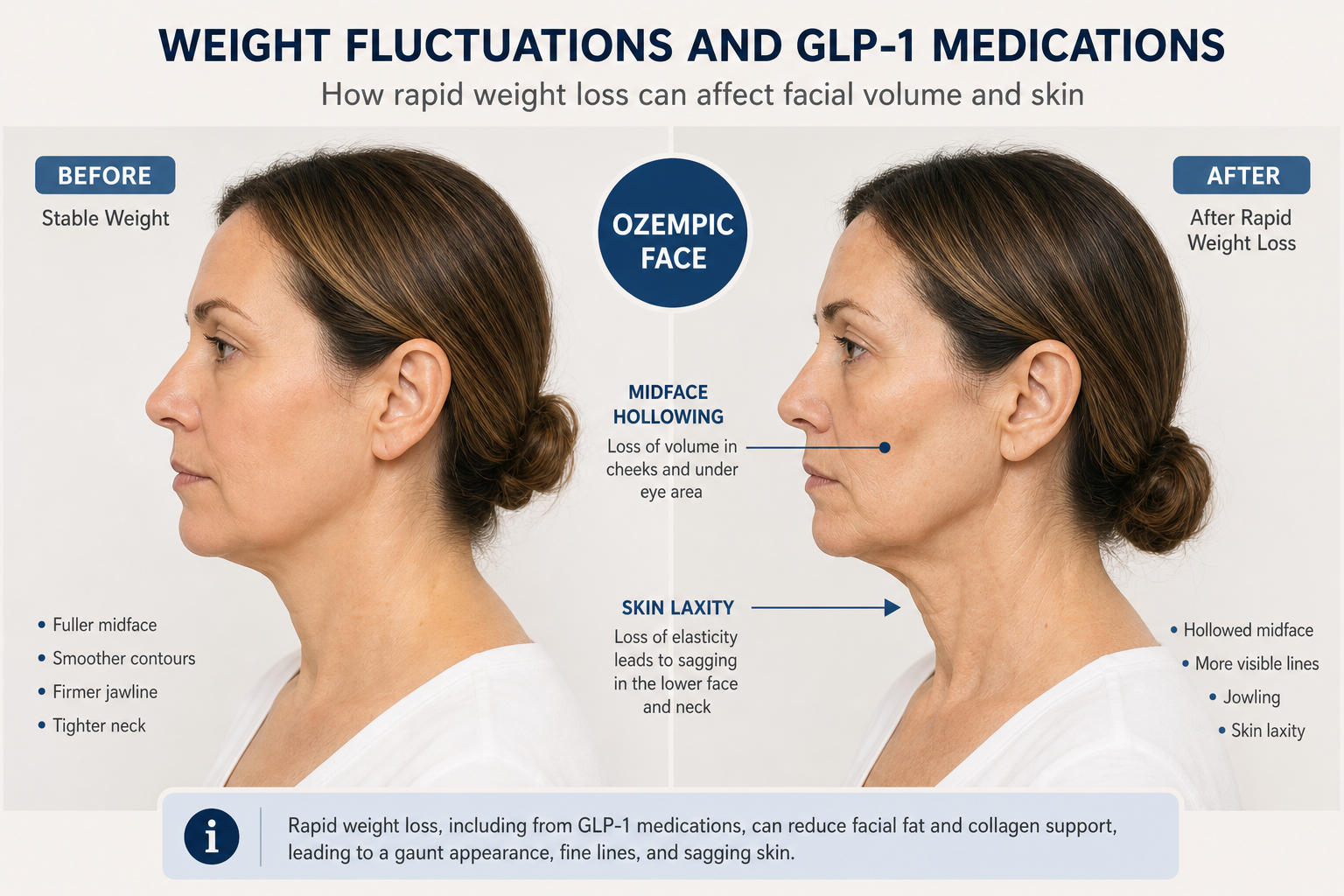
Conversely, being significantly overweight can also contribute to jowl appearance by adding excess soft tissue volume to the lower face and neck, which increases the gravitational load on already-stressed retaining ligaments and skin.
Lifestyle Factors: Tech Neck, Sleep Position, Stress, and Nutrition
Tech Neck and Screen Posture
Tech neck refers to the postural habit of tilting the head downward to look at phones, tablets, and laptops for extended periods. This repeated flexion of the neck creates horizontal creases across the neck and may contribute to the loosening of the platysma muscle and the skin of the lower face over time. While tech neck is unlikely to be a primary cause of jowls on its own, it may accelerate the appearance of lower facial and neck laxity, particularly in younger people who are already genetically predisposed.
Sleep Position
Sleeping consistently on one side presses the face against a pillow for hours each night, creating repeated mechanical compression and skin folding. Over years, this can contribute to asymmetric skin laxity and may make jowling more pronounced on the habitual sleep side. This is one reason why some people notice that their jowls are more visible on one side than the other — asymmetric jowls are common and often have a positional or habitual component alongside any underlying structural asymmetry.
Stress and Cortisol
Chronic psychological stress elevates cortisol, the body’s primary stress hormone. Sustained high cortisol levels have been shown to degrade collagen in the skin by suppressing fibroblast activity and increasing the activity of collagen-degrading enzymes. While stress is rarely discussed as a standalone cause of jowls, it is a meaningful contributor to accelerated skin aging in people under prolonged pressure.
Nutritional Deficiencies
Collagen synthesis requires specific nutritional cofactors, including vitamin C, zinc, and adequate dietary protein. Vitamin C is essential for the hydroxylation of proline and lysine — amino acids that form the backbone of collagen fibres. Zinc supports fibroblast function and wound healing. Protein provides the amino acid building blocks for collagen itself. Chronic deficiency in any of these nutrients can impair the skin’s ability to maintain and regenerate its collagen matrix, potentially accelerating the loss of skin firmness in the lower face.
Bruxism
Bruxism — habitual teeth grinding or jaw clenching — causes hypertrophy (enlargement) of the masseter muscles at the sides of the jaw. While this can create a squarer jawline appearance in some individuals, it also places chronic mechanical stress on the jaw and surrounding soft tissue. Over time, the altered muscle dynamics and tissue stress associated with bruxism may affect the appearance of the lower face and jawline, though this is a less well-studied contributor compared to the primary causes above.
At What Age Do Jowls Typically Start?
Jowl formation is a gradual process that begins earlier than most people expect. Collagen and elastin decline starts in the mid-20s, and subtle changes in facial fat distribution and ligament laxity can begin in the 30s. Most people first notice visible jowling in their 40s, when the cumulative effect of multiple simultaneous changes becomes apparent. By the 50s and 60s, jowling is common and often more pronounced, particularly in those with significant sun exposure history, a history of smoking, or a genetic predisposition.
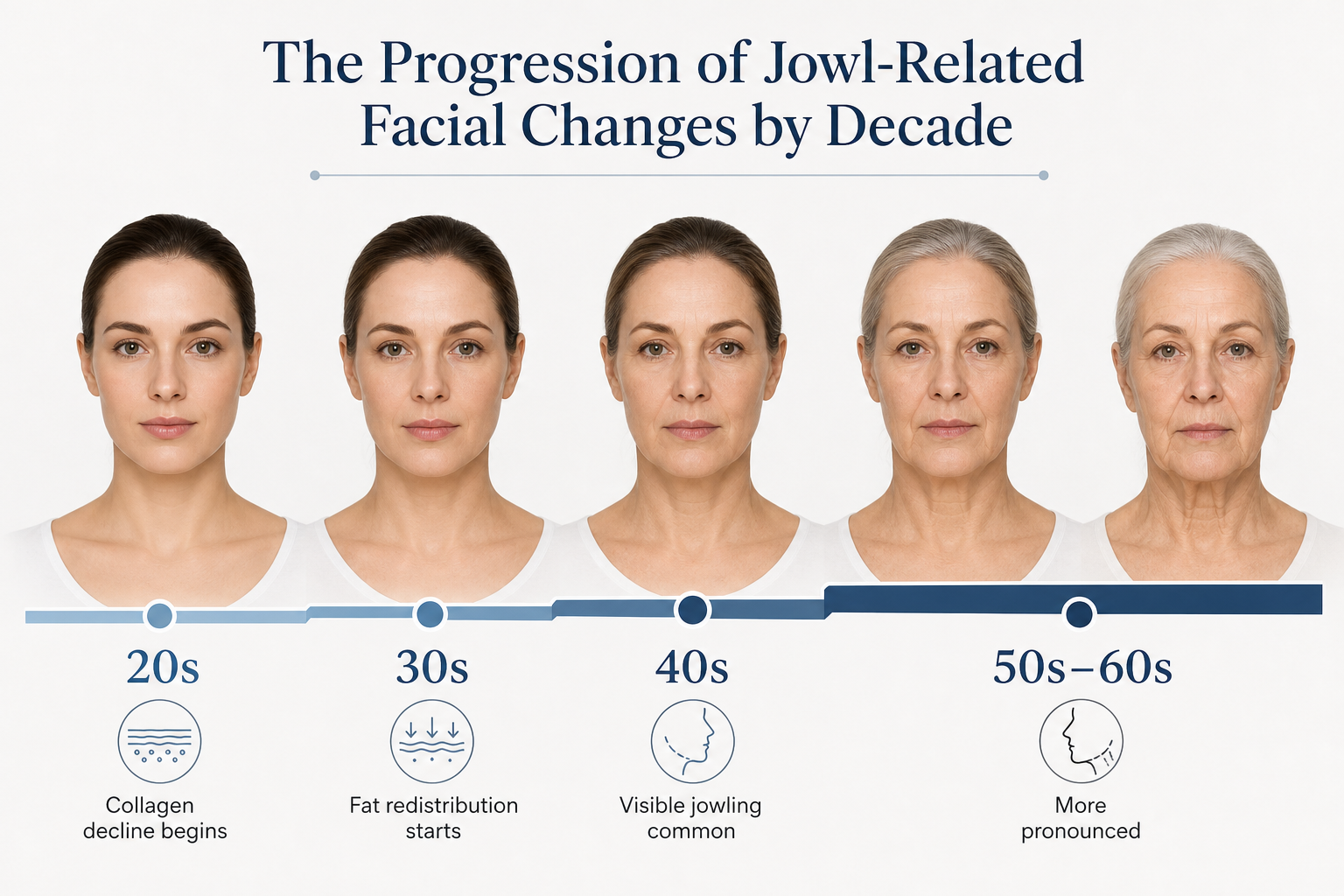
However, early-onset jowls in the 20s and 30s are not rare. Younger patients who notice early jawline changes should not assume that nothing can be done — early intervention with appropriate treatments may slow progression, and identifying modifiable lifestyle factors (sun protection, smoking cessation, weight stability) can make a meaningful difference over time.
Associated Signs of Lower Facial Aging
Jowls rarely appear in isolation. They are typically accompanied by other signs of lower facial aging that share the same underlying causes. Marionette lines — the vertical creases that run from the corners of the mouth downward toward the chin — develop as tissue descends and the skin folds at predictable points. Nasolabial folds (the lines from the nose to the corners of the mouth) deepen as midface volume loss allows the cheek tissue to descend. Neck laxity and the loss of a defined cervicomental angle (the angle between the chin and neck) often accompany jowl formation as the platysma muscle weakens. Recognising these associated changes is important because effective treatment often needs to address the face as a whole rather than targeting jowls in isolation.
Frequently Asked Questions
Can you get jowls in your 20s?
Yes. While uncommon, jowls can develop in the 20s, particularly in people with a strong genetic predisposition, very thin skin, significant weight fluctuations, or high cumulative sun exposure. Early-onset jowls are more likely to be subtle but can be distressing for younger patients. A consultation with an aesthetic practitioner can help identify contributing factors.
Does losing weight cause jowls?
Rapid or significant weight loss can contribute to jowl formation by reducing the facial fat volume that previously supported the overlying skin. If skin elasticity is already reduced — due to age, sun damage, or genetics — it may not retract fully after fat loss, resulting in increased skin laxity along the jawline. This effect is more pronounced with faster weight loss, such as that associated with GLP-1 medications.
Are jowls hereditary?
Genetic predisposition plays a significant role. Inherited factors including skin thickness, ligament strength, SMAS robustness, and facial fat distribution all influence when and how prominently jowls develop. If your parents or grandparents developed jowls early, you may be at higher risk of a similar timeline.
Does sun protection really help prevent jowls?
Daily broad-spectrum SPF use is one of the most evidence-supported strategies for slowing UV-induced collagen breakdown. While it cannot prevent all age-related changes, consistent sun protection from an early age meaningfully reduces the rate of photoaging and may delay the onset of visible skin laxity in the lower face.
Why are my jowls worse on one side?
Asymmetric jowls are common. Contributing factors include habitual sleep position (consistently sleeping on one side), a dominant chewing side, underlying facial asymmetry, or differences in sun exposure between sides of the face (for example, the driver’s side in left-hand-drive countries). Structural asymmetry in the underlying bone and fat distribution can also play a role.
Do facial exercises help with jowls?
Evidence for facial exercises as a treatment for established jowls is limited. Some small studies suggest that targeted facial muscle exercises may modestly improve facial fullness and contour, but they are unlikely to reverse the structural changes — ligament weakening, bone resorption, and fat pad descent — that drive jowl formation. They may be more useful as a preventive measure than a corrective one.
Can jowls be prevented entirely?
Jowls cannot be prevented entirely, as they are driven in part by unavoidable biological aging processes. However, their onset and severity can be meaningfully influenced by modifiable factors: consistent sun protection, not smoking, maintaining a stable weight, adequate nutrition, and managing chronic stress. Addressing these factors early offers the best opportunity to slow the progression of lower facial aging.
Understanding Jowls as a Starting Point for Informed Decisions
Jowls are not a single problem with a single cause — they are the visible result of multiple simultaneous changes in the skin, fat, ligaments, muscle, and bone of the lower face. Understanding this multi-layer model helps explain why jowls can appear at different ages, why they vary so much between individuals, and why addressing them effectively often requires a comprehensive approach rather than a single treatment.
If you are noticing early changes along your jawline, or if jowling has become a concern that affects your confidence, a consultation with a qualified aesthetic practitioner or dermatologist is a useful first step. A thorough assessment of your facial anatomy, skin quality, and the specific factors contributing to your jowling can help identify which approaches — whether preventive, non-surgical, or surgical — may be appropriate for your individual situation. No single treatment suits everyone, and realistic expectations are an important part of any informed decision.