How to Choose Natural-Looking Fillers in London
Dermal fillers have become one of the most requested non-surgical treatments in London, yet the gap between a subtle, refreshed result and an overfilled appearance often comes down to a handful of decisions made before a single injection is placed. This guide explains what genuinely separates natural-looking dermal fillers London patients are happy with from results they later regret — covering filler types, treatment areas, how to evaluate a clinic, and what the evolving UK aesthetics licensing landscape means for your safety.
Key Takeaways
- Natural-looking filler results depend far more on the injector’s knowledge of facial anatomy and their conservative approach than on the brand of product used.
- Hyaluronic acid fillers remain the most widely used option because they are reversible with hyaluronidase, making them a lower-risk starting point for most patients.
- Pillow face and other overfilled appearances are largely preventable through staged treatments, correct tissue-plane placement, and a less-is-more philosophy.
- UK aesthetics licensing is changing; understanding what qualifications and governance structures to look for in a doctor-led clinic protects you as a patient.
- Filler stacking — repeated top-ups without assessing cumulative volume — is an underappreciated risk that a thorough before and after consultation should address.
What Makes Fillers Look Natural?
The most common misconception about dermal fillers is that the product itself determines the outcome. In reality, injection technique and product placement account for the majority of the aesthetic result. A skilled injector working with an average product will almost always outperform an inexperienced one using a premium brand. Natural-looking results come from treating the face as a whole rather than isolating individual features, restoring lost volume where it has genuinely diminished rather than adding new volume indiscriminately, and respecting the soft-tissue architecture that gives each face its character.
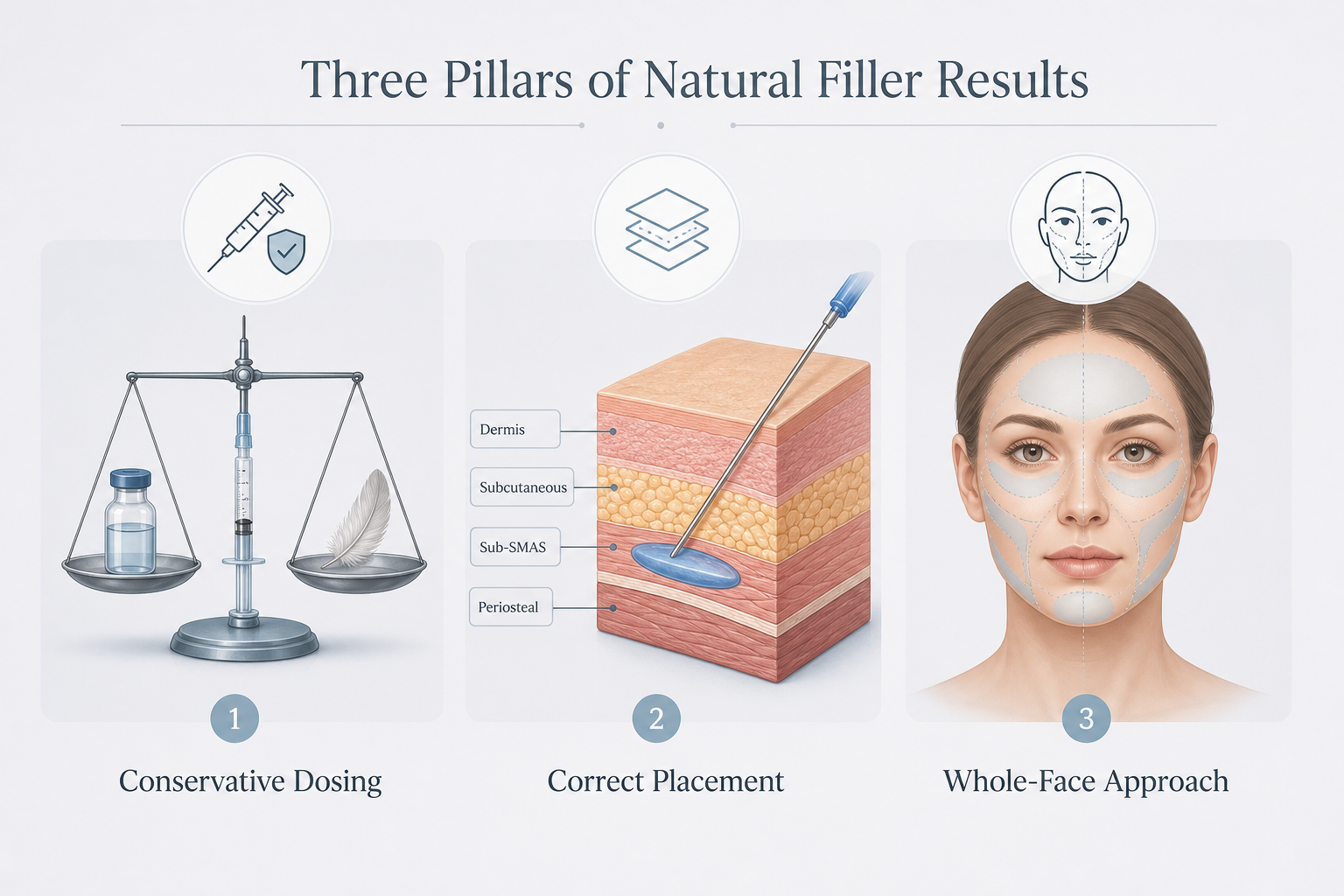
Facial balance and harmony are the underlying goals. The face ages in three dimensions — bone resorbs, fat compartments shift, and skin loses elasticity — so a natural correction addresses those structural changes rather than simply inflating a lip or cheek in isolation. Practitioners who understand facial proportions and the relationship between highlights, shadows, and facial contours can achieve a refreshed appearance that colleagues and friends may notice without being able to identify why. That is the benchmark for a genuinely subtle enhancement.
Conservative dosing is equally important. Placing a smaller volume precisely in the correct anatomical layer produces better lift and definition than a larger volume placed imprecisely. This is why the less-is-more principle is not simply a marketing phrase — it reflects the biomechanics of how filler interacts with tissue. Staged treatments, where a modest initial volume is assessed at a review appointment before any additional product is considered, consistently produce more natural outcomes than single high-volume sessions.
Hyaluronic Acid Fillers: The Foundation of Natural Results
Hyaluronic acid fillers are the most widely used category of dermal filler in the UK and the logical starting point for most patients seeking natural-looking results. Hyaluronic acid (HA) is a naturally occurring sugar molecule found in skin and connective tissue, which means well-placed HA filler integrates smoothly with surrounding tissue and supports skin hydration as well as volume. Crucially, HA fillers are reversible with hyaluronidase — an enzyme that dissolves the product — which provides a meaningful safety margin if results are unsatisfactory or a complication arises.
Not all HA fillers behave identically. Products vary in their viscosity, cohesivity, and G-prime (a measure of firmness), and matching the right product to the right area is part of what distinguishes an experienced injector. Softer, low-G-prime products such as Belotero Balance or Juvéderm Volbella are better suited to delicate areas like the lips and tear troughs, where a firmer product would create visible lumps or an unnatural feel. Higher-G-prime products such as Juvéderm Voluma or Restylane Lyft provide the structural support needed for cheek and jawline definition. Teoxane’s RHA (Resilient Hyaluronic Acid) range is formulated to move with facial expressions, making it particularly relevant for dynamic areas like the nasolabial folds and marionette lines where rigidity would look unnatural.
Biostimulators such as Sculptra (poly-L-lactic acid) and Radiesse (calcium hydroxylapatite) work differently — they stimulate collagen production gradually rather than providing immediate volume. These products can produce very natural results in appropriate candidates, particularly for global volume loss and skin quality improvement, but they are not reversible with hyaluronidase and require a practitioner experienced in their specific injection protocols.
Filler Brand Comparison for Natural Results
| Product / Range | Type | Best Suited Areas | Approximate Longevity | Reversible? |
|---|---|---|---|---|
| Juvéderm Volbella (Allergan) | HA – Vycross technology | Lips, fine lines | 12–18 months | Yes – hyaluronidase |
| Juvéderm Voluma (Allergan) | HA – Vycross technology | Cheeks, midface | 18–24 months | Yes – hyaluronidase |
| Restylane Lyft (Galderma) | HA – NASHA technology | Cheeks, jawline | 12–18 months | Yes – hyaluronidase |
| Belotero Balance | HA – CPM technology | Tear troughs, fine lines | 6–12 months | Yes – hyaluronidase |
| Teosyal RHA (Teoxane) | HA – Resilient HA | Dynamic areas, nasolabial folds | 12–15 months | Yes – hyaluronidase |
| Sculptra (Galderma) | Poly-L-lactic acid biostimulator | Global volume loss, temples | 2+ years | No |
| Radiesse (Merz) | Calcium hydroxylapatite biostimulator | Jawline, hands, skin quality | 12–18 months | No |
Treatment Areas and What Natural Results Look Like
Each area of the face presents different challenges for achieving a natural outcome, and understanding what realistic improvement looks like helps set appropriate expectations before a consultation.
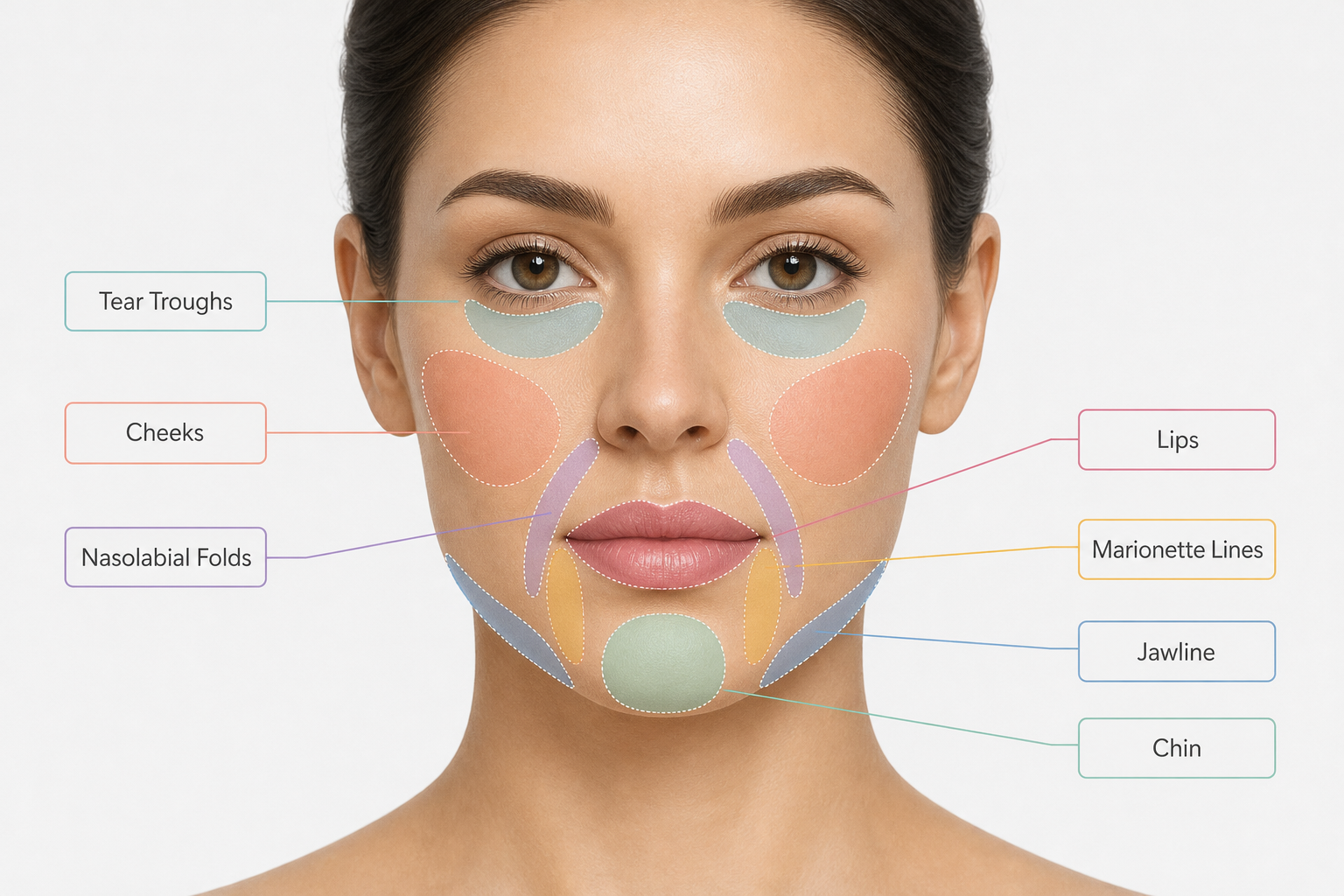
Cheek fillers should restore the gentle convexity of the midface that diminishes with age, creating a subtle lift that also softens nasolabial folds indirectly. Overfilled cheeks — the classic pillow face appearance — occur when excessive volume is placed too anteriorly or superficially, creating an unnatural roundness that distorts facial proportions. A well-placed cheek filler is often undetectable as a procedure; the face simply looks less tired.
Lip fillers are among the most visible treatments and among the most frequently overdone. Natural lip enhancement respects the existing lip shape, maintains the philtrum columns, and preserves the natural vermilion border. The goal is usually to restore volume lost with age or to add modest definition, not to dramatically increase size. Patients who want to restore lost volume rather than fundamentally change their lip shape tend to be the most satisfied.
Jawline and chin fillers can improve facial structure and balance, particularly in patients with a recessed chin or poorly defined mandibular angle. When placed conservatively, these treatments create a more defined profile without appearing surgical. Excessive volume in the jawline can create an unnaturally square or heavy appearance.
Tear trough fillers address under-eye hollows and are among the most technically demanding treatments. The tear trough area has thin skin, proximity to the orbital rim, and a complex vascular anatomy. Results depend heavily on the injector’s experience and the correct product selection — a product that is too firm or placed too superficially will create visible lumps or a bluish discolouration (Tyndall effect). Not every under-eye concern is suitable for filler; pigmentation, puffiness, and vascular visibility may not respond well and may require alternative approaches.
Nasolabial folds and marionette lines can be softened with filler, though treating the underlying volume loss in the midface often produces a more natural result than directly filling the fold itself.
Understanding Pillow Face and How to Avoid It
Pillow face — the puffy, rounded, mask-like appearance associated with excessive filler — is the outcome most patients seeking natural-looking results are trying to avoid. It develops through a combination of factors: too much total volume, incorrect tissue-plane placement, filler stacking over multiple sessions without adequate assessment, and sometimes the use of products with inappropriate rheological properties for the area treated.
Filler stacking deserves particular attention because it is an underappreciated cumulative risk. Each time a patient receives a top-up before previous filler has fully degraded, the total volume in the tissue increases. Over several years and multiple sessions, this can produce a gradual distortion that neither the patient nor the practitioner notices session by session. A responsible clinic will assess the existing filler volume at every consultation and may recommend a period without treatment — or even partial dissolution with hyaluronidase — before adding more product.
If you are already concerned that you may have an overfilled appearance, hyaluronidase dissolution is a safe and effective option for HA fillers. A qualified medical practitioner can dissolve some or all of the existing product, allow the tissue to settle, and then reassess whether and how much filler is appropriate. This process requires patience — the face needs several weeks to fully recover after dissolution — but it is a well-established corrective pathway.
How to Choose a Clinic in London
London has hundreds of clinics offering dermal fillers, ranging from highly regulated medical practices to unlicensed beauty salons. The variation in practitioner training, governance, and safety standards is significant, and choosing carefully is one of the most important decisions a patient can make.
A doctor-led clinic — one where a GMC-registered doctor either performs treatments or directly supervises and takes clinical responsibility — provides a meaningful layer of governance. Nurse practitioners registered with the NMC and dentists registered with the GDC can also be highly skilled injectors, but the key question is whether the clinic has a clear clinical governance structure, a named responsible clinician, and access to emergency reversal agents including hyaluronidase. Clinics operating without these structures present a higher risk, regardless of how professional their marketing appears.
When reviewing a clinic’s before and after portfolio, look for patients who still look like themselves — not a homogeneous set of faces that all share the same inflated features. A practitioner with genuine skill will have a portfolio showing diverse patients with results tailored to their individual facial structure. Ethnic and structural diversity in a portfolio is a positive indicator; it suggests the practitioner adapts their approach rather than applying a template.
Red Flags to Watch For
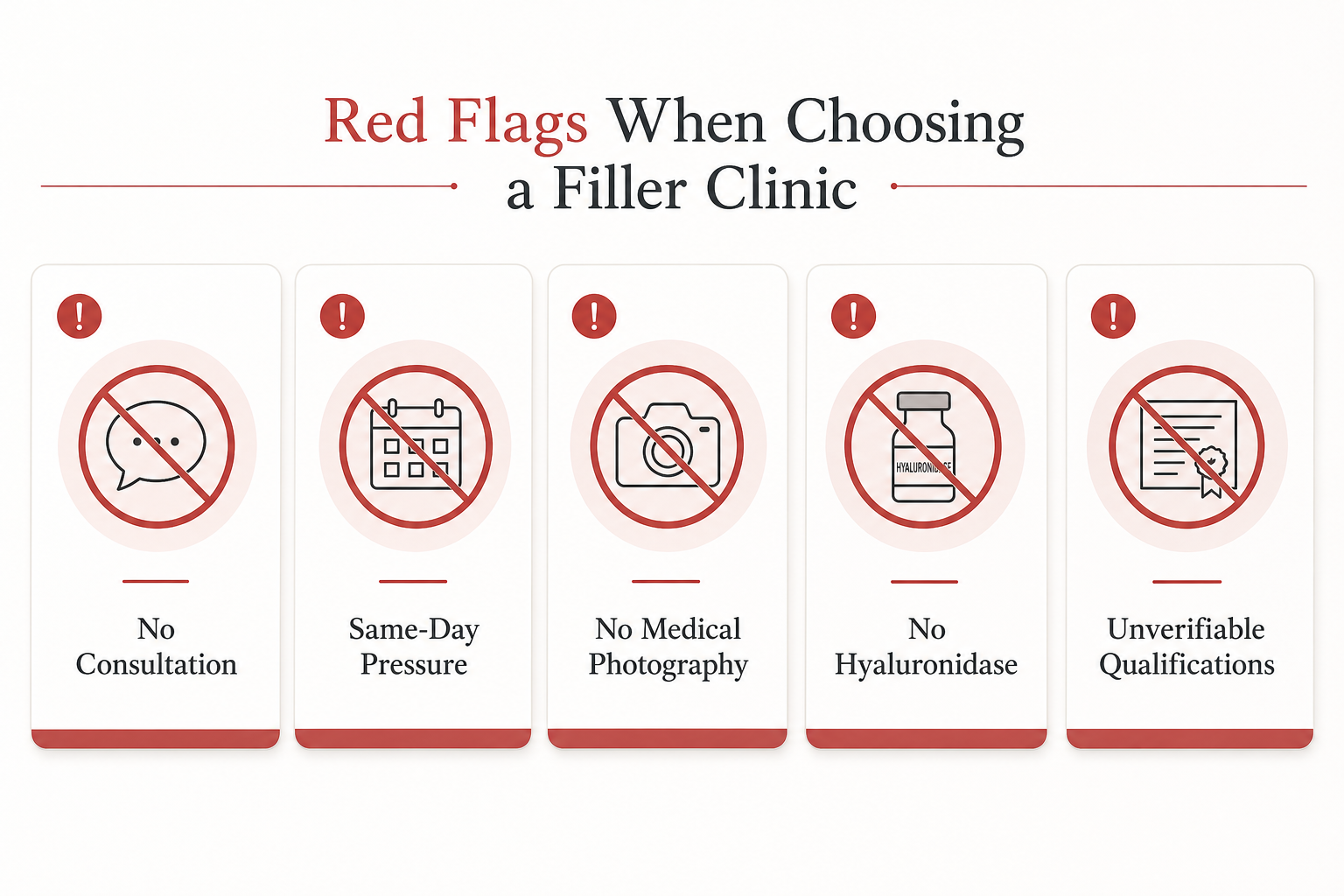
- No formal consultation or facial assessment before treatment is offered
- Pressure to book on the day with no cooling-off period
- No medical photography taken before treatment
- Inability to confirm that hyaluronidase is available on-site for emergency reversal
- Practitioner cannot explain which product they are using or why
- Prices significantly below the London market average without a clear explanation
- No aftercare or post-treatment review offered
- Clinic cannot confirm the practitioner’s registration body or number
Questions Worth Asking Before You Book
- What is your registration body and number, and can I verify it?
- Which filler product will you use, and why is it appropriate for my concern?
- Do you have hyaluronidase available in case of a vascular complication?
- What is your approach if I am unhappy with the result?
- How much existing filler do you think I have, and does it need to be assessed before adding more?
- Can I see before and after photographs of patients with a similar concern to mine?
UK Aesthetics Licensing: What Patients Need to Know
The regulatory landscape for aesthetic treatments in the UK is changing in ways that directly affect patient safety. The Health and Care Act 2022 introduced a framework for licensing non-surgical cosmetic procedures, and the government’s 2025 response confirmed that a local authority licensing scheme is being implemented. Under this framework, facial fillers are classified in an amber tier, meaning they will require practitioners to hold a licence issued by their local authority to perform them legally.
It is important to understand what this does and does not mean. Standard facial fillers administered by non-medical practitioners are not currently within the scope of CQC (Care Quality Commission) regulated activities — a common misconception. CQC registration applies to specific medical procedures and healthcare services, not to cosmetic filler treatments as a category. The incoming local authority licensing scheme is the primary consumer protection mechanism for this sector.
In practical terms, patients in London should currently ask clinics directly about their governance structure, the qualifications of the person performing treatment, and whether they operate within a medically supervised environment. Clinics near Harley Street and in other established medical districts often — though not always — operate within more robust governance frameworks, but location alone is not a guarantee of quality. The incoming UK aesthetics licensing changes will eventually make it easier to verify a practitioner’s legal standing, but until full implementation, due diligence remains the patient’s responsibility.
Social Media, Filters, and Realistic Expectations
One of the most significant contributors to dissatisfaction with filler results is the gap between what patients see on social media and what is achievable in real life. Heavily filtered images, strategic lighting, and post-production editing routinely make filler results appear more dramatic and more perfect than they are in person. Patients who arrive at a consultation with a screenshot of a heavily edited image as their goal are likely to be disappointed — not because the treatment cannot improve their appearance, but because the reference image does not represent a real outcome.
A thorough before and after consultation should include an honest conversation about what the patient’s own facial structure can realistically achieve. Natural-looking results are by definition subtle; they should make a patient look refreshed and well-rested, not obviously treated. If a practitioner promises to replicate a social media image without discussing the limitations of that comparison, that is itself a warning sign.
Frequently Asked Questions
Can dermal fillers genuinely look natural?
Yes, when performed by an experienced qualified medical practitioner using appropriate products and a conservative approach, dermal fillers can produce results that are undetectable as a procedure. The key variables are the injector’s knowledge of facial anatomy, the volume used, and the choice of product for the specific area. Many patients who have had well-placed fillers are never identified as having had treatment.
How long do dermal fillers last?
Longevity varies by product type, treatment area, and individual metabolism. Most hyaluronic acid fillers last between 6 and 18 months, with denser products in less mobile areas tending to last longer. Biostimulators like Sculptra may produce effects lasting two years or more. Results are not permanent, and maintenance treatments are typically needed to sustain the outcome.
What is the difference between a doctor-led clinic and other providers?
A doctor-led clinic has a GMC-registered doctor who takes clinical responsibility for treatments, either by performing them directly or by supervising other practitioners. This provides a clearer governance structure, access to prescription medications including hyaluronidase for emergency reversal, and a defined accountability pathway if something goes wrong. Other qualified practitioners such as NMC-registered nurses can also provide safe treatment, but the governance structure around them matters as much as their individual qualifications.
What should I do if I think I have too much filler?
If you are concerned about an overfilled appearance, consult a qualified medical practitioner who can assess the existing filler volume and discuss whether hyaluronidase dissolution is appropriate. Hyaluronidase dissolves hyaluronic acid filler safely and effectively. The face typically needs several weeks to settle after dissolution before any new filler is considered. Not all fillers are dissolvable — biostimulators such as Sculptra and Radiesse cannot be reversed with hyaluronidase.
Is a Harley Street clinic automatically better?
Location in a prestigious medical district is not a guarantee of quality or safety. Some of London’s most skilled practitioners work in Harley Street and surrounding areas, but the address alone does not confirm qualifications, governance, or clinical standards. Evaluate any clinic on the basis of the practitioner’s verifiable registration, the quality of their consultation process, their portfolio, and their safety protocols — regardless of postcode.
How do I know if a clinic uses genuine filler products?
Ask the practitioner to show you the sealed product packaging before treatment. Reputable clinics use products sourced through legitimate medical supply chains and will be transparent about the brand and formulation being used. Unusually low prices can sometimes indicate counterfeit or grey-market products, which carry significant safety risks.
Making an Informed Decision About Fillers in London
Choosing natural-looking fillers in London is ultimately a decision about who you trust with your face as much as which product they use. The best outcomes come from practitioners who take time to understand your facial structure and your goals, who apply a conservative approach and are willing to stage treatment over multiple appointments, and who operate within a clinical governance framework that prioritises your safety over throughput.
Before booking, verify the practitioner’s registration, review their portfolio critically, and ensure the consultation includes a genuine facial assessment rather than a quick upsell. Ask about filler stacking if you have had previous treatments, and be honest about your expectations — particularly if they have been shaped by social media. Subtle enhancement that makes you look like a better version of yourself, rather than a different person, is both achievable and the standard that a skilled injector should be aiming for.
If you are unsure where to start, an initial consultation with a qualified medical practitioner — with no obligation to proceed — is the most useful first step. A good practitioner will tell you honestly what is and is not achievable for your specific concerns, and that conversation alone is worth the time.