Breast Dimpling Warning Signs: What the Skin Changes on Your Breast Could Mean
Noticing a change in the skin of your breast — a small indentation, a puckered patch, or a texture that looks different from usual — can be alarming. While breast dimpling is not always a sign of cancer, it is a change that should never be dismissed or monitored at home indefinitely. Understanding what causes breast skin changes, which signs are more concerning, and when to seek medical attention can help you act quickly and confidently if something does not look right.
Key Takeaways
- Breast dimpling can result from both benign conditions and serious causes including breast cancer, so any new or unexplained skin change warrants prompt medical evaluation.
- Inflammatory breast cancer (IBC) is a rare but aggressive form that frequently causes dimpling and orange peel texture without a palpable lump, making awareness of non-lump symptoms especially important.
- The clinical term peau d’orange describes a specific orange peel texture caused by lymphatic blockage and is a recognized warning sign that requires urgent assessment.
- Benign causes such as fat necrosis, mastitis, and fibrocystic breast changes can also produce skin changes that mimic cancer on examination or imaging, so professional diagnosis is always necessary.
- Early diagnosis significantly improves outcomes for all forms of breast cancer, including IBC, which accounts for a disproportionately high share of breast cancer deaths relative to its incidence.
What Is Breast Dimpling?
Breast dimpling refers to a visible indentation, concavity, or sunken area on the skin surface of the breast. It may appear as a single small dent, a broader area of skin retraction, or a widespread pitted texture resembling the skin of an orange. The change can affect any part of the breast, including areas near the armpit, the lower pole, or the skin surrounding the nipple. In some cases, dimpling is only visible in certain positions — for example, when the arms are raised above the head or when leaning forward — because these movements alter the tension in the underlying connective tissue and make subtle tethering more apparent.
Skin puckering and dimpling are different from normal breast asymmetry or the natural variation in skin texture that many people have. The key concern is a new change — something that was not present before and has appeared without an obvious explanation such as recent surgery or injury. Any new dimpling, indentation, or change in breast skin texture should be assessed by a clinician rather than observed at home.
How Does Breast Cancer Cause Dimpling?
The breast contains a network of fibrous bands called Cooper’s ligaments, which run from the skin surface down through the breast tissue to the underlying chest wall. These suspensory ligaments give the breast its shape and support. When a tumour grows within the breast, it can attach to or infiltrate these ligaments, causing them to shorten and pull the overlying skin inward. The result is the characteristic skin tethering or skin retraction seen as a dimple or pucker on the surface.
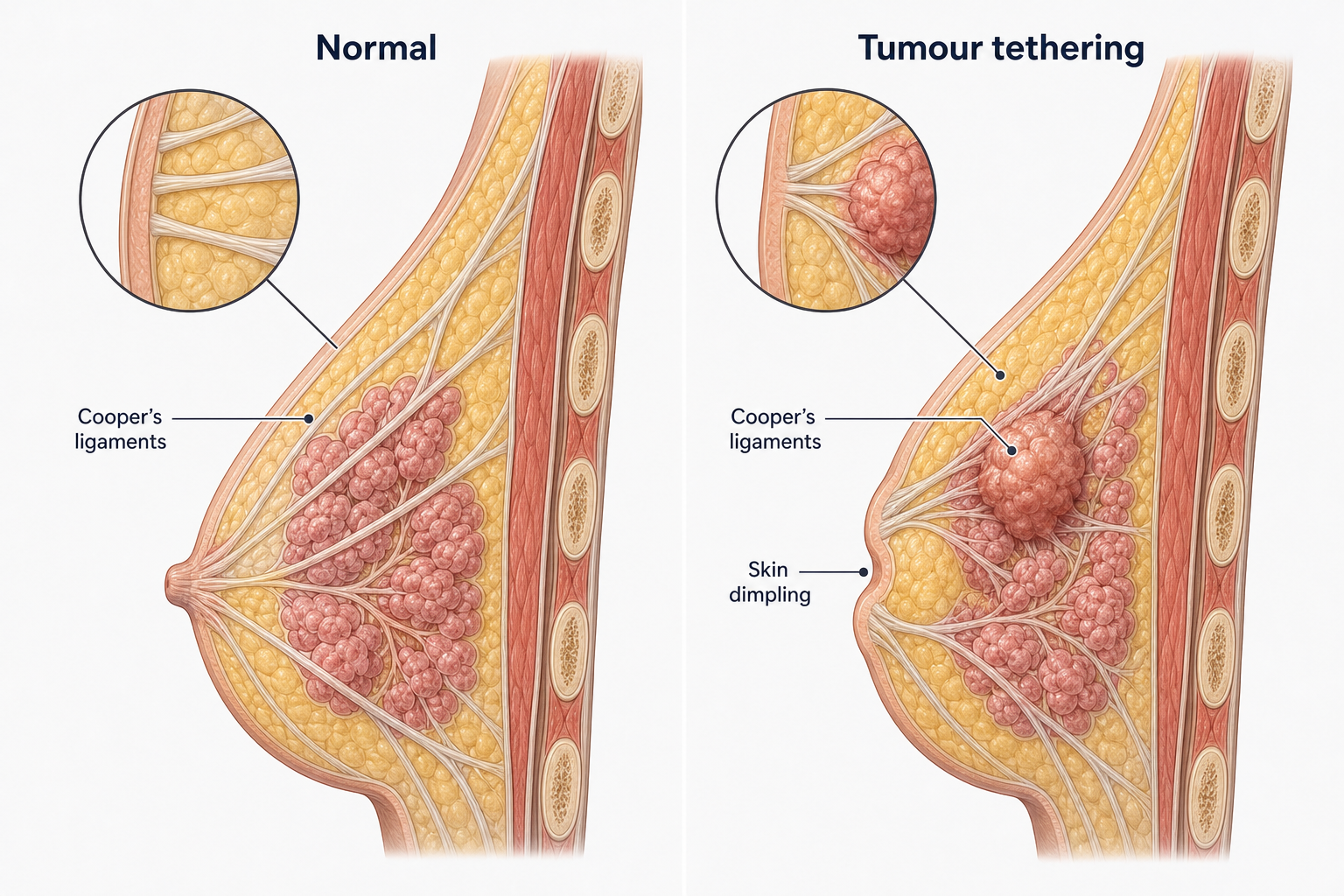
A separate mechanism operates in inflammatory breast cancer. In IBC, cancer cells block the small lymphatic channels within the dermis — the deeper layer of skin. When lymph fluid cannot drain normally, it accumulates and causes the skin to swell, thicken, and develop a pitted appearance. This is the origin of the clinical term peau d’orange, which is French for “skin of an orange” and describes the characteristic orange peel texture produced by this lymphatic blockage. The pitting occurs because the skin is tethered at the hair follicle openings while the surrounding tissue swells, creating the dimpled surface.
A clinical observation sometimes used to detect early skin tethering is the “pushing sign”: when the breast tissue beneath a suspicious area is gently pushed upward, subtle tethering that is not visible at rest may become apparent as the skin fails to move freely with the underlying tissue. This is a clinical examination technique used by trained practitioners and is not a substitute for formal medical assessment.
Types of Breast Cancer Associated with Dimpling
Inflammatory breast cancer (IBC) is the form most strongly associated with breast dimpling and peau d’orange. IBC is rare, accounting for approximately one to five percent of all breast cancer diagnoses, but it is disproportionately lethal — responsible for an estimated ten to fifteen percent of all breast cancer deaths. This disparity exists because IBC grows and spreads rapidly, is often diagnosed at a later stage, and does not always produce a palpable lump, meaning it can be missed if only a lump is being looked for. Symptoms of IBC typically develop over weeks rather than months and include rapid breast swelling, warmth, redness, heaviness, and the orange peel texture of peau d’orange. Swollen axillary lymph nodes under the arm are also common.
Invasive ductal carcinoma is the most common form of breast cancer overall and can also cause dimpling when a tumour grows close to the skin or attaches to Cooper’s ligaments. Unlike IBC, invasive ductal carcinoma more commonly presents with a palpable lump alongside any skin changes. Lobular breast cancer can cause subtle skin changes including dimpling and skin thickening, though it tends to be harder to detect on imaging because of the way its cells spread through tissue. Paget’s disease of the breast, a rarer form, primarily affects the nipple and areola and may cause skin changes in that specific area including crusting, redness, and nipple retraction.
Dimpling Without a Lump
One of the most important and underappreciated facts about breast dimpling is that it can occur without any palpable lump. This is particularly true of inflammatory breast cancer, where the cancer cells spread through the lymphatic channels of the skin rather than forming a discrete mass. Many people have been reassured — incorrectly — that because they cannot feel a lump, there is nothing to worry about. Breast dimpling, skin puckering, nipple retraction, or any other unexplained skin change on the breast requires medical evaluation regardless of whether a lump is present.
Dimpling without a lump can also occur when a tumour is positioned deep within the breast tissue and is not yet large enough to feel, but has already caused tethering of the overlying skin through its effect on Cooper’s ligaments. This is one reason why clinical breast examination alone is insufficient for diagnosis, and why imaging — including mammogram, ultrasound, or breast MRI — is an essential part of the assessment.
Benign Causes of Breast Dimpling
Not every case of breast dimpling is caused by cancer. Several benign conditions can produce similar skin changes, and distinguishing between them requires professional assessment rather than self-diagnosis.
Fat necrosis occurs when fatty tissue within the breast is damaged — typically following an injury, surgery, biopsy, or radiation treatment. As the damaged tissue heals, it can form a firm, irregular area that pulls on the surrounding skin and creates a dimple or indentation. Fat necrosis can also mimic cancer on a mammogram, appearing as an irregular density or calcification, which is why follow-up imaging or biopsy is sometimes needed even when the clinical history suggests a benign cause.
Mastitis is an infection of the breast tissue, most commonly occurring in women who are breastfeeding. It causes redness, warmth, swelling, and tenderness, and in some cases can produce skin changes that superficially resemble inflammatory breast cancer. The key differentiator is that mastitis typically resolves with a course of antibiotics within one to two weeks. If skin changes persist or worsen despite antibiotic treatment, further investigation for IBC is warranted. A breast abscess — a localised collection of pus — can also cause skin changes and dimpling in the affected area.
Fibrocystic breast changes are a common benign condition in which the breast tissue becomes lumpy or rope-like, often fluctuating with the menstrual cycle. In some cases, fibrocystic changes can cause areas of skin irregularity, though frank dimpling is less typical. Benign tumours such as fibroadenomas or cysts can occasionally pull on Cooper’s ligaments if they are positioned close to the skin, producing a subtle indentation. Surgical scarring from previous breast procedures can also cause skin tethering that persists long after the wound has healed.
Mastitis vs. Inflammatory Breast Cancer: Key Differences
| Feature | Mastitis | Inflammatory Breast Cancer (IBC) |
|---|---|---|
| Who it affects | Most common in breastfeeding women | Can affect any woman; more common in younger women and Black women |
| Onset | Usually rapid, over days | Rapid, over weeks |
| Skin appearance | Red, warm, swollen; may have peau d’orange | Red, warm, swollen; peau d’orange common |
| Palpable lump | Sometimes (abscess) | Often absent |
| Fever | Common | Less common |
| Response to antibiotics | Resolves within 1–2 weeks | Does not resolve with antibiotics |
| Axillary lymph nodes | May be mildly enlarged | Often significantly enlarged |
| Next step if no improvement | Urgent referral for imaging and biopsy | Immediate specialist referral required |
How to Check for Breast Dimpling at Home
A regular breast self-exam is a useful habit for becoming familiar with how your breasts normally look and feel, so that changes are easier to notice. Stand in front of a mirror with good lighting. First, look at your breasts with your arms relaxed at your sides. Then raise both arms above your head and look again — this position stretches the skin and can reveal subtle dimpling or skin tethering that is not visible at rest. Next, place your hands on your hips and press firmly to flex your chest muscles, and observe the breast contour from different angles.
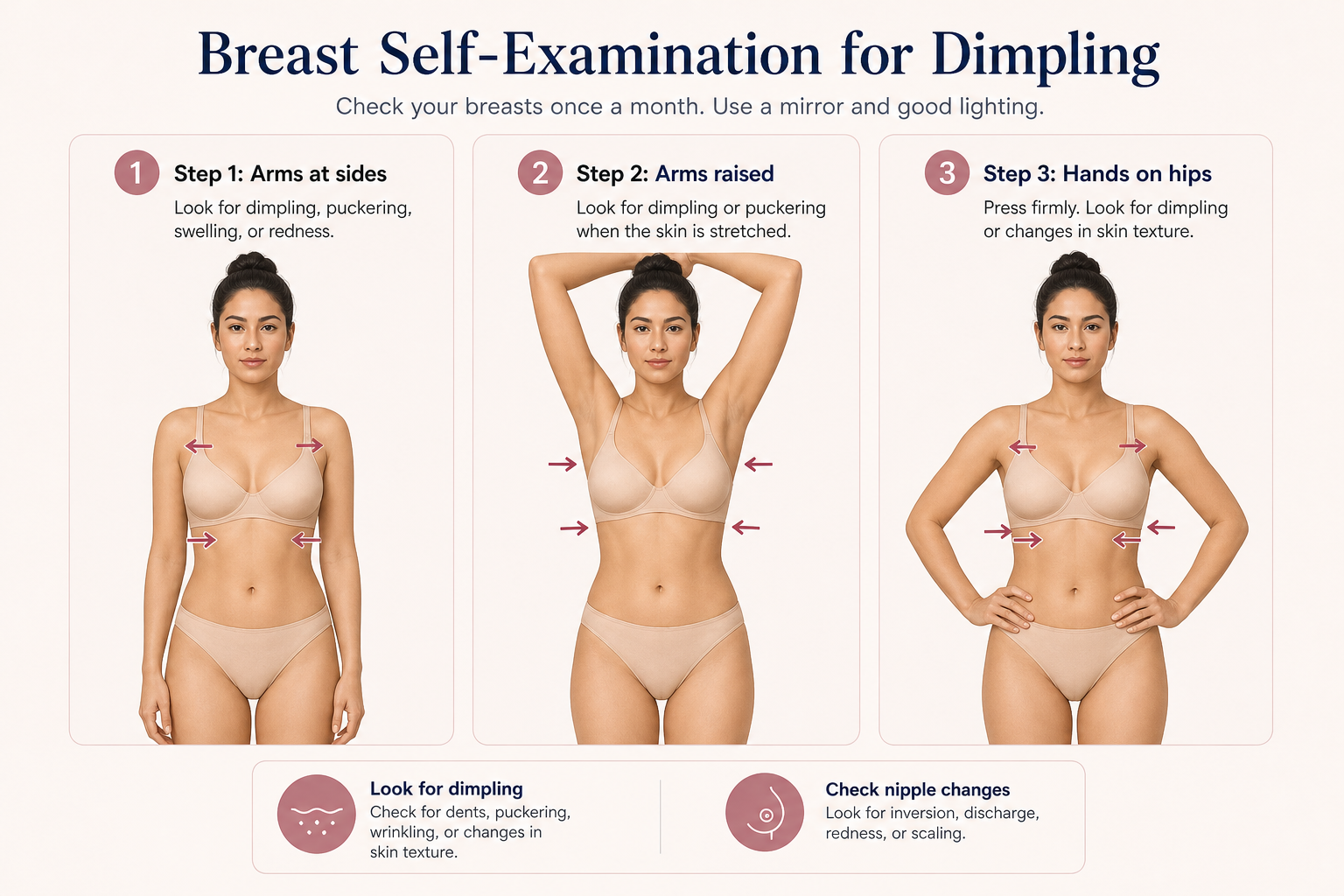
Look for any new indentation, puckering, or change in skin texture. Check whether the nipple has changed position, become inverted, or is producing any discharge. Look for any area of redness, thickening, or skin that looks or feels different from the surrounding tissue. Gently feel the breast tissue with the flat of your fingers in a systematic pattern, covering the entire breast and the area up to the armpit where the axillary lymph nodes are located. If you notice anything new or unusual, contact your doctor promptly. A breast self-exam is not a substitute for clinical examination or screening mammography, but it can help you detect changes between appointments.
When to See a Doctor
Any new or unexplained breast skin change should be assessed by a doctor without delay. The following signs are particularly important and warrant prompt medical attention:
- A new dimple, indentation, or area of skin puckering on the breast
- Orange peel texture (peau d’orange) affecting any part of the breast
- Nipple retraction or a nipple that has recently become inverted
- Rapid swelling, redness, or warmth in the breast, especially without fever or infection
- Skin thickening or a heavy, full feeling in the breast that is new
- Swollen or tender lymph nodes under the arm
- Any nipple discharge, particularly if it is bloody or occurs without squeezing
- Skin changes that do not resolve after a course of antibiotics prescribed for suspected mastitis
Do not wait to see whether a skin change resolves on its own, particularly if it has been present for more than a week or two without an obvious benign explanation. Early diagnosis is one of the most important factors in treatment outcomes for all forms of breast cancer, including IBC.
How Is Breast Dimpling Diagnosed?
Diagnosis begins with a thorough clinical breast examination by a doctor or specialist. The clinician will assess the appearance and texture of the skin, check for any palpable masses, and examine the axillary lymph nodes. They will ask about how long the change has been present, whether it has changed over time, and any relevant medical history including previous breast conditions, surgery, or injury.
Imaging is an essential part of the assessment. A mammogram is usually the first imaging test requested, but it is important to note that mammography can miss inflammatory breast cancer — IBC does not always form a discrete mass that shows up clearly on a mammogram, and women with dense breast tissue may have reduced mammographic sensitivity. An ultrasound is often used alongside or instead of mammography, particularly in younger women or those with dense breasts, as it can detect skin thickening, lymph node changes, and fluid accumulation that may not be visible on a mammogram. A breast MRI may be requested when other imaging is inconclusive or when IBC is suspected, as MRI provides detailed information about the extent of disease and lymphatic involvement.
If imaging findings are suspicious or inconclusive, a tissue sample is needed to confirm the diagnosis. A skin punch biopsy — in which a small circular sample of skin is removed under local anaesthetic — is particularly useful when IBC or skin involvement is suspected, as it allows the pathologist to look for cancer cells within the dermal lymphatics. A core biopsy or fine needle aspiration may be used to sample a deeper mass if one is present. The type of biopsy recommended will depend on the clinical findings and the area of concern.
Breast Dimpling in Men
Although breast cancer is far less common in men than in women, it does occur, and breast dimpling is a relevant warning sign in men as well. Male breast cancer accounts for less than one percent of all breast cancer cases, but the same mechanisms — tumour tethering of Cooper’s ligaments, lymphatic blockage — can produce skin changes including dimpling, puckering, and nipple retraction. Men are often less aware of breast cancer warning signs and may delay seeking assessment, which can result in later-stage diagnosis. Any man who notices a new skin change, lump, or nipple change on the chest should seek medical evaluation promptly.
Risk Factors and Who Is Most Affected
Breast dimpling caused by cancer can affect people of any age, sex, or background, but certain factors are associated with higher risk for specific conditions. Inflammatory breast cancer is diagnosed more frequently in younger women, in women who are overweight or obese, and in Black women compared with white women — a disparity that researchers are continuing to investigate. IBC is also more likely to be diagnosed at an advanced stage, partly because its symptoms can be mistaken for infection and partly because it does not always produce a lump that prompts earlier investigation.
General breast cancer risk factors — including age, family history, genetic mutations such as BRCA1 and BRCA2, previous breast conditions, hormone use, and lifestyle factors — apply broadly, though IBC does not follow the same risk profile as other breast cancers in all respects. Women with dense breast tissue face additional diagnostic challenges because dense tissue can obscure findings on mammography, making ultrasound or MRI more important components of their assessment.
Frequently Asked Questions
Is breast dimpling always a sign of cancer?
No. Breast dimpling can result from benign conditions including fat necrosis, mastitis, fibrocystic breast changes, and surgical scarring. However, because dimpling can also be an early sign of breast cancer — including inflammatory breast cancer — any new or unexplained skin change should be assessed by a doctor. It is not possible to determine the cause from appearance alone without clinical examination and appropriate imaging.
What kind of breast cancer causes dimpling?
Inflammatory breast cancer (IBC) is most strongly associated with breast dimpling and peau d’orange, but invasive ductal carcinoma, lobular breast cancer, and other forms can also cause skin tethering and dimpling when a tumour affects Cooper’s ligaments or the overlying skin. Paget’s disease of the breast causes skin changes specifically around the nipple and areola.
Does breast dimpling hurt?
Breast dimpling itself is not always painful. In inflammatory breast cancer, the breast may feel heavy, tender, or warm, and there may be a burning or aching sensation. Mastitis typically causes significant tenderness and pain. Dimpling caused by fat necrosis or tumour tethering of ligaments may be painless. The presence or absence of pain does not reliably indicate whether a cause is benign or cancerous.
Can dimpling appear without a lump?
Yes. Dimpling without a lump is a recognised presentation, particularly in inflammatory breast cancer, where cancer cells spread through the lymphatic channels of the skin rather than forming a discrete mass. Dimpling can also occur when a tumour is deep within the breast and not yet palpable. The absence of a lump does not rule out a serious underlying cause.
Can breast dimpling appear in both breasts at the same time?
Bilateral breast dimpling — affecting both breasts simultaneously — is uncommon and more likely to have a benign explanation such as skin changes related to weight fluctuation or ageing. However, any new bilateral change should still be assessed by a doctor. Inflammatory breast cancer and most other breast cancers typically affect one breast.
How is inflammatory breast cancer different from other breast cancers?
IBC is distinguished by its rapid onset, the absence of a discrete lump in many cases, and its characteristic skin changes including redness, warmth, swelling, and peau d’orange. It tends to be diagnosed at a later stage and has a higher mortality rate relative to its incidence than most other breast cancers. It requires a specific treatment approach, typically beginning with chemotherapy before surgery.
Will a mammogram detect inflammatory breast cancer?
A mammogram may not reliably detect IBC because IBC does not always form a discrete mass. Women with dense breast tissue face additional challenges with mammographic sensitivity. Ultrasound and breast MRI are often more informative for IBC assessment, and a skin punch biopsy is usually required to confirm the diagnosis by identifying cancer cells within the dermal lymphatics.
What to Do If You Notice Breast Skin Changes
Breast dimpling and other skin changes on the breast are symptoms that deserve prompt, professional attention — not watchful waiting at home. The range of possible causes spans from entirely benign conditions that resolve with simple treatment to aggressive cancers where early diagnosis makes a meaningful difference to outcomes. No article, symptom checker, or self-examination can replace a clinical assessment, and the reassurance that comes from a proper evaluation is far more reliable than the anxiety of uncertainty.
If you have noticed a new dimple, area of skin puckering, orange peel texture, nipple retraction, or any other unexplained change in your breast, contact your doctor or a breast specialist as soon as possible. Describe when you first noticed the change, whether it has evolved, and any other symptoms you have experienced. Bring this information to your appointment and ask about the full range of investigations that may be appropriate for your situation, including imaging and, if indicated, biopsy. Acting promptly gives you the best chance of a clear answer and, if treatment is needed, the best opportunity for a good outcome.