Gentle Rosacea Skincare Routine: A Dermatologist-Guided Approach
Rosacea is a chronic inflammatory skin condition that affects millions of people, causing persistent facial redness, visible blood vessels, and in some cases acne-like bumps or skin thickening. Building the right skincare routine can meaningfully reduce rosacea flare-up frequency and severity, but the wrong products can make symptoms significantly worse. This guide explains how to construct a gentle, evidence-informed routine for rosacea-prone skin, which ingredients to prioritize, which to avoid, and how to adapt your approach based on your specific rosacea subtype.
Key Takeaways
- A dermatologist-recommended skincare routine for rosacea centers on three core steps: a gentle non-foaming cleanser, a ceramide-rich moisturizer, and a mineral sunscreen with zinc oxide applied every morning.
- Fragrance, alcohol, sodium lauryl sulfate, witch hazel, and most chemical exfoliants are among the most common product-related rosacea flare-up triggers and should be avoided.
- Niacinamide, azelaic acid, centella asiatica, hyaluronic acid, and ceramides are among the best-supported ingredients for calming rosacea-prone skin and supporting skin barrier repair.
- Rosacea subtypes differ meaningfully: erythematotelangiectatic rosacea (persistent redness and flushing) and papulopustular rosacea (acne-like bumps) may benefit from slightly different product choices.
- Skincare alone does not replace prescription treatment; a dermatologist can assess whether topical or oral medications are appropriate alongside your routine.
Understanding Rosacea and Why Skincare Matters
Rosacea is not a single condition but a spectrum of subtypes, each with distinct features. Erythematotelangiectatic rosacea (ETR) is characterized by persistent central facial erythema, flushing, and visible blood vessels called telangiectases. Papulopustular rosacea (PPR) presents with inflammatory papules and pustules that resemble acne but lack the comedones (blackheads and whiteheads) typical of acne vulgaris. Phymatous rosacea involves progressive skin thickening, most commonly affecting the nose (rhinophyma). Ocular rosacea causes eye irritation, dryness, and recurrent styes. Understanding which subtype or combination of subtypes you have helps determine which skincare approach is most appropriate.
Across all subtypes, research consistently identifies skin barrier dysfunction as a central feature of rosacea. A compromised skin barrier allows irritants and allergens to penetrate more easily, amplifies inflammatory responses, and increases transepidermal water loss, leaving skin dehydrated and reactive. This is why skin barrier repair is not simply a cosmetic goal in rosacea — it is a clinically meaningful objective. Products that strengthen the barrier reduce the frequency and intensity of flares, while products that disrupt it can trigger or worsen symptoms even when they appear gentle on the label.
Rosacea Subtypes and Routine Differences
Most skincare guides treat rosacea as a uniform condition, but subtype-specific guidance is more clinically useful. If your primary concern is persistent redness and flushing (ETR), the priority is barrier support, anti-inflammatory ingredients, and rigorous sun protection. Calming serums containing niacinamide for rosacea or green tea extract are particularly relevant here, as both have demonstrated anti-inflammatory and vascular-calming properties in published research.
If you have papulopustular rosacea with acne-like bumps, azelaic acid becomes especially relevant. Azelaic acid is FDA-approved for rosacea and has both anti-inflammatory and antimicrobial properties, making it one of the most evidence-supported topical options for PPR. It can be used as a prescription formulation (15–20%) or in lower over-the-counter concentrations. Unlike salicylic acid or glycolic acid, azelaic acid does not typically aggravate rosacea-prone skin when introduced gradually. If you have both subtypes simultaneously — which is common — a routine that addresses barrier repair, redness, and mild breakouts simultaneously is appropriate, though prescription guidance is often warranted.
Step-by-Step Morning Routine for Rosacea
Step 1: Gentle Cleansing
Begin with a gentle non-foaming cleanser applied with your fingertips only — never a cleansing brush, exfoliating cloth, or sponge. Foaming cleansers frequently contain sodium lauryl sulfate (SLS), a surfactant that strips the skin’s natural lipid layer and disrupts the barrier. Look for a non-comedogenic, fragrance-free formula with a mild, low-pH formulation. Micellar water is a suitable alternative for those with very reactive skin, as it removes surface impurities without requiring rinsing with tap water, which can be drying. Always use lukewarm water — hot water dilates blood vessels and can trigger flushing, while cold water may cause reactive redness in sensitive skin.
Step 2: Calming Serum (Optional but Beneficial)
After cleansing and while skin is still slightly damp, a calming serum can deliver targeted anti-inflammatory and hydrating actives. Niacinamide (vitamin B3) at concentrations of 2–5% is one of the most well-supported options for rosacea-prone skin: it reduces transepidermal water loss, strengthens the skin barrier, and has demonstrated anti-inflammatory effects in clinical studies. Hyaluronic acid is another useful serum ingredient, functioning as a humectant that draws moisture into the skin without causing irritation. Centella asiatica (cica) extract, beta-glucan, panthenol (pro-vitamin B5), and allantoin are additional calming ingredients with a reasonable evidence base for sensitive and reactive skin. Apply the serum gently using fingertips only, pressing rather than rubbing.
Step 3: Fragrance-Free Moisturizer
A fragrance-free moisturizer applied while skin is still slightly damp helps seal in hydration and reinforce the skin barrier. Look for a ceramide-rich moisturizer, as ceramides are lipid molecules that form a critical part of the skin’s natural barrier structure. Formulations that combine ceramides with glycerin (a humectant), squalane (a gentle emollient derived from plant sources), and petrolatum or similar occlusives provide layered barrier support. Avoid moisturizers containing alcohol, fragrance or parfum (including natural fragrance), witch hazel, menthol, camphor, or eucalyptus — all of which can provoke rosacea flares even in products marketed as soothing.
Step 4: Mineral Sunscreen — Non-Negotiable
UV exposure is the most frequently reported rosacea trigger, cited by over 80% of patients in survey data from the National Rosacea Society. Applying a broad-spectrum SPF 30 or higher mineral sunscreen every morning — regardless of weather or season — is the single most impactful daily habit for reducing rosacea flare-up frequency. Mineral sunscreens containing zinc oxide and/or titanium dioxide are preferred over chemical sunscreen filters such as oxybenzone or avobenzone, which can cause stinging and irritation on rosacea-prone skin. Zinc oxide also has mild anti-inflammatory properties. Choose a non-comedogenic, fragrance-free formula with a lightweight texture; tinted mineral sunscreens have the added benefit of providing some color correction for redness.
Step-by-Step Evening Routine for Rosacea
Step 1: Makeup Removal and Cleansing
If you wear makeup, remove it before cleansing. Micellar water applied with a soft cotton pad using gentle pressing motions (not rubbing) is a well-tolerated option for rosacea-prone skin. Cleansing balms formulated without fragrance or essential oils are another option, particularly for those wearing heavier coverage products. Avoid oil cleansers that contain high concentrations of essential oils, as these can be irritating. Follow makeup removal with your gentle non-foaming cleanser using lukewarm water, again using only your fingertips.
Step 2: Active Treatment (If Using One)
The evening routine is the appropriate time to apply any active treatment, whether prescription or over-the-counter. Prescription topicals for rosacea include metronidazole gel or cream, azelaic acid (15–20%), brimonidine tartrate gel (for temporary redness reduction in ETR), and ivermectin cream (Soolantra), which targets the Demodex mite population implicated in PPR. If you are using azelaic acid over-the-counter, apply it after cleansing and before moisturizer. Allow it to absorb for a few minutes before the next step.
Retinoids deserve specific mention because they are frequently asked about in the context of rosacea and anti-aging. Low-dose retinol or retinaldehyde may be tolerated by some people with rosacea when introduced very gradually — starting once weekly and building slowly — but retinoids should generally be avoided during active flares. They can increase skin sensitivity and temporarily worsen redness. If anti-aging is a priority alongside rosacea management, peptides are a gentler alternative that can support collagen synthesis without the irritation risk associated with retinoids. Discuss retinoid use with a dermatologist before starting.
Step 3: Ceramide-Rich Moisturizer
Apply your fragrance-free moisturizer as the final step in the evening routine. At night, a slightly richer formulation may be appropriate, particularly in winter or for those with dry rosacea. Ingredients such as squalane, glycerin, ceramides, and petrolatum work together to restore the barrier overnight. Those with oily rosacea may prefer a lighter gel-cream texture to avoid congestion, while those with dry rosacea may benefit from a thicker cream or the addition of a small amount of petrolatum over particularly dry areas.
Ingredients to Prioritize and Ingredients to Avoid
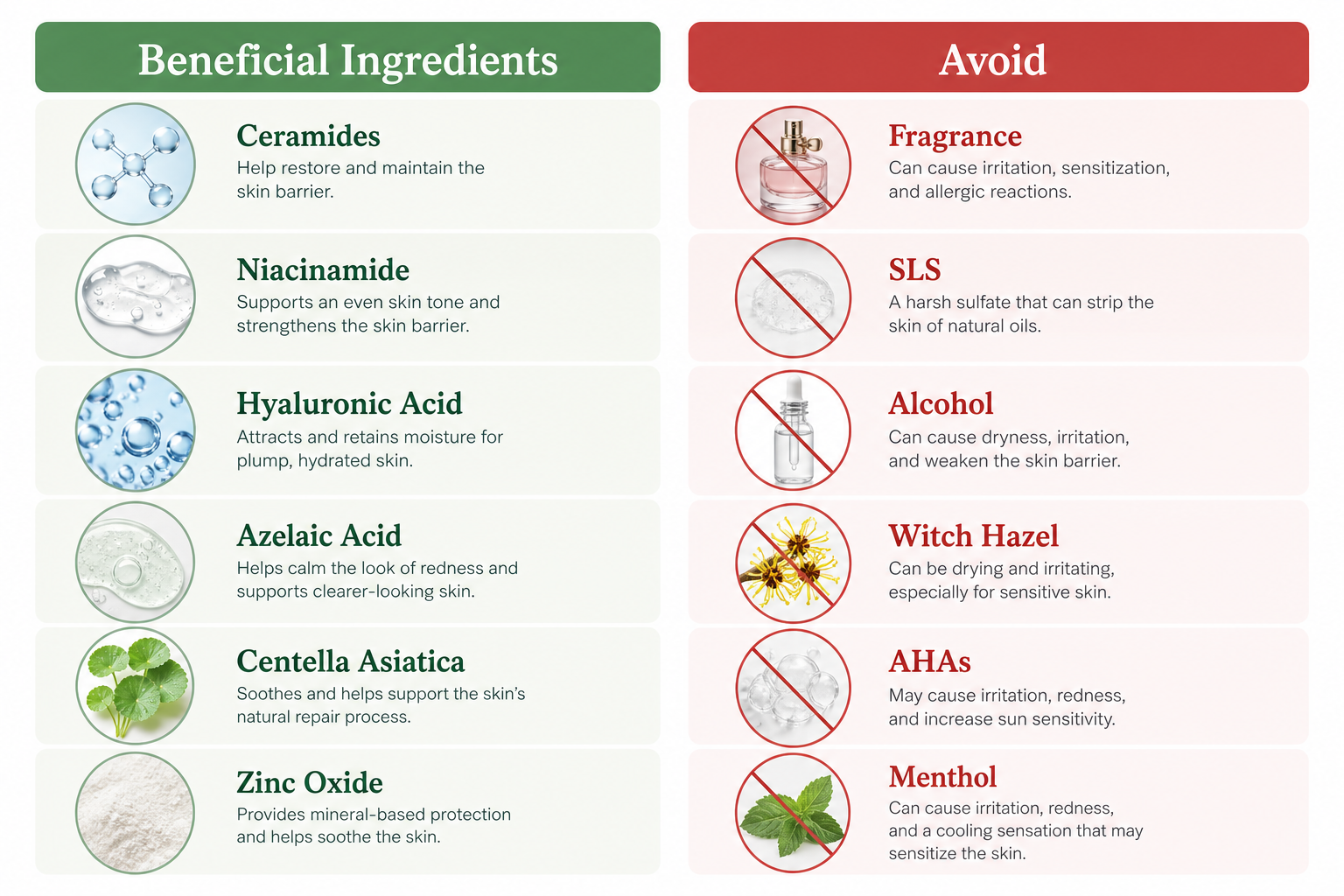
| Beneficial Ingredients | Ingredients to Avoid |
|---|---|
| Ceramides (barrier repair) | Fragrance / parfum (synthetic and natural) |
| Niacinamide (anti-inflammatory, barrier support) | Sodium lauryl sulfate (SLS) |
| Hyaluronic acid (humectant hydration) | Alcohol (drying, irritating) |
| Azelaic acid (FDA-approved, anti-inflammatory) | Witch hazel (astringent) |
| Centella asiatica / cica (soothing) | Glycolic acid, lactic acid (AHAs) |
| Green tea extract / EGCG (antioxidant) | Salicylic acid (BHA) |
| Squalane (gentle emollient) | Menthol, peppermint, camphor, eucalyptus |
| Glycerin (humectant) | Essential oils (no clinical evidence for rosacea) |
| Allantoin (soothing) | Chemical sunscreen filters (oxybenzone, avobenzone) |
| Panthenol / pro-vitamin B5 (anti-inflammatory) | Retinoids during active flares |
| Beta-glucan (calms immune response) | Physical scrubs, exfoliating cloths, facial brushes |
| Zinc oxide / titanium dioxide (mineral UV filters) | Astringents and toners with alcohol |
How to Safely Introduce New Products
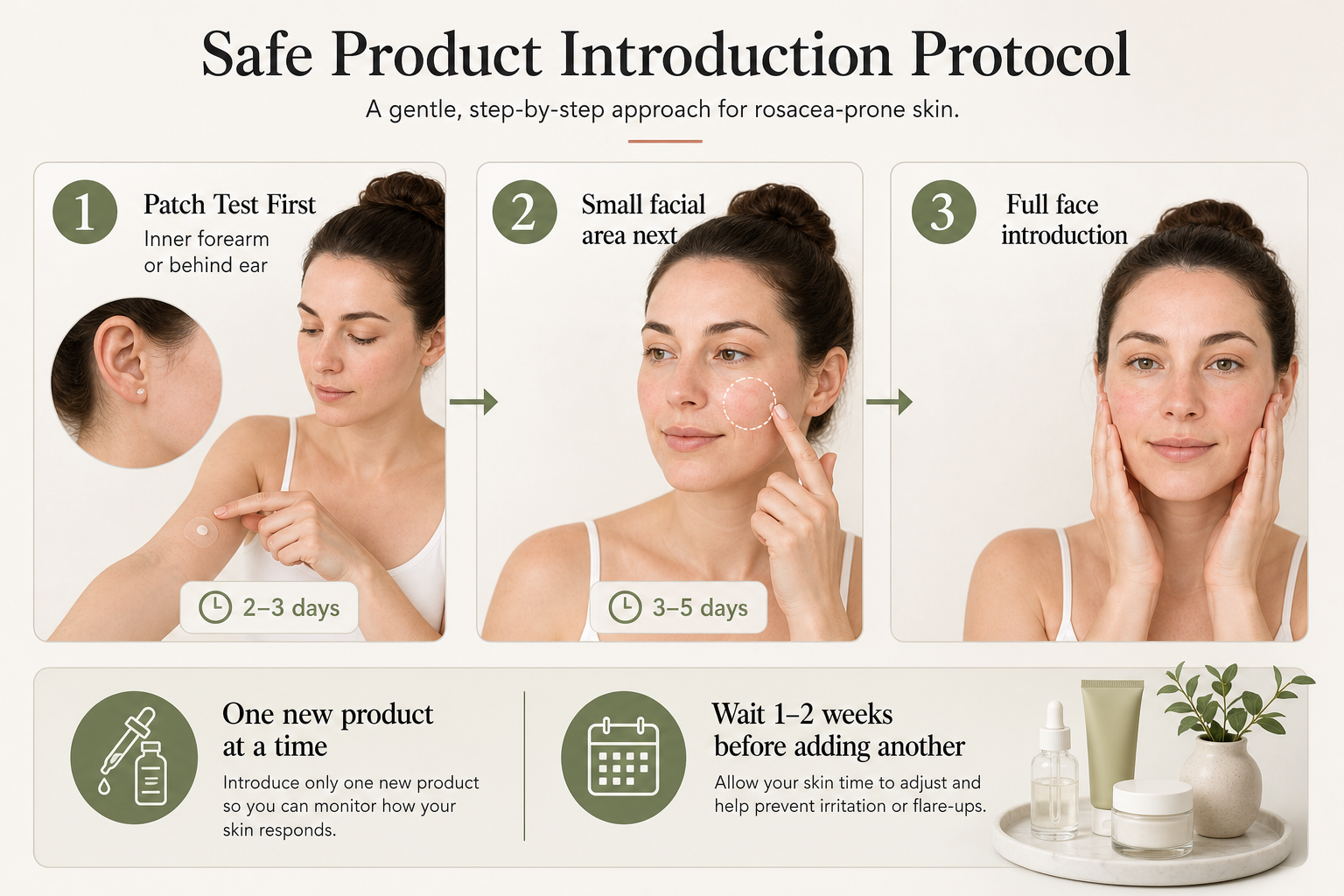
One of the most underserved areas in rosacea skincare guidance is the practical protocol for introducing new products. Rosacea-prone skin can react unpredictably, and introducing multiple new products simultaneously makes it impossible to identify which one caused a reaction. A structured approach significantly reduces this risk.
Begin by patch testing new products before applying them to your full face. Apply a small amount to the inner forearm or behind the ear for two to three consecutive days and observe for redness, stinging, or itching. If no reaction occurs, apply the product to a small area of the face — such as the cheek — for a further three to five days before incorporating it into your full routine. Introduce only one new product at a time, waiting at least one to two weeks before adding another. This approach allows you to identify problematic products quickly and avoid compounding reactions. Keep a simple log of new products and any skin changes; this information is also useful to share with a dermatologist.
Identifying and Managing Your Personal Rosacea Triggers
Skincare products are only one category of rosacea flare-up triggers. Environmental and lifestyle factors play an equally significant role, and these vary considerably between individuals. Common triggers identified by the American Academy of Dermatology and the National Rosacea Society include sun and UV exposure, hot water and heat, spicy foods, alcohol consumption (which causes vasodilation), emotional stress, wind and extreme temperatures, vigorous exercise, and certain medications including some blood pressure drugs.
Keeping a trigger journal — a simple daily log of activities, foods, environmental conditions, and skin reactions — can help you identify your personal pattern over two to four weeks. This is more useful than relying on population-level trigger lists, because individual responses vary significantly. For example, some people with rosacea tolerate moderate exercise without flaring if they cool down promptly with a fan and lukewarm water, while others find any increase in core body temperature reliably triggers redness. Personalizing your avoidance strategy based on your own data is more effective than attempting to avoid every reported trigger simultaneously.

Rosacea-Friendly Makeup and Coverage
Makeup can be used safely with rosacea when products are chosen carefully. Mineral powder makeup is generally well tolerated because it contains fewer potential irritants than liquid formulations and often includes zinc oxide, which has mild anti-inflammatory properties. A green-tinted color-correcting primer applied before foundation can visually neutralize facial redness without requiring heavy coverage. Choose fragrance-free, non-comedogenic makeup products and avoid formulations containing alcohol, fragrance, or known irritants.
Makeup removal deserves as much attention as product selection. Rubbing or scrubbing to remove makeup can mechanically irritate rosacea-prone skin and trigger flushing. Micellar water applied with a soft cotton pad using gentle pressing motions is a reliable first step. For heavier or long-wear coverage, a fragrance-free cleansing balm can dissolve makeup more effectively before the micellar water step, reducing the need for friction. Avoid makeup wipes, which typically require rubbing and may contain alcohol or fragrance.
Seasonal Adjustments to Your Rosacea Routine
Rosacea symptoms often fluctuate with the seasons, and adapting your routine accordingly can help maintain better control year-round. In summer, UV exposure intensifies, making broad-spectrum SPF 30 or higher mineral sunscreen even more critical. Lightweight, non-comedogenic moisturizer textures are preferable in warm weather to avoid overheating the skin. Reapplying sunscreen every two hours during outdoor activity is important, as UV exposure remains the most consistently reported rosacea trigger.
In winter, cold air and wind can strip moisture from the skin and compromise the barrier, while indoor heating reduces ambient humidity. A richer ceramide-rich moisturizer or the addition of a squalane facial oil over your regular moisturizer can help compensate. Wearing a soft scarf to protect the face from wind — avoiding rough wool fabrics that contact the skin directly — is a practical physical measure. Humidifiers in sleeping areas may also help maintain skin hydration during cold months.
When Skincare Alone Is Not Enough
A well-constructed skincare routine is an important foundation for managing rosacea, but it is not a substitute for medical treatment in moderate to severe cases. Prescription topical treatments such as metronidazole, azelaic acid at prescription strength, brimonidine, and ivermectin cream have demonstrated efficacy in clinical trials for reducing rosacea papules, pustules, and persistent erythema. Oral antibiotics such as low-dose doxycycline (sub-antimicrobial dose) are used for their anti-inflammatory rather than antibiotic properties in PPR.
In-office procedures can address features that skincare cannot meaningfully improve. Intense pulsed light (IPL) and vascular lasers such as the Vbeam pulsed dye laser are used to reduce visible blood vessels and persistent redness in ETR. These treatments do not cure rosacea but can provide significant cosmetic improvement that is maintained with ongoing skincare and trigger management. A dermatologist can assess which combination of prescription treatment, in-office procedures, and skincare is appropriate for your specific subtype and severity.
Frequently Asked Questions
Can rosacea be cured with the right skincare routine?
Rosacea is a chronic condition without a known cure. A consistent, well-chosen skincare routine can significantly reduce flare frequency and severity and help maintain remission, but it does not eliminate the underlying condition. Prescription treatments and in-office procedures may be needed for more complete symptom control.
Is mineral or chemical sunscreen better for rosacea?
Mineral sunscreen with zinc oxide or titanium dioxide is generally preferred for rosacea-prone skin. Chemical sunscreen filters such as oxybenzone and avobenzone can cause stinging, burning, or irritation on sensitive skin. Zinc oxide also has mild anti-inflammatory properties. Choose a fragrance-free, non-comedogenic mineral formula with broad-spectrum SPF 30 or higher.
Can I use retinol if I have rosacea?
Retinol and other retinoids can be used cautiously by some people with rosacea, but they carry a meaningful risk of increasing skin sensitivity and triggering flares, particularly during active rosacea episodes. If anti-aging is a priority, peptides are a gentler starting point. If you wish to try retinol, introduce it very slowly — once weekly at a low concentration — and ideally do so under dermatologist guidance.
How long does it take for a rosacea skincare routine to show results?
Skin barrier repair and reduction in baseline redness typically take four to eight weeks of consistent use to become noticeable. Some people see improvement in skin comfort and reactivity within two to three weeks. Results depend on product choice, consistency, trigger avoidance, and whether prescription treatment is also being used.
Does diet affect rosacea?
Research published in peer-reviewed journals, including a narrative review in PMC, suggests a link between rosacea and gut health, including associations with small intestinal bacterial overgrowth and alterations in the gut microbiome. Beyond the well-known triggers of spicy food and alcohol, some patients report sensitivity to histamine-rich foods, hot beverages, and certain fermented foods. Keeping a food and symptom diary can help identify individual dietary triggers, though the evidence base for specific dietary interventions in rosacea remains developing.
What is the simplest effective routine for rosacea?
A three-step core routine — gentle non-foaming cleanser, fragrance-free ceramide-rich moisturizer, and mineral sunscreen with zinc oxide every morning — is the minimum effective foundation. Adding a niacinamide or hyaluronic acid serum and an evening active such as azelaic acid can provide additional benefit. Simplicity and consistency matter more than using many products.
Building a Rosacea Routine That Works for Your Skin
The best skincare for rosacea is not defined by a single product but by a consistent, simplified routine built around barrier support, anti-inflammatory ingredients, and rigorous sun protection. Prioritizing a gentle non-foaming cleanser, a ceramide-rich fragrance-free moisturizer, and a mineral sunscreen with zinc oxide every morning provides a clinically sound foundation for most people with rosacea-prone skin. Adding a calming serum with niacinamide or hyaluronic acid and, where appropriate, azelaic acid in the evening can meaningfully reduce redness and improve skin resilience over time.
Equally important is what you avoid: fragrance, alcohol, SLS, witch hazel, AHAs, BHAs, and physical exfoliation are among the most common product-related triggers and should be removed from your routine regardless of how they are marketed. Introducing new products one at a time with a structured patch test protocol protects against compounding reactions and helps you identify what your skin genuinely tolerates.
If your rosacea is moderate to severe, involves significant papules and pustules, or is not responding to optimized skincare, a consultation with a dermatologist is the appropriate next step. Prescription treatments and in-office procedures can provide a level of control that skincare alone cannot achieve, and a dermatologist can tailor recommendations to your specific rosacea subtype, skin type, and lifestyle. A well-managed routine, combined with professional guidance where needed, gives rosacea-prone skin the best realistic chance of remaining calm and comfortable long-term.