Are Lip Fillers Haram? Islamic Rulings, Scholar Views & Multi-Faith Perspectives
Whether lip fillers are haram is one of the most frequently asked questions at the intersection of aesthetic medicine and religious practice. The answer is not a simple yes or no — it depends on scholarly interpretation, the purpose of the procedure, the ingredients used, and whether the alteration is temporary or permanent. This article brings together the main Islamic jurisprudential positions, names the scholars and institutions behind them, addresses the medical necessity exception, examines ingredient purity, and offers a structured comparison of how Christianity and Judaism approach cosmetic procedures — a perspective largely absent from existing discussions on this topic.
Key Takeaways
- The majority position among contemporary Islamic scholars is that purely cosmetic lip fillers are not permissible, primarily because they constitute taghyir khalqillah — changing Allah’s creation without necessity.
- A medical necessity exception (darura) exists: corrective or reconstructive procedures for conditions such as a cleft lip or post-trauma repair are generally considered permissible across scholarly opinion.
- The temporary nature of hyaluronic acid fillers (which dissolve within months) is acknowledged by some scholars but does not, in the majority view, automatically make the procedure permissible.
- Ingredient purity matters independently: fillers derived from porcine (pig-derived) sources raise a separate concern under Islamic law, even if the procedure itself were otherwise permitted.
- Christianity and Judaism each have their own frameworks — centred on stewardship of the body and halachic reasoning respectively — and neither tradition issues a single universal ruling.
What Does Haram Mean, and Why Does It Apply to Cosmetic Procedures?
In Islamic jurisprudence, haram refers to actions that are explicitly forbidden. The opposite, halal, describes what is permitted. Between these two poles lie several intermediate categories, and scholars apply considerable reasoning — known as ijtihad — to modern questions that the classical texts did not directly address, including injectable cosmetic procedures.
The primary Quranic reference used in discussions about cosmetic alteration is Surah An-Nisa 4:119, in which Shaytan declares his intention to command people to alter the creation of Allah. Classical and contemporary scholars have used this verse as the basis for the concept of taghyir khalqillah — the prohibition on changing what Allah has created without legitimate reason. A supporting hadith, recorded in Sahih al-Bukhari (5931), condemns the practice of altering the body for the sake of beauty, using the example of eyebrow plucking to change the natural appearance. Scholars have extended the reasoning in both hadith and Quranic verse to modern cosmetic interventions.
The key jurisprudential question is whether a given procedure constitutes tajmil — beautification for its own sake, which is generally impermissible when it involves permanent or significant alteration — or whether it falls within the permitted category of tahsin, which covers grooming and enhancement that does not fundamentally alter the body’s natural form. Lip fillers, which introduce a foreign substance to change the shape and volume of the lips, are assessed against this distinction.
What Islamic Scholars and Fatwa Bodies Say
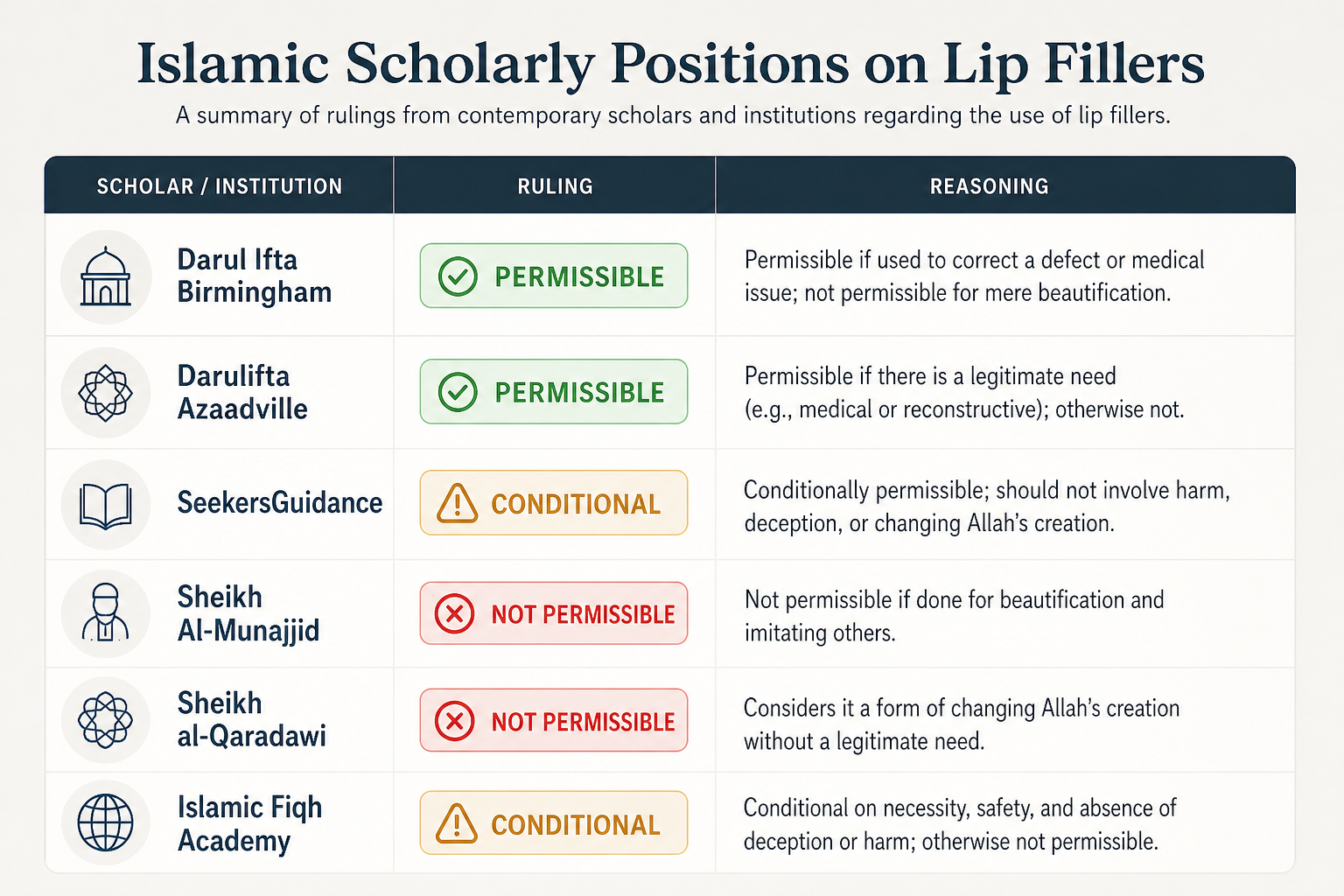
Several authoritative institutions and named scholars have issued rulings on lip fillers or closely analogous cosmetic procedures. Their positions are summarised below.
| Scholar / Institution | Ruling | Key Reasoning |
|---|---|---|
| Darul Ifta Birmingham (Hanafi) | Discouraged / not permissible for cosmetic purposes | Constitutes alteration of Allah’s creation; medical exception acknowledged |
| Darulifta Azaadville (Hanafi) | Not permissible | Purely cosmetic lip augmentation falls under prohibited taghyir; medical necessity changes the ruling |
| SeekersGuidance (Hanafi) | Not permissible | Cites both tajmil and the concept of muthla (unnecessary bodily interference); temporary nature does not override the prohibition |
| Sheikh Muhammad Al-Munajjid (IslamQA.info) | Not permissible | Analogous to lip-swelling creams used to alter natural appearance; falls under changing Allah’s creation |
| Sheikh Yusuf al-Qaradawi | Permissible with conditions | Distinguishes between excessive vanity-driven alteration and moderate beautification; emphasises intention (niyyah) and proportionality |
| Islamic Fiqh Academy | Permissible for corrective / reconstructive purposes; impermissible for purely cosmetic use | Applies the darura principle; cosmetic-only procedures without medical indication are not covered |
The scholar consensus leans toward impermissibility for purely cosmetic lip augmentation. Sheikh al-Qaradawi’s more permissive position is a minority view, though it is cited by those who argue that moderate, non-excessive beautification does not cross the threshold of prohibited alteration. The majority of Hanafi institutions — the most widely followed madhab in South Asia, the UK, and much of the Muslim world — hold that cosmetic lip fillers are not permissible.
Does the Temporary Nature of Hyaluronic Acid Fillers Change the Ruling?
A common question is whether the temporary vs. permanent nature of a procedure affects its permissibility. Hyaluronic acid filler — the most widely used type in lip augmentation — is a biodegradable substance that the body gradually breaks down, typically over six to twelve months. Unlike surgical implants or permanent lip augmentation techniques, hyaluronic acid fillers dissolve naturally and can also be reversed using an enzyme called hyaluronidase.
Some individuals reason that because the alteration is temporary, it does not constitute a lasting change to Allah’s creation and should therefore be treated differently from permanent cosmetic surgery. SeekersGuidance and Darul Ifta Birmingham have both addressed this argument directly. Their position is that the temporary nature of the filler does not, by itself, render the procedure permissible. The act of introducing a foreign substance to alter the appearance of the lips — even temporarily — still falls within the category of taghyir (alteration) rather than tahsin (permitted beautification). The intention behind the procedure and the degree of alteration remain the primary considerations, not the duration of the effect.
That said, some scholars acknowledge that temporality is a mitigating factor that may reduce the severity of the ruling in certain contexts, particularly when the alteration is minor and the intention is not rooted in excessive vanity. This remains a minority position and does not represent a formal fatwa permitting the procedure.
The Medical Necessity Exception
Islamic jurisprudence applies the principle of darura — necessity — to situations where a normally impermissible action becomes permissible because of genuine need. In the context of lip procedures, this exception is consistently recognised across scholarly opinion.
Corrective or reconstructive procedures are generally considered permissible when they address a congenital lip deformity such as a cleft lip, repair damage caused by an accident or burn, or restore function and normal appearance following illness or trauma. In these cases, the procedure is not classified as purely cosmetic lip augmentation driven by tajmil; it is a medically indicated corrective procedure aimed at restoring what was lost or was never present due to a medical condition.
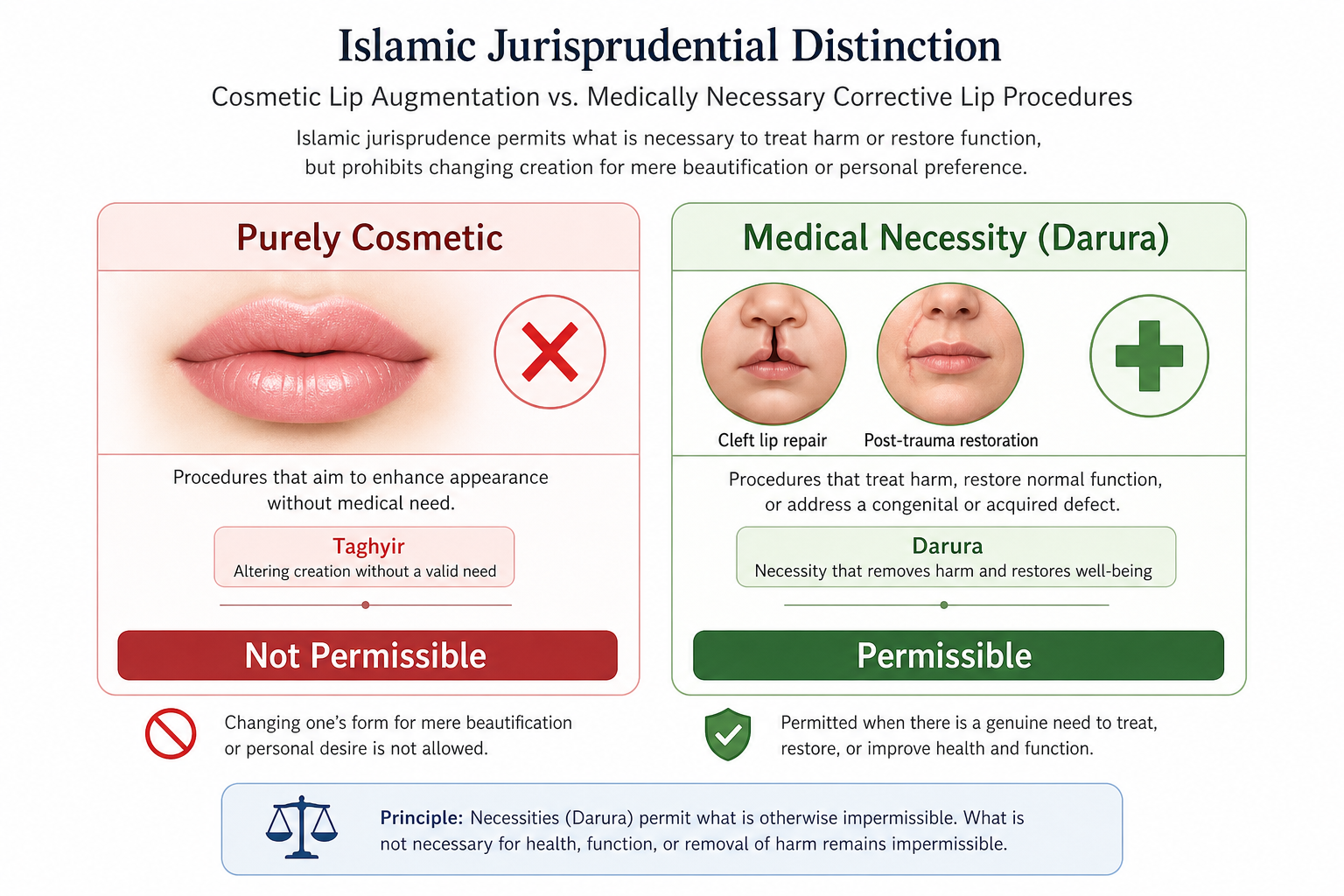
The distinction between a purely cosmetic procedure and a medically indicated one is therefore central to the Islamic ruling. A person seeking fuller lips to conform to a beauty trend is in a different position, jurisprudentially, from a person seeking to correct a lip deformity that causes functional or significant psychological distress. Scholars who apply the darura principle carefully note that the exception should not be stretched to cover procedures that are, in reality, motivated by vanity or social pressure rather than genuine medical need.
Ingredient Purity: The Halal Status of Filler Ingredients
Even if a scholar were to permit lip fillers under certain conditions, a separate question arises regarding ingredient purity. Hyaluronic acid used in dermal fillers can be derived from different sources. Historically, some formulations used hyaluronic acid extracted from rooster combs or other animal tissues. Modern pharmaceutical-grade hyaluronic acid fillers are predominantly produced through bacterial fermentation, which does not involve animal-derived ingredients and is generally considered acceptable from a halal perspective.
However, some filler products or associated preparations may contain ingredients derived from porcine (pig-derived) sources, including certain stabilisers or lidocaine formulations. Porcine-derived substances are impermissible under Islamic law regardless of the procedure’s overall ruling. A Muslim patient who is considering any injectable treatment should ask the clinic directly about the specific product being used, request the manufacturer’s ingredient information, and verify whether the product has been assessed for halal compliance.
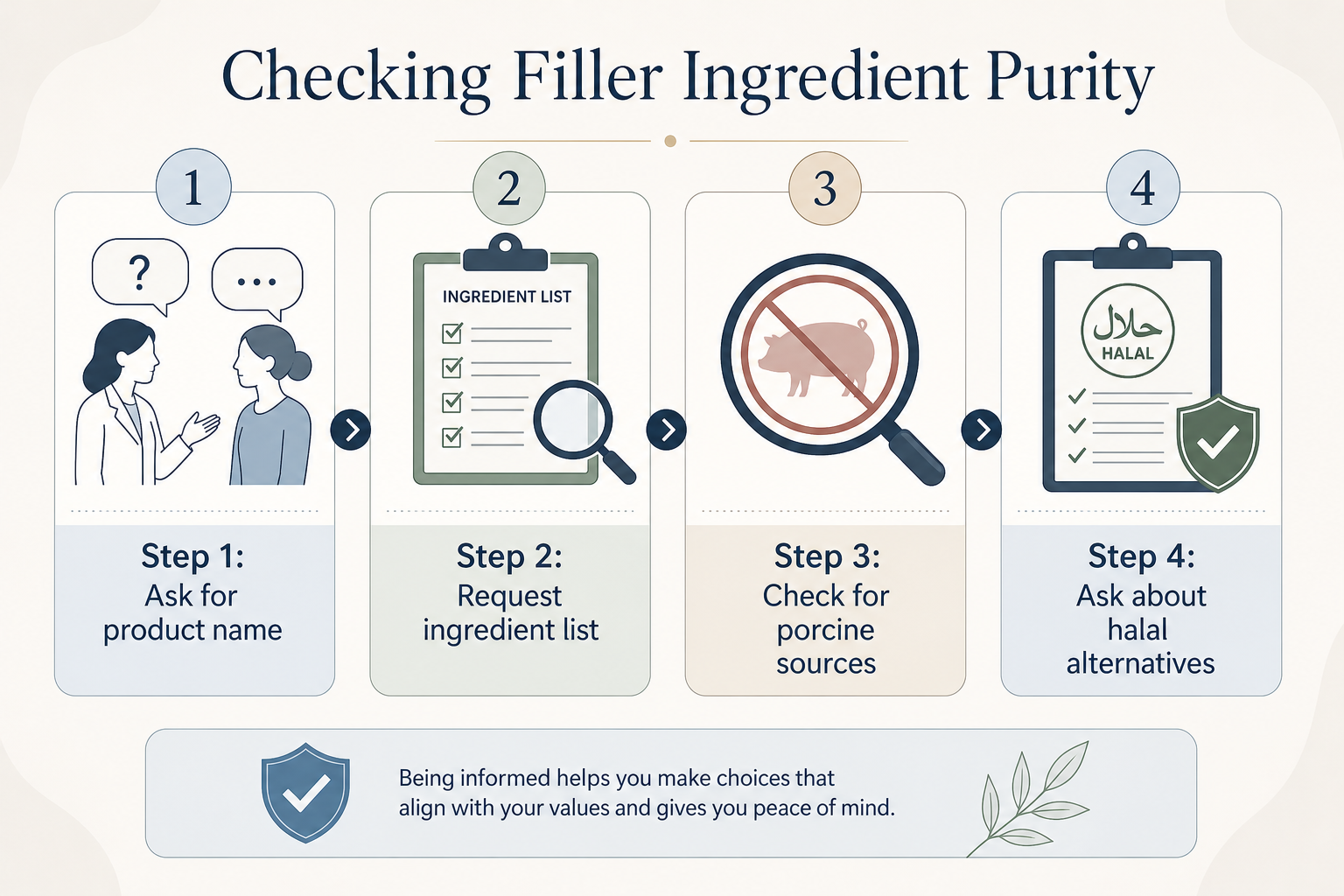
Practically, this means asking questions such as: Is the hyaluronic acid in this filler produced through bacterial fermentation? Does the formulation contain any animal-derived components? Is there a halal-certified alternative available? Reputable clinics should be able to provide this information or direct patients to the manufacturer’s documentation. This ingredient-purity consideration applies independently of the broader jurisprudential question about whether the procedure itself is permissible.
What If I Already Had Lip Fillers Before Learning the Ruling?
This is a genuinely common concern, particularly among younger Muslim women who may have undergone lip augmentation before engaging with Islamic scholarship on the topic. The pastoral response from scholars such as those at SeekersGuidance is compassionate and non-judgmental. In Islamic theology, actions performed in ignorance (jahl) are treated differently from deliberate transgressions. A person who had lip fillers without knowledge of the ruling is not considered to have sinned in the same way as someone who proceeded knowingly.
The recommended course of action, according to scholars who hold that cosmetic lip fillers are impermissible, is to seek sincere repentance (tawbah), resolve not to repeat the procedure, and — if the individual wishes — to allow the filler to dissolve naturally or to have it dissolved using hyaluronidase. There is no obligation to have the filler immediately removed, and scholars do not generally advise causing harm to oneself in the process of correcting a past action. The emphasis is on intention going forward rather than punitive action in the present.
How Do Christianity and Judaism View Lip Fillers and Cosmetic Procedures?
A structured comparison of religious perspectives on cosmetic procedures is largely absent from existing discussions, yet many patients come from Christian or Jewish backgrounds and face similar questions about faith and aesthetic medicine.
Christian Perspectives
Christianity does not have a single centralised authority issuing rulings on cosmetic procedures in the way that Islamic jurisprudence operates through fatwas and recognised scholars. The dominant Christian ethical framework draws on the concept of the body as a temple, derived from 1 Corinthians 6:19-20, which describes the body as a temple of the Holy Spirit and calls believers to honour God with their bodies. This principle of stewardship of the body is used by many Christian thinkers to evaluate cosmetic procedures.
The Catholic Church’s Catechism (CCC 2290) addresses the virtue of temperance and warns against vanity and excessive concern with physical appearance, but does not explicitly prohibit cosmetic procedures. Catholic moral theology generally evaluates cosmetic interventions on the basis of proportionality, motive, and whether the procedure serves a legitimate human good. Reconstructive procedures following illness or injury are broadly accepted; purely elective procedures motivated by vanity are viewed with more caution, though not universally condemned.
Protestant and Orthodox Christian traditions vary considerably. Many Protestant denominations leave cosmetic decisions to personal conscience, applying a motive-based ethics framework: the question is not whether the procedure is inherently sinful but whether the motivation behind it reflects pride, discontentment, or an unhealthy preoccupation with outward appearance. 1 Peter 3:3-4 is frequently cited, which contrasts outward adornment with the inner beauty of a gentle and quiet spirit. The practical conclusion in most mainstream Christian contexts is that lip fillers are not categorically forbidden but should be approached with honest reflection on motive and proportion.
Jewish Perspectives
Jewish law (halacha) approaches cosmetic procedures through several lenses: the prohibition on self-harm, the concern about arrogance and vanity, and the distinction between reconstructive and purely aesthetic intervention. A halachic ruling on cosmetic surgery typically weighs the psychological benefit to the individual against the risks involved and the motivation behind the procedure.
Orthodox rabbinic authorities generally permit reconstructive procedures and may permit cosmetic procedures when there is a significant psychological need — for example, when a physical feature causes genuine distress that affects a person’s functioning or wellbeing. Purely aesthetic procedures motivated by vanity or social conformity are viewed less favourably, though they are not universally prohibited. Reform and Conservative Jewish communities tend to apply a more permissive framework, emphasising individual autonomy and the legitimacy of personal wellbeing as a religious value. The Talmudic principle of pikuach nefesh (preservation of life and wellbeing) can be invoked where psychological suffering is demonstrable, though its application to elective cosmetic procedures is debated among rabbinic authorities.
Multi-Faith Comparison at a Glance
| Tradition | General Position on Cosmetic Lip Fillers | Key Principle | Exception |
|---|---|---|---|
| Islam (majority scholarly view) | Not permissible for purely cosmetic use | Taghyir khalqillah — changing Allah’s creation | Medical necessity (darura); corrective procedures |
| Islam (minority view — al-Qaradawi) | Permissible with conditions | Moderate beautification; intention and proportionality | Must not be excessive or vanity-driven |
| Catholic Christianity | Cautious; not explicitly forbidden | Stewardship of the body; temperance | Reconstructive / medically indicated procedures |
| Protestant Christianity | Personal conscience; motive-based | Body as a temple; inner beauty over outward appearance | Varies by denomination and individual discernment |
| Orthodox Judaism | Cautious; permissible with significant psychological need | Halachic ruling balancing harm, vanity, and wellbeing | Reconstructive; demonstrable psychological distress |
| Reform / Conservative Judaism | Generally permissible with reflection | Individual autonomy; personal wellbeing as a value | Broad latitude; motive still considered |
Social Media Pressure, Religious Identity, and the Psychological Dimension
The question of whether lip fillers are haram does not arise in a cultural vacuum. Many young Muslim women encounter it in the context of social media beauty standards that heavily promote full, augmented lips as an aesthetic ideal. The pressure to conform to these standards — often amplified by influencer culture and filtered imagery — can create genuine tension between religious identity and the desire to participate in mainstream beauty culture.
Scholars and Muslim counsellors who address this topic often emphasise that the Islamic framework is not designed to make believers feel inadequate about their natural appearance. The concept of rida (contentment) and shukr (gratitude) for the body one has been given is presented not as a restriction but as a form of spiritual wellbeing. The concern about purely cosmetic procedures is rooted in the idea that chasing external beauty standards — particularly those driven by vanity rather than genuine need — can undermine a person’s relationship with their own identity and with their faith.
This psychological dimension is worth acknowledging honestly. A person who feels significant distress about their appearance, whether due to a genuine physical concern or the cumulative effect of social comparison, is in a different position from someone seeking a trend-driven enhancement. Both Islamic jurisprudence and the halachic discussion in Judaism recognise that psychological wellbeing is a legitimate consideration — though the threshold for what constitutes sufficient need to change a ruling varies considerably between scholars and traditions.
Botox vs. Lip Fillers: Are the Rulings the Same?
Botulinum toxin (commonly known by the brand name Botox) and lip fillers are frequently discussed together, but they are distinct treatments with potentially different jurisprudential implications. Botulinum toxin works by temporarily relaxing specific muscles, reducing the appearance of dynamic lines. It does not introduce a foreign volumising substance into the tissue in the same way that a dermal filler does. Some scholars who have addressed Botox argue that because it works with the body’s existing musculature rather than adding foreign material, it may be assessed differently — though the majority position still views purely cosmetic Botox as falling within the category of impermissible alteration.
Lip fillers, by contrast, introduce hyaluronic acid or another substance directly into the lip tissue to increase volume and change shape. This is a more direct form of physical alteration, which is why some scholars who might take a more lenient view of Botox maintain a stricter position on fillers. Patients who are researching the religious permissibility of one treatment should not assume that the ruling automatically applies to the other — each procedure warrants its own assessment.
Frequently Asked Questions
Is lip filler haram if it dissolves after six months?
The majority scholarly position is that the temporary nature of hyaluronic acid filler does not automatically make the procedure permissible. The act of altering the lips with a foreign substance is still considered a form of taghyir (alteration of Allah’s creation), regardless of how long the effect lasts. Some scholars treat temporality as a mitigating factor, but this does not represent a formal ruling permitting the procedure.
Are lip fillers permissible for correcting a lip deformity?
Yes, in most scholarly opinions. The principle of darura (necessity) permits procedures that correct a congenital deformity, repair damage from an accident or illness, or restore normal appearance and function. A corrective or reconstructive procedure is treated differently from purely cosmetic lip augmentation.
Does the ingredient source of the filler matter in Islam?
Yes, independently of the broader ruling on the procedure. Fillers containing porcine-derived (pig-derived) substances are impermissible under Islamic law. Most modern hyaluronic acid fillers use bacterially fermented hyaluronic acid, which does not involve animal-derived ingredients, but patients should verify this with their clinic before proceeding.
What should I do if I already had lip fillers before knowing the ruling?
Scholars generally advise sincere repentance (tawbah) and a resolution not to repeat the procedure. There is no obligation to have the filler immediately dissolved, and causing harm to oneself in the process of correcting a past action is not recommended. The filler can be allowed to dissolve naturally or removed if the individual chooses.
Do all Islamic scholars agree that lip fillers are haram?
No. The majority position — held by Darul Ifta Birmingham, Darulifta Azaadville, SeekersGuidance, and Sheikh Al-Munajjid — is that purely cosmetic lip fillers are not permissible. Sheikh Yusuf al-Qaradawi represents a minority view that moderate beautification with good intention may be permissible. Individuals are encouraged to consult a qualified scholar from their own tradition for a personal ruling.
Is the ruling the same for Christians and Jews?
Neither Christianity nor Judaism issues a single universal ruling equivalent to an Islamic fatwa. Christian ethics generally applies a motive-based framework centred on stewardship of the body, while Jewish halachic reasoning weighs psychological need, risk, and the distinction between reconstructive and purely aesthetic procedures. Both traditions tend to be more permissive than the majority Islamic scholarly position, though neither endorses purely vanity-driven cosmetic procedures without reflection.
Does intention (niyyah) affect the Islamic ruling on lip fillers?
Intention is always relevant in Islamic ethics, but it does not override a ruling that is based on the nature of the act itself. A person who seeks lip fillers with a sincere and modest intention is in a better moral position than one driven by excessive vanity, but the majority of scholars hold that the act of cosmetic lip augmentation remains impermissible regardless of the underlying motivation, unless a genuine medical necessity applies.
Making an Informed Decision That Respects Your Faith and Wellbeing
The question of whether lip fillers are haram is ultimately one that sits at the intersection of religious scholarship, personal conscience, and individual circumstance. The majority position among contemporary Islamic scholars is that purely cosmetic lip augmentation is not permissible, grounded in the principle of taghyir khalqillah and supported by Quranic and hadith references. The medical necessity exception is consistently recognised, and ingredient purity is a separate but equally important consideration for Muslim patients.
For those from Christian or Jewish backgrounds, the frameworks differ but share a common thread: the motive behind a cosmetic procedure, the degree of alteration, and whether the procedure serves a genuine human need are all morally relevant. No mainstream religious tradition treats cosmetic procedures as entirely neutral consumer choices, but equally, none categorically condemns all forms of aesthetic care.
If you are navigating this question, consulting a qualified scholar or religious authority from your own tradition is the most reliable path to a ruling that reflects your specific circumstances. If you are also considering a cosmetic procedure for medical or reconstructive reasons, a consultation with a qualified aesthetic practitioner can help clarify whether your concern falls within the category of a medically indicated treatment — a distinction that matters both clinically and, for many patients, religiously.