What Is a Gummy Smile? Causes, Diagnosis & Correction Options
A gummy smile is a common aesthetic concern in which an excessive amount of gum tissue is visible when a person smiles. Clinically referred to as excessive gingival display, it affects a significant proportion of the population and can influence how people feel about their appearance — though for many, it is simply a natural variation that requires no treatment at all. For those who do wish to address it, a range of options exists, from temporary injectable treatments to permanent surgical procedures. Understanding the underlying cause is essential, because the most appropriate correction depends entirely on why the gummy smile is occurring in the first place.
Key Takeaways
- A gummy smile is generally defined as more than 3–4 mm of gum tissue visible above the upper teeth during a full smile.
- The condition has a multifactorial etiology — causes include skeletal, muscular, dental, and soft tissue factors, and identifying the correct cause determines the right treatment.
- Non-surgical options such as botulinum toxin injections and orthodontic treatment may suit mild to moderate cases; surgical options are available for more significant or structural causes.
- Treatment is elective and cosmetic in most cases; a multidisciplinary approach involving a periodontist, orthodontist, or oral surgeon is often needed for complex presentations.
- Results vary considerably depending on the treatment chosen, the underlying cause, and individual anatomy — a thorough clinical assessment is always the starting point.
Defining a Gummy Smile
When you smile, a small amount of gum tissue above the upper teeth is entirely normal. The threshold at which gum display becomes clinically significant is generally accepted as more than 3–4 mm of visible gingival tissue above the upper incisors during a full, natural smile. Beyond this point, many people — and clinicians — describe the appearance as a gummy or gingival smile. The condition is more common in women than men and tends to be most noticeable in younger adults, partly because gum tissue naturally recedes slightly with age.
It is worth noting that aesthetic perception is subjective. Studies suggest that most observers begin to find gum display aesthetically displeasing at around 3–4 mm, but individual preferences vary. Some people with 5–6 mm of gingival display are entirely comfortable with their smile, while others find even 3 mm bothersome. Treatment is always a personal decision, not a medical necessity, and a good clinician will explore your goals and expectations before recommending any intervention.
What Causes a Gummy Smile?
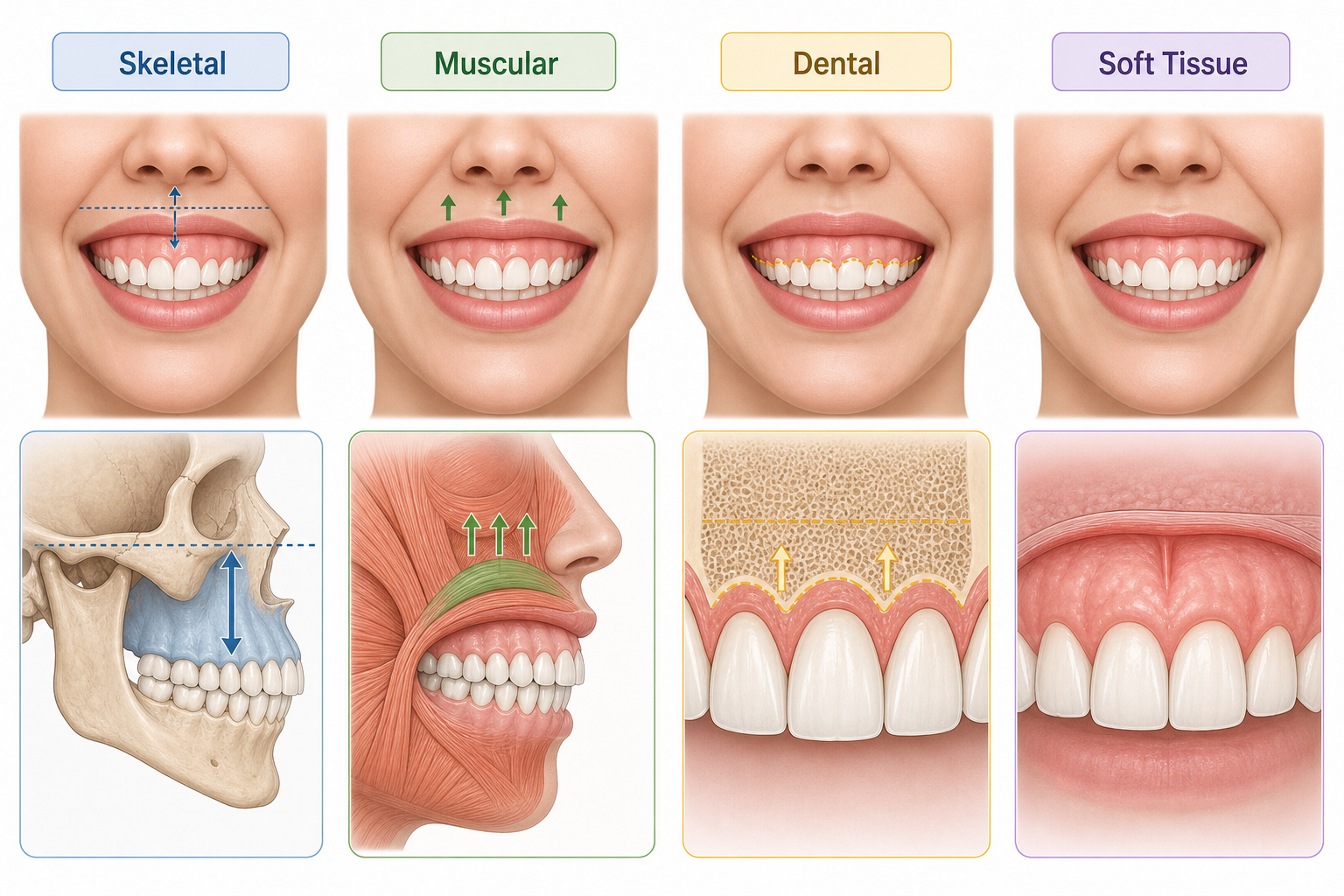
Understanding the cause of a gummy smile is the single most important step in choosing an effective correction. The condition has a genuinely multifactorial etiology, meaning several different anatomical factors — sometimes in combination — can produce the same visible result.
Skeletal Causes
Vertical maxillary excess refers to overgrowth of the upper jaw in a downward direction. When the maxilla (upper jaw) is longer than average vertically, the gum line sits lower relative to the upper lip, exposing more gum tissue during smiling. This is one of the more significant structural causes and typically requires orthognathic surgery for meaningful correction. A related skeletal factor is dentoalveolar extrusion, where the teeth and surrounding bone have over-erupted downward.
Muscular Causes
A hyperactive upper lip — sometimes called a hypermobile lip — is one of the most common causes of mild to moderate gummy smiles. In these cases, the muscles that elevate the upper lip (particularly the levator labii superioris alaeque nasi) contract more forcefully or travel further than average during smiling, pulling the lip higher and exposing more gum tissue. This muscular cause responds particularly well to botulinum toxin injections, which temporarily reduce the muscle’s range of movement.
Dental Causes
Altered passive eruption is a condition in which the gum tissue fails to recede to its normal position as the teeth finish erupting during adolescence. The result is that the teeth appear shorter than they actually are, because a portion of the tooth crown remains covered by gum tissue. This is a dental and periodontal cause that typically responds well to gum contouring or crown lengthening procedures. Separately, teeth that are genuinely short — due to wear, genetics, or incomplete development — can also create the impression of excessive gum display even when the gum line itself is normal.
Soft Tissue Causes
Gingival hypertrophy, or gingival overgrowth, occurs when the gum tissue itself is thicker or more voluminous than average. This can be a natural anatomical variation, but it is also associated with certain medications. Drugs including some calcium channel blockers (used for blood pressure), anticonvulsants such as phenytoin, and immunosuppressants such as cyclosporine are known to cause medication-induced gingival overgrowth as a side effect. This is a clinically important cause that is underrecognised in consumer-facing information — if you take any of these medications and have noticed changes in your gum tissue, discussing this with your dentist or periodontist is an important first step.
Combined and Multifactorial Presentations
Many patients present with more than one contributing factor simultaneously. For example, a person may have both a hyperactive upper lip and altered passive eruption, or vertical maxillary excess combined with gingival hypertrophy. In these cases, a single treatment is unlikely to achieve a satisfying result, and a planned combination of interventions — guided by a multidisciplinary team — is typically more effective.
How Is a Gummy Smile Diagnosed?
Diagnosis begins with a thorough clinical assessment, usually by a general dentist who may then refer to one or more specialists depending on the suspected cause. The assessment typically includes a periodontal examination of the gum tissue, photographs of the smile at rest and during full animation, bite analysis, and in some cases cephalometric imaging (X-rays of the skull and jaw) to evaluate skeletal proportions. Digital smile design — a modern consultation tool that uses photographs or 3D imaging to simulate potential outcomes — is increasingly used to help patients visualise treatment possibilities before committing to any procedure.
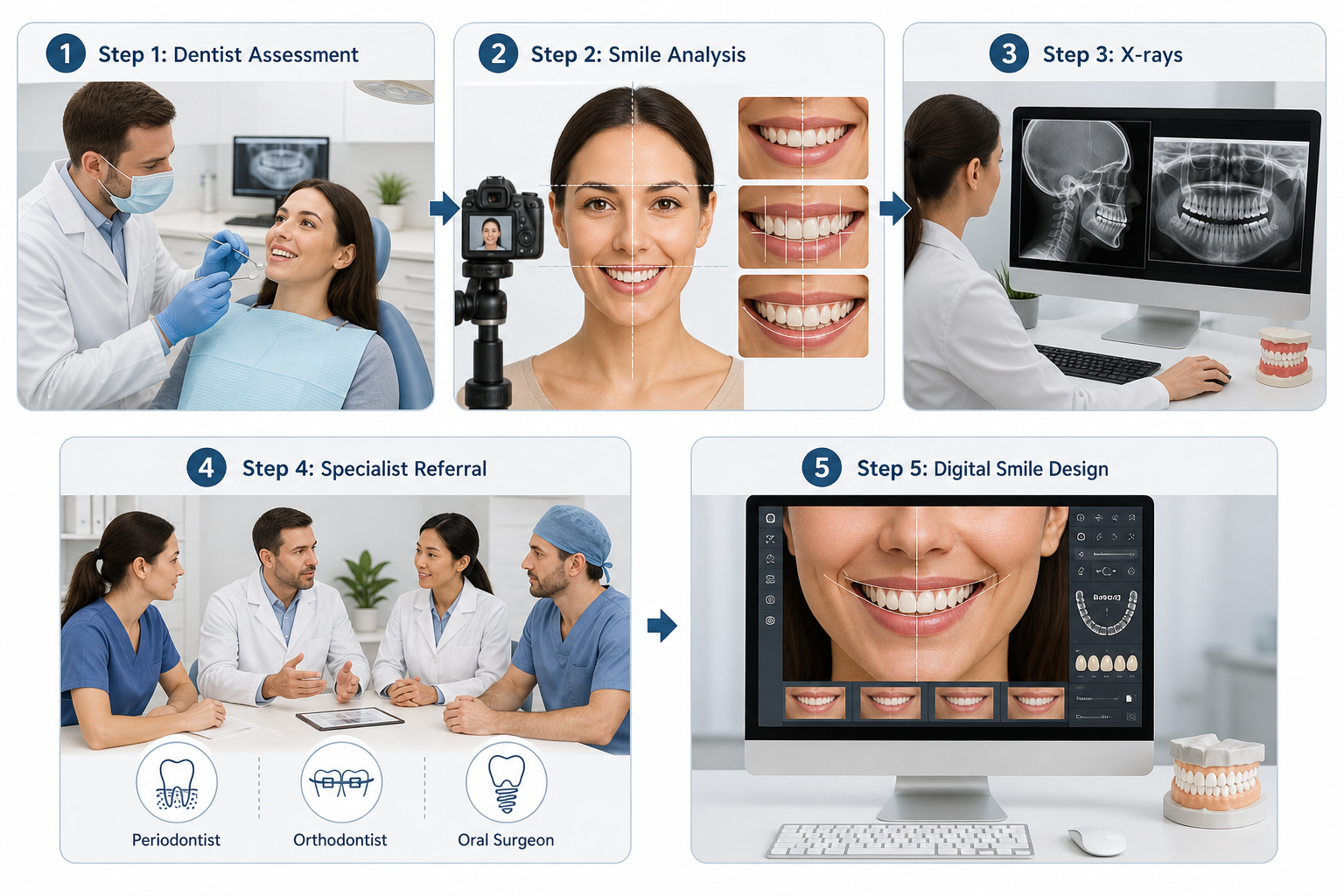
The specialists most commonly involved include a periodontist (a gum specialist) for soft tissue and dental causes, an orthodontist for bite and tooth position issues, and an oral and maxillofacial surgeon for skeletal causes. Cosmetic dentists and plastic surgeons may also be involved when lip-related or restorative treatments are planned. For complex cases, a coordinated multidisciplinary approach produces the most predictable and harmonious results.
Gummy Smile Correction: Treatment Options
Treatment options range from temporary non-surgical injections to permanent surgical procedures. The right choice depends on the underlying cause, the severity of gum display, the patient’s preferences, and their tolerance for downtime and recovery. The table below provides an overview of the main options.
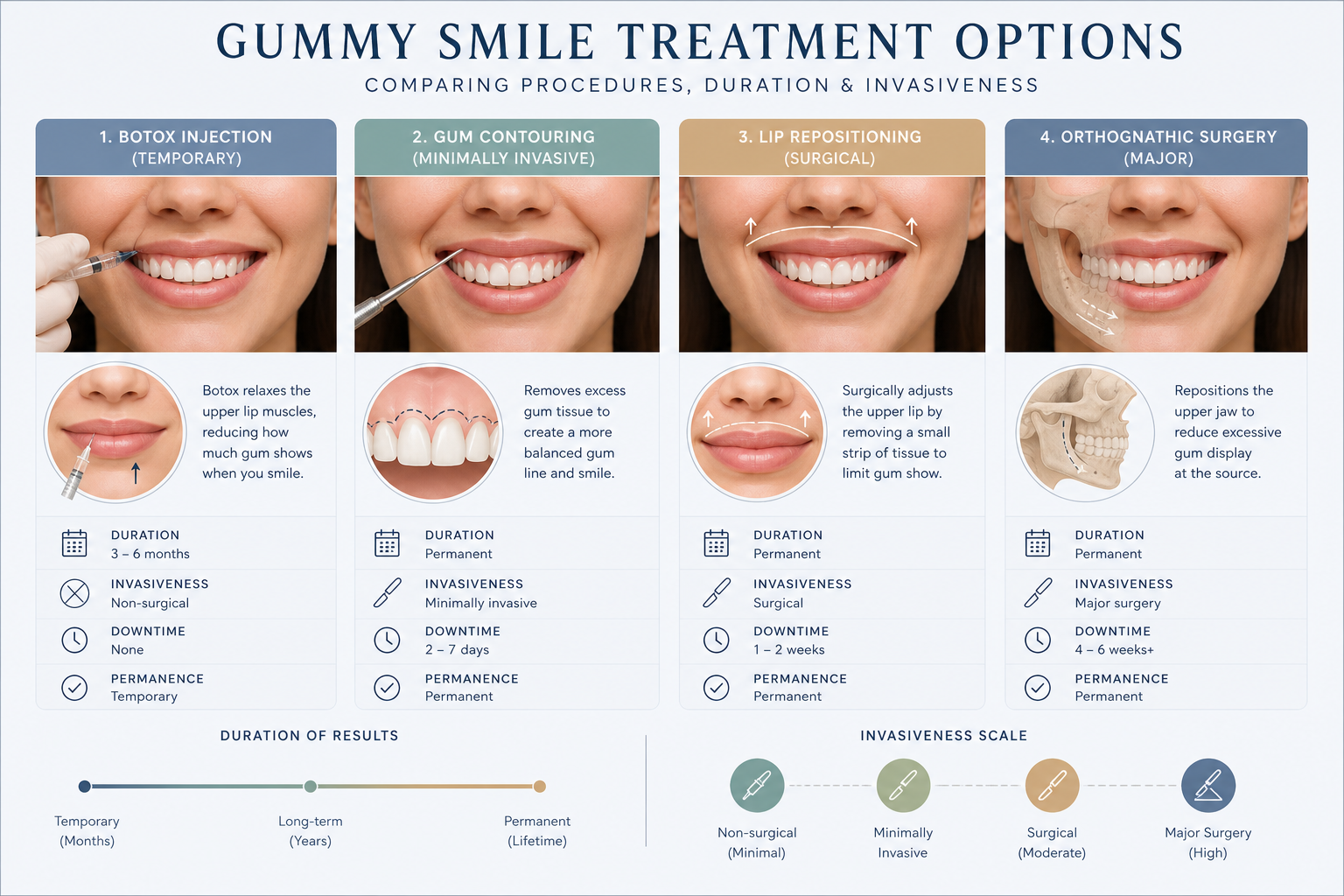
| Treatment | Best Suited For | Duration of Results | Recovery | Reversible? |
|---|---|---|---|---|
| Botulinum toxin (Botox) | Hyperactive upper lip | 3–6 months | Minimal (hours) | Yes |
| Orthodontics (braces / clear aligners) | Dental / bite-related causes | Long-term (with retention) | Ongoing treatment (months–years) | Partially |
| Gum contouring / gingivectomy | Altered passive eruption, gingival hypertrophy | Permanent (in most cases) | 1–2 weeks | No |
| Crown lengthening | Short clinical crowns, altered passive eruption | Permanent | 2–4 weeks | No |
| Lip repositioning surgery | Hyperactive / hypermobile lip | Long-term (relapse possible) | 2–4 weeks | No |
| Orthognathic surgery | Vertical maxillary excess (skeletal) | Permanent | Several weeks to months | No |
| Porcelain veneers / crowns | Short teeth, cosmetic enhancement | 10–15 years (with care) | Minimal | No |
| Hyaluronic acid / PDO threads | Mild cases, lip volume/position | Variable (months) | Minimal | Partially |
Botulinum Toxin Injections
For patients whose gummy smile is caused by a hyperactive upper lip, botulinum toxin — commonly known by the brand name Botox — is one of the most frequently used non-surgical options. Small amounts of the neuromodulator are injected into the muscles responsible for elevating the upper lip, temporarily reducing their range of movement and limiting how high the lip rises during smiling. The result is typically a reduction in gum exposure of 2–4 mm, with effects lasting approximately 3–6 months before the treatment needs to be repeated.
It is important to note that the use of botulinum toxin for gummy smile correction is an off-label use — meaning it is not a formally licensed indication in most countries, though it is widely practised by trained aesthetic clinicians. Results depend heavily on the injector’s experience and the accuracy of muscle identification. Potential side effects include temporary asymmetry, difficulty with certain lip movements, and — rarely — an unintended effect on adjacent muscles. These effects resolve as the toxin wears off. Botulinum toxin is not appropriate for gummy smiles caused by skeletal or dental factors.
Gum Contouring and Crown Lengthening
Gum contouring (also called gum reshaping or gingivectomy) involves removing and reshaping excess gum tissue to expose more of the tooth crown. It is performed by a periodontist or oral surgeon using a scalpel or, increasingly, a dental laser. Laser gingivectomy tends to involve less bleeding and a more comfortable recovery than traditional scalpel techniques, though both approaches can achieve good aesthetic results. The procedure is typically performed under local anaesthetic and takes one to two hours depending on how many teeth are involved.
Crown lengthening is a more involved procedure that addresses not only the gum tissue but also the underlying bone, and is used when the gum line cannot be repositioned without also recontouring the supporting bone. It is particularly appropriate for cases of altered passive eruption where the bone level is too close to the tooth crown. Recovery after crown lengthening is generally two to four weeks, and the final aesthetic result may take several months to fully stabilise as the tissues heal and settle.
Lip Repositioning Surgery
Lip repositioning surgery is a minimally invasive surgical procedure that limits the upward movement of the upper lip by removing a strip of mucous membrane from inside the lip and suturing the lip to a lower position. It is an alternative to botulinum toxin for muscular causes, offering a longer-lasting result without the need for repeat injections. However, some degree of relapse — where the lip gradually returns toward its original position — has been reported in the literature, and the procedure is not reversible. Recovery typically involves swelling and restricted lip movement for two to four weeks.
Orthognathic Surgery
For patients with significant vertical maxillary excess — where the upper jaw is structurally too long — orthognathic surgery (specifically a Le Fort I osteotomy) is the most definitive treatment. This procedure repositions the upper jaw upward, reducing the amount of gum tissue visible during smiling. It is a major surgical procedure performed under general anaesthesia, requiring a recovery period of several weeks to months and typically preceded by a period of orthodontic preparation. Orthognathic surgery is generally reserved for cases where the skeletal discrepancy is significant enough that softer interventions would not produce a satisfactory result. In some cases where the jaw position also affects bite function or breathing, the procedure may have a functional as well as cosmetic rationale, which can affect insurance or funding eligibility.
Orthodontic Treatment
Braces or clear aligners such as Invisalign may be used to address gummy smiles caused by dental factors — particularly where teeth have over-erupted or where bite correction can improve the relationship between the teeth, gums, and lips. Orthodontic treatment is often used as part of a broader multidisciplinary plan, for example preceding orthognathic surgery or combined with gum contouring. On its own, orthodontic treatment is unlikely to fully resolve a gummy smile caused by muscular or skeletal factors, but it can make a meaningful contribution to overall smile aesthetics when dental positioning is a contributing cause.
Emerging and Adjunctive Options
Hyaluronic acid infiltration into the upper lip and PDO thread lifts are emerging as additional non-surgical options for mild cases, particularly where lip volume or position contributes to gum exposure. Evidence for these approaches in the context of gummy smile correction is still developing, and they are generally considered adjunctive rather than primary treatments. A 2024 cohort study (PMC11506583) reported patient-reported improvements in confidence following hyaluronic acid treatment, though larger controlled trials are needed to establish efficacy and durability more firmly. Porcelain veneers or dental crowns may also be used to lengthen the visible portion of short teeth, improving the tooth-to-gum ratio without altering the gum line itself.
Combination and Multidisciplinary Treatment
One of the most important — and frequently overlooked — aspects of gummy smile correction is that many patients benefit from more than one treatment. A patient with both altered passive eruption and a hyperactive upper lip, for example, may achieve a far better result from combining gum contouring with botulinum toxin injections than from either treatment alone. Similarly, a patient with vertical maxillary excess may require orthodontic preparation before orthognathic surgery, followed by gum contouring to refine the final result.
A coordinated multidisciplinary approach — where a periodontist, orthodontist, and oral surgeon work from a shared treatment plan — tends to produce more predictable and harmonious outcomes than treating each factor in isolation. Digital smile design tools can be particularly useful in this context, allowing the team and patient to visualise the intended result before any irreversible steps are taken. If you are consulting about gummy smile correction, asking whether a combined approach might be appropriate for your specific presentation is a worthwhile question.
How Long Do Results Last?
Durability varies significantly by treatment. Botulinum toxin results are temporary by nature, typically lasting three to six months, after which repeat injections are needed to maintain the effect. Some patients find that with regular treatment over time, they require slightly less frequent sessions, though this is not universal. Gum contouring and crown lengthening produce permanent changes to the gum line in most cases, though the long-term result depends on maintaining good periodontal health. Lip repositioning surgery offers longer-lasting results than injections but carries a documented risk of partial relapse, particularly in the first year after the procedure. Orthognathic surgery produces permanent skeletal changes, though post-surgical orthodontic retention is typically required to maintain the dental result.
Gummy Smile and Oral Health
Beyond aesthetics, excessive gum tissue — particularly when caused by gingival hypertrophy — can have implications for oral health. Thickened or overgrown gum tissue creates deeper pockets around the teeth that are harder to clean effectively, increasing the risk of plaque accumulation, gingival inflammation, and over time, periodontal disease. Patients with medication-induced gingival overgrowth should discuss both the cosmetic and health implications with their periodontist, as scaling and root planing or gingivectomy may serve both aesthetic and preventive purposes. Addressing the underlying cause — including reviewing medication options with the prescribing physician where appropriate — is an important part of management.
Is a Gummy Smile Normal?
Yes — a gummy smile is a natural anatomical variation, not a medical condition or a sign of poor health. Many people with significant gum display are entirely comfortable with their smile and have no desire to change it. Treatment is always elective and should be driven by the patient’s own goals, not by external pressure or a sense that something is wrong. The psychological impact of a gummy smile varies considerably between individuals: research suggests that some people experience reduced self-confidence or smile avoidance, while others are entirely unbothered. If your gummy smile affects your quality of life or self-esteem, exploring correction options is entirely reasonable — but if you are comfortable with your appearance, no intervention is necessary.
Gummy Smile Correction in Children and Adolescents
Treatment timing matters, particularly for surgical options. Orthognathic surgery and permanent gum procedures are generally deferred until jaw growth is complete — typically in the late teens for most patients, though this varies. Performing irreversible skeletal or soft tissue procedures before growth is complete risks the result being altered as the jaw continues to develop. Orthodontic treatment, however, can begin earlier and may be used to guide dental development in a more favourable direction. If a younger patient or their parent is concerned about a gummy smile, an orthodontic assessment is usually the appropriate starting point, with definitive treatment planned once growth is complete.
Cost and Insurance Considerations
Gummy smile correction is considered a cosmetic procedure in most cases and is therefore not covered by dental or medical insurance. Costs vary considerably depending on the treatment chosen, the number of teeth or areas involved, and the clinician’s experience and location. Botulinum toxin injections are typically the most accessible entry point in terms of cost, though the ongoing need for repeat sessions means cumulative costs accumulate over time. Surgical procedures such as crown lengthening, lip repositioning, and orthognathic surgery carry higher upfront costs but may offer longer-lasting results. In cases where orthognathic surgery is deemed medically necessary — for example, when jaw position significantly affects bite function or contributes to obstructive sleep apnoea — partial insurance coverage may be available, though this varies by insurer and country. Many clinics offer financing options; it is worth asking about these during your consultation.
Frequently Asked Questions
Can a gummy smile be fixed without surgery?
Yes, in many cases. If the cause is a hyperactive upper lip, botulinum toxin injections can reduce gum display without any surgical procedure. Gum contouring using a dental laser is minimally invasive and does not involve general anaesthesia. Orthodontic treatment with clear aligners is another non-surgical route for dental causes. However, significant skeletal causes such as vertical maxillary excess typically require orthognathic surgery for meaningful correction.
How many units of Botox are used for a gummy smile?
Specific dosing information is not appropriate to share in a patient-facing guide, as the amount varies depending on individual muscle anatomy, the degree of lip elevation, and the clinician’s assessment. This should be discussed with a qualified practitioner during a consultation. What is important to know is that the doses used are typically small, and the treatment is performed as an outpatient appointment with no significant downtime.
Does gummy smile correction hurt?
Botulinum toxin injections involve minor discomfort similar to any small injection. Gum contouring and crown lengthening are performed under local anaesthetic, so the procedure itself should not be painful, though some soreness and sensitivity during healing is expected. Orthognathic surgery is performed under general anaesthesia and involves a more significant recovery period with associated discomfort managed with prescribed pain relief.
Will a gummy smile come back after treatment?
This depends on the treatment. Botulinum toxin results are temporary and will wear off within months. Gum contouring and crown lengthening produce permanent changes to the gum line in most cases. Lip repositioning surgery has a documented risk of partial relapse. Orthognathic surgery produces permanent skeletal changes, though maintaining the dental result requires post-surgical orthodontic retention.
Do I need to see a specialist, or can my regular dentist treat a gummy smile?
Your general dentist is usually the right starting point. They can assess the likely cause and refer you to the appropriate specialist — a periodontist for gum tissue issues, an orthodontist for bite and tooth position, an oral surgeon for skeletal causes, or an aesthetic clinician for botulinum toxin treatment. Complex cases often benefit from a coordinated multidisciplinary team rather than a single practitioner working in isolation.
Is gummy smile correction permanent?
Some treatments produce permanent results (gum contouring, crown lengthening, orthognathic surgery), while others are temporary (botulinum toxin) or carry a risk of partial relapse (lip repositioning surgery). The permanence of any result also depends on maintaining good oral health and, in the case of orthodontic treatment, wearing retainers as directed.
Deciding on Gummy Smile Correction: What to Consider First
Gummy smile correction is not a one-size-fits-all decision. The most important factor is identifying the underlying cause accurately, because a treatment that works well for a muscular cause will have little effect on a skeletal one, and vice versa. A thorough clinical assessment — ideally involving the relevant specialists — is the essential first step before any treatment is chosen.
For those with mild gum display caused by a hyperactive upper lip, botulinum toxin offers a low-commitment, reversible starting point that allows you to assess the aesthetic improvement before considering anything more permanent. For those with altered passive eruption or gingival hypertrophy, gum contouring or crown lengthening can produce lasting results with relatively straightforward recovery. For more complex or skeletal presentations, a multidisciplinary plan that may include orthodontics, surgery, and soft tissue refinement is likely to produce the most satisfying and durable outcome.
If your gummy smile affects your confidence or quality of life, speaking with a qualified clinician — starting with your dentist — is a reasonable and worthwhile step. A good consultation will clarify the cause, outline realistic options, and help you make an informed decision that reflects your goals, your anatomy, and your tolerance for treatment and recovery.