
Underarm Pigmentation: Causes of Axillary Hyperpigmentation Explained
Darkening of the underarm skin is one of the most common cosmetic concerns patients raise during aesthetic consultations, yet it is frequently misunderstood. Underarm pigmentation — clinically referred to as axillary hyperpigmentation — can develop gradually over years or appear relatively quickly in response to a specific trigger. Understanding what causes it is the essential first step before considering any treatment, because the underlying mechanism largely determines which approach is most likely to be effective.
Key Takeaways
- Axillary hyperpigmentation has multiple distinct causes, including friction, hair removal methods, hormonal changes, skin conditions, and certain medications — and more than one cause can be present at the same time.
- The skin in the axilla (underarm) is structurally different from skin elsewhere on the body, making it particularly susceptible to post-inflammatory pigmentation and chronic irritation.
- Identifying the underlying cause is essential before selecting any treatment, as the wrong approach can worsen pigmentation rather than improve it.
- Many contributing factors — such as shaving technique, deodorant choice, and clothing friction — can be modified, and doing so is often a necessary part of any management plan.
- A qualified practitioner can assess the skin, identify contributing factors, and recommend appropriate treatment options tailored to the individual.
Why the Underarm Skin Is Particularly Vulnerable
The axillary skin has several characteristics that make it more prone to pigmentation changes than skin on other parts of the body. It is a flexural area — meaning it sits within a fold — which means the skin surfaces regularly press against each other and against clothing. This creates a warm, moist environment with persistent low-grade friction. The skin in this region is also thinner and more sensitive than skin on the arms or torso, and it contains a high density of hair follicles, sweat glands, and apocrine glands. All of these factors increase the likelihood of irritation, inflammation, and the pigmentation that can follow.
Melanocytes — the cells responsible for producing melanin, the pigment that gives skin its colour — are present throughout the skin. When the skin experiences repeated trauma, inflammation, or hormonal stimulation, melanocytes can become overactive and deposit excess melanin in the upper layers of the skin. This process, known as post-inflammatory hyperpigmentation (PIH), is the common final pathway for many different causes of underarm darkening. People with medium to darker skin tones (Fitzpatrick skin types III to VI) are generally more prone to post-inflammatory hyperpigmentation, though the condition can affect any skin tone.
Friction and Repeated Mechanical Irritation
Chronic friction is one of the most frequently overlooked causes of axillary hyperpigmentation. The underarm is subject to constant movement — from arm swinging during walking, exercise, and daily activity — and the skin regularly rubs against clothing, particularly tight-fitting garments made from synthetic fabrics. Over time, this repeated mechanical irritation triggers a low-grade inflammatory response in the skin, which stimulates melanin production and leads to gradual darkening.
Tight clothing, rough fabric textures, and poorly fitting bras or tops that create persistent pressure in the axillary fold are common contributors. Patients who exercise frequently or who wear compression garments may notice that underarm darkening develops or worsens in areas of highest contact. Addressing friction — by choosing looser, breathable fabrics and avoiding tight underarm seams — is often a recommended first step in managing pigmentation caused by this mechanism, regardless of what other treatments are being considered.
Hair Removal Methods and Their Role in Axillary Darkening
The method used to remove underarm hair is one of the most significant modifiable causes of axillary hyperpigmentation. Shaving is the most common hair removal method, and it contributes to underarm darkening in several ways. The razor blade creates micro-abrasions on the skin surface with each pass, causing repeated low-level trauma. Shaving also cuts the hair at or just below the skin surface rather than removing it at the root, which means the dark cross-section of the hair shaft remains visible just beneath the skin — an effect that can make the underarm appear darker even when no true pigmentation change has occurred.
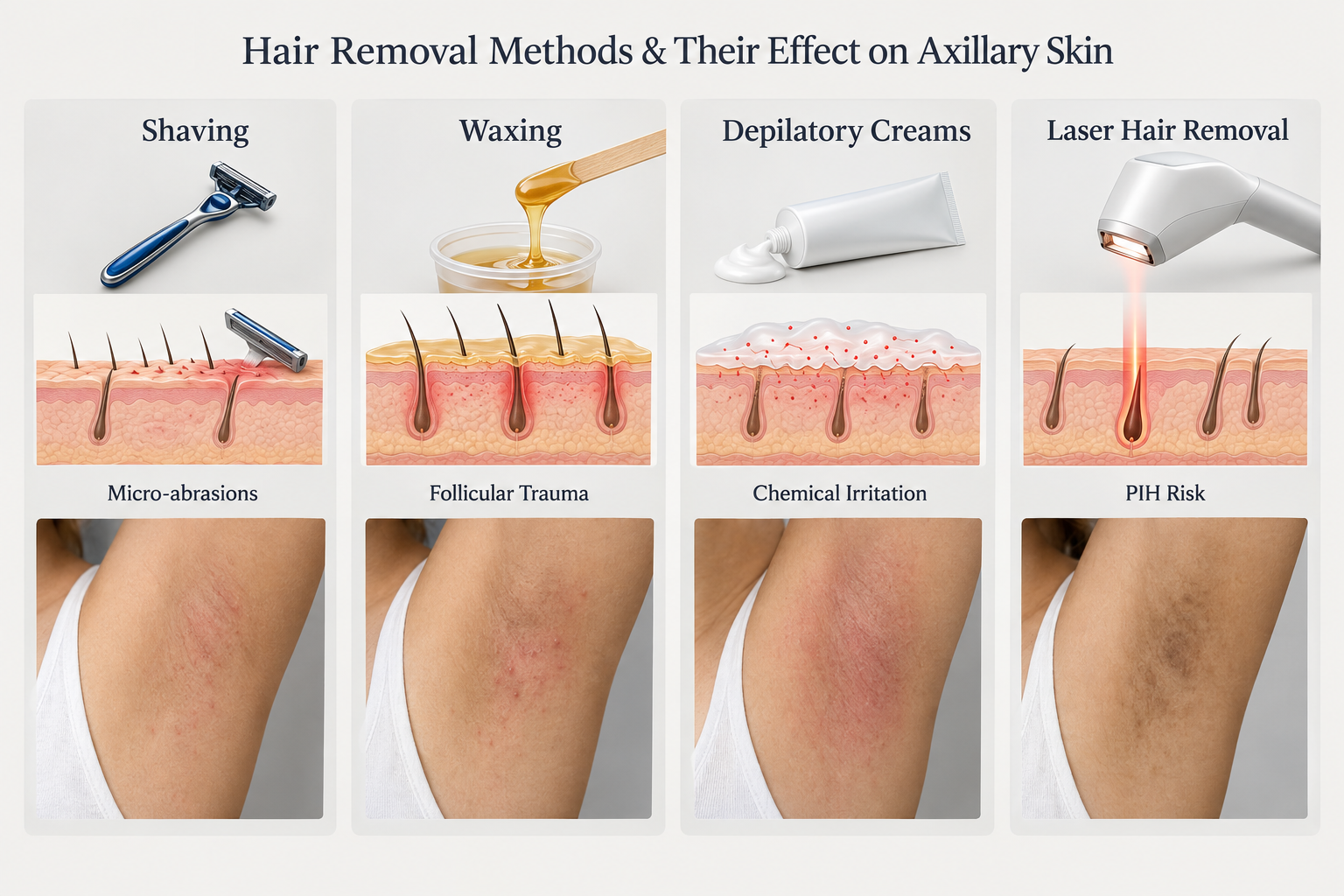
Waxing and threading remove hair from the root, which eliminates the visible hair shaft effect, but these methods involve a degree of mechanical trauma to the follicle and surrounding skin. Repeated waxing can cause follicular inflammation, and in individuals prone to post-inflammatory hyperpigmentation, this inflammation can trigger melanin overproduction over time. Depilatory creams contain alkaline chemicals that dissolve the hair shaft, and while they avoid the mechanical trauma of shaving, they can cause chemical irritation in sensitive axillary skin, particularly with frequent use.
Laser hair removal, when performed appropriately for the individual’s skin type, may reduce the cycle of repeated trauma associated with shaving and waxing. However, laser treatments themselves carry a risk of post-inflammatory hyperpigmentation if the parameters are not correctly selected for the patient’s skin tone — a consideration that underscores the importance of experienced clinical assessment before any laser procedure in this area.
Deodorants, Antiperspirants, and Chemical Irritation
Deodorants and antiperspirants are applied daily to the axillary skin, and their ingredients can contribute to underarm pigmentation in susceptible individuals. Aluminium-based compounds, which are the active ingredients in most antiperspirants, can cause contact irritation in some people. Fragrances, preservatives, and alcohol — common components of both deodorants and antiperspirants — are also potential irritants and allergens. Repeated exposure to an irritating or allergenic ingredient triggers an inflammatory response in the skin, which can lead to post-inflammatory hyperpigmentation over time.
Allergic contact dermatitis — a delayed immune reaction to a specific ingredient — can cause redness, itching, and inflammation in the underarm, followed by darkening as the inflammation resolves. Irritant contact dermatitis, which does not involve an immune response but results from direct chemical damage to the skin barrier, can produce a similar outcome. Patients who notice that underarm darkening is accompanied by itching, redness, or a rash may benefit from patch testing to identify a specific allergen, and switching to a fragrance-free, alcohol-free formulation is often recommended as a precautionary measure.
Hormonal Influences on Underarm Pigmentation
Hormonal changes are a well-recognised cause of hyperpigmentation across multiple areas of the body, and the axilla is no exception. Oestrogen and progesterone can stimulate melanocyte activity, which is why pigmentation changes are commonly observed during pregnancy, when using combined oral contraceptive pills, or during hormonal therapy. The condition known as melasma — characterised by irregular patches of darker skin — most commonly affects the face, but hormonally driven pigmentation can also develop in body fold areas including the underarms.
Insulin resistance and conditions associated with it, such as polycystic ovary syndrome (PCOS) and type 2 diabetes, are associated with a specific form of skin darkening called acanthosis nigricans. This condition produces velvety, thickened, darkened skin in body folds including the axillae, the back of the neck, and the groin. Acanthosis nigricans is not primarily a cosmetic concern — it is a skin sign that may indicate an underlying metabolic condition requiring medical evaluation. Any patient presenting with this pattern of darkening should be assessed by a doctor to rule out or manage the underlying cause before cosmetic treatment is considered.
Acanthosis Nigricans: A Clinically Important Cause
Acanthosis nigricans deserves particular attention because it is frequently mistaken for ordinary underarm pigmentation, yet it has a distinct appearance and a different underlying mechanism. The skin in acanthosis nigricans appears darker than the surrounding skin but also has a characteristic velvety or rough texture, and the affected area may feel thickened to the touch. It most commonly develops in the axillae, the back of the neck, and skin folds around the groin and abdomen.
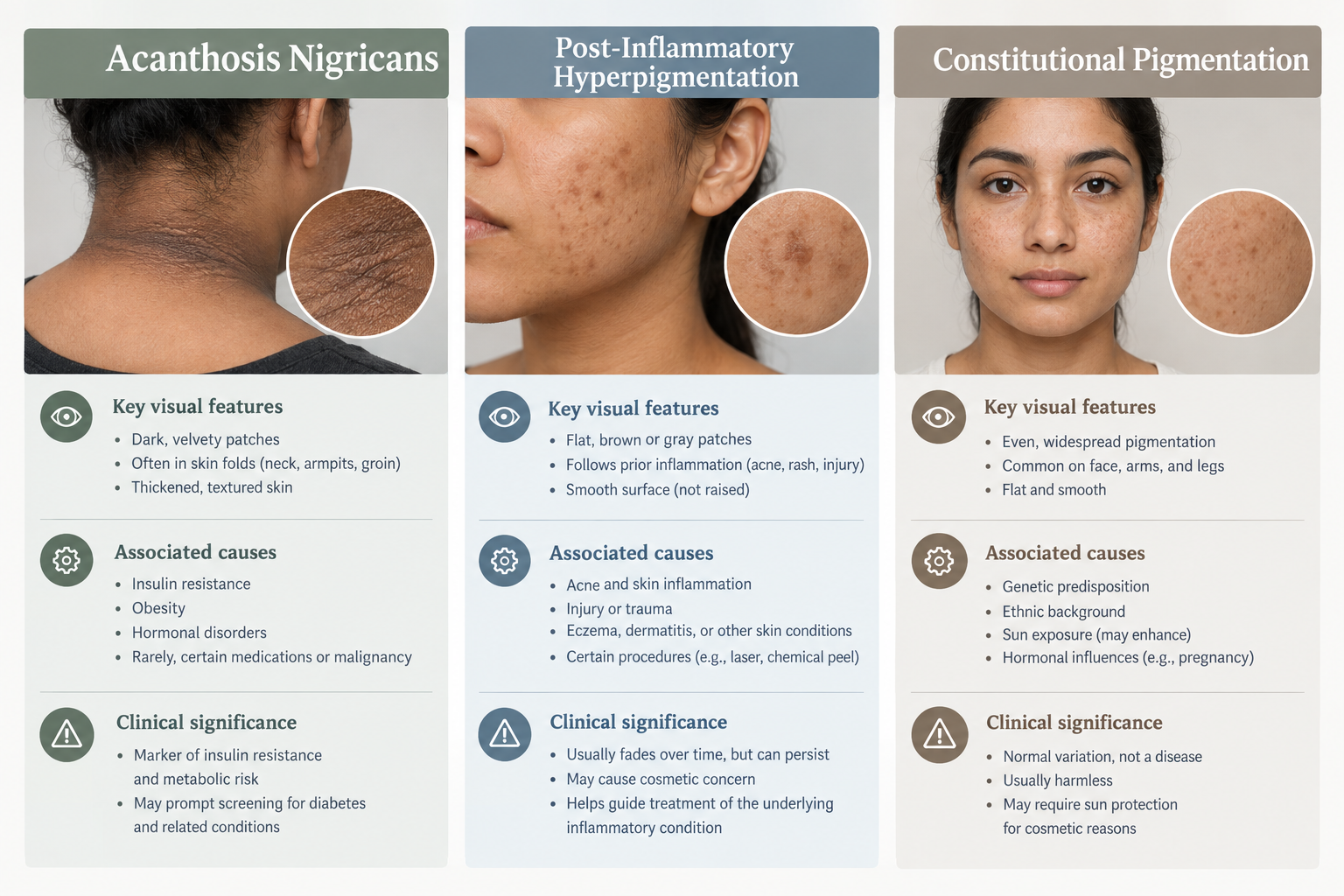
The condition is most commonly associated with insulin resistance, obesity, and endocrine disorders, though it can also occur in association with certain medications — including systemic corticosteroids, niacin, and some hormonal treatments — and, rarely, with internal malignancy in adults. Because acanthosis nigricans can be a marker of significant metabolic or systemic disease, a clinical assessment is essential when this pattern is suspected. Cosmetic treatments applied without addressing the underlying cause are unlikely to produce lasting improvement and may delay appropriate medical management.
Post-Inflammatory Hyperpigmentation After Skin Trauma
Post-inflammatory hyperpigmentation (PIH) is the skin’s response to injury or inflammation, and it is one of the most common mechanisms underlying underarm darkening. When the skin experiences trauma — whether from shaving, waxing, friction, chemical irritation, or an inflammatory skin condition — the healing process can involve an increase in melanin production in the affected area. This excess melanin may be deposited in the epidermis (the outer layer of skin), giving the skin a brown appearance, or in the deeper dermis, where it tends to appear grey or blue-grey and is generally more difficult to treat.
The degree of post-inflammatory hyperpigmentation that develops after a given injury varies considerably between individuals and is influenced by skin tone, the severity of the initial inflammation, and whether the triggering factor continues. In individuals with darker skin tones, PIH tends to be more pronounced and may persist for longer. Preventing further inflammation — by addressing the underlying cause — is a fundamental part of managing PIH, because continuing the triggering behaviour while attempting to treat the pigmentation is unlikely to produce meaningful improvement.
Skin Conditions That Contribute to Axillary Darkening
Several dermatological conditions can cause or contribute to underarm pigmentation, and distinguishing these from simple post-inflammatory darkening is important for appropriate management.
Eczema and Atopic Dermatitis
Eczema affecting the axillary skin causes itching, inflammation, and repeated scratching, all of which can trigger post-inflammatory hyperpigmentation. The underarm is a common site for flexural eczema, particularly in children and adults with atopic dermatitis. Managing the eczema itself — with appropriate emollients and, where necessary, topical treatments prescribed by a doctor — is the primary approach, and pigmentation often improves once the inflammatory cycle is controlled.
Erythrasma
Erythrasma is a superficial bacterial skin infection caused by Corynebacterium minutissimum that commonly affects body folds including the axillae. It produces reddish-brown, slightly scaly patches that can be mistaken for fungal infection or simple pigmentation. Erythrasma is diagnosed clinically and, characteristically, fluoresces coral-red under a Wood’s lamp examination. It is treated with topical or oral antibiotics, and the pigmentation associated with it typically improves with successful treatment of the infection.
Confluent and Reticulated Papillomatosis
This is a less common skin condition that produces a reticulated (net-like) pattern of hyperpigmented, slightly raised skin in the upper trunk and axillary areas. It is sometimes confused with acanthosis nigricans but has a distinct appearance and responds to antibiotic treatment. A dermatological assessment is required for accurate diagnosis.
Medications and Systemic Factors
Certain medications are associated with hyperpigmentation as a side effect, and the axillary skin can be affected. Medications known to cause or worsen pigmentation include some antimalarials, certain chemotherapy agents, minocycline (an antibiotic used for acne), amiodarone (used for heart rhythm disorders), and some antipsychotic medications. If underarm darkening develops or worsens after starting a new medication, this should be discussed with the prescribing doctor — stopping or changing a medication should never be done without medical guidance.
Systemic conditions beyond insulin resistance can also influence skin pigmentation. Addison’s disease, a condition involving adrenal insufficiency, causes generalised hyperpigmentation that may be particularly noticeable in skin folds and areas of friction. Haemochromatosis, a condition of iron overload, can also cause skin darkening. These are uncommon causes of axillary pigmentation, but they illustrate why a thorough medical history is an important part of any assessment when the cause of underarm darkening is not immediately apparent.
Genetic and Skin-Type Factors
Genetic predisposition plays a role in how readily the skin produces excess melanin in response to stimulation. Individuals with naturally darker skin tones have more active melanocytes and are more prone to developing post-inflammatory hyperpigmentation after any form of skin irritation or trauma. This does not mean that underarm darkening is inevitable or untreatable in people with darker skin, but it does mean that the threshold for triggering pigmentation may be lower, and that treatment approaches need to be carefully selected to avoid causing further inflammation and worsening the pigmentation.
Some individuals also have a constitutional tendency toward darker skin in body fold areas — a natural variation in pigmentation distribution that is not caused by any pathological process. In these cases, the skin in the axillae, groin, and inner thighs may simply be naturally darker than the surrounding skin, and this is a normal finding rather than a condition requiring treatment. A clinical assessment can help distinguish constitutional pigmentation from acquired hyperpigmentation with a specific underlying cause.
Identifying the Cause: What a Clinical Assessment Involves
Because axillary hyperpigmentation can result from several different mechanisms — and because some causes require medical management rather than cosmetic treatment — a thorough assessment by a qualified practitioner is an important starting point. A clinical assessment typically involves a detailed history covering hair removal habits, products applied to the area, clothing choices, any relevant medical conditions, medications, and the timeline of the pigmentation change. The skin is examined visually, and in some cases a Wood’s lamp examination may help characterise the depth of the pigmentation or identify specific conditions such as erythrasma.
Understanding whether the pigmentation is epidermal (in the outer skin layers), dermal (in the deeper layers), or mixed is clinically relevant because it influences which treatments are likely to be effective. Epidermal pigmentation generally responds better to topical treatments and certain energy-based procedures than dermal pigmentation, which is typically more resistant. Where an underlying medical condition such as acanthosis nigricans, a hormonal disorder, or a medication side effect is suspected, referral to an appropriate specialist may be recommended before or alongside any cosmetic management.
Frequently Asked Questions
Is underarm pigmentation permanent?
Not necessarily. Whether axillary hyperpigmentation is permanent depends largely on its cause. Post-inflammatory hyperpigmentation caused by shaving, friction, or product irritation can fade over time — particularly if the triggering factor is removed — though this process can take many months. Pigmentation associated with ongoing conditions such as unmanaged insulin resistance or continued mechanical irritation is unlikely to resolve without addressing the underlying cause. A clinical assessment can help determine the likely prognosis for an individual case.
Can switching deodorant help with underarm darkening?
In some cases, yes. If the underarm pigmentation is partly driven by irritant or allergic contact dermatitis from a deodorant or antiperspirant ingredient, switching to a fragrance-free, alcohol-free, or hypoallergenic formulation may reduce ongoing inflammation and allow the skin to recover. However, switching deodorant alone is unlikely to resolve established pigmentation quickly, and it may not be the primary cause in every individual.
Does shaving cause permanent underarm darkening?
Shaving does not typically cause permanent darkening, but repeated shaving-related trauma can lead to post-inflammatory hyperpigmentation that persists for a significant period. The visible darkening associated with the hair shaft cross-section just beneath the skin surface is not true pigmentation and resolves when hair removal method is changed. Established post-inflammatory pigmentation from shaving trauma may take months to fade and may benefit from targeted treatment.
What is the difference between acanthosis nigricans and ordinary underarm pigmentation?
Acanthosis nigricans produces darkened skin with a distinctive velvety or thickened texture, most commonly in body folds. It is associated with insulin resistance, obesity, and certain medications or systemic conditions. Ordinary post-inflammatory hyperpigmentation tends to be flat and smooth in texture. If the darkened skin in the underarm feels rough or velvety, or if it is accompanied by similar changes in the neck or groin, a medical assessment is advisable to evaluate for an underlying metabolic condition.
Can underarm pigmentation be a sign of a medical condition?
In some cases, yes. Acanthosis nigricans can indicate insulin resistance, PCOS, or type 2 diabetes. Generalised hyperpigmentation including in skin folds may occasionally be associated with adrenal conditions. Medication side effects can also cause skin darkening. While most cases of underarm pigmentation have benign, lifestyle-related causes, a clinical assessment is worthwhile — particularly if the darkening is accompanied by skin texture changes, developed rapidly, or is associated with other symptoms.
Is it safe to use skin-lightening products on the underarms without professional guidance?
Over-the-counter skin-lightening products vary considerably in their ingredients, concentrations, and safety profiles. Some ingredients, such as high-concentration hydroquinone or certain chemical exfoliants, can cause irritation or worsen pigmentation if used incorrectly — particularly in sensitive axillary skin. Professional guidance helps ensure that any topical treatment is appropriate for the specific cause of pigmentation, the individual’s skin type, and the depth of the pigmentation, reducing the risk of adverse effects.
Understanding the Cause Is the Foundation of Effective Management
Axillary hyperpigmentation is a common concern with a range of possible causes, and no single treatment approach is appropriate for every individual. The most important step is identifying which factors are driving the pigmentation in a specific case — whether that is repeated friction, a hair removal method, product irritation, a hormonal influence, an underlying skin condition, or a combination of several factors. Without this understanding, treatment is unlikely to produce lasting improvement and may, in some cases, make the situation worse.
Modifiable lifestyle factors — including hair removal technique, clothing choices, and product selection — are worth addressing regardless of what other management is being considered, because continuing the triggering behaviour undermines any treatment. Where an underlying medical condition is suspected, appropriate medical evaluation should take priority. For established pigmentation without an ongoing medical cause, a range of treatment options may be discussed with a qualified practitioner, with the choice depending on the depth and type of pigmentation, the individual’s skin tone, and their overall health. A consultation with an experienced aesthetic or dermatological practitioner is the appropriate starting point for anyone seeking to understand and address underarm pigmentation effectively.


