
Chin Dimple Causes: What Creates That Cleft in the Chin?
A chin dimple — sometimes called a cleft chin or chin cleft — is one of the most recognisable facial features a person can have. For some it is a celebrated trait; for others it is a source of self-consciousness. Understanding what actually causes a chin dimple, how it forms, and what determines its appearance can help you make sense of your own facial anatomy and decide whether any cosmetic intervention is worth exploring.
Key Takeaways
- A chin dimple is primarily caused by an underlying variation in the shape of the chin bone (mandible) and the way the overlying soft tissue and muscle attach to it.
- Genetics play a central role, but a cleft chin is not caused by a single gene — it results from a combination of inherited traits influencing bone and soft tissue development.
- Chin dimples are not a medical concern; they are a normal anatomical variation found across all ethnicities and both sexes.
- The appearance of a chin dimple can change over time with ageing, weight fluctuation, and changes in facial soft tissue volume.
- Both surgical and non-surgical cosmetic options exist for those who wish to reduce or enhance a chin dimple, and a qualified practitioner can advise on suitability.
What Is a Chin Dimple?
A chin dimple is an indentation or cleft located at the centre of the chin. It sits along the midline of the face, directly below the lower lip, and can range from a subtle vertical groove to a more pronounced Y-shaped or rounded depression. The term cleft chin is often used interchangeably with chin dimple, though strictly speaking a cleft chin tends to refer to a more defined bony separation, while a chin dimple may describe a softer, shallower indentation in the overlying skin and fat.
Chin dimples are distinct from the small dimples that appear on the cheeks when a person smiles. Cheek dimples are caused by a variation in the zygomaticus major muscle, whereas a chin dimple has a different anatomical origin rooted in the structure of the lower jaw and the mentalis muscle. Both types are considered normal anatomical variants rather than abnormalities.
The Primary Cause: Bone Structure and Soft Tissue
The most direct cause of a chin dimple is an incomplete fusion of the two halves of the lower jawbone (mandible) during foetal development. During early development, the lower jaw forms from two separate bony processes that fuse together along the midline. In most people this fusion is complete and the chin surface is smooth. In some individuals, the fusion leaves a slight groove or notch in the underlying bone — and this bony irregularity creates a corresponding indentation in the skin above it.
The overlying soft tissue — including subcutaneous fat and the mentalis muscle — follows the contour of the bone beneath it. Where the bone has a midline groove, the skin and fat tend to be pulled inward slightly, creating the visible dimple. The depth and shape of the chin dimple therefore depends on both the degree of bony variation and the thickness of the soft tissue covering it. A person with thinner facial fat may display a more pronounced cleft, while someone with fuller soft tissue may show only a subtle groove.
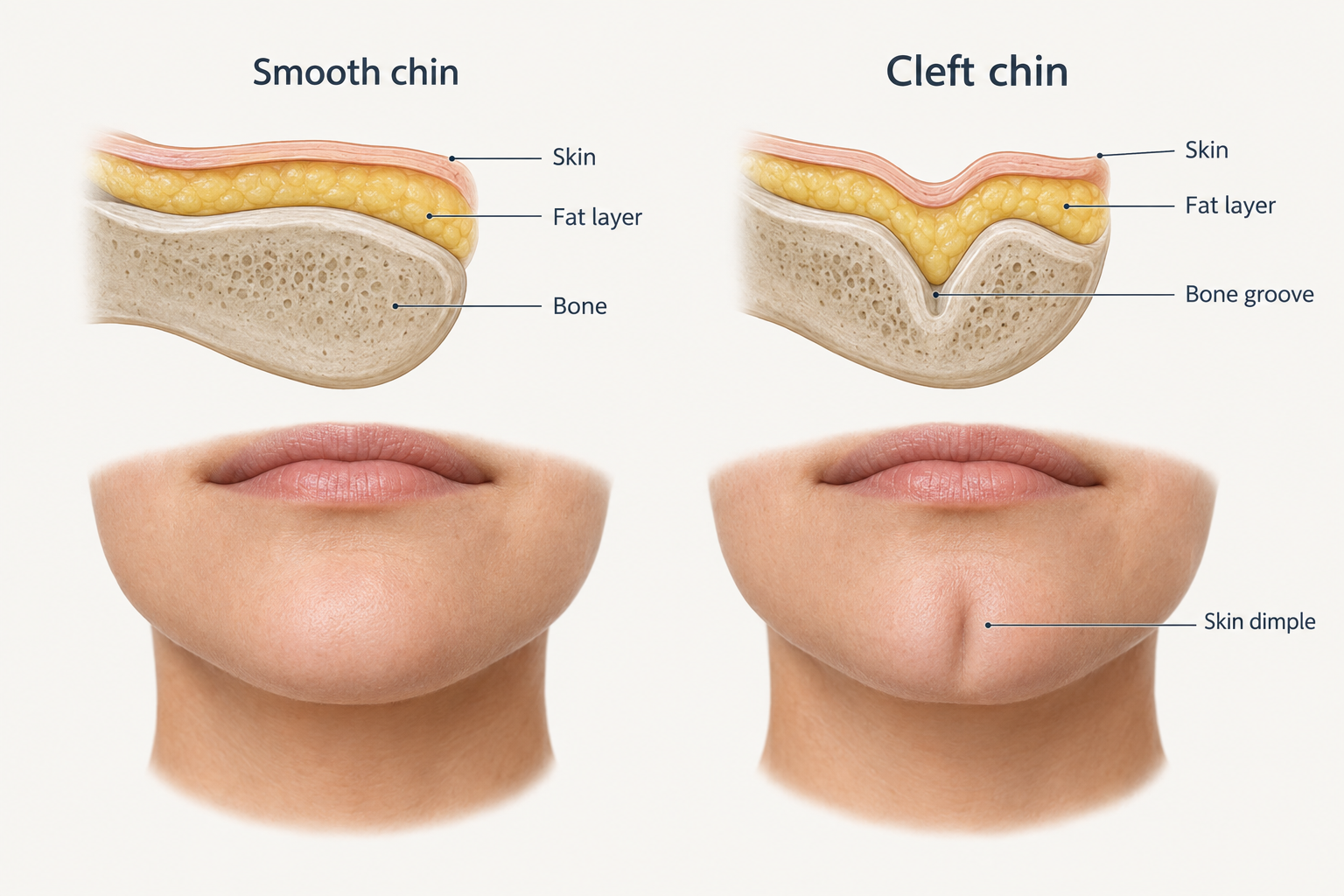
The mentalis muscle also contributes to the appearance of a chin dimple. This paired muscle runs vertically from the incisive fossa of the mandible to the skin of the chin and is responsible for raising the lower lip and wrinkling the chin skin. Where the two bellies of the mentalis muscle are separated by a midline gap — which often corresponds to the bony groove — the skin between them is less supported and more likely to indent, reinforcing the dimple appearance.
The Role of Genetics in Chin Dimple Formation
Genetics are widely recognised as the primary driver of whether a person develops a chin dimple. For many decades, a cleft chin was cited in textbooks as a classic example of a dominant genetic trait — meaning that inheriting just one copy of the relevant gene variant from either parent would be sufficient to produce the feature. However, more recent genetic research has complicated this simple picture.
Current understanding suggests that chin dimple formation is a polygenic trait, meaning it is influenced by multiple genes rather than a single dominant gene. Studies examining large populations have found that the inheritance pattern of cleft chins does not follow the straightforward dominant-recessive model as neatly as once thought. Environmental factors during foetal development, including the precise timing and completeness of mandibular fusion, may also play a role alongside genetic predisposition.
What this means practically is that two parents without a visible chin dimple can have a child who develops one, and vice versa. Family resemblance in chin shape is common, but it is not perfectly predictable. If a chin dimple runs strongly in your family, there is a reasonable likelihood that close relatives share similar underlying bone structure — but this is not guaranteed.
Ethnic and Sex-Related Variation
Chin dimples appear across all ethnic groups, though their prevalence varies. Some population studies suggest that cleft chins are more commonly observed in people of European descent compared with East Asian or sub-Saharan African populations, though robust large-scale epidemiological data on this point remain limited. The variation likely reflects differences in average mandibular morphology across populations rather than any single genetic factor.
There is also a modest sex-related difference in how chin dimples appear. Male facial anatomy tends to involve a broader, more prominent chin with a squarer shape, which can make a midline cleft more visually apparent. Female chins are typically narrower and more tapered, which may make a chin dimple appear softer or less defined even when the underlying bony variation is similar. Hormonal influences on bone development during puberty may contribute to these differences in chin shape between sexes.
How Ageing Affects a Chin Dimple
The appearance of a chin dimple is not static throughout life. Several age-related changes can alter how prominent or subtle a chin dimple looks over time.
As facial fat redistributes and volume is lost with age, the soft tissue covering the chin becomes thinner. This can make an existing chin dimple appear more pronounced in older adults, because there is less subcutaneous fat to soften the underlying bony contour. Conversely, weight gain or increased facial volume — whether natural or from cosmetic treatment — can partially fill in a chin dimple and reduce its visibility.
Skin laxity is another factor. As collagen and elastin fibres in the skin break down with age, the skin over the chin may become looser and less taut. This can change the texture and depth of a chin dimple, sometimes making it appear more irregular or accompanied by surrounding skin folds. The mentalis muscle may also show increased activity with age in some individuals, contributing to dynamic chin wrinkling that can interact with the appearance of a dimple.
Dental changes, including tooth loss or changes in bite alignment, can affect the projection and shape of the lower jaw over time, which in turn may subtly influence how a chin dimple presents. These changes are gradual and vary considerably between individuals.
Can a Chin Dimple Appear or Disappear?
A chin dimple that is present from birth or early childhood is unlikely to disappear entirely on its own, because its underlying cause — the bony structure of the mandible — does not change without intervention. However, its visibility can fluctuate significantly depending on soft tissue changes, as described above.
Some people notice that their chin dimple becomes more or less visible depending on facial expression. The mentalis muscle contracts when a person pouts, raises the lower lip, or makes certain expressions, and this contraction can temporarily deepen or alter the appearance of a chin dimple. This dynamic component is separate from the static bony cause.
In rare cases, what appears to be a new chin dimple in adulthood may actually reflect a change in soft tissue distribution — for example, localised fat loss in the chin area — rather than a change in the underlying bone. If a new or changing indentation in the chin area is noticed without an obvious cause, it is worth discussing with a medical professional to rule out any unrelated skin or soft tissue concern, though this is uncommon.
Is a Chin Dimple a Medical Concern?
A chin dimple is not a medical condition and does not require treatment. It is a normal anatomical variation that carries no health implications. Chin dimples are not associated with any underlying syndrome, developmental disorder, or increased medical risk in the vast majority of cases.
It is worth distinguishing a chin dimple from a true midline cleft of the chin, which is an extremely rare congenital condition involving incomplete fusion of the soft tissues as well as the bone. This condition — sometimes called a median cleft of the lower lip and mandible — is part of a broader spectrum of craniofacial clefting disorders and is entirely different from the common cosmetic chin dimple. True congenital clefts of this type are typically identified and managed in infancy by specialist craniofacial teams and are not what most people mean when they refer to a chin dimple.
Cosmetic Concerns: When People Seek Treatment
While a chin dimple is medically benign, some individuals find it aesthetically bothersome and seek cosmetic treatment either to reduce or to enhance it. The reasons vary: some people feel their chin dimple makes their face look asymmetrical or draws unwanted attention; others actively want a more defined cleft chin and seek to create or deepen one.
Understanding the underlying cause of a chin dimple is important before pursuing any cosmetic intervention, because the appropriate approach depends on whether the dimple is primarily bony, muscular, or soft-tissue in origin — and on the individual’s specific anatomy and goals.
Non-Surgical Options for Reducing a Chin Dimple
For those who wish to soften or reduce the appearance of a chin dimple without surgery, several non-surgical approaches may be considered, depending on individual anatomy and the degree of change desired.
Dermal fillers — typically hyaluronic acid-based products — can be injected into the chin dimple to add volume and reduce the depth of the indentation. This approach works best when the dimple is primarily caused by a soft tissue deficit rather than a very deep bony cleft. Results are temporary, typically lasting several months to over a year depending on the product used, the individual’s metabolism, and the amount of movement in the area. Risks include bruising, swelling, asymmetry, and in rare cases vascular complications, which is why treatment should only be performed by a qualified and experienced practitioner.

Botulinum toxin injections (such as Botox) may be used to relax the mentalis muscle, which can reduce the dynamic component of a chin dimple — the deepening that occurs with certain facial expressions. This approach is unlikely to eliminate a chin dimple caused primarily by bone structure, but it may soften its appearance in some individuals. Results are temporary, typically lasting three to four months, and the treatment requires repeat sessions to maintain effect.
Neither dermal fillers nor botulinum toxin can alter the underlying bone structure. For individuals with a pronounced bony cleft, non-surgical treatments may provide only modest improvement, and realistic expectations are essential before proceeding.
Surgical Options
Surgical correction of a chin dimple — or surgical creation of one — is possible and may be considered by individuals seeking a more permanent change. Surgical options include:
- Genioplasty: A surgical procedure that reshapes the chin bone. In the context of a chin dimple, a surgeon may use bone grafting or implant placement to fill in the bony groove, or conversely may create a groove to produce a cleft chin effect. Genioplasty is a significant surgical procedure with associated risks including infection, nerve injury, asymmetry, and a recovery period of several weeks.
- Chin implants: Silicone or other implant materials can be placed over the chin bone to alter its contour. A carefully selected implant may reduce the visual prominence of a chin dimple by smoothing the overlying surface. Risks include implant displacement, infection, and changes in sensation.
- Soft tissue procedures: In some cases, a surgeon may address the soft tissue and muscle directly — for example, by releasing or repositioning the mentalis muscle or adjusting the subcutaneous fat layer. These approaches are less commonly performed in isolation and are typically combined with other chin procedures.
Surgical options carry greater risks and longer recovery times than non-surgical alternatives and are generally considered only when non-surgical approaches are insufficient or when the individual has a clear, stable goal and has undergone thorough consultation with a qualified surgeon.
Creating a Chin Dimple: Cosmetic Dimpleplasty
Some individuals without a natural chin dimple wish to create one. A procedure sometimes called chin dimpleplasty — distinct from cheek dimpleplasty — involves creating a small indentation in the chin through a minor surgical technique, typically performed under local anaesthesia. The procedure involves making a small internal incision and placing a suture that tethers the skin to the underlying tissue, creating a dimple effect.
Results from chin dimpleplasty can be variable. The dimple may be visible at rest initially and then settle to appear primarily with movement, or it may fade over time as the suture loosens. Risks include infection, scarring, asymmetry, and an unnatural appearance. Anyone considering this procedure should consult with a surgeon experienced in facial procedures and discuss realistic outcomes in detail.
Frequently Asked Questions
Is a chin dimple the same as a cleft chin?
The terms are often used interchangeably, but there is a subtle distinction. A cleft chin typically refers to a more defined, bony midline groove in the chin, while a chin dimple may describe a softer or shallower indentation. Both share the same underlying cause — incomplete midline fusion of the mandible combined with soft tissue variation — and neither is a medical concern.
Are chin dimples inherited from one parent or both?
Chin dimples were historically described as a dominant trait inherited from one parent, but current understanding suggests the reality is more complex. Multiple genes influence chin shape, and the trait does not follow a simple dominant-recessive pattern. It is possible to have a chin dimple without either parent having one, and vice versa.
Can a chin dimple get deeper with age?
Yes, a chin dimple can appear more pronounced with age as facial fat thins and skin loses some of its elasticity, making the underlying bony contour more visible. Weight loss can have a similar effect. Conversely, weight gain or cosmetic volume restoration may reduce its visibility.
Can botulinum toxin remove a chin dimple?
Botulinum toxin injections into the mentalis muscle can reduce the dynamic deepening of a chin dimple that occurs with facial expressions, but they cannot alter the underlying bone structure. For dimples that are primarily bony in origin, the improvement from botulinum toxin alone is likely to be modest. A qualified practitioner can assess whether this approach is appropriate for your specific anatomy.
Is it possible to create a chin dimple without surgery?
There is no reliably effective non-surgical method to create a permanent chin dimple. Some people experiment with makeup contouring techniques to simulate the appearance of a dimple, but these are temporary cosmetic effects. Surgical dimpleplasty is the only established method for creating a chin dimple, and results can vary.
Does a chin dimple affect facial symmetry?
A chin dimple sits along the midline of the face and is generally symmetrical by nature. However, slight asymmetry in the dimple’s position or depth is common and is a normal variation. Significant asymmetry in the chin area — particularly if it develops suddenly or is accompanied by other changes — is worth discussing with a medical professional.
Are there any risks to leaving a chin dimple untreated?
A chin dimple carries no medical risks and does not require treatment. It is a benign anatomical feature. The decision to pursue cosmetic treatment is entirely personal and should be made after careful consideration of realistic outcomes, potential risks, and individual goals — ideally following a consultation with a qualified aesthetic practitioner or surgeon.
Understanding Your Chin Dimple Before Making Any Decision
A chin dimple is, at its core, a reflection of how your lower jaw developed and how your soft tissue sits over it — a combination of inherited bone structure, muscle anatomy, and the natural variation that makes every face unique. For the vast majority of people, a chin dimple is simply a characteristic feature that requires no intervention whatsoever.
If you are considering cosmetic treatment — whether to reduce, soften, or enhance a chin dimple — the most important first step is understanding what is actually causing your specific dimple. A thorough assessment by a qualified aesthetic practitioner or surgeon will help determine whether the dimple is primarily bony, muscular, or soft-tissue in origin, and which approach, if any, is likely to produce a meaningful and safe result for your anatomy and goals.
Non-surgical options such as dermal fillers and botulinum toxin offer temporary, lower-risk approaches that may suit those seeking modest improvement without commitment to surgery. Surgical options offer more lasting change but carry greater risks and recovery demands. Neither path should be entered into without realistic expectations and a clear understanding of what the treatment can and cannot achieve for your individual chin structure.


