
Thread Lift Effectiveness: What Results Can You Realistically Expect?
A threading face lift — also called a thread lift or PDO thread lift — is a minimally invasive procedure designed to lift and reposition sagging facial tissue without the need for surgical incisions. Interest in thread lifting has grown considerably as patients look for alternatives to traditional facelift surgery, but questions about how effective the treatment actually is, how long results last, and who is most likely to benefit remain common. This article addresses those questions directly, drawing on available clinical evidence and established clinical practice.
Key Takeaways
- A threading face lift can produce a visible but modest lift in areas such as the jowls, midface, brows, and neck, with results typically lasting between 12 and 24 months depending on thread type and individual factors.
- Thread lifts work best for patients with mild to moderate skin laxity; they are generally not considered a replacement for surgical facelift in patients with significant tissue descent.
- The procedure stimulates collagen production around the threads, which may contribute to gradual skin quality improvements beyond the immediate mechanical lift.
- Side effects are usually mild and temporary, but more serious complications such as thread migration, puckering, or infection can occur and require prompt clinical attention.
- Results vary considerably between individuals, and a thorough consultation with a qualified practitioner is essential to assess suitability and set realistic expectations.
What Is a Threading Face Lift?
A threading face lift is a non-surgical facial rejuvenation procedure in which fine medical-grade threads are inserted beneath the skin using a thin needle or cannula. Once positioned, the threads are gently tensioned to lift and reposition soft tissue, creating a more defined facial contour. Unlike a surgical facelift, no skin is removed and no general anaesthesia is required. The procedure is typically performed in a clinic setting under local anaesthetic and takes approximately 45 to 90 minutes depending on the number of areas treated.
The most widely used threads in aesthetic practice are made from polydioxanone (PDO), a material with a long-established safety record in surgical sutures. Other thread materials include poly-L-lactic acid (PLLA) and polycaprolactone (PCL), which differ in their absorption timelines and the degree of collagen stimulation they may produce. Threads are available in several configurations — smooth, twisted, barbed, or cog — and the choice of thread type influences both the lifting effect and the duration of results.
How Does a Thread Lift Work?
Thread lifts produce their effect through two distinct mechanisms. The first is a direct mechanical lift: barbed or cog threads grip the surrounding tissue and, when tensioned, physically reposition it into a higher, more youthful position. This mechanical effect is visible almost immediately after treatment and accounts for the initial change in facial contour.
The second mechanism is biological. As the body recognises the threads as a foreign material, it initiates a controlled healing response that stimulates the production of new collagen around each thread. This neocollagenesis — the formation of new collagen — can gradually improve skin firmness and texture over the weeks and months following treatment, even as the threads themselves begin to dissolve. Because PDO, PLLA, and PCL threads are all biodegradable, they are eventually absorbed by the body, but the collagen scaffolding they stimulate may persist for longer than the threads themselves.
The combination of an immediate mechanical lift and a slower biological response is one reason why some patients notice continued improvement in skin quality for several months after the procedure, rather than a single fixed result that then declines uniformly.
Treatment Areas and Common Uses
Threading face lift procedures are most commonly used to address the lower face and midface, where gravitational descent tends to become visible from the mid-thirties onwards. Frequently treated areas include the jowls, nasolabial folds, cheeks, brow, and the jawline. Thread lifting can also be applied to the neck, though this area requires careful patient selection and practitioner experience.
Beyond lifting, smooth PDO threads are sometimes used in a mesh or grid pattern to improve overall skin texture, fine lines, and skin laxity without producing a significant directional lift. This approach is sometimes referred to as a PDO thread skin rejuvenation treatment rather than a lift, and the goals differ accordingly. Patients considering thread treatment should clarify with their practitioner whether the intended outcome is primarily a lift, a skin quality improvement, or a combination of both.
How Effective Is a Threading Face Lift?
The effectiveness of a threading face lift depends on several factors, including the degree of skin laxity present, the thread type and configuration used, the practitioner’s technique, and the patient’s individual tissue characteristics. Clinical studies and published case series generally report that thread lifts can produce a meaningful improvement in facial contour and perceived youthfulness in appropriately selected patients, but the evidence base is still developing and study quality varies.
Patients with mild to moderate skin laxity tend to achieve the most satisfying outcomes. In this group, thread lifting can create a visible improvement in jowl definition, cheek position, and brow height that is noticeable to both the patient and an observer. Patients with more advanced skin laxity or significant volume loss may find that thread lifting alone produces a limited result, and a combination approach — incorporating dermal fillers, skin booster treatments, or other modalities — may be discussed to address multiple aspects of facial ageing simultaneously.
It is important to understand that a threading face lift does not replicate the degree of correction achievable with a surgical facelift. Surgical techniques allow for the repositioning and removal of excess skin and deeper tissue, which is not possible with a thread-based approach. For patients seeking a subtle, natural-looking improvement with minimal downtime, thread lifting may be a reasonable option to explore. For those with more advanced facial ageing who are willing to accept surgical recovery, a surgical consultation may be more appropriate.
How Long Do Thread Lift Results Last?
Thread lift results are temporary. The mechanical lift produced by barbed or cog threads typically lasts between 12 and 18 months, though some patients report maintaining a visible improvement for up to 24 months, particularly when PLLA or PCL threads are used. PDO threads are generally absorbed within approximately six months, but the collagen stimulation they trigger may sustain some degree of improvement beyond that point.
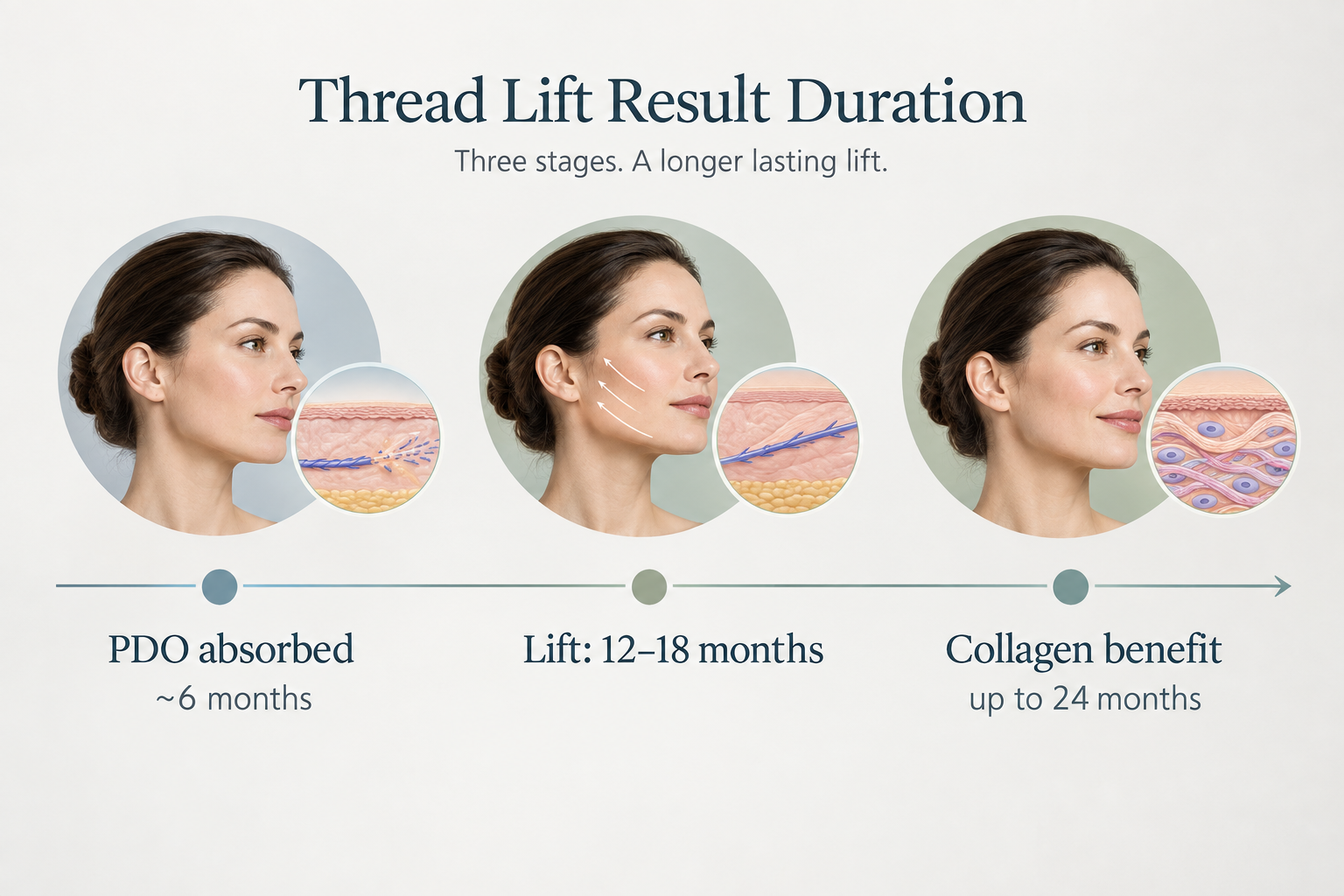
Several factors influence how long results are maintained. Skin quality, the degree of ongoing sun exposure, lifestyle factors such as smoking, and the natural rate of continued facial ageing all play a role. Patients who combine thread lifting with complementary treatments — such as radiofrequency skin tightening, injectable skin boosters, or appropriate skincare — may find that their overall result is better maintained over time, though this has not been rigorously studied in controlled trials.
Repeat thread lift procedures are possible once the initial threads have been absorbed and the tissue has settled, and some patients choose to undergo maintenance treatments to sustain their results. The decision to repeat treatment should be made following a fresh clinical assessment rather than on a fixed schedule.
What Happens During a Thread Lift Appointment?
Before the procedure, a qualified practitioner will assess the patient’s facial anatomy, skin quality, and degree of laxity, and discuss realistic outcomes. A medical history review is standard, covering medications, previous procedures, allergies, and relevant health conditions. Photographs are typically taken for comparison purposes.
On the day of treatment, the skin is cleansed and a topical or local anaesthetic is applied to minimise discomfort. The practitioner marks the planned thread entry and exit points, then inserts the threads using a fine needle or blunt-tipped cannula. Once the threads are in position, they are tensioned to achieve the desired lift and any excess thread is trimmed. The number of threads used varies depending on the treatment area and the degree of correction required.
Most patients describe the procedure as mildly uncomfortable rather than painful, with the local anaesthetic significantly reducing sensation during insertion. Some pressure or pulling sensation may be felt as the threads are tensioned. The appointment typically concludes with aftercare instructions covering activity restrictions, sleeping position, and facial movements in the days immediately following treatment.
Recovery and Downtime
One of the reasons patients consider a threading face lift over surgical alternatives is the relatively limited downtime. Most patients experience some degree of swelling, bruising, and mild tenderness in the treated areas for the first few days after the procedure. These effects are generally manageable and typically resolve within one to two weeks, though individual recovery varies.
Temporary skin dimpling or puckering at the thread entry points is common in the first week and usually settles as the tissue adjusts to the threads. Practitioners typically advise patients to avoid vigorous facial massage, dental procedures requiring wide mouth opening, and strenuous exercise for a short period after treatment. Sleeping on the back rather than the side is often recommended during the initial recovery phase to avoid displacing the threads.
Most patients are able to return to work and social activities within a few days, though visible bruising may require camouflage makeup during this period. Full results are generally assessed at four to six weeks, once initial swelling has resolved and the tissue has settled around the threads.
Risks and Side Effects
A threading face lift carries a range of potential side effects and risks that patients should understand before proceeding. Common and usually temporary side effects include bruising, swelling, tenderness, and mild asymmetry in the days following treatment. Skin dimpling or puckering at insertion points is also frequently reported and typically resolves within one to two weeks.
Less common but more significant complications include thread migration, where a thread shifts from its intended position, and thread extrusion, where a thread becomes visible or breaks through the skin surface. Infection at the insertion site is possible and requires prompt medical attention. Nerve injury is rare but has been reported, and in some cases may cause temporary or, very rarely, prolonged altered sensation.
Visible thread outlines beneath the skin, persistent asymmetry, and an unsatisfactory aesthetic result are also recognised outcomes that may require further treatment or, in some cases, thread removal. The risk of complications is influenced by practitioner experience, patient anatomy, and adherence to aftercare guidance. Choosing a qualified and experienced practitioner who performs thread lifting regularly is an important factor in minimising risk.
Who May Be Suitable for a Thread Lift?
Thread lifting tends to produce the most satisfying results in patients who have mild to moderate facial skin laxity, good baseline skin quality, and realistic expectations about the degree of improvement achievable. Patients in their late thirties to mid-fifties are often considered good candidates, though suitability is determined by anatomy and tissue quality rather than age alone.
Patients who are not ready for or do not wish to undergo surgical facelift surgery, but who have noticed early jowling, a loss of midface definition, or brow descent, may find thread lifting a useful option to discuss with a practitioner. Thread lifting may also be considered as a complement to other non-surgical treatments rather than as a standalone solution for more complex facial ageing.
Patients with very thin skin, significant volume loss, or advanced skin laxity are generally less likely to achieve a satisfying result from thread lifting alone. Those with active skin infections, certain autoimmune conditions, bleeding disorders, or who are pregnant or breastfeeding are typically not suitable candidates. A thorough pre-treatment consultation is essential to identify any contraindications and to ensure the treatment plan is appropriate for the individual.
Alternatives to a Threading Face Lift
Several non-surgical and surgical alternatives exist for patients considering facial lifting and rejuvenation. The most appropriate option depends on the degree of laxity present, the patient’s goals, tolerance for downtime, and overall health.
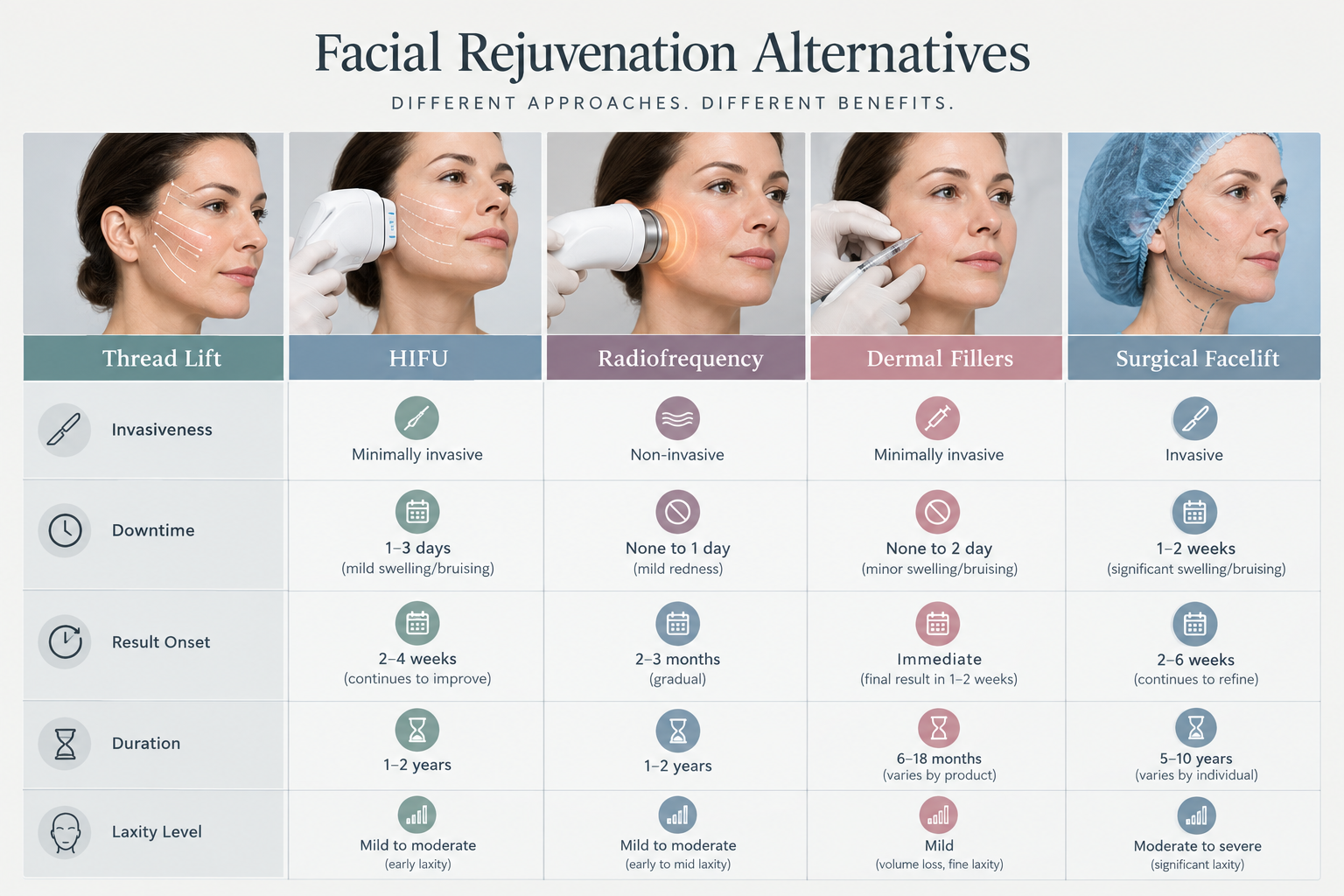
- High-intensity focused ultrasound (HIFU): HIFU devices deliver focused ultrasound energy to the deeper layers of the skin and superficial muscular aponeurotic system (SMAS), stimulating collagen production and producing a gradual tightening effect. HIFU is non-invasive and requires no needles, but results develop slowly over two to three months and may be more subtle than thread lifting in some patients.
- Radiofrequency skin tightening: Radiofrequency energy heats the deeper dermis to stimulate collagen remodelling. Devices such as monopolar, bipolar, and microneedling radiofrequency platforms are used for skin tightening and mild lifting. Results are gradual and multiple sessions may be required.
- Dermal fillers: Injectable hyaluronic acid fillers can restore volume to areas such as the cheeks and temples, which may indirectly improve the appearance of jowling and facial descent. Fillers address volume loss rather than tissue laxity directly, and the two concerns often coexist.
- Surgical facelift (rhytidectomy): A surgical facelift remains the most effective intervention for significant facial skin laxity and tissue descent. It produces more durable and dramatic results than any non-surgical approach, but requires general or sedation anaesthesia, a longer recovery period, and carries the risks associated with surgery.
- Combination non-surgical approaches: Many practitioners recommend combining thread lifting with complementary treatments such as skin boosters, botulinum toxin, or energy-based devices to address multiple aspects of facial ageing simultaneously and potentially extend the overall result.
Frequently Asked Questions
Is a thread lift painful?
Most patients find the procedure tolerable with local anaesthetic applied beforehand. Some pressure or mild discomfort may be felt during thread insertion and tensioning, but significant pain during the procedure is uncommon. Post-procedure tenderness for a few days is normal.
Can thread lift results be seen immediately?
An initial lifting effect is usually visible immediately after treatment, though swelling in the first few days can temporarily obscure the result. The final outcome is generally assessed at four to six weeks once swelling has fully resolved and the tissue has settled.
Can a thread lift be combined with other treatments?
Yes. Thread lifting is frequently combined with dermal fillers, botulinum toxin, skin boosters, or energy-based treatments to address different aspects of facial ageing. The timing and sequencing of combination treatments should be planned carefully with a qualified practitioner.
What happens when the threads dissolve?
As biodegradable threads are gradually absorbed by the body, the direct mechanical lift diminishes. However, the collagen stimulated around the threads may provide some ongoing skin quality benefit. The rate at which the visible result fades varies between individuals and thread types.
Is a thread lift reversible?
Thread lifts are not straightforwardly reversible in the way that, for example, hyaluronic acid fillers can be dissolved. If a thread migrates or produces an unsatisfactory result, removal may be possible in some cases, but this depends on the thread type, position, and how much time has passed since insertion. This is one reason why choosing an experienced practitioner is important.
How does a thread lift differ from a surgical facelift?
A surgical facelift involves incisions, the removal of excess skin, and repositioning of deeper facial structures, producing more significant and longer-lasting correction. A threading face lift is minimally invasive, requires no incisions, and produces a more modest result with considerably less downtime. The two procedures are not equivalent and suit different degrees of facial ageing.
How much does a thread lift cost?
Thread lift costs vary depending on the number of threads used, the treatment areas, the practitioner’s experience, and the clinic location. Patients should be cautious of unusually low prices, as thread lifting requires skill and appropriate training to perform safely. A detailed cost breakdown should be provided during the consultation.
Is a Threading Face Lift Worth Considering for You?
A threading face lift can be an effective option for patients with mild to moderate facial skin laxity who are seeking a visible but natural-looking improvement without surgical downtime. The procedure offers a meaningful mechanical lift combined with the potential for gradual collagen stimulation, and for appropriately selected patients, results can be satisfying for 12 to 24 months. However, thread lifting is not a substitute for surgical facelift in patients with significant tissue descent, and results vary considerably depending on individual anatomy, thread selection, and practitioner technique.
The decision to proceed with a threading face lift should be made after a thorough consultation with a qualified and experienced practitioner who can assess your facial anatomy, discuss realistic outcomes, and identify whether thread lifting, an alternative treatment, or a combination approach is most likely to meet your goals. If you are exploring your options for facial rejuvenation, a professional assessment is the most reliable starting point for understanding what may be achievable for you specifically.


