Tattooing After Laser Removal: Timing, Healing and What to Expect
Getting a tattoo after laser removal is entirely possible, and for many people it is the whole point of the process — whether that means a fresh design on cleared skin or a cover-up tattoo over a faded one. The key variables are timing, skin condition, and choosing the right professionals for both stages. This guide explains how laser removal changes the skin, what fully healed skin actually looks and feels like, how long the waiting period should be, and what decisions you will need to make before sitting in a tattoo artist’s chair again.
Key Takeaways
- New ink on laser-treated skin is safe once the skin has fully healed, but rushing the process increases the risk of poor ink retention, scarring, and infection.
- Most practitioners recommend waiting at least six to twelve weeks after the final laser session before tattooing, and up to six months if significant skin changes occurred.
- Partial fading — typically two to five sessions — is often enough for a cover-up tattoo, while full removal requires six to fifteen or more sessions depending on the tattoo.
- Skin type, laser technology used, and the presence of any scar tissue all affect how quickly the treated area is ready for new ink.
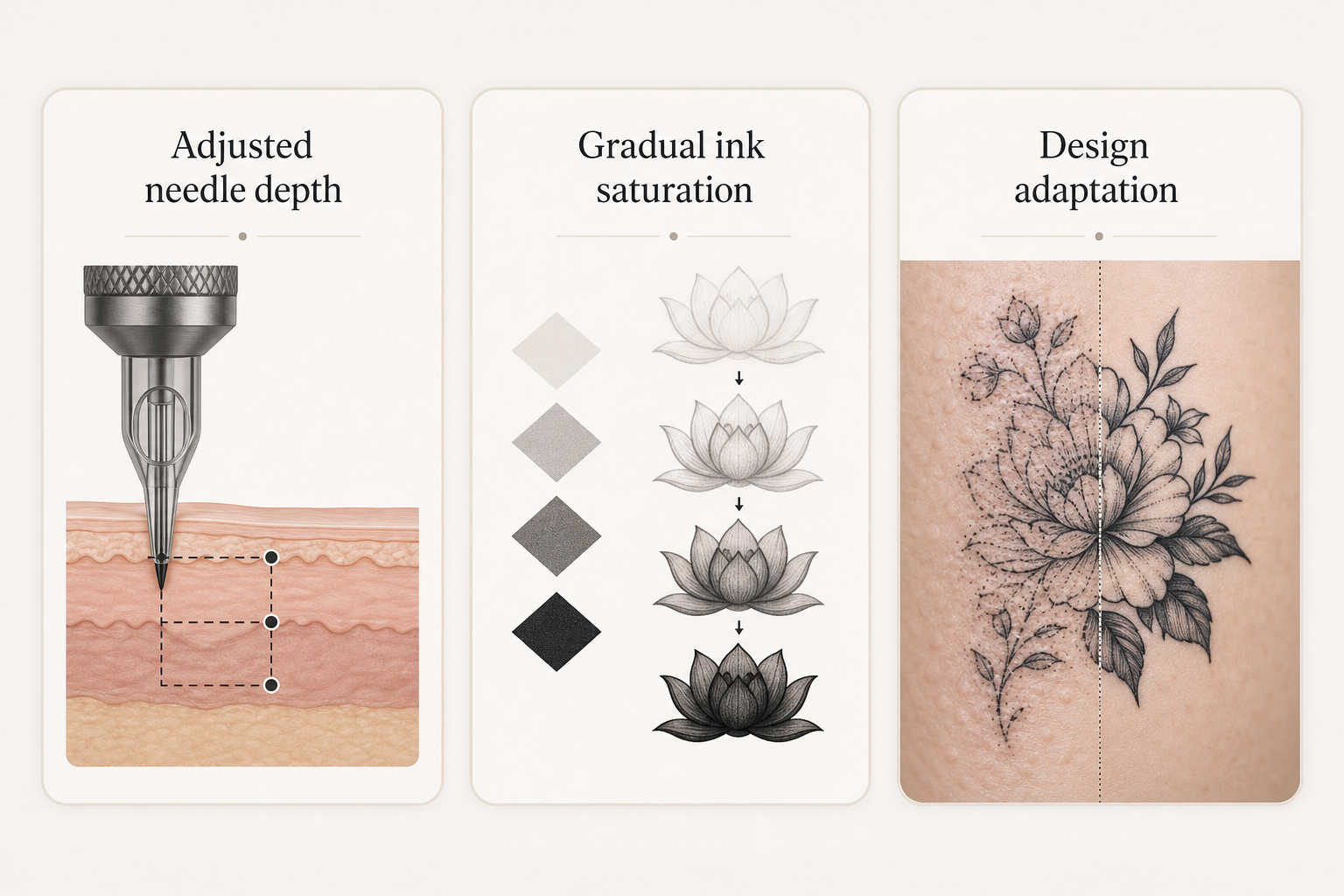
- An experienced tattoo artist familiar with laser-treated skin will adapt needle depth and ink saturation technique to account for any texture changes.
How Laser Tattoo Removal Changes the Skin
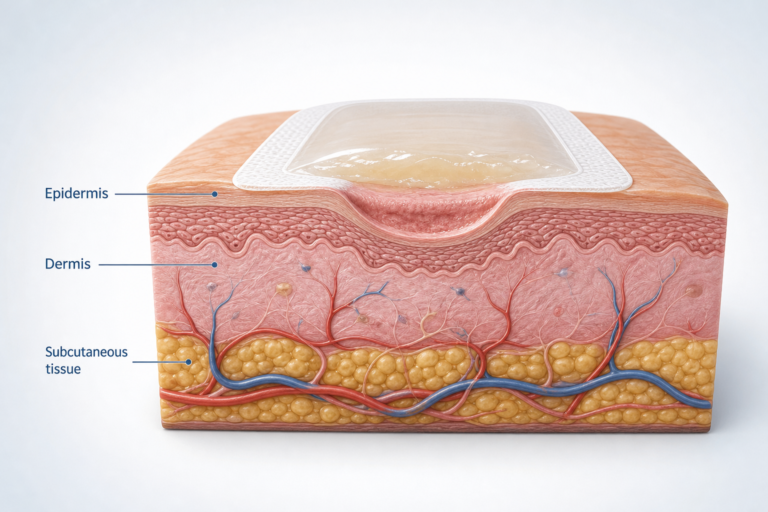
Understanding what laser removal actually does to the skin helps explain why timing matters so much before re-tattooing. Laser tattoo removal works through a process called selective photothermolysis: short pulses of laser energy are absorbed by tattoo ink particles in the dermis, the deeper layer of skin beneath the surface epidermis. The energy shatters those ink particles into smaller fragments, which the body’s immune system then gradually clears through the lymphatic system over the weeks following each session.
Modern picosecond lasers — such as PicoWay and PicoSure — deliver energy in ultra-short pulses measured in trillionths of a second, which fragments ink more efficiently and with less thermal damage to surrounding tissue compared with older Q-switched nanosecond lasers. This distinction matters for re-tattooing because picosecond laser treatment tends to preserve the surrounding skin architecture better, which may mean the treated area recovers more predictably. However, both laser types cause a controlled injury to the skin that triggers an inflammatory healing response, and that response must complete fully before new ink is introduced.
Each laser session produces visible short-term effects — frosting (a white reaction on the skin surface), redness, swelling, and sometimes blistering or scabbing in the days that follow. Beneath the surface, collagen remodeling occurs as the skin repairs itself. This process takes considerably longer than the visible surface healing, which is why the skin can look normal on the outside while still undergoing structural changes underneath.
What Fully Healed Skin Actually Looks Like
Competitors frequently advise waiting until the skin “has healed” without explaining what that means in practice. Fully healed skin after laser tattoo removal has several identifiable characteristics that you and your practitioner can assess before scheduling a new tattoo appointment.
The treated area should show no active redness, warmth, or raised texture. Any scabbing or blistering from the most recent session should have resolved completely, with no open or fragile areas remaining. Skin tone in the treated area should have stabilized — meaning any post-treatment hyperpigmentation (darkening) or hypopigmentation (lightening) has either resolved or reached a stable baseline. Hypopigmentation, a pale patch caused by laser energy affecting melanin-producing cells called melanocytes, is one of the more persistent changes and may not fully resolve in all cases, particularly in people with darker skin tones.
The skin surface should feel smooth and similar in texture to the surrounding untreated skin. If there is any residual raised texture, firmness, or sensitivity, collagen remodeling is likely still ongoing and the skin is not yet ready for tattooing. A qualified laser specialist can assess these signs at a follow-up appointment and give a clearer indication of readiness than a self-assessment alone.
Skin Type and Hypopigmentation Risk
Skin type has a meaningful effect on both the laser removal process and the timeline before re-tattooing. People with higher Fitzpatrick skin types — a clinical scale from I (very fair) to VI (very dark) — have more melanin in their skin, which means laser energy can affect pigment-producing cells more significantly. This increases the risk of hypopigmentation, where the treated area becomes noticeably lighter than the surrounding skin.
For people with medium to darker skin tones, hypopigmentation may take longer to stabilize or may not fully resolve. Tattooing over an area with active or unstable hypopigmentation can produce unpredictable results, as the ink sits in skin that has altered pigment characteristics. In these cases, a longer waiting period — potentially closer to six months after the final laser session — is often advisable, and the laser settings used during removal should have been adjusted appropriately for skin type from the outset. If you have a higher Fitzpatrick skin type and are planning to re-tattoo, discussing this specifically with both your laser specialist and your tattoo artist before proceeding is particularly important.
How Long Should You Wait Before Getting a New Tattoo?
The minimum waiting period most practitioners recommend after the final laser session is six weeks, but six to twelve weeks is a more commonly cited practical guideline for straightforward cases. For people who experienced significant blistering, prolonged hypopigmentation, or any scarring during the removal process, waiting up to six months is a more cautious and appropriate approach.
One factor that is rarely discussed is what might be called the immune system overlap problem. After each laser session, the immune system is actively working to clear fragmented ink particles from the dermis. This immune activity continues for weeks after each session. If a new tattoo is placed while this clearance process is still underway, the immune system may treat some of the fresh ink as another foreign substance to be cleared — potentially contributing to poor ink retention in the new tattoo. Waiting until immune system clearance from the removal process has substantially completed reduces this risk.
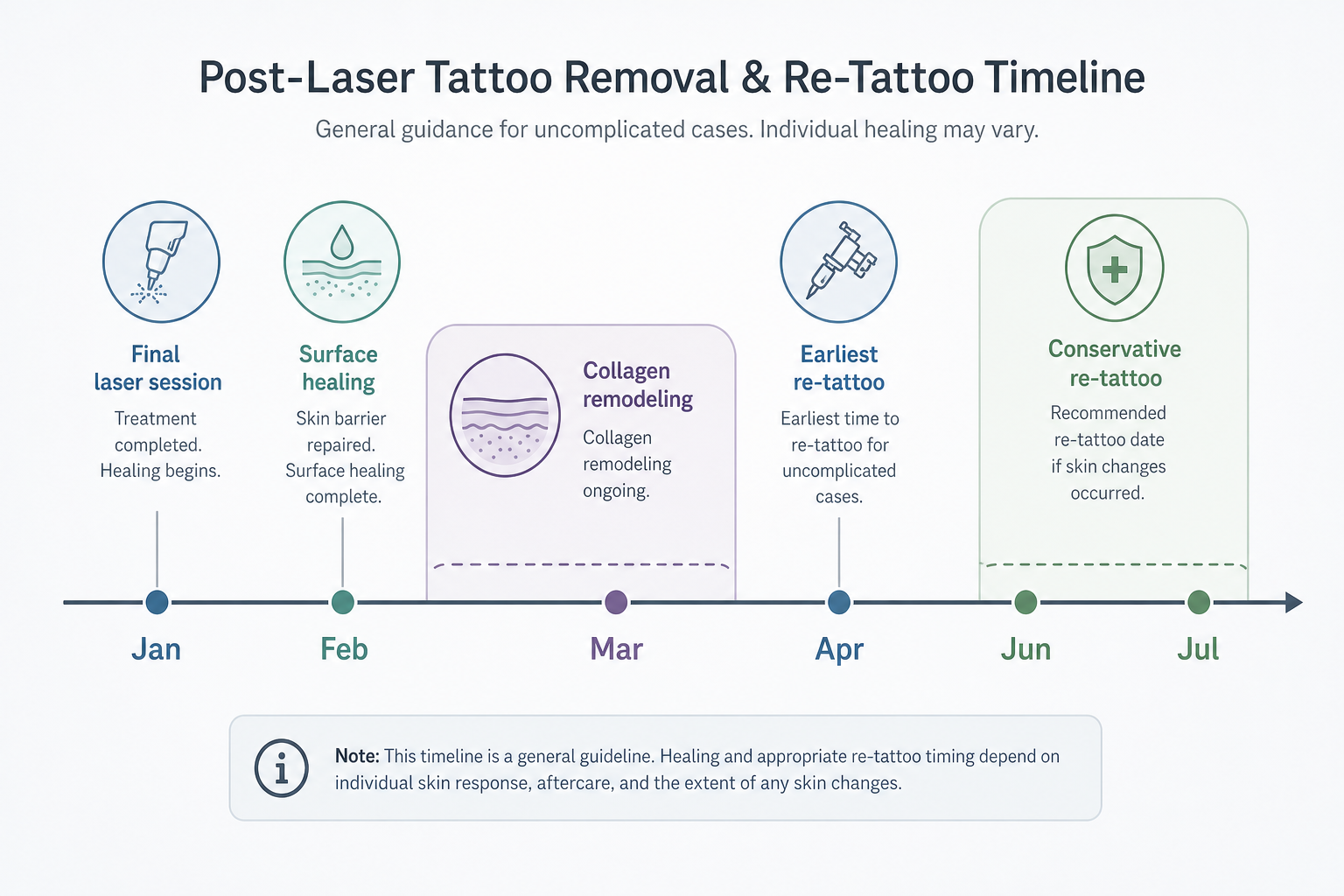
A practical real-world timeline helps illustrate this. If your final laser removal session takes place in January, surface healing will typically be visible within two to four weeks. However, the deeper collagen remodeling and immune clearance processes continue through February and March. A conservative target for a new tattoo appointment would be April at the earliest for uncomplicated cases, and June or July if there were any significant skin changes. Your laser specialist is best placed to advise on your specific situation at a follow-up assessment.
Full Removal vs. Partial Fading: Which Path Is Right for You?
One of the most important decisions when planning a tattoo after laser removal is whether you need complete removal or whether partial fading is sufficient. These two paths have meaningfully different timelines, costs, and outcomes.
| Factor | Partial Fading (Cover-Up) | Full Removal + New Tattoo |
|---|---|---|
| Typical sessions needed | 2–5 sessions | 6–15+ sessions |
| Approximate timeline | 6–12 months total | 1–3+ years total |
| Design flexibility | Limited by residual ink placement and density | Full creative freedom |
| Relative cost | Lower (fewer sessions) | Higher (more sessions) |
| Skin impact | Less cumulative laser exposure | More cumulative laser exposure |
| Best suited for | Darker, more saturated cover-up designs | Any new design, including fine line or light colour work |
Partial fading involves reducing the density and saturation of the existing tattoo enough that a skilled tattoo artist can work over it with a new design. This typically requires two to five laser sessions spaced four to seven weeks apart, followed by the standard healing period before tattooing. The cover-up tattoo design must be planned around the residual ink — generally requiring a darker, more saturated new design that can visually dominate what remains underneath. This approach is faster and less expensive than full removal, but it constrains design flexibility.
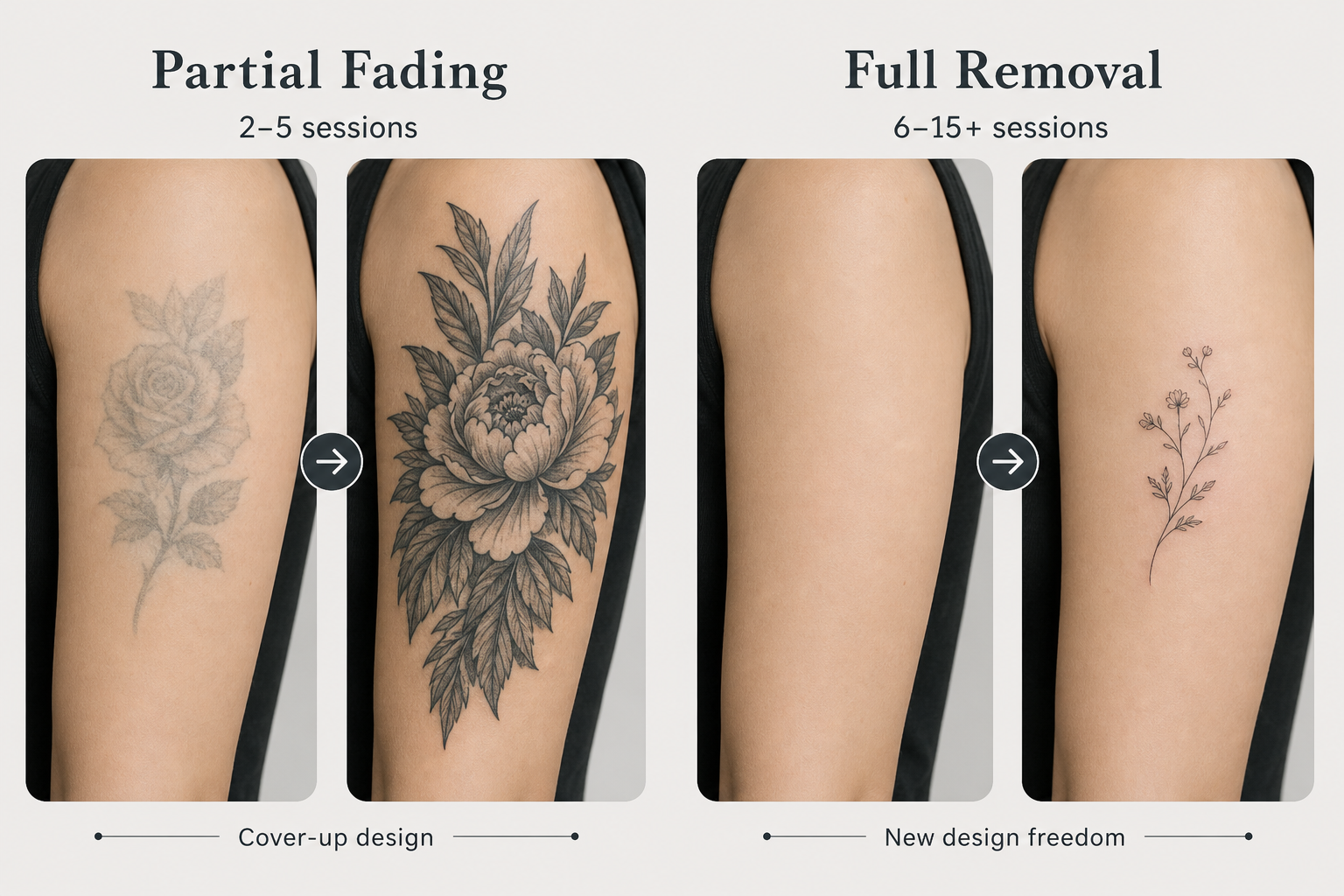
Full removal aims to clear the skin as completely as possible, creating what tattoo artists sometimes call a blank canvas. This path requires significantly more laser sessions — often six to fifteen or more depending on the tattoo’s age, size, ink colours, and depth — and a correspondingly longer overall timeline. The advantage is that the new tattoo design is not constrained by the placement or density of the original ink. Fine line work, watercolour styles, and light colour palettes that would be impossible over residual ink become viable options.
The Effect of Ink Colour on Re-Tattooing Readiness
Ink colour affects both how effectively laser removal works and what design options are realistic for a new tattoo. Black and dark blue inks respond most readily to laser treatment across multiple wavelengths. Green, purple, and teal inks require specific laser wavelengths and may take more sessions to fade. Red, orange, and yellow inks can be particularly stubborn.
A less commonly discussed issue is paradoxical ink darkening, which can occur with certain pigments — particularly white, flesh-toned, and some pink inks — when exposed to laser energy. These pigments can oxidize and turn darker rather than lighter after laser treatment, which directly affects what new tattoo designs are viable over that area. If the original tattoo contained these colours and paradoxical darkening occurred, the treated area may have a darker residual tone that needs to be factored into the new design. Discussing the specific ink colours in your original tattoo with your laser specialist before beginning removal helps set realistic expectations for the outcome.
Risks of Tattooing Too Soon on Laser-Treated Skin
Placing new ink on laser-treated skin before it has fully healed carries several meaningful risks. Poor ink retention is one of the most common outcomes — the skin’s compromised structure means ink does not settle evenly, leading to a patchy or faded appearance in the new tattoo shortly after healing. This is frustrating and costly to address.
Infection risk is elevated in skin that has not fully recovered from laser treatment. The skin barrier may still be compromised even when the surface appears intact, making it more susceptible to bacterial entry during the tattooing process. Scarring risk also increases when a tattoo needle works through skin that is still undergoing collagen remodeling — the mechanical trauma of tattooing can disrupt the healing process and worsen skin texture changes that might otherwise have resolved.
Uneven ink saturation is another practical concern. Laser-treated skin may have areas of varying texture and density, and ink may take differently across those areas, producing an inconsistent result even with a skilled artist. Waiting for the skin to fully stabilize reduces but does not eliminate this variability.
Understanding Scar Tissue Before Re-Tattooing
A nuance worth understanding is that much of what appears to be scarring after laser tattoo removal is often pre-existing texture from the original tattooing process rather than damage caused by the laser itself. Tattooing inherently involves repeated needle penetration of the dermis, which can create subtle textural changes — particularly in heavily worked areas or in tattoos applied with excessive pressure. Laser removal does not erase this pre-existing texture, and in some cases the removal process can make it more visible as the overlying ink fades.
True laser-induced scar tissue is less common with modern laser technology when treatment is performed by a qualified practitioner at appropriate settings, but it can occur, particularly with older Q-switched lasers or when sessions are spaced too closely. If genuine scar tissue is present in the treated area, this affects how a new tattoo will look and feel. An experienced tattoo artist will assess the texture of the treated area before agreeing to work on it and may advise waiting longer or adjusting the design to avoid the most affected areas.
What an Experienced Tattoo Artist Does Differently on Laser-Treated Skin
Finding an experienced tattoo artist who has worked on laser-treated skin is consistently recommended, but rarely explained in practical terms. The differences in technique are meaningful. On skin with altered texture from laser treatment, an artist may adjust needle depth to account for changes in the dermis — going too deep risks further trauma to already-remodeled tissue, while going too shallow results in ink that does not anchor properly.
Ink saturation passes may be approached more conservatively on laser-treated skin, with the artist building colour gradually rather than working heavily in a single pass. This reduces trauma to the skin and gives a better indication of how the ink is taking before committing to full saturation. The artist may also adapt the design to work with rather than against any residual ink or texture — for example, placing darker elements over areas where residual ink remains, or avoiding fine detail work in areas with uneven skin texture where precision is harder to achieve.
Before booking, it is worth asking a prospective tattoo artist directly whether they have experience working on laser-treated skin and how they approach it. A reputable artist will be willing to assess the treated area in a consultation before committing to the work.
Aftercare for a New Tattoo on Previously Lasered Skin
Aftercare for a new tattoo placed on previously laser-treated skin follows the same general principles as standard tattoo aftercare — keeping the area clean, moisturised, and protected from sun exposure — but there are a few additional considerations. Skin that has undergone laser removal may be more sensitive than untreated skin, and the healing response may differ slightly. Following the aftercare instructions provided by both your tattoo artist and your laser specialist is important.
Sun protection is particularly relevant for previously lasered skin, as areas that experienced hypopigmentation or hyperpigmentation during removal may be more susceptible to UV-related pigment changes. Using a high-SPF sunscreen on the healed new tattoo and avoiding prolonged sun exposure during the healing period helps protect both the new ink and the underlying skin. If you notice any unusual redness, swelling, or signs of infection during healing, seek prompt assessment from a medical professional rather than waiting to see if it resolves.
Frequently Asked Questions
Can you get a tattoo directly over a tattoo that has only been partially faded?
Yes, provided the skin has fully healed after the most recent laser session and the waiting period has been observed. The cover-up tattoo design will need to be planned around the residual ink — typically requiring a darker, more saturated design. A consultation between your laser specialist and tattoo artist before proceeding helps ensure the timing and design are appropriate.
Does laser-treated skin hold ink as well as untreated skin?
When the skin has fully healed and sufficient time has passed after the final laser session, ink retention in a new tattoo is generally comparable to untreated skin. However, areas with significant texture changes or residual hypopigmentation may hold ink slightly differently. An experienced tattoo artist can assess this during a consultation and adjust technique accordingly.
How many laser sessions are needed before a cover-up tattoo?
The number of sessions needed for partial fading before a cover-up tattoo varies depending on the original tattoo’s size, ink colours, age, and depth. Two to five sessions is a commonly cited range for fading sufficiently to allow a cover-up, but some tattoos — particularly those with dense black ink or multiple colours — may require more. Your laser specialist can give a more specific estimate after assessing the tattoo.
Will the new tattoo look different because of the laser treatment?
If the skin has healed fully and the waiting period has been observed, the new tattoo should look similar to a tattoo on untreated skin. Any residual skin texture changes or hypopigmentation may affect the final appearance, which is why a thorough assessment before tattooing is important. Choosing an experienced tattoo artist who can adapt their technique to the skin’s condition improves the likelihood of a good outcome.
Is it safe to tattoo over an area that has hypopigmentation after laser removal?
Tattooing over hypopigmented skin is possible but requires careful consideration. The altered pigment characteristics of the skin may affect how ink colours appear once healed. In some cases, the new tattoo ink can help camouflage the lighter area, but results are not guaranteed. A consultation with both your laser specialist and tattoo artist is advisable before proceeding, particularly if the hypopigmentation is significant or has not yet stabilized.
Does the type of laser used for removal affect how quickly I can re-tattoo?
Laser technology does play a role. Picosecond lasers generally cause less thermal damage to surrounding tissue compared with older Q-switched nanosecond lasers, which may support a more predictable recovery. However, the individual healing response, skin type, and number of sessions completed are all significant factors. Your laser specialist is best placed to advise on readiness based on the specific technology used and your skin’s response.
Planning Your Next Tattoo After Laser Removal: A Practical Decision Guide
The decision to get a tattoo after laser removal involves more variables than most people anticipate, but it is a well-established and achievable goal when approached methodically. The most important steps are allowing adequate time after the final laser session, having the treated area assessed by a qualified professional before booking a tattoo appointment, and choosing a tattoo artist with relevant experience in working on laser-treated skin.
If you are pursuing partial fading for a cover-up tattoo, involve your tattoo artist in the planning process early — ideally before you begin laser sessions — so the fading protocol can be targeted to the areas that most need lightening for the new design. If you are pursuing full removal before a new tattoo, build realistic expectations around the timeline: full removal of a complex tattoo can take one to three years or more, and the re-tattooing process begins only after that is complete and the skin has healed.
A consultation with a qualified laser specialist who can assess your skin type, the characteristics of the original tattoo, and the technology available is the most useful starting point. From there, a clear plan covering the number of sessions needed, the expected waiting period, and the realistic design options for the new tattoo gives you the information needed to make a confident, well-timed decision.