
Skin Analysis and Skin Type: What to Expect from a Professional Assessment in London
Understanding your skin type and its underlying condition is the foundation of any effective skincare or aesthetic treatment plan. A professional skin analysis in London goes well beyond a basic visual inspection, using clinical tools and practitioner expertise to assess hydration levels, sebum production, pigmentation patterns, pore size, skin texture, and signs of premature ageing. Whether you are considering a course of treatments or simply want clearer guidance on your daily skincare routine, a thorough skin assessment can provide genuinely useful, personalised information that generic online quizzes cannot replicate.
Key Takeaways
- Professional skin analysis identifies your skin type and condition using clinical assessment tools, not just visual observation, providing a more accurate baseline than self-assessment.
- Skin type and skin condition are distinct concepts: skin type is largely determined by genetics and sebum production, while skin condition reflects current factors such as hydration, sensitivity, and environmental damage.
- Advanced imaging technologies used in London clinics can reveal subsurface pigmentation, vascular patterns, and early signs of sun damage that are not visible to the naked eye.
- A skin analysis appointment is typically non-invasive, takes between 20 and 60 minutes, and forms the basis of a tailored treatment or skincare recommendation.
- Results from a skin analysis are most useful when interpreted by a qualified practitioner who can contextualise findings within your medical history, lifestyle, and aesthetic goals.
What Is a Professional Skin Analysis?
A professional skin analysis is a structured clinical assessment of the skin’s surface and, depending on the technology used, its deeper layers. The goal is to characterise both skin type and skin condition accurately so that treatment recommendations, product choices, and lifestyle advice are genuinely matched to the individual. In a clinical setting, this assessment is typically performed by a dermatologist, aesthetic nurse, cosmetic doctor, or trained aesthetician using a combination of visual examination, tactile assessment, and diagnostic devices.
Skin analysis differs from a standard consultation in that it produces measurable or documented findings rather than relying solely on the patient’s self-reported concerns. Many London clinics now use digital imaging systems, such as the VISIA Complexion Analysis system or similar multi-spectral imaging platforms, which capture standardised photographs under different light conditions. These images can reveal surface texture, pore distribution, UV-induced pigmentation, subsurface brown spots, red areas associated with vascular activity, and bacterial porphyrins linked to acne. The resulting data gives the practitioner a detailed picture of the skin’s current state and, in some cases, allows comparison over time to track the effects of treatment.
It is important to understand that a skin analysis is an assessment tool, not a treatment. The value of the appointment lies in the quality of the interpretation and the recommendations that follow, rather than in the technology itself.
Skin Type vs Skin Condition: An Important Distinction
One of the most clinically useful things a skin analysis can clarify is the difference between your skin type and your current skin condition, two concepts that are frequently confused.
Skin type refers to the inherent characteristics of your skin, primarily determined by genetics and the activity of your sebaceous glands. The most widely used classification system identifies five broad skin types: normal, dry, oily, combination, and sensitive. These categories reflect how much sebum the skin naturally produces and how it responds to environmental factors. Skin type is relatively stable over time, though it can shift gradually with age, hormonal changes, or significant lifestyle changes.
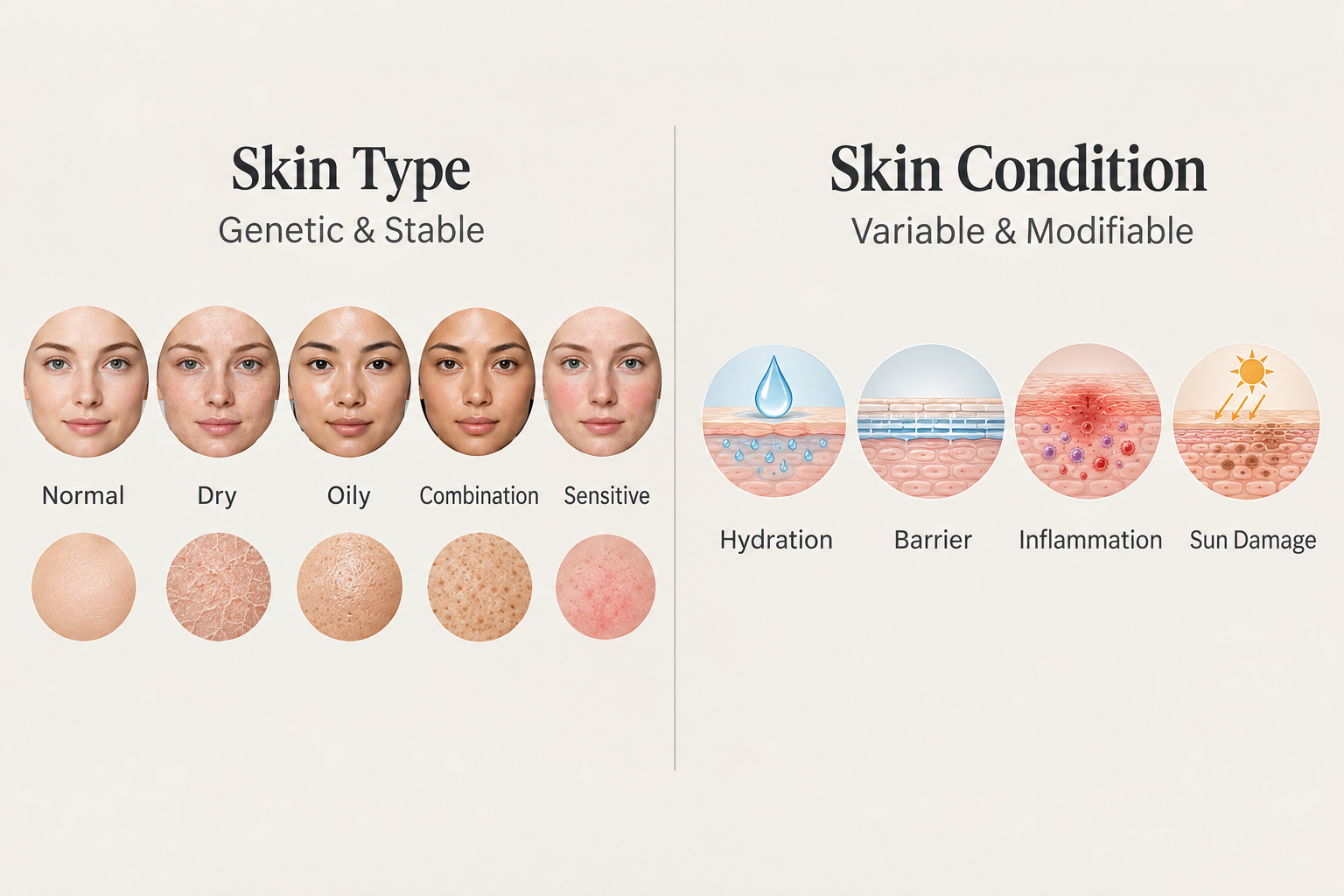
Skin condition, by contrast, describes the current state of the skin and is influenced by factors that can change: hydration levels, barrier function, inflammation, sun damage, acne activity, hyperpigmentation, and the effects of previous treatments or products. A person with an oily skin type may currently have a compromised skin barrier due to over-cleansing, making their skin simultaneously oily and sensitised. A person with a dry skin type may have well-managed hydration if they are using appropriate products consistently.
Distinguishing between the two matters because treatment and product recommendations differ significantly depending on whether a concern reflects a fixed skin type or a modifiable skin condition. A professional skin analysis is designed to make this distinction clearly, which is something a self-assessment questionnaire rarely achieves with accuracy.
The Five Main Skin Types Explained
Understanding the five main skin types provides useful context for interpreting the results of a skin analysis and for understanding why certain treatments or products may be recommended.
Normal Skin
Normal skin produces sebum at a balanced rate, maintaining adequate hydration without excess oiliness. Pores are typically small and not prominently visible. The skin tone is generally even, and the skin is neither prone to frequent breakouts nor to significant dryness or flaking. In clinical terms, normal skin has a well-functioning barrier and a balanced transepidermal water loss rate. This skin type is relatively uncommon in its pure form, particularly in adults living in urban environments such as London, where pollution, stress, and variable weather can shift the skin’s condition over time.
Dry Skin
Dry skin produces less sebum than average, which can compromise the skin’s natural lipid barrier. This often results in a feeling of tightness, visible flaking or roughness, and a dull or lacklustre complexion. Fine lines may appear more prominent on dry skin because the reduced lipid content makes the skin less supple. Dry skin is more susceptible to sensitivity and irritation, and it may react adversely to products containing high concentrations of alcohol or certain active ingredients. Clinically, dry skin is associated with elevated transepidermal water loss and reduced sebum output as measured by a sebumeter.
Oily Skin
Oily skin is characterised by excess sebum production, which can lead to a shiny or greasy appearance, enlarged pores, and a tendency towards comedones and acne breakouts. Despite its challenges, oily skin often ages more slowly in terms of fine line formation because the natural oils provide a degree of lubrication and barrier protection. Oily skin can be exacerbated by humidity, hormonal fluctuations, certain dietary patterns, and the use of comedogenic products. A skin analysis can measure sebum levels objectively, which is useful when distinguishing between genuinely oily skin and skin that appears oily due to dehydration.
Combination Skin
Combination skin presents with oiliness in the T-zone, which includes the forehead, nose, and chin, alongside normal or dry skin on the cheeks and around the eyes. This is one of the most common skin types, particularly in younger adults. The challenge with combination skin is that a single product approach rarely addresses all areas effectively. A professional skin analysis can map the distribution of sebum production across the face, providing a more nuanced picture than a general self-assessment.
Sensitive Skin
Sensitive skin is not a single defined skin type in the same way as the others; it is better understood as a skin condition or predisposition. Sensitive skin reacts more readily to environmental triggers, topical products, temperature changes, and stress. Reactions may include redness, stinging, burning, or itching. Sensitive skin can occur alongside any of the other skin types. In a clinical assessment, sensitivity may be evaluated through a detailed history of reactions, visual assessment of redness and vascular patterns, and in some cases patch testing. It is worth noting that self-reported skin sensitivity does not always correlate with clinically measurable sensitivity, which is another reason why professional assessment adds value.
Methods Used in Professional Skin Analysis
London clinics offering professional skin analysis typically use a combination of assessment methods, ranging from straightforward clinical observation to sophisticated digital imaging. The specific tools available vary between clinics, and not every clinic will offer every technology.
Visual and Tactile Assessment
The foundation of any skin analysis is a careful visual examination under good lighting, often supplemented by a magnifying lamp or dermatoscope. The practitioner assesses skin tone, texture, visible pores, surface hydration, redness, pigmentation, and any active lesions. Tactile assessment, where the practitioner gently presses or stretches the skin, provides information about elasticity, firmness, and the degree of subcutaneous volume loss. This hands-on component remains clinically important even when advanced imaging is available.
Multi-Spectral and UV Imaging
Multi-spectral imaging systems capture the skin under standard white light, cross-polarised light, parallel-polarised light, and ultraviolet light. Each lighting condition reveals different features. UV photography, for example, can highlight areas of subclinical sun damage and melanin accumulation that are not yet visible on the surface, providing an early indication of future pigmentation concerns. Cross-polarised light reduces surface reflection, making it easier to assess deeper vascular and pigmentation changes. These systems produce standardised images that can be stored and compared at follow-up appointments, making them particularly useful for tracking treatment progress.
Skin Hydration and Sebum Measurement
Handheld devices such as corneometers measure the electrical capacitance of the skin’s surface layers, which correlates with hydration levels. Sebometers measure the amount of sebum on the skin surface using a tape-based method. These objective measurements are more reliable than visual assessment alone for distinguishing between dry, dehydrated, and oily skin conditions, and they can help identify areas where the skin barrier may be compromised.
Skin Texture and Pore Analysis
Some imaging systems include software that analyses pore size distribution, surface roughness, and fine line density across different facial zones. This information can be useful when considering treatments aimed at improving skin texture, such as chemical peels, microneedling, or laser resurfacing, as it provides a measurable baseline against which results can be compared.
What Happens During a Skin Analysis Appointment?
A skin analysis appointment in a London clinic typically begins with a brief consultation to understand your current skincare routine, any known skin concerns, relevant medical history, and your aesthetic goals. You will usually be asked to arrive with a clean face, free from makeup and heavy skincare products, so that the assessment reflects your skin’s natural state rather than the effects of recent product application.
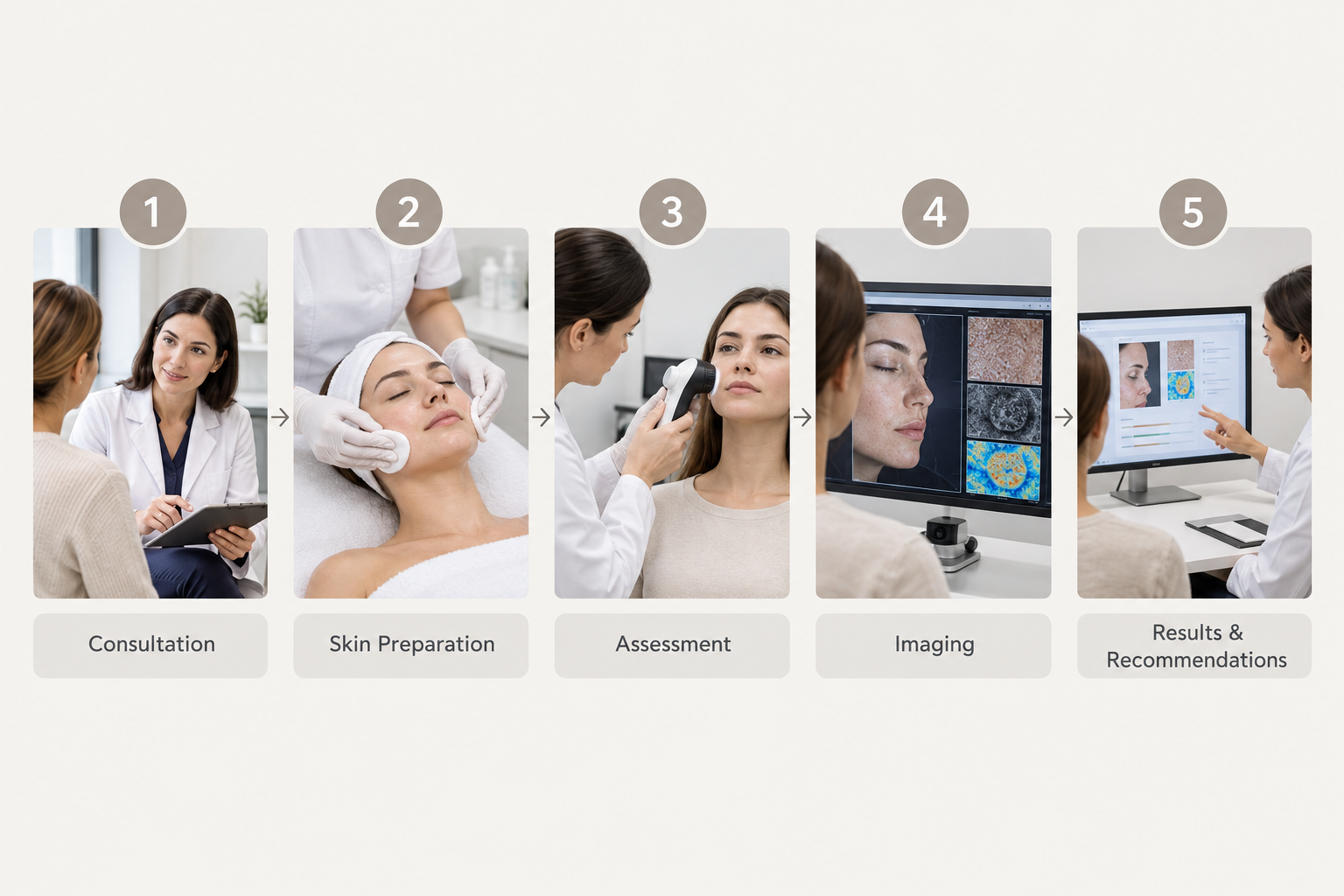
The practitioner will then perform the assessment using whichever combination of methods the clinic offers. If imaging technology is used, you will be positioned in front of the device and asked to remain still while images are captured from multiple angles. The process is non-invasive and painless. The appointment typically takes between 20 and 60 minutes in total, depending on the depth of the assessment and the time spent discussing findings.
Following the assessment, the practitioner will review the results with you, explaining what the findings mean in practical terms. This discussion should cover your skin type, any identified skin conditions or concerns, and specific recommendations for treatments, professional skincare products, or lifestyle adjustments. A reputable clinic will provide written or digital documentation of the findings so that you have a record to refer to.
How Skin Analysis Guides Treatment Planning
The primary clinical value of a skin analysis is that it allows treatment recommendations to be matched to the individual’s actual skin characteristics rather than to a general category or self-reported concern. This matters because many common skin concerns, such as dullness, uneven tone, or enlarged pores, can have multiple underlying causes, and the most effective treatment approach depends on which cause is dominant in a given individual.
For example, a patient presenting with facial redness may have rosacea, post-inflammatory erythema, broken capillaries, or simply a reactive skin barrier. Each of these conditions responds differently to treatment. A skin analysis that includes vascular imaging can help distinguish between these possibilities and guide the practitioner towards an appropriate recommendation, whether that involves laser treatment for vascular lesions, barrier repair skincare, or a referral to a dermatologist for rosacea management.
Similarly, hyperpigmentation can arise from post-inflammatory changes, melasma, solar lentigines, or a combination of these. UV imaging and a detailed history can help identify the likely cause and inform whether a treatment such as a chemical peel, a targeted depigmentation programme, or a laser procedure is likely to be appropriate and safe for that individual’s skin type and Fitzpatrick classification.
Skin analysis findings also inform product selection. Recommending a retinoid-based product to someone with a compromised skin barrier, for instance, may worsen sensitivity before it improves the skin. Knowing the baseline barrier function allows the practitioner to sequence product introductions appropriately.
Limitations of Skin Analysis
A professional skin analysis is a valuable tool, but it has meaningful limitations that are worth understanding before booking an appointment.
- Technology does not replace clinical judgement. Imaging systems provide data, but the interpretation of that data requires clinical experience. The same image can be interpreted differently by practitioners with different levels of training.
- A single assessment is a snapshot. Skin changes with the seasons, hormonal cycles, stress levels, and lifestyle factors. A skin analysis performed in winter may not fully reflect the skin’s behaviour in summer, and vice versa.
- Skin analysis cannot diagnose medical conditions. If a practitioner identifies a lesion or pattern that may indicate a dermatological condition, they should refer you to a dermatologist rather than treating it as a cosmetic concern. Skin analysis in an aesthetic clinic is not a substitute for a medical dermatology consultation.
- Results depend on preparation. Arriving with recently applied products, having had a facial treatment in the preceding days, or being in an unusual state of hydration or stress can all affect the findings.
- Not all clinics use the same technology. The depth and accuracy of a skin analysis varies considerably between clinics. A basic visual assessment and a multi-spectral imaging session are both described as skin analysis, but they provide very different levels of information.
Who May Benefit from a Skin Analysis in London?
A professional skin analysis may be particularly useful for people who are uncertain about their skin type, who have tried multiple products without consistent improvement, or who are considering a course of aesthetic treatments and want a clearer baseline. It is also relevant for people who have noticed changes in their skin, such as increased sensitivity, new pigmentation, or a shift in oiliness, and want to understand whether these changes reflect a new skin condition or a change in skin type.
People with a history of acne, rosacea, or significant sun exposure may find that a detailed skin analysis provides useful information about the current state of their skin that is not apparent from visual self-assessment alone. Those planning treatments such as laser resurfacing, chemical peels, or microneedling may benefit from a pre-treatment skin analysis to establish a baseline and to identify any factors that might affect treatment suitability or outcomes.
A skin analysis is generally suitable for adults of all ages and Fitzpatrick skin types. There are no significant contraindications to the assessment itself, though the treatment recommendations that follow will naturally take into account individual factors including skin type, medical history, and current medications.
Choosing a Skin Analysis Clinic in London
London has a wide range of clinics offering skin analysis services, from medical aesthetic clinics staffed by doctors and nurses to beauty salons offering basic skin assessments. The quality and clinical depth of the assessment varies considerably, so it is worth considering a few practical factors when choosing a provider.
Look for clinics where the skin analysis is performed or supervised by a qualified practitioner with relevant training in dermatology or aesthetic medicine. Ask in advance what assessment methods are used, whether the findings will be documented and shared with you, and whether the appointment includes a discussion of results and recommendations. A reputable clinic will not use a skin analysis primarily as a sales tool to push a specific product range or treatment package; the recommendations should be genuinely tailored to your findings.
It is also reasonable to ask whether the clinic can refer you to a dermatologist if the assessment identifies a concern that falls outside the scope of aesthetic treatment. This is a marker of a responsible clinical approach.
Frequently Asked Questions
How long does a skin analysis appointment take?
Most professional skin analysis appointments in London take between 20 and 60 minutes, depending on the methods used and the time spent discussing findings. Appointments that include multi-spectral imaging and a detailed consultation tend to be at the longer end of this range.
Do I need to prepare my skin before a skin analysis?
Most clinics ask you to arrive with a clean face, free from makeup, SPF, and heavy skincare products. Avoid having a facial treatment or using exfoliating products in the 24 to 48 hours before your appointment, as these can temporarily alter the skin’s surface characteristics and affect the accuracy of the assessment.
Is a skin analysis the same as a facial consultation?
Not necessarily. A facial consultation typically focuses on your concerns and goals and may involve a brief visual assessment. A professional skin analysis is a more structured and often more detailed evaluation of the skin’s measurable characteristics, using specific tools or imaging technology to produce documented findings. Some clinics combine both into a single appointment.
Can a skin analysis identify skin cancer?
A skin analysis in an aesthetic clinic is not a medical screening for skin cancer. If a practitioner notices a lesion or pigmented area that warrants further investigation, they should refer you to a dermatologist or GP. If you have a specific concern about a mole or skin lesion, a dermatology appointment is the appropriate first step rather than an aesthetic skin analysis.
How often should I have a professional skin analysis?
There is no universal recommendation. Many practitioners suggest an annual assessment as a useful baseline, with additional assessments before starting a new treatment course or if you notice significant changes in your skin. If you are undergoing a course of treatments, a follow-up analysis at the end of the course can help document the changes achieved.
Will the skin analysis tell me exactly which products to use?
A good skin analysis should result in specific, evidence-informed product and treatment recommendations tailored to your findings. However, these recommendations should be understood as a starting point rather than a definitive prescription. Skin responds to products over time, and adjustments may be needed as your skin condition changes.
Is a skin analysis worth the cost?
The value of a skin analysis depends on the quality of the assessment and the usefulness of the recommendations that follow. For people who have been using products that are not well matched to their skin type, or who are planning a significant investment in aesthetic treatments, a professional assessment can prevent costly mistakes and improve outcomes. It is less likely to add value if the clinic uses it primarily as a sales consultation rather than a genuine clinical evaluation.
Making an Informed Decision About Skin Analysis
A professional skin analysis in London can provide genuinely useful, personalised information about your skin type and current skin condition, going well beyond what self-assessment or generic skincare advice can offer. The most clinically meaningful assessments combine objective measurement tools with experienced practitioner interpretation and result in specific, tailored recommendations rather than generic product suggestions.
The key is to approach a skin analysis as a clinical starting point rather than a standalone solution. The findings are most valuable when they inform a coherent plan, whether that involves a targeted skincare routine, a course of professional treatments, or simply a clearer understanding of how to care for your skin day to day. If you are considering aesthetic treatments or have persistent skin concerns that have not responded to standard approaches, a professional skin analysis with a qualified practitioner is a reasonable and practical first step. Look for a clinic that is transparent about its methods, documents its findings, and prioritises your skin health over a sales outcome.


