
How Long Does Cheek Filler Last? Longevity, Factors & What to Expect
Cheek filler is one of the most commonly requested dermal filler treatments, used to restore volume, lift the midface, and improve facial contour. A question almost every patient asks before booking is how long the results will actually last. The honest answer is that cheek filler longevity varies considerably between individuals, but understanding the key factors that influence duration can help you set realistic expectations and plan your treatment schedule accordingly.
Key Takeaways
- Cheek filler results typically last between 12 and 24 months, though individual variation is significant and some patients see effects persist longer.
- The type of filler product used, the volume injected, your metabolism, lifestyle habits, and the injector’s technique all influence how long results last.
- Hyaluronic acid fillers are the most widely used option for cheek augmentation and can be partially or fully dissolved with hyaluronidase if needed.
- Results are not permanent; maintenance treatments are usually required to sustain the effect over time.
- A qualified medical practitioner should assess your anatomy, skin quality, and goals before any filler treatment to determine suitability and appropriate product choice.
What Is Cheek Filler and How Does It Work?
Cheek filler refers to injectable dermal filler placed in or around the malar (cheekbone) region to add volume, definition, or lift to the midface. The most commonly used products are based on hyaluronic acid (HA), a naturally occurring substance found in skin and connective tissue. HA fillers work by attracting and retaining water molecules within the tissue, creating a volumising effect that can restore age-related volume loss or enhance natural contour.
Some practitioners also use calcium hydroxylapatite (CaHA) fillers, such as Radiesse, for cheek augmentation. CaHA products have a different mechanism: they provide immediate volume and also stimulate the body’s own collagen production over time. Poly-L-lactic acid (PLLA) fillers, such as Sculptra, work primarily as a collagen biostimulator rather than an immediate volumiser, with results developing gradually over several months. The filler category chosen has a direct bearing on how long results may last and how the product behaves in the tissue.
During a cheek filler appointment, the practitioner typically uses a fine needle or a blunt-tipped cannula to deposit the product at specific depths within the tissue layers. The approach depends on the product used, the anatomy of the patient, and the clinical goal — whether that is restoring lost volume, lifting the midface, or improving facial symmetry.
How Long Does Cheek Filler Typically Last?
For hyaluronic acid cheek fillers, the most commonly cited duration in clinical practice is approximately 12 to 18 months, with some patients maintaining visible results for up to 24 months. This range reflects genuine variation across patients rather than a single predictable timeline. Certain HA filler formulations designed specifically for deep tissue placement and structural support — such as those with higher cross-linking density — are generally associated with longer duration compared to softer, more superficial products.
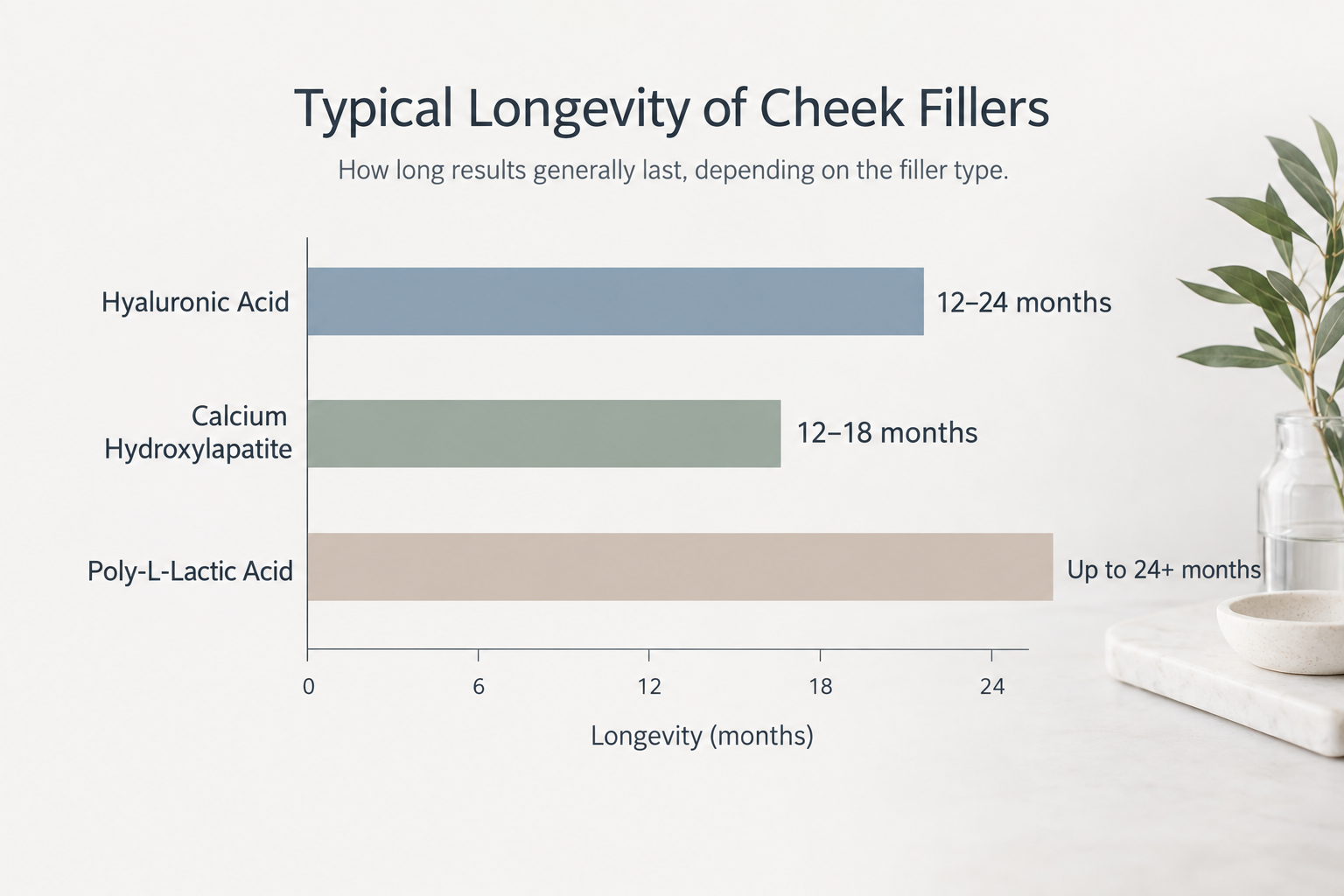
Calcium hydroxylapatite fillers used in the cheek area may last between 12 and 18 months on average, with the collagen-stimulating component potentially contributing to a sustained improvement in skin quality even after the filler itself has been metabolised. Poly-L-lactic acid treatments typically require a course of two to three sessions spaced several weeks apart, with results developing gradually and potentially lasting up to two years or more in some patients, though individual responses vary.
It is important to understand that filler does not disappear all at once. Volume tends to reduce gradually as the product is broken down by the body’s natural enzymatic processes. Many patients notice a subtle reduction in fullness before the effect becomes visibly diminished, which is why practitioners often recommend a top-up or maintenance appointment before results have fully faded rather than waiting until the cheeks have returned entirely to their pre-treatment appearance.
Factors That Affect How Long Cheek Filler Lasts
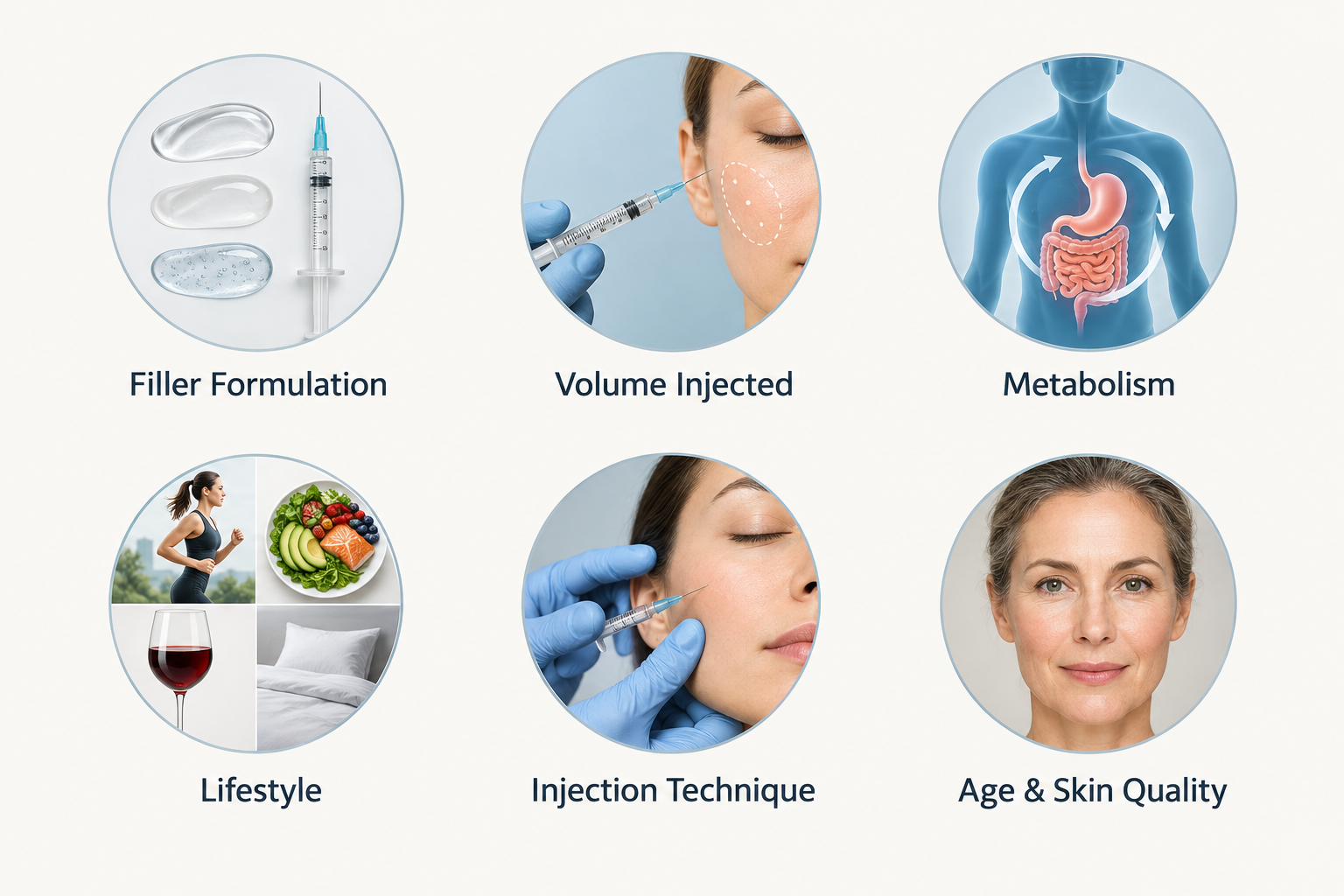
Several interconnected factors influence cheek filler longevity, and understanding them helps explain why two patients treated on the same day with the same product may have noticeably different experiences.
Filler Product and Formulation
Not all hyaluronic acid fillers are equivalent. Products vary in their degree of cross-linking, particle size, gel consistency, and concentration of HA. Thicker, more cohesive formulations designed for deep placement in the cheek area — such as those used for structural support — tend to resist enzymatic breakdown more effectively than lighter, more hydrophilic products. Practitioners select the product based on the treatment goal, the depth of placement, and the patient’s tissue characteristics.
Volume Injected
The amount of filler placed in the cheek area can influence perceived longevity. A larger volume of product may maintain a visible effect for longer simply because there is more material to be metabolised before the result becomes undetectable. However, injecting excessive volume is not a clinically appropriate strategy for extending duration, as overfilling carries its own risks including an unnatural appearance and increased complication potential.
Individual Metabolism
Metabolic rate is one of the most significant and least controllable variables in filler longevity. Patients with a faster metabolism tend to break down hyaluronic acid more quickly than those with a slower metabolic rate. This is partly why younger, more active patients sometimes report shorter filler duration compared to older patients, even when the same product and volume are used.
Lifestyle and Physical Activity
High levels of physical activity, particularly intense cardiovascular exercise, may accelerate filler metabolism by increasing blood flow and tissue turnover. Sun exposure and UV damage can also degrade hyaluronic acid in the skin over time. Smoking is associated with accelerated skin ageing and may affect how long filler results are maintained. Staying well hydrated supports skin quality generally, though it does not directly prevent filler breakdown.
Placement Depth and Technique
Filler placed in deeper tissue planes — such as the supraperiosteal layer directly above the bone — tends to last longer than product placed in more superficial layers where there is greater movement and enzymatic activity. Practitioner technique, including the depth of injection, the distribution of product, and the use of a needle versus cannula, can all influence both the aesthetic result and how the filler integrates with surrounding tissue over time.
Previous Filler Treatments
Patients who have had repeated cheek filler treatments over several years sometimes report that results appear to last longer with subsequent sessions. One proposed explanation is that repeated HA filler placement may stimulate some degree of collagen production in the surrounding tissue, providing a degree of structural support that persists even as the filler itself is metabolised. This observation is not universally consistent across patients, and the evidence base for this mechanism remains limited.
Age and Skin Quality
Skin laxity, tissue quality, and the degree of age-related volume loss can all affect how filler behaves and how long results remain visible. In patients with significant skin laxity, filler alone may not provide the same degree of lift or longevity as in patients with better skin elasticity. A thorough clinical assessment helps determine whether filler is the most appropriate approach or whether complementary treatments may be beneficial.
What to Expect During and After Treatment
A cheek filler appointment typically begins with a consultation to assess facial anatomy, discuss goals, and review medical history. Before the injections, a topical anaesthetic cream is usually applied to the treatment area to reduce discomfort. Many HA filler products also contain lidocaine, a local anaesthetic, within the gel itself, which helps manage discomfort during the procedure.
The injection process for cheek filler generally takes between 15 and 30 minutes, depending on the volume being placed and the technique used. Patients may experience mild pressure, a stinging sensation, or temporary discomfort during the procedure. Immediately after treatment, some swelling, redness, and tenderness at the injection sites is normal and expected.
Swelling is typically most noticeable in the first 24 to 72 hours and usually resolves within one to two weeks. Bruising may also occur, particularly around the injection sites, and can take up to two weeks to fully resolve. The final result is generally more accurately assessed two to four weeks after treatment, once swelling has fully subsided and the filler has settled into the tissue.
Most patients can return to normal daily activities immediately or within a day of treatment. Practitioners typically advise avoiding strenuous exercise, excessive heat such as saunas or steam rooms, and alcohol for 24 to 48 hours after the procedure to minimise swelling and bruising risk.
Risks and Side Effects of Cheek Filler
Cheek filler is associated with a range of potential side effects and risks that patients should understand before proceeding. Common, expected side effects include temporary swelling, bruising, redness, and tenderness at the injection sites. These typically resolve within one to two weeks without intervention.
Less common but more significant risks include asymmetry, lumpiness or irregularity in the filler distribution, and the Tyndall effect — a bluish discolouration that can occur if HA filler is placed too superficially. Infection is a rare but possible complication of any injectable procedure and requires prompt medical attention if suspected.
The most serious risk associated with dermal filler injections is vascular occlusion, which occurs when filler is inadvertently injected into or compresses a blood vessel, potentially compromising blood supply to surrounding tissue. In the cheek area, this is a rare but recognised complication that can have serious consequences including tissue necrosis or, in very rare cases, vision changes if the ophthalmic circulation is affected. This underscores the importance of choosing a qualified, experienced medical practitioner who is trained to recognise and manage complications promptly.
Delayed-onset nodules and inflammatory reactions, sometimes referred to as biofilm-related complications, can occur weeks, months, or even years after filler placement. These are uncommon but require specialist assessment and management. Patients with a history of cold sores should inform their practitioner, as filler injections can occasionally trigger a herpes simplex reactivation.
Hyaluronic acid fillers have the advantage of being reversible: hyaluronidase, an enzyme, can be injected to dissolve HA filler if a complication occurs or if the patient is unhappy with the result. This reversibility is one reason HA fillers remain the most widely used option for cheek augmentation. CaHA and PLLA fillers are not reversible in the same way.
Who May Be Suitable for Cheek Filler
Cheek filler may be appropriate for adults who have experienced age-related volume loss in the midface, those seeking improved cheek definition or contour, or individuals with naturally flat or asymmetric cheeks who wish to enhance their facial structure. Suitability depends on a thorough clinical assessment of facial anatomy, skin quality, medical history, and individual goals.
Cheek filler is generally not recommended during pregnancy or breastfeeding. Patients with active skin infections, inflammatory skin conditions, or certain autoimmune conditions may not be suitable candidates. Those taking blood-thinning medications such as warfarin or aspirin may have an increased risk of bruising and should discuss this with their practitioner. A history of severe allergic reactions, particularly to any filler component, is a contraindication that requires careful evaluation.
Patients with unrealistic expectations or those seeking a result that filler alone cannot achieve — such as significant skin tightening or correction of deep structural asymmetry — may benefit from a broader discussion about complementary or alternative approaches before proceeding.
Alternatives to Cheek Filler
Cheek filler is not the only option for addressing midface volume loss or improving cheek contour. Understanding the alternatives helps patients make a more informed decision about which approach may best suit their goals.
- Collagen biostimulators (Sculptra, Radiesse): These injectable treatments stimulate the body’s own collagen production rather than providing immediate volume. Results develop gradually and may last longer than standard HA fillers in some patients, though they require a different treatment schedule and are not reversible.
- Thread lifts: Dissolvable sutures placed under the skin can provide a degree of midface lift. Results are generally more modest than surgical options and typically last 12 to 18 months, though evidence on long-term outcomes varies.
- Ultrasound-based skin tightening (HIFU): High-intensity focused ultrasound treatments such as Ultherapy target deeper tissue layers to stimulate collagen and provide a degree of lift. These are non-injectable and may suit patients who prefer to avoid needles, though results are generally more subtle than filler for volume restoration.
- Radiofrequency treatments: Devices using radiofrequency energy can improve skin laxity and stimulate collagen, which may complement filler treatment or serve as an alternative for patients with mild concerns.
- Surgical options: For patients with significant volume loss, skin laxity, or structural concerns, surgical procedures such as fat grafting or facelift surgery may provide more substantial and longer-lasting results. These carry greater risks and recovery time and are not appropriate for all patients.
The most appropriate approach depends on the individual’s anatomy, the degree of change desired, their tolerance for downtime and risk, and their budget for ongoing maintenance. A qualified practitioner can help assess which option or combination of options may be most suitable.
When to Consider a Top-Up or Maintenance Treatment
Most practitioners recommend scheduling a review appointment two to four weeks after the initial cheek filler treatment to assess the settled result and determine whether any refinement is needed. For ongoing maintenance, the timing of top-up treatments depends on how quickly the individual metabolises the filler and how much volume reduction they find acceptable before seeking retreatment.
Many patients choose to return for a maintenance appointment when they notice the cheeks beginning to look less full or defined, which may be anywhere from 9 to 18 months after the initial treatment for most HA fillers. Returning before the filler has completely dissolved can sometimes allow a smaller top-up volume to be used, as some residual product may still be present in the tissue. Waiting until results have fully faded typically means starting from the beginning with a full treatment volume.
There is no universal rule about how often cheek filler should be repeated. The decision should be based on the individual’s aesthetic goals, the clinical assessment of remaining filler, and a balanced discussion of the risks and benefits of ongoing treatment. Practitioners should not encourage unnecessary or excessively frequent retreatment.
Frequently Asked Questions
Does cheek filler look natural?
When placed by an experienced practitioner using an appropriate product and volume for the individual’s anatomy, cheek filler can produce a natural-looking enhancement. Overfilling or using an unsuitable product for the tissue type can result in an unnatural appearance. A thorough consultation and conservative approach are important for achieving results that complement the patient’s existing features.
Can cheek filler be dissolved if I don’t like the result?
Hyaluronic acid cheek fillers can be partially or fully dissolved using hyaluronidase injections. This is one of the key advantages of HA-based products. Calcium hydroxylapatite and poly-L-lactic acid fillers cannot be dissolved in the same way, which is an important consideration when choosing a product.
Does cheek filler hurt?
Most patients experience mild to moderate discomfort during cheek filler injections. Topical anaesthetic cream applied before the procedure and lidocaine contained within many filler products help manage pain. Discomfort levels vary between individuals and depend on the technique used and the sensitivity of the treatment area.
Will my cheeks look worse after the filler wears off?
As cheek filler gradually metabolises, the cheeks typically return to their pre-treatment appearance rather than looking worse than before. There is no strong clinical evidence that HA filler causes the face to sag or lose more volume than it would have naturally over the same period. However, patients who have had repeated high-volume treatments over many years should discuss their long-term treatment plan with a qualified practitioner.
How much cheek filler is typically needed?
The volume required varies considerably depending on the degree of volume loss, the patient’s anatomy, and the desired outcome. A practitioner will assess these factors during consultation. Using an appropriate volume for the individual is more important than using a fixed amount, and a conservative approach is generally advisable, particularly for first-time patients.
Is there any downtime after cheek filler?
Most patients can resume normal daily activities immediately or within a day of treatment. Swelling and bruising are the most common reasons patients may prefer to schedule treatment before a period of lower social commitments. Strenuous exercise, excessive heat, and alcohol are typically advised against for 24 to 48 hours post-treatment.
Can cheek filler migrate over time?
Filler migration — movement of the product away from the intended placement area — is a recognised but relatively uncommon occurrence. It is more likely with softer, more hydrophilic products placed in areas of significant movement. Using an appropriate product for the cheek area and placing it at the correct depth reduces this risk. If migration occurs, hyaluronidase can be used to dissolve HA filler in the affected area.
Planning Your Cheek Filler Treatment Realistically
Cheek filler can be an effective option for restoring midface volume, improving facial contour, and addressing age-related changes in the cheek area. Results from hyaluronic acid fillers typically last between 12 and 18 months for most patients, with some individuals maintaining visible effects for up to 24 months depending on the product used, the volume placed, and individual metabolic factors. Longer-lasting results may be achievable with collagen biostimulators, though these involve a different treatment approach and timeline.
Understanding that cheek filler is a temporary treatment requiring ongoing maintenance is an important part of setting realistic expectations. The decision to proceed should be based on a thorough consultation with a qualified medical practitioner who can assess your anatomy, discuss appropriate product options, explain the realistic benefits and limitations for your specific situation, and ensure you are aware of the relevant risks before treatment begins. If you are considering cheek filler, seeking a practitioner with appropriate medical training and experience in facial anatomy is the most important step you can take toward a safe and satisfying outcome.


