
Russian Lip Filler Technique: What It Is, How It Works, and What to Expect
The Russian lip filler technique has become one of the most requested approaches to lip augmentation in recent years, appealing to patients who want more defined shape and vertical height rather than simple volume. Unlike conventional lip filler methods that focus on projection and fullness, the Russian technique prioritises a flatter, more structured profile with a pronounced cupid’s bow and lifted central peaks. Understanding exactly what this technique involves, who it may suit, and what its realistic limitations are can help you have a more informed conversation with a qualified practitioner before booking a treatment.
Key Takeaways
- The Russian lip technique uses a specific injection method to create vertical height and a defined cupid’s bow rather than forward projection.
- It requires advanced injector skill and a thorough understanding of lip anatomy, making practitioner selection particularly important.
- Results typically last six to twelve months, depending on the filler product used, individual metabolism, and lifestyle factors.
- The technique is not universally suitable; lip anatomy, skin quality, and previous filler history all influence whether it is an appropriate option.
- Risks associated with Russian lip filler are broadly similar to those of standard lip augmentation but may be influenced by the injection depth and technique used.
What Is the Russian Lip Technique?
The Russian lip technique is a method of injecting hyaluronic acid dermal filler into the lips using a series of small, precise deposits placed vertically from the base of the lip upward toward the vermilion border. The name is widely attributed to an aesthetic trend originating in Russia and Eastern Europe, where a heart-shaped, doll-like lip with a prominent cupid’s bow and lifted central peaks became a popular aesthetic ideal. The technique is defined more by its injection approach and intended outcome than by any specific filler product.
In a conventional lip augmentation, filler is often placed horizontally along the lip border and body to add volume and forward projection. The Russian technique instead builds the lip vertically, creating the appearance of greater height in the central upper lip, a more defined philtrum column area, and a flatter side profile. The result is a lip that appears taller and more structured rather than fuller or more projected. This distinction matters because patients seeking the two outcomes may have quite different starting anatomies and expectations.
How the Injection Technique Differs from Standard Lip Filler
Standard lip augmentation typically involves injecting hyaluronic acid filler along the vermilion border to define the lip edge, into the body of the lip for volume, and sometimes into the philtrum columns or oral commissures. The filler is generally placed in a linear or bolus fashion, and the overall effect tends to add fullness in all directions, including forward projection.
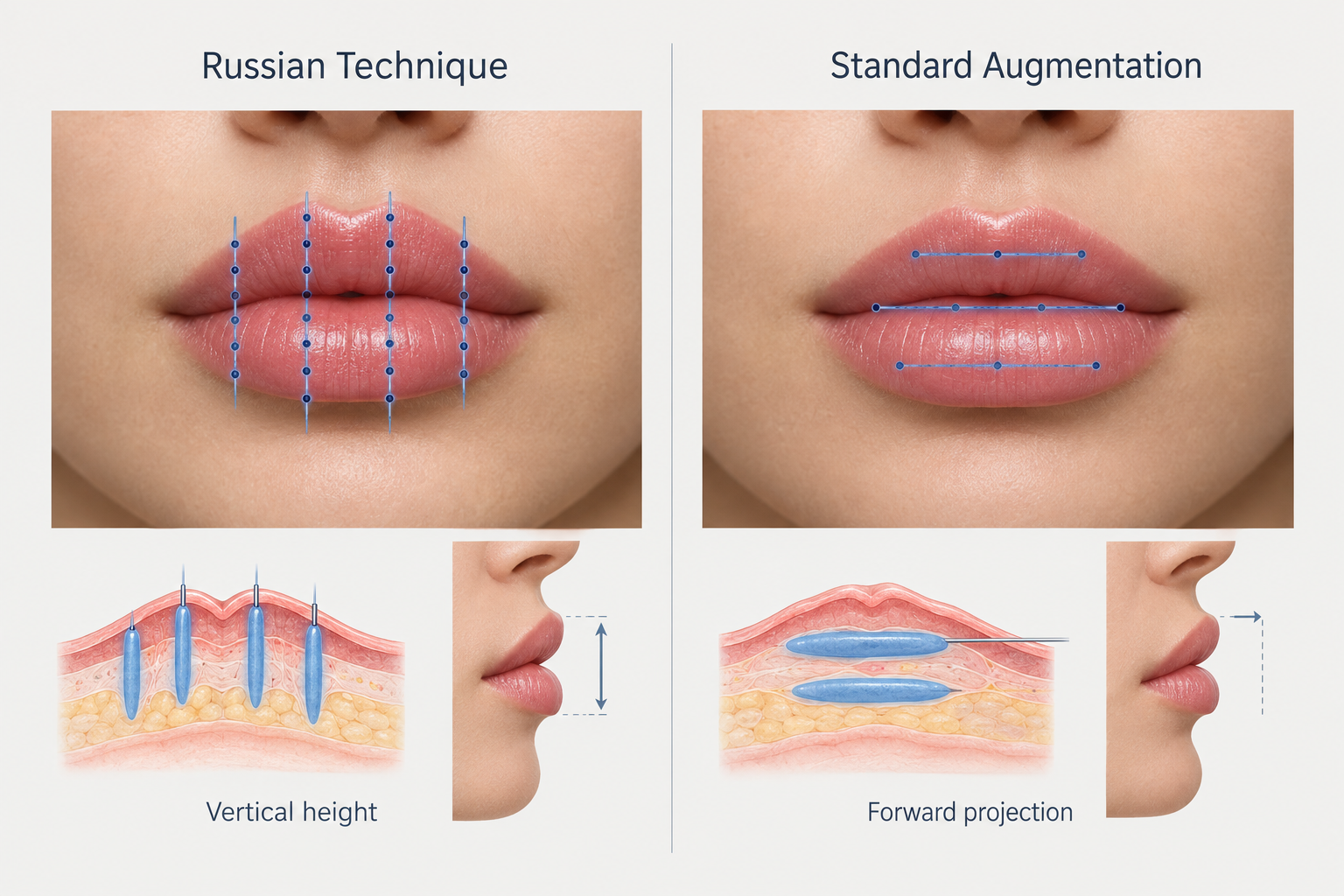
The Russian lip injection technique uses multiple small vertical columns of filler, each placed from the base of the lip toward the vermilion border. The injector works in a series of precise points across the upper and sometimes lower lip, depositing small amounts of product at each location rather than threading larger volumes in a single pass. This columnar approach is intended to lift the lip tissue upward and create defined peaks at the cupid’s bow, while keeping the side profile relatively flat. Because the filler is placed in smaller, more controlled deposits, the technique demands a high level of precision and a detailed understanding of lip anatomy, including the positions of blood vessels and the layered structure of the lip tissue.
Some practitioners describe the Russian technique as requiring more injection points than a standard treatment, which can mean a longer appointment and, in some cases, more post-treatment bruising or swelling at multiple sites. The depth of injection also varies by practitioner and by the specific area being treated, and this is one reason why the technique is generally considered more technically demanding than conventional lip augmentation.
What Results Can the Russian Lip Technique Achieve?
When performed on a suitable candidate by an experienced injector, the Russian lip technique may produce a lip shape characterised by a more defined and elevated cupid’s bow, taller central upper lip peaks, a flatter side profile compared to standard augmentation, and a heart-shaped or structured appearance. The lower lip is typically treated more conservatively to maintain proportion, and the overall result is intended to look defined rather than voluminous.
It is important to understand that the Russian technique is primarily a shaping method rather than a volume-adding method. Patients who want significantly larger lips may find that a conventional approach or a combination of techniques better meets their goals. The Russian technique tends to suit patients who want more definition, a more prominent cupid’s bow, or a lifted central lip without the rounded, projected look associated with classic augmentation.
Results are not permanent. Hyaluronic acid fillers used in lip augmentation are gradually broken down by the body, and most patients can expect results to last approximately six to twelve months. Individual variation is significant; factors such as the specific filler product chosen, the volume used, the patient’s metabolism, sun exposure, and lifestyle habits such as smoking can all influence how long results are maintained. Maintenance treatments are typically needed to sustain the effect.
Who May Be a Suitable Candidate?
The Russian lip technique may be worth discussing with a practitioner if you have naturally thin or flat lips with little vertical height, a poorly defined cupid’s bow, or a lip shape that lacks central definition. Patients who have previously had lip filler and found that standard augmentation gave them more projection than they wanted may also find the Russian approach better aligned with their aesthetic goals.
Suitable candidates are generally adults in good general health with realistic expectations about what the technique can achieve. A thorough consultation should include an assessment of your natural lip anatomy, skin quality, and any previous filler treatments, as existing filler can influence how new product integrates and how the final shape appears.
The technique may be less appropriate for patients who already have significant lip volume, those with very thin lip skin that may not support the columnar filler deposits well, or those whose anatomy makes the desired heart-shaped result difficult to achieve safely. Patients with a history of cold sores should inform their practitioner, as lip injections can trigger a herpes simplex outbreak; antiviral prophylaxis is sometimes recommended before treatment in these cases.
Standard contraindications for lip filler apply to the Russian technique as well. These include active infection or inflammation in or around the treatment area, known allergy to hyaluronic acid or any filler component, pregnancy and breastfeeding, and certain autoimmune or bleeding conditions. A full medical history review at consultation is essential before any injectable treatment.
The Treatment Experience: What to Expect at Your Appointment
A Russian lip filler appointment typically begins with a consultation or pre-treatment assessment, during which the practitioner will review your medical history, discuss your aesthetic goals, and assess your lip anatomy. Photographs are often taken for reference. The practitioner should explain the technique, the filler product to be used, the expected outcome, and the potential risks before obtaining your informed consent.
A topical anaesthetic cream is usually applied to the lips before treatment to reduce discomfort. Many hyaluronic acid fillers used for lip augmentation also contain lidocaine, a local anaesthetic, within the formulation, which can further reduce sensation during injection. Despite these measures, some discomfort, pressure, or stinging during injection is common, and the lips are a sensitive area. Most patients tolerate the procedure well, but individual pain thresholds vary.
Because the Russian technique involves multiple small injection points rather than fewer, longer passes, the appointment may take slightly longer than a standard lip filler session. Patients should expect the treatment itself to take approximately thirty to sixty minutes, though this varies by practitioner and the amount of product being placed.
Immediately after treatment, the lips will typically appear swollen, and the final shape will not be visible until the initial swelling has resolved. Some bruising at the injection sites is common, particularly given the number of entry points involved in the Russian technique. Most patients are advised to avoid strenuous exercise, alcohol, and significant heat exposure for at least twenty-four to forty-eight hours after treatment.
Recovery, Downtime, and When Results Become Visible
Swelling after Russian lip filler is expected and is usually most pronounced in the first twenty-four to forty-eight hours. The lips may feel firm or tender during this period. Bruising, if it occurs, typically resolves within five to ten days. Most patients feel comfortable returning to normal daily activities within one to two days, though visible bruising may require makeup coverage for longer.
The final result of Russian lip filler is generally visible once the swelling has fully resolved, which usually takes one to two weeks. During the first week, the lips may look uneven or more swollen in some areas than others, which can be concerning but is usually a normal part of the healing process. Patients are generally advised to attend a review appointment two to four weeks after treatment so the practitioner can assess the outcome and address any asymmetry or areas where additional product may be beneficial.
Patients should avoid pressing, massaging, or applying significant pressure to the lips in the days immediately following treatment unless specifically instructed to do so by their practitioner. Dental procedures should ideally be scheduled before treatment or delayed for at least two weeks afterward.
Risks and Side Effects
The risks associated with Russian lip filler are broadly consistent with those of any hyaluronic acid lip augmentation, though the technique-specific factors of multiple injection points and precise vertical placement may influence the risk profile in certain respects. Patients should be aware of the following potential side effects and complications before proceeding.

Common and expected side effects include swelling, bruising, tenderness, and temporary firmness at the injection sites. These typically resolve within one to two weeks and are considered a normal part of the treatment response rather than complications.
Asymmetry is a recognised risk with any lip filler treatment. The Russian technique, with its emphasis on precise shaping, may make asymmetry more noticeable if the columnar deposits are not placed evenly. Minor asymmetry can often be addressed at a review appointment; significant asymmetry may require dissolving the filler with hyaluronidase and retreating after the tissue has settled.
Lumps and nodules can occur if filler is placed superficially or if the product does not integrate smoothly. These may resolve on their own but can sometimes require treatment with hyaluronidase.
Vascular occlusion is a rare but serious complication of any lip filler injection. It occurs when filler is inadvertently injected into or compresses a blood vessel, potentially restricting blood flow to the surrounding tissue. Symptoms can include blanching, pain, or skin colour changes and require immediate treatment. Practitioners should be trained to recognise and manage this complication, including having hyaluronidase available. The risk of vascular complications is one reason why practitioner experience and anatomical knowledge are particularly important for the Russian technique, which involves multiple injection points in a vascular area.
Infection is uncommon when treatment is performed in a clean clinical environment using sterile technique, but it remains a possibility with any injectable procedure. Signs of infection include increasing redness, warmth, pain, or discharge and should be assessed promptly by a medical professional.
Tyndall effect, a bluish discolouration caused by superficially placed filler, is a recognised risk with lip and perioral injections and is more likely when product is placed too close to the skin surface.
Patients should ensure their practitioner is appropriately qualified, experienced in lip anatomy and injectable techniques, and able to manage complications including vascular occlusion. In the United Kingdom, regulations around who can legally administer aesthetic injectables have been evolving, and patients are advised to verify that their practitioner meets current professional standards.
How the Russian Technique Compares to Standard Lip Augmentation
Choosing between the Russian lip technique and a conventional lip augmentation approach depends primarily on the aesthetic outcome you are seeking. The two methods use the same category of product — hyaluronic acid dermal filler — but differ in injection technique, intended shape, and the type of result they are designed to produce.
Standard lip augmentation is generally better suited to patients who want overall volume, a fuller appearance, or more forward projection. It tends to involve fewer injection points, may be associated with a slightly shorter treatment time, and is a well-established approach with a long clinical track record. The Russian technique is better suited to patients who want vertical height, a defined cupid’s bow, and a structured shape without significant projection. It requires greater technical precision and is more dependent on the individual injector’s skill and experience.
Neither approach is universally superior. The right choice depends on your starting anatomy, your aesthetic goals, and the assessment of a qualified practitioner who can evaluate whether your lip structure is suitable for the Russian technique specifically. Some practitioners use a combination of both approaches, placing foundational volume conventionally and then refining the shape using Russian-style vertical deposits.
Alternatives to the Russian Lip Technique
If the Russian lip technique is not appropriate for your anatomy or goals, several alternatives may be worth discussing with a practitioner.
- Standard hyaluronic acid lip augmentation remains the most widely performed approach and may be more suitable for patients seeking overall volume rather than structural definition.
- Lip border definition using filler placed precisely along the vermilion border can enhance the lip outline and improve cupid’s bow definition without adding significant volume, and may be a more conservative starting point for patients new to lip filler.
- Philtrum column enhancement with small amounts of filler can lift the central upper lip and improve the appearance of the cupid’s bow without treating the full lip body.
- Lip flip using botulinum toxin involves injecting a small amount of muscle-relaxing toxin into the orbicularis oris muscle around the upper lip, causing it to relax and the lip to roll slightly outward. This can create the appearance of a fuller upper lip without adding volume and may suit patients who want a subtle change. Results are temporary, typically lasting eight to twelve weeks.
- Dissolving existing filler with hyaluronidase may be recommended before any new technique is attempted if previous filler has altered the lip anatomy in a way that would interfere with the desired outcome.
Choosing a Practitioner for Russian Lip Filler
The Russian lip technique is widely regarded as more technically demanding than standard lip augmentation because of the precision required for multiple vertical injection points and the importance of understanding the layered anatomy of the lip. Practitioner selection is therefore particularly important.
When researching practitioners, look for evidence of specific training and experience in advanced lip injection techniques, not just general filler experience. Ask to see a portfolio of before and after photographs of Russian lip results specifically, and ensure the practitioner can clearly explain the technique, the product they intend to use, and how they would manage a complication such as vascular occlusion. A practitioner who is unwilling to discuss risks or who cannot explain the technique in plain language may not be the right choice.
A thorough consultation before treatment is not optional. It is the appropriate setting for the practitioner to assess your anatomy, review your medical history, discuss your goals, and determine whether the Russian technique is genuinely suitable for you or whether an alternative approach would better serve your needs.
Frequently Asked Questions
Is the Russian lip technique more painful than standard lip filler?
The Russian technique involves more injection points than a conventional approach, which may mean more discomfort during the procedure. Topical anaesthetic cream and lidocaine-containing filler products are typically used to manage pain, and most patients find the treatment tolerable. Individual pain thresholds vary, and the experience depends significantly on the practitioner’s technique and the products used.
How long does Russian lip filler last?
Results from Russian lip filler typically last six to twelve months, which is broadly consistent with standard hyaluronic acid lip augmentation. The exact duration depends on the specific filler product used, the volume placed, individual metabolism, and lifestyle factors. Maintenance treatments are needed to sustain the result over time.
Can the Russian lip technique be reversed?
Yes. Hyaluronic acid fillers used in the Russian technique can be dissolved using hyaluronidase, an enzyme that breaks down hyaluronic acid. Dissolving is sometimes used to correct asymmetry, lumps, or unsatisfactory results, and is also the first-line treatment for vascular occlusion. Dissolution does not always return the lips to their exact pre-treatment state, particularly if multiple treatments have been performed over time.
Will the Russian technique work if I already have lip filler?
Existing filler can influence how new product integrates and how the final shape appears. Some practitioners recommend dissolving previous filler before attempting the Russian technique to ensure a clean foundation, particularly if the existing filler has created a shape that conflicts with the desired outcome. This should be assessed individually at consultation.
Is the Russian lip technique suitable for thin lips?
The Russian technique may be suitable for patients with naturally thin lips who want more vertical height and definition rather than volume. However, very thin lip skin may not support the columnar filler deposits as well as thicker tissue, and the practitioner will need to assess whether the anatomy is appropriate. Not every patient with thin lips will be a good candidate for this specific technique.
How soon after treatment can I wear lipstick?
Most practitioners advise avoiding makeup on the lips for at least twenty-four hours after treatment to reduce the risk of introducing bacteria to the injection sites. After this period, lipstick and lip products can generally be used normally, though patients should follow their practitioner’s specific aftercare instructions.
Is the Russian Lip Technique the Right Choice for Your Goals?
The Russian lip filler technique offers a genuinely different aesthetic outcome from standard lip augmentation, and for patients whose goals align with its defining characteristics — vertical height, a structured cupid’s bow, and a flatter profile — it may be a well-suited option. It is not, however, a universally superior approach, and it is not appropriate for every patient or every aesthetic goal.
The technique’s dependence on precise injection skill means that the quality of the result is closely tied to the experience and training of the practitioner performing it. Patients considering Russian lip filler should prioritise a thorough consultation with a qualified and experienced injector who can honestly assess whether their anatomy and goals make them a suitable candidate, explain the realistic outcomes and limitations, and demonstrate a clear understanding of how to manage potential complications.
If you are drawn to the defined, structured look associated with the Russian technique, a consultation is the appropriate next step. A practitioner who takes time to understand your goals, assess your anatomy, and discuss alternatives where relevant is better placed to help you achieve a result you will be satisfied with than one who applies a single technique to every patient regardless of individual suitability.


