
How to Get Rid of Smile Lines: Treatment Options Explained
Smile lines — the creases that run from the sides of the nose down toward the corners of the mouth — are one of the most common concerns patients raise during aesthetic consultations. They develop gradually as a natural result of facial movement, volume loss, and changes in skin quality, which means there is rarely a single cause or a single solution. This article explains the main treatment options available, how each one works, what results are realistic, and what to consider before booking a consultation.
Key Takeaways
- Smile lines, also called nasolabial folds, form due to a combination of repeated facial movement, collagen loss, and fat redistribution — not one factor alone.
- Dermal fillers are currently the most widely used clinical treatment for deep nasolabial folds, offering visible improvement with relatively short downtime.
- Botulinum toxin injections can soften dynamic lines around the mouth but are generally less effective for deep static nasolabial folds on their own.
- Skin quality treatments such as radiofrequency, microneedling, and laser resurfacing may improve fine lines and skin texture but typically produce more modest results on deeper folds.
- No treatment stops the underlying ageing process; maintenance appointments are usually needed to sustain results over time.
What Are Smile Lines and Why Do They Form?
Nasolabial folds are the paired skin creases that extend from the outer edges of the nostrils to the corners of the mouth. A degree of nasolabial folding is anatomically normal and present from childhood, but the folds tend to deepen and become more prominent with age. Understanding why they form helps explain why different treatments target different aspects of the problem.
Several overlapping processes contribute to the development of deeper smile lines. Repeated facial expressions — smiling, laughing, and speaking — gradually etch movement patterns into the skin over decades. At the same time, the face loses subcutaneous fat volume, particularly in the mid-face and cheek area, which causes the overlying skin to descend and fold more noticeably. Collagen and elastin production also declines with age, reducing the skin’s ability to spring back after movement. Bone resorption in the mid-face further reduces structural support. Sun exposure, smoking, and significant weight fluctuations can accelerate all of these changes.
Because nasolabial folds have multiple contributing causes, a practitioner will typically assess which factors are most prominent before recommending a treatment approach. A fold driven primarily by volume loss in the cheeks may respond differently to treatment than one caused mainly by skin laxity or surface skin quality changes.
Dermal Fillers for Nasolabial Folds
Dermal fillers are the most commonly used injectable treatment for smile lines and are considered a well-established option for moderate to deep nasolabial folds. Most fillers used in this area contain hyaluronic acid, a naturally occurring substance in the skin that attracts and retains water, adding volume and support to the treated tissue.
When injected along or beneath the nasolabial fold, hyaluronic acid filler physically lifts and softens the crease. Some practitioners also address the mid-face or cheek area rather than — or in addition to — treating the fold directly, because restoring volume higher in the face can reduce the gravitational descent that makes the fold more prominent. The specific approach depends on the patient’s anatomy and the practitioner’s assessment.
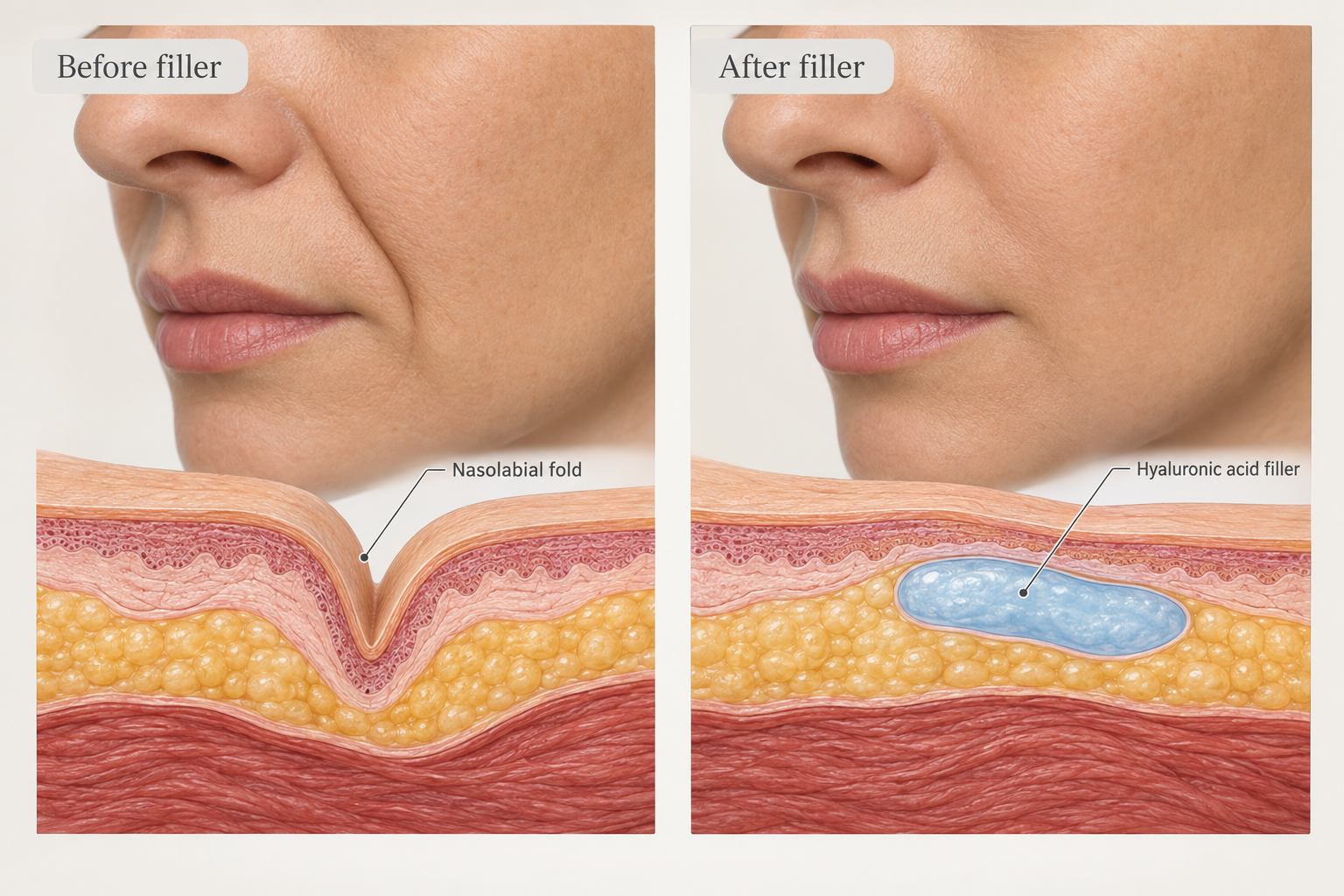
Results from hyaluronic acid filler in the nasolabial area are typically visible immediately after treatment, though some initial swelling is normal and the final result usually settles within one to two weeks. Duration varies between patients and depends on the product used, the volume injected, the depth of placement, and individual metabolism, but many patients find results last between nine and eighteen months before a top-up is needed.
Hyaluronic acid fillers have the practical advantage of being dissolvable. If a result is unsatisfactory or a complication occurs, an enzyme called hyaluronidase can be injected to break down the filler. This reversibility is considered an important safety feature, though dissolution is a clinical procedure and not a guaranteed correction of every outcome.
Risks associated with dermal fillers in the nasolabial area include bruising, swelling, tenderness, asymmetry, lumpiness, and — in rare but serious cases — vascular occlusion, where filler inadvertently enters or compresses a blood vessel. Vascular complications in this region can have significant consequences and require immediate treatment. Choosing a qualified and experienced practitioner who understands facial anatomy and has access to hyaluronidase is an important safety consideration.
Botulinum Toxin Injections Around the Mouth
Botulinum toxin — available under brand names including Botox, Dysport, and Azzalure — works by temporarily reducing muscle activity in the injected area. For dynamic facial lines caused by repeated muscle movement, this can soften the appearance of creases while the effect lasts, typically three to five months depending on the product, dose, and individual response.
Botulinum toxin is not generally the primary treatment for deep nasolabial folds, because these folds are largely structural rather than purely movement-driven. However, botulinum toxin may be used around the perioral area — the muscles around the mouth — to reduce the pulling action that contributes to certain types of lines, including fine lines above the upper lip and downward pull at the corners of the mouth. In some cases, a practitioner may combine botulinum toxin with dermal filler as part of a broader facial treatment plan.
Injections around the mouth require careful technique and precise placement because the muscles in this area are involved in essential functions including speech, eating, and facial expression. Incorrect placement or excessive dosing can cause temporary functional changes such as difficulty with certain mouth movements. This underlines the importance of treatment by a practitioner with specific experience in perioral anatomy.
Skin Resurfacing and Collagen-Stimulating Treatments
Several non-injectable treatments aim to improve the appearance of smile lines by stimulating collagen production, improving skin texture, or tightening lax skin. These approaches tend to be more effective for fine surface lines and mild skin laxity than for deep structural nasolabial folds.
Radiofrequency Treatments
Radiofrequency (RF) devices deliver controlled heat energy into the deeper layers of the skin, stimulating collagen remodelling and producing a degree of skin tightening. Both non-invasive surface RF and microneedling radiofrequency — which combines fine needles with RF energy delivered directly into the dermis — are used for facial skin laxity and fine lines. Results from radiofrequency treatments develop gradually over several weeks to months as new collagen forms, and a course of sessions is usually recommended. The degree of improvement for deep nasolabial folds is generally more modest than that achieved with dermal fillers.
Microneedling
Microneedling uses fine needles to create controlled micro-injuries in the skin, triggering a wound-healing response that stimulates collagen and elastin production. It may improve overall skin texture, fine lines, and mild skin laxity. Multiple sessions are typically needed, and results are gradual. Microneedling is unlikely to significantly reduce a deep nasolabial fold on its own but may complement other treatments as part of a broader skin quality programme.
Laser Resurfacing
Ablative and fractional laser treatments remove or remodel the outer layers of skin to stimulate collagen production and improve surface texture. Fractional lasers, which treat a fraction of the skin surface at a time, offer a balance between effectiveness and recovery time. Laser resurfacing can improve fine lines around the mouth and improve overall skin quality, but deeper folds generally require volume-based treatments in addition to surface resurfacing. Downtime varies depending on the laser type and settings used, ranging from a few days of redness and peeling to a longer recovery for more aggressive treatments.
Ultrasound-Based Skin Tightening
Focused ultrasound treatments, such as those using high-intensity focused ultrasound (HIFU) technology, deliver energy to deeper tissue layers including the superficial muscular aponeurotic system (SMAS), which is the same layer addressed in surgical facelifts. These treatments aim to lift and tighten lax tissue. Evidence for their effectiveness in reducing nasolabial folds specifically is variable, and results tend to be more noticeable in patients with mild to moderate laxity rather than significant volume loss or deep folds.
Polynucleotides and Skin Biostimulators
Polynucleotide injections and other biostimulator treatments — including products containing poly-L-lactic acid or calcium hydroxylapatite — work by stimulating the skin’s own collagen production rather than adding immediate volume. These treatments are sometimes used in the mid-face and lower face to gradually improve skin quality, firmness, and fine lines over a series of sessions. Results develop slowly over weeks to months and may be more suitable for patients seeking gradual skin quality improvement rather than immediate correction of a deep fold. Evidence for these treatments continues to develop, and a practitioner can advise whether they may be appropriate for a specific concern.
Surgical Options for Deeper Folds
For patients with significant skin laxity, deep nasolabial folds, and substantial volume redistribution, surgical procedures such as a facelift (rhytidectomy) or mid-face lift may produce more durable results than non-surgical treatments alone. Surgery repositions descended facial tissue and removes excess skin, addressing the structural causes of deep folds more directly. Surgical options involve anaesthesia, a longer recovery period, and greater procedural risk than non-surgical treatments, and are typically considered when non-surgical approaches have reached their limits or when the degree of change desired exceeds what injectables and energy devices can realistically achieve. A consultation with a qualified plastic or reconstructive surgeon is appropriate for patients considering this route.
What to Expect During and After Treatment
The treatment experience varies considerably depending on which approach is chosen. Injectable treatments such as dermal fillers and botulinum toxin are typically performed in a clinic appointment lasting between thirty minutes and one hour. A topical anaesthetic cream may be applied beforehand to reduce discomfort, and many filler products contain lidocaine, a local anaesthetic, within the formulation. Most patients describe the sensation as mild to moderate discomfort rather than significant pain, though individual tolerance varies.
After dermal filler treatment to the nasolabial area, some bruising, swelling, and tenderness at the injection sites is common and usually resolves within a few days to two weeks. Strenuous exercise, alcohol, and significant heat exposure are generally advised against for the first twenty-four to forty-eight hours. Most patients return to normal activities the same day or the following day, though visible bruising may require some social downtime.
Energy-based treatments such as radiofrequency and laser resurfacing typically involve more planned downtime, ranging from mild redness and sensitivity for a few days with gentler treatments to a week or more of peeling and redness with more intensive laser procedures. Results from collagen-stimulating treatments appear gradually and may not be fully visible for two to three months after a course of sessions.
Who May Be Suitable for Smile Line Treatments
Suitability for any smile line treatment depends on a clinical assessment of the individual patient. Factors a practitioner will typically consider include the depth and character of the nasolabial fold, the degree of mid-face volume loss, skin quality and laxity, overall facial anatomy, medical history, current medications, and the patient’s goals and expectations.
Patients who are pregnant or breastfeeding are generally advised to postpone elective aesthetic treatments. Active skin infections, inflammatory skin conditions, or a history of severe allergic reactions may affect suitability for certain treatments. Patients taking blood-thinning medications may have an increased risk of bruising with injectable treatments. A thorough consultation and medical history review before any procedure is essential.
Realistic expectations are an important part of suitability. Non-surgical treatments can soften and improve the appearance of smile lines, but they do not stop the ageing process, and results require maintenance. Patients expecting a permanent or surgical-level result from injectable or energy-based treatments may not be well suited to these approaches.
Combining Treatments for Better Results
Practitioners often find that combining treatments produces more balanced and natural-looking results than a single approach. For example, addressing mid-face volume loss with filler while also improving skin quality with radiofrequency or microneedling may produce a more comprehensive improvement than treating the nasolabial fold in isolation. A treatment plan tailored to the individual’s specific combination of volume loss, skin laxity, and surface skin quality is generally more effective than a one-size-fits-all approach.
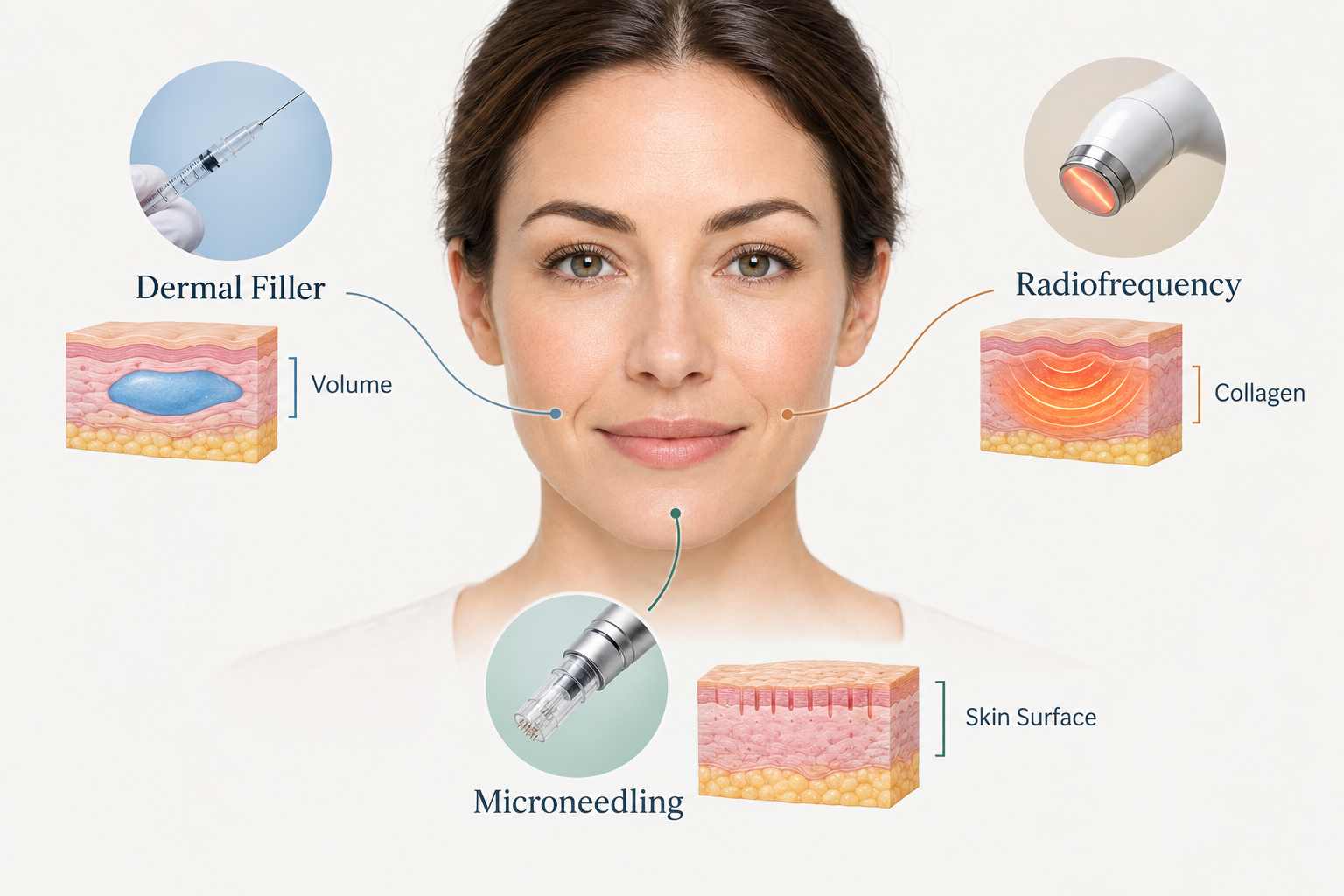
Combination approaches also allow lower volumes of filler to be used in some cases, which can reduce the risk of an overfilled appearance. The appropriate combination and sequence of treatments is best determined through a thorough consultation with a qualified practitioner who can assess the face as a whole rather than focusing on a single concern.
Frequently Asked Questions
Can smile lines be prevented?
Nasolabial folds are a natural part of facial ageing and cannot be entirely prevented. However, consistent sun protection, not smoking, maintaining a stable weight, and a good skincare routine that supports skin hydration and collagen health may slow the rate at which they deepen. Preventive aesthetic treatments are sometimes discussed with younger patients, though the evidence for early intervention specifically to prevent nasolabial fold progression is limited.
Are dermal fillers in the nasolabial area safe?
Dermal fillers are widely used in this area and are considered safe when administered by a qualified and experienced practitioner. Serious complications such as vascular occlusion are rare but can occur, and the risk is reduced by choosing a practitioner with thorough knowledge of facial anatomy and access to hyaluronidase for emergency reversal. Mild side effects such as bruising and swelling are common and temporary.
How long do filler results last in the nasolabial area?
Results vary between patients, but hyaluronic acid filler in the nasolabial fold typically lasts between nine and eighteen months. Factors affecting longevity include the specific product used, the volume injected, individual metabolism, and lifestyle factors. Regular maintenance appointments help sustain results over time.
Will treating my smile lines make me look unnatural?
Overfilling the nasolabial fold is a recognised aesthetic concern and can produce an unnatural appearance. A skilled practitioner will aim for a natural-looking softening of the fold rather than complete elimination, and will consider the face as a whole. Discussing your goals clearly during consultation and reviewing before-and-after examples of the practitioner’s work can help align expectations.
Is botulinum toxin effective for deep nasolabial folds?
Botulinum toxin alone is generally not the most effective treatment for deep nasolabial folds, which are primarily structural rather than purely movement-driven. It may be used around the perioral area to address specific dynamic lines or as part of a combination approach, but dermal fillers or volume-restoring treatments are typically more appropriate for the fold itself.
How many treatment sessions will I need?
For dermal fillers, a single session often produces visible improvement, though some patients return for a small top-up once initial swelling has settled. For collagen-stimulating treatments such as radiofrequency, microneedling, or polynucleotides, a course of three to six sessions is commonly recommended, with results building gradually over several months.
Choosing the Right Approach for Your Smile Lines
Getting rid of smile lines is not a single-step process, and the most appropriate treatment depends on the underlying causes, the depth of the fold, the patient’s skin quality, and their goals. Dermal fillers remain the most established non-surgical option for moderate to deep nasolabial folds, offering visible and relatively immediate results with manageable downtime. Botulinum toxin, skin resurfacing, radiofrequency, and biostimulator treatments each have a role in specific situations, particularly for fine lines, skin quality improvement, or as part of a combination plan.
No non-surgical treatment produces permanent results, and maintaining improvement over time requires ongoing care. For patients with significant skin laxity or volume loss that exceeds what injectables can address, a surgical consultation may be worth considering. The most useful first step is a thorough consultation with a qualified aesthetic practitioner who can assess your specific anatomy, explain the realistic outcomes of each option, and help you make an informed decision about which approach — or combination of approaches — may be appropriate for you.


