
Heart-Shaped Face: Features, Characteristics, and What Defines This Face Shape
The heart-shaped face is one of the most commonly referenced face shapes in aesthetic medicine and beauty analysis, yet it is also one of the most frequently misidentified. Understanding what genuinely defines a heart-shaped face — its bone structure, proportions, and soft tissue characteristics — can help patients have more informed conversations with aesthetic practitioners about facial balance, contouring, and treatment suitability.
Key Takeaways
- A heart-shaped face is characterised by a wide forehead, prominent cheekbones, and a narrow, pointed chin, with the widest point of the face sitting at or above the temples.
- The defining structural features include the forehead width, cheekbone prominence, jawline taper, and chin shape — all of which influence how the face is perceived in terms of balance and proportion.
- Aesthetic treatments for heart-shaped faces typically focus on creating visual balance between the upper and lower face rather than changing the face shape itself.
- Face shape analysis is a useful starting point for aesthetic consultations, but individual anatomy, soft tissue volume, and personal goals always take priority over generalised categories.
- No face shape is inherently more or less attractive; aesthetic medicine aims to support individual goals and facial harmony rather than conforming to a single ideal.
What Is a Heart-Shaped Face?
A heart-shaped face is defined by a forehead that is noticeably wider than the jawline, combined with a chin that tapers to a relatively narrow or pointed end. When viewed from the front, the overall outline of the face resembles the upper portion of a heart symbol — broad at the top and narrowing progressively toward the chin. The cheekbones in a heart-shaped face are typically prominent and sit at or near the widest point of the face, contributing to the characteristic upper-face fullness.
The term is used in both lay and clinical contexts, though aesthetic practitioners tend to use more precise anatomical language when assessing facial structure. In practice, face shape categories — including heart, oval, round, square, oblong, and diamond — serve as useful shorthand for discussing facial proportions, but they are rarely perfectly discrete. Many individuals have features that overlap two or more categories, and soft tissue volume, skin laxity, and age-related changes can all shift how a face appears over time.
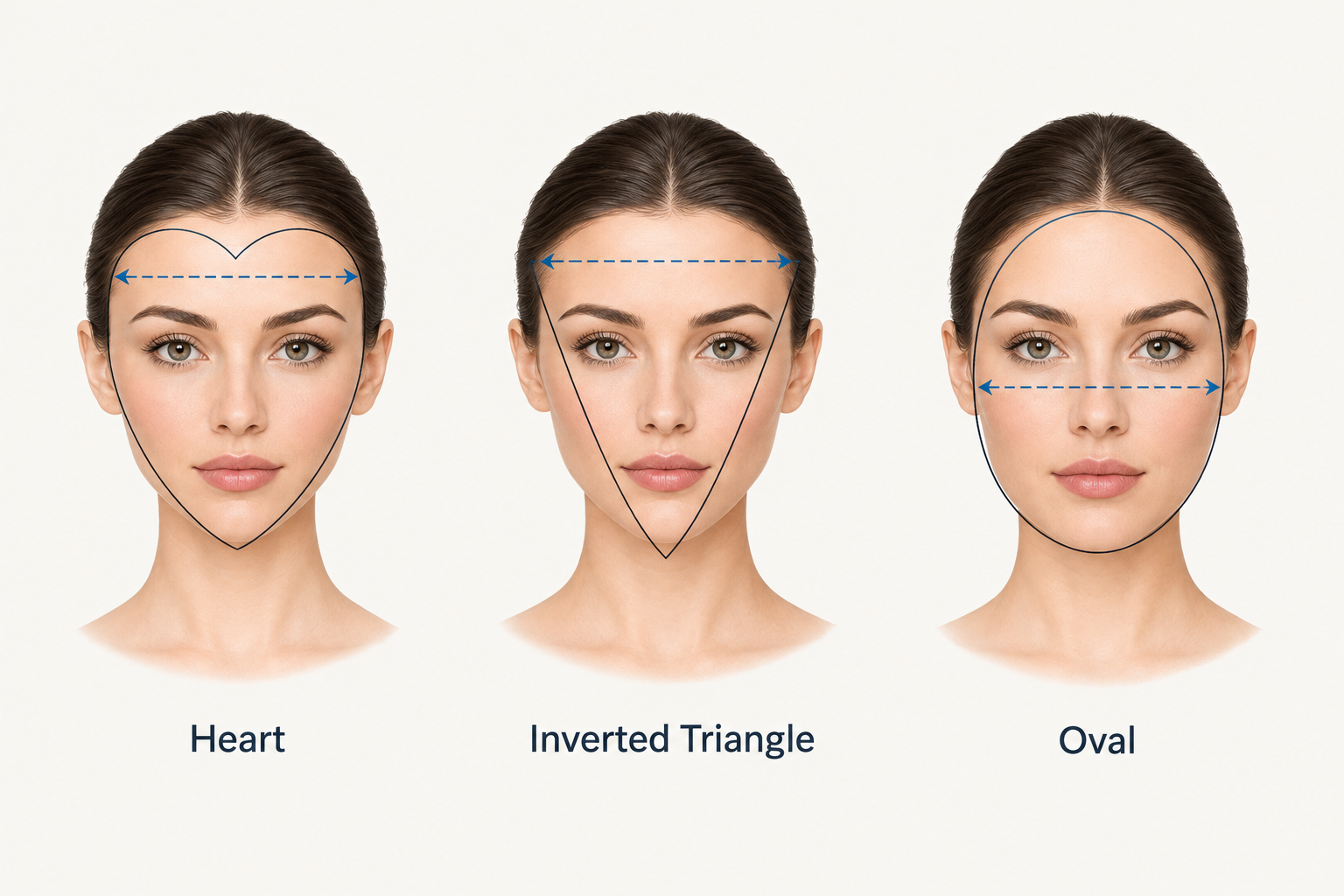
It is also worth noting that a heart-shaped face is sometimes confused with an inverted triangle face shape. The two share similarities — both feature a wider upper face and a narrower lower face — but the heart shape typically includes a more defined, rounded hairline (sometimes with a widow’s peak), softer cheekbone prominence, and a chin that is pointed rather than simply narrow. The inverted triangle tends to have a more angular, geometric quality overall.
Defining Features of a Heart-Shaped Face
Several structural and soft tissue characteristics combine to create what is recognised as a heart-shaped face. No single feature is sufficient on its own; it is the combination and proportion of these elements that produces the overall shape.
Forehead Width and Shape
The forehead in a heart-shaped face is typically the widest part of the face when measured horizontally. This width may be due to broader temporal bones, a naturally wide cranial structure, or a combination of both. The hairline often follows a rounded or gently curved path, and some individuals with this face shape have a widow’s peak — a downward point of hair growth at the centre of the forehead — which further emphasises the heart-like outline. The forehead itself may be relatively tall or of average height; the key characteristic is its width relative to the jaw.
Cheekbone Prominence
Prominent cheekbones are a consistent feature of the heart-shaped face. The zygomatic bones (cheekbones) sit high and are often visible as a gentle projection beneath the outer corners of the eyes. This prominence contributes to the upper-face fullness that characterises the shape and creates a natural highlight point on the mid-face. In younger individuals, soft tissue volume over the cheekbones reinforces this appearance; with age, volume loss in this area can alter the perceived face shape significantly.
Jawline and Lower Face
The jawline in a heart-shaped face tapers gradually from the cheekbones downward, creating a narrowing effect through the lower third of the face. The jaw angles are typically less pronounced than in a square or rectangular face shape, giving the lower face a softer, more curved appearance. The overall width of the lower jaw is noticeably narrower than the forehead, which is one of the clearest distinguishing features of this face shape.
Chin Shape
The chin is one of the most defining elements of a heart-shaped face. It is typically narrow and may come to a gentle point, though it is not always sharply angular. A slightly pointed or tapered chin creates the lower tip of the heart outline and contributes to the overall impression of facial delicacy in the lower third. In some individuals, the chin may also be slightly prominent in profile, projecting forward relative to the lower lip, which can affect how the face reads from the side as well as the front.
Overall Facial Proportions
Facial proportion analysis — sometimes referred to in the context of the classical thirds — divides the face into upper, middle, and lower sections. In a heart-shaped face, the upper third (forehead to brow) and middle third (brow to base of nose) are often relatively balanced, while the lower third (base of nose to chin) may appear narrower or more tapered than in other face shapes. This proportional difference is what creates the characteristic visual weight in the upper face and the sense of delicacy in the lower face.
How to Identify a Heart-Shaped Face
Identifying a heart-shaped face involves assessing several measurements and visual characteristics together rather than relying on a single feature. A straightforward approach is to compare the width of the forehead, cheekbones, and jaw, then consider the chin shape.
- Forehead width: Measure or visually assess the width of the forehead at its broadest point, typically just below the hairline at the temples.
- Cheekbone width: Assess the width across the cheekbones at their most prominent point, usually at the outer corners of the eyes.
- Jaw width: Measure the width of the jaw just above the chin, at the widest point of the lower face.
- Chin shape: Observe whether the chin tapers to a point or is more rounded, square, or flat.
In a heart-shaped face, the forehead is typically the widest measurement, the cheekbones are close in width to the forehead or slightly narrower, and the jaw is noticeably narrower than both. The chin tapers rather than being broad or flat. If the cheekbones are the widest point and the forehead and jaw are both narrower, the face shape may be closer to a diamond. If the jaw and forehead are similar in width with a rounded overall outline, the shape may be closer to round or oval.
It is worth acknowledging that self-assessment of face shape can be imprecise. Hairstyle, facial hair, makeup, and even the angle of a photograph can all influence how a face shape appears. Aesthetic practitioners typically assess facial structure in person, using both visual analysis and, where relevant, anatomical measurements or imaging.
How Face Shape Relates to Aesthetic Medicine
In aesthetic medicine, face shape analysis is used as a framework for discussing facial balance and harmony rather than as a rigid prescription for treatment. The goal of most facial aesthetic treatments is not to change the fundamental bone structure — which is largely fixed in adults — but to address soft tissue volume, skin quality, and surface contour in ways that support the individual’s goals and enhance their natural features.
For individuals with a heart-shaped face, aesthetic consultations often focus on the relationship between the upper and lower face. Because the upper face is naturally wider and the lower face narrower, some patients seek treatments that either soften the upper face or add definition and volume to the lower face to create a greater sense of balance. Others may be entirely satisfied with their natural proportions and seek treatment for unrelated concerns such as skin quality, fine lines, or volume loss in specific areas.
Forehead and Temple Considerations
The wider forehead characteristic of a heart-shaped face can sometimes be a point of self-consciousness for patients, particularly if the forehead appears very prominent or if temporal hollowing develops with age. Temporal hollowing — a loss of soft tissue volume in the area beside the forehead and above the cheekbones — can make the upper face appear more angular and the transition from forehead to mid-face less smooth. Soft tissue filler treatments in the temporal region may be discussed in consultation as a way to restore volume and soften this transition, though suitability depends on individual anatomy and medical history.
Botulinum toxin treatments are sometimes used in the forehead region to address dynamic lines or to make subtle adjustments to brow position and shape, which can influence how the upper face reads overall. These treatments require careful assessment by a qualified practitioner, as the forehead and brow area involves complex muscle interactions that vary between individuals.
Cheekbone and Mid-Face Volume
The naturally prominent cheekbones of a heart-shaped face are often considered an aesthetic asset, contributing to mid-face definition and a youthful appearance. However, age-related volume loss in the mid-face — which typically begins in the third and fourth decades of life — can reduce cheekbone prominence and alter the overall face shape over time. Soft tissue filler treatments in the mid-face or cheek region may be considered to restore lost volume, though the approach should be tailored to the individual’s anatomy rather than applied according to face shape alone.
Jawline and Chin Considerations
The narrower lower face of a heart-shaped face means that the jaw and chin are often areas of interest in aesthetic consultations. Some patients with this face shape feel that the lower face appears too narrow or that the chin is too pointed, while others appreciate these features. Soft tissue filler treatments can be used to add subtle volume to the chin or to soften a very pointed chin tip, potentially creating a more balanced relationship between the upper and lower face. Jawline definition treatments may also be discussed, though the appropriateness of any intervention depends on the individual’s anatomy, goals, and overall facial proportions.
Botulinum toxin treatment in the masseter muscles — the large muscles used for chewing, located at the sides of the jaw — is sometimes discussed in the context of facial slimming or softening of the lower face. In individuals with a heart-shaped face, this treatment is less commonly indicated than in those with a square or wide jaw, since the lower face is already relatively narrow. A thorough assessment is essential before considering any treatment in this area.
Age-Related Changes in a Heart-Shaped Face
The features that define a heart-shaped face in youth do not remain static. Age-related changes in bone density, soft tissue volume, skin elasticity, and fat compartment distribution all influence how the face shape appears over time. Understanding these changes is relevant both for patients seeking to maintain their natural features and for those noticing shifts in their facial appearance.
In a heart-shaped face, some of the most noticeable age-related changes tend to occur in the mid-face and lower face. Volume loss in the cheek fat compartments can reduce the prominence of the cheekbones and create a flatter or more hollowed mid-face appearance. As skin laxity increases, the soft tissue of the lower face may descend, potentially making the jawline appear less defined and the chin area less distinct. These changes can, paradoxically, make a heart-shaped face appear more oval or even square over time, as the lower face gains apparent width from descended tissue while the upper face loses volume.
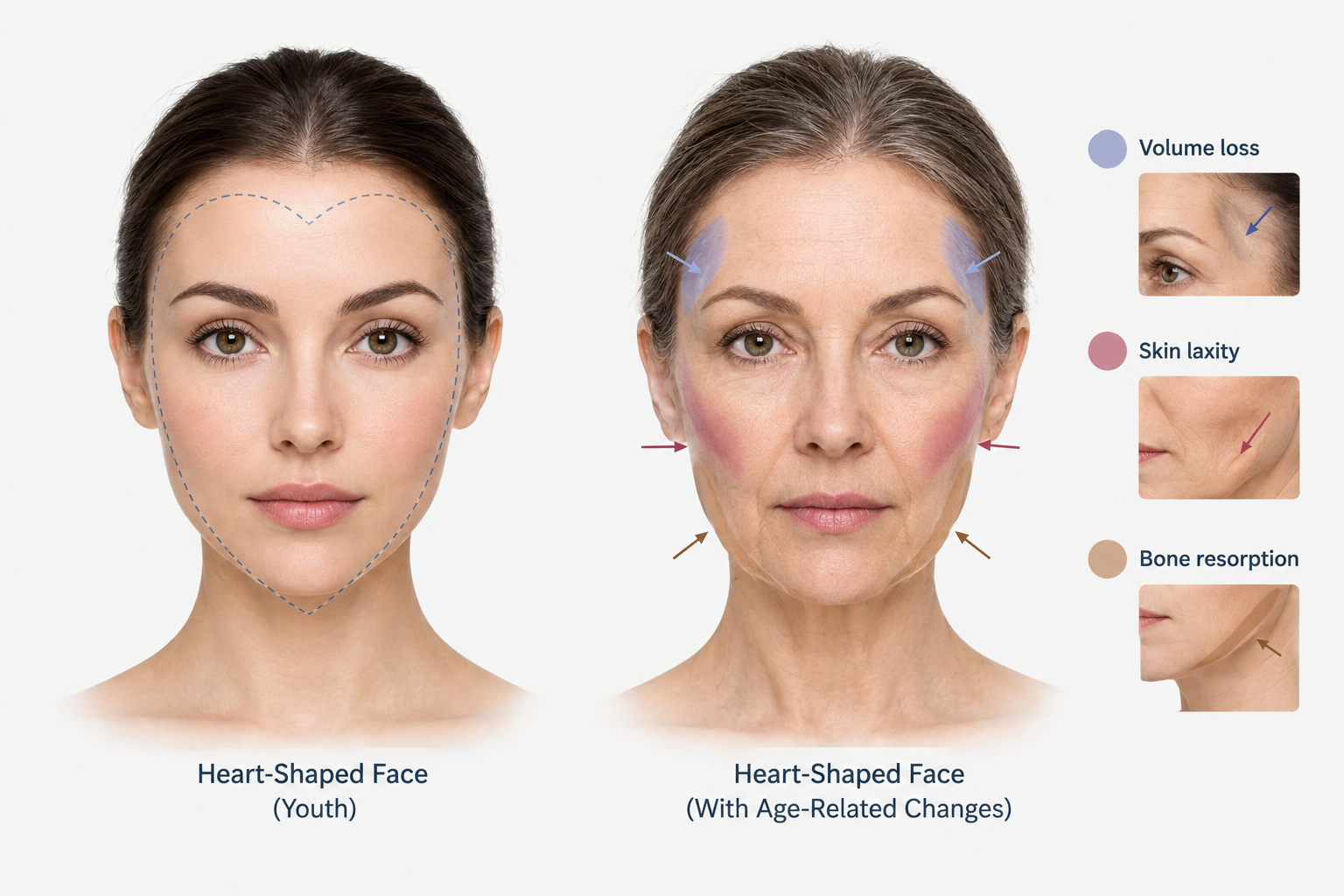
Bone resorption — the gradual reduction in facial bone volume that occurs with ageing — also affects the chin and jaw in ways that can alter the lower face proportions. The chin may appear to recede slightly, and the overall lower face may lose some of its youthful definition. These structural changes are distinct from soft tissue changes and are not addressable through non-surgical treatments alone.
Aesthetic Treatments Relevant to Heart-Shaped Faces
The following treatments are sometimes discussed in the context of heart-shaped face aesthetics. Suitability for any treatment depends on individual anatomy, medical history, skin condition, and personal goals, and should always be assessed by a qualified practitioner.
Dermal Fillers
Hyaluronic acid dermal fillers are among the most commonly used non-surgical treatments for facial contouring and volume restoration. In the context of a heart-shaped face, fillers may be considered for the temples, mid-face, chin, or jawline, depending on the individual’s concerns and goals. Results are temporary, typically lasting between six months and two years depending on the product used, the treatment area, and individual factors such as metabolism and lifestyle. Risks include bruising, swelling, asymmetry, and, in rare cases, more serious complications such as vascular occlusion, which underscores the importance of treatment by a trained and experienced practitioner.
Botulinum Toxin
Botulinum toxin injections are used to temporarily relax specific facial muscles, reducing the appearance of dynamic lines and making subtle adjustments to facial contour. In the context of face shape, botulinum toxin may be discussed for forehead lines, brow shaping, or masseter reduction. The effects are temporary, typically lasting three to six months, and the treatment requires repeat sessions to maintain results. Individual response varies, and the outcome depends significantly on practitioner technique and the patient’s muscle anatomy.
Skin Quality Treatments
Treatments that address skin texture, tone, and quality — such as chemical peels, microneedling, laser resurfacing, and radiofrequency treatments — are relevant for all face shapes and are not specific to heart-shaped faces. However, improving skin quality can enhance the overall appearance of facial features and complement structural treatments. These treatments vary widely in mechanism, downtime, and evidence base, and suitability depends on skin type, concern, and individual health factors.
Surgical Options
Surgical procedures such as rhinoplasty (nose reshaping), genioplasty (chin surgery), or facial fat grafting can make more significant and longer-lasting changes to facial structure and proportions. These options are beyond the scope of non-surgical aesthetic medicine and require consultation with a qualified plastic or maxillofacial surgeon. They carry greater risks and longer recovery periods than non-surgical treatments and are typically considered when non-surgical approaches are insufficient to meet the patient’s goals.
Face Shape Analysis: Useful Tool or Oversimplification?
Face shape categories, including the heart shape, are useful as a starting point for aesthetic discussions, but they have meaningful limitations. Human faces are three-dimensional structures with considerable individual variation, and no two heart-shaped faces are identical. Factors such as ethnic background, age, body weight, and individual bone structure all influence facial appearance in ways that a simple two-dimensional category cannot fully capture.
In clinical practice, experienced aesthetic practitioners typically move beyond face shape categories relatively quickly, focusing instead on specific anatomical features, proportional relationships, and the patient’s individual goals. A patient who identifies as having a heart-shaped face may have concerns that are entirely unrelated to their face shape — such as under-eye hollowing, nasolabial folds, or skin texture — and these concerns are addressed on their own merits rather than through the lens of face shape alone.
It is also important to recognise that aesthetic medicine does not operate from a single ideal of facial beauty. The goal of a well-conducted aesthetic consultation is to understand what the individual patient finds concerning or would like to improve, and to discuss realistic options for addressing those specific concerns. Face shape analysis is one tool among many, not a blueprint for treatment.
Frequently Asked Questions
Is a heart-shaped face the same as an inverted triangle face?
These two face shapes share similarities — both have a wider upper face and a narrower lower face — but they are not identical. A heart-shaped face typically features a rounded or curved hairline, sometimes with a widow’s peak, softer cheekbone prominence, and a gently pointed chin. An inverted triangle face tends to have a more angular, geometric quality, with a straighter hairline and a jaw that narrows more sharply. In practice, the distinction can be subtle, and some individuals have features of both.
Can aesthetic treatments change my face shape?
Non-surgical aesthetic treatments cannot change the underlying bone structure of the face. What they can do is alter soft tissue volume, skin quality, and surface contour in ways that may influence how the face appears in terms of balance and proportion. Surgical procedures can make more significant structural changes, but these carry greater risks and require specialist surgical consultation.
Do I need treatment because I have a heart-shaped face?
No. A heart-shaped face is a natural facial structure, not a condition that requires treatment. Aesthetic treatments are elective and should only be considered if an individual has specific concerns they wish to address and has been assessed as suitable by a qualified practitioner. Many people with heart-shaped faces have no aesthetic concerns related to their face shape at all.
How does ageing affect a heart-shaped face?
Ageing affects all face shapes through a combination of bone resorption, soft tissue volume loss, and changes in skin elasticity. In a heart-shaped face, the most noticeable changes often occur in the mid-face and lower face, where volume loss can reduce cheekbone prominence and alter the lower face contour. These changes may make the face appear less distinctly heart-shaped over time. A qualified aesthetic practitioner can assess age-related changes and discuss relevant options during a consultation.
What is a widow’s peak and is it always present in a heart-shaped face?
A widow’s peak is a downward-pointing V-shaped growth of hair at the centre of the forehead hairline. It is associated with heart-shaped faces because it emphasises the upper-face width and contributes to the heart-like outline. However, not everyone with a heart-shaped face has a widow’s peak, and having a widow’s peak does not automatically mean a person has a heart-shaped face. It is one possible feature, not a defining requirement.
Should I choose hairstyles or makeup based on my face shape?
Hairstyle and makeup guidance based on face shape is widely discussed in beauty contexts, but these recommendations are general suggestions rather than rules. Individual preferences, hair texture, skin tone, and personal style all matter more than face shape categories. If you are interested in guidance tailored to your specific features, a consultation with a skilled hairstylist or makeup artist who can assess your face in person is more useful than general face shape advice.
Understanding Your Face Shape Before an Aesthetic Consultation
Knowing that you have a heart-shaped face — or that your face shares characteristics with this shape — can be a useful starting point when preparing for an aesthetic consultation. It gives you a framework for describing your facial structure and may help you articulate which features you are happy with and which you would like to discuss. However, it is important to approach any consultation with realistic expectations about what non-surgical treatments can and cannot achieve.
A qualified aesthetic practitioner will conduct their own assessment of your facial anatomy, taking into account your bone structure, soft tissue volume, skin quality, and the specific concerns you raise. They will discuss treatment options that are appropriate for your individual anatomy and goals, explain the realistic benefits and limitations of each option, and outline the relevant risks and aftercare requirements. Face shape is one part of this picture, but it is the individual — not the category — that guides a responsible aesthetic consultation.
If you are considering aesthetic treatment and would like to understand how your facial features and proportions relate to the options available, booking a consultation with a qualified and experienced aesthetic practitioner is the most reliable next step. A thorough in-person assessment provides far more useful information than any general guide to face shapes can offer.


