
Private Mole Removal Cost in the UK: What Affects the Price?
Private mole removal in the UK typically costs between £150 and £800 per mole, though prices outside this range are not uncommon. The variation is significant, and understanding what drives it can help you compare quotes meaningfully, ask the right questions at consultation, and avoid paying for services that may not match your clinical needs. This article explains the main factors that influence the cost of private mole removal, what the procedure generally involves, and what to consider before choosing a provider.
Key Takeaways
- Private mole removal cost in the UK varies widely depending on mole size, location, removal method, and the type of clinic or practitioner you choose.
- A consultation fee is usually charged separately and may or may not be deducted from the treatment cost if you proceed.
- Histological analysis — laboratory examination of the removed tissue — is an important safety step that may or may not be included in the quoted price.
- NHS mole removal is generally available only when a mole is considered clinically suspicious; cosmetic removal is not routinely funded.
- Choosing a provider based on price alone carries risk; clinical qualifications, facilities, and aftercare arrangements matter significantly.
Why Mole Removal Is Rarely a Fixed Price
Unlike many cosmetic treatments where a standard session price is straightforward, mole removal involves several variables that make a single flat fee impractical. Each mole is different in terms of its size, depth, position on the body, and whether it raises any clinical concern. The removal technique that is most appropriate for one mole may be entirely unsuitable for another. Clinics price their services to reflect these differences, which is why two people seeking mole removal on the same day at the same clinic may receive very different quotes.
It is also worth noting that private mole removal encompasses both cosmetic removal — where a mole is benign but the patient wishes it removed for aesthetic reasons — and clinically indicated removal, where a mole has features that warrant closer examination. The pathway, the urgency, and sometimes the cost differ between these two scenarios.
Consultation Fees and Initial Assessment
Most reputable private clinics charge a consultation fee before any removal procedure. This fee typically ranges from £50 to £200 and covers a clinical assessment of the mole, a discussion of your medical history, and an explanation of the recommended removal method. Some clinics deduct the consultation fee from the treatment cost if you proceed; others do not, so it is worth clarifying this in advance.
During the consultation, a qualified practitioner — ideally a dermatologist or a surgeon with relevant experience — will examine the mole, often using a dermatoscope (a magnifying instrument that allows closer inspection of skin lesion features). This assessment helps determine whether the mole is likely benign, whether removal is appropriate, and which technique is most suitable. Skipping a proper consultation to reduce upfront cost is not advisable, as a clinical assessment is an important safety step rather than an optional add-on.
How Mole Size and Depth Affect Cost
The physical characteristics of a mole are among the most direct influences on removal cost. Larger moles require more time, greater technical precision, and in many cases a more involved closure technique to minimise scarring. A small, flat mole of a few millimetres may be removed quickly with minimal tissue disruption, while a larger raised or deeply rooted mole may require excision with sutures and a longer procedure time.
Depth matters because it determines how much tissue needs to be removed to achieve a clear margin — particularly relevant when histological analysis is planned. A superficial shave excision may be appropriate for a raised benign mole, but a mole with features that warrant complete removal will typically require a deeper elliptical excision, which is a more involved surgical procedure. Clinics generally charge more for larger or deeper moles, and some use a tiered pricing structure based on mole diameter.
Removal Method and Its Impact on Price
The technique used to remove a mole is one of the clearest drivers of cost variation. Different methods carry different equipment requirements, procedure times, and levels of clinical skill.
Surgical Excision
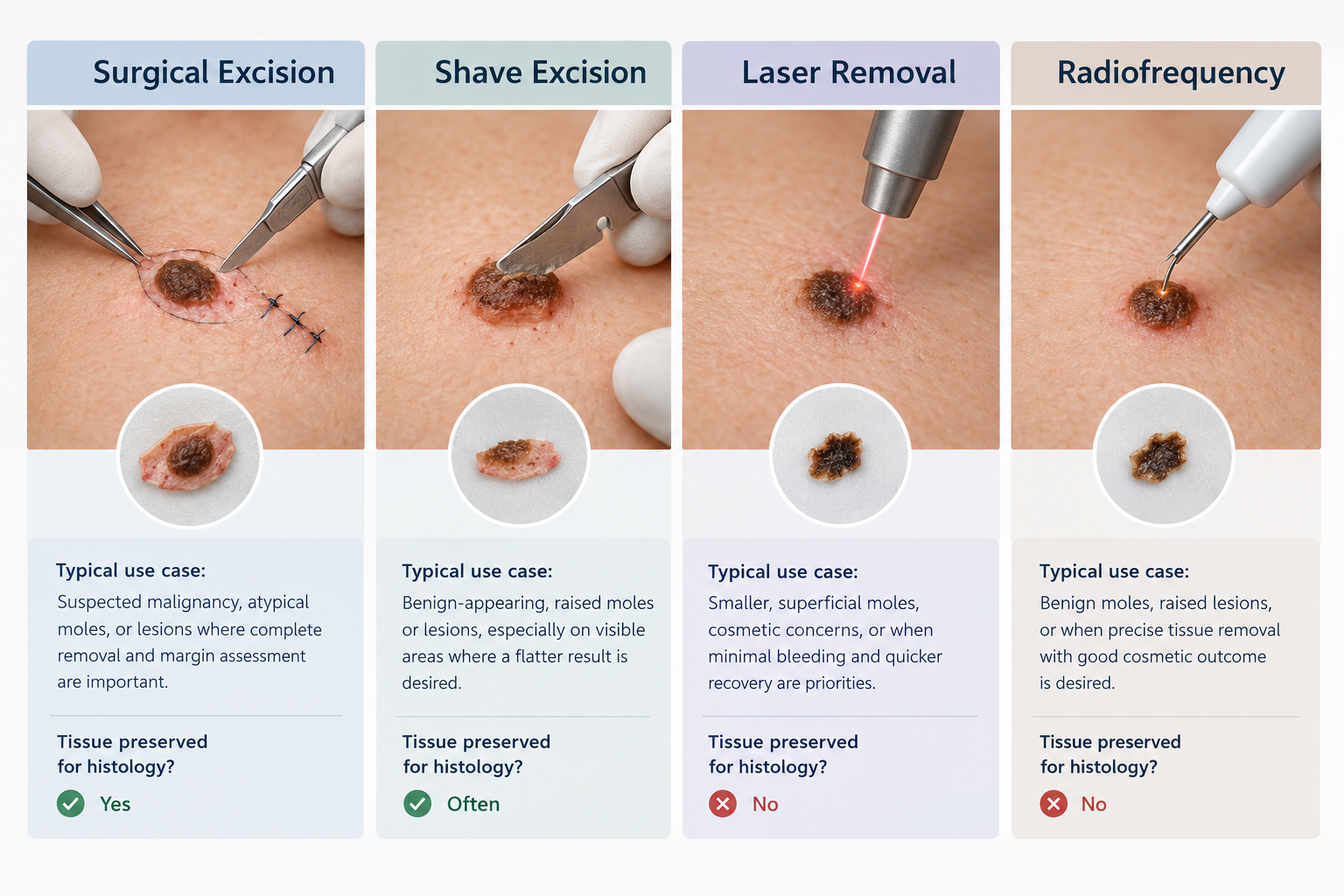
Surgical excision involves cutting the mole out with a scalpel, typically under local anaesthetic, and closing the wound with sutures. This method is suitable for moles of most sizes and is the standard approach when histological analysis of the removed tissue is required. Because it involves a minor surgical procedure, it tends to sit at the higher end of the price range — often between £300 and £800 or more per mole — reflecting the skill, sterile environment, and follow-up care involved.
Shave Excision
Shave excision uses a surgical blade to shave a raised mole flush with the surrounding skin surface. It is generally quicker than full excision and does not always require sutures. This technique is typically used for benign raised moles and is often priced lower than full surgical excision, though it may not be appropriate for all mole types. The removed tissue can still be sent for histological analysis.
Laser Removal
Laser mole removal uses focused light energy to break down pigmented cells within the mole. It is generally suitable only for small, flat, benign moles and cannot provide a tissue sample for laboratory analysis. This is an important limitation: if there is any clinical uncertainty about a mole, laser removal is not appropriate because the tissue is destroyed rather than preserved. Laser removal tends to be priced competitively, sometimes between £150 and £400, but its suitability is more restricted than surgical methods.
Radiofrequency and Electrosurgery
Radiofrequency (RF) removal and electrosurgery use electrical energy to remove or destroy mole tissue. Like laser removal, these methods may not preserve tissue for histological examination. They can be effective for certain benign lesions but are not universally appropriate. Pricing varies between clinics and is broadly comparable to laser removal in many cases.
Histological Analysis: An Important Cost Consideration
Histological analysis — sending the removed mole tissue to a pathology laboratory for microscopic examination — is a clinically important step that is not always included in the headline price quoted by a clinic. Laboratory analysis can confirm whether a mole is benign or whether it contains any abnormal cells that require further attention. For surgical excision, this is generally considered best practice.
When comparing private mole removal costs, it is essential to ask whether histological analysis is included. Some clinics include it as standard; others charge it separately, typically adding £50 to £150 or more to the overall cost. Choosing a provider that omits histological analysis purely to offer a lower price may not be in your best clinical interest, particularly if the mole has any features that are difficult to assess visually.
Mole Location on the Body
Where a mole sits on the body influences both the complexity of removal and the cost. Moles on the face, particularly around the eyes, nose, or lips, require greater precision to minimise visible scarring and may take longer to remove safely. Moles in areas with thin or delicate skin, near joints, or in locations that are difficult to access may also attract a higher fee. Conversely, moles on the back or limbs in straightforward positions are generally less technically demanding to remove.
Scarring risk also varies by body location. Areas such as the chest, shoulders, and upper back are more prone to hypertrophic or keloid scarring in susceptible individuals, which may influence the recommended technique and the aftercare required — both of which can affect the overall cost of treatment.
Number of Moles Being Removed
Many clinics offer a reduced per-mole price when multiple moles are removed in the same session. If you are considering removing several moles, it is worth asking whether a multi-mole pricing structure is available. However, the number of moles that can safely be removed in a single session depends on their location, size, and the overall time and tissue disruption involved. A practitioner should advise on what is clinically appropriate rather than simply accommodating as many removals as possible in one appointment.
Type of Clinic and Practitioner Qualifications
The type of facility and the qualifications of the practitioner performing the removal are significant factors in both price and safety. Private dermatology clinics staffed by consultant dermatologists or plastic surgeons typically charge more than general aesthetic clinics or beauty salons offering mole removal as part of a broader treatment menu. This price difference often reflects the level of clinical training, the quality of the sterile environment, the availability of histological analysis, and the standard of aftercare.
In the UK, mole removal is a procedure that carries clinical risk and should be performed by a suitably qualified medical professional. The General Medical Council (GMC) registers doctors, and the British Association of Dermatologists and the British Association of Plastic, Reconstructive and Aesthetic Surgeons (BAPRAS) represent relevant specialist bodies. Checking a practitioner’s qualifications and registration before proceeding is a reasonable and important step. Lower prices at unregulated or minimally supervised settings may reflect reduced clinical oversight rather than genuine efficiency.
Geographic Location Within the UK
Private healthcare costs in the UK vary by region. Clinics in London and the South East generally charge more than those in other parts of England, Scotland, Wales, or Northern Ireland. This reflects differences in operating costs, rental prices, and local market rates rather than necessarily a difference in clinical quality. If you are willing to travel, comparing prices across regions may be worthwhile, though travel costs and the practicality of follow-up appointments should be factored into the overall calculation.
Aftercare, Follow-Up, and Additional Costs
The quoted price for mole removal does not always include everything involved in the full episode of care. Aftercare dressings, follow-up appointments to check healing or remove sutures, and the results consultation where histology findings are discussed may be charged separately at some clinics. Before committing to a provider, it is worth asking specifically what is included in the quoted price and what might be billed additionally.
If a mole removal results in a scar that requires further treatment — such as silicone gel, steroid injections for raised scarring, or laser scar revision — these represent additional costs that are not typically included in the initial removal price. While good technique minimises scarring risk, some degree of scarring is an inherent possibility with any skin removal procedure, and this should be discussed honestly at consultation.
NHS Versus Private Mole Removal
The NHS does not routinely fund mole removal for cosmetic reasons. NHS referral for mole assessment and removal is generally reserved for moles that display features associated with potential malignancy — such as asymmetry, irregular borders, multiple colours, a diameter greater than 6mm, or a mole that is evolving in appearance. If your GP considers a mole clinically suspicious, referral through the two-week wait pathway for suspected skin cancer is available without cost to the patient.
For moles that are assessed as benign but that you wish to have removed for cosmetic or comfort reasons, private treatment is the usual route in the UK. Understanding this distinction helps set realistic expectations: private mole removal cost is a genuine out-of-pocket expense for most patients seeking cosmetic removal, and NHS funding is not a realistic alternative in the absence of clinical concern.
Risks and Limitations to Factor Into Your Decision
Mole removal is generally a low-risk minor procedure when performed by a qualified practitioner in an appropriate clinical setting, but it is not without potential complications. Relevant risks include infection, bleeding, scarring, incomplete removal requiring a further procedure, and — in the rare event that a mole contains abnormal cells — the need for wider excision or specialist referral. These risks are not eliminated by paying a higher price, but they are more likely to be managed appropriately when the procedure is performed by a suitably trained clinician with access to proper facilities and histological analysis.
Incomplete removal is a specific consideration: some moles, particularly those removed by shave excision or laser, may recur if not fully removed. Recurrence may require a further procedure and additional cost. Discussing the likelihood of complete removal with your practitioner before the procedure is a sensible step.
Questions to Ask Before Booking Private Mole Removal
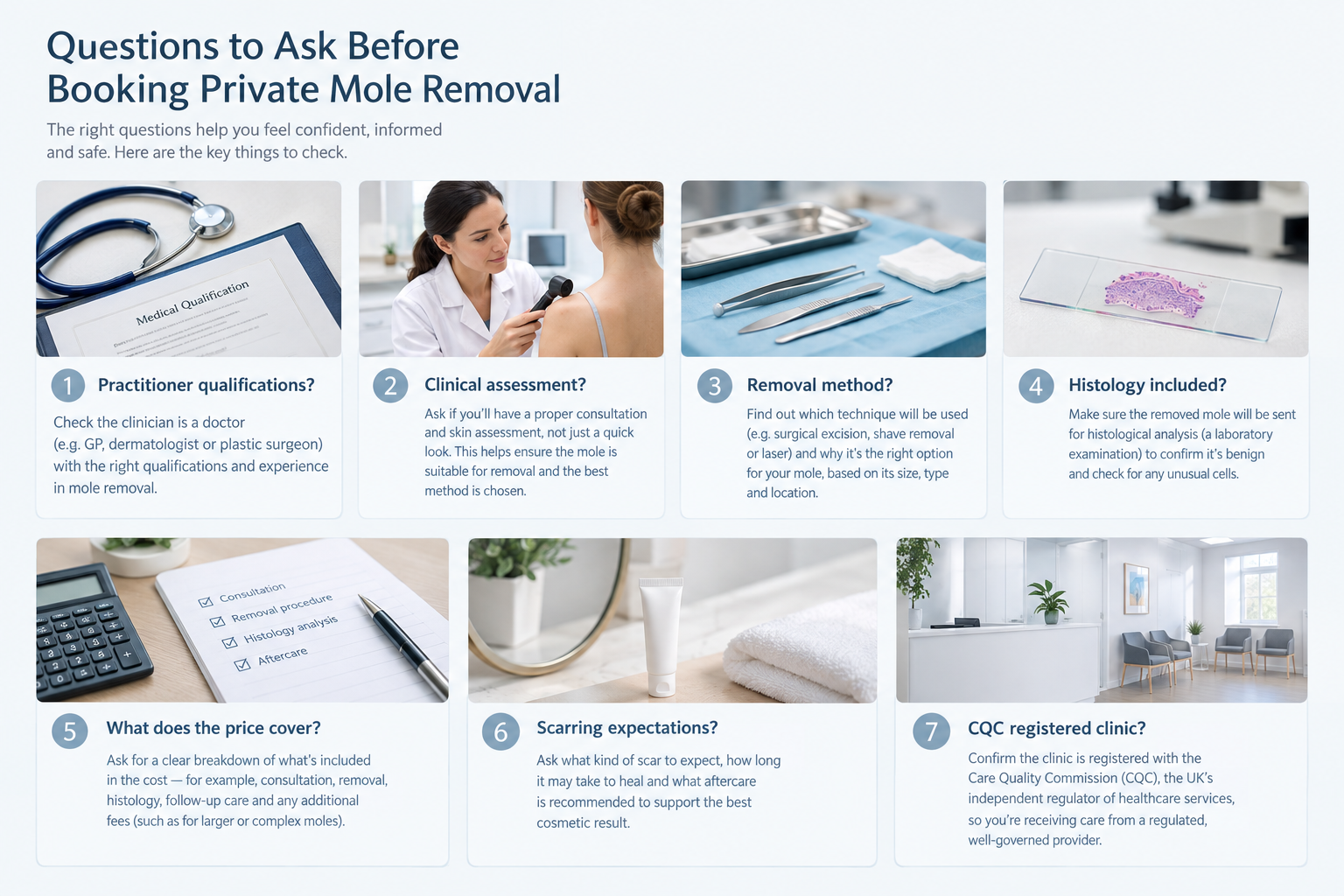
- What qualifications does the practitioner performing the removal hold, and are they registered with the GMC or a relevant specialist body?
- Is a clinical assessment of the mole included before removal, and will a dermatoscope be used?
- Which removal method is recommended for my mole, and why?
- Is histological analysis of the removed tissue included in the price?
- What does the quoted price include — consultation, procedure, dressings, suture removal, follow-up, and histology results?
- What is the clinic’s policy if the mole recurs or if histology indicates further treatment is needed?
- What scarring outcome is realistic for my mole’s size and location?
- Is the facility registered with the Care Quality Commission (CQC) or equivalent regulatory body?
Frequently Asked Questions
How much does private mole removal typically cost in the UK?
Private mole removal in the UK generally costs between £150 and £800 per mole, depending on the removal method, mole size and location, the type of clinic, and whether histological analysis is included. Some complex cases or specialist clinics may charge outside this range. Always request an itemised quote that clarifies exactly what is included.
Is histological analysis always necessary?
Histological analysis — laboratory examination of the removed tissue — is considered best practice when a mole is surgically excised, as it confirms whether the tissue is benign and whether the mole has been fully removed. It is particularly important if the mole has any features that are difficult to assess visually. Some removal methods, such as laser, destroy the tissue and cannot provide a sample for analysis, which is one reason these methods are generally limited to clearly benign moles.
Can the NHS remove a mole for free?
The NHS will assess and remove a mole without charge if it is considered clinically suspicious and potentially malignant. Cosmetic removal of benign moles is not routinely funded by the NHS. If you are concerned about a mole’s appearance or behaviour, speaking to your GP is the appropriate first step, as they can assess whether an NHS referral is warranted.
Does mole removal leave a scar?
Some degree of scarring is an inherent possibility with any procedure that removes skin tissue. The extent of scarring depends on the removal method, the mole’s size and location, the practitioner’s technique, and individual healing factors. Surgical excision typically leaves a fine linear scar. Shave excision may leave a flat, slightly discoloured mark. Laser removal may leave minimal visible change in suitable cases. Scarring risk should be discussed honestly at consultation.
How do I know if a clinic is reputable?
In the UK, look for clinics registered with the Care Quality Commission (CQC) in England, or equivalent bodies in Scotland, Wales, and Northern Ireland. Check that the practitioner performing the removal is registered with the General Medical Council (GMC) and has relevant qualifications in dermatology or surgery. Membership of recognised professional bodies such as the British Association of Dermatologists adds further reassurance. Be cautious of clinics that offer mole removal without a prior clinical assessment or that cannot confirm whether histological analysis is available.
Can multiple moles be removed in one session?
In many cases, yes. Removing multiple moles in a single session can be more cost-effective and convenient. However, the number that can safely be removed at once depends on their size, location, and the overall procedure time involved. A qualified practitioner should advise on what is clinically appropriate for your individual situation rather than simply maximising the number of removals per session.
Making an Informed Choice About Private Mole Removal
Private mole removal cost in the UK is shaped by a combination of clinical, technical, and logistical factors — none of which should be considered in isolation. A lower price is not inherently a better deal if it reflects a less thorough assessment, the absence of histological analysis, or a less qualified practitioner. Equally, the highest price does not automatically guarantee the best outcome.
The most useful approach is to request a detailed, itemised quote from at least two or three reputable clinics, confirm what is included at each stage of care, and prioritise providers who offer a proper clinical assessment before any removal takes place. If a mole has any features that concern you — changes in size, shape, colour, or texture, or a mole that bleeds or itches — speaking to your GP before seeking private removal is a sensible first step, as an NHS referral may be appropriate. For moles that are clearly benign and removed for cosmetic reasons, private treatment with a qualified practitioner in a regulated facility remains a reasonable and widely available option across the UK.


