
Nose Fillers Gone Wrong: Complications, Warning Signs, and What to Do
Non-surgical rhinoplasty using dermal filler has become one of the most requested aesthetic procedures, offering a way to reshape the nose without surgery. However, the nose is also one of the highest-risk areas for filler injection, and when complications occur, they can range from minor cosmetic concerns to serious medical emergencies. Understanding what can go wrong, why it happens, and what to do about it is essential reading for anyone considering the procedure — or anyone who has already had it and is concerned about their results.
Key Takeaways
- The nose has a complex and variable blood supply, making vascular complications from nose filler among the most serious risks in aesthetic medicine.
- Warning signs such as skin blanching, severe pain, or vision changes after nose filler require immediate medical attention — delays can lead to permanent tissue damage or vision loss.
- Many complications, including asymmetry, overfilling, and migration, result from poor technique or inappropriate product selection rather than unavoidable patient factors.
- Hyaluronidase can dissolve hyaluronic acid filler and is a critical emergency tool, but it must be administered promptly and by a trained practitioner.
- Choosing a qualified, medically trained injector who understands nasal anatomy and carries hyaluronidase is the single most important risk-reduction step a patient can take.
Why the Nose Is a High-Risk Area for Filler
The nose presents unique anatomical challenges that make it significantly more dangerous for filler injection than areas such as the lips or cheeks. The nasal region is supplied by several arterial branches, including the dorsal nasal artery, the lateral nasal artery, and the columellar artery, all of which are small, variable in position, and located close to the skin surface. Injecting filler into or near one of these vessels can cause a vascular occlusion — a blockage that cuts off blood supply to surrounding tissue.
What makes this particularly dangerous is the interconnected nature of the nasal blood supply with vessels that supply the eye. The ophthalmic artery, which feeds the retina, shares anastomotic connections with nasal vessels. In rare but documented cases, filler injected into a nasal artery has travelled retrogradely into the ophthalmic circulation, causing partial or complete vision loss. This is one of the most feared complications in all of aesthetic medicine, and the nose is one of the most commonly implicated injection sites when it occurs.
The skin over the nasal tip and alar regions also has limited collateral circulation, meaning that even a small vascular compromise can result in significant tissue ischaemia. This anatomical reality means that non-surgical rhinoplasty carries a higher inherent risk profile than many other filler treatments, regardless of the injector’s skill level.
Common Nose Filler Complications
Complications from nose filler exist on a spectrum from minor and temporary to severe and potentially permanent. Understanding the different categories helps patients recognise what they are experiencing and respond appropriately.
Vascular Occlusion and Skin Necrosis
Vascular occlusion occurs when filler compresses or enters a blood vessel, restricting or blocking blood flow to the surrounding tissue. In the nose, this can cause ischaemia — a dangerous reduction in oxygen supply — that, if untreated, progresses to tissue necrosis, meaning the skin and underlying tissue begin to die. Early signs include sudden skin blanching (the skin turns white or pale), followed by a dusky blue or purple discolouration, severe pain, and a mottled appearance. The alar region and nasal tip are particularly vulnerable. If recognised and treated immediately with hyaluronidase, warm compresses, and appropriate medical management, outcomes can be improved significantly. Delayed treatment substantially increases the risk of permanent scarring.
Vision Changes and Ocular Complications
Filler-related vision loss is rare but represents the most catastrophic possible outcome of nose filler injection. It occurs when filler particles enter the arterial circulation and travel to the ophthalmic artery or its branches, causing retinal artery occlusion. Symptoms may include sudden blurred vision, partial visual field loss, or complete vision loss in one eye, sometimes accompanied by eye pain or a drooping eyelid. These symptoms can appear during or immediately after injection. Vision loss from this mechanism is often irreversible, as the retina is highly sensitive to ischaemia. Any visual disturbance following nose filler must be treated as a medical emergency requiring immediate transfer to hospital ophthalmology services.
Asymmetry and Uneven Results
Asymmetry is one of the most frequently reported cosmetic complications after non-surgical rhinoplasty. It may result from uneven filler placement, differences in the underlying bone and cartilage structure, swelling that resolves unevenly, or filler migration over time. Mild asymmetry in the early days after treatment is often related to swelling and may resolve as the product settles. Persistent asymmetry that remains after four to six weeks is unlikely to self-correct and may require correction with hyaluronidase dissolution followed by careful re-treatment, or in some cases surgical assessment.
Filler Migration
Dermal filler placed in the nose can migrate away from the intended treatment area, particularly if a low-viscosity product is used, if excessive volume is injected, or if the patient experiences repeated trauma to the area. Migration can cause a broadened, irregular, or unnatural appearance to the nose. In some cases, filler that has migrated becomes palpable as a lump or nodule beneath the skin. Hyaluronic acid filler migration can generally be addressed with hyaluronidase, though multiple treatment sessions may be needed to fully dissolve displaced product.
Tyndall Effect and Superficial Placement
The Tyndall effect refers to a bluish discolouration of the skin that occurs when hyaluronic acid filler is placed too superficially. Light scatters differently through the filler compared to surrounding tissue, creating a visible blue or grey tint beneath the skin. In the nose, where the skin is thin, this is a recognised risk. The Tyndall effect does not resolve on its own and requires treatment with hyaluronidase to dissolve the superficially placed filler.
Infection and Biofilm Formation
Any injection carries a risk of introducing bacteria into the skin. Infection following nose filler may present as increasing redness, warmth, swelling, and pain in the days after treatment, sometimes with pus formation. A more complex problem is biofilm — a community of bacteria that forms around the filler and is resistant to standard antibiotic treatment. Biofilm-related infections may present as recurrent swelling or nodules that appear weeks or months after treatment, often triggered by illness or dental procedures. Biofilm management typically requires a combination of hyaluronidase dissolution, prolonged antibiotic therapy, and specialist input.
Granuloma Formation
Granulomas are inflammatory nodules that can form as a delayed immune response to filler material. They may appear months or even years after treatment and present as firm, sometimes tender lumps. Granulomas are more commonly associated with permanent or semi-permanent fillers, but can occasionally occur with hyaluronic acid products. Treatment options include intralesional corticosteroid injections, hyaluronidase for hyaluronic acid-based granulomas, or in resistant cases, surgical excision.
Overfilling and Unnatural Appearance
Excessive filler volume in the nose can create a widened, heavy, or unnatural appearance that is sometimes described as a “pillow nose” or “sausage nose.” This is a technique-related complication that occurs when too much product is placed in a single session or when cumulative treatments over time have added excessive volume. The nose may appear broader, less defined, or structurally inconsistent with the rest of the face. Correction with hyaluronidase is usually effective for hyaluronic acid filler, though the process may require patience and more than one dissolution session.
Warning Signs That Require Immediate Action
Certain symptoms following nose filler injection should be treated as medical emergencies. Patients and practitioners alike must be aware of these red flags and act without delay.

- Skin blanching or white patches appearing during or immediately after injection — a potential sign of vascular occlusion
- Severe or worsening pain that is disproportionate to the procedure
- Skin turning blue, purple, or mottled in the nose, tip, or surrounding areas
- Any change in vision, including blurring, partial loss, or complete loss of vision in one or both eyes
- Eye pain, drooping eyelid, or double vision following injection
- Headache, nausea, or neurological symptoms appearing shortly after treatment
- Increasing redness, heat, and swelling in the days following treatment, suggesting infection
If any of these symptoms occur, the patient should contact their treating practitioner immediately. If the practitioner is unavailable or if vision is affected, emergency services or the nearest hospital emergency department should be contacted without delay. Time is critical in managing vascular complications — the window for effective intervention is narrow.
Why Do Nose Filler Complications Happen?
Complications from non-surgical rhinoplasty can arise from a combination of anatomical, technical, and product-related factors. Understanding the contributing causes helps patients make more informed choices about where and with whom they have treatment.
Practitioner Training and Experience
The single most significant modifiable risk factor is the training and experience of the injector. Non-surgical rhinoplasty is widely considered one of the most technically demanding filler procedures. It requires a thorough understanding of nasal anatomy, including the variable course of nasal blood vessels, the ability to recognise early warning signs of vascular compromise, and immediate access to hyaluronidase for emergency reversal. Practitioners without formal medical training, or those who have not received specific training in high-risk filler areas, are more likely to cause complications and less likely to manage them effectively when they occur.
In many countries, regulations governing who can legally administer dermal filler remain inconsistent. This means that in some regions, individuals without medical qualifications may legally offer nose filler treatments. Patients should seek treatment only from medically qualified practitioners — such as doctors, dentists, or nurses with prescribing authority — who have specific training in facial anatomy and emergency complication management.
Product Selection
Not all dermal fillers are appropriate for nasal use. The nose requires a filler with sufficient structural support to reshape cartilage and bone, but the product must also be placed carefully to avoid vascular compression. Using a filler that is too soft may lead to migration or poor structural results. Using a product that is too firm or injected in excessive volume increases the risk of vascular compression. Hyaluronic acid fillers are strongly preferred for nose filler procedures because they can be dissolved with hyaluronidase in an emergency. Permanent fillers such as silicone or PMMA (polymethylmethacrylate) cannot be dissolved and carry a significantly higher risk of long-term complications including granuloma formation and infection.
Injection Technique
Technique-related factors include injection depth, injection speed, the volume deposited per pass, and whether aspiration is performed before injecting. Injecting too quickly, depositing large boluses of filler, or placing product in the wrong tissue plane all increase complication risk. The use of a blunt-tipped cannula rather than a sharp needle is sometimes advocated as a way to reduce vascular injury risk, though neither approach eliminates the risk entirely, and the evidence comparing the two techniques in nasal injection specifically remains limited.
Patient Anatomy
Individual anatomical variation means that the course of nasal blood vessels differs between patients. Previous nasal surgery, trauma, or prior filler treatments can alter the normal anatomy further, making the procedure more complex and potentially more dangerous. Patients with a history of nasal surgery or significant prior filler accumulation in the nose may face higher procedural risk and should discuss this history in detail with their practitioner before proceeding.
How Are Nose Filler Complications Treated?
Treatment depends on the type and severity of the complication. Early recognition and prompt action are the most important factors in achieving a good outcome.
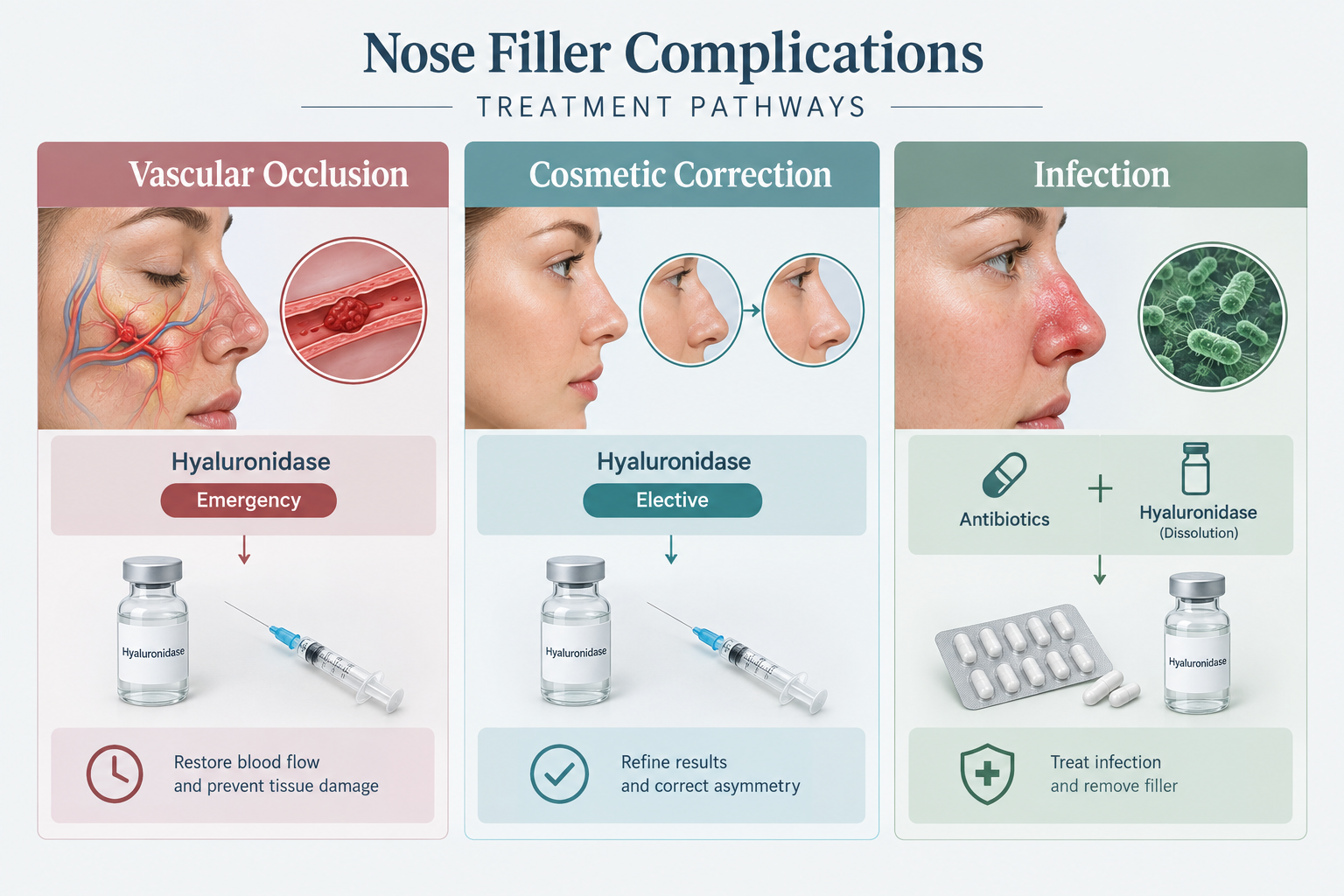
Hyaluronidase for Vascular Occlusion
Hyaluronidase is an enzyme that dissolves hyaluronic acid filler. In the context of vascular occlusion, it is used as an emergency intervention to break down filler that is compressing or has entered a blood vessel, restoring circulation to the affected tissue. Hyaluronidase must be available at every clinic that performs hyaluronic acid filler treatments, and the practitioner must be trained to recognise the indications for its use and administer it without delay. The dose used in an emergency vascular occlusion scenario is typically much higher than that used for elective filler dissolution.
Hyaluronidase for Cosmetic Correction
For non-emergency complications such as overfilling, migration, asymmetry, the Tyndall effect, or lumps, hyaluronidase can be used electively to dissolve unwanted hyaluronic acid filler. The process involves injecting hyaluronidase into the area of concern, which breaks down the filler over the following days. Multiple sessions may be needed for complete dissolution, particularly if significant volumes of filler are present or if the product has been in place for a long time. Patients should be aware that hyaluronidase may also dissolve some naturally occurring hyaluronic acid in the tissue, which can temporarily cause a slightly hollowed appearance before the body replenishes it.
Infection Management
Acute bacterial infections following nose filler are treated with appropriate antibiotics, guided by the clinical presentation and, where possible, culture results. Suspected biofilm requires a more aggressive approach, often combining hyaluronidase dissolution of the filler with prolonged antibiotic courses. Patients who develop signs of infection after nose filler should seek medical assessment promptly rather than waiting to see whether symptoms resolve.
Granuloma Treatment
Inflammatory granulomas may respond to intralesional corticosteroid injections, which reduce the immune response driving the nodule formation. For hyaluronic acid-related granulomas, hyaluronidase may also be helpful. Persistent or large granulomas, particularly those associated with non-dissolvable fillers, may ultimately require surgical removal.
Reducing Your Risk Before Treatment
While no aesthetic procedure is entirely without risk, patients can take meaningful steps to reduce the likelihood of complications from nose filler.
- Choose a medically qualified practitioner with specific training in facial anatomy and high-risk filler areas, not simply someone who offers the treatment at a low price.
- Confirm that hyaluronidase is available at the clinic and that the practitioner is trained to use it in an emergency.
- Disclose your full medical history, including any previous nasal surgery, trauma, prior filler treatments, blood-thinning medications, or known allergies.
- Ask about the specific filler product being used and why it has been selected for your anatomy and goals.
- Avoid permanent fillers in the nose, as these cannot be dissolved and carry a higher long-term complication risk.
- Do not seek treatment from practitioners operating outside regulated clinical environments or those who cannot explain their emergency protocols.
- Be cautious about cumulative treatments — repeated nose filler sessions over time can lead to excessive volume accumulation and increased complication risk.
Alternatives to Nose Filler
For patients who are concerned about the risks of non-surgical rhinoplasty or who have experienced complications, it is worth understanding the available alternatives.
Surgical rhinoplasty remains the gold standard for permanent, precise nasal reshaping. It allows the surgeon to address bone, cartilage, and soft tissue in a controlled environment, with results that are durable and not subject to migration or dissolution. Surgical rhinoplasty carries its own risks, including anaesthetic risks, infection, scarring, and the possibility of revision surgery, and requires a meaningful recovery period. However, for patients seeking significant or permanent change, it may offer a more predictable long-term outcome than repeated filler treatments.
For patients who have had nose filler complications and are left with residual deformity after hyaluronidase treatment, surgical assessment may be appropriate. In some cases, filler that has been present for a long time can cause changes to the surrounding tissue that persist even after the filler itself has been dissolved.
Some patients who are interested in subtle nasal refinement may find that addressing other facial features — such as the chin or jawline — creates a more balanced facial profile without the need for nasal intervention. A thorough consultation with a qualified practitioner can help identify whether nasal treatment is genuinely the most appropriate approach for a patient’s specific concerns.
Frequently Asked Questions
Can nose filler complications be reversed?
Many complications from hyaluronic acid nose filler can be partially or fully reversed using hyaluronidase, which dissolves the filler. This includes overfilling, migration, asymmetry, lumps, and the Tyndall effect. Vascular occlusion can also be treated with hyaluronidase, but the outcome depends heavily on how quickly treatment is initiated. Complications involving permanent fillers cannot be dissolved and may require surgical management. Vision loss caused by retinal artery occlusion is often irreversible.
How long after nose filler can complications appear?
Vascular complications typically occur during or immediately after injection. Infection may develop within days. Delayed complications such as granulomas, biofilm-related swelling, or filler migration can appear weeks, months, or even years after treatment. Any new or worsening symptoms in a previously treated area should be assessed by a qualified practitioner.
Is nose filler safe?
Non-surgical rhinoplasty carries a higher risk profile than many other filler treatments due to the complex nasal blood supply and its connections to the ocular circulation. The procedure can be performed more safely when carried out by a medically trained and experienced practitioner using an appropriate hyaluronic acid filler and with hyaluronidase immediately available. However, it is not a risk-free procedure, and patients should be fully informed of the potential complications before consenting to treatment.
What should I do if I think my nose filler has gone wrong?
Contact your treating practitioner immediately. If you experience any change in vision, skin that is turning white, blue, or purple, or severe pain, treat this as a medical emergency and seek urgent care. Do not wait to see if symptoms improve on their own when vascular warning signs are present. For non-urgent concerns such as asymmetry or lumps, arrange a follow-up appointment with your practitioner to discuss options including hyaluronidase dissolution.
Can nose filler cause permanent damage?
Yes, in serious cases. Untreated or delayed vascular occlusion can result in permanent scarring or tissue loss in the nose. Filler-related retinal artery occlusion can cause permanent vision loss. These outcomes are rare but are well-documented in the medical literature. This is why prompt recognition and treatment of warning signs is so important.
How do I find a safe practitioner for nose filler?
Look for a practitioner with a recognised medical qualification — such as a doctor, dentist, or registered nurse prescriber — who has specific training in facial anatomy and advanced filler techniques. Ask whether they carry hyaluronidase and have a protocol for managing vascular emergencies. Be cautious of practitioners who offer very low prices, do not conduct a thorough consultation, or cannot clearly explain the risks of the procedure.
What to Consider Before Deciding on Nose Filler
Non-surgical rhinoplasty can produce meaningful aesthetic improvements for carefully selected patients when performed by a skilled and appropriately trained practitioner. However, the nose is not a forgiving area for filler, and the consequences of complications can be severe. Patients considering the procedure should approach it with a clear understanding of the risks involved, not just the potential benefits.
The most important protective factor is the choice of practitioner. A medically qualified injector with specific training in nasal anatomy, a thorough consultation process, and immediate access to emergency reversal agents represents a meaningfully different risk environment than an unqualified or undertrained provider. Price should not be the primary decision factor when the stakes include the possibility of tissue loss or vision impairment.
If you have already had nose filler and are concerned about your results or experiencing any symptoms, seek a review with a qualified medical practitioner as soon as possible. Early intervention consistently produces better outcomes than delayed management. A consultation with an experienced aesthetic doctor can help clarify whether your concerns are cosmetic in nature and addressable with hyaluronidase, or whether they require more urgent attention.


