
How Long Does Nose Filler Last? Duration, Factors & What to Expect
Nose filler, also known as non-surgical rhinoplasty, uses injectable hyaluronic acid to reshape, refine, or balance the nose without surgery. One of the most common questions patients ask before booking a treatment is how long the results will actually last. The honest answer is that duration varies — typically between 9 and 18 months — and several individual and treatment-related factors influence how quickly the filler breaks down. This article explains what determines longevity, what the treatment experience involves, what risks to be aware of, and how nose filler compares to surgical alternatives, so you can approach a consultation with realistic expectations.
Key Takeaways
- Nose filler results typically last between 9 and 18 months, though individual variation is significant and some patients may see effects persist longer or fade sooner.
- The type of hyaluronic acid filler used, the volume injected, the injection technique, and individual metabolism all influence how long results last.
- Non-surgical rhinoplasty can address concerns such as a dorsal hump, asymmetry, a drooping tip, or a flat nasal bridge, but it cannot reduce the overall size of the nose.
- Nose filler carries specific risks, including vascular occlusion, which is a rare but serious complication requiring immediate treatment; choosing a qualified and experienced practitioner is essential.
- Results are temporary and reversible with hyaluronidase, which is an important safety advantage over surgical rhinoplasty.
What Is Non-Surgical Rhinoplasty?
Non-surgical rhinoplasty is a minimally invasive cosmetic procedure in which a practitioner injects a dermal filler — most commonly a hyaluronic acid-based product — into specific areas of the nose to alter its shape, improve symmetry, or create the appearance of a smoother profile. The procedure does not involve incisions, general anaesthesia, or the extended recovery period associated with surgical rhinoplasty. Because hyaluronic acid is a substance that occurs naturally in the body, it is gradually broken down over time, which is why the results are temporary rather than permanent.
Hyaluronic acid fillers used in the nose are typically denser and more cohesive than those used in softer facial areas such as the lips. This firmness helps the filler hold its shape under the relatively rigid structure of the nose. Different filler products have different rheological properties — meaning differences in thickness, elasticity, and how they integrate with surrounding tissue — and these characteristics influence both the aesthetic result and how long the filler remains effective.
How Long Does Nose Filler Typically Last?
For most patients, nose filler results last between 9 and 18 months. This range reflects genuine clinical variation rather than a vague estimate. Some patients find their results begin to soften noticeably at around 9 to 12 months, while others retain a visible improvement for closer to 18 months or, in some cases, slightly beyond. A small number of patients report that traces of filler remain detectable for longer, particularly if multiple treatment sessions have been performed over time, though the aesthetic effect generally diminishes before the filler is fully absorbed.
The nose tends to retain filler for longer than highly mobile areas of the face, such as the lips, because the nasal tissue experiences less repetitive movement. Lips are in near-constant motion during speaking and eating, which accelerates filler breakdown. The nose, by contrast, is relatively static, which contributes to the comparatively longer duration seen in this treatment area. However, the nose is also a structurally complex area with a rich blood supply, which is relevant both to longevity and to the risk profile of the procedure.
Factors That Affect How Long Nose Filler Lasts
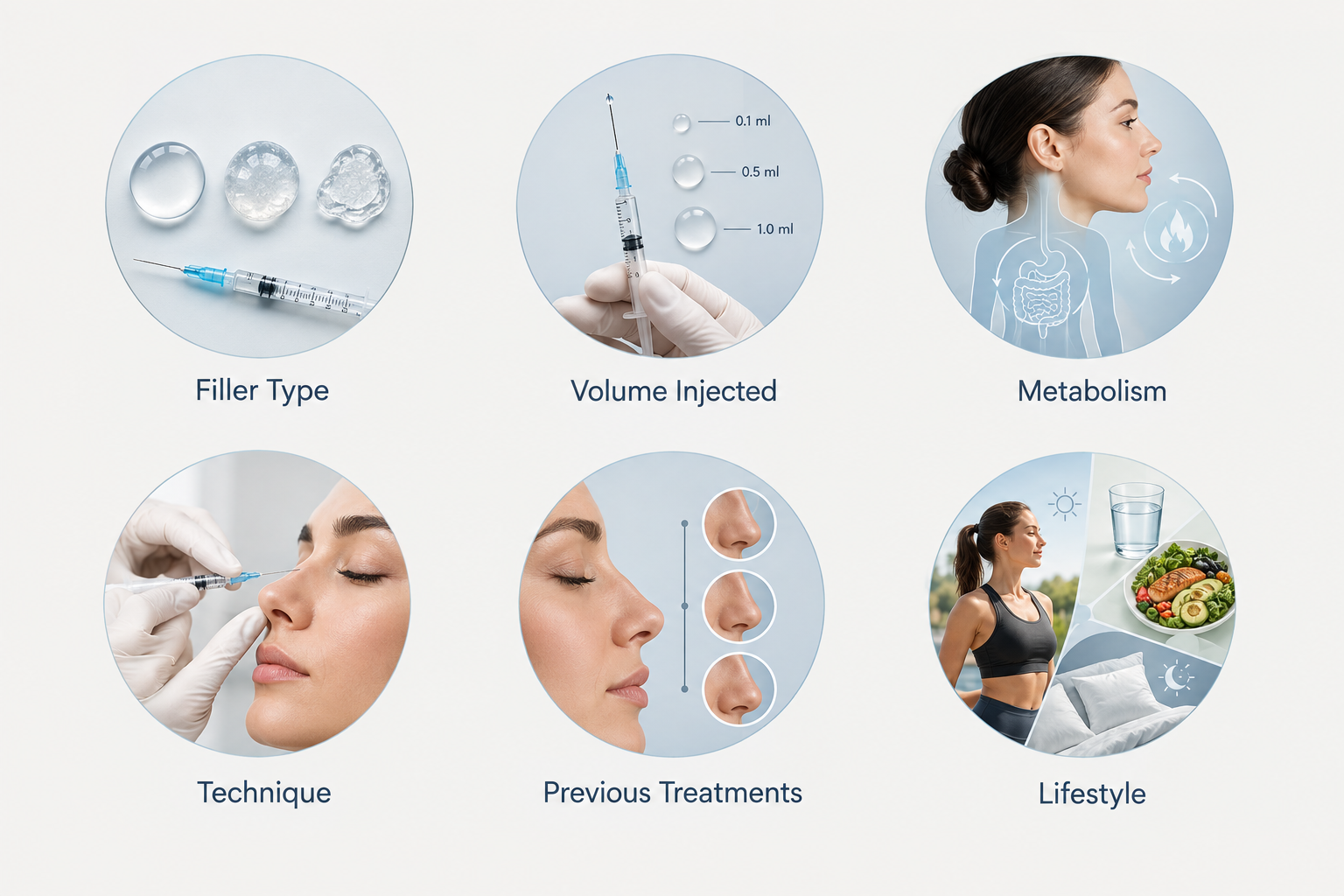
Understanding what influences filler longevity helps set realistic expectations and informs decisions about timing and maintenance. Several factors interact to determine how quickly hyaluronic acid breaks down in any individual patient.
Filler Type and Product Selection
Not all hyaluronic acid fillers are identical. Products vary in their degree of cross-linking — a manufacturing process that determines how resistant the filler is to enzymatic breakdown. More highly cross-linked fillers tend to last longer because they are more resistant to hyaluronidase, the enzyme the body uses to break down hyaluronic acid. Practitioners typically select a firmer, more cohesive filler for the nose to provide structural support and maintain shape, and this choice also tends to support longer duration compared with softer products used elsewhere on the face.
Volume Injected
The amount of filler placed during a session influences how long a visible result persists. Larger volumes take longer to fully metabolise, so patients who receive a more substantial correction may notice their results lasting toward the upper end of the typical range. However, volume must always be appropriate to the anatomy and the desired outcome — overfilling the nose carries aesthetic and safety risks, so practitioners do not simply inject more filler to extend longevity.
Individual Metabolism
Metabolic rate is one of the most significant and least controllable factors in filler longevity. Patients with a faster metabolism tend to break down hyaluronic acid more quickly. Regular vigorous exercise, which elevates metabolic activity, may also contribute to faster filler degradation, though the clinical evidence on this specific relationship is limited. Age, hormonal factors, and general health can all influence how the body processes injected hyaluronic acid.
Injection Technique and Practitioner Experience
Where and how the filler is placed affects both the aesthetic result and its durability. Precise placement in the correct tissue plane, using an appropriate product for the nasal anatomy, contributes to a result that holds its shape for longer. Poorly placed filler may migrate, distort, or break down unevenly. Practitioner experience and anatomical knowledge are therefore relevant not only to safety but also to the longevity and quality of the outcome.
Previous Filler Treatments
Patients who have had repeated nose filler treatments over several years sometimes find that subsequent sessions last longer. This may be partly because residual cross-linked hyaluronic acid from previous treatments accumulates in the tissue, and partly because the practitioner can build on an existing foundation rather than starting from scratch. However, repeated treatments also carry a cumulative risk of tissue changes, and a thorough assessment of previous filler history is important before any top-up session.
Lifestyle and Environmental Factors
Sun exposure, smoking, and high levels of physical stress may accelerate the breakdown of dermal fillers generally, though the evidence specific to nasal filler is limited. Maintaining good skin health and following any aftercare guidance provided by the practitioner may support the longevity of the result, though these factors are unlikely to dramatically extend or shorten duration on their own.
What Can Nose Filler Address?
Non-surgical rhinoplasty can be used to address a range of aesthetic concerns, though it has clear limitations. Understanding what the treatment can and cannot achieve is important for realistic expectations.
Nose filler may be suitable for patients who want to smooth a dorsal hump — the bump on the bridge of the nose — by adding volume above and below it to create a straighter profile. It can also be used to lift a drooping nasal tip, improve nasal symmetry, define the bridge on a flat or wide nose, or refine the appearance of a post-surgical nose where minor irregularities remain. These are additive corrections: the filler adds volume to create an optical illusion of a different shape rather than physically removing tissue.
Nose filler cannot reduce the overall size of the nose, narrow wide nostrils, or correct significant structural concerns. Patients seeking a smaller nose or major reshaping are not suitable candidates for non-surgical rhinoplasty and may wish to discuss surgical options with a qualified surgeon.
The Treatment Experience
A nose filler appointment typically begins with a consultation to assess the patient’s anatomy, discuss their goals, review their medical history, and determine whether the treatment is appropriate. Photographs are usually taken for reference. The practitioner will explain the planned approach, the products to be used, and the realistic outcome.
The procedure itself is generally brief, often completed within 15 to 30 minutes. A topical anaesthetic cream may be applied beforehand to reduce discomfort, and some filler products contain lidocaine, a local anaesthetic, within the formulation. The practitioner uses either a fine needle or a blunt-tipped cannula to deliver the filler to the target areas. Patients typically experience mild pressure or a brief stinging sensation during injection.
Immediately after treatment, some swelling, redness, and tenderness at the injection sites is normal and usually resolves within a few days. Bruising is possible, particularly around the nasal tip and bridge. Most patients can return to normal daily activities the same day, though strenuous exercise, significant sun exposure, and pressure on the nose are generally advised against for the first 24 to 48 hours. The final result becomes clearer once initial swelling has settled, usually within one to two weeks.
Risks and Limitations of Nose Filler
Nose filler carries a specific and important risk profile that patients must understand before proceeding. The nose has a complex vascular anatomy, and the most serious complication associated with nasal filler is vascular occlusion — a situation in which filler enters or compresses a blood vessel, potentially restricting blood flow to the skin or, in rare cases, to the eye. Vascular occlusion can cause tissue necrosis (skin death) or, in extremely rare cases, vision changes or blindness. This is a medical emergency requiring immediate treatment with hyaluronidase to dissolve the filler.
The risk of vascular complications is one of the primary reasons why nose filler should only be performed by a practitioner with thorough knowledge of nasal anatomy, experience with injectable treatments, and immediate access to hyaluronidase. Patients should ask their practitioner directly about their training, their experience with nasal filler specifically, and their emergency protocols before agreeing to treatment.
More common but less serious side effects include temporary swelling, bruising, redness, tenderness, and asymmetry. Infection is uncommon but possible. Filler migration — where the product shifts from the intended position — can occur, particularly with repeated treatments or if an inappropriate product is used. Nodules or irregularities under the skin may develop in some cases. Most of these concerns can be addressed with hyaluronidase if necessary, which is a meaningful safety advantage of hyaluronic acid fillers over permanent or semi-permanent alternatives.
Who May Be Suitable for Nose Filler?
Non-surgical rhinoplasty may be appropriate for adults who have realistic expectations about what the treatment can achieve, are in good general health, and have specific aesthetic concerns that can be addressed by adding volume rather than removing tissue. Patients who are considering surgical rhinoplasty but are uncertain about committing to a permanent change sometimes use nose filler as a temporary way to preview a different nasal shape.
Nose filler is generally not suitable for patients who are pregnant or breastfeeding, have an active skin infection or inflammation in the treatment area, have a known allergy to hyaluronic acid or lidocaine, have certain bleeding disorders or are taking anticoagulant medications, or have previously had permanent filler injected into the nose. Patients with a history of cold sores may need prophylactic antiviral treatment before any injectable procedure near the face. A thorough medical history review at consultation is essential to identify any contraindications.
When to Consider a Top-Up Treatment
Most patients who are happy with their nose filler results choose to return for a maintenance appointment when they notice the correction beginning to soften, typically somewhere between 9 and 15 months after the initial treatment. There is no fixed schedule that applies to every patient, and the decision to top up should be based on the individual’s assessment of their result rather than a predetermined timeline.
Before any repeat treatment, the practitioner should assess how much residual filler remains in the tissue. Injecting additional filler on top of incompletely absorbed product can lead to overfilling, distortion, or an unnatural appearance over time. Some practitioners recommend dissolving residual filler with hyaluronidase before starting fresh, particularly if the patient has had multiple previous sessions or if there is any irregularity in the existing result.
Nose Filler vs Surgical Rhinoplasty
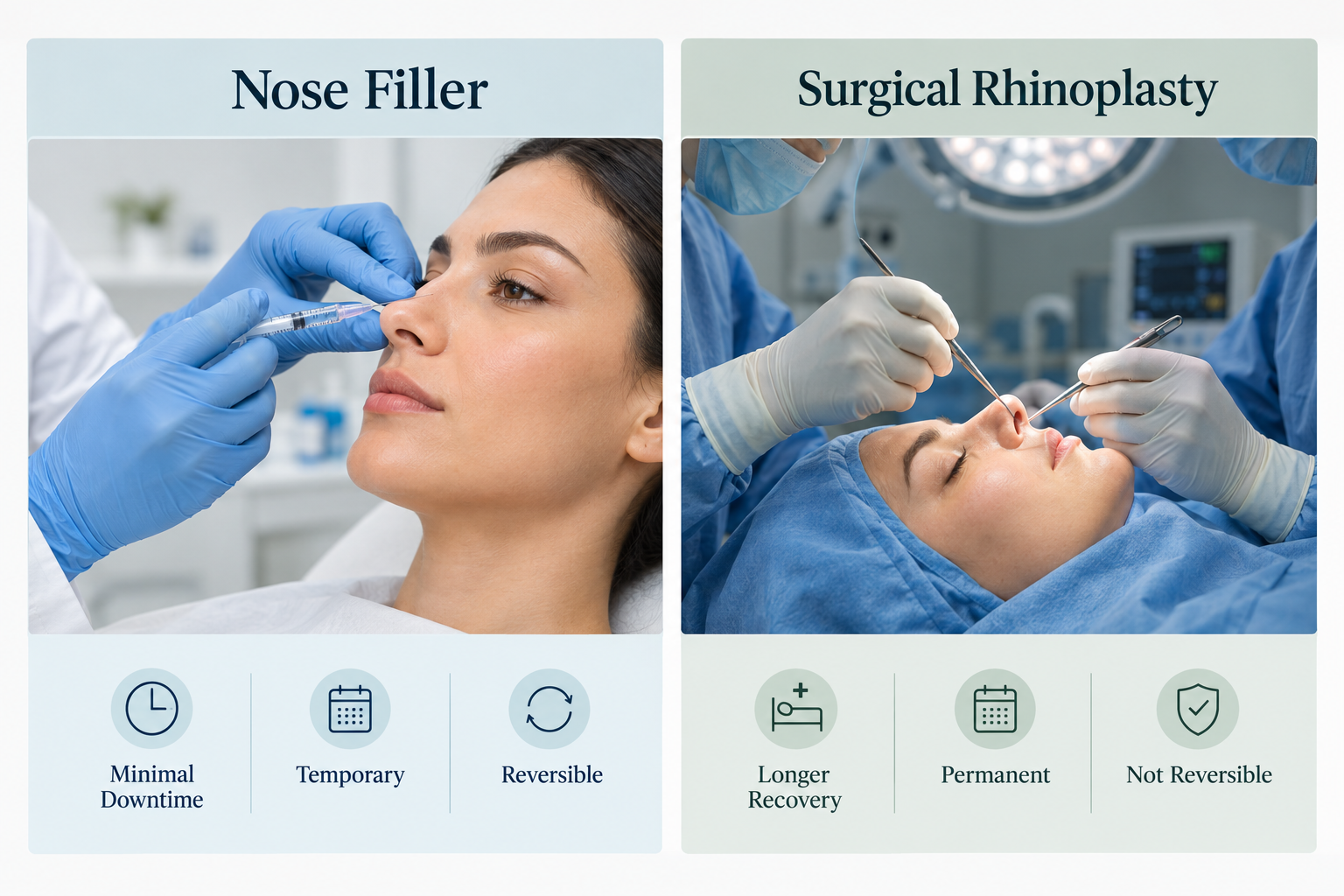
Non-surgical rhinoplasty and surgical rhinoplasty serve different patient needs and are not direct substitutes for one another. Understanding the key differences helps patients identify which option is worth discussing with the appropriate specialist.
| Characteristic | Nose Filler (Non-Surgical) | Surgical Rhinoplasty |
|---|---|---|
| Procedure type | Injectable, minimally invasive | Surgical, requires anaesthesia |
| Duration of results | 9–18 months typically | Long-lasting to permanent |
| Reversibility | Reversible with hyaluronidase | Not reversible |
| Downtime | Minimal, usually 1–3 days | Significant, several weeks |
| What it can address | Humps, asymmetry, tip lift, bridge definition | Size reduction, structural reshaping, functional correction |
| Risk profile | Vascular occlusion, bruising, migration | Surgical risks, scarring, prolonged swelling |
| Maintenance | Repeat treatments required | Generally not required |
| Cost over time | Recurring cost per session | Higher upfront, no repeat cost |
Patients who want a permanent reduction in nasal size, correction of breathing difficulties, or significant structural change will not achieve their goals with filler and should consult a board-certified plastic surgeon or ENT specialist. For patients seeking a subtle, reversible improvement with minimal downtime, non-surgical rhinoplasty may be worth discussing with a qualified aesthetic practitioner.
Frequently Asked Questions
Can nose filler last longer than 18 months?
In some patients, particularly those who have had repeated treatments over time, traces of hyaluronic acid filler may remain detectable beyond 18 months. However, the visible aesthetic effect typically diminishes before the filler is fully absorbed. Individual metabolism, product type, and cumulative treatment history all play a role. Practitioners should assess residual filler before any top-up session to avoid overfilling.
Does nose filler hurt?
Most patients describe the procedure as mildly uncomfortable rather than painful. Topical anaesthetic cream is usually applied beforehand, and many filler products contain lidocaine to reduce discomfort during injection. The nose is a sensitive area, so some patients experience more discomfort than others, particularly around the nasal tip. Discomfort generally resolves quickly after the procedure.
Can nose filler be dissolved if I am unhappy with the result?
Yes. Hyaluronic acid fillers can be dissolved using an enzyme called hyaluronidase, which breaks down the filler relatively quickly. This is one of the key safety and flexibility advantages of hyaluronic acid over permanent or semi-permanent filler materials. Dissolution is also the first-line emergency treatment if a vascular complication occurs, which is why practitioners must have hyaluronidase immediately available.
Will my nose look different immediately after treatment?
There will be an immediate visible change, but the result seen immediately after injection is not the final outcome. Initial swelling can make the nose appear larger or slightly uneven. As swelling resolves over one to two weeks, the true result becomes clearer. Patients should avoid judging the outcome in the first few days after treatment.
Is it safe to have nose filler repeatedly over many years?
Repeated nose filler treatments carry cumulative risks, including the gradual accumulation of residual filler in the tissue, potential changes to the nasal skin, and an increased complexity of the vascular anatomy over time. Practitioners should carefully assess the nose before each session and consider dissolving existing filler when appropriate. There is no universally agreed maximum number of sessions, but ongoing treatment should always be based on a thorough individual assessment.
How soon after nose filler can I exercise?
Most practitioners advise avoiding strenuous exercise for at least 24 to 48 hours after treatment. Vigorous physical activity increases blood flow and may contribute to increased swelling or bruising in the short term. Specific aftercare guidance should be provided by the treating practitioner and followed carefully.
What is the difference between nose filler and a permanent nose filler?
Hyaluronic acid nose filler is temporary and reversible. Some practitioners have historically used permanent or semi-permanent filler materials in the nose, but these are associated with a higher risk of long-term complications, including granulomas, migration, and difficulty managing adverse events. Most reputable practitioners now use only hyaluronic acid-based products for non-surgical rhinoplasty because of the reversibility and established safety profile.
Is Nose Filler the Right Choice for Your Goals?
Nose filler offers a genuinely useful option for patients seeking a subtle, reversible improvement to nasal shape without surgery. The typical duration of 9 to 18 months means the treatment requires ongoing maintenance, and the cumulative cost of repeat sessions over several years is worth factoring into the decision alongside the upfront cost of each appointment. For patients who want a permanent result or a significant reduction in nasal size, surgical rhinoplasty remains the appropriate route and should be discussed with a qualified surgeon.
The most important step before any nose filler treatment is a thorough consultation with a practitioner who has specific experience in non-surgical rhinoplasty, a clear understanding of nasal vascular anatomy, and the training and equipment to manage complications if they arise. The reversibility of hyaluronic acid filler is a meaningful safety advantage, but it does not eliminate risk — it makes the management of adverse events more straightforward when they occur in experienced hands. If you are considering nose filler, use your consultation to ask about the practitioner’s experience, the products they use, their approach to safety, and what realistic results look like for your specific anatomy.


