
Laser Mole Removal Safety: What Patients Need to Know
Laser mole removal is a popular option for people who want to remove benign skin lesions with minimal scarring and a relatively quick recovery. However, safety depends heavily on patient selection, accurate diagnosis, and the clinical setting in which the procedure is performed. This article explains how laser mole removal works, who may be a suitable candidate, what the procedure involves, what risks exist, and when other approaches may be more appropriate.
Key Takeaways
- Laser mole removal is generally considered suitable only for confirmed benign moles; any lesion with suspicious features should be assessed by a dermatologist before treatment.
- The procedure works by using focused light energy to break down pigmented cells, but it does not produce a tissue sample for histological analysis.
- Common side effects include temporary redness, swelling, and changes in pigmentation; scarring is possible but less common when the procedure is performed correctly.
- Multiple sessions may be needed for complete removal, and results can vary depending on mole depth, skin tone, and the laser technology used.
- Surgical excision remains the preferred method when a mole requires pathological examination or when malignancy cannot be confidently excluded.
What Is Laser Mole Removal?
Laser mole removal is a non-surgical cosmetic procedure that uses concentrated light energy to target and break down the melanin-rich cells that give a mole its colour and structure. The laser delivers short pulses of energy to the pigmented tissue, causing the cells to fragment and be gradually absorbed or shed by the body. Unlike surgical excision, the procedure does not involve cutting the skin or placing sutures, which is one reason many patients find it appealing.
The lasers most commonly used for mole removal include Q-switched Nd:YAG lasers, ablative carbon dioxide (CO2) lasers, and Er:YAG lasers. Each works through a slightly different mechanism. Q-switched devices target pigment selectively, while ablative lasers vaporise the surface layers of tissue more broadly. The choice of laser depends on the mole’s characteristics, its depth within the skin, and the practitioner’s clinical assessment.
It is important to understand that laser mole removal is a cosmetic procedure, not a diagnostic one. Because no tissue is removed and sent for laboratory analysis, the procedure cannot confirm whether a mole is benign. This is a fundamental safety consideration that distinguishes laser treatment from surgical excision.
Is Laser Mole Removal Safe?
When performed on confirmed benign moles by a qualified and experienced practitioner using appropriate equipment, laser mole removal is generally considered a safe procedure with a low rate of serious complications. The key phrase here is confirmed benign. The safety of the procedure depends almost entirely on accurate pre-treatment assessment.
Before any laser treatment is considered, a thorough clinical evaluation of the mole is essential. Many practitioners use dermoscopy, a technique that allows magnified examination of skin lesion structures, to assess whether a mole shows any features associated with atypical or potentially malignant change. If there is any clinical doubt, referral to a dermatologist or a biopsy should take priority over cosmetic removal.
The primary safety concern with laser mole removal is the risk of treating a lesion that has not been properly evaluated. Melanoma, the most serious form of skin cancer, can sometimes resemble a benign mole. Removing such a lesion with a laser without obtaining a tissue sample could delay diagnosis and potentially allow a malignancy to progress undetected. This is why reputable clinics will decline to treat any mole that has not been assessed as benign, and why patients should be cautious about providers who offer laser mole removal without a thorough pre-treatment skin check.
Who May Be a Suitable Candidate?
Laser mole removal may be appropriate for individuals who have small, flat, or slightly raised moles that have been clinically assessed and confirmed as benign. Candidates are generally people in good overall health who are seeking cosmetic improvement, such as removing a mole that is cosmetically bothersome or located in an area prone to irritation from clothing or shaving.
Factors that may support suitability include a stable mole with no recent changes in size, shape, colour, or texture; a lesion that is superficial rather than deeply rooted in the skin; and a patient with realistic expectations about the outcome. Lighter skin tones have historically been considered more straightforward to treat with certain laser types, though advances in laser technology have expanded the range of skin tones that can be treated safely. A qualified practitioner will assess Fitzpatrick skin type as part of the pre-treatment evaluation.
Factors that may make a patient less suitable or require additional caution include a history of keloid scarring, active skin infections or inflammatory conditions in the treatment area, a recent tan or sun-damaged skin, pregnancy or breastfeeding, and the use of photosensitising medications. Patients with a personal or family history of melanoma should be particularly careful and may be better served by surgical removal with histological analysis.
The Importance of Pre-Treatment Skin Assessment
A thorough skin assessment before laser mole removal is not a formality; it is the most important safety step in the entire process. Any mole being considered for laser treatment should be evaluated using established clinical criteria. The ABCDE criteria, which assess Asymmetry, Border irregularity, Colour variation, Diameter, and Evolution, provide a useful framework for identifying features that warrant further investigation.
Dermoscopy significantly improves the accuracy of clinical assessment compared to the naked eye alone. A practitioner trained in dermoscopy can identify structural patterns within a mole that may indicate atypical features not visible on the surface. If dermoscopy reveals any concerning characteristics, the appropriate course of action is referral or surgical excision with histological examination, not laser treatment.
Patients should also be aware that a mole’s appearance can change over time. A mole that was assessed as benign several years ago may have changed since that assessment. Any mole that has recently changed in appearance should be re-evaluated before treatment is considered. Reputable practitioners will document the mole’s appearance at the time of assessment and may photograph it for comparison.
What Happens During the Procedure?
A laser mole removal appointment typically begins with a consultation and skin assessment if this has not already been completed. The treatment area is cleaned, and a topical anaesthetic cream may be applied to reduce discomfort, particularly for larger or more sensitive lesions. The time required for the anaesthetic to take effect varies but is usually around 30 to 45 minutes.
During the procedure itself, the practitioner directs the laser beam at the mole in a series of controlled pulses. Patients commonly describe the sensation as a snapping or stinging feeling, similar to the flick of a rubber band against the skin. The duration of the treatment depends on the size and number of moles being treated but is often completed within a few minutes per lesion.
After the laser pulses are delivered, the treated area may appear red, swollen, or slightly crusted. A soothing gel or dressing may be applied. The practitioner will provide aftercare instructions, which typically include keeping the area clean, avoiding sun exposure, applying a recommended healing ointment, and refraining from picking or scratching the treated skin. Following aftercare instructions carefully is important for minimising the risk of infection, pigmentation changes, and scarring.
Recovery and Downtime
Recovery after laser mole removal is generally straightforward for most patients. The treated area typically goes through a healing process over one to three weeks, during which a small scab or crust may form and gradually shed. It is important not to pick at this crust, as doing so can increase the risk of scarring and infection.
Redness and mild swelling in the days immediately following treatment are normal responses. These usually resolve within a few days. Some patients notice temporary darkening of the treated area before it lightens, which is a normal part of the healing process. Sun protection is particularly important during recovery, as the newly healed skin is more vulnerable to UV-induced pigmentation changes. A broad-spectrum sunscreen with a high SPF should be applied consistently to the treated area once the skin has healed sufficiently.
Most patients are able to return to normal daily activities immediately or within a day of treatment, though strenuous exercise and activities that cause significant sweating are often advised against for the first few days. The overall downtime is generally low compared to surgical excision, which is one of the practical advantages of the laser approach for suitable candidates.
Risks and Side Effects
Laser mole removal carries a range of possible side effects and risks that patients should understand before proceeding. Most side effects are mild and temporary, but more significant complications can occur, particularly if the procedure is not performed correctly or if aftercare instructions are not followed.
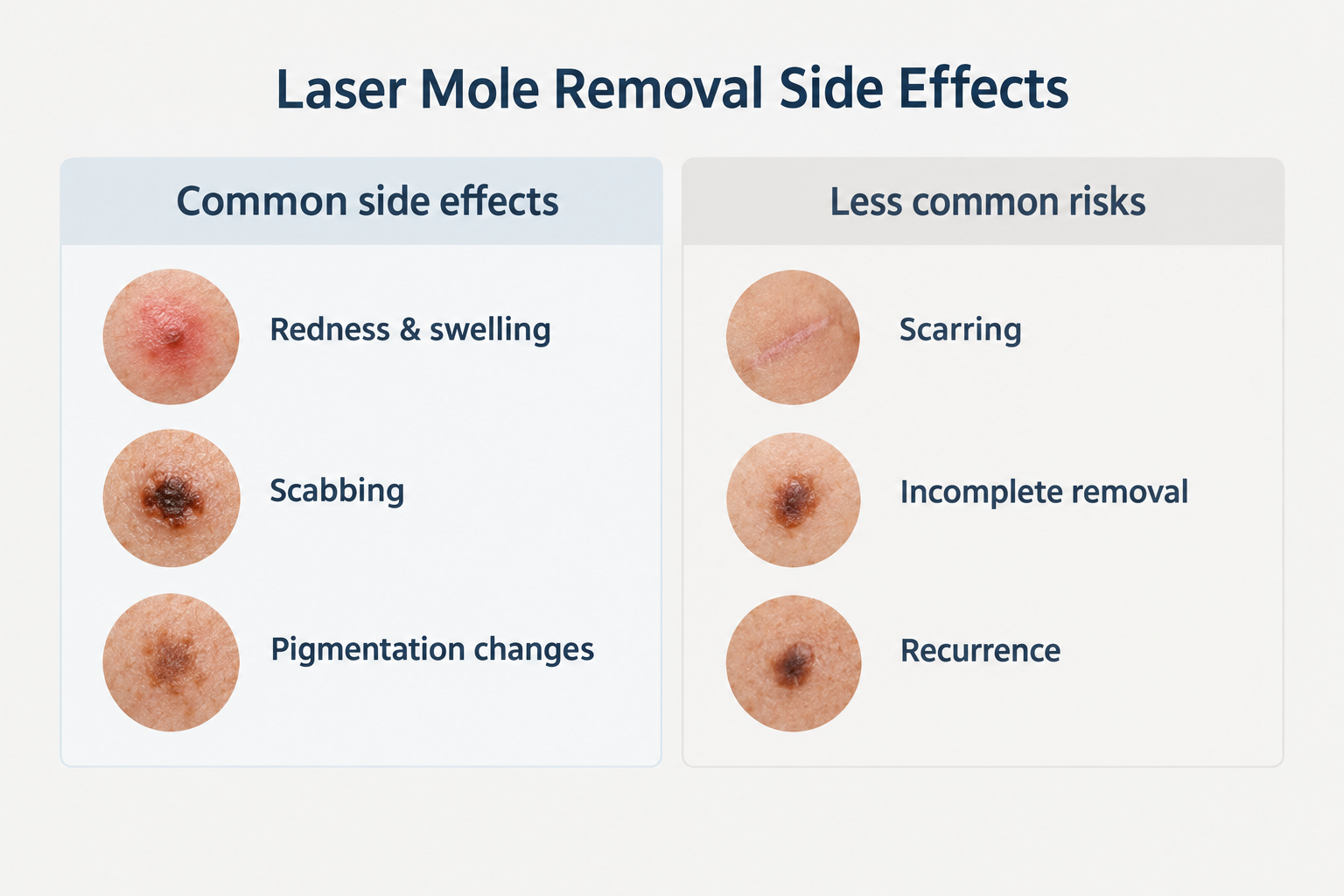
Common side effects include temporary redness, swelling, tenderness, and the formation of a small scab or crust at the treatment site. These are expected parts of the healing process and typically resolve within one to three weeks. Temporary changes in skin pigmentation are also relatively common. Post-inflammatory hyperpigmentation, where the treated area becomes darker than the surrounding skin, is more likely in individuals with darker skin tones or those who have had significant sun exposure. Hypopigmentation, where the treated area becomes lighter, can also occur and may be more persistent.
Scarring is a less common but possible outcome, particularly if the mole is deep, if the laser settings are not appropriate for the patient’s skin type, or if the treated area becomes infected or is subjected to trauma during healing. Incomplete removal is another consideration; some moles, particularly those with deeper roots, may not be fully eliminated in a single session and may require additional treatments. There is also a small risk of mole recurrence after laser treatment.
The most clinically significant risk, as discussed earlier, is the possibility of treating a mole that has not been adequately assessed. Patients should ensure that any clinic offering laser mole removal has a clear protocol for pre-treatment assessment and that the practitioner performing the assessment is qualified to evaluate skin lesions.
How Many Sessions May Be Needed?
The number of laser sessions required to remove a mole depends on several factors, including the mole’s size, colour, depth, and the type of laser used. Superficial, flat, lightly pigmented moles may respond well to a single treatment session. Raised, darker, or deeper moles are more likely to require two or more sessions to achieve satisfactory clearance.
Practitioners will typically reassess the treated area at a follow-up appointment, usually four to eight weeks after the initial session, to evaluate the response and determine whether further treatment is needed. Patients should be aware that results are not always predictable, and complete removal cannot be guaranteed in every case. Managing expectations before treatment begins is an important part of the consultation process.
Alternatives to Laser Mole Removal
Laser treatment is one of several options for mole removal, and it is not always the most appropriate choice. Understanding the alternatives helps patients make an informed decision in consultation with a qualified practitioner.
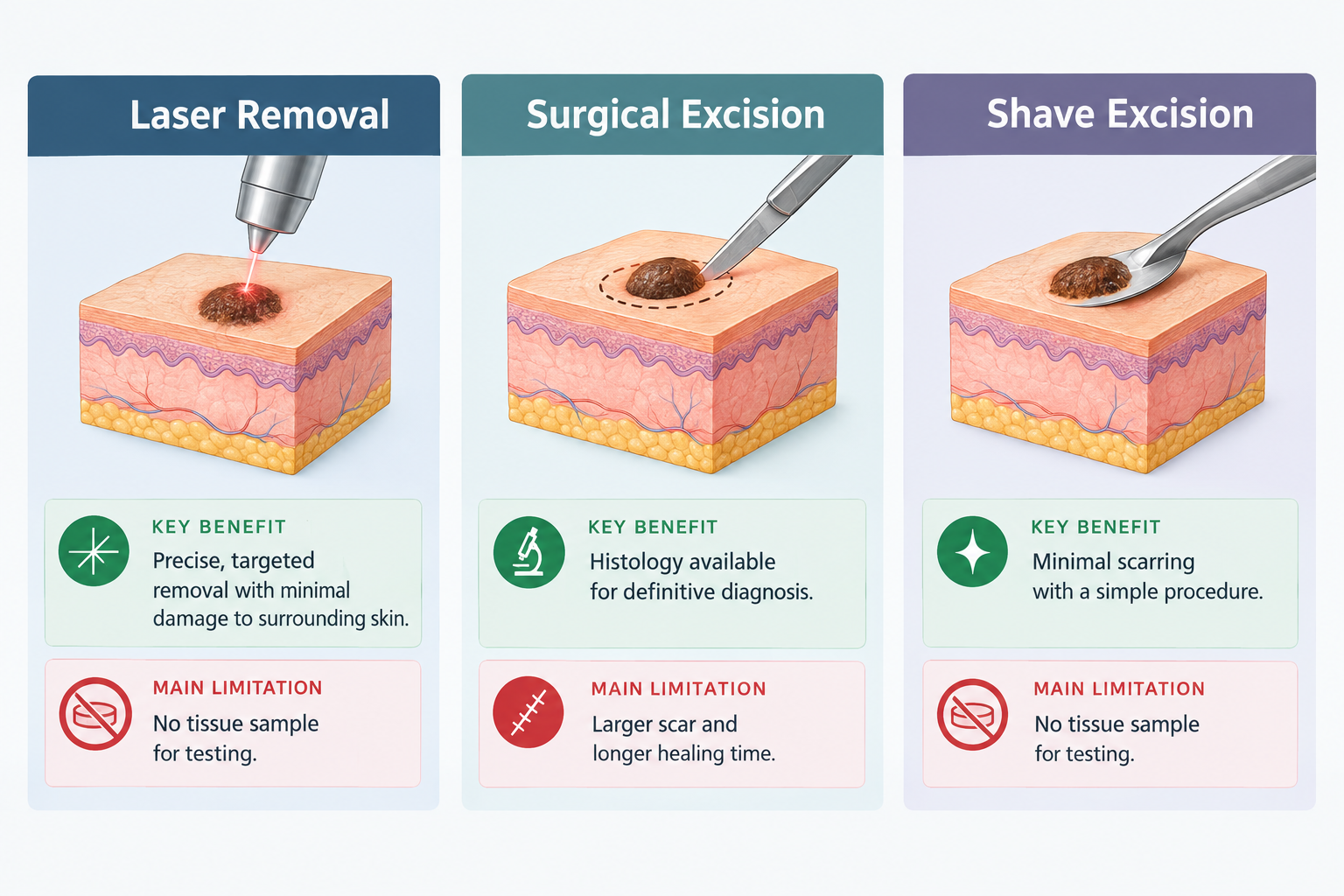
Surgical excision involves cutting out the mole and a small margin of surrounding tissue, then closing the wound with sutures. This method produces a tissue sample that can be sent for histological analysis, which is a significant advantage when there is any uncertainty about a mole’s nature. Surgical excision is generally considered the gold standard for moles that require pathological examination. It does leave a small scar, though skilled surgeons can minimise this.
Shave excision is a technique in which the mole is shaved flush with the skin surface using a surgical blade. It is suitable for raised moles and also produces a tissue sample for analysis. The resulting mark is usually minimal, though the mole may recur if any cells remain below the shave level.
Cryotherapy uses liquid nitrogen to freeze and destroy mole tissue. It is a relatively quick procedure but does not produce a tissue sample, and results can be less predictable than surgical methods. It is more commonly used for other types of benign skin lesions such as seborrhoeic keratoses and warts.
The choice between these options should be guided by the mole’s clinical characteristics, the patient’s medical history, the desired cosmetic outcome, and whether histological analysis is considered necessary. A qualified practitioner can help determine which approach is most appropriate for an individual patient’s circumstances.
Choosing a Safe and Qualified Provider
The safety of laser mole removal is closely linked to the qualifications and experience of the practitioner performing the procedure. Patients should look for a provider who has formal training in dermatology or aesthetic medicine, experience with laser treatments, and a clear protocol for pre-treatment skin assessment including dermoscopy.
A reputable provider will not offer laser mole removal without first conducting a thorough clinical assessment of the lesion. They should be willing to refer patients to a dermatologist or recommend surgical excision if there is any doubt about a mole’s nature. Clinics that offer rapid, assessment-free mole removal should be approached with caution.
Patients should also ask about the specific laser technology being used, the practitioner’s experience with that device, and what aftercare support is provided. A clear explanation of realistic outcomes, possible side effects, and the number of sessions that may be needed is a sign of a responsible and transparent provider.
Frequently Asked Questions
Can laser mole removal cause cancer?
Laser mole removal does not cause cancer. However, the main concern is that laser treatment on an undiagnosed malignant lesion could destroy tissue that would otherwise have been available for pathological analysis, potentially delaying a cancer diagnosis. This is why pre-treatment assessment is essential and why any mole with suspicious features should not be treated with a laser without prior dermatological evaluation.
Does laser mole removal leave a scar?
Scarring is possible but is generally less likely with laser removal than with some surgical methods when the procedure is performed correctly on suitable lesions. The risk of scarring increases with deeper moles, incorrect laser settings, infection during healing, or picking at the treated area. Most patients experience only minor, temporary skin changes that resolve as the skin heals.
Is laser mole removal painful?
Most patients describe the sensation during laser mole removal as mild to moderate discomfort, often compared to the snap of a rubber band against the skin. Topical anaesthetic cream is commonly applied before treatment to reduce discomfort. Pain tolerance varies between individuals, and the practitioner can adjust the approach if needed.
How long does it take for the skin to heal after laser mole removal?
The initial healing phase, during which a small scab forms and sheds, typically takes one to three weeks. The skin may continue to remodel and improve in appearance for several weeks to months after that. Sun protection during the healing period is important to reduce the risk of pigmentation changes.
Can all moles be removed with a laser?
Not all moles are suitable for laser removal. Deep moles, moles with atypical features, and any lesion that has not been confirmed as benign are generally not appropriate candidates for laser treatment. A clinical assessment is required to determine whether laser removal is suitable for a specific mole.
Will the mole grow back after laser removal?
Mole recurrence after laser treatment is possible, particularly if the mole has deeper components that were not fully addressed during treatment. Surgical excision with clear margins is less likely to result in recurrence because the entire lesion is physically removed. If a mole reappears after laser treatment, it should be reassessed clinically before any further treatment is considered.
Making an Informed Decision About Laser Mole Removal
Laser mole removal can be a safe and effective option for removing confirmed benign moles with relatively low downtime and a good cosmetic outcome for suitable patients. The procedure is not appropriate for every mole, and its safety depends fundamentally on thorough pre-treatment assessment by a qualified practitioner who can confidently exclude atypical or malignant features before any laser energy is applied.
Patients considering laser mole removal should prioritise finding a provider with genuine expertise in skin lesion assessment, not just laser operation. If a mole has changed recently, has irregular features, or has not been evaluated by a qualified clinician, surgical excision with histological analysis is the safer and more diagnostically informative choice. For moles that have been properly assessed and confirmed as benign, laser removal may offer a practical and cosmetically appealing solution, provided expectations are realistic and aftercare is followed carefully.
A consultation with a qualified dermatologist or aesthetic medicine practitioner is the appropriate first step for anyone considering mole removal, regardless of the method being considered.


