Laser Hair Removal on Tanned Skin: Risks, Timing and What You Need to Know
Laser hair removal and a fresh tan are a combination that most clinicians actively discourage, and for good clinical reasons. Whether your colour comes from a beach holiday, a tanning bed, or a bottle of self-tanner, the presence of extra melanin in the skin changes how laser energy behaves — and not in a way that benefits you. This guide explains the science behind that risk, how different types of tan affect your safety, which laser technologies handle pigmented skin more tolerably, and how to plan your treatment sessions around your lifestyle so you get the best possible results without compromising your skin.
Key Takeaways
- Laser hair removal on tanned skin carries a meaningfully higher risk of burns, post-inflammatory hyperpigmentation, and hypopigmentation because the laser cannot reliably distinguish between melanin in the skin surface and melanin inside the hair follicle.
- The type of tan matters: a sunburn is an absolute contraindication, a deep solarium tan carries the highest risk, a light natural tan requires careful assessment, and a self-tanner requires removal but does not alter the skin’s actual pigment level.
- Waiting for the tan to fade — typically two to six weeks depending on depth and laser type — significantly reduces complication risk and improves treatment efficacy.
- The Nd:YAG 1064 nm laser is generally considered the safest option for darker or temporarily tanned skin because its longer wavelength bypasses much of the epidermal melanin and targets the hair follicle more selectively.
- A patch test before a full session on recently tanned skin is an important safety step that responsible clinics should always offer.
Why Tanning Changes the Way Laser Hair Removal Works
Laser hair removal works on a principle called selective photothermolysis. The laser emits a specific wavelength of light that is preferentially absorbed by melanin — the pigment found inside the hair follicle — generating heat that damages the follicle and inhibits future hair growth. The key word is selective: the laser is designed to target the melanin in the follicle while leaving the surrounding skin largely unaffected.
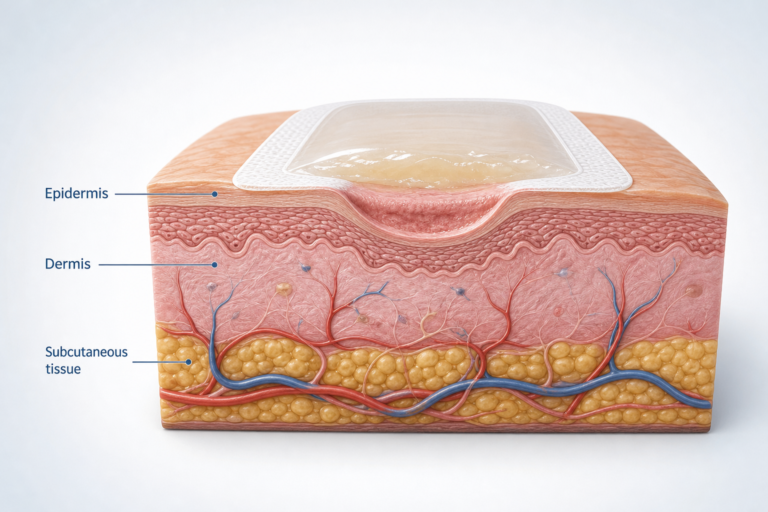
When the skin is tanned, the epidermis — the outermost skin layer — contains significantly elevated levels of melanin. This epidermal melanin acts as a competing chromophore, meaning it absorbs laser energy that was intended for the hair follicle. This creates two simultaneous problems. First, the laser energy is partially diverted away from the follicle, reducing hair follicle destruction and making the treatment less effective. Second, the energy absorbed by the skin surface generates heat in the epidermis itself, raising the risk of burns, blistering, and lasting pigment changes.
This phenomenon is sometimes called melanin competition or off-target absorption, and it is the central reason why tanned skin and laser hair removal are a poor combination. The laser cannot reliably distinguish between the melanin sitting in your epidermis from sun exposure and the melanin inside the hair follicle it is trying to destroy. The more epidermal melanin is present, the greater the risk of the laser causing unintended thermal damage to the skin surface.
What Are the Real Risks?
The risks of performing laser hair removal on tanned skin are not theoretical. They are well-documented in clinical literature and represent genuine, sometimes lasting, harm to the skin.
- Burns and blistering: Excessive heat absorption by epidermal melanin can cause superficial or, in more severe cases, deeper thermal burns. Blistering is a recognised complication, particularly when high fluence settings are used on skin that has been recently tanned.
- Post-inflammatory hyperpigmentation (PIH): This is one of the most common complications. PIH occurs when the skin responds to laser-induced inflammation by producing excess melanin, leaving dark patches or spots at the treatment site. It can persist for months and, in some cases, longer.
- Hypopigmentation: The opposite of PIH, hypopigmentation refers to the loss of pigment in treated areas, resulting in light or white patches. This can occur when the laser destroys melanocytes — the cells responsible for producing melanin — in the epidermis. Hypopigmentation can be particularly difficult to treat and may be permanent in some cases.
- Scarring: Severe thermal injury can lead to scarring, though this is less common when treatments are performed by trained practitioners using appropriate settings.
- Reduced treatment efficacy: Because laser energy is diverted to epidermal melanin rather than the hair follicle, the follicle may not receive sufficient heat to be permanently disabled. This means the session may produce less hair reduction than expected, effectively wasting a treatment in your course.
The severity of these risks depends on several factors: how dark the tan is, which laser is used, what fluence (energy level) is applied, and the individual’s baseline Fitzpatrick skin type. A clinician who adjusts laser settings downward to compensate for a tan may reduce the burn risk, but this typically comes at the cost of treatment efficacy — a trade-off that rarely benefits the patient.
Not All Tans Carry the Same Risk
Understanding the type of tan you have is clinically important, because different sources of skin darkening carry different levels of risk and require different waiting periods before laser treatment can safely proceed.
| Type of Tan | Effect on Skin Melanin | Risk Level | Recommended Wait Before Treatment |
|---|---|---|---|
| Sunburn | Active skin inflammation; compromised barrier | Absolute contraindication — do not treat | Until fully healed, minimum 4–6 weeks |
| Deep solarium / tanning bed tan | High epidermal melanin elevation; UV-A dominant | Very high | 4–6 weeks minimum |
| Deep natural sun tan | Significant epidermal melanin elevation | High | 4–6 weeks |
| Light natural sun tan | Moderate epidermal melanin elevation | Moderate — requires clinical assessment | 2–4 weeks, depending on laser type |
| Self-tanner / spray tan / gradual tanning cream | Surface colour only; does not alter true melanin levels | Low (if fully removed before treatment) | Remove product thoroughly 1–2 weeks before; confirm with clinician |
| Melanotan (injectable tanning peptide) | Stimulates systemic melanin production; elevated baseline | High — emerging safety concern | Discuss with clinician; no established safe interval |
A sunburn is an absolute contraindication to laser hair removal. Sunburned skin is actively inflamed, the epidermal barrier is compromised, and applying laser energy to it significantly increases the risk of severe burns and lasting pigment damage. No responsible clinic should treat sunburned skin under any circumstances.
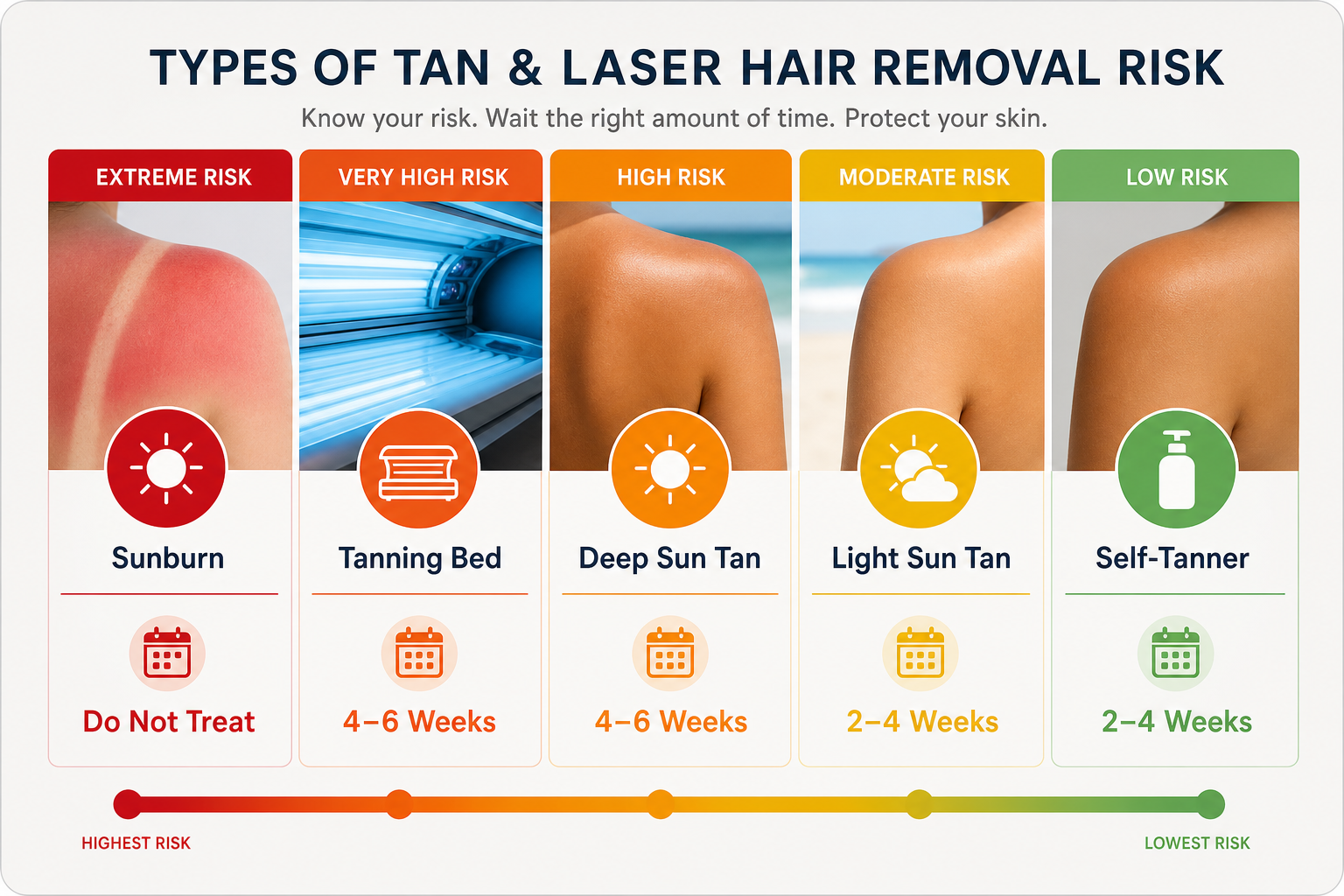
Tanning bed or solarium tans deserve particular caution. UV-A radiation from tanning beds penetrates more deeply into the skin than natural sunlight and can produce a dense, persistent tan that takes longer to fade. The elevated epidermal melanin from solarium use creates a high risk of off-target absorption during laser treatment.
Self-tanners and spray tans work differently. These products contain dihydroxyacetone (DHA), a chemical that reacts with proteins in the outermost skin layer to produce a temporary brown colour. Crucially, self-tanners do not stimulate melanin production and do not alter the skin’s true pigment level. If the product is thoroughly removed before a laser session, the underlying skin melanin level should be unchanged. However, any residual product on the skin surface can still absorb laser energy unpredictably, so complete removal and a clinician assessment are essential.
Melanotan — an injectable peptide sometimes used to stimulate tanning — is an emerging concern that very few clinics currently address in their protocols. Melanotan II works by stimulating melanocyte activity systemically, elevating melanin production throughout the skin. This creates a baseline melanin elevation that may persist well beyond the visible tan and significantly increases the risk of post-inflammatory hyperpigmentation during laser treatment. If you have used Melanotan, you should disclose this to your clinician before any laser session.
Naturally Dark Skin vs. Temporarily Tanned Skin: An Important Distinction
A clinically important distinction that is often overlooked is the difference between someone with a naturally deeper skin tone and someone with a lighter baseline skin tone who has acquired a temporary tan. These two situations are not equivalent, even if the skin appears a similar shade at the time of treatment.
The Fitzpatrick skin type scale classifies skin from Type I (very fair, always burns) through to Type VI (deeply pigmented, never burns). A person with a Fitzpatrick Type IV or V baseline has a naturally higher melanin level that an experienced clinician can account for by selecting an appropriate laser and adjusting settings accordingly. A person with a Fitzpatrick Type II baseline who has developed a deep tan has temporarily elevated their epidermal melanin beyond what their skin is accustomed to managing, and the laser settings that would normally be safe for their skin type may now be inappropriate.
This distinction matters because it affects both laser selection and parameter adjustment. A clinician experienced in treating diverse skin tones will assess your natural skin tone — not just your current colour — and make decisions based on your baseline Fitzpatrick classification alongside the degree of any temporary tan.
Which Laser Is Safest for Tanned or Darker Skin?
Not all laser systems carry the same risk when treating tanned or naturally darker skin. The key variable is wavelength: longer wavelengths penetrate more deeply into the skin and are less strongly absorbed by epidermal melanin, making them inherently safer for pigmented skin types.
| Laser Type | Wavelength | Best Fitzpatrick Range | Suitability for Tanned Skin |
|---|---|---|---|
| Alexandrite | 755 nm | I–III | Poor — high epidermal melanin absorption; significant risk on tanned skin |
| Diode | 810 nm | I–V (with care) | Moderate — intermediate absorption; suitable for mild tans with adjusted settings |
| Nd:YAG | 1064 nm | III–VI | Best — lowest epidermal melanin absorption; preferred for tanned and darker skin |
| IPL (Intense Pulsed Light) | Multiple wavelengths | I–III | Poor — broad spectrum increases off-target absorption risk on tanned skin |
The Nd:YAG 1064 nm laser is widely regarded as the safest option for tanned or naturally darker skin. Its longer wavelength means it is less readily absorbed by epidermal melanin and penetrates more deeply to reach the hair follicle. This reduces the risk of surface burns and pigment changes while still achieving meaningful hair follicle destruction. Many clinics use the Nd:YAG as their primary device for Fitzpatrick Types IV through VI and for patients who present with a moderate tan.
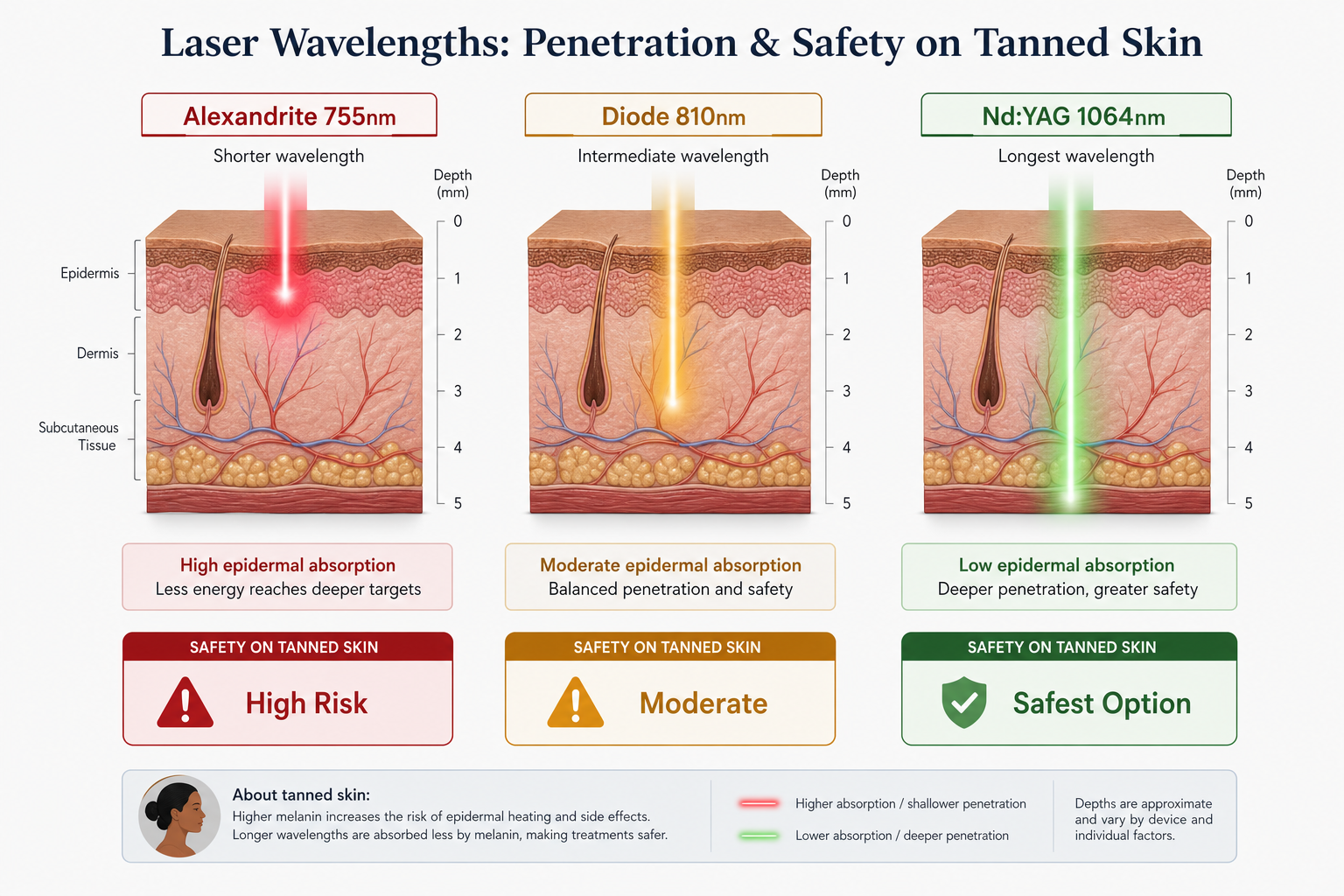
The alexandrite laser at 755 nm has a shorter wavelength that is strongly absorbed by melanin, making it highly effective for fair skin with dark hair but significantly riskier on tanned or darker skin. IPL devices emit multiple wavelengths simultaneously and offer even less selectivity, making them generally unsuitable for tanned skin.
Epidermal cooling technology — including contact cooling plates, cryogen spray systems, and chilled gel — plays a supporting role in protecting the skin surface during laser treatment. By lowering the temperature of the epidermis immediately before and during the laser pulse, cooling systems help reduce the thermal impact on the skin surface. However, epidermal cooling is a risk-mitigation tool, not a solution that makes laser treatment on a fresh tan safe. It reduces but does not eliminate the risk of surface damage when epidermal melanin is elevated.
How Long Should You Wait Before Your Next Session?
The standard clinical guidance is to wait for the tan to fade before proceeding with laser hair removal. In practice, this means allowing the elevated epidermal melanin from sun exposure to return to your natural baseline level. The time required depends on how deep the tan is and how quickly your skin naturally turns over.
For a light tan from incidental sun exposure, a waiting period of two to four weeks is often sufficient, particularly if the Nd:YAG laser is being used and a patch test confirms the skin is responding safely. For a deeper tan from prolonged sun exposure or tanning bed use, four to six weeks is a more appropriate minimum. A sunburn requires full healing before any assessment can take place, which typically means at least four to six weeks and sometimes longer depending on severity.
During the waiting period, consistent use of a broad-spectrum SPF 30 or higher sunscreen will help prevent further tanning and support the skin’s return to its natural tone. Avoiding further UV exposure — including tanning beds — is essential during this time.
Planning Your Laser Sessions Around Sun Exposure: A Practical Approach
For people who spend time outdoors in summer or take regular holidays, planning a laser hair removal course requires some forward thinking. A typical course involves six to eight sessions spaced four to eight weeks apart, meaning the full course spans several months. Scheduling this strategically can help you avoid the conflict between tanning and treatment.
Starting a laser course in autumn or early winter is often the most practical approach for people who tan in summer. Sessions can be completed through the cooler months when sun exposure is lower, and the skin is more likely to remain at its natural baseline tone. By the time summer arrives, the course may be complete or near completion, and the skin will have had time to recover fully.
If you are mid-course when a holiday or period of sun exposure occurs, communicate with your clinic in advance. It is generally better to postpone a session by a few weeks than to treat tanned skin and risk a complication that could set back your results or cause lasting skin damage. Most clinics would rather reschedule than treat skin that is not ready.
After each laser session, sun avoidance is equally important. Treated skin is temporarily more sensitive to UV radiation, and sun exposure in the two to four weeks following a session increases the risk of post-inflammatory hyperpigmentation. Applying a broad-spectrum SPF — ideally a mineral formulation containing zinc oxide or titanium dioxide, which are less likely to irritate post-laser skin than some chemical UV filters — is strongly recommended during this recovery window.
What to Do If You Already Had Treatment on Tanned Skin
If you have already undergone a laser session on tanned skin and are experiencing redness, darkening, or light patches, the appropriate response depends on the severity of the reaction. Mild redness and temporary darkening in the days immediately following treatment are relatively common and often resolve on their own with careful sun protection and gentle skincare.
If you notice persistent dark patches consistent with post-inflammatory hyperpigmentation, a dermatologist or experienced clinician can assess the extent of the pigment change and discuss management options. These may include topical agents such as azelaic acid, kojic acid, or niacinamide, alongside strict sun protection to prevent further darkening. More significant PIH may be addressed with targeted treatments, though response varies between individuals and timelines can be lengthy.
Hypopigmentation — the development of light or white patches — is more concerning and warrants prompt assessment by a dermatologist. Some cases of hypopigmentation resolve partially over time, but others may be persistent. Early professional evaluation is important.
If you experienced a burn or blister, keep the area clean, avoid picking or breaking blisters, and seek medical advice promptly. Do not proceed with further laser sessions until the skin has fully healed and a qualified clinician has assessed the cause of the reaction.
Pre-Treatment Preparation: What You Should Do Before a Session
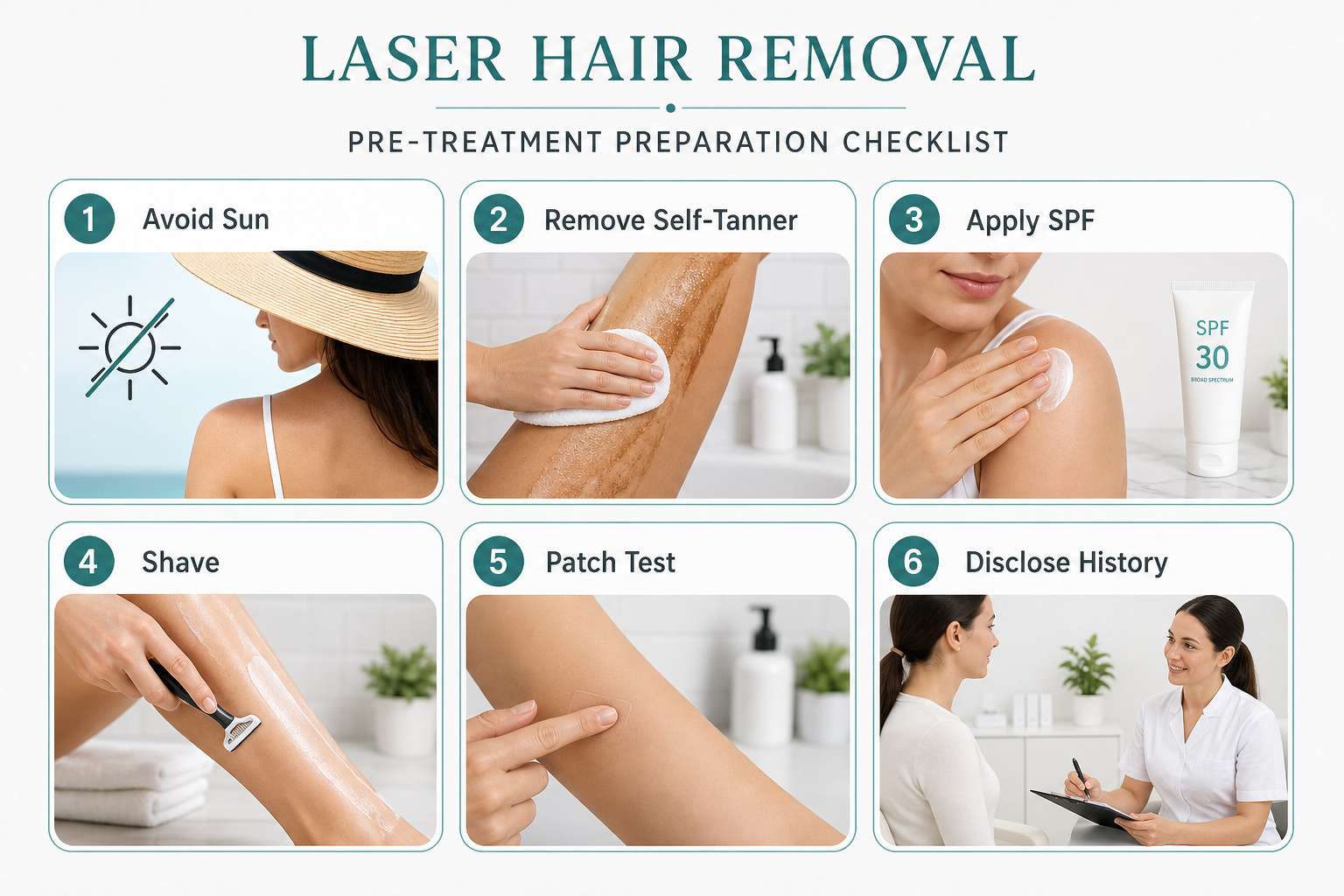
Responsible preparation before a laser hair removal session reduces risk and improves outcomes, particularly for anyone who has had recent sun exposure.
- Avoid sun exposure and tanning beds for at least four weeks before your session. If you have been on holiday or spent significant time outdoors, inform your clinic and allow additional time for the tan to fade.
- Remove all self-tanner products thoroughly in the week before your appointment. Residual DHA on the skin surface can interfere with laser energy delivery.
- Apply broad-spectrum SPF daily in the weeks leading up to your session to prevent further tanning and support your skin returning to its natural tone.
- Shave the treatment area one to two days before your session as directed by your clinic. Do not wax, thread, or use depilatory creams, as these remove the hair root that the laser needs to target.
- Attend a patch test if your clinician recommends one, particularly if your skin tone has changed since your last session or if you are starting a new course. A patch test on a small area allows the clinician to assess your skin’s response to the laser settings before treating a larger area.
- Disclose all relevant information to your clinician, including any recent sun exposure, tanning bed use, self-tanner use, Melanotan use, new medications (particularly photosensitising drugs), or changes to your skin.
Questions to Ask Your Clinic Before Treatment
Choosing a clinic with robust protocols for assessing tanned skin is as important as the laser technology they use. Before committing to a session, consider asking the following:
- Which laser system do you use, and is it appropriate for my current skin tone?
- Do you perform a patch test before treating skin that has recently been tanned?
- How do you assess whether my skin has returned to its natural baseline before proceeding?
- What is your protocol if I arrive for a session with a tan that was not there at my last appointment?
- What aftercare do you recommend to minimise the risk of pigment changes?
- What should I do if I experience a reaction after treatment?
A clinic that answers these questions clearly and confidently, and that is willing to postpone a session rather than treat skin that is not ready, is demonstrating the kind of clinical judgement that protects your safety and your results.
Frequently Asked Questions
Can I get laser hair removal if I have a slight tan?
A very light tan may be manageable depending on the laser type, your natural skin tone, and the clinician’s assessment. The Nd:YAG 1064 nm laser offers more tolerance for mild pigmentation than shorter-wavelength devices. However, even a light tan increases risk compared to untanned skin, and a patch test is advisable. Your clinician should assess your skin in person before proceeding.
Is self-tanner safe before laser hair removal?
Self-tanner does not alter your skin’s actual melanin level, so it does not carry the same biological risk as a real tan. However, any residual product on the skin surface can absorb laser energy unpredictably. Remove all self-tanning products thoroughly at least one to two weeks before your session and confirm with your clinician that the skin surface is clear before treatment.
How long after laser hair removal can I tan?
Most clinicians recommend avoiding sun exposure and tanning beds for at least two to four weeks after each laser session. Treated skin is temporarily more sensitive to UV radiation, and early sun exposure significantly increases the risk of post-inflammatory hyperpigmentation. Use a broad-spectrum SPF consistently during this period.
What sunscreen should I use after laser hair removal?
A broad-spectrum SPF 30 or higher is the minimum recommendation. After laser treatment, mineral sunscreens containing zinc oxide or titanium dioxide are often better tolerated than chemical UV filters, which can occasionally cause irritation on recently treated skin. Apply generously and reapply every two hours when outdoors.
Does a tan make laser hair removal less effective?
Yes. When epidermal melanin is elevated by tanning, laser energy that should reach the hair follicle is partially absorbed by the skin surface instead. This means the follicle receives less heat than needed for effective hair follicle destruction, potentially resulting in incomplete treatment and more regrowth than expected. Treating tanned skin may effectively waste a session in your course.
Can tanning beds cause the same problems as sun tanning before laser?
Yes, and in some respects tanning bed use carries a higher risk. UV-A radiation from tanning beds penetrates more deeply into the skin and can produce a denser, more persistent tan than equivalent time in natural sunlight. The elevated epidermal melanin from solarium use creates a significant risk of off-target absorption during laser treatment. Tanning beds should be avoided for at least four to six weeks before any laser session.
What is a patch test and why does it matter for tanned skin?
A patch test involves applying the laser to a small, discreet area of skin using the intended treatment settings, then observing the skin’s response over 24 to 48 hours before proceeding with a full session. For tanned skin, a patch test is a particularly important safety step because it allows the clinician to assess whether the current melanin level creates an unacceptable risk of burns or pigment changes at the planned fluence. A responsible clinic will offer a patch test whenever there is meaningful uncertainty about skin readiness.
Planning Laser Hair Removal Safely Around Your Skin and Lifestyle
Laser hair removal is a well-established and effective treatment for long-term hair reduction, but its safety and effectiveness depend heavily on the condition of the skin at the time of each session. Tanned skin — whether from the sun, a tanning bed, or injectable tanning peptides — introduces a genuine clinical risk that no amount of technology or technique can fully eliminate. The most reliable way to protect yourself is to allow your skin to return to its natural skin tone before each session, use consistent sun protection throughout your treatment course, and work with a clinic that takes these protocols seriously.
If you are planning a course of laser hair removal and you spend time outdoors or holiday in sunny climates, discuss your schedule openly with your clinician from the outset. A well-planned treatment calendar that accounts for your lifestyle will deliver better results and a safer experience than trying to fit sessions around a tan. A qualified practitioner can assess your Fitzpatrick skin type, recommend the most appropriate laser for your skin, and advise on the timing that gives you the best chance of achieving the hair reduction you are looking for without compromising your skin’s health.