Natural Lip Filler Before and After: What Realistic Results Actually Look Like
Natural lip filler before and after results can look remarkably different depending on the injector’s technique, the amount of product used, and the individual anatomy of the patient. When done well, the change is noticeable but not obvious — fuller, more defined lips that still move naturally and suit the rest of the face. This guide explains what realistic natural results look like, how they are achieved, what to expect during recovery, and how to evaluate whether the outcome you want is achievable for your lip type.
Key Takeaways
- Natural-looking lip filler results depend on conservative dosing, appropriate technique, and a thorough understanding of facial proportions — not just the amount of product injected.
- Hyaluronic acid filler is the standard choice for lip augmentation because it integrates softly with tissue and can be dissolved if needed.
- Swelling peaks within 24–48 hours and typically resolves by the two-week mark, when final results become visible.
- Starting with 0.5ml rather than 1ml is often recommended for first-time patients seeking subtle enhancement.
- Choosing a skilled injector with a strong before-and-after gallery is one of the most important factors in achieving a natural outcome.
What Natural Lip Filler Results Actually Look Like
The phrase “natural-looking results” is used frequently in aesthetic medicine, but it has a specific meaning in the context of lip augmentation. A natural result does not mean invisible — it means the lips look like a polished, slightly enhanced version of the patient’s own lips. The shape is recognisably theirs. The movement is soft and unaffected. The proportions suit the face rather than dominating it.
In practical terms, a well-executed natural result typically shows improved definition along the vermillion border — the edge where the lip meets the surrounding skin — and a more pronounced cupid’s bow on the upper lip. The lips appear fuller but not stretched. The philtrum columns, the two ridges running from the nose to the upper lip, remain visible and defined. The upper and lower lip ratio stays balanced, with the lower lip generally slightly fuller than the upper, which is consistent with natural lip anatomy.
What natural results do not look like is equally important to understand. An overfilled or overdone look typically involves an upper lip that is larger than the lower, loss of the natural cupid’s bow shape, a visible ridge or shelf at the vermillion border caused by filler migration, and lips that appear stiff or fail to move expressively. These outcomes are associated with excessive volume, poor technique, or repeated treatments without adequate assessment between sessions.
How Results Differ by Lip Type
Before-and-after results vary considerably depending on the patient’s starting anatomy, and understanding this helps set realistic expectations.
Thin Lips
Patients with naturally thin lips often see the most visible change from a conservative treatment. A 0.5ml hyaluronic acid filler treatment can add meaningful volume and border definition without creating an unnatural appearance. The goal is usually to bring the lips into better proportion with the rest of the face rather than to create dramatic fullness.
Asymmetric Lips
Mild lip asymmetry is extremely common. Skilled injectors can use targeted filler placement to improve lip symmetry and balance, adding slightly more volume to the flatter or thinner side. The result is a more even appearance that still looks natural because it works with the patient’s existing structure rather than imposing a uniform shape.
Mature Lips with Volume Loss
As the face ages, the lips lose volume, the vermillion border becomes less defined, and vertical lip lines — sometimes called perioral lines or smoker’s lines — can develop. Lip filler in this context is less about augmentation and more about lip rejuvenation: restoring what was there rather than adding something new. Results in mature patients often look particularly natural because the filler is replacing lost tissue rather than creating new volume.
Lips with Undefined Borders
Some patients have adequate volume but poor border definition, meaning the edge of the lip blends softly into the surrounding skin without a clear outline. Targeted treatment along the vermillion border and cupid’s bow can create definition and lip projection without significantly increasing overall size, producing a refined result that reads as natural even at close range.
Techniques That Produce Natural-Looking Results
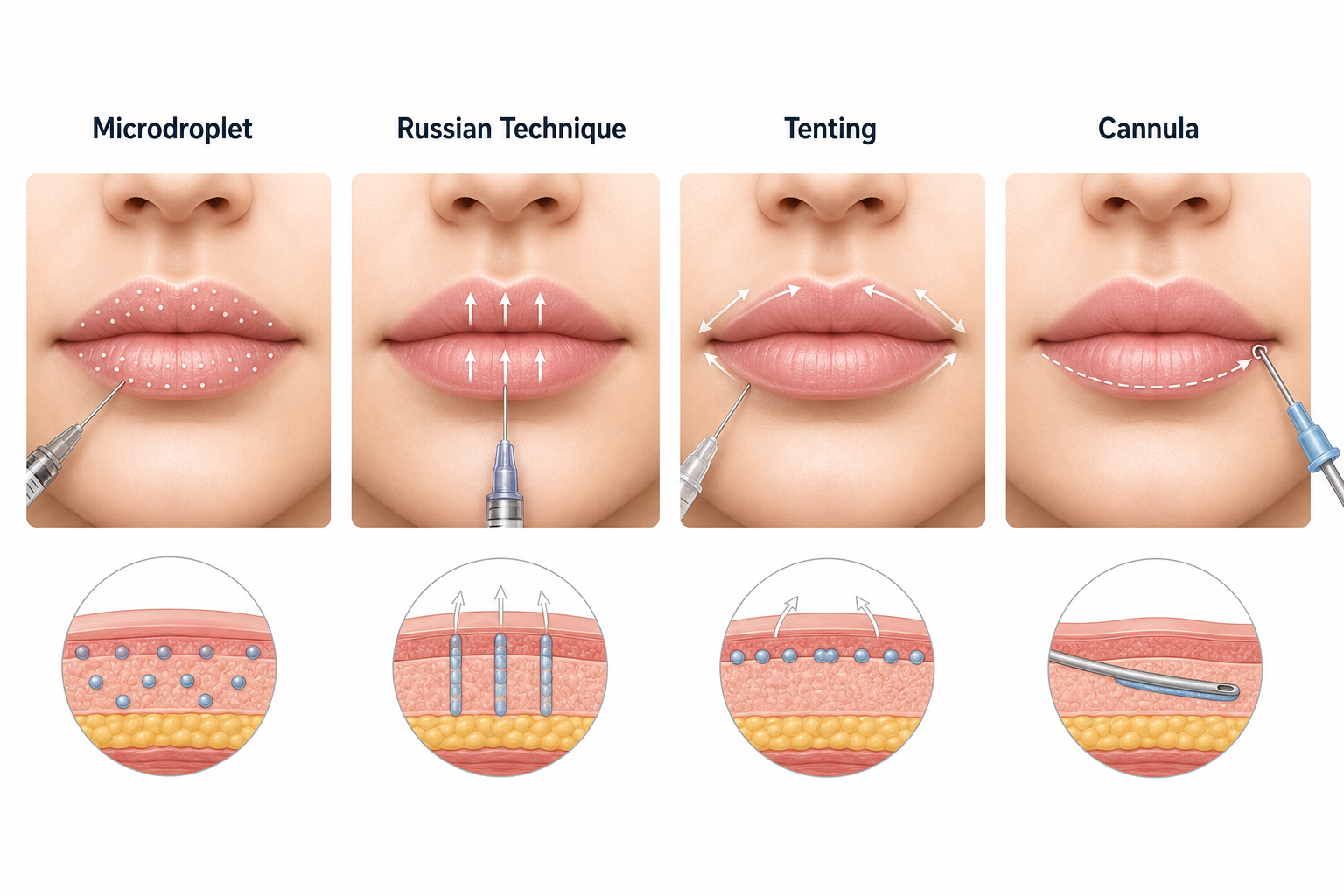
The injection technique used has a significant influence on whether lip filler results look natural. Different approaches suit different goals and lip types, and an experienced injector will often combine techniques within a single treatment.
Microdroplet Technique
The microdroplet technique involves placing very small, precise amounts of filler at multiple points across the lip. This distributes volume evenly and avoids the lumpy or uneven texture that can result from depositing larger amounts in fewer locations. It is particularly well suited to patients seeking subtle enhancement or those with thin lips where precision matters most.
Russian Lip Technique
The Russian lip technique uses vertical injections to lift and project the centre of the lip rather than simply adding horizontal volume. The result is a heart-shaped, defined appearance with a pronounced cupid’s bow and visible lip tubercle — the central fullness of the upper lip. When performed conservatively, this technique can produce a very natural-looking result with good definition and minimal lateral spread.
Tenting Technique
The tenting technique involves injecting filler along the vermillion border to lift and define the lip edge. It is particularly effective for improving border definition and cupid’s bow shape without adding significant bulk to the body of the lip.
Cannula Method
A blunt-tip cannula is a flexible, rounded-tip instrument used as an alternative to a sharp needle. Because it does not cut through tissue in the same way, the cannula method is associated with less bruising and swelling in some patients. It is often used for adding volume to the body of the lip and can allow smooth, even filler distribution.
Layering Approach
A layering approach involves building volume gradually across multiple sessions rather than adding a large amount in a single treatment. This is particularly useful for patients who want significant enhancement but want to reach that goal incrementally, allowing the tissue to adapt and the patient to assess results at each stage before proceeding further.
How Much Filler Gives a Natural Result: 0.5ml vs 1ml
| Volume | Best For | Typical Outcome | Considerations |
|---|---|---|---|
| 0.5ml (half syringe) | First-time patients, subtle enhancement, thin lips, border definition | Soft increase in volume and definition; minimal change in overall lip size | May not be sufficient for patients with significant volume loss; ideal starting point |
| 1ml (full syringe) | Patients with moderate volume loss, those building on previous treatment, more noticeable augmentation | Visible increase in fullness; more pronounced shape change | Requires careful technique to avoid overfilled appearance; better suited to experienced patients or those with larger lips |
For most first-time patients, 0.5ml is a sensible starting point. It allows the injector to assess how the tissue responds to filler, gives the patient an opportunity to see results before committing to more volume, and significantly reduces the risk of an overdone outcome. A touch-up or maintenance session can always add more product once the initial results have settled. Starting conservatively and building gradually is a widely recommended approach in aesthetic medicine.
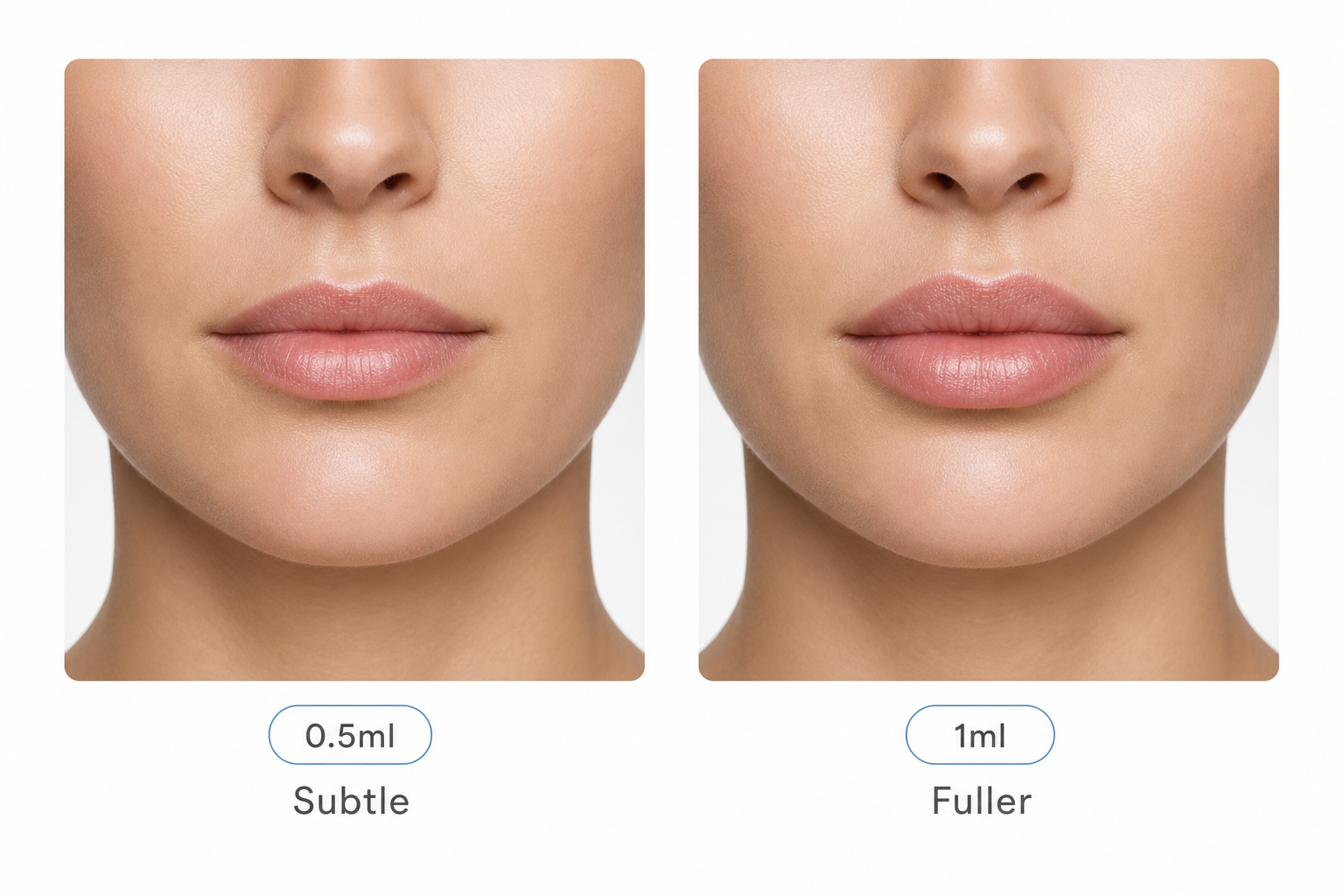
Whether 1ml is appropriate depends on the individual’s anatomy, the degree of volume loss, and the goals discussed during consultation. For patients with naturally fuller lips or those who have had previous treatments, 1ml may produce a proportionate result. For patients with very thin lips or a smaller facial structure, 1ml in a single session may create more volume than looks natural.
Filler Products Used for Natural Lip Results
Hyaluronic acid filler is the standard product used for lip augmentation. Hyaluronic acid is a substance that occurs naturally in the body, and HA-based fillers integrate with lip tissue to create a soft, flexible result. They are also reversible — if a patient is unhappy with the outcome, the filler can be dissolved using an enzyme called hyaluronidase. This reversibility is an important safety consideration and a genuine confidence-builder for first-time patients who are concerned about unnatural results.
Several HA filler products are used for lip treatments, and they differ in their gel viscosity, elasticity, and cross-linking technology — properties that affect how the product behaves in tissue. Softer, more flexible formulations such as Restylane Kysse and Restylane Silk are often preferred for lips because they move naturally with facial expression. Juvederm Ultra XC is another commonly used option. RHA (Resilient Hyaluronic Acid) formulations, including RHA 2 and RHA 3, are designed to adapt to facial movement and may be suitable for patients who prioritise a dynamic, natural feel. The choice of product should be made by the injector based on the patient’s anatomy, goals, and the specific areas being treated.
The Swelling Timeline: What to Expect Day by Day
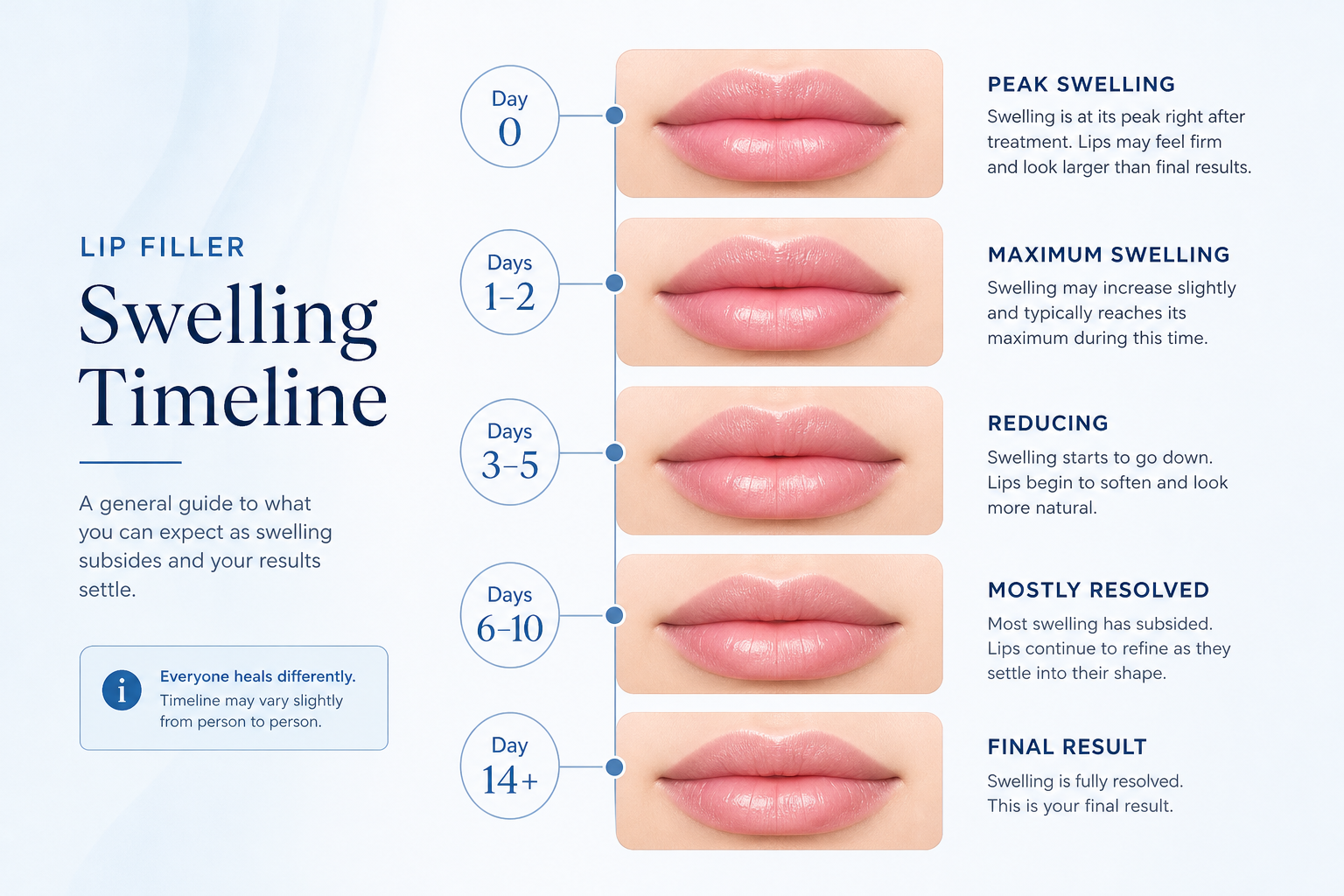
Swelling after lip filler is normal and expected, and it is one of the most common sources of anxiety for patients in the days immediately following treatment. Understanding the typical timeline helps patients interpret what they are seeing and avoid drawing conclusions about their final results too early.
| Timeframe | What to Expect |
|---|---|
| Day 0 (treatment day) | Immediate swelling and possible bruising; lips appear significantly larger than the intended result |
| Days 1–2 | Peak swelling; lips may look uneven or asymmetric; bruising may develop or worsen |
| Days 3–5 | Swelling begins to reduce; shape becomes more visible but results still not final |
| Days 6–10 | Most swelling resolved; lips begin to look closer to the intended outcome; minor lumps or firmness may still be present |
| Day 14 and beyond | Filler settling is largely complete; final results visible; any remaining minor asymmetry or firmness should be assessed at this point |
The emotional experience of the first week deserves acknowledgement. Many patients find that the swollen appearance in the first 48 hours is alarming, particularly if the lips look much larger or more uneven than expected. This is a normal part of the process and does not reflect the final result. Cold compresses, keeping the head elevated, and avoiding alcohol and strenuous exercise in the first 24–48 hours can help manage swelling. If significant bruising, pain, or asymmetry persists beyond two weeks, a follow-up appointment with the injector is appropriate.
Filler Migration: What It Is and How to Avoid It
Filler migration refers to the movement of filler product away from the intended injection site. In the lips, this most commonly appears as a blurring of the vermillion border — the product spreads into the skin above the upper lip, creating a puffy or undefined appearance sometimes described as a “shelf” or “duck lip” effect. Migration is more likely when large volumes are injected repeatedly without adequate assessment, when injection technique is imprecise, or when filler is placed too superficially.
Choosing an experienced injector who uses conservative dosing and appropriate technique is the most effective way to reduce the risk of migration. Patients who have had multiple previous treatments should discuss their history openly during consultation, as cumulative volume can increase the likelihood of migration over time. If migration has already occurred, hyaluronidase can be used to dissolve the misplaced filler before new treatment is considered.
How Facial Proportions Affect Whether Results Look Natural
Lip filler results do not exist in isolation — they are read in the context of the entire face. A volume of filler that looks natural on one patient may look excessive on another because of differences in facial structure, lip-to-face ratio, and the relationship between the lips, nose, and chin.
Clinically, the upper and lower lip ratio is an important reference point. A ratio of approximately 1:1.6 — with the lower lip slightly fuller than the upper — is generally considered proportionate and natural-looking. Treatments that reverse this ratio by overfilling the upper lip tend to produce an unnatural result regardless of the technique used. The position of the chin and the projection of the nose also influence how the lips read: a patient with a recessed chin may find that lip projection looks more prominent than intended, while a patient with a stronger chin may accommodate more volume naturally.
A thorough consultation should include an assessment of the whole face, not just the lips. Injectors who consider facial proportions and harmony — rather than simply adding volume to the lips in isolation — are more likely to produce results that look genuinely natural.
How to Evaluate a Before-and-After Gallery
Before-and-after photos are one of the most useful tools for assessing a provider’s work, but they require some critical evaluation to be genuinely informative. The following factors are worth considering when reviewing a clinic’s portfolio.
- Consistent lighting and angles: Photos taken under different lighting conditions or from different angles can make results appear more dramatic than they are. Look for galleries where before and after images are taken under comparable conditions.
- Healed results, not fresh results: Photos taken immediately after treatment show swollen lips, not final results. Look for images labelled as taken at two weeks or later, when filler settling is complete.
- Natural movement: Video content showing the patient speaking or smiling is more informative than static photos, as it demonstrates whether the lips move naturally after treatment.
- Variety of starting points: A gallery that includes patients with different lip types — thin, asymmetric, mature — demonstrates broader clinical experience than one showing only ideal candidates.
- Unedited images: Heavy filtering or editing can obscure the true result. Unedited clinical photographs are a more reliable indicator of actual outcomes.
Questions to Ask Your Injector Before Booking
A consultation is an opportunity to assess whether the injector is the right fit for your goals. The following questions can help you make an informed decision.
- What volume of filler do you recommend for my lips, and why?
- Which product do you plan to use, and what are its properties?
- What technique will you use, and how does it suit my lip anatomy?
- Can I see before-and-after photos of patients with similar lips to mine?
- What does the recovery process typically look like, and when will I see final results?
- What happens if I am unhappy with the result — can the filler be dissolved?
- How do you approach patients who want a natural result rather than a dramatic change?
How Long Do Natural Lip Filler Results Last?
Hyaluronic acid lip filler typically lasts between six and twelve months, though this varies between individuals. Factors that influence longevity include the patient’s metabolic rate, the specific product used, the volume injected, and the area of the lip treated. Patients with faster metabolisms tend to break down filler more quickly. The lips are also a high-movement area, which means filler in this location generally does not last as long as filler used in less mobile areas of the face.
Maintenance sessions — typically using 0.5ml — can extend and refresh results before the filler has fully dissolved. Some patients find that with regular maintenance, they can maintain their preferred appearance with smaller top-up volumes over time. Others prefer to allow the filler to dissolve fully between treatments. Both approaches are reasonable, and the right schedule depends on individual goals and how the patient’s tissue responds.
Who May Be Suitable — and Who Should Wait
Lip filler may be suitable for adults who are in good general health, have realistic expectations about the degree of change achievable, and have discussed their goals thoroughly with a qualified practitioner. It is commonly sought by patients who want subtle enhancement of lip shape or volume, those experiencing age-related volume loss, and those with naturally thin or asymmetric lips.
Lip filler is generally not recommended during pregnancy or breastfeeding. Patients with active infections, cold sores, or inflammatory skin conditions in or around the lips should wait until these have resolved. Certain medications — including blood thinners — may increase the risk of bruising and should be discussed during consultation. Patients with a history of severe allergic reactions or autoimmune conditions should disclose this information, as it may affect suitability or require additional precautions.
Patients who have had previous lip filler should inform their injector of the products used and the approximate timing of previous treatments, as residual filler can affect how new product integrates and how much additional volume is appropriate.
Frequently Asked Questions
Will lip filler look natural on me?
Whether lip filler looks natural depends on the volume used, the technique applied, and how well the treatment is tailored to your individual anatomy. Starting with a conservative amount — typically 0.5ml for first-time patients — and choosing an experienced injector significantly improves the likelihood of a natural outcome. A thorough consultation that includes an assessment of your facial proportions is an important first step.
How long does swelling last after lip filler?
Swelling typically peaks within 24–48 hours of treatment and resolves gradually over the following week to ten days. Most patients see results that are close to final by the two-week mark. Bruising, if it occurs, usually fades within seven to ten days. Avoiding alcohol, strenuous exercise, and heat in the first 48 hours can help manage swelling.
Is 1ml of lip filler too much for a natural result?
Not necessarily, but it depends on the individual. For patients with naturally thin lips or a smaller facial structure, 1ml in a single session may produce more volume than looks natural. For patients with moderate volume loss or those building on previous treatment, 1ml may be appropriate. Many practitioners recommend starting with 0.5ml and assessing results before adding more.
Can lip filler be reversed if I don’t like the result?
Yes. Hyaluronic acid filler can be dissolved using an enzyme called hyaluronidase. This is one of the key safety advantages of HA-based products and is an important consideration for patients who are nervous about unnatural results. Dissolving is generally effective, though it may require more than one session depending on the volume of filler present.
What is the difference between the Russian lip technique and a standard lip filler treatment?
The Russian lip technique uses vertical injections to lift and project the centre of the lip, creating a defined cupid’s bow and heart-shaped appearance. A standard treatment typically focuses on adding volume to the body of the lip. The Russian technique tends to produce a more defined, structured result with less lateral spread, which some patients find looks more natural. The best technique depends on the patient’s anatomy and goals.
How do I avoid the duck lip look?
The overdone or duck lip appearance is most commonly caused by excessive volume in the upper lip, poor technique, or filler migration. Choosing a conservative starting volume, communicating clearly with your injector about wanting a natural result, and selecting a practitioner with a strong portfolio of natural-looking outcomes are the most effective preventive measures. Reviewing before-and-after photos of the injector’s previous patients before booking is strongly recommended.
Is Natural Lip Filler Right for You?
Natural lip filler results — the kind that enhance without transforming, that look like your lips but better — are achievable for most patients when the treatment is approached thoughtfully. The key variables are realistic expectations, conservative dosing, appropriate technique, and the skill of the injector. No single factor guarantees a natural outcome on its own; all of them work together.
If you are considering lip augmentation for the first time, starting with a smaller volume and building gradually is a lower-risk path to the result you want. If you have had previous treatments and are concerned about cumulative volume or migration, a consultation that includes an honest assessment of your current lip anatomy is a sensible starting point. And if you are uncertain about any aspect of the process — the product, the technique, the recovery, or the reversibility — those are exactly the questions to raise with a qualified practitioner before committing to treatment.
A well-chosen injector with relevant experience, a transparent before-and-after gallery, and a willingness to discuss your goals in detail is the most reliable foundation for a result you will be happy with at the two-week mark and beyond.