
How to Get Rid of Milia: Safe Removal Methods Explained
Milia are small, white or yellowish cysts that sit just beneath the skin’s surface, most commonly appearing around the eyes, nose, and cheeks. Although they are harmless, many people find them cosmetically bothersome and want to remove them safely. Understanding what milia are, why they form, and which removal methods are appropriate can help you avoid the skin damage that comes from attempting to squeeze or pick them at home.
Key Takeaways
- Milia are keratin-filled cysts trapped beneath the skin and cannot be squeezed out like ordinary spots without risking scarring or infection.
- Professional extraction by a trained practitioner is the most reliable and safest removal method for established milia.
- Topical retinoids and gentle exfoliation may help prevent new milia from forming and can support clearance of superficial cysts over time.
- Several professional treatments — including lancing, electrocautery, laser, and chemical peels — may be appropriate depending on the number, location, and type of milia.
- Milia often recur, so addressing contributing factors such as heavy skincare products and sun damage is important for long-term management.
What Are Milia and Why Do They Form?
Milia (singular: milium) are benign epidermal inclusion cysts filled with keratin, a protein naturally produced by skin cells. Unlike a whitehead or comedone, milia sit beneath an intact layer of skin rather than inside a pore, which is why they feel firm and cannot be easily expressed. They are not caused by bacteria and are not a form of acne, although they are frequently mistaken for one.
Milia are classified into two broad categories. Primary milia arise spontaneously when dead skin cells become trapped in small pockets near the surface of the skin. They are common in newborns — where they typically resolve on their own within a few weeks — but also occur in adults, particularly around the eyelids and cheeks. Secondary milia develop as a result of skin trauma, such as burns, blistering conditions, dermabrasion, or prolonged use of occlusive skincare products that block normal skin cell shedding.
Several factors may increase the likelihood of developing milia in adults. These include chronic sun damage, which thickens the outer skin layer and impairs normal desquamation (the natural shedding of dead skin cells), the use of heavy creams or oil-based products around the eye area, and certain skin conditions such as rosacea or bullous pemphigoid. Genetics also appear to play a role in some individuals who develop milia repeatedly despite careful skincare habits.
Can Milia Go Away on Their Own?
In some cases, milia do resolve without treatment, particularly when they are superficial and have formed recently. Primary milia in adults may occasionally clear over several weeks to months if the contributing factors — such as a heavy moisturiser or occlusive sunscreen — are removed. However, established milia that have been present for several months are unlikely to disappear without some form of intervention, whether professional or topical.
Waiting is a reasonable approach if the milia are not causing distress and are few in number. A dermatologist or aesthetic practitioner can advise whether watchful waiting, topical treatment, or professional removal is the most appropriate course of action based on the type, location, and duration of the cysts.
What You Should Not Do: The Risks of DIY Removal
Attempting to remove milia at home by squeezing, picking, or using a needle without proper training carries meaningful risks. Because milia sit beneath an intact skin layer rather than inside an open pore, applying pressure rarely dislodges the cyst and is more likely to cause bruising, broken capillaries, post-inflammatory hyperpigmentation, or scarring — particularly in the delicate skin around the eyes.
Online tutorials that demonstrate home lancing with a sterilised needle may appear straightforward, but the depth of insertion, the angle of approach, and the technique required to extract the keratin sac intact all require clinical skill. An incomplete extraction leaves the cyst wall in place, meaning the milium is likely to reform. Infection is also a risk when instruments are not properly sterilised or when the procedure is performed in a non-clinical environment. For these reasons, professional assessment and treatment are strongly recommended for any milia that are persistent, numerous, or located close to the eye.
Professional Milia Removal Methods
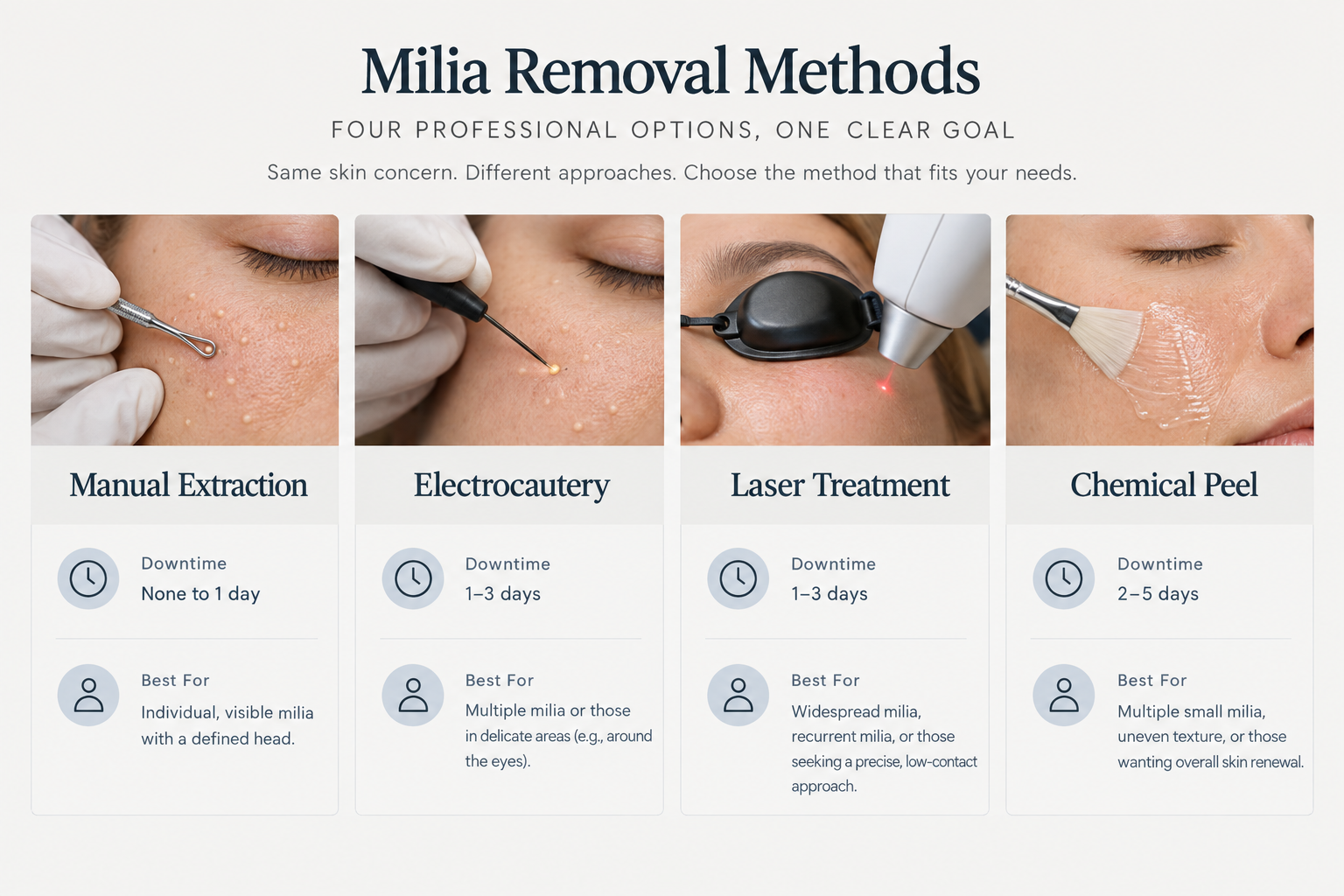
Several professional techniques are used to remove milia safely and effectively. The most appropriate method depends on the number of milia, their depth, their location on the face or body, and the patient’s skin type and medical history. A qualified practitioner — typically a dermatologist, aesthetic nurse, or trained aesthetician — will assess these factors before recommending a treatment approach.
Manual Extraction (Lancing and Expression)
Manual extraction is the most widely used professional method for milia removal. The practitioner uses a sterile lancet or fine needle to make a small incision in the skin overlying the cyst, then gently expresses the keratin contents using a comedone extractor or light manual pressure. When performed correctly, the procedure is quick, precise, and leaves minimal marking. The area may appear slightly red immediately afterwards, but this typically settles within a few hours to a day.
Manual extraction is well suited to individual or small clusters of milia on the cheeks, nose, and forehead. It requires more caution around the eyelids, where the skin is thinner and the risk of bruising is higher. Results are immediate — the milia are physically removed during the appointment — but the procedure does not prevent new milia from forming if the underlying causes are not addressed.
Electrocautery and Diathermy
Electrocautery uses a fine electrical current to heat and destroy the contents of the milia cyst. The practitioner applies a small probe to the surface of each milium, delivering a controlled burst of energy that desiccates the keratin plug and allows it to be removed or to shed naturally over the following days. Electrocautery can be effective for multiple milia treated in a single session and may be preferred when manual extraction is technically difficult due to the depth or location of the cysts.
Mild discomfort, temporary redness, and small scabs are expected after electrocautery. The scabs typically resolve within one to two weeks. There is a small risk of post-inflammatory pigmentation, particularly in individuals with darker skin tones, so this method requires careful patient selection and appropriate aftercare guidance.
Laser Treatment for Milia
Laser-based treatments, including ablative fractional lasers and carbon dioxide (CO2) lasers, can be used to vaporise milia cysts with precision. Laser treatment may be particularly useful when milia are numerous, when they are located in areas that are difficult to treat manually, or when the patient also has other skin concerns — such as fine lines or uneven skin texture — that may benefit from the same treatment session.
Laser milia removal typically involves some redness and mild swelling in the treated area, with small crusts forming over each treated site. Recovery time varies depending on the laser type and the number of milia treated, but most patients can expect the skin to settle within one to two weeks. Laser treatment carries a risk of temporary hyperpigmentation or hypopigmentation, and it is not suitable for all skin types without careful assessment. A patch test and thorough consultation are advisable before proceeding.
Chemical Peels
Chemical peels use exfoliating acids — such as glycolic acid, salicylic acid, or trichloroacetic acid (TCA) — to accelerate the shedding of the outer skin layer. By promoting cell turnover, chemical peels can help superficial milia resolve more quickly and may reduce the formation of new cysts over time. They are often used as part of a broader skin resurfacing programme rather than as a standalone milia treatment.
Superficial peels using lower concentrations of glycolic or salicylic acid carry minimal downtime and are generally well tolerated. Medium-depth peels using TCA are more effective for thickened or sun-damaged skin but require a longer recovery period and carry a greater risk of pigmentation changes. The suitability of a chemical peel for milia management depends on the patient’s skin type, the severity of the milia, and any concurrent skin conditions.
Cryotherapy
Cryotherapy involves applying liquid nitrogen to freeze and destroy the milia cyst. The treated area blisters and then heals over the following one to two weeks. Cryotherapy is less commonly used for milia than for other skin lesions such as warts or seborrhoeic keratoses, but it may be considered in specific cases. It carries a risk of hypopigmentation — a lightening of the treated skin — which can be more noticeable in individuals with darker skin tones, and this risk should be discussed thoroughly before treatment.
Topical Treatments That May Help
Topical treatments are not a rapid solution for established milia, but they can play a meaningful role in preventing new cysts from forming and in supporting the gradual resolution of superficial milia over time.
Retinoids
Topical retinoids — including prescription tretinoin and over-the-counter retinol — work by accelerating skin cell turnover and promoting the shedding of dead skin cells. This mechanism may help prevent keratin from becoming trapped beneath the skin surface and can gradually improve the appearance of superficial milia with consistent use over several weeks to months. Retinoids are generally applied in the evening and should be introduced slowly to minimise irritation, particularly around the sensitive eye area. They are not suitable during pregnancy and should be used with appropriate sun protection, as they can increase photosensitivity.
Exfoliating Acids
Alpha-hydroxy acids (AHAs) such as glycolic acid and lactic acid, and beta-hydroxy acids (BHAs) such as salicylic acid, can support normal desquamation and may reduce the likelihood of milia formation when used regularly as part of a skincare routine. These ingredients are available in a range of over-the-counter concentrations and are generally well tolerated when introduced gradually. They are not a substitute for professional removal of established milia but may complement professional treatment and help maintain results.
Reviewing Skincare Products
Heavy, occlusive moisturisers and eye creams — particularly those containing petrolatum, mineral oil, or certain waxes — may contribute to milia formation in susceptible individuals by preventing normal skin cell shedding. Switching to lighter, non-comedogenic formulations around the eye area and cheeks may reduce recurrence. A practitioner or dermatologist can help identify whether specific products in a patient’s routine may be contributing to the problem.
Sun Protection and Milia Prevention
Chronic ultraviolet (UV) exposure is a recognised contributing factor to milia in adults. UV damage thickens the stratum corneum — the outermost layer of the skin — and impairs the normal process by which dead skin cells are shed, making it easier for keratin to become trapped. Daily broad-spectrum sun protection with an SPF of 30 or higher is therefore an important part of both preventing new milia and supporting the long-term health of the skin after treatment. Choosing a sunscreen with a lightweight, non-occlusive formulation is advisable for individuals who are prone to milia.

Risks, Side Effects, and Realistic Expectations
All professional milia removal methods carry some degree of risk, and it is important to have realistic expectations before proceeding with any treatment. The most common side effects across methods include temporary redness, mild swelling, and small scabs or crusts at the treated sites. These effects are generally short-lived and resolve within days to a couple of weeks depending on the technique used.
More significant risks — including scarring, post-inflammatory hyperpigmentation, hypopigmentation, and infection — are uncommon when treatment is performed by a qualified practitioner using appropriate technique and aftercare. However, the risk profile varies between methods and between individuals. People with darker skin tones (Fitzpatrick skin types IV–VI) are at higher risk of pigmentation changes following certain treatments, particularly electrocautery, laser, and cryotherapy, and this should be discussed in detail during consultation.
Milia can recur after successful removal, particularly if the underlying contributing factors — such as sun damage, occlusive skincare products, or a tendency toward impaired desquamation — are not addressed. A single treatment session removes existing milia but does not guarantee that new ones will not form. Ongoing skincare management and periodic professional review may be needed for individuals who are prone to recurrence.
Who May Be Suitable for Professional Milia Removal
Most adults with established milia that have not resolved on their own are potential candidates for professional removal. Suitability for a specific method depends on several factors that a practitioner will assess during consultation, including:
- The number, size, and depth of the milia
- Their location on the face or body, particularly proximity to the eyes
- Skin type and tone, which influences the risk of pigmentation changes
- Current skincare routine and any products that may be contributing to milia formation
- Medical history, including any skin conditions, bleeding disorders, or use of medications such as anticoagulants or isotretinoin
- History of keloid scarring or abnormal wound healing
- Pregnancy or breastfeeding, which may affect the suitability of certain topical treatments
A thorough consultation with a qualified practitioner is the appropriate starting point. Self-diagnosis is not always reliable — other skin lesions such as syringomas, sebaceous hyperplasia, closed comedones, and flat warts can resemble milia and require different management approaches.
Milia Around the Eyes: Special Considerations
Milia around the eyes — particularly on the upper and lower eyelids — are among the most common presentations in adults and also among the most delicate to treat. The skin in this area is significantly thinner than elsewhere on the face, which increases the risk of bruising, broken capillaries, and visible marking if removal is not performed carefully.
Manual extraction by an experienced practitioner remains the preferred approach for periorbital milia in most cases, as it allows precise, controlled removal with minimal surrounding tissue disruption. Laser and electrocautery treatments can also be used around the eyes but require additional precautions, including appropriate eye protection. Patients should ensure that any practitioner treating milia in the periorbital area has specific experience with this anatomical region.
Frequently Asked Questions
How long does it take to remove milia professionally?
A professional milia extraction appointment typically takes between 15 and 45 minutes depending on the number of milia being treated and the method used. Manual extraction of a small number of milia can be completed quickly, while laser or electrocautery sessions for multiple cysts may take longer. Your practitioner will give you a realistic time estimate during consultation.
Does milia removal hurt?
Most patients describe professional milia extraction as mildly uncomfortable rather than painful. A fine lancet creates a very small incision, and the sensation is often compared to a brief pinprick. Electrocautery and laser treatments may involve a slightly more noticeable sensation, and a topical anaesthetic cream can be applied beforehand to improve comfort, particularly around the sensitive eye area.
Will milia come back after removal?
Milia can recur after professional removal, particularly in individuals who are prone to them. Addressing contributing factors — such as switching to lighter skincare products, using a retinoid, maintaining regular gentle exfoliation, and wearing daily sun protection — can help reduce the likelihood of recurrence. Some patients require periodic treatment sessions to manage milia on an ongoing basis.
Can I use retinol to get rid of milia at home?
Topical retinol may help superficial milia resolve gradually over time by accelerating skin cell turnover, and it can help prevent new milia from forming. However, retinol is unlikely to remove established, deeper milia on its own and is not a substitute for professional extraction when milia are persistent or numerous. It is best used as a complementary measure alongside professional treatment.
Are milia the same as whiteheads?
No. Milia and whiteheads are distinct conditions. Whiteheads (closed comedones) are a form of acne that form inside hair follicles and can be expressed with gentle pressure. Milia are keratin-filled cysts that sit beneath an intact layer of skin, have no connection to a pore, and cannot be safely squeezed out. Treating milia as whiteheads and attempting to squeeze them is a common cause of skin damage and scarring.
How much does professional milia removal cost?
The cost of professional milia removal varies depending on the method used, the number of milia treated, the practitioner’s experience, and the clinic’s location. Manual extraction is generally the most affordable option. Laser treatment and electrocautery sessions for multiple milia typically cost more. A consultation with a qualified practitioner will provide a personalised cost estimate based on your specific needs.
Should I see a dermatologist or an aesthetician for milia removal?
Both dermatologists and trained aesthetic practitioners can perform milia removal, but the appropriate choice depends on your circumstances. If you are unsure whether the lesions are milia, if they are numerous, if they are located very close to the eye, or if you have a relevant medical history, a dermatologist’s assessment is advisable. For straightforward milia in a healthy adult, a qualified aesthetician or aesthetic nurse with specific experience in milia removal may be appropriate.
Deciding on the Right Approach to Milia Removal
Milia are a common and benign skin concern, but removing them safely requires understanding the difference between what can be managed at home and what genuinely warrants professional treatment. For most adults with persistent milia, professional extraction by a qualified practitioner offers the most reliable and lowest-risk path to clearance. Topical retinoids, gentle exfoliation, and a review of occlusive skincare products can support long-term prevention and complement professional treatment.
The right removal method depends on individual factors including the number and location of the milia, skin type, and medical history — all of which a practitioner will assess during a consultation. Attempting to remove milia at home without proper training risks scarring and infection, particularly around the delicate eye area. If you are concerned about milia that have not resolved on their own, or if you are unsure whether what you are seeing is actually milia, a professional assessment is the safest and most effective starting point.


