
Russian Lip Filler: What the Technique Involves, Results, and Risks
The Russian lip filler technique has become one of the most requested approaches in aesthetic medicine, particularly among patients who want a more defined, heart-shaped lip appearance without significant volume increase. Unlike conventional lip filler methods, the Russian technique prioritises vertical lift and cupid’s bow definition over outward projection. Understanding how it differs from standard lip augmentation, what results are realistic, and what risks are involved can help you have a more informed conversation with a qualified practitioner before booking a treatment.
Key Takeaways
- The Russian lip technique uses a specific injection method to lift the centre of the lips vertically and enhance cupid’s bow definition rather than simply adding volume.
- Results may last between six and twelve months depending on the filler product used, individual metabolism, and lifestyle factors.
- The technique requires advanced injector skill; outcomes are highly dependent on practitioner experience and anatomical assessment.
- Swelling and bruising are common after treatment and may take up to two weeks to fully resolve, making immediate results difficult to assess.
- Russian lip filler is not suitable for everyone; a thorough consultation and medical history review are essential before treatment.
What Is the Russian Lip Technique?
The Russian lip technique is an advanced hyaluronic acid filler injection method designed to reshape the lips by creating vertical height and a more pronounced cupid’s bow, rather than projecting the lips outward as traditional augmentation tends to do. The name refers to the aesthetic ideal associated with the look — a flat, doll-like lip profile with a lifted centre and defined peaks — rather than any specific product or brand. The technique involves placing small, precise deposits of dermal filler at multiple points along the lip border and body, working from the base of the lip upward to encourage a lifting effect.
Standard lip filler injections typically use a linear threading or bolus technique that adds volume throughout the lip body, often resulting in a fuller, more projected appearance. The Russian approach differs in both injection depth and placement strategy. Filler is generally deposited closer to the dermis in a series of small, controlled amounts rather than in larger volumes along the vermilion border alone. This method aims to reshape the lip architecture rather than simply inflate it, which is why many patients describe the result as more structured and less obviously augmented.
It is important to understand that the Russian lip technique is a method of injection, not a specific filler product. Any suitable hyaluronic acid dermal filler may be used, and the practitioner’s choice of product will depend on the desired outcome, the patient’s existing lip tissue, and clinical judgement.
How the Russian Lip Injection Method Works
During a Russian lip filler treatment, the practitioner places multiple small filler deposits at precise anatomical points across the lip. Rather than injecting along the border in a single pass, the technique typically involves a series of individual injection points, often using a needle rather than a cannula, to allow accurate placement at each site. The filler is deposited in a way that encourages the lip tissue to lift vertically from the base, creating height at the centre of the upper lip and accentuating the natural peaks of the cupid’s bow.
The number of injection points used in the Russian technique is generally higher than in conventional lip augmentation. This increases the precision of the result but also means the treatment takes longer and requires a practitioner with a detailed understanding of lip anatomy. Because filler is placed in multiple small amounts rather than one or two larger deposits, the risk of uneven distribution may be reduced when performed correctly — though this is highly dependent on technique and experience.
Topical anaesthetic cream is typically applied to the lips before treatment to reduce discomfort. Many hyaluronic acid fillers used for lip augmentation also contain lidocaine, a local anaesthetic, within the formulation, which can further reduce sensation during injection. Most patients describe the procedure as uncomfortable rather than severely painful, though individual pain tolerance varies.
Russian Lip Filler vs Standard Lip Filler
The most meaningful difference between the Russian lip technique and conventional lip augmentation lies in the intended aesthetic outcome. Standard lip filler is well suited to patients who want overall volume increase, a plumper appearance, or more projection when viewed from the side. The Russian technique is better suited to patients who want vertical lift, a more defined cupid’s bow, a flatter lip profile, and a result that looks less augmented in terms of outward projection.
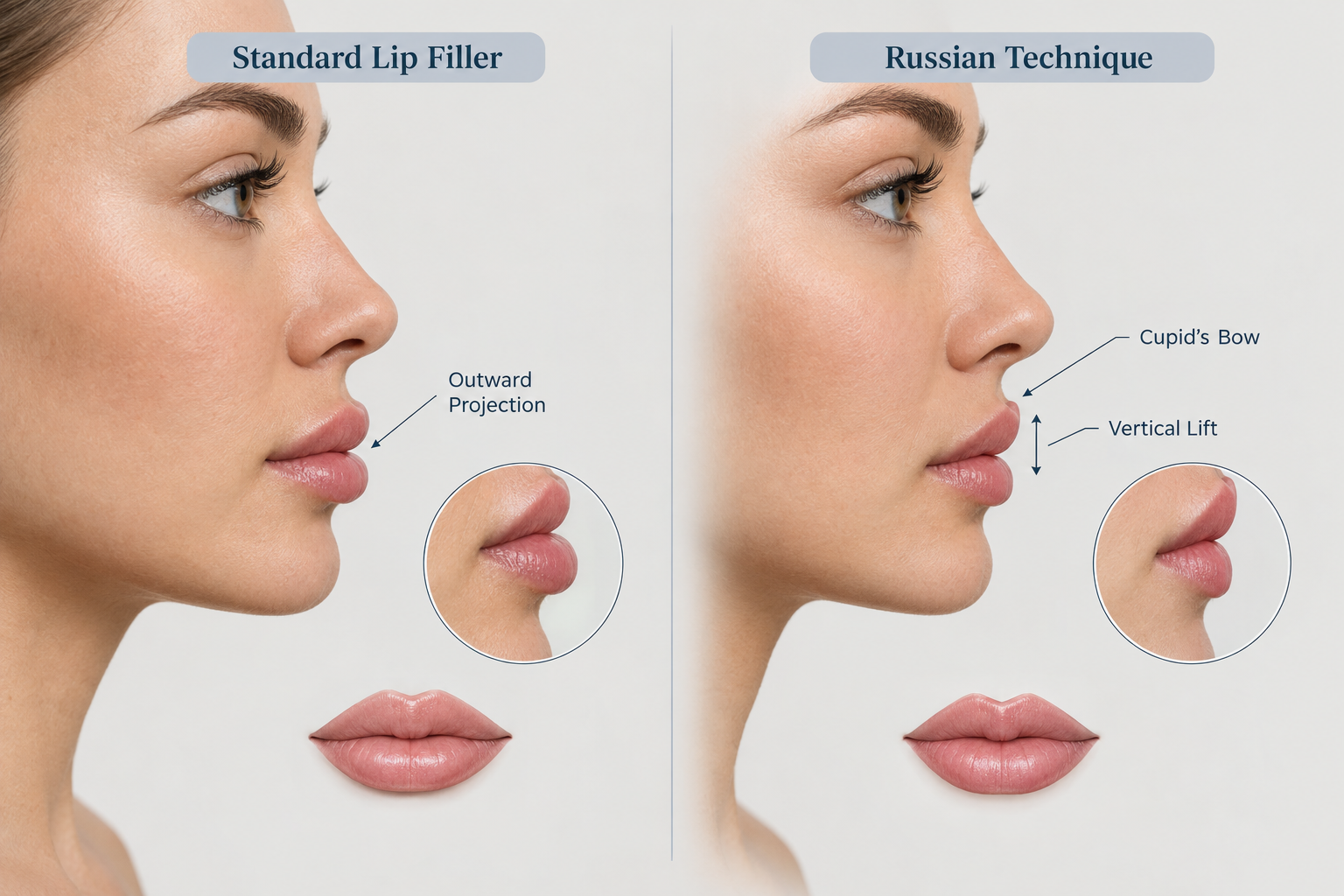
From a technical standpoint, the Russian method involves more injection points, a different depth of placement, and a greater emphasis on the central upper lip. This makes it a more technically demanding procedure. Not every practitioner who offers standard lip filler will have the training or experience to perform the Russian technique safely and effectively. Patients should specifically ask about a practitioner’s experience with this method during consultation.
In terms of product volume, the Russian technique does not necessarily require more filler than a standard treatment. In some cases, a similar or even smaller volume may be used, because the goal is reshaping rather than volumising. However, the number of injection sites is higher, which can influence the pattern of swelling and bruising in the days following treatment.
What Results Can You Expect?
Immediately after a Russian lip filler treatment, the lips will appear swollen and the result will not reflect the final outcome. Swelling is a normal response to injection and is often more pronounced with the Russian technique due to the higher number of injection points. Most patients experience noticeable swelling for three to five days, with residual swelling potentially lasting up to two weeks. Bruising is also common and may affect the lip border and surrounding skin.
Once swelling has fully resolved, the intended result of the Russian technique should become visible: a lifted central upper lip, more defined cupid’s bow peaks, and a flatter, more structured lip profile. The degree of change depends on the volume of filler used, the patient’s starting anatomy, and the practitioner’s technique. Results are not guaranteed to match any specific reference image, and individual anatomy plays a significant role in what is achievable.
Hyaluronic acid lip filler results are temporary. Depending on the product used, individual metabolism, and lifestyle factors such as sun exposure and smoking, results from Russian lip filler may last approximately six to twelve months. Some patients find that results in the lip area fade more quickly than in other facial areas due to the high movement of the lips during eating, speaking, and facial expression. Maintenance treatments are typically needed to sustain the result over time.
Who May Be Suitable for the Russian Lip Technique
The Russian lip technique may be worth discussing with a practitioner if you are looking for greater definition and vertical lift rather than significant volume increase. It may be particularly relevant for patients who have a naturally flat or undefined cupid’s bow, a thin upper lip with little natural height, or who have previously had lip filler and found the result too projected or unnatural in appearance.
Suitable candidates are generally adults in good health with realistic expectations about what the technique can achieve. A thorough consultation should include a review of medical history, current medications, and any previous aesthetic treatments. Patients who have had previous lip filler should inform their practitioner, as existing filler can affect placement and outcome. In some cases, dissolving previous hyaluronic acid filler with hyaluronidase before proceeding with the Russian technique may be recommended.
The Russian technique may not be appropriate for patients who want a significantly larger lip, as the method is not primarily designed for volume augmentation. Patients with very thin lips may also have limited tissue to work with, which can affect the degree of lift achievable. Individual anatomy, including the natural shape of the lip border and the distance between the nose and upper lip, will influence what results are realistic.
Who May Not Be Suitable
Russian lip filler, like all injectable treatments, is not appropriate for everyone. Patients who are pregnant or breastfeeding are generally advised to avoid elective cosmetic injectable procedures. Those with active infections, cold sores, or inflammatory skin conditions affecting the lip area should postpone treatment until the condition has resolved, as injecting into or near an active infection carries a risk of spreading it.
Patients with a history of severe allergic reactions, particularly to hyaluronic acid fillers or lidocaine, should discuss this carefully with their practitioner before proceeding. Those taking blood-thinning medications, including certain over-the-counter supplements such as high-dose fish oil or aspirin, may be at increased risk of bruising and should seek medical advice before treatment. Patients with autoimmune conditions or those undergoing immunosuppressive therapy should also discuss suitability with both their treating physician and the aesthetic practitioner.
A history of cold sores (herpes simplex virus) is relevant because lip injections can trigger an outbreak. Practitioners may recommend antiviral prophylaxis for patients with a known history of cold sores before proceeding with any lip filler treatment.
Risks and Side Effects of Russian Lip Filler
All injectable lip filler treatments carry risks, and the Russian technique is no exception. Understanding these risks before treatment is an important part of informed consent.
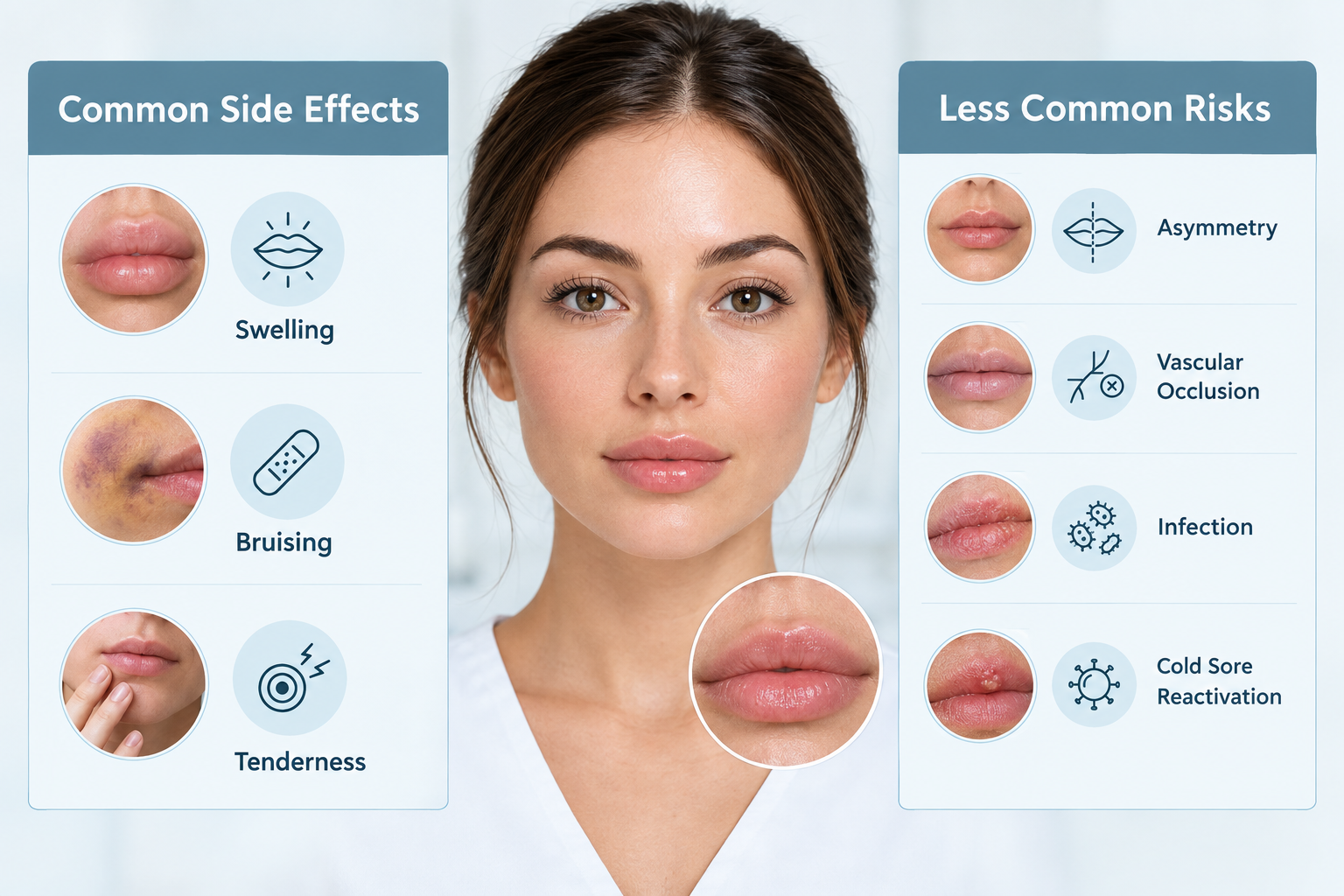
Common side effects that are expected and typically resolve within one to two weeks include swelling, bruising, tenderness, and redness at the injection sites. Because the Russian technique involves more injection points than standard lip augmentation, these effects may be more pronounced or take slightly longer to settle.
Less common but clinically significant risks include:
- Asymmetry: Uneven results can occur due to swelling, technique variation, or differences in the underlying anatomy. Minor asymmetry often improves as swelling resolves, but persistent asymmetry may require a review appointment or correction.
- Lumps or nodules: Small areas of filler that feel firm or irregular under the skin can occur, particularly if filler is placed superficially. These may resolve over time or may require treatment with hyaluronidase.
- Tyndall effect: A bluish discolouration visible through the skin can occur if filler is placed too superficially. This is more likely with certain filler products and injection depths.
- Infection: Although uncommon when treatment is performed in a clean clinical environment, infection is a possible complication of any injectable procedure.
- Cold sore reactivation: Lip injections can trigger herpes simplex outbreaks in susceptible individuals.
- Vascular occlusion: This is a rare but serious complication in which filler is inadvertently injected into or compresses a blood vessel, potentially restricting blood flow to the surrounding tissue. Vascular occlusion in the lip area requires immediate recognition and treatment. Patients should be aware of warning signs such as sudden blanching, mottled skin colour, or severe pain, and should contact their practitioner immediately if these occur.
Choosing a qualified and experienced practitioner who has appropriate training in managing complications, including access to hyaluronidase for dissolving filler if needed, significantly reduces but does not eliminate these risks.
The Treatment Experience: What to Expect at Your Appointment
A Russian lip filler appointment typically begins with a consultation or pre-treatment review, during which the practitioner will assess your lip anatomy, discuss your goals, review your medical history, and explain what the technique can and cannot achieve for your specific anatomy. Photographs may be taken for clinical records.
Topical anaesthetic cream is usually applied to the lips and left for approximately fifteen to thirty minutes before injections begin. The injection phase of the Russian technique generally takes longer than standard lip filler due to the higher number of precise injection points — typically between twenty and forty minutes, though this varies by practitioner and the volume being placed.
After treatment, the practitioner may gently massage the area or apply ice to reduce immediate swelling. You will usually be given aftercare instructions, which typically include avoiding strenuous exercise, excessive heat such as saunas or hot baths, alcohol, and pressure on the lips for at least twenty-four to forty-eight hours. Avoiding makeup on the lips for the first day is also commonly advised to reduce infection risk.
A follow-up or review appointment is often recommended two to four weeks after treatment, once swelling has fully resolved, to assess the result and determine whether any refinement is needed.
How Long Does Russian Lip Filler Last?
The longevity of Russian lip filler results depends on several factors, including the specific hyaluronic acid product used, the volume placed, the patient’s individual metabolism, and lifestyle habits. In general, lip filler tends to break down more quickly than filler placed in less mobile areas of the face, because the lips are in near-constant movement during daily activities.
Most patients find that Russian lip filler results last between six and twelve months before a maintenance treatment is needed to sustain the appearance. Some patients with faster metabolisms or very active lifestyles may notice results fading sooner. Conversely, patients who have had repeated treatments over time may find that results last slightly longer as the tissue adapts, though this varies individually and should not be assumed.
Hyaluronic acid filler is reversible. If a patient is unhappy with the result or experiences a complication, hyaluronidase can be used to dissolve the filler. This is one of the reasons hyaluronic acid remains the preferred filler type for lip augmentation in most clinical settings.
Alternatives to the Russian Lip Technique
The Russian lip technique is one of several approaches to lip enhancement, and it is not the right choice for every patient or every aesthetic goal.
Standard lip filler using conventional injection techniques remains appropriate for patients who primarily want volume increase or a fuller, more projected lip appearance. It is a well-established treatment with a long safety record when performed by a qualified practitioner.
Lip border definition using small amounts of filler placed precisely along the vermilion border can improve lip shape and definition without adding significant volume, and may suit patients who want subtle refinement rather than a noticeable change.
Lip flip using botulinum toxin is a non-filler option that relaxes the muscle just above the upper lip, causing the lip to roll slightly outward and appear marginally fuller. The effect is subtle, temporary, and does not add volume or lift in the way that filler does. It may suit patients who want a very minimal change or who are not yet ready for filler.
Perioral rejuvenation addressing fine lines around the mouth, loss of lip volume associated with ageing, and changes in lip shape may involve a combination of approaches rather than a single technique. A practitioner experienced in facial aesthetics can advise on which combination of treatments may best address a patient’s specific concerns.
No single technique is universally superior. The most appropriate approach depends on the patient’s anatomy, goals, and the practitioner’s clinical assessment.
Frequently Asked Questions
Is the Russian lip technique more painful than standard lip filler?
The Russian technique involves more injection points than conventional lip augmentation, which may mean slightly more discomfort during the procedure. However, topical anaesthetic cream and lidocaine-containing filler products are routinely used to manage pain. Most patients describe the experience as uncomfortable but tolerable. Individual pain sensitivity varies considerably.
Can the Russian lip technique be reversed?
Yes. Because the Russian technique uses hyaluronic acid filler, the result can be partially or fully reversed using hyaluronidase, an enzyme that dissolves hyaluronic acid. Reversal is not always immediate or complete in a single session, and the process should be performed by a qualified practitioner.
How much filler is typically used in the Russian technique?
The volume used varies depending on the patient’s starting anatomy and the desired outcome. The Russian technique does not necessarily require more filler than standard lip augmentation; in some cases, a similar or smaller volume is used because the focus is on reshaping rather than volumising. Your practitioner will advise on the appropriate amount during consultation.
Will my lips look obviously done after Russian lip filler?
The Russian technique is often chosen by patients who want a more natural-looking result with less outward projection. However, the appearance of any lip filler treatment depends on the volume used, the patient’s anatomy, and the practitioner’s skill. Overfilling or poor technique can produce an unnatural result regardless of the injection method used. Discussing your goals clearly with your practitioner and reviewing their portfolio of previous work can help set realistic expectations.
How soon after treatment can I see the final result?
Swelling after Russian lip filler can be significant in the first few days and may take up to two weeks to fully resolve. The final result should not be assessed until swelling has completely settled. Many practitioners recommend a review appointment at two to four weeks post-treatment for this reason.
Can I have the Russian technique if I already have lip filler?
This depends on how much existing filler is present and how it is distributed. In some cases, a practitioner may recommend dissolving previous filler before proceeding with the Russian technique to ensure accurate placement and a predictable result. This should be assessed individually during consultation.
Is the Russian lip technique suitable for older patients?
Age alone is not a contraindication to lip filler. However, the anatomy of the lips changes with age — including thinning of the lip tissue, lengthening of the philtrum, and loss of definition — and these changes affect what is achievable with any injection technique. A practitioner experienced in age-related lip changes can advise on whether the Russian technique or an alternative approach is more appropriate for a specific patient’s anatomy and goals.
Is Russian Lip Filler the Right Choice for Your Goals?
The Russian lip technique offers a distinct aesthetic outcome compared to conventional lip augmentation, making it a genuinely useful option for patients who want vertical lift, a more defined cupid’s bow, and a structured lip shape without significant outward projection. For patients whose primary goal is overall volume increase or a fuller, plumper appearance, standard lip filler techniques may be more appropriate.
The technique’s results are temporary, typically lasting six to twelve months, and maintenance treatments are needed to sustain the appearance over time. The higher number of injection points involved means that swelling and bruising may be more noticeable in the days following treatment, and the final result requires patience to assess. Risks, while manageable in experienced hands, are real and should be discussed thoroughly before proceeding.
Practitioner selection is particularly important with the Russian technique. Because it is more technically demanding than standard lip augmentation, outcomes are closely tied to the injector’s training, anatomical knowledge, and experience with this specific method. Reviewing a practitioner’s portfolio, asking about their training, and ensuring they have access to hyaluronidase for emergency reversal are all reasonable steps before committing to treatment.
If you are considering Russian lip filler, a detailed consultation with a qualified aesthetic practitioner who can assess your individual anatomy and discuss realistic outcomes for your specific goals is the most important first step.


