
How Long Does Tear Trough Filler Last? Longevity, Results & What to Expect
Tear trough filler is one of the more technically demanding injectable treatments available, used to address hollowness and shadowing in the area between the lower eyelid and the cheek. A common and entirely reasonable question before committing to treatment is how long the results actually last — and the honest answer is that it varies considerably from person to person. Most patients can expect results to remain visible for somewhere between nine months and two years, though several factors influence where an individual falls within that range. This article explains what determines tear trough filler longevity, what realistic results look like, how the treatment works, and what to consider before booking a consultation.
Key Takeaways
- Tear trough filler results typically last between 9 months and 2 years, depending on the product used, the amount placed, and individual patient factors such as metabolism and anatomy.
- The tear trough area is technically complex; results depend heavily on practitioner experience and appropriate patient selection.
- Hyaluronic acid is the most commonly used filler type for this area and can be dissolved with hyaluronidase if needed, which is an important safety consideration.
- Not everyone is a suitable candidate — patients with significant puffiness, excess skin, or certain anatomical features may achieve better outcomes with alternative treatments.
- Maintenance top-up treatments are usually required to sustain results over time, and the interval between sessions may lengthen after the first few treatments.
What Is Tear Trough Filler?
The tear trough is the groove that runs from the inner corner of the eye diagonally toward the cheek. When this area becomes hollow or shadowed — due to volume loss, genetics, or the natural ageing process — it can create a tired or aged appearance that is difficult to address with skincare alone. Tear trough filler involves injecting a small amount of dermal filler into or around this groove to restore volume, reduce shadowing, and soften the transition between the lower eyelid and the cheek.
Hyaluronic acid (HA) fillers are the standard choice for this area. Hyaluronic acid is a naturally occurring substance found in the skin and connective tissue, and HA-based fillers are favoured for the tear trough because they can be dissolved using an enzyme called hyaluronidase if a complication arises or if the result is unsatisfactory. This reversibility is a meaningful safety advantage in a high-risk anatomical zone close to the eye. Some practitioners use cannulas rather than needles to reduce bruising and the risk of vascular injury, though technique varies between clinicians.
How Long Does Tear Trough Filler Last?
Tear trough filler longevity typically falls in the range of 9 to 18 months for most patients, with some individuals maintaining visible results for up to two years. This range is wider than many patients expect, and understanding why helps set realistic expectations before treatment.
The tear trough area tends to retain filler for longer than highly mobile areas such as the lips, because the periorbital region experiences relatively less repetitive movement. However, individual metabolism plays a significant role — patients with faster metabolic rates tend to break down hyaluronic acid more quickly. Body weight fluctuations can also affect how long results remain visible, since changes in facial fat distribution alter the appearance of the treated area even when the filler itself is still present.
The specific hyaluronic acid product used matters as well. Fillers formulated with a higher degree of cross-linking — meaning the HA molecules are more tightly bonded — generally last longer than softer, less cross-linked products. For the tear trough, practitioners typically select a soft, low-viscosity filler to avoid the Tyndall effect (a bluish discolouration that can occur when filler is placed too superficially), which means the product chosen may not be the longest-lasting on the market. The practitioner’s decision to prioritise safety and a natural appearance over maximum longevity is clinically appropriate in this area.
The volume of filler placed also influences duration. Larger volumes may last longer in absolute terms, but overfilling the tear trough carries its own risks, including puffiness, migration, and an unnatural appearance. Experienced practitioners typically use conservative amounts and build gradually over multiple sessions if needed.
Factors That Affect How Long Results Last
Several patient-specific and treatment-specific variables influence tear trough filler longevity. Understanding these helps explain why two patients treated on the same day with the same product may have noticeably different experiences.
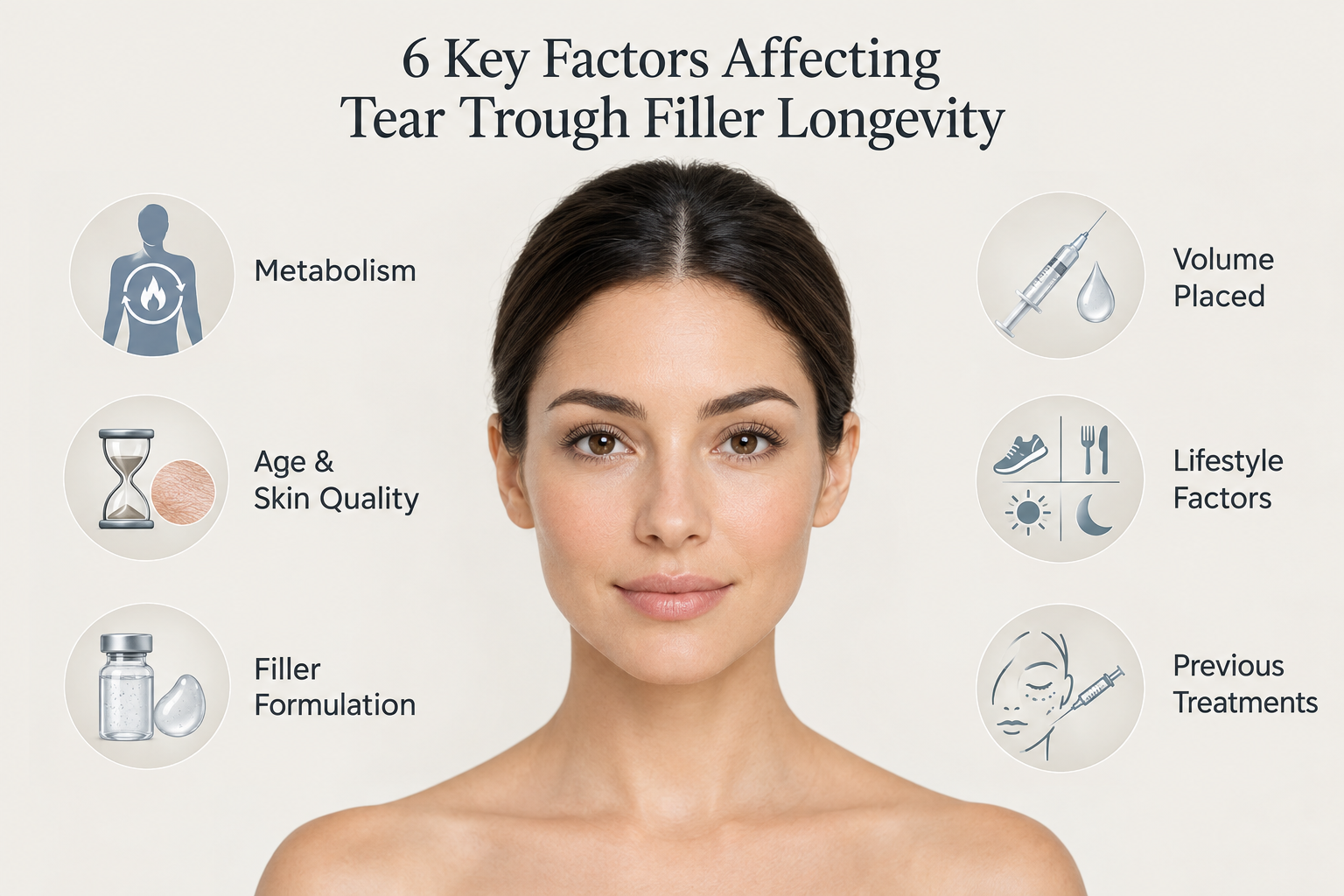
- Individual metabolism: Hyaluronic acid is broken down by the body’s own enzymes over time. Patients with a faster metabolic rate — which can be influenced by exercise habits, thyroid function, and other physiological factors — may notice results fading sooner.
- Age and skin quality: Older skin with reduced collagen density may not support filler as effectively, potentially affecting how results appear over time. Conversely, some older patients with more significant volume loss may benefit from slightly larger volumes that can extend visible duration.
- Filler product and formulation: Different hyaluronic acid products have different rheological properties (how they flow and behave in tissue). Products selected for the tear trough are usually softer and more hydrophilic, which may mean they absorb water and appear to change slightly in the weeks after treatment.
- Volume placed: Conservative volumes, while safer, may require top-up sooner than larger placements. This is a deliberate clinical trade-off.
- Lifestyle factors: Sun exposure, smoking, and poor hydration can accelerate skin ageing and may influence how long filler results remain visible, though the direct effect on filler degradation specifically is less well established.
- Previous treatments: Patients who have had tear trough filler before may find that subsequent treatments last longer. Some evidence suggests that repeated hyaluronic acid injections can stimulate collagen production in the surrounding tissue, which may contribute to sustained improvement over time.
- Anatomy: The depth and shape of the tear trough, the thickness of the overlying skin, and the degree of underlying volume loss all affect both the initial result and how long it remains visible.
What Results Can You Realistically Expect?
Immediately after tear trough filler treatment, some swelling is normal and expected. The periorbital area is particularly prone to post-injection swelling, and results in the first few days may not accurately reflect the final outcome. Most practitioners advise waiting at least two weeks before assessing the result, and in some cases up to four weeks for swelling to fully resolve and the filler to settle.
When the treatment is well-matched to the patient’s anatomy and performed by an experienced injector, tear trough filler can meaningfully reduce the appearance of hollowness and under-eye shadowing. Patients often report looking less tired and more refreshed. However, tear trough filler does not address all causes of under-eye concerns. Dark circles caused primarily by pigmentation or visible blood vessels beneath thin skin may not respond significantly to volume replacement alone. Puffiness caused by fat pad prolapse — where the orbital fat pushes forward — is also unlikely to be improved by filler and may actually be worsened if filler is added to an already full area.
Results are typically subtle rather than dramatic, which is appropriate for this delicate area. The goal is a natural improvement in the transition between the lower eyelid and the cheek, not a visible change in facial structure. Patients seeking a more significant transformation may need to consider whether tear trough filler alone can meet their expectations, or whether a combination approach or alternative treatment would be more appropriate.
When to Consider a Top-Up Treatment
Most patients who are happy with their tear trough filler results will return for a maintenance appointment when they notice the hollowness or shadowing beginning to return. This is typically somewhere between 9 and 18 months after the initial treatment, though some patients go longer between sessions.
There is no fixed schedule that applies to everyone. A qualified practitioner will assess the area at a follow-up appointment and advise whether additional filler is appropriate, whether the existing filler has fully dissolved, and whether the same approach remains suitable. It is worth noting that some residual hyaluronic acid may still be present even when the visible result has faded, so a practitioner may recommend a smaller top-up volume rather than repeating the full original amount.
Patients who have had several rounds of treatment sometimes find that the interval between top-ups gradually extends. This may be partly due to the cumulative collagen-stimulating effect of repeated hyaluronic acid injections, though this effect is not guaranteed and the evidence base is still developing.
Risks and Limitations of Tear Trough Filler
The tear trough is considered one of the higher-risk areas for dermal filler treatment due to its proximity to the eye and the delicate anatomy of the periorbital region. Patients should be aware of both common and less common risks before proceeding.
Common side effects include bruising, swelling, and temporary tenderness at the injection site. These typically resolve within one to two weeks. The Tyndall effect — a bluish or greyish discolouration visible through thin skin — can occur if filler is placed too superficially, and is more likely in patients with very thin lower eyelid skin. This can usually be corrected by dissolving the filler with hyaluronidase.
Puffiness or a swollen appearance under the eyes is another recognised complication, sometimes occurring weeks or months after treatment as the hyaluronic acid absorbs water. This is one reason why conservative volumes and appropriate product selection are important in this area.
More serious but rare complications include vascular occlusion, where filler inadvertently enters or compresses a blood vessel. In the periorbital region, this carries a risk of vision changes or, in very rare cases, permanent visual impairment. This underlines the importance of choosing a practitioner with specific training and experience in periorbital anatomy, and of ensuring the clinic has hyaluronidase immediately available. Patients should seek urgent medical attention if they experience any sudden changes in vision, severe pain, or skin colour changes following treatment.
Infection, granuloma formation (a localised inflammatory reaction), and filler migration are additional risks that, while uncommon, are worth understanding before treatment.
Who May Be Suitable for Tear Trough Filler
Tear trough filler tends to produce the most satisfying results in patients whose under-eye concerns are primarily caused by volume loss or hollowness rather than other factors. Suitable candidates typically have good skin quality, relatively thin but not excessively thin lower eyelid skin, and a clearly defined hollow that creates shadowing.
Patients who may not be well-suited to tear trough filler include those with significant lower eyelid puffiness caused by fat pad prolapse, those with very thin or crepey skin that may make filler visible or increase the risk of the Tyndall effect, and those whose dark circles are primarily pigmentary in origin. A thorough assessment by a qualified practitioner is essential to determine whether tear trough filler is the most appropriate option for a given patient’s anatomy and concerns.
Tear trough filler is generally not recommended during pregnancy or breastfeeding. Patients with active skin infections, certain autoimmune conditions, or a history of severe allergic reactions should discuss their medical history in detail before treatment. Those taking blood-thinning medications may have an increased risk of bruising.
Alternatives to Tear Trough Filler
For patients who are not suitable candidates for tear trough filler, or who prefer a non-injectable approach, several alternatives may be worth discussing with a practitioner.
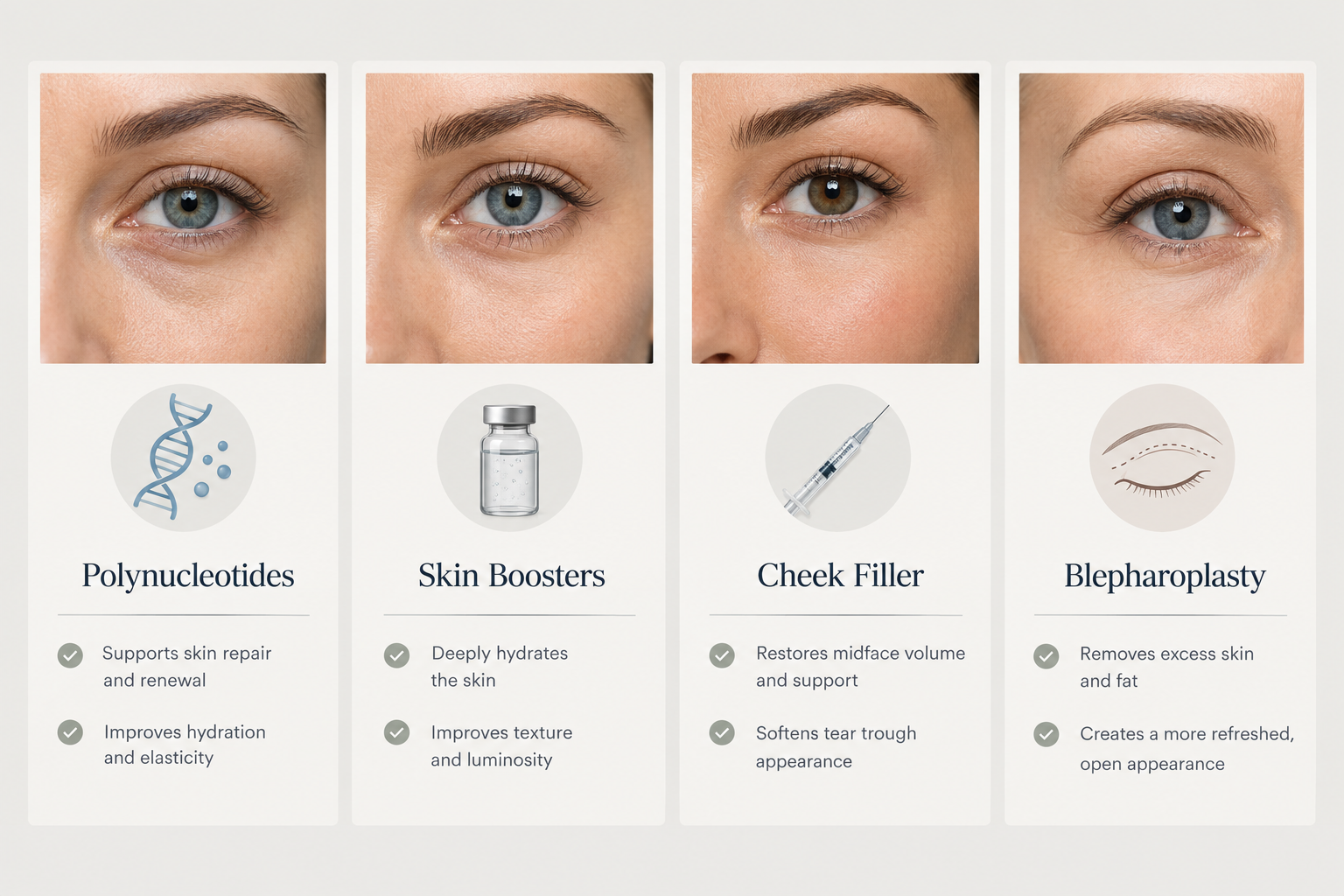
Polynucleotides (PDRN/PN injections): Polynucleotide treatments involve injecting fragments of purified DNA into the skin to stimulate tissue regeneration, improve hydration, and support collagen production. They are increasingly used in the periorbital area and may be particularly useful for patients whose under-eye concerns relate more to skin quality and fine lines than to volume loss. Polynucleotides do not replace volume in the same way as hyaluronic acid filler, so they address a different aspect of under-eye ageing. Some practitioners use them alongside filler for a combined approach.
Profhilo and skin boosters: Injectable skin hydrators such as Profhilo contain high concentrations of hyaluronic acid but are designed to improve skin quality and stimulate collagen rather than add structural volume. They may improve the appearance of fine lines and skin laxity around the eye area but are not a direct substitute for tear trough filler in patients with significant hollowness.
Cheek filler: In some patients, volume loss in the mid-face and cheek area contributes to the appearance of tear trough hollowing. Restoring volume to the cheeks can indirectly improve the under-eye area by lifting and supporting the overlying tissue. This approach may be more appropriate than direct tear trough treatment in certain anatomical presentations.
Surgical options: For patients with significant fat pad prolapse, excess skin, or structural changes that cannot be adequately addressed with injectables, surgical options such as lower blepharoplasty (eyelid surgery) may be more appropriate. This is a decision that requires consultation with an oculoplastic or plastic surgeon.
Topical treatments: While no topical product can replicate the results of filler, ingredients such as retinoids, vitamin C, caffeine, and peptides may help improve skin quality, reduce pigmentation, and support the appearance of the under-eye area over time. These are best considered as complementary to, rather than replacements for, clinical treatments.
Frequently Asked Questions
Does tear trough filler dissolve on its own?
Yes. Hyaluronic acid filler is gradually broken down by the body’s own enzymes over time, which is why results are temporary. The rate of dissolution varies between individuals. If a patient wants the filler removed sooner — for example, due to a complication or an unsatisfactory result — hyaluronidase can be injected to dissolve it more quickly.
Is tear trough filler painful?
Most patients describe the procedure as mildly uncomfortable rather than significantly painful. Topical anaesthetic cream is usually applied before treatment to reduce discomfort, and many hyaluronic acid fillers contain lidocaine (a local anaesthetic) within the formulation. The use of a blunt-tipped cannula rather than a sharp needle can also reduce discomfort and bruising for some patients.
How soon will I see results after tear trough filler?
Some improvement may be visible immediately after treatment, but initial swelling can make it difficult to assess the true result. Most practitioners recommend waiting two to four weeks for swelling to fully resolve before evaluating the outcome. The filler may also settle slightly during this period.
Can tear trough filler make dark circles worse?
Tear trough filler is most effective for dark circles caused by hollowness and shadowing. If dark circles are primarily caused by pigmentation or visible blood vessels, filler may not improve them and could, in some cases, make the area appear more prominent if the Tyndall effect occurs. A thorough assessment before treatment helps identify the most likely cause and the most appropriate approach.
How many sessions of tear trough filler will I need?
Many patients achieve a satisfactory result after a single session, though some may benefit from a small top-up at a follow-up appointment two to four weeks later. Ongoing maintenance treatments are typically needed every 9 to 18 months to sustain results, though this varies between individuals.
What should I avoid after tear trough filler?
Most practitioners advise avoiding strenuous exercise, alcohol, excessive heat (such as saunas or steam rooms), and direct sun exposure for at least 24 to 48 hours after treatment. Rubbing or applying pressure to the treated area should also be avoided in the days following the procedure. Specific aftercare instructions will be provided by the treating practitioner.
Is it safe to have tear trough filler repeatedly?
Repeated tear trough filler treatments are common and generally considered safe when performed by an experienced practitioner using appropriate products and volumes. However, cumulative filler build-up over many years is a recognised concern in some patients, and practitioners may recommend dissolving existing filler before retreating in certain cases. Regular assessment at each appointment helps ensure the approach remains appropriate over time.
Making an Informed Decision About Tear Trough Filler
Tear trough filler can be an effective option for patients with under-eye hollowness caused by volume loss, offering results that typically last between 9 months and 2 years depending on individual factors. The treatment is not suitable for everyone, and the most important step before proceeding is a thorough consultation with a qualified and experienced practitioner who can assess your anatomy, identify the underlying cause of your under-eye concerns, and advise whether filler is the most appropriate approach.
The longevity of results, the risks involved, and the realistic level of improvement achievable are all factors worth discussing in detail before treatment. Patients who understand that results are temporary, that maintenance is required, and that the tear trough is a technically demanding area are generally better placed to make a decision that aligns with their expectations. If you are considering tear trough filler, seeking a practitioner with specific training in periorbital anatomy and a clear protocol for managing complications — including immediate access to hyaluronidase — is an important part of choosing treatment safely.


