
Fat Dissolving Injections in London: What to Expect, Results & Risks
Fat dissolving injections have become one of the more commonly requested non-surgical body contouring treatments at aesthetic clinics across London. They are used to reduce localised pockets of fat that tend to resist diet and exercise, such as a double chin, jowls, or small areas of stubborn fat on the body. This article explains how fat dissolving injections work, what the treatment experience involves, what results are realistic, and what risks and limitations prospective patients should understand before booking a consultation.
Key Takeaways
- Fat dissolving injections are a non-surgical treatment designed to reduce small, localised fat deposits — they are not a weight loss solution or a treatment for obesity.
- Most patients require a course of two to four sessions, spaced several weeks apart, before meaningful results become visible.
- Common side effects include swelling, bruising, redness, and tenderness at the injection site; these typically resolve within one to two weeks.
- Results may be long-lasting once the target fat cells are destroyed, but maintaining a stable weight is important for preserving the outcome.
- Choosing a qualified, experienced practitioner in a regulated clinical setting is essential for both safety and appropriate patient selection.
What Are Fat Dissolving Injections?
Fat dissolving injections are a category of injectable treatments that use a solution to break down and destroy fat cells in a targeted area. Once the fat cells are disrupted, the body’s lymphatic system gradually clears the released fatty material over several weeks. The result, when the treatment is appropriate for the patient and the area, is a reduction in the volume of localised fat.
The most widely used active ingredients in fat dissolving injections are deoxycholic acid and phosphatidylcholine, sometimes used in combination. Deoxycholic acid is a bile acid that occurs naturally in the body and plays a role in the digestion of dietary fat. When injected into subcutaneous fat tissue, it disrupts the cell membrane of fat cells, causing them to break down. Phosphatidylcholine, derived from soya lecithin, is often used alongside deoxycholic acid and is thought to assist in the emulsification and clearance of fat.
In London clinics, two of the most frequently offered fat dissolving products are Aqualyx and Lemon Bottle. Aqualyx contains a plant-based compound derived from deoxycholic acid and has been used in aesthetic practice for a number of years. Lemon Bottle is a more recently introduced product that contains a combination of ingredients including riboflavin, lecithin, and bromelain, and has attracted significant interest, though independent clinical evidence for this specific formulation remains more limited than for established deoxycholic acid products. Practitioners and patients should be aware that the evidence base varies between products.
How Fat Dissolving Injections Work
When a fat dissolving solution is injected into subcutaneous fat tissue, the active compounds act on the membranes of adipocytes — the cells that store fat. The disruption of these membranes causes the cells to release their contents, which are then processed and eliminated by the body’s immune and lymphatic systems over a period of weeks. Because the fat cells themselves are destroyed rather than simply reduced in size, the results can be long-lasting provided the patient maintains a stable body weight. Remaining fat cells can still enlarge if caloric intake increases significantly.
It is important to distinguish fat dissolving injections from other body contouring approaches. Unlike CoolSculpting, which uses controlled cooling to induce fat cell death, or high-intensity focused ultrasound (HIFU) body treatments, fat dissolving injections rely on a chemical mechanism. They are also fundamentally different from treatments such as Emsculpt, which targets muscle tissue rather than fat cells. Fat dissolving injections do not build muscle, tighten skin, or produce weight loss on the scales — their purpose is localised fat reduction in specific, small areas.
Treatment Areas
Fat dissolving injections are best suited to small, defined areas of localised fat rather than large volumes of adipose tissue. The most commonly treated areas at London aesthetic clinics include:
- Submental fat (double chin): This is one of the most established treatment areas. Deoxycholic acid has regulatory approval in some countries specifically for submental fat reduction, and clinical evidence for this indication is more robust than for many other areas.
- Jowls: Small deposits along the jawline may be addressed, though results depend on the degree of skin laxity present.
- Bra fat and back fat: Small pockets of fat around the bra line or upper back are sometimes treated.
- Inner and outer thighs: Localised fat deposits in these areas may respond to treatment, though the volume of fat and skin quality are important considerations.
- Abdomen: Small areas of stubborn abdominal fat may be targeted, though this area requires careful assessment as the fat layer depth and distribution vary considerably between individuals.
- Knees and ankles: Localised fat in these areas is occasionally treated, though evidence is more limited.
Fat dissolving injections are not appropriate for treating large volumes of fat, and they are not a substitute for surgical liposuction when significant fat reduction is the goal. A thorough clinical assessment is needed to determine whether the area and volume of fat are suitable for this approach.
What Happens During a Fat Dissolving Injection Appointment
A typical fat dissolving injection appointment at a London clinic begins with a consultation or a pre-treatment review if a separate consultation has already taken place. The practitioner will assess the treatment area, confirm suitability, discuss realistic expectations, and review the patient’s medical history and any relevant contraindications.
The skin over the treatment area is usually cleaned and may be marked to guide injection placement. A topical anaesthetic cream is sometimes applied beforehand to reduce discomfort, though this is not always necessary depending on the area and the patient’s preference. The solution is then administered through a series of small injections across the target area. The number of injection points varies depending on the size of the area being treated.
Most appointments take between 30 and 60 minutes, including preparation time. Patients typically experience a stinging or burning sensation during the injections, which usually subsides within a few minutes. Swelling begins relatively quickly after treatment and is a normal part of the inflammatory process that initiates fat cell breakdown.
Recovery and Downtime
Swelling is the most predictable and often the most pronounced side effect following fat dissolving injections. In the submental area in particular, swelling can be quite significant in the first few days and may temporarily make the treated area appear larger before it reduces. This is a normal response and not a sign that something has gone wrong, but patients should be prepared for this and plan accordingly — for example, avoiding important social or professional commitments in the days immediately following treatment.
Typical recovery experiences include:
- Swelling: Usually peaks within 24 to 72 hours and gradually subsides over one to two weeks, though some mild swelling may persist longer.
- Bruising: Common at injection sites and usually resolves within one to two weeks.
- Redness and warmth: Expected in the treated area and typically short-lived.
- Tenderness or firmness: The treated area may feel tender to the touch and slightly firm or lumpy as the tissue responds to treatment. This generally resolves over several weeks.
- Numbness or tingling: Temporary altered sensation in the treated area is possible and usually resolves without intervention.
Most patients are able to return to normal daily activities relatively quickly, though strenuous exercise and heat exposure such as saunas or hot baths are generally advised against for a short period after treatment. Specific aftercare guidance will be provided by the treating practitioner.
When Results Appear and How Long They Last
Fat dissolving injections do not produce immediate visible results. The process of fat cell breakdown and clearance by the lymphatic system takes time, and visible changes typically begin to emerge four to six weeks after a treatment session. Full results from a single session may not be apparent until eight to twelve weeks have passed.
Because most patients require more than one session to achieve their desired outcome, the overall timeline from first treatment to final result can span several months. Practitioners generally recommend spacing sessions six to eight weeks apart to allow the body adequate time to process the treated fat before assessing whether further treatment is needed.
Once fat cells have been destroyed, they do not regenerate. This means that the reduction in fat cell number in the treated area can be long-lasting. However, the remaining fat cells in the area — and elsewhere in the body — can still expand if body weight increases. Patients who maintain a stable weight after treatment are more likely to preserve their results over time. Fat dissolving injections are not a permanent solution to weight management and should not be approached as such.
How Many Sessions Are Typically Needed
The number of fat dissolving injection sessions required varies depending on the treatment area, the volume of fat being targeted, the product used, and the individual patient’s response. Most patients require between two and four sessions to achieve a satisfactory outcome, though some may see adequate results after a single session in smaller or more responsive areas, while others may need additional treatments.
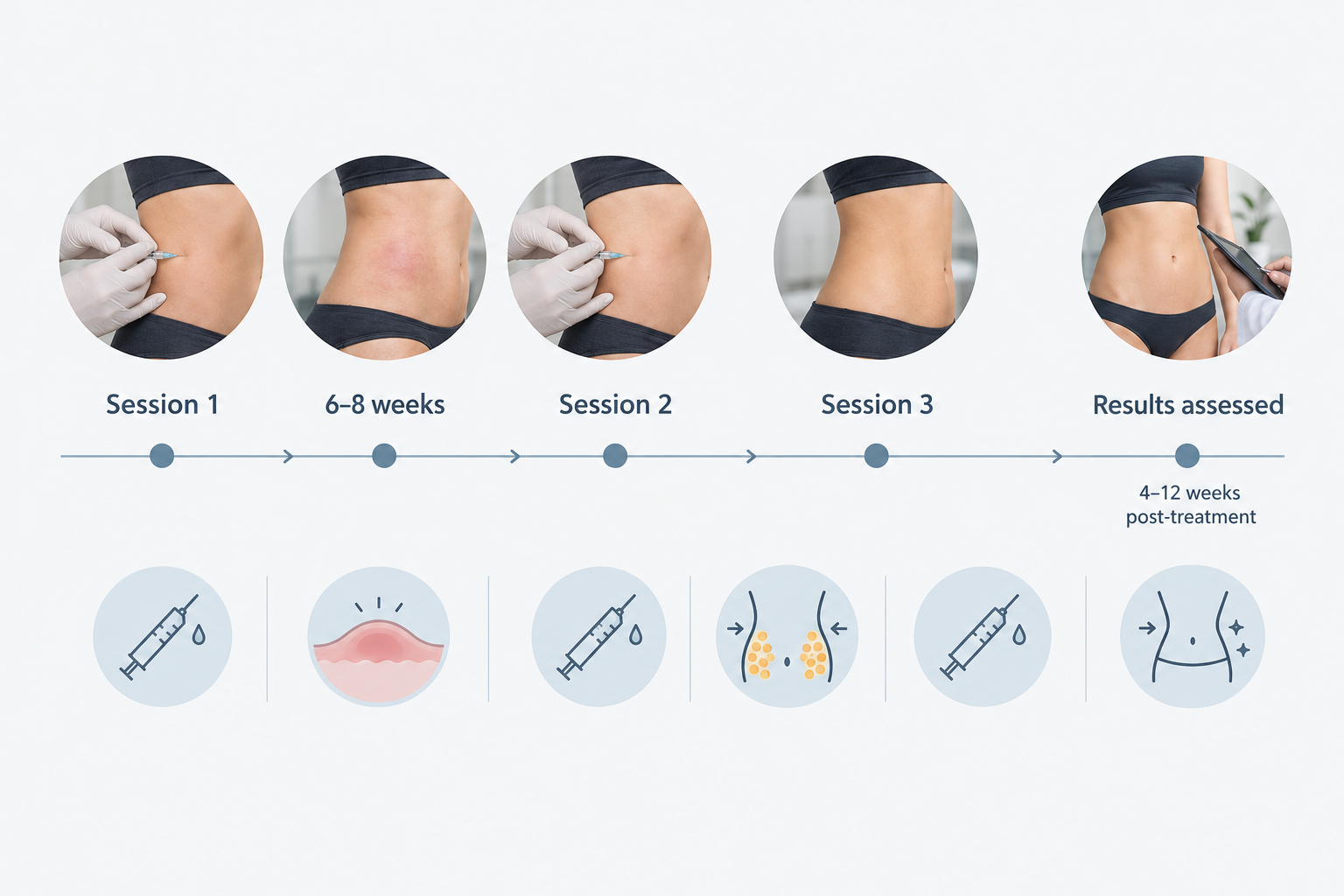
During the initial consultation, a practitioner should provide a realistic estimate of the likely number of sessions based on a physical assessment of the area. Patients should be cautious of any provider who guarantees a specific outcome after a fixed number of sessions without first conducting a proper assessment, as individual responses to fat dissolving treatments vary considerably.
Risks and Side Effects
Fat dissolving injections carry a range of potential risks and side effects that patients should understand before proceeding. While many side effects are mild and temporary, more serious complications are possible, particularly when treatment is performed by an inadequately trained practitioner or in an inappropriate clinical setting.
Common and Expected Side Effects
- Swelling, bruising, and redness at the injection site
- Tenderness and discomfort in the treated area
- Temporary firmness or lumpiness under the skin
- Temporary numbness or altered sensation
Less Common but Possible Risks
- Skin irregularities: Uneven fat reduction or contour irregularities can occur if the product is not distributed evenly or if the patient’s anatomy is not well suited to the treatment.
- Nerve injury: In the submental area, there is a risk of temporary or, rarely, more prolonged nerve effects if the injection is placed incorrectly. This underscores the importance of practitioner expertise and anatomical knowledge.
- Skin necrosis: Tissue damage is a rare but serious complication associated with incorrect injection technique or product placement.
- Infection: As with any injectable treatment, there is a small risk of infection at the injection site.
- Allergic reaction: Hypersensitivity reactions to the injected solution are uncommon but possible.
- Unsatisfactory results: Some patients do not achieve the degree of fat reduction they hoped for, and results are not guaranteed.
The risk profile of fat dissolving injections is meaningfully influenced by the skill and training of the practitioner, the suitability of the patient, and the quality of the product used. Patients in London should seek treatment from a qualified medical professional — such as a doctor, dentist, or nurse prescriber with specific training in aesthetic injectables — working in a regulated clinical environment.
Who May Be Suitable for Fat Dissolving Injections
Fat dissolving injections may be appropriate for adults who have localised, pinchable fat deposits that have not responded adequately to a healthy diet and regular exercise, and who are otherwise in good general health. Suitable candidates are typically at or near a healthy body weight and have realistic expectations about the degree of improvement that is achievable.
Good skin elasticity in the treatment area is an advantage, as the skin will need to adapt to the reduced volume of fat beneath it. Patients with significant skin laxity may find that fat reduction in an area worsens the appearance of loose skin rather than improving overall contour, and alternative or complementary treatments may be more appropriate in such cases.
Who May Not Be Suitable
Fat dissolving injections are not appropriate for everyone. A clinical assessment is required to identify contraindications and factors that may increase risk. Patients who may not be suitable include those who:
- Are pregnant or breastfeeding
- Have active infection or inflammation in the proposed treatment area
- Have a known allergy to any component of the injection solution
- Have significant skin laxity in the treatment area that is unlikely to improve with fat reduction alone
- Have a body mass index significantly above the healthy range, as fat dissolving injections are not a treatment for excess weight
- Have certain autoimmune conditions or are taking medications that may affect healing or increase bleeding risk
- Have unrealistic expectations about the degree of change achievable
A thorough medical history review and physical assessment by a qualified practitioner are essential before treatment proceeds.
Alternatives to Fat Dissolving Injections
Several other non-surgical and surgical options exist for localised fat reduction and body contouring, and the most appropriate choice depends on the patient’s goals, anatomy, and the area being treated.
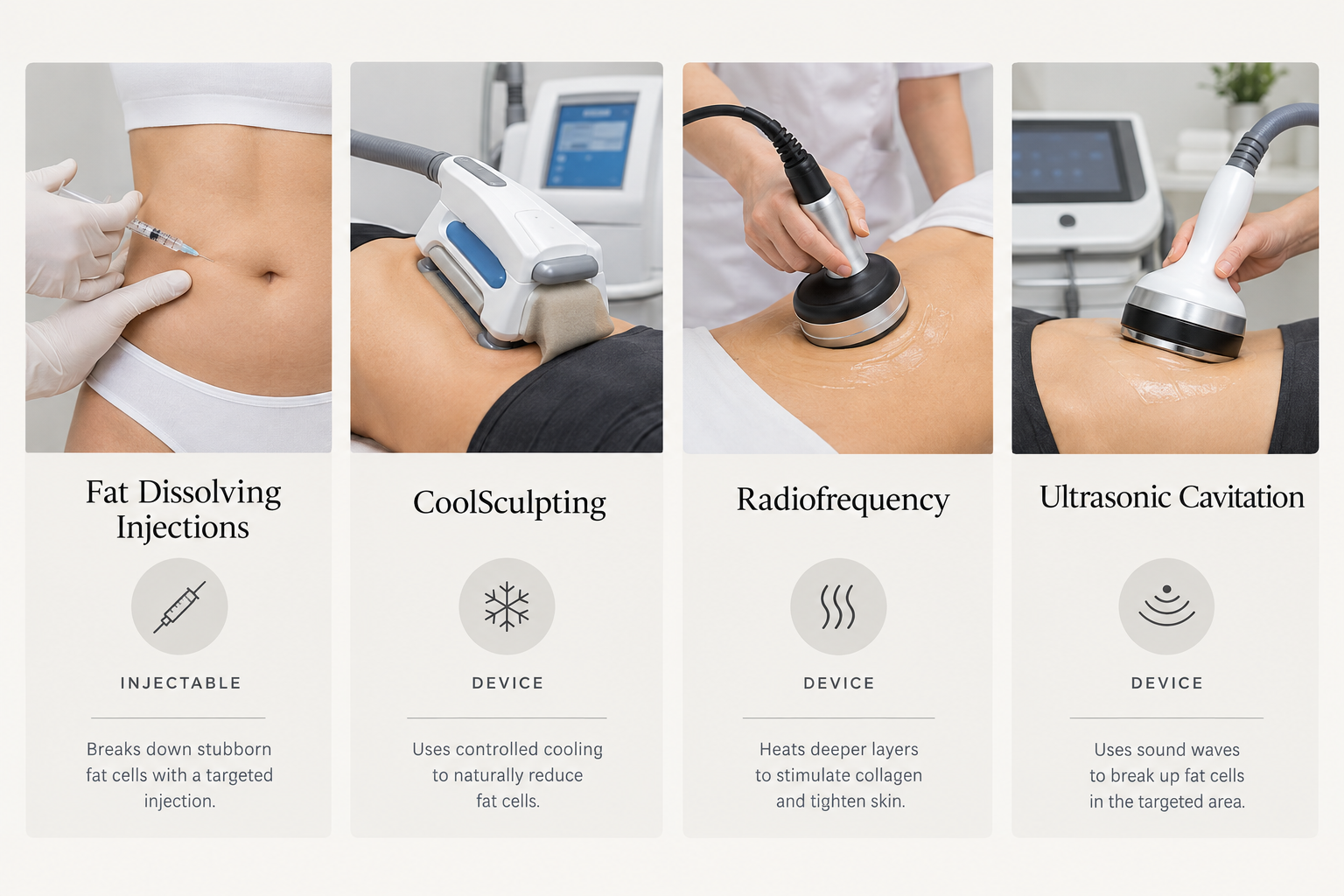
CoolSculpting (cryolipolysis) uses controlled cooling to freeze and destroy fat cells without injections. It is a well-established non-surgical fat reduction treatment with a substantial evidence base, and may be suitable for larger treatment areas than fat dissolving injections typically address.
High-intensity focused ultrasound (HIFU) for body contouring uses focused ultrasound energy to target fat cells at a specific depth beneath the skin. Some devices also offer a degree of skin tightening, which may be relevant for patients with mild laxity concerns alongside fat reduction goals.
Radiofrequency treatments are primarily used for skin tightening but some devices combine radiofrequency with other technologies to address both fat and skin laxity simultaneously.
Emsculpt and Emsculpt Neo use high-intensity electromagnetic energy to stimulate muscle contractions, with Emsculpt Neo also incorporating radiofrequency for fat reduction. These treatments are focused on muscle definition and toning rather than purely on fat removal, and suit patients whose primary goal is improved muscle tone alongside modest fat reduction.
Surgical liposuction remains the most effective option for removing larger volumes of fat and producing significant body contouring changes. It carries greater risks and requires recovery time, but may be more appropriate when the volume of fat or the degree of change desired exceeds what non-surgical treatments can realistically achieve.
A qualified practitioner should be able to discuss which option, or combination of options, is most likely to address a patient’s specific concerns effectively and safely.
Choosing a Provider for Fat Dissolving Injections in London
London has a large number of clinics and practitioners offering fat dissolving injections, and the quality of training, clinical oversight, and product standards varies considerably. Patients should prioritise safety and clinical competence over price or convenience when selecting a provider.
Key factors to consider when choosing a clinic for fat dissolving injections in London include:
- Practitioner qualifications: The injecting practitioner should be a regulated healthcare professional with specific training in aesthetic injectables and a sound understanding of facial and body anatomy.
- Consultation quality: A reputable clinic will offer a thorough consultation before treatment, assess suitability honestly, and decline to treat patients for whom the procedure is not appropriate.
- Product transparency: The clinic should be able to tell you clearly which product will be used, what it contains, and what the evidence base for that product is.
- Aftercare and complication management: A responsible provider will have clear aftercare protocols and a process for managing complications if they arise.
- Realistic expectations: Be cautious of any clinic that promises dramatic results, guarantees a specific outcome, or significantly undercuts market pricing in a way that raises questions about product quality or practitioner experience.
Frequently Asked Questions
Are fat dissolving injections painful?
Most patients experience a stinging or burning sensation during the injections, which is typically short-lived. The intensity of discomfort varies depending on the treatment area and individual pain tolerance. Topical anaesthetic cream can be applied beforehand to reduce discomfort, and practitioners can discuss pain management options during the consultation.
How much do fat dissolving injections cost in London?
Pricing varies between clinics and depends on the treatment area, the product used, and the number of sessions required. A single session for a small area such as the submental region may start from a few hundred pounds, while a full course of treatments across multiple sessions will cost more. Patients should obtain a clear breakdown of costs during the consultation and be wary of unusually low prices that may reflect compromises in product quality or practitioner experience.
Can fat dissolving injections be used on the face?
Fat dissolving injections are sometimes used for small areas of facial fat, such as jowls or buccal fat, though facial treatment requires particular care given the proximity of important anatomical structures including nerves and blood vessels. Facial fat dissolving should only be performed by a practitioner with advanced knowledge of facial anatomy and significant experience with injectable treatments.
Will the fat come back after fat dissolving injections?
The fat cells that are destroyed by the treatment do not regenerate. However, if a patient gains weight after treatment, the remaining fat cells in the treated area and elsewhere in the body can enlarge, which may reduce or reverse the visible improvement. Maintaining a stable weight after treatment helps to preserve results.
How is Aqualyx different from Lemon Bottle?
Aqualyx and Lemon Bottle are both fat dissolving injectable products used in UK aesthetic clinics, but they have different formulations. Aqualyx contains a plant-derived deoxycholic acid compound and has a longer track record in aesthetic practice. Lemon Bottle is a newer product with a different ingredient profile including riboflavin, lecithin, and bromelain. Independent clinical evidence for Lemon Bottle is currently more limited than for established deoxycholic acid formulations. Practitioners should be able to explain the rationale for their product choice during the consultation.
Is there any downtime after fat dissolving injections?
There is no strict period of enforced rest, but swelling, bruising, and tenderness in the days following treatment mean that many patients prefer to allow a few days before returning to social or professional commitments, particularly after submental treatment where swelling can be visible. Strenuous exercise and heat exposure are generally advised against for a short period after treatment.
Is Fat Dissolving the Right Approach for You?
Fat dissolving injections can be a useful non-surgical option for adults with small, localised fat deposits who have realistic expectations and are in good general health. The treatment is not a solution for weight loss, is not appropriate for large volumes of fat, and does not address skin laxity. Results require patience — they develop gradually over weeks and months, and most patients need more than one session.
The evidence base for fat dissolving injections is strongest for the submental area using deoxycholic acid-based products. For other treatment areas and newer products, the clinical evidence is less extensive, and patients should factor this into their decision-making. Risks are real and are meaningfully influenced by practitioner skill and patient selection, which makes choosing a qualified, experienced provider in a regulated clinical setting one of the most important decisions a prospective patient can make.
If you are considering fat dissolving injections in London, a thorough consultation with a qualified medical professional is the appropriate starting point. A good practitioner will assess whether the treatment is genuinely suitable for your concerns, discuss realistic outcomes, and help you understand whether alternative or complementary approaches might better serve your goals.


