
Crow’s Feet: Causes, Treatments and What to Realistically Expect
Crow’s feet are the fine lines and wrinkles that radiate outward from the outer corners of the eyes. They are among the earliest visible signs of facial ageing and one of the most common concerns patients raise during aesthetic consultations. Understanding what causes them, which treatments have meaningful evidence behind them, and what realistic results look like can help you approach any conversation with a practitioner from a more informed position.
Key Takeaways
- Crow’s feet form primarily through repeated muscle contraction around the eye, combined with progressive loss of skin elasticity and collagen as we age.
- Botulinum toxin injections are the most widely used and best-evidenced treatment for dynamic crow’s feet — those that appear or deepen with expression.
- Static crow’s feet, visible even at rest, may benefit from a combination approach including skin-quality treatments, resurfacing, or carefully placed dermal filler.
- Results from any treatment vary between individuals and depend on skin type, depth of lines, lifestyle factors, and the specific approach used.
- Maintenance is required for all current treatments; no single procedure offers a permanent solution.
What Causes Crow’s Feet Around the Eyes?
The skin around the eyes is thinner than almost anywhere else on the face. It contains fewer sebaceous glands, less subcutaneous fat, and a more delicate collagen network, which makes it particularly susceptible to the mechanical stress of repeated facial movement. Every time you smile, squint, or laugh, the orbicularis oculi muscle — the circular muscle surrounding the eye — contracts and compresses the overlying skin into folds. Over years and decades, these repeated compressions gradually etch permanent creases into the skin.
Intrinsic ageing compounds this process. From the mid-twenties onward, collagen and elastin production slows, the skin becomes progressively less able to spring back after being folded, and the fat compartments around the eye begin to shift or reduce in volume. The result is that lines which once appeared only during expression gradually become visible at rest as well. Clinicians often distinguish between dynamic lines — those that appear or worsen with movement — and static lines — those present even when the face is relaxed. This distinction matters because it influences which treatments are likely to be most effective.
Several external factors accelerate the process. Ultraviolet radiation degrades collagen and elastin directly, which is why cumulative sun exposure is consistently associated with earlier and deeper periorbital wrinkling. Smoking impairs skin microcirculation and collagen synthesis. Habitual squinting — whether from sun exposure, screen use, or uncorrected vision — increases the frequency and force of orbicularis oculi contractions. Dehydration and poor sleep quality affect skin barrier function and recovery. These factors do not cause crow’s feet independently, but they meaningfully influence how quickly and deeply they develop.
Botulinum Toxin for Crow’s Feet: How It Works
Botulinum toxin injections — commonly known by brand names such as Botox, Dysport, and Azzalure — are the most established non-surgical treatment for crow’s feet. The active ingredient, botulinum toxin type A, works by temporarily blocking the nerve signals that trigger muscle contraction. When injected into the orbicularis oculi muscle at the outer eye corner, it reduces the force and frequency of the contractions that create crow’s feet, allowing the overlying skin to remain smoother during expression.
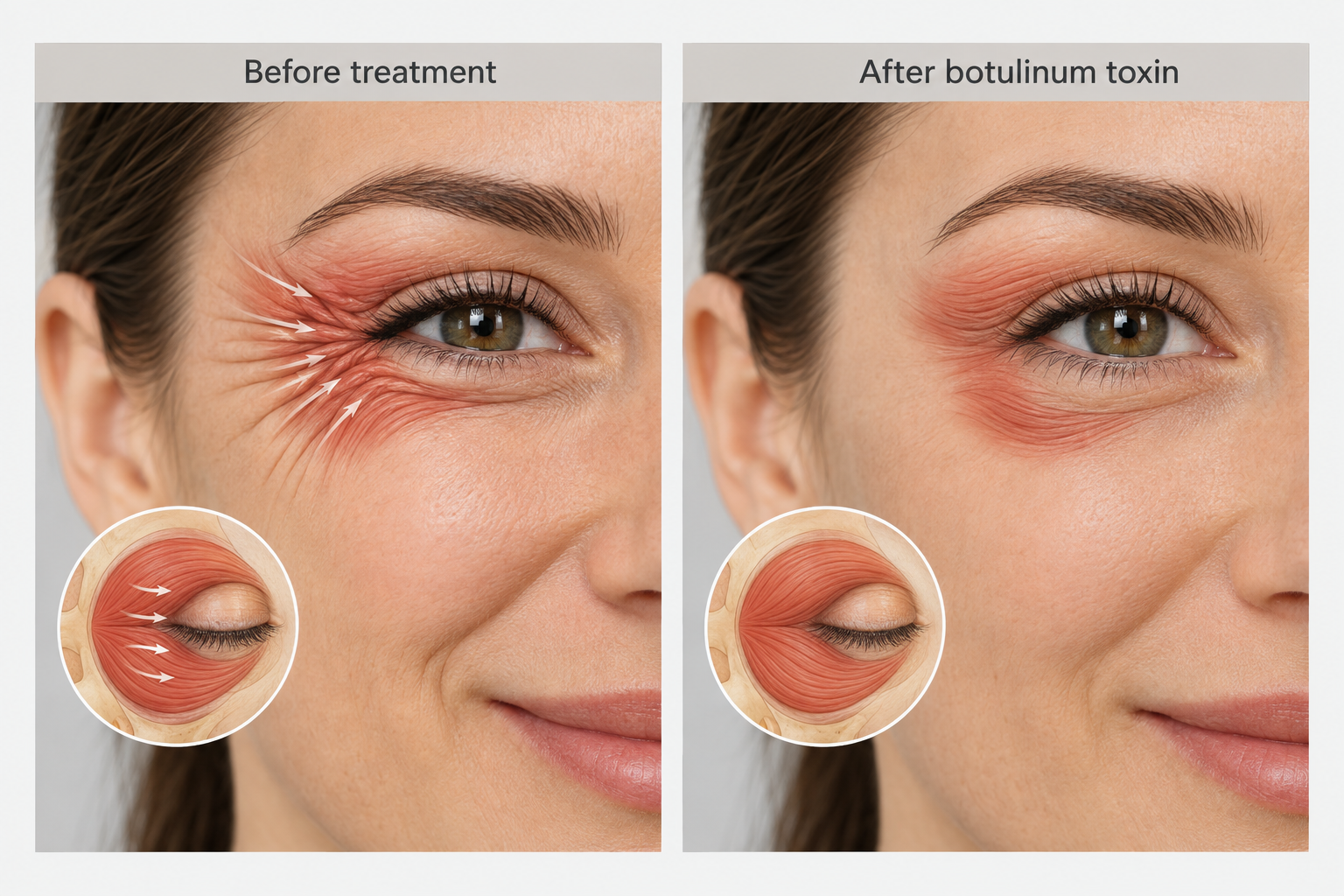
The treatment is administered as a series of small injections placed around the lateral orbital area. The procedure itself typically takes only a few minutes per side. Most patients describe the sensation as a brief, mild sting. No anaesthetic is usually required, though a topical numbing cream can be applied beforehand if preferred. There is no meaningful downtime; most people return to normal activities immediately, though practitioners generally advise avoiding strenuous exercise, alcohol, and lying flat for several hours after treatment.
Results from botulinum toxin for crow’s feet typically become visible within three to seven days, with the full effect usually apparent by two weeks. The duration of effect varies between individuals but commonly ranges from three to five months, after which the muscle gradually regains its normal activity and lines return. Regular maintenance treatments are required to sustain the result. Over time, some patients find that consistent treatment leads to a modest softening of static lines, as the skin has had extended periods without the mechanical stress of repeated folding.
Different botulinum toxin brands — including Botox, Dysport, and Azzalure — contain the same active ingredient but differ in formulation, unit measurement, and reconstitution. Units are not interchangeable between brands, and dosing decisions are made by the treating practitioner based on individual anatomy and muscle activity. The choice of brand is generally a clinical decision rather than a meaningful patient preference.
Who May Be Suitable for Botulinum Toxin Treatment?
Botulinum toxin for crow’s feet tends to produce the most noticeable improvement in patients whose lines are predominantly dynamic — meaning they are most visible during smiling or squinting and less prominent at rest. Patients with moderate to deep static lines may see some softening but are less likely to achieve complete resolution from botulinum toxin alone.
A thorough consultation should assess the depth and character of the lines, the strength and pattern of orbicularis oculi contraction, the quality and laxity of the surrounding skin, and the patient’s overall facial anatomy. Certain factors may affect suitability or require additional caution, including:
- Pregnancy or breastfeeding
- Known allergy to botulinum toxin or any product component
- Active infection or skin condition at the treatment site
- Neuromuscular conditions such as myasthenia gravis or Eaton-Lambert syndrome
- Certain medications, including some antibiotics and anticoagulants
- Previous adverse reactions to botulinum toxin
This list is not exhaustive. A qualified practitioner will take a full medical history before recommending treatment.
Risks and Side Effects of Botulinum Toxin Around the Eyes
Botulinum toxin treatment for crow’s feet has a well-established safety profile when performed by a trained and experienced practitioner, but it is not without risk. Common and generally temporary side effects include redness, swelling, and bruising at injection sites. These typically resolve within a few days.
More significant but less common complications include:
- Eyelid ptosis (drooping): Unintended spread of the toxin to the levator palpebrae muscle can cause temporary drooping of the upper eyelid. This is uncommon when treatment is performed correctly and resolves as the toxin wears off.
- Brow heaviness or descent: Relaxation of the lateral orbicularis oculi can occasionally affect brow position, particularly in patients with pre-existing brow ptosis.
- Asymmetry: Differences in muscle activity between sides can result in uneven results. This can often be corrected with a small additional treatment at a review appointment.
- Dry eye or altered tear distribution: Relevant in patients with pre-existing dry eye conditions; this should be discussed during consultation.
- Headache: Reported by some patients in the days following treatment, usually mild and self-limiting.
Serious complications are rare but possible with any injectable treatment. Choosing a practitioner with appropriate training, qualifications, and a clear understanding of periorbital anatomy significantly reduces risk.
Treating Static Crow’s Feet: Beyond Botulinum Toxin
When crow’s feet are visible at rest — not just during expression — botulinum toxin alone may not fully address the concern. Static lines reflect cumulative changes in skin structure, including collagen loss, reduced elasticity, and sometimes mild volume depletion in the lateral cheek and temple area. A combination approach is often more effective for these patients.

Dermal Fillers
Hyaluronic acid dermal fillers are occasionally used in the periorbital area to address volume loss or to soften deeper static lines. However, the skin around the eyes is thin and vascular, and filler placement in this region requires considerable technical skill and anatomical knowledge. The risk of complications — including vascular occlusion, the Tyndall effect (a bluish discolouration from superficially placed filler), and lumpiness — is higher in this area than in many other facial zones. Filler for crow’s feet specifically is less commonly performed than filler for the tear trough or cheek, and it is not appropriate for all patients. A careful assessment of the underlying cause of the lines is essential before considering this option.
Skin Resurfacing Treatments
Treatments that stimulate collagen remodelling and improve skin texture can complement or, in some cases, partially substitute for injectable treatments. Options that may be discussed in this context include:
- Laser resurfacing: Ablative and fractional laser treatments can improve skin texture, reduce fine lines, and stimulate new collagen formation. The periorbital area can be treated, though the thin skin around the eyes requires careful parameter selection. Downtime varies from a few days to several weeks depending on the depth of treatment.
- Radiofrequency microneedling: Combines microneedling with radiofrequency energy to stimulate collagen and elastin in the deeper dermis. May improve skin laxity and fine lines around the eye over a course of treatments.
- Chemical peels: Superficial to medium-depth peels can improve skin texture and mild fine lines. Deeper peels carry more risk around the eye area and require specialist assessment.
- Microneedling: Collagen induction therapy through fine needles may improve skin quality and superficial lines over a series of sessions, though evidence for significant improvement of established crow’s feet is more limited.
Energy-Based Skin Tightening
Devices using ultrasound energy (such as high-intensity focused ultrasound, or HIFU) or radiofrequency can target deeper tissue layers to stimulate collagen contraction and new collagen production. These treatments are sometimes used for mild skin laxity around the eye and brow area. Results are generally modest and gradual, appearing over two to three months, and are more suited to early laxity than to established deep wrinkles.
Topical Skincare
While no topical product can replicate the results of injectable or energy-based treatments, certain ingredients have meaningful evidence for improving skin quality and reducing the appearance of fine lines over time. Retinoids (vitamin A derivatives) are among the best-evidenced topical agents for stimulating collagen synthesis and improving skin texture. Broad-spectrum sunscreen is arguably the most important preventive measure, as UV protection directly slows the collagen degradation that contributes to static wrinkling. Peptides, antioxidants, and humectants such as hyaluronic acid may support skin hydration and barrier function, though their effect on established crow’s feet is modest.
Combination Approaches and Treatment Planning
For many patients, the most effective strategy for crow’s feet involves combining treatments that address different aspects of the concern. Botulinum toxin reduces the dynamic component by limiting muscle contraction. Skin-quality treatments such as laser resurfacing or radiofrequency microneedling address the structural changes in the dermis. Appropriate skincare supports and prolongs the results of clinical treatments. A practitioner experienced in facial aesthetics will assess which combination is appropriate based on the individual’s anatomy, skin type, depth of lines, and treatment goals.
It is worth noting that treating crow’s feet in isolation does not always produce the most harmonious result. The lateral eye area is closely connected visually and anatomically to the brow, temple, and upper cheek. A practitioner may recommend addressing adjacent areas — such as volume loss in the temple or cheek — as part of a broader facial assessment, rather than focusing exclusively on the lines at the eye corner.
How Long Do Results Last?
The longevity of results depends on the treatment used and the individual patient. Botulinum toxin for crow’s feet typically lasts three to five months, though some patients find effects persist slightly longer or shorter depending on their metabolism, muscle activity, and the dose administered. Skin resurfacing treatments may produce improvements that last one to two years or longer, but the underlying ageing process continues, and maintenance treatments are generally needed. Energy-based tightening treatments typically produce results lasting twelve to eighteen months on average, again with individual variation.
No currently available non-surgical treatment offers a permanent solution to crow’s feet. Surgical options such as lateral canthopexy or blepharoplasty can address more significant skin laxity and excess tissue around the eye, but these are distinct procedures with their own indications, risks, and recovery requirements, and are outside the scope of most aesthetic clinic consultations.
Prevention and Lifestyle Factors
While genetic factors significantly influence how and when crow’s feet develop, several modifiable lifestyle factors can slow their progression. Daily use of a broad-spectrum SPF 30 or higher sunscreen is the single most evidence-supported preventive measure for periorbital wrinkling. Wearing UV-protective sunglasses reduces both UV exposure and habitual squinting. Adequate hydration, a balanced diet rich in antioxidants, not smoking, and consistent use of a retinoid-containing eye cream from an appropriate age can all contribute to maintaining skin quality over time. These measures are most effective as prevention; they are unlikely to significantly reverse established deep static lines.
Frequently Asked Questions
At what age do crow’s feet typically appear?
Crow’s feet can begin to appear as dynamic lines — visible only during expression — in the late twenties or early thirties. The age at which they become static, meaning visible at rest, varies considerably depending on genetics, sun exposure history, skin type, and lifestyle. Some people notice static lines in their mid-thirties; others not until their forties or later.
Will botulinum toxin make my eyes look unnatural or frozen?
When administered by an experienced practitioner at an appropriate dose, botulinum toxin for crow’s feet should soften lines without eliminating all expression. The goal is a natural-looking reduction in wrinkling during movement, not complete immobility. Over-treatment can produce an unnatural appearance, which is one reason why choosing a qualified and experienced practitioner matters. Results are temporary, so any effect — including an unwanted one — will resolve as the toxin wears off.
Can I treat crow’s feet with skincare alone?
Topical skincare, particularly retinoids and sunscreen, can improve skin quality and may reduce the appearance of very fine superficial lines over time. However, established crow’s feet — especially those visible at rest — are unlikely to be significantly improved by skincare alone. Skincare is most valuable as a preventive measure and as a complement to clinical treatments.
Is there any downtime after botulinum toxin treatment for crow’s feet?
Most patients experience no meaningful downtime. Mild redness and occasional small bruises at injection sites are the most common immediate effects and typically resolve within a few days. Practitioners usually advise avoiding strenuous exercise, alcohol, and significant heat exposure for the remainder of the day after treatment.
Can crow’s feet be treated during pregnancy or breastfeeding?
Botulinum toxin is not recommended during pregnancy or breastfeeding. Most other aesthetic treatments, including laser resurfacing and chemical peels, are also generally avoided during this period. Patients who are pregnant, planning to become pregnant, or breastfeeding should discuss their situation with a qualified practitioner before considering any treatment.
How many botulinum toxin sessions will I need?
A single treatment session addresses crow’s feet for the duration of the toxin’s effect, typically three to five months. Ongoing maintenance sessions are required to sustain the result. Some patients choose to have treatment two to three times per year; others prefer to treat only when lines become noticeable again. There is no fixed schedule that applies to everyone.
Are there non-injectable alternatives worth considering?
Yes. Depending on the nature and depth of the crow’s feet, options such as laser resurfacing, radiofrequency microneedling, HIFU, and chemical peels may be appropriate either as alternatives or as complementary treatments. These are generally better suited to improving skin quality and static lines than to addressing the dynamic component that botulinum toxin targets. A practitioner can advise on which approach or combination is most likely to address your specific concerns.
Making an Informed Decision About Crow’s Feet Treatment
Crow’s feet are a normal part of facial ageing, and the decision to treat them — or not — is entirely personal. For those who find them a meaningful concern, effective options exist, with botulinum toxin offering the strongest evidence base for dynamic lines and a range of complementary treatments available for static wrinkling and skin quality. Realistic expectations are important: treatments can meaningfully reduce the appearance of crow’s feet and slow their progression, but they do not stop the ageing process, and maintenance is an ongoing commitment.
The most useful first step is a consultation with a qualified aesthetic practitioner who can assess your specific anatomy, skin type, and goals, explain which options are appropriate for you, and give you an honest picture of what results are realistically achievable. A good consultation should feel informative rather than pressured, and should leave you with a clear understanding of the proposed treatment, its limitations, and the alternatives available to you.


