Cheek Filler Cost UK: What Drives the Price and What to Budget For
Cheek filler prices in the UK typically range from around £250 to £900 or more per session, but that headline figure tells you very little about what you are actually paying for. The real cost depends on a combination of factors — how much product you need, which filler brand is used, where the clinic is located, and critically, who is performing the treatment. Understanding these variables helps you compare quotes meaningfully, spot potential red flags, and budget realistically for both the initial treatment and any ongoing maintenance.
Key Takeaways
- Cheek filler cost in the UK varies widely based on practitioner qualifications, filler brand, volume required, and clinic location — not just the treatment area itself.
- Because cheeks require bilateral treatment (both sides of the face), the total product volume — and therefore cost — is higher than for many single-area treatments.
- Premium filler brands such as Juvederm Voluma and Restylane Lyft cost more per syringe but may offer longer-lasting results, affecting the true annual cost of maintenance.
- A consultation fee, two-week review, and access to hyaluronidase for emergencies are all part of a responsible treatment package and should be factored into your budget.
- Prices significantly below the market average are a meaningful safety signal, not just a bargain — the risks of poorly performed cheek filler can be serious.
What Is the Typical Cheek Filler Cost in the UK?
Most UK clinics price cheek filler on a per-syringe or per-ml basis, with a single 1ml syringe typically costing between £250 and £500 depending on the brand and clinic. Because a full cheek treatment almost always involves bilateral treatment — addressing both cheeks symmetrically — the practical starting point for most patients is 2ml, bringing the product cost alone to £500–£900 or more. Patients with more significant midface volume loss, or those seeking a more pronounced cheekbone definition, may require 3ml or more across a course of treatment.
London clinics, particularly those in areas such as Harley Street or Chelsea, typically charge a 15–30% premium above regional averages, reflecting higher clinic overheads and, in many cases, more experienced practitioners. Clinics in the North of England, the Midlands, and Scotland tend to sit at the lower end of the price range, though this does not automatically indicate lower quality. The table below gives a general sense of how pricing varies by volume and region.
| Volume | Typical Goal | London Estimate | Regional Estimate |
|---|---|---|---|
| 1ml (0.5ml per side) | Subtle contouring or early volume loss | £350–£550 | £250–£400 |
| 2ml (1ml per side) | Moderate volume restoration or lift | £600–£900 | £450–£700 |
| 3ml+ (1.5ml+ per side) | Significant age-related volume loss | £850–£1,400+ | £650–£1,100+ |
These figures are indicative. Your practitioner should provide a written treatment plan with a clear breakdown of product, volume, and any additional fees before you commit to anything.
How Much Filler Do You Actually Need?
The volume of filler required is one of the most significant cost drivers, and it varies considerably between patients. A younger patient seeking subtle cheekbone definition with minimal volume loss may achieve a natural result with 1ml total (0.5ml per side). Someone in their forties or fifties experiencing noticeable midface volume loss — where the cheeks have flattened and the nasolabial folds have deepened — is more likely to need 2–3ml to achieve a meaningful improvement. Patients with more advanced facial ageing or structural changes may require staged treatment across multiple sessions.
It is worth noting that well-placed cheek filler can sometimes soften the appearance of nasolabial folds simultaneously, because restoring midface volume lifts the overlying tissue. This means that addressing the cheeks alone may reduce the need for separate filler in adjacent areas, which has a practical effect on your overall treatment budget. A thorough facial assessment at consultation should identify whether this applies to your anatomy.
Filler Brand and Product Quality
The brand of filler used has a direct impact on the per-syringe cost and on how long results may last. In the UK, the most widely used premium cheek fillers are Juvederm Voluma (manufactured by Allergan/AbbVie) and Restylane Lyft (manufactured by Galderma). Both are CE-marked hyaluronic acid fillers specifically formulated for deep injection into the midface, and both have established safety profiles supported by clinical data.
Juvederm Voluma uses Vycross cross-linking technology, which produces a firm, cohesive gel suited to providing structural lift in the cheek area. Clinical studies suggest results may last up to 18–24 months in the cheeks, which is longer than many other facial areas due to the relatively low movement of the midface. Restylane Lyft uses NASHA gel technology and is similarly indicated for cheek augmentation, with results typically lasting 12–18 months. Restylane Contour, which uses XpresHAn Technology, is another option sometimes used for more flexible, natural-looking cheek enhancement.
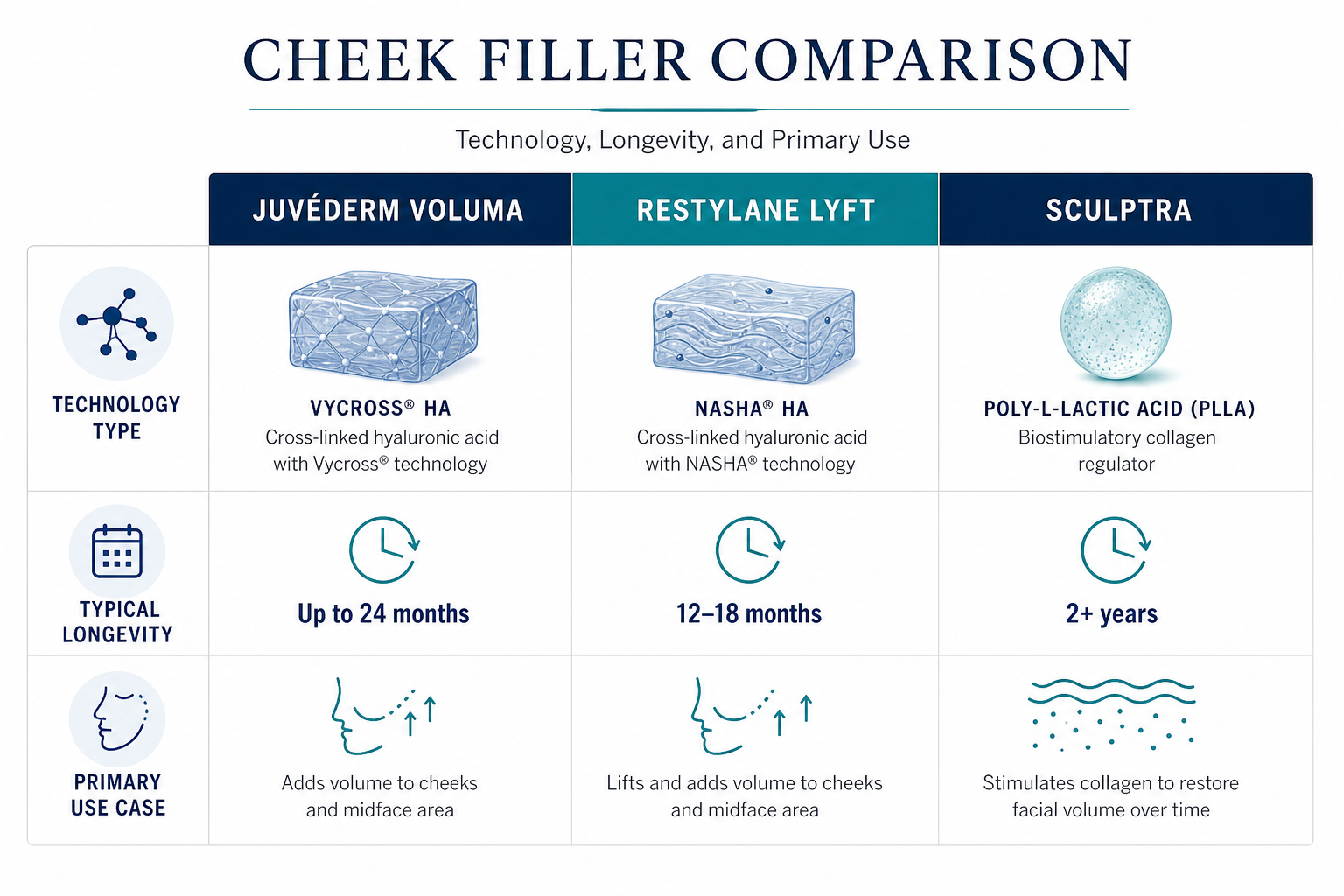
Sculptra (poly-L-lactic acid) and Radiesse (calcium hydroxylapatite) are biostimulator-type products sometimes used in the midface. These work differently from standard hyaluronic acid fillers — they stimulate collagen production rather than adding immediate volume — and may last two years or more. They are generally priced similarly to or above premium HA fillers per session, but the longer duration can make them cost-effective over time.
Non-branded or mid-range HA fillers are available at lower price points, but they may not be specifically formulated for deep cheek injection, and their longevity and safety data are less well established. A reputable clinic will be transparent about which product they are using and why it is appropriate for your treatment goals.
Practitioner Qualifications and Clinic Type
Practitioner qualifications are one of the most important — and most price-relevant — factors in cheek filler treatment. In the UK, cheek filler can currently be administered by a range of practitioners, including doctors, dentists, nurses, pharmacists, and, in some settings, individuals without a healthcare background. This variation in training and accountability is directly reflected in pricing.
A doctor-led clinic, where a GMC-registered doctor either performs the treatment or directly supervises it, typically charges more than a beauty therapist-led setting. This premium reflects not only the practitioner’s clinical training but also their ability to manage complications — including vascular occlusion, a rare but serious risk where filler inadvertently enters a blood vessel. Cheek filler is injected in close proximity to important facial vessels, making anatomical knowledge and emergency management capability genuinely important.
When assessing a clinic, look for practitioners registered with the General Medical Council (GMC), Nursing and Midwifery Council (NMC), or General Dental Council (GDC). Voluntary registers such as the JCCP (Joint Council for Cosmetic Practitioners) and Save Face provide an additional layer of accountability, as listed practitioners have agreed to meet defined standards of training, insurance, and practice. Practitioners holding a Level 7 aesthetic qualification have completed postgraduate-level training in facial anatomy and complication management.
The UK government has announced a licensing regime for non-surgical cosmetic procedures, expected to come into effect from late 2026. When implemented, this will require practitioners performing certain aesthetic treatments — including dermal filler injections — to hold a licence, which is likely to raise the baseline standard of practice and may affect pricing and practitioner availability across the market.
Injection Technique as a Pricing Factor
The injection technique used by your practitioner can affect both the cost of treatment and your recovery experience. Cheek filler can be administered using a sharp needle or a blunt-tipped cannula. Cannula technique involves a single entry point through which the practitioner threads a flexible tube to deposit filler across a wider area, reducing the number of puncture sites and generally lowering the risk of bruising and swelling. Many experienced practitioners charge a premium for cannula-based treatment, reflecting the additional skill required.
Needle technique allows for more precise placement in specific anatomical points and is often used for structural cheekbone definition. Some practitioners use a combination of both approaches depending on the treatment goal and the patient’s anatomy. The choice of injection technique should be explained during your consultation as part of your treatment plan, not presented as an upsell after the fact.
Hidden and Additional Costs to Budget For
The quoted price for cheek filler often covers only the product and the injection appointment itself. Several additional costs are worth factoring into your total budget before you book.
- Consultation fee: Many reputable clinics charge a consultation fee of £20–£150. Some clinics make this redeemable against treatment if you proceed. Be cautious of clinics that offer free consultations with no clinical assessment — a thorough facial evaluation takes time and expertise.
- Two-week review appointment: A responsible clinic will offer a follow-up appointment approximately two weeks after treatment to assess the result and address any concerns. This should ideally be included in the quoted price, but confirm this in advance.
- Top-up treatment: If additional product is needed at the review stage to achieve the agreed result, a top-up treatment may be charged separately, typically £50–£150 depending on the volume required.
- Hyaluronidase availability: Hyaluronidase is an enzyme that can dissolve hyaluronic acid filler and is used in the management of vascular complications. Any clinic performing HA filler injections should have hyaluronidase on-site and a practitioner trained to administer it. If you later need filler dissolved for aesthetic reasons, this is typically charged at £150–£250 per session.
- Aftercare products: Some clinics include aftercare products such as arnica gel or SPF in the treatment price; others charge separately.
- Corrective treatment: If results are unsatisfactory or complications arise, corrective treatment may involve additional costs not covered by the original fee.
The True Annual Cost of Cheek Filler Maintenance
Because cheek filler results are temporary, understanding the long-term cost is more useful than focusing solely on the upfront price. Hyaluronic acid cheek fillers typically last 12–24 months, depending on the product used, the volume injected, your metabolism, and lifestyle factors such as sun exposure and smoking. Biostimulators such as Sculptra may last two years or more but often require an initial course of two to three sessions.
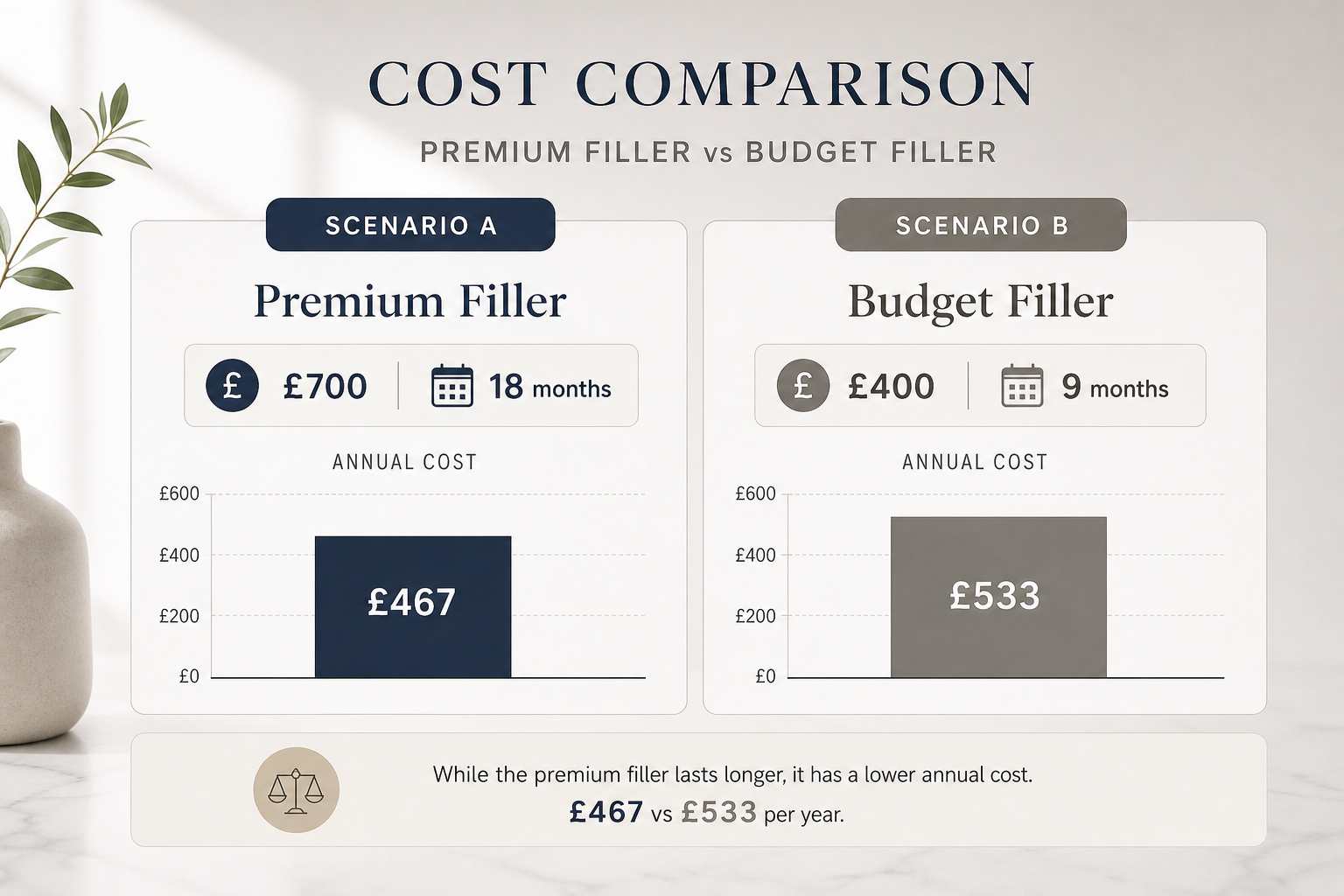
To illustrate the difference in annual cost, consider a patient who chooses a premium product such as Juvederm Voluma at £700 for 2ml, with results lasting 18 months. The annualised cost is approximately £467 per year. A patient who chooses a cheaper, shorter-lasting product at £400 for 2ml with results lasting only 9 months would pay approximately £533 per year — more in total, despite the lower upfront price. This calculation does not account for consultation fees, reviews, or top-ups, which add to the real cost in both scenarios.
Some patients choose to have a top-up treatment before the filler has fully dissolved, which can maintain results with a smaller volume of product than starting from scratch. Others prefer to allow the filler to wear off completely between treatments. Your practitioner should help you develop a maintenance approach that suits both your aesthetic goals and your budget.
Finance and Payment Options
A growing number of UK aesthetic clinics offer payment plans or 0% finance options for cosmetic treatments, including cheek filler. These arrangements allow patients to spread the cost of treatment over several months without interest, though the availability and terms vary between providers. If you are considering a payment plan, check whether the finance is provided directly by the clinic or through a third-party lender, and confirm the total repayable amount and any conditions. Finance should never be a reason to proceed with a treatment you are uncertain about — it is a payment convenience, not a reason to rush a decision.
Price Red Flags: When Cheap Becomes a Risk
Cheek filler is not a commodity service where the cheapest option is simply the best value. The cheek area involves injection near important facial blood vessels, and the consequences of a vascular complication — including tissue damage or, in very rare cases, vision changes — can be serious and require immediate medical management. A practitioner who lacks the training, anatomical knowledge, or emergency supplies to handle such an event represents a genuine clinical risk, regardless of how low their price is.
As a general guide, cheek filler priced below approximately £150–£200 per area should prompt serious questions about what is being compromised. At that price point, it is difficult to account for the cost of a CE-marked filler product, appropriate insurance, a clinical setting, and a qualified practitioner. Unusually low prices may also indicate the use of non-CE-marked products sourced outside regulated supply chains, which carry additional safety risks.
Practical red flags to watch for include: no consultation or clinical assessment before treatment; pressure to book immediately; no mention of a treatment plan or aftercare; inability to confirm the filler brand or batch number; no hyaluronidase on-site; and practitioners who cannot demonstrate registration with a recognised professional body or voluntary register such as the JCCP or Save Face.
What a Responsible Quote Should Include
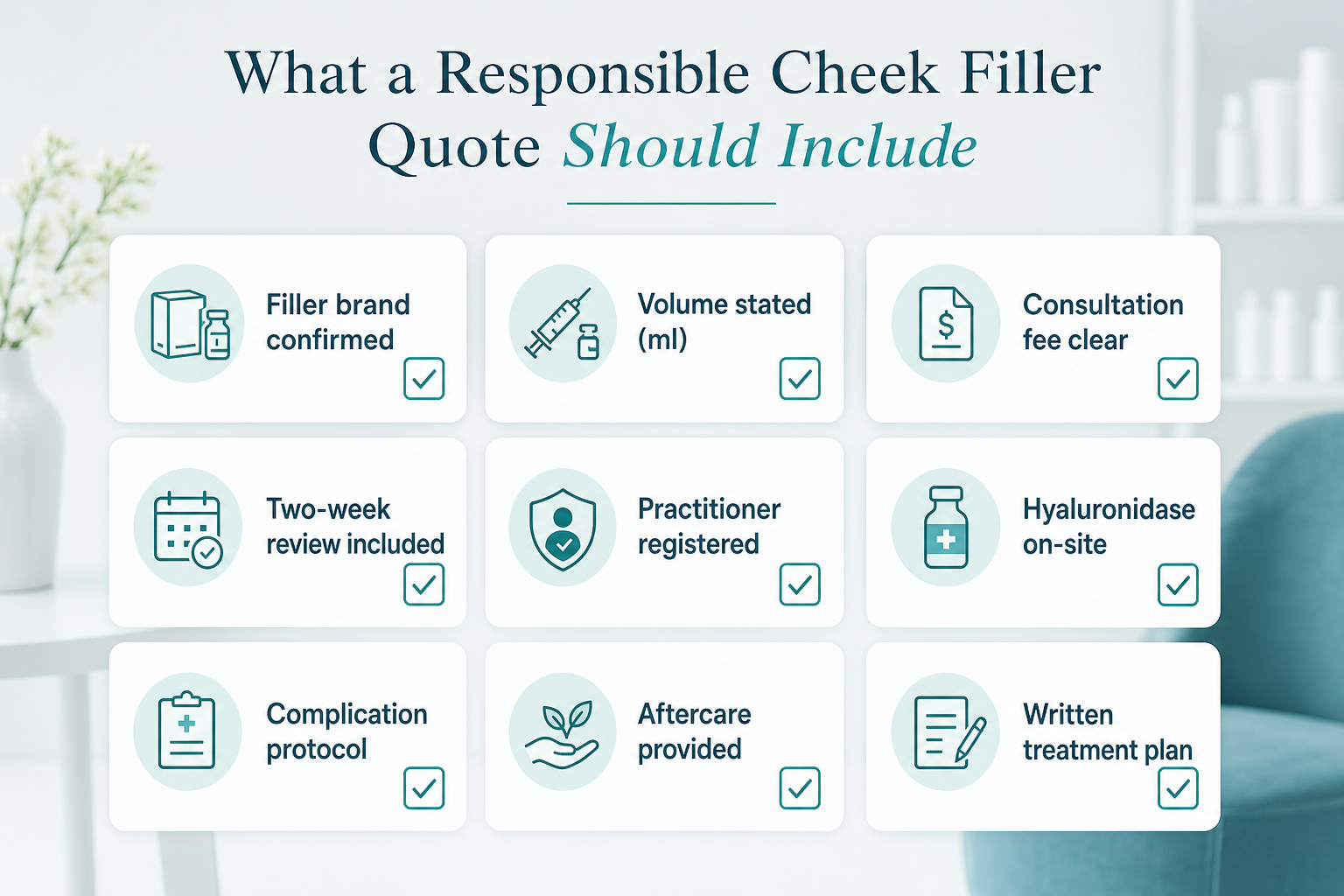
Before committing to cheek filler treatment, ask the clinic to confirm what is included in the quoted price. A transparent and responsible clinic should be able to confirm the following:
- The specific filler brand and product being used, and why it is appropriate for your goals
- The volume of filler included in the price (per syringe or per ml)
- Whether the consultation fee is included or redeemable against treatment
- Whether a two-week review appointment is included
- The practitioner’s qualifications and professional registration
- Whether hyaluronidase is available on-site
- The clinic’s complication management protocol
- Whether aftercare guidance and products are provided
- The cancellation and refund policy
A written treatment plan outlining your agreed goals, the product to be used, the volume, and the expected outcome is a sign of a professional clinic. If a clinic is reluctant to provide this information clearly, that itself is a reason to look elsewhere.
Frequently Asked Questions
Is 1ml of cheek filler enough?
For some patients — particularly younger individuals seeking subtle cheekbone definition rather than volume restoration — 1ml total (0.5ml per side) may be sufficient. However, for patients with noticeable midface volume loss or those seeking a more significant lift, 2ml or more is typically required to achieve a natural and lasting result. Your practitioner should assess your facial anatomy and discuss realistic expectations at consultation.
Why do cheek filler prices vary so much between clinics?
Price variation reflects genuine differences in practitioner qualifications, filler brand and quality, clinic location and overheads, injection technique, and what is included in the quoted price. A lower price does not automatically mean poor quality, but a significantly below-average price warrants careful scrutiny of what is being offered and by whom.
How long does cheek filler last?
Cheek filler tends to last longer than filler in higher-movement areas such as the lips. Premium hyaluronic acid products such as Juvederm Voluma may last 18–24 months in the cheeks; Restylane Lyft typically lasts 12–18 months. Individual factors including metabolism, lifestyle, and the volume injected all influence longevity. Results vary between patients.
Can cheek filler be dissolved if I am unhappy with the result?
Hyaluronic acid fillers can be dissolved using hyaluronidase, an enzyme that breaks down the filler material. This is typically charged separately at around £150–£250 per session. Non-HA fillers such as Sculptra or Radiesse cannot be dissolved in the same way, which is an important consideration when choosing a product. Ensure your clinic has hyaluronidase available before proceeding with any HA filler treatment.
Does the NHS provide cheek filler for volume loss?
Cheek filler for cosmetic purposes is not available on the NHS. In rare cases, significant facial volume loss related to a medical condition — such as HIV-associated lipoatrophy or post-illness facial wasting — may be considered in a clinical context, but this would be assessed and managed through appropriate medical channels rather than a cosmetic clinic.
Are payment plans available for cheek filler in the UK?
Some UK aesthetic clinics offer 0% finance or payment plans, allowing patients to spread the cost of treatment over several months. Availability varies by clinic. Always confirm the total repayable amount and the terms of any finance agreement before proceeding.
Budgeting Realistically for Cheek Filler Treatment
Cheek filler cost in the UK is genuinely variable, and that variability is meaningful — it reflects real differences in safety, quality, and clinical expertise, not just marketing. The most useful approach is to establish a realistic total budget that accounts for the product volume you are likely to need, the practitioner qualifications you should expect, the clinic’s location, and the additional costs that a responsible treatment package involves.
For most patients, a realistic starting budget for a bilateral cheek filler treatment with a qualified practitioner using a premium CE-marked filler is £500–£900, excluding consultation fees and follow-up. Patients with more significant volume loss or those seeking staged treatment should budget accordingly. Comparing quotes on price alone, without understanding what each quote includes and who is performing the treatment, is unlikely to lead to the best outcome.
If you are considering cheek filler, book a consultation with a practitioner registered with the GMC, NMC, or GDC, or listed on the JCCP or Save Face register. Use the consultation to ask detailed questions about the product, the technique, the treatment plan, and what happens if something goes wrong. A practitioner who welcomes those questions is a practitioner worth trusting with your face.