Testosterone Cypionate Price UK: What Affects the Cost and What to Expect
Testosterone cypionate is one of the most widely discussed options for testosterone replacement therapy (TRT), yet its pricing in the UK is rarely straightforward. Unlike some medications with a fixed NHS list price, testosterone cypionate sits in a complex regulatory and supply position that causes costs to vary considerably depending on where you access it, how it is sourced, and what monitoring is included. This guide explains the key factors that determine what you will actually pay, from the medication itself to the full annual cost of treatment.
Key Takeaways
- Testosterone cypionate is a prescription-only medicine (POM) and a Class C controlled drug in the UK, meaning it can only be legally obtained with a valid private prescription from a licensed prescriber.
- Because testosterone cypionate is not a UK-licensed product, it is typically sourced on a named-patient basis through a compounding pharmacy or imported with MHRA authorisation, which adds cost compared with licensed alternatives.
- The medication cost alone is only part of the picture — initial setup costs, monitoring blood panels, and consultation fees can add several hundred pounds, particularly in the first year.
- Comparing price per milligram rather than price per vial gives a more accurate picture of value when evaluating different concentrations and pack sizes.
- A shared care agreement with an NHS GP can reduce ongoing costs significantly after the initial private assessment.
Why Testosterone Cypionate Has a Unique Pricing Position in the UK
Testosterone cypionate is a long-acting ester of testosterone, meaning it releases slowly after injection and typically requires dosing once or twice per week. Pharmacologically, it is very similar to testosterone enanthate, differing mainly in the length of its carbon chain. However, the key difference for UK patients is regulatory rather than pharmacological: testosterone cypionate is not a standard UK-licensed product. Testosterone enanthate has licensed products available in the UK market, whereas testosterone cypionate often needs to be sourced through a compounding pharmacy or imported on a named-patient basis with appropriate MHRA authorisation.
This regulatory distinction has a direct effect on price. A licensed medication can be dispensed routinely by any GPhC-registered pharmacy at a predictable cost. Testosterone cypionate, by contrast, may need to be manufactured or imported specifically to fulfil a bespoke prescription for an individual patient. That additional step — whether it involves a specialist compounding pharmacy or a licensed pharmaceutical importer — introduces costs that do not apply to standard dispensing. Patients considering testosterone cypionate should understand this from the outset, because it explains why prices can appear inconsistent across different providers.
Legal Status and Why It Matters for Cost
Testosterone cypionate is classified as a Class C controlled drug under the Misuse of Drugs Act 1971 and is also a prescription-only medicine (POM). It falls under Schedule 4 Part 2 of the Misuse of Drugs Regulations, which governs how it can be prescribed, dispensed, and stored. Practically, this means it cannot be purchased legally without a valid private prescription from a qualified prescriber, and it cannot be legally imported by post or courier for personal use outside of a regulated supply chain.
The controlled drug status affects pricing indirectly. Pharmacies handling Schedule 4 controlled drugs must meet additional regulatory requirements, and specialist importers must hold appropriate MHRA authorisation. These compliance costs are reflected in the final price to the patient. It also means that significantly cheaper sources operating outside this framework are not operating legally, and the quality and safety of such products cannot be verified.
NHS vs Private Access: A Significant Cost Divide
| Access Route | Medication Options | Approximate Medication Cost | Monitoring Included | Typical Annual Cost |
|---|---|---|---|---|
| NHS | Sustanon 250, Nebido, testosterone gels | £9.90 per prescription item (England); free in Scotland, Wales, NI | Yes, via GP or endocrinology | Low — primarily prescription charges |
| Private clinic (subscription model) | Testosterone cypionate, enanthate, and others | £119–£140/month (all-in) | Often included or partially included | £1,400–£1,680 ongoing |
| Private clinic (itemised model) | Testosterone cypionate and others | Medication billed separately | Billed per blood panel and consultation | £1,200–£3,600 depending on frequency |
| GPhC-registered pharmacy (direct) | Testosterone cypionate (named-patient) | Approximately £136 per 10ml multi-dose vial plus delivery | Not included | Varies — medication only |
The standard NHS formulary for hypogonadism does not include testosterone cypionate. NHS TRT options are Sustanon 250, Nebido, and testosterone gels. For patients who qualify for NHS treatment, the cost is simply the standard prescription charge — currently £9.90 per item in England, and free in Scotland, Wales, and Northern Ireland. This makes NHS TRT dramatically cheaper than private treatment, but access depends on meeting clinical criteria for hypogonadism, and waiting times for specialist referral can be lengthy.
Private access to testosterone cypionate involves costs at every stage. The total annual cost of private TRT in the UK typically ranges from approximately £1,200 to £3,600, depending on the clinic, the treatment protocol, and how frequently monitoring is carried out. Understanding what drives that range requires looking at each cost component separately.
Breaking Down the Actual Cost Components
Initial Setup Costs
Before a single injection is administered, patients accessing private TRT typically face a set of initial setup costs. An initial consultation with a private prescriber generally costs between £100 and £250. Comprehensive blood testing — which should include total and free testosterone, sex hormone-binding globulin (SHBG), luteinising hormone (LH), follicle-stimulating hormone (FSH), haematocrit, and a metabolic panel — typically adds £150 to £350. A follow-up consultation to review results and confirm the prescription may cost a further £50 to £150. In total, patients should expect to invest approximately £250 to £500 before treatment begins. These initial setup costs are unavoidable at a reputable clinic and are not usually included in the ongoing monthly medication price.
Medication Cost: Price Per Milligram, Not Price Per Vial
Testosterone cypionate is most commonly supplied in a multi-dose vial, typically 10ml. The two standard concentrations are 200mg/ml and 250mg/ml. A 10ml vial at 200mg/ml contains 2,000mg of testosterone cypionate in total, while the same volume at 250mg/ml contains 2,500mg. Comparing the price per milligram rather than the price per vial is the only meaningful way to assess value, because a higher-concentration vial at a higher price may actually represent a lower cost per dose.
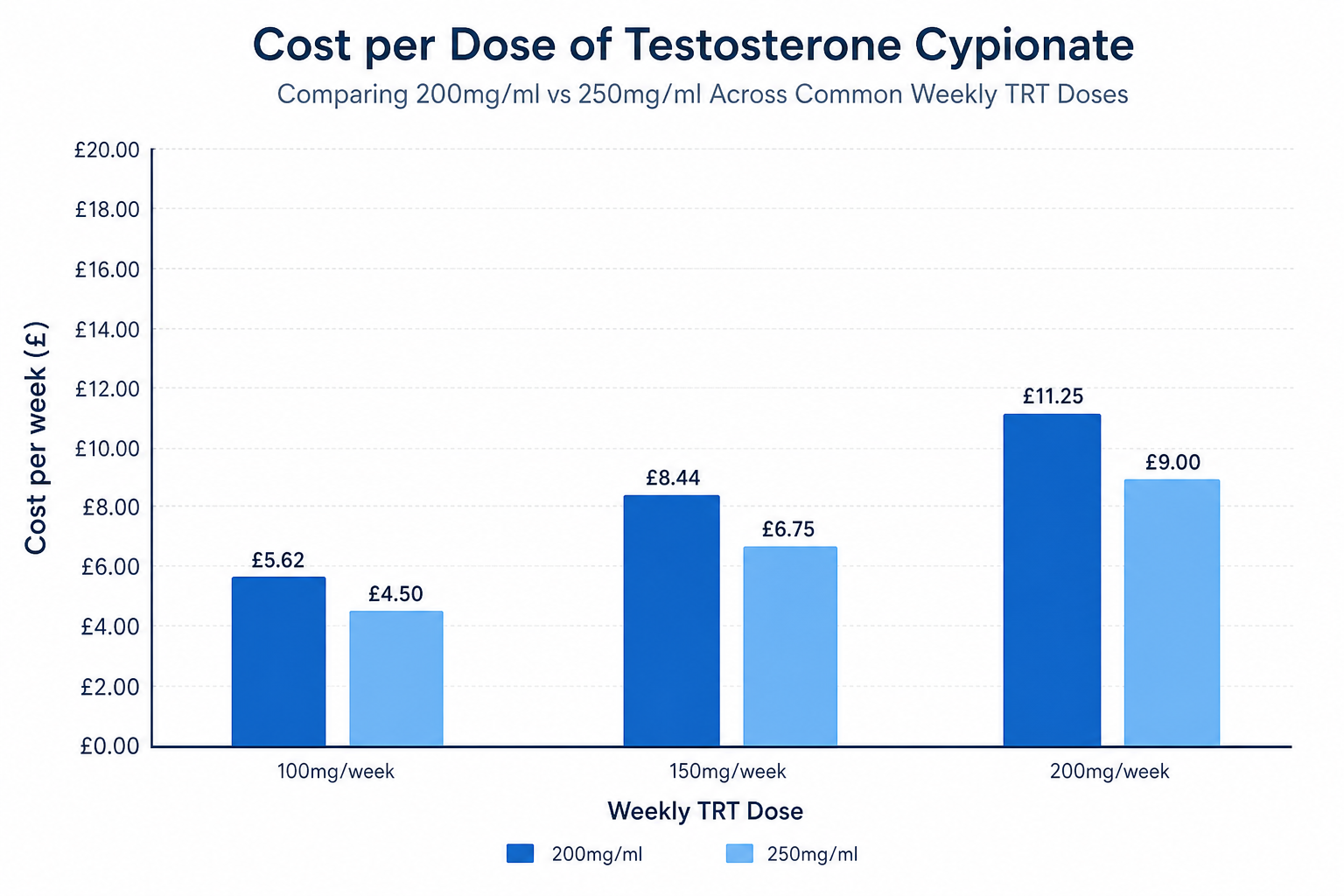
Regulated UK pharmacy prices for testosterone cypionate on a named-patient basis are considerably higher than the raw vial prices sometimes quoted online. One regulated GPhC-registered pharmacy charges approximately £136 for a 10ml multi-dose vial plus a special delivery fee. At a common TRT dose of 100mg per week, a 200mg/ml vial provides 20 doses, meaning the medication cost alone works out at approximately £6.80 per week or around £29 per month from that source. At 150mg per week, the same vial lasts approximately 13 weeks, and at 200mg per week, approximately 10 weeks. Patients should work through this calculation using their prescribed dose and the actual price quoted by their pharmacy, not a headline vial price.
Some private TRT subscription providers offer testosterone cypionate at a fixed monthly price of approximately £119 to £140, which may include the medication, injection supplies, and some degree of clinical oversight. Itemised clinics bill separately for each element, which can be cheaper or more expensive depending on how frequently monitoring is required.
Monitoring Blood Panels and Follow-Up Consultations
Responsible TRT requires regular monitoring. A monitoring blood panel typically includes haematocrit, haemoglobin, PSA (in older men), liver enzymes, lipid profile, and hormone levels. Clinics vary considerably in how they structure this. Some include quarterly blood panels in a monthly subscription fee. Others bill each panel separately at £80 to £200 per test. The difference between quarterly and bi-annual monitoring can add several hundred pounds to the annual cost of treatment. Patients comparing clinic prices should establish clearly whether monitoring is included, how frequently it is conducted, and what happens if results require an additional consultation.
Injection Equipment and Administration Costs
Testosterone cypionate is administered by subcutaneous injection or intramuscular injection, depending on the prescribing protocol. Patients self-administering at home require needles, syringes, and sharps disposal. These consumables are a modest but ongoing cost — typically £10 to £30 per month depending on injection frequency and the supplier. Some clinics include injection equipment in their monthly fee; others do not. Patients who prefer clinic-administered injections will pay a per-visit fee that can significantly increase the annual cost of treatment.
Why Testosterone Cypionate Costs More Than Sustanon in the UK
Patients sometimes ask why testosterone cypionate appears to cost more than Sustanon 250, which is a licensed UK product available through the NHS formulary. The answer lies in the supply chain. Sustanon 250 is manufactured by a major pharmaceutical company, is licensed in the UK, and can be dispensed by any pharmacy from standard stock. Testosterone cypionate, by contrast, must either be compounded by a specialist compounding pharmacy as a licensed special or imported on a named-patient basis through a distributor holding MHRA authorisation. Each of these routes involves additional regulatory steps, quality assurance processes, and handling costs that are absent from standard dispensing. The import or compounding premium is real and is not simply a clinic markup.
Testosterone enanthate occupies a middle position. Licensed testosterone enanthate products exist in the UK market, making it somewhat easier and cheaper to source than testosterone cypionate, though private clinics may still charge a premium for it compared with NHS Sustanon. For patients whose primary goal is effective TRT rather than a specific ester, the pharmacological similarity between testosterone cypionate and testosterone enanthate means the choice may reasonably be guided by cost and availability rather than clinical preference.
How a Shared Care Agreement Can Reduce Long-Term Costs
A shared care agreement is an arrangement in which a private specialist initiates TRT and then transfers ongoing prescribing and monitoring responsibility to an NHS GP. Not all NHS GPs will accept shared care for testosterone cypionate, partly because it is not a licensed UK product and falls outside the standard NHS formulary. However, some GPs will agree to prescribe and monitor once a private specialist has established the diagnosis, the appropriate dose, and the treatment protocol.
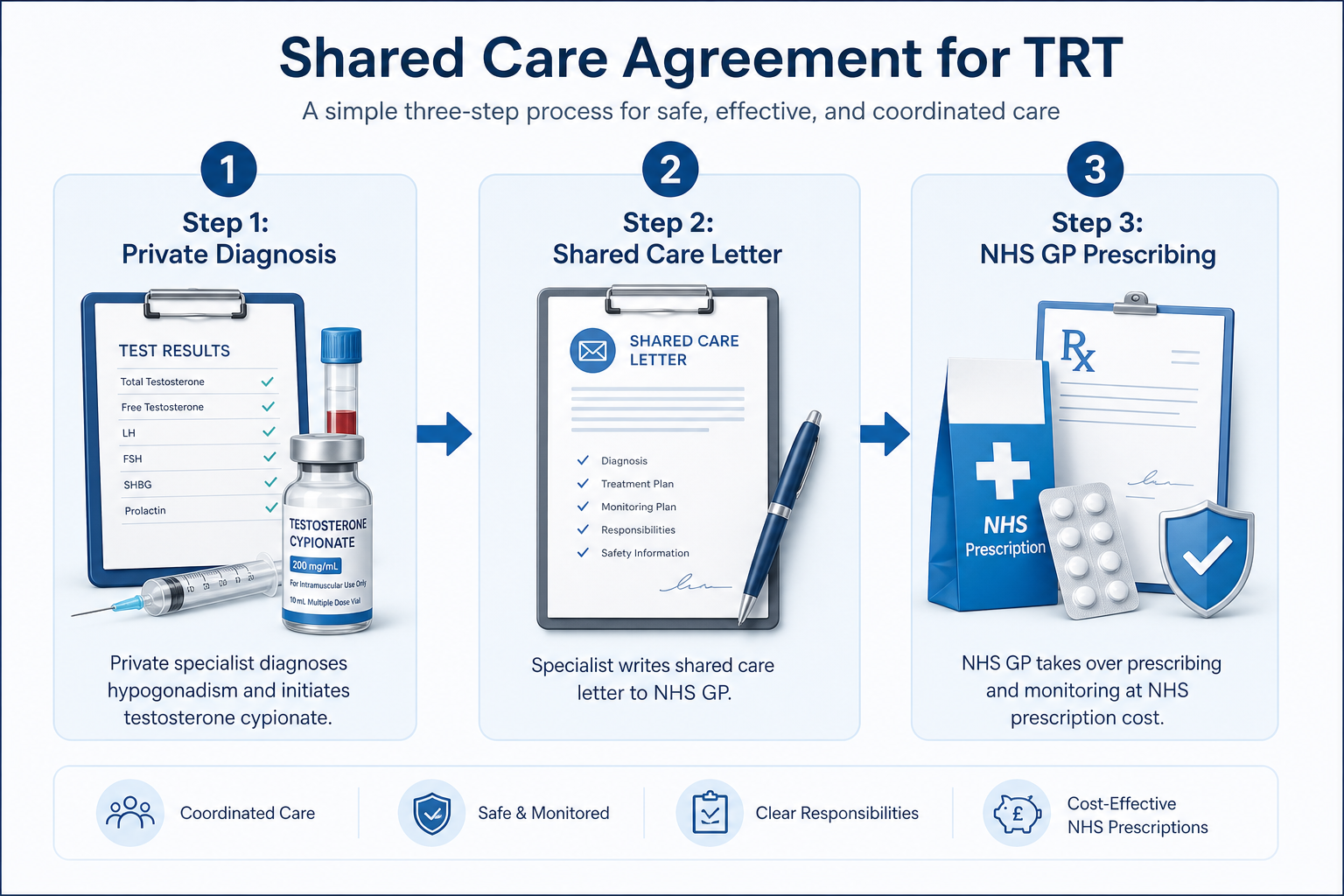
Where a shared care agreement is successfully established, the ongoing medication cost reverts to the standard NHS prescription charge, and monitoring blood panels may be conducted through NHS pathology services. This can reduce the annual cost of treatment substantially after the first year. Patients interested in this route should discuss it explicitly with their private prescriber at the outset, ask whether the clinic has experience facilitating shared care arrangements, and be prepared for the possibility that their GP may decline. The process typically requires a detailed letter from the private specialist and may take several months to arrange.
Year One vs Year Two: How Costs Change Over Time
The first year of private TRT is almost always the most expensive. Initial setup costs, which are non-recurring, inflate the year-one total significantly. A patient paying £300 in initial consultation and blood testing fees, then £140 per month for medication and monitoring, will spend approximately £1,980 in year one. In year two, with no setup costs and assuming stable dosing, the same patient might spend approximately £1,680. If a shared care agreement is established in year two, costs could fall further still.
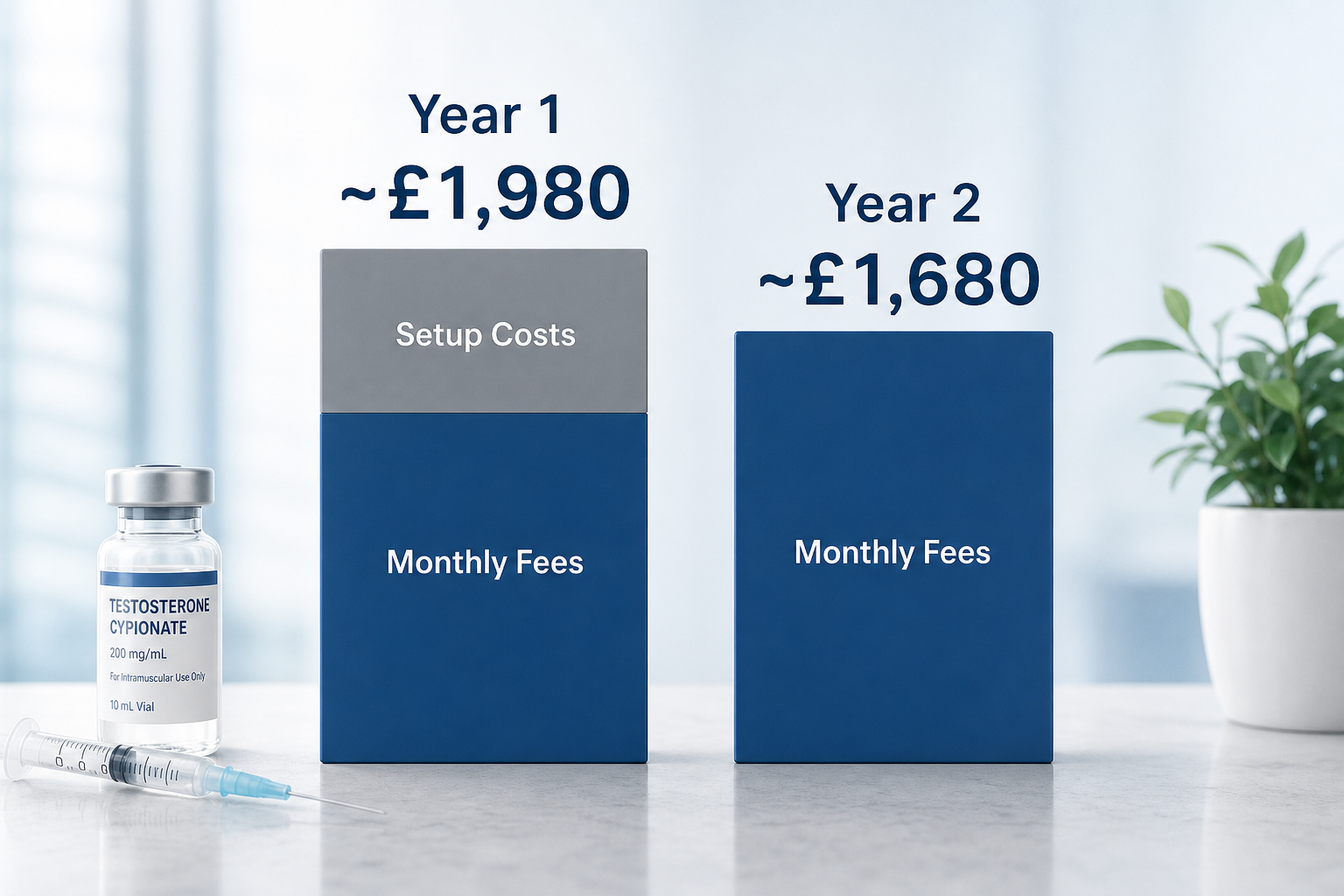
This trajectory matters when evaluating whether private TRT is financially sustainable. Patients who are deterred by the year-one cost should understand that ongoing costs are typically lower, and that the initial investment covers the diagnostic work needed to confirm hypogonadism and establish a safe, effective dose. Clinics that present only the monthly medication cost without disclosing initial setup costs are not giving a complete picture of what treatment will actually cost.
Subscription Model vs Itemised Billing: Which Costs Less?
Private TRT clinics in the UK broadly operate on two pricing models. Subscription-model clinics charge a fixed monthly fee — typically £100 to £150 — that bundles the medication, injection supplies, and some degree of clinical oversight into a single payment. Itemised clinics charge separately for each element: the prescription, the medication, each blood panel, and each consultation. Neither model is universally cheaper. A subscription model offers predictability and may represent good value for patients who require frequent monitoring. An itemised model may be cheaper for patients who are stable on treatment and require only bi-annual blood panels and infrequent consultations.
When comparing clinics, patients should ask for a full cost breakdown that includes the initial consultation, blood testing, the medication at their likely dose, monitoring frequency, and any additional fees such as prescription charges or delivery. A clinic quoting £119 per month may be more or less expensive than one quoting £140 per month, depending on what each price includes and excludes.
Supply Availability and Its Effect on Price
Because testosterone cypionate is not a standard UK-licensed product, its supply is more vulnerable to disruption than that of licensed alternatives. UK pharmacies sourcing testosterone cypionate on a named-patient basis depend on specialist importers and compounding facilities, and periodic shortages do occur. When supply is constrained, prices may rise, or patients may need to switch temporarily to an alternative formulation such as testosterone enanthate. Patients should be aware of this risk when choosing a clinic and should ask how the clinic manages supply disruptions and whether alternative formulations are available if needed.
Frequently Asked Questions
Can I get testosterone cypionate on the NHS?
Testosterone cypionate is not part of the standard NHS formulary for hypogonadism. NHS TRT options are Sustanon 250, Nebido, and testosterone gels. Testosterone cypionate is available only through private prescription in the UK, typically sourced on a named-patient basis or through a compounding pharmacy.
What is a realistic monthly cost for testosterone cypionate in the UK?
The medication cost alone, when sourced through a regulated GPhC-registered pharmacy, may work out at approximately £29 to £55 per month depending on dose and vial price. When consultation fees and monitoring blood panels are included, the total monthly cost at a private clinic typically ranges from £100 to £200 or more, depending on the clinic model and monitoring frequency.
Is testosterone cypionate the same as testosterone enanthate?
Testosterone cypionate and testosterone enanthate are both long-acting esters of testosterone with very similar pharmacological profiles. The main practical difference in the UK is regulatory: testosterone enanthate has licensed products available in the UK market, while testosterone cypionate typically requires named-patient importation or compounding. This can make testosterone enanthate marginally easier and sometimes cheaper to source through regulated channels.
Why does the price vary so much between clinics?
Price variation reflects differences in sourcing (compounding vs importation), clinic overhead, what is included in the quoted price (medication only vs medication plus monitoring), monitoring frequency, and whether the clinic uses a subscription or itemised billing model. Comparing like for like — including all costs at a given dose and monitoring schedule — is the only reliable way to compare clinic prices.
Is it safe to buy testosterone cypionate from online sources without a prescription?
No. Testosterone cypionate is a prescription-only medicine and a Class C controlled drug. Purchasing it without a valid private prescription is illegal. Products sold through unregulated online sources have not been subject to pharmaceutical quality controls, and their actual content, concentration, and sterility cannot be verified. Patients should only obtain testosterone cypionate through a GPhC-registered pharmacy with a valid prescription from a licensed UK prescriber.
What blood tests are needed and how often?
A responsible TRT monitoring blood panel typically includes total and free testosterone, SHBG, haematocrit, haemoglobin, PSA (in men over 40), liver enzymes, and a lipid profile. Most clinics recommend testing at three months after starting or adjusting treatment, then every six to twelve months once stable. More frequent monitoring increases the annual cost of treatment but is clinically appropriate during dose adjustment.
Can I reduce costs with a shared care agreement?
A shared care agreement, where an NHS GP takes over prescribing and monitoring after a private specialist has established treatment, can significantly reduce ongoing costs. However, not all GPs will accept shared care for testosterone cypionate because it is not a licensed UK product. Discussing this possibility with your private prescriber at the outset is worthwhile if long-term cost reduction is a priority.
Making an Informed Decision About Testosterone Cypionate Costs
The price of testosterone cypionate in the UK is shaped by a combination of regulatory, supply chain, and clinical factors that are largely absent from the pricing of standard licensed medications. Patients who understand these factors are better placed to compare clinics fairly, ask the right questions, and avoid being misled by headline prices that exclude significant costs. The medication itself — when sourced correctly through a GPhC-registered pharmacy on a named-patient basis — represents only one part of the total expenditure. Initial setup costs, monitoring blood panels, consultation fees, and injection equipment all contribute to the real annual cost of treatment.
For patients with confirmed hypogonadism, the clinical benefits of appropriate testosterone replacement therapy can be meaningful, but treatment should always be initiated and monitored by a qualified prescriber following a thorough assessment. If you are considering testosterone cypionate as part of a TRT programme, a consultation with a specialist in hormone health is the appropriate starting point — both to confirm clinical suitability and to receive a transparent, itemised cost breakdown before committing to treatment.