Why Are My Lips Uneven? Causes of Lip Asymmetry Explained
Almost everyone has some degree of lip asymmetry — it is one of the most common features of natural facial variation. If you have noticed that one side of your lip sits higher, appears fuller, or moves differently from the other, there is usually a straightforward explanation rooted in genetics, anatomy, or the gradual changes that come with age. In some cases, however, a sudden or pronounced change in lip symmetry can signal something that warrants a clinical assessment. This article explains the main causes of uneven lips, how to think about your own lip asymmetry, and when it may be worth discussing your concerns with a qualified practitioner.
Key Takeaways
- Natural facial asymmetry is universal — perfectly symmetrical lips are the exception, not the rule, and mild unevenness is rarely a medical concern.
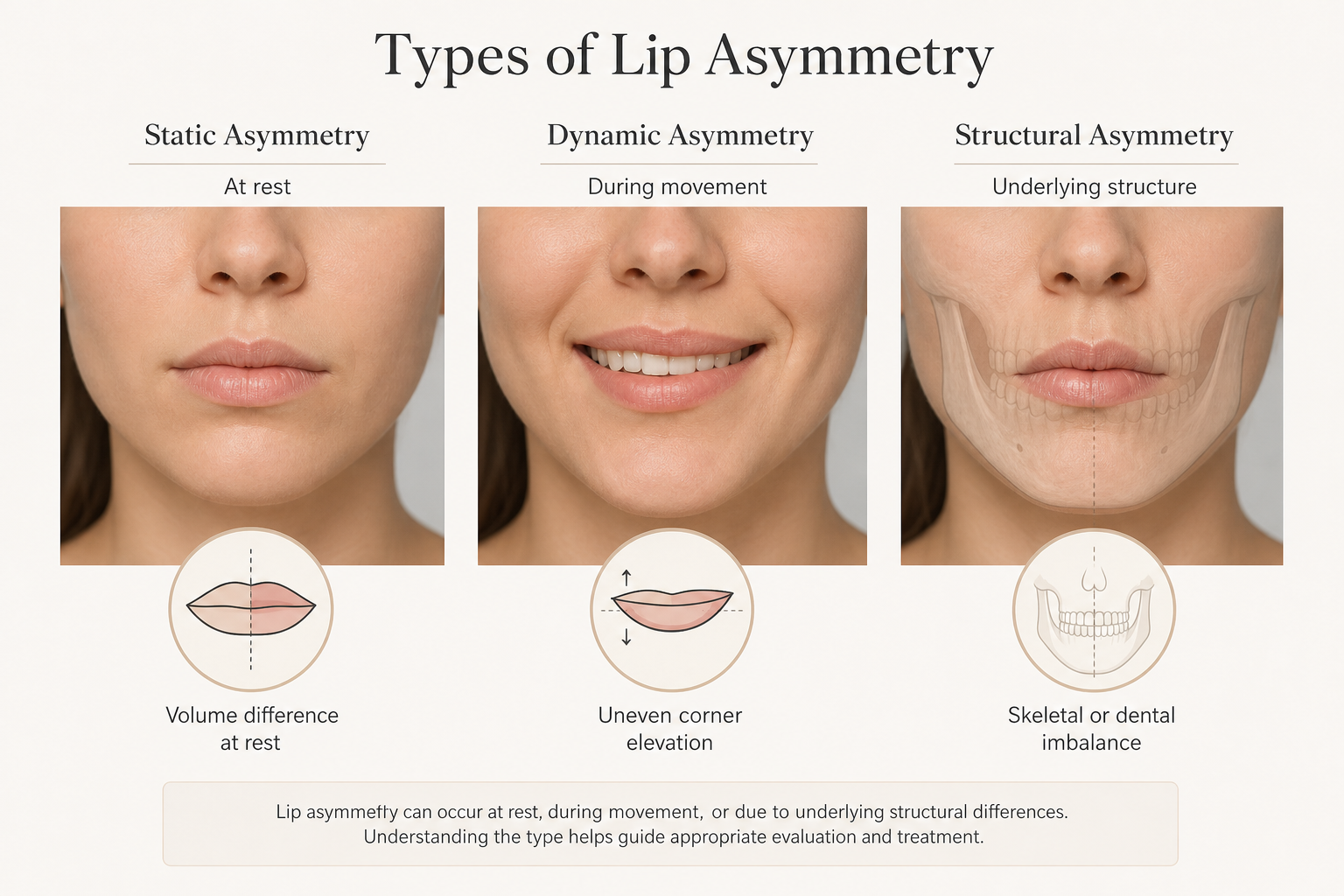
- Lip asymmetry can be classified as static (present at rest), dynamic (appearing during movement or expression), or structural (related to underlying bone or dental anatomy).
- The most common causes include genetics, age-related collagen loss, facial muscle imbalance, and jaw or dental structure — all of which can be assessed by a qualified practitioner.
- Sudden onset of lip asymmetry, particularly with numbness, drooping, or difficulty moving the face, should be evaluated by a doctor promptly as it may indicate a neurological cause.
- Non-surgical options such as dermal filler and neuromodulators, as well as surgical approaches, may help improve lip symmetry depending on the underlying cause.
What Does Lip Asymmetry Actually Mean?
Lip asymmetry refers to a visible difference between the left and right sides of the lips — in height, volume, shape, or movement. This can affect the upper lip, the lower lip, or both. The vermillion border (the defined edge where the lip meets the surrounding skin) may appear higher on one side, the Cupid’s bow peaks may sit at different heights, or one corner of the mouth may rest lower than the other. Asymmetry may be present all the time, only visible during certain expressions, or a combination of both.
Clinicians often distinguish between three types of lip asymmetry, and understanding which type applies to you can help clarify the likely cause and the most appropriate approach:
- Static asymmetry is present when the face is completely at rest. It tends to reflect structural factors such as bone shape, dental anatomy, or long-standing volume differences.
- Dynamic asymmetry becomes apparent during movement — smiling, speaking, or pursing the lips — and is more often related to differences in facial muscle activity or nerve function.
- Structural asymmetry involves the underlying skeleton or dental occlusion and typically influences both the resting appearance and how the lips move.
Many people have a combination of these, and the distinction matters because the cause — and therefore the most useful response — differs between them.
Genetics and Natural Facial Asymmetry
The single most common reason lips are uneven is simply genetics. The shape, volume, and position of the lips are inherited traits, and natural facial asymmetry is present in virtually every human face to some degree. Studies using three-dimensional facial scanning have consistently shown that no human face is perfectly symmetrical, and the lips are among the most variable features. Differences in the height of the lip corners, the prominence of the Cupid’s bow on each side, or the fullness of the upper versus lower lip are all normal anatomical variations that most people are born with.
Genetic lip asymmetry is typically stable over time and is not associated with any underlying health concern. It may become more noticeable in photographs, particularly selfies taken at close range with a wide-angle lens, which can exaggerate facial proportions. If your lips have always appeared slightly uneven and the difference has not changed, a genetic or congenital cause is the most likely explanation.
Age-Related Changes and Collagen Loss
Lip asymmetry that develops or worsens gradually over time is frequently related to the natural ageing process. The lips rely on a combination of collagen, elastin, hyaluronic acid, and subcutaneous fat for their shape, projection, and definition. From the mid-twenties onwards, the body produces progressively less collagen and elastin, and the fat compartments of the face begin to shift and reduce in volume. These changes do not always occur at the same rate on both sides of the face, which can cause or worsen lip asymmetry.
Age-related lip changes that contribute to uneven appearance include:
- Volume loss — one side of the lip may lose fat or hyaluronic acid more quickly, making it appear thinner or less projected than the other.
- Loss of vermillion border definition — the lip edge becomes less distinct as collagen loss reduces structural support, and this can affect each side differently.
- Skin laxity — reduced elastin causes the skin around the lips to become looser, which can alter how the lips sit at rest.
- Smoker’s lines and perioral wrinkling — repeated muscle movement around the mouth, combined with collagen loss, can create fine lines and subtle distortions that affect the perceived symmetry of the lip border.
Sun exposure and smoking both accelerate collagen breakdown and are associated with earlier and more pronounced age-related lip changes. UV damage degrades collagen and elastin in the skin, while smoking reduces blood flow to the skin and introduces repeated muscle contractions around the mouth that contribute to asymmetric wrinkling over time.
Facial Muscle Imbalance and Uneven Muscle Tension
The lips are controlled by a complex group of muscles, the most significant of which is the orbicularis oris — a circular muscle that encircles the mouth and governs pursing, puckering, and closure. This muscle works in coordination with several other facial muscles that elevate, depress, and retract the lip corners. When there is an imbalance in the strength or tone of these muscles on either side of the face, the lips can appear or move unevenly.
Facial muscle imbalance contributing to dynamic asymmetry can arise from several sources. Many people habitually chew food predominantly on one side of the mouth, which over years can develop the jaw muscles and associated facial muscles more on that side. This unilateral chewing pattern subtly alters the resting tone and movement of the muscles around the mouth, contributing to a visible difference in how each side of the lip moves during expression. Similarly, habitual facial expressions — such as a one-sided smile or a tendency to hold tension in one cheek — can reinforce asymmetric muscle patterns over time.
Uneven muscle tension is also a common reason why lips appear more asymmetrical when smiling or speaking than when the face is at rest. If your lips look relatively even in a neutral expression but noticeably uneven during movement, a dynamic muscle imbalance is a likely contributor.
Facial Nerve Causes: Bell’s Palsy and Related Conditions
The facial nerve (the seventh cranial nerve) controls the muscles of facial expression on each side of the face. Damage to or dysfunction of this nerve can cause weakness or paralysis of the muscles on one side, resulting in visible lip asymmetry, drooping of the lip corner, and difficulty moving the affected side of the face normally.
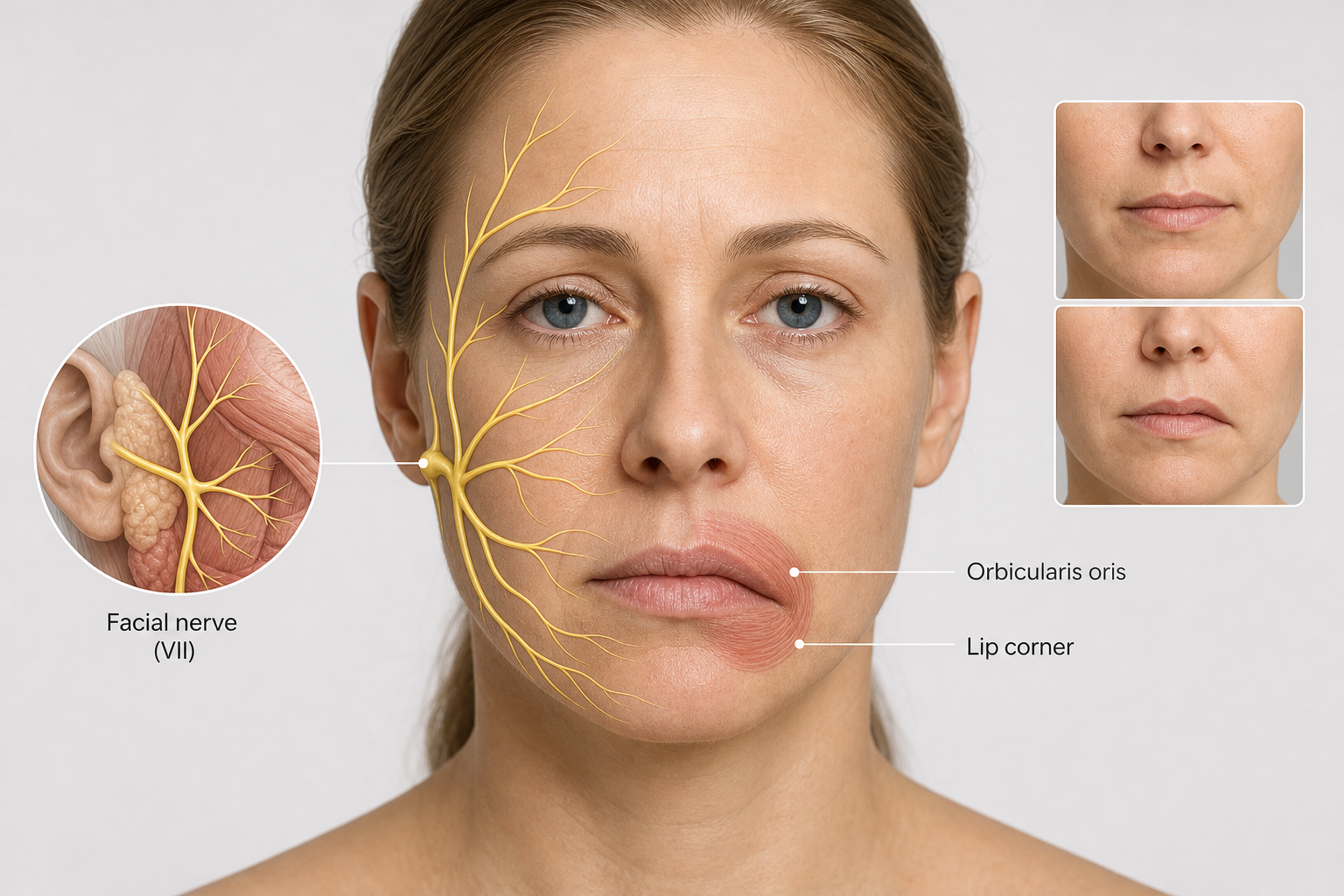
Bell’s palsy is the most common cause of sudden unilateral facial weakness in adults. It involves inflammation of the facial nerve, typically following a viral infection, and causes rapid onset of weakness or paralysis affecting one side of the face — including the lips, cheek, and eye. Most people with Bell’s palsy recover fully within weeks to months, though some experience residual asymmetry. Other conditions that can affect the facial nerve and produce lip asymmetry include Ramsay Hunt syndrome (caused by the varicella-zoster virus), stroke, and in rarer cases, tumours or trauma affecting the nerve pathway.
It is important to distinguish nerve-related lip asymmetry from cosmetic asymmetry. If you experience a sudden change in lip or facial symmetry — particularly if accompanied by weakness, numbness, difficulty closing one eye, or changes in taste — you should seek prompt medical assessment rather than a cosmetic consultation. These symptoms may indicate a neurological cause that requires urgent evaluation.
Less dramatic nerve-related asymmetry can also result from previous dental procedures, facial trauma, or surgical interventions that have affected small branches of the facial nerve. In these cases, the asymmetry is typically stable and may be partial rather than complete.
Jaw Misalignment, Dental Structure, and Skeletal Support
The position and shape of the underlying jaw and teeth provide the structural foundation on which the lips rest. Jaw misalignment, dental occlusion problems, or differences in the skeletal support on each side of the face can all influence lip symmetry in ways that are not immediately obvious.
Common structural contributors include:
- Jaw asymmetry — a jaw that is not perfectly centred or that has developed unevenly can cause the lips and mouth to sit off-centre or at a slight angle.
- Dental midline shift — when the midline of the upper or lower teeth does not align with the centre of the face, it can affect how the lips drape over the teeth and appear at rest or during smiling.
- Missing teeth or poorly fitting dentures — the loss of a tooth or inadequate dental support can cause the lip on the affected side to appear to sink inward or lose projection.
- Malocclusion (crossbite or overbite) — bite problems alter the relationship between the upper and lower jaws, which can affect lip posture and symmetry.
- TMJ (temporomandibular joint) disorder — dysfunction of the jaw joint can contribute to asymmetric jaw positioning and associated lip changes.
Structural asymmetry of this kind is typically present at rest and during movement. Orthodontic treatment, dental restoration, or in more significant cases orthognathic surgery may address the underlying cause, though these are decisions that require specialist dental or maxillofacial assessment.
Trauma, Scarring, and Previous Procedures
Physical injury to the lips or surrounding area can alter lip symmetry through direct tissue damage or scar formation. Scar tissue is less elastic than normal skin and can tether or distort the lip border, causing one side to appear pulled, thickened, or restricted in movement. Injuries that affect the vermillion border are particularly likely to produce visible asymmetry because even small disruptions to this defined edge are noticeable.
Previous cosmetic procedures can also contribute to lip asymmetry. Poorly placed or unevenly distributed lip filler can create volume differences between the two sides, and in some cases filler migration can distort the lip border. Lip implants or fat grafting procedures that have not produced uniform results may similarly cause asymmetry. Hyaluronidase — an enzyme used to dissolve hyaluronic acid filler — can be used to correct filler-related asymmetry in appropriate cases, though this requires assessment by an experienced practitioner.
Congenital conditions such as cleft lip, even when surgically repaired in childhood, can leave residual asymmetry due to differences in scar tissue, muscle attachment, and tissue volume. Less commonly, conditions such as hemifacial microsomia (underdevelopment of one side of the face) or congenital unilateral lower lip paralysis can cause significant structural lip asymmetry from birth.
Lifestyle Factors and Their Role
Several everyday habits and lifestyle factors can contribute subtly to lip asymmetry, though they are rarely the sole cause of a noticeable difference.
- Sleep position — consistently sleeping on one side of the face presses the cheek and lip against a pillow for hours each night. Over many years, this repeated compression may contribute subtly to asymmetric skin changes, though it is unlikely to be a primary cause of significant lip asymmetry on its own.
- Dehydration — the lips are particularly sensitive to hydration status. When the body is dehydrated, the lips can appear thinner, less defined, and subtly uneven, as volume differences that are normally minimal become more apparent. This effect is temporary and resolves with adequate hydration.
- Habitual facial postures — resting the chin on one hand, habitually pressing the face against a surface, or holding the mouth in an asymmetric position during concentration can reinforce muscle imbalances over time.
- Hormonal changes — fluctuations in oestrogen and other hormones, particularly during perimenopause, can accelerate collagen loss and changes in skin quality that may affect lip definition and symmetry.
Why Do Lips Look More Uneven in Photos?
Many people notice lip asymmetry primarily in photographs rather than in the mirror, and this is often partly explained by the optics of photography rather than a change in the lips themselves. Smartphone cameras, particularly in selfie mode, use wide-angle lenses at close range, which introduces barrel distortion — a type of lens distortion that exaggerates features near the edges of the frame and can make facial proportions appear different from how they look in person or in a flat mirror. Lighting direction also plays a significant role: a light source positioned to one side of the face creates shadows that emphasise volume differences and can make one side of the lip appear fuller or more defined than the other.
If your lips appear noticeably more uneven in photographs than in a mirror, it is worth considering whether the camera angle, distance, or lighting may be contributing to the effect before concluding that the asymmetry has worsened. A straight-on photograph taken in even, diffuse lighting at arm’s length provides a more accurate representation than a close-range selfie.
How to Assess Your Own Lip Asymmetry
A simple self-assessment can help you understand the nature of your lip asymmetry and communicate it more clearly to a practitioner. Stand in front of a well-lit mirror and observe your lips in three positions: completely at rest with the mouth gently closed, during a relaxed natural smile, and while speaking or making an exaggerated expression such as pursing the lips. Note whether the asymmetry is present in all three positions or only during movement. Also observe whether the difference is in height (one corner sits higher), volume (one side appears fuller), or shape (the Cupid’s bow or vermillion border differs between sides).
This distinction — whether the asymmetry is static, dynamic, or both — is one of the most useful pieces of information you can bring to a consultation, as it helps a practitioner identify the most likely cause and the most appropriate approach.
When Should You See a Doctor?
Most lip asymmetry is cosmetic in nature and does not require urgent medical attention. However, certain features should prompt a prompt medical assessment rather than a cosmetic consultation:
- Sudden onset of lip or facial asymmetry that was not present before
- Weakness or inability to move one side of the face normally
- Numbness or altered sensation around the lips or face
- Difficulty closing one eye fully
- Changes in taste or hearing on one side
- Asymmetry following a head injury or dental procedure
These features may indicate Bell’s palsy, stroke, or another neurological condition that requires medical evaluation. If you are uncertain whether your lip asymmetry is cosmetic or medical in origin, a GP assessment is a sensible first step.
Treatment Options for Uneven Lips
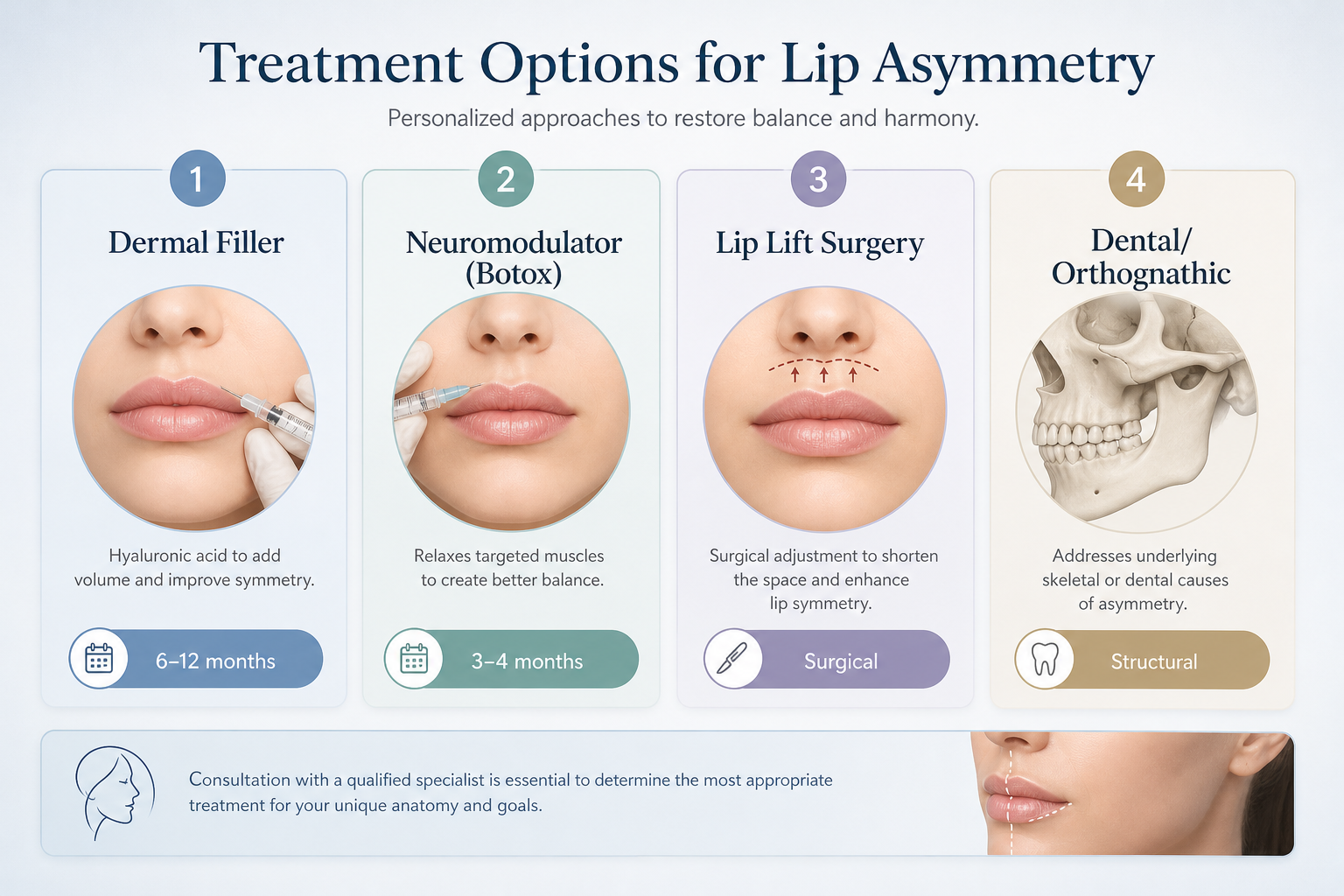
Where lip asymmetry is cosmetic and the cause has been identified, several treatment approaches may help improve lip symmetry. The most appropriate option depends on the type and cause of the asymmetry, the degree of difference, and individual anatomy.
Dermal filler — hyaluronic acid-based lip filler (such as Juvederm or Restylane) can be used to add volume selectively to the less full side of the lip, adjust the height of the vermillion border, or improve the definition of the Cupid’s bow. Results are temporary, typically lasting six to twelve months depending on the product and individual metabolism, and the filler can be dissolved with hyaluronidase if needed. Lip filler is one of the most commonly used approaches for volume-related static asymmetry.
Neuromodulators (botulinum toxin) — small doses of botulinum toxin injected into specific muscles around the mouth can reduce overactive muscle pull on one side, helping to balance dynamic asymmetry. A lip flip technique, where botulinum toxin is used to relax the upper lip border, can also subtly adjust lip position and symmetry. Results are temporary, typically lasting three to four months.
Lip lift surgery — a surgical lip lift shortens the distance between the nose and the upper lip and can be used to correct structural asymmetry in the lip height or position. This is a more permanent option but involves surgical recovery and carries the risks associated with any surgical procedure.
Orthognathic or dental treatment — where jaw misalignment or dental structure is the primary cause, orthodontic treatment, dental restoration, or orthognathic surgery may address the underlying structural issue. These are specialist-led decisions and are not cosmetic treatments in the conventional sense.
No treatment can guarantee perfect symmetry, and a realistic expectation is improvement rather than elimination of asymmetry. A thorough consultation with a qualified and experienced practitioner is essential before any treatment, as the approach must be tailored to the specific cause and anatomy of each individual.
Frequently Asked Questions
Is it normal to have uneven lips?
Yes. Some degree of lip asymmetry is present in virtually every face and is considered a normal feature of human anatomy. Perfect bilateral symmetry is extremely rare. Mild unevenness is not a sign of a health problem and does not require treatment unless it causes personal concern.
Why do my lips look more uneven when I smile?
Dynamic asymmetry — asymmetry that appears or worsens during movement — is typically related to differences in facial muscle activity on each side of the face. The muscles that elevate the lip corners and move the cheeks during smiling may have slightly different strength or tone on each side, which becomes visible during expression but less apparent at rest.
Can lip filler make uneven lips worse?
Lip filler placed without careful attention to existing asymmetry can worsen the appearance of unevenness. It is important to consult a practitioner who assesses your baseline lip symmetry before treatment and plans the placement accordingly. Filler-related asymmetry can usually be corrected with hyaluronidase if needed.
Does sleeping on one side cause permanent lip asymmetry?
Sleeping consistently on one side may contribute subtly to asymmetric skin changes over many years, but it is unlikely to be a primary cause of significant lip asymmetry. The effect, if any, is gradual and minor compared to genetic, structural, and age-related factors.
Can uneven lips get worse with age?
Yes, in some cases. Age-related collagen loss, volume loss, and changes in skin laxity do not always progress at the same rate on both sides of the face, which can cause existing asymmetry to become more noticeable over time. Lifestyle factors such as sun exposure and smoking can accelerate this process.
When should I be concerned about sudden lip asymmetry?
Sudden onset of lip or facial asymmetry — particularly with weakness, numbness, difficulty moving the face, or trouble closing one eye — should be assessed by a doctor promptly. These symptoms may indicate Bell’s palsy, stroke, or another neurological condition that requires medical evaluation rather than a cosmetic approach.
Understanding Your Lip Asymmetry Before Seeking Treatment
Lip asymmetry is almost always a normal feature of facial anatomy, and for most people the cause is a combination of genetics, gradual age-related changes, and subtle differences in facial muscle activity. Understanding whether your asymmetry is static, dynamic, or structural — and whether it has been present for years or appeared recently — is the most useful starting point for deciding whether and how to address it.
If your lip asymmetry is long-standing, stable, and primarily a cosmetic concern, a consultation with a qualified aesthetic practitioner can help clarify the likely cause and whether a non-surgical option such as dermal filler or a neuromodulator may be appropriate for your anatomy and goals. If the asymmetry has appeared suddenly or is accompanied by any neurological symptoms, a medical assessment should come first. In either case, realistic expectations and a thorough understanding of the cause are the foundation of any useful next step.