What Is an 8 Point Face Lift? The Filler Lifting Technique Explained
The 8 point face lift is a structured dermal filler technique designed to lift and rejuvenate the face by targeting specific anatomical points rather than simply filling individual lines. Unlike a traditional surgical facelift, this approach uses hyaluronic acid dermal filler to restore lost volume, improve facial contour, and create a subtle but meaningful lift — all without incisions, general anaesthesia, or significant downtime. This article explains how the technique works, what the injection points target, who may be a suitable candidate, what realistic results look like, and how the 8 point lift compares to other options.
Key Takeaways
- The 8 point face lift is a non-surgical facelift technique using hyaluronic acid dermal filler placed at strategic anatomical points across the mid and lower face.
- It was developed by Brazilian plastic surgeon Dr Mauricio de Maio and later evolved into the individualised MD Codes™ system.
- The technique works through a cascade lifting effect: supporting the mid-face reduces the appearance of jowls, marionette lines, and nasolabial folds without treating each area in isolation.
- Results typically last 12–18 months depending on filler type, individual metabolism, and lifestyle factors.
- The treatment is best suited to mild to moderate skin laxity and is not a replacement for surgical repositioning in cases of advanced facial ageing.
The Origins of the 8 Point Face Lift
The 8 point face lift was developed by Dr Mauricio de Maio, a Brazilian plastic surgeon who recognised that facial ageing is not simply a matter of wrinkles appearing — it is a structural process involving bone density loss, fat pad descent, and mid-face volume loss. Rather than treating individual lines as isolated problems, Dr de Maio mapped out a series of anatomical injection points that, when treated together, could restore the underlying architecture of a youthful face.
The original protocol identified eight specific points — later codified as L1 through L8 in the MD Codes™ system — each corresponding to a distinct anatomical zone. The MD Codes™ framework moved the technique beyond a fixed eight-point template and towards an individualised, anatomy-led approach. A practitioner trained in MD Codes™ assesses each patient’s unique facial structure and selects the relevant codes rather than applying the same eight injections to every face. This evolution is important: the term “8 point facelift” is now widely used as a general descriptor for this whole-face filler strategy, even when the actual number of points treated varies between patients.
How the 8 Point Face Lift Works
The central principle behind the 8 point lift is structural support rather than surface-level filling. Hyaluronic acid dermal filler is placed at precise depths — sometimes at the bone level, sometimes within the fat compartments — to recreate the scaffolding that supports the overlying skin and soft tissue. When this scaffolding is restored, the face lifts from within rather than being pushed outward, which is why well-executed results look natural rather than inflated.
A key concept that distinguishes this technique from standard filler treatment is the cascade lifting effect. By restoring volume and structural support in the mid-face — particularly the cheek and malar area — the practitioner indirectly improves the appearance of the lower face. Descended fat pads and sagging tissue in the jowl and marionette line area are partly a consequence of lost mid-face support. When that support is re-established, the lower face improves as a secondary benefit, often without requiring large volumes of filler in those areas directly. This domino mechanism means that a relatively small amount of product, placed strategically, can achieve a more significant result than the same volume injected into individual lines.
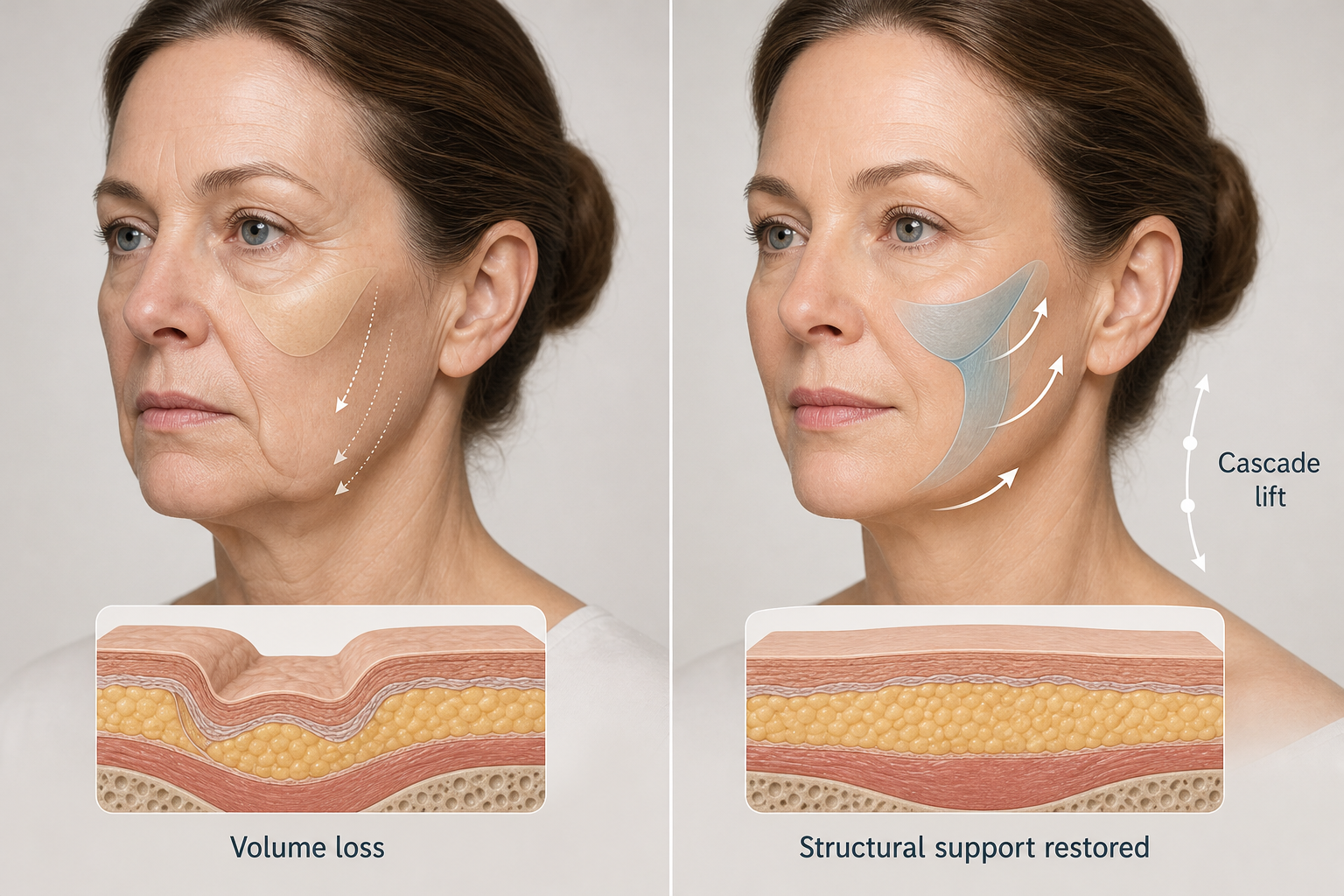
The whole-face approach also means the practitioner considers facial harmony and symmetry throughout. Rather than correcting one area and inadvertently creating imbalance elsewhere, the 8 point technique is planned as a coordinated treatment across the face.
The 8 Injection Points: What Each Area Targets
The L1–L8 codes in the MD Codes™ system correspond to the following anatomical zones, each addressing a specific aspect of age-related volume loss and facial support:
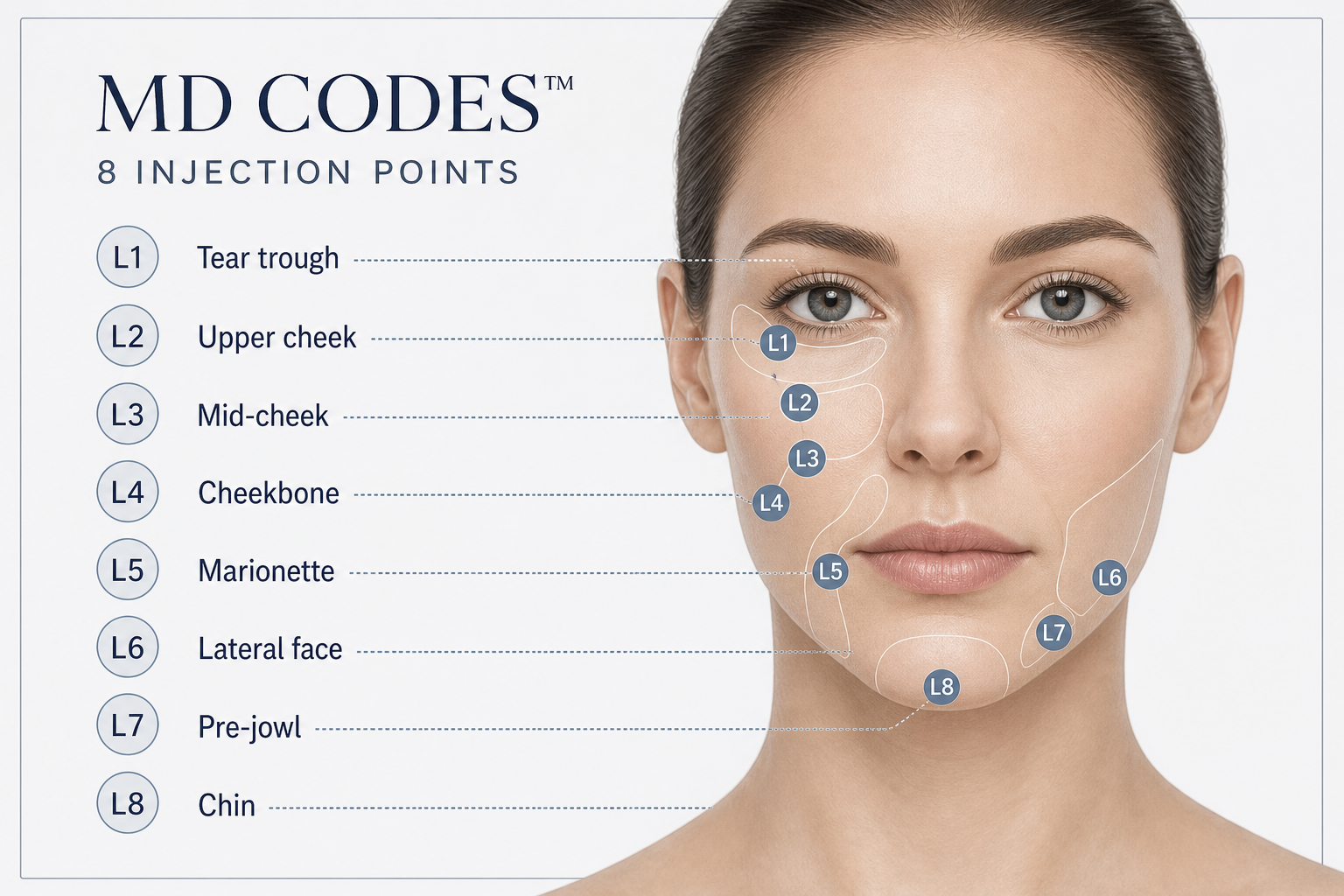
- L1 — Infraorbital / tear trough area: Filler placed here addresses under-eye hollows and the transition between the lower eyelid and cheek, reducing the tired appearance associated with infraorbital shadowing.
- L2 — Palpebral-malar sulcus / upper cheek: This point targets the groove that can develop between the lower eyelid and the cheek, improving the smooth contour of the upper mid-face.
- L3 — Mid-cheek: Restoring volume at the mid-cheek supports the overlying skin and contributes to the cascade effect that improves the lower face.
- L4 — Mid-face projection: Filler at this point enhances cheekbone definition and overall mid-face projection, recreating the inverted triangle of youth that characterises a youthful facial shape.
- L5 — Marionette lines / mouth corners: Volume placed here softens the lines that run from the corners of the mouth downward and addresses the downturned appearance of the mouth corners.
- L6 — Buccal / lateral lower face: This point targets the lateral fat pad area, supporting the lower cheek and reducing the accordion-like lines that appear with movement.
- L7 — Pre-jowl hollow / jawline: Filler in the pre-jowl area fills the hollow that develops in front of the jowl, improving jawline definition and reducing the stepped appearance associated with jowling.
- L8 — Chin: Chin support improves lower face balance, lengthens the apparent lower third of the face, and contributes to overall facial harmony.
Not every patient requires treatment at all eight points. A thorough facial assessment determines which zones are contributing most to the visible signs of ageing and which points will deliver the greatest improvement for that individual.
What the Treatment Experience Involves
The 8 point face lift begins with a detailed consultation and facial assessment. The practitioner evaluates bone structure, fat pad position, skin quality, and the degree of age-related volume loss before planning which anatomical points to treat and how much hyaluronic acid filler to use. This planning stage is as important as the injection itself.
On the day of treatment, a topical anaesthetic — usually a numbing cream containing lidocaine — is applied to the skin for approximately 20–30 minutes before the procedure begins. Most hyaluronic acid fillers used in this technique also contain lidocaine within the product itself, which further reduces discomfort during injection. Patients typically describe the sensation as pressure or a brief pinch rather than continuous pain.
The injections are delivered using either a fine needle or a blunt-tipped cannula, depending on the injection point and the practitioner’s technique. Cannulas are often preferred in areas where there is a higher risk of bruising or where a fanning technique is used to distribute filler across a broader area. The full treatment usually takes between 40 and 60 minutes. Most patients can return to normal daily activities immediately or within a day, making minimal downtime one of the practical advantages of this approach.
Results: What to Expect and How Long They Last
An immediate improvement in facial volume and contour is usually visible after the 8 point lift. However, some swelling is normal in the days following treatment, and the final result typically settles over approximately two weeks as swelling resolves and the filler integrates with the surrounding tissue. Patients are generally advised to assess their results at the two-week mark rather than immediately after the appointment.
The duration of results depends on several factors: the specific hyaluronic acid filler product used, the injection depth, the patient’s individual metabolism, activity level, and lifestyle. Results commonly last between 12 and 18 months. Higher-density fillers placed at deeper levels — such as those used for cheekbone support — tend to last longer than lighter products used in more superficial areas. Most patients choose to return for a maintenance top-up treatment around the 12-month mark to sustain their results.
A secondary benefit that is less commonly discussed is the potential for hyaluronic acid filler to stimulate collagen production in the surrounding tissue over time. While this effect is modest and should not be overstated, it may contribute to gradual improvements in skin quality alongside the immediate volumising result.
When filler eventually breaks down and is absorbed by the body, the face returns gradually to its pre-treatment appearance. The face does not look worse than before treatment — a concern some patients raise — because the filler simply diminishes rather than causing any structural change to the underlying tissue.
Who May Be a Suitable Candidate
The 8 point face lift tends to produce the most satisfying results in patients with mild to moderate facial ageing who retain reasonable skin elasticity. The technique is most commonly sought by patients in their mid-thirties to mid-fifties, though suitability depends on individual anatomy rather than age alone. Patients who have begun to notice mid-face volume loss, flattening of the cheeks, early jowling, deepening nasolabial folds, or a generally tired appearance may find this approach addresses several concerns in a single treatment session.
The treatment is also suitable for men, though this is rarely discussed. Male facial anatomy differs from female anatomy in bone structure, fat distribution, and skin thickness, and a practitioner experienced in treating male patients will adjust the injection points and filler volumes accordingly to achieve results that suit masculine facial proportions.
Patients who are not suitable for this treatment include those who are pregnant or breastfeeding, those with an active skin infection or inflammatory condition in the treatment area, those with a known allergy to hyaluronic acid or lidocaine, and those with a history of anaphylaxis. Patients taking blood-thinning medications should discuss this with their practitioner before treatment, as these increase the risk of bruising.
The 8 point lift is not appropriate for patients with advanced skin laxity or significant jowling where the volume of descended tissue is substantial. In these cases, the structural cascade effect of filler alone is unlikely to achieve a meaningful improvement, and a surgical consultation may be more appropriate.
Addressing the “Overfilled” Concern
One of the most common concerns patients raise is the fear of looking puffy, unnatural, or “done.” It is worth being direct about this: the overfilled appearance associated with some filler treatments is a consequence of poor planning, not an inevitable outcome of dermal filler itself. When filler is placed without a whole-face strategy — for example, repeatedly adding volume to the cheeks without considering facial balance — the result can look heavy or disproportionate over time.
The 8 point technique, when performed by a practitioner with appropriate training in facial anatomy, is specifically designed to avoid this outcome. The goal is to use minimal product for maximal lift by placing filler at the points where it will have the greatest structural effect. Natural-looking results depend on the practitioner’s understanding of anatomy, their assessment of how much volume is appropriate for each patient, and their willingness to use restraint rather than simply adding more product.
Honest Limitations of the 8 Point Face Lift
The 8 point face lift is a genuinely useful technique for the right patient, but it has real limitations that any responsible discussion should acknowledge. Hyaluronic acid filler cannot remove excess skin. If skin laxity is the primary concern — rather than volume loss — filler alone will not address it. The technique also cannot replicate the mechanical repositioning of the SMAS (superficial musculoaponeurotic system) layer that a surgical facelift achieves. For patients with significant jowling, deep skin folds, or substantial tissue descent, a surgical consultation is likely to be more appropriate.
Results are temporary and require ongoing maintenance. Over a period of years, the cumulative cost of maintenance treatments should be considered alongside the cost of a single surgical procedure when patients are weighing their options. The treatment also does not address dynamic wrinkles caused by muscle movement — these are better managed with botulinum toxin injections, which are often combined with the 8 point lift for a more comprehensive facial rejuvenation result.
How the 8 Point Face Lift Compares to Alternatives
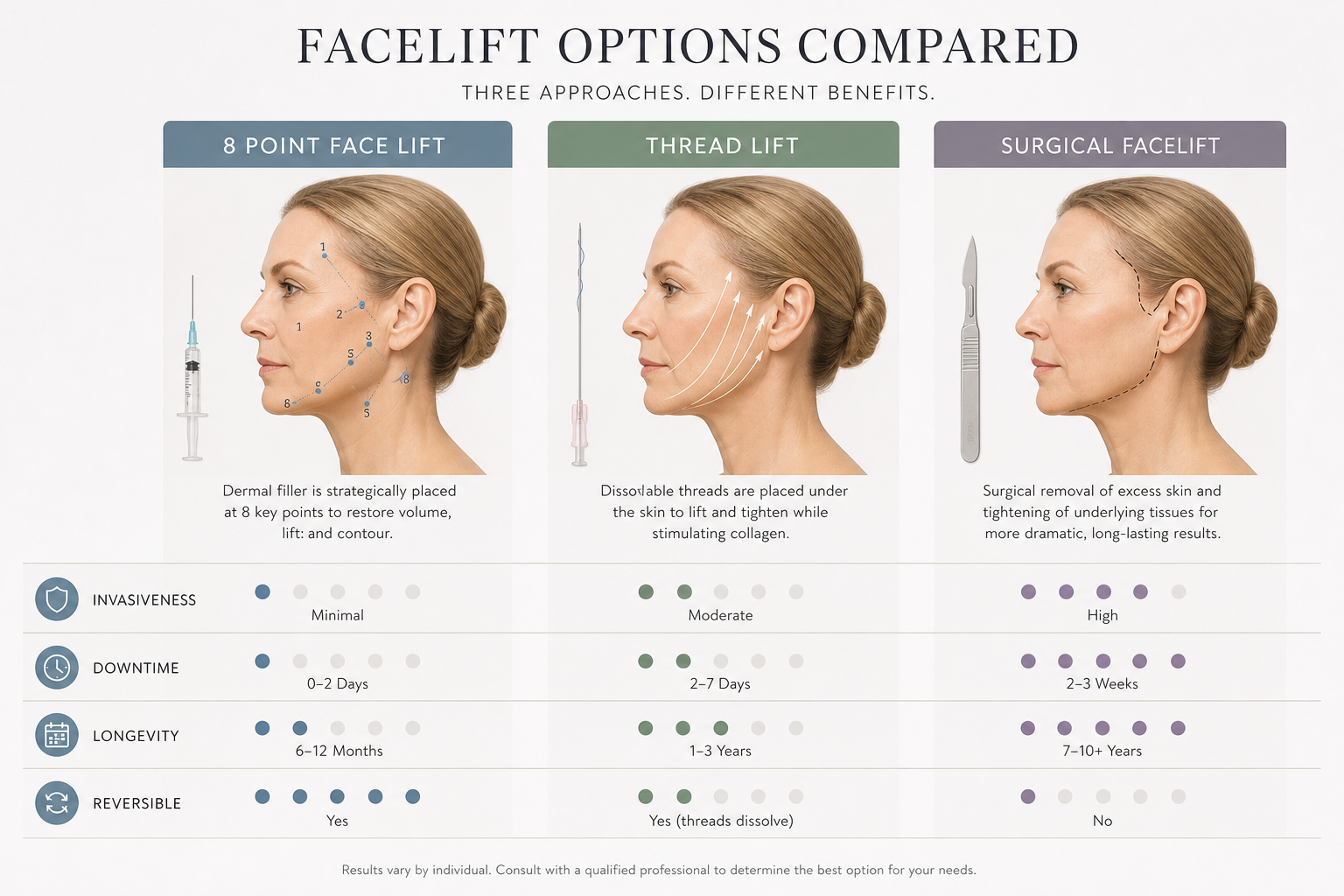
| Feature | 8 Point Face Lift | Thread Lift | Surgical Facelift |
|---|---|---|---|
| Mechanism | Restores volume and structural support with filler | Mechanically repositions tissue with dissolvable threads | Surgically repositions and removes excess skin and tissue |
| Invasiveness | Non-surgical, injections only | Minimally invasive, small entry points | Surgical, incisions required |
| Downtime | Minimal (1–2 days for most patients) | Several days to 1–2 weeks | 2–6 weeks depending on extent |
| Longevity | 12–18 months | 12–18 months | 5–10 years |
| Addresses volume loss | Yes — primary mechanism | No — repositions but does not add volume | No — removes and repositions tissue |
| Addresses skin laxity | Limited — not suitable for significant laxity | Moderate — mechanical lift | Yes — most effective for significant laxity |
| Reversibility | Reversible with hyaluronidase | Threads dissolve over time; not immediately reversible | Not reversible |
| Anaesthesia | Topical numbing cream | Local anaesthetic | General or sedation anaesthesia |
| Best suited to | Mild to moderate volume loss and early ageing | Mild to moderate tissue descent | Moderate to advanced ageing with significant laxity |
The 8 point lift and thread lift are sometimes combined, as they address different aspects of facial ageing — volume loss and tissue repositioning respectively. Combining the 8 point lift with botulinum toxin injections for dynamic lines, or with skin quality treatments such as skin boosters or energy-based devices, can also produce a more comprehensive result than any single treatment alone.
Side Effects, Risks, and Aftercare
The most common side effects following an 8 point face lift are redness, swelling, tenderness, and bruising at the injection sites. These are expected responses to the injections and typically resolve within a few days, though swelling in some areas — particularly around the tear trough — can take up to two to three weeks to fully subside. Applying ice to the treated areas in the hours following treatment can help reduce inflammation.
Rarer but more serious risks include infection, vascular compromise (where filler inadvertently affects blood supply to surrounding tissue), nodule formation, and allergic reaction. These risks are minimised by choosing a practitioner with appropriate training in facial anatomy and injection technique, and by ensuring the treatment is performed in a clinical setting where complications can be managed promptly. The reversibility of hyaluronic acid filler with hyaluronidase — an enzyme that dissolves HA — is an important safety feature of this treatment category.
Standard aftercare advice includes avoiding touching or massaging the treated areas for 24–72 hours, avoiding alcohol and strenuous exercise for 24–48 hours, avoiding saunas and steam rooms for at least 48 hours, and avoiding makeup for 24 hours. Patients taking aspirin or other blood-thinning medications should discuss whether to pause these before treatment with their prescribing doctor. Daily use of SPF 30 or higher is recommended to protect the skin and support long-term skin health.
Pre-Treatment Preparation Checklist
- Avoid alcohol for at least 24 hours before treatment to reduce bruising risk.
- Avoid aspirin, ibuprofen, and other non-steroidal anti-inflammatory drugs (NSAIDs) for several days before treatment unless prescribed — discuss with your doctor first.
- Avoid fish oil supplements and high-dose vitamin E for one week before treatment if possible.
- Arrive with clean skin, free from makeup, moisturiser, and SPF on the day of treatment.
- Inform your practitioner of any medications, supplements, allergies, or recent dental work before the appointment.
- Do not book treatment immediately before an important event — allow at least two weeks for swelling to fully resolve.
Frequently Asked Questions
Does the 8 point face lift hurt?
Most patients find the treatment tolerable. Topical numbing cream is applied before the procedure, and most hyaluronic acid fillers used in this technique contain lidocaine, which reduces discomfort during injection. Patients typically describe a pressure or pinching sensation rather than significant pain. Sensitivity varies between individuals and between injection points.
How many syringes of filler are needed?
The volume required depends on the degree of age-related volume loss and the number of points being treated. Most patients require between two and four syringes of hyaluronic acid filler across the full treatment. The whole-face approach is designed to achieve meaningful results with a relatively modest volume of product by placing it strategically rather than in large quantities.
Is the 8 point face lift reversible?
Yes. Because hyaluronic acid filler is used, the treatment is reversible with hyaluronidase, an enzyme that dissolves HA filler. This is an important safety consideration and one of the advantages of HA-based treatments over permanent or semi-permanent fillers.
How soon will I see results?
An improvement in volume and contour is usually visible immediately after treatment. However, some swelling is normal and the final result settles over approximately two weeks. Patients are advised to assess their outcome at the two-week mark rather than immediately after the appointment.
Can the 8 point face lift be combined with other treatments?
Yes. The 8 point lift addresses volume loss and structural support but does not treat dynamic wrinkles caused by muscle movement. Combining it with botulinum toxin injections for forehead lines, frown lines, or crow’s feet can produce a more complete facial rejuvenation result. Skin quality treatments such as skin boosters, polynucleotides, or energy-based devices may also complement the structural improvements achieved with filler.
What happens when the filler wears off?
As hyaluronic acid filler is gradually absorbed by the body, the face returns slowly to its pre-treatment appearance. The face does not look worse than before treatment — the filler simply diminishes over time. There is no sudden or dramatic change, and patients typically notice a gradual return of the concerns that prompted them to seek treatment in the first place.
Is the 8 point face lift suitable for men?
Yes. The technique is suitable for both men and women. Male facial anatomy differs in bone structure, fat distribution, and skin thickness, so a practitioner experienced in treating male patients will adjust the injection points, product selection, and volumes to achieve results that suit masculine facial proportions and maintain a natural appearance.
Is the 8 Point Face Lift Worth Considering for Your Concerns?
The 8 point face lift is a well-structured, anatomy-led approach to facial rejuvenation that can deliver meaningful, natural-looking results for the right patient. Its strengths lie in its whole-face strategy, the cascade lifting effect that improves multiple areas with relatively modest filler volumes, its minimal downtime, and the reversibility of hyaluronic acid filler. For patients experiencing mild to moderate facial ageing — particularly mid-face volume loss, early jowling, and a generally tired or deflated appearance — it represents a credible non-surgical option worth discussing with a qualified practitioner.
Its limitations are equally important to understand. The 8 point lift cannot remove excess skin, cannot replicate surgical tissue repositioning, and is not appropriate for patients with advanced skin laxity or significant structural descent. Results are temporary and require maintenance. These are not reasons to dismiss the technique, but they are reasons to approach it with realistic expectations and to have an honest conversation with a practitioner who will assess your individual anatomy rather than apply a one-size-fits-all protocol.
If you are considering this treatment, look for a practitioner with specific training in facial anatomy and the MD Codes™ system or equivalent structured approach, and ensure your consultation includes a thorough assessment of your facial structure, skin quality, and goals before any treatment is planned.