What Do Skin Tags Look Like? A Complete Visual Guide
Skin tags are among the most common benign skin growths, yet many people are unsure whether the small, soft growth they have noticed is actually a skin tag or something that warrants medical attention. Understanding what a skin tag looks like — its color, shape, texture, size, and typical location — can help you decide whether to monitor it, seek a professional opinion, or explore removal options.
Key Takeaways
- A skin tag is a small, soft, flesh-colored benign growth attached to the skin by a thin stalk called a peduncle, giving it a characteristic hanging appearance.
- Most skin tags measure between 1 to 5 millimeters, though they can occasionally grow larger; they are painless, noncancerous, and do not spread.
- Common locations include the neck, armpits, groin, eyelids, and under the breasts — areas where skin friction or skin folds are present.
- Skin tags can be confused with moles, warts, and seborrheic keratosis; a dermatologist can confirm the diagnosis if you are uncertain.
- A skin tag that turns purple or black, bleeds, grows rapidly, or changes significantly should be assessed by a healthcare professional.
What Is a Skin Tag?
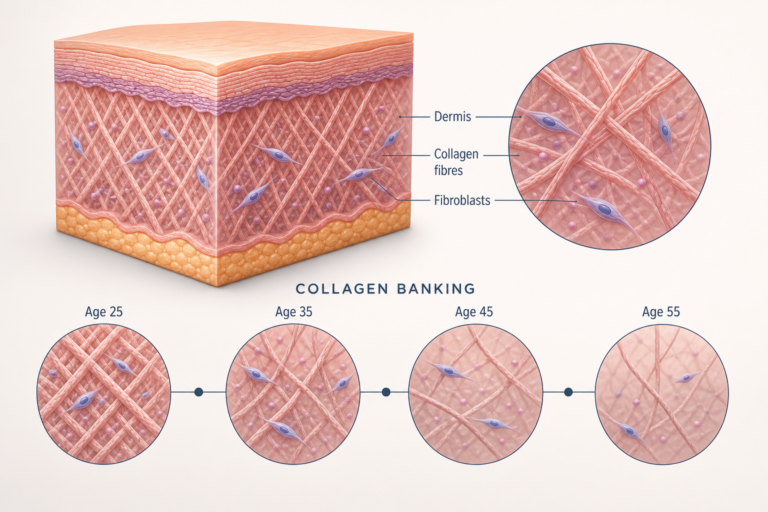
The medical name for a skin tag is acrochordon (plural: acrochordons), though they are also referred to as fibroepithelial polyps or fibroma molle in clinical settings. An acrochordon is a small outgrowth of epidermal tissue that projects from the surrounding skin surface. Internally, skin tags are composed of loose collagen fibers, dilated capillaries and lymphatic vessels, nerve cells, and fat cells, all covered by a thin layer of epidermis. Despite their sometimes alarming appearance, they are entirely benign and have no potential to become cancerous on their own.
Skin tags are extremely common. Research suggests that approximately 46 to 50 percent of adults will develop at least one during their lifetime, with prevalence increasing after the age of 40. They affect men and women in roughly equal numbers. Multiple skin tags on the same individual are not unusual, particularly in people with obesity, Type 2 diabetes, or a family history of the condition. Hormonal changes during pregnancy can also trigger new skin tag formation.
What Do Skin Tags Look Like? Key Visual Characteristics
Identifying a skin tag is usually straightforward once you know what to look for. The following characteristics describe a typical, mature skin tag.
Color
Most skin tags are flesh-colored or skin-colored, meaning they closely match the surrounding skin tone. Some may appear slightly darker — ranging from light tan to brown — particularly on individuals with medium or deeper skin tones, where the growth may be more pigmented than the surrounding skin or, conversely, slightly lighter due to reduced melanin in the elevated tissue. Skin tags can also darken gradually with age. A skin tag that suddenly turns purple or black has usually undergone thrombosis (see the section on thrombosed skin tags below) and is not a sign of cancer.
Shape and Structure
The defining structural feature of a skin tag is its peduncle — a thin stalk that connects the growth to the underlying skin. This pedunculated structure gives skin tags their characteristic soft, hanging skin appearance. The body of the tag itself may be rounded, ovular, tube-like, or balloon-like, and it moves freely when touched because it is attached only at the narrow stalk. Some smaller tags appear more thread-like or cylindrical, while larger ones can develop a more blob-like, irregular form.
Texture
The surface of a skin tag is typically smooth or slightly wrinkled. Unlike warts, which have a rough, cauliflower-like texture, or seborrheic keratosis, which has a waxy, crusty surface, skin tags feel soft and pliable to the touch. They compress easily and spring back when released. Occasionally, the surface may appear slightly crinkled, giving rise to the description of wrinkly bumps in some clinical literature.
Size
The majority of skin tags measure between 1 to 5 millimeters in diameter — roughly the size of a sesame seed or the tip of a ballpoint pen. This small size is one reason they are often noticed only incidentally, for example when a necklace or collar repeatedly catches on one. In rare cases, skin tags can grow considerably larger, reaching up to 5 centimeters (approximately the diameter of a golf ball), though this is uncommon. Larger tags are more likely to become irritated through clothing or jewelry contact.
Sensation
Skin tags are generally painless and cause no symptoms unless they are repeatedly rubbed or snagged. Persistent friction from clothing, jewelry, or skin-on-skin contact can cause a tag to become red, sore, or mildly inflamed. They do not itch, bleed spontaneously, or produce discharge under normal circumstances.
How Skin Tags Look at Different Stages
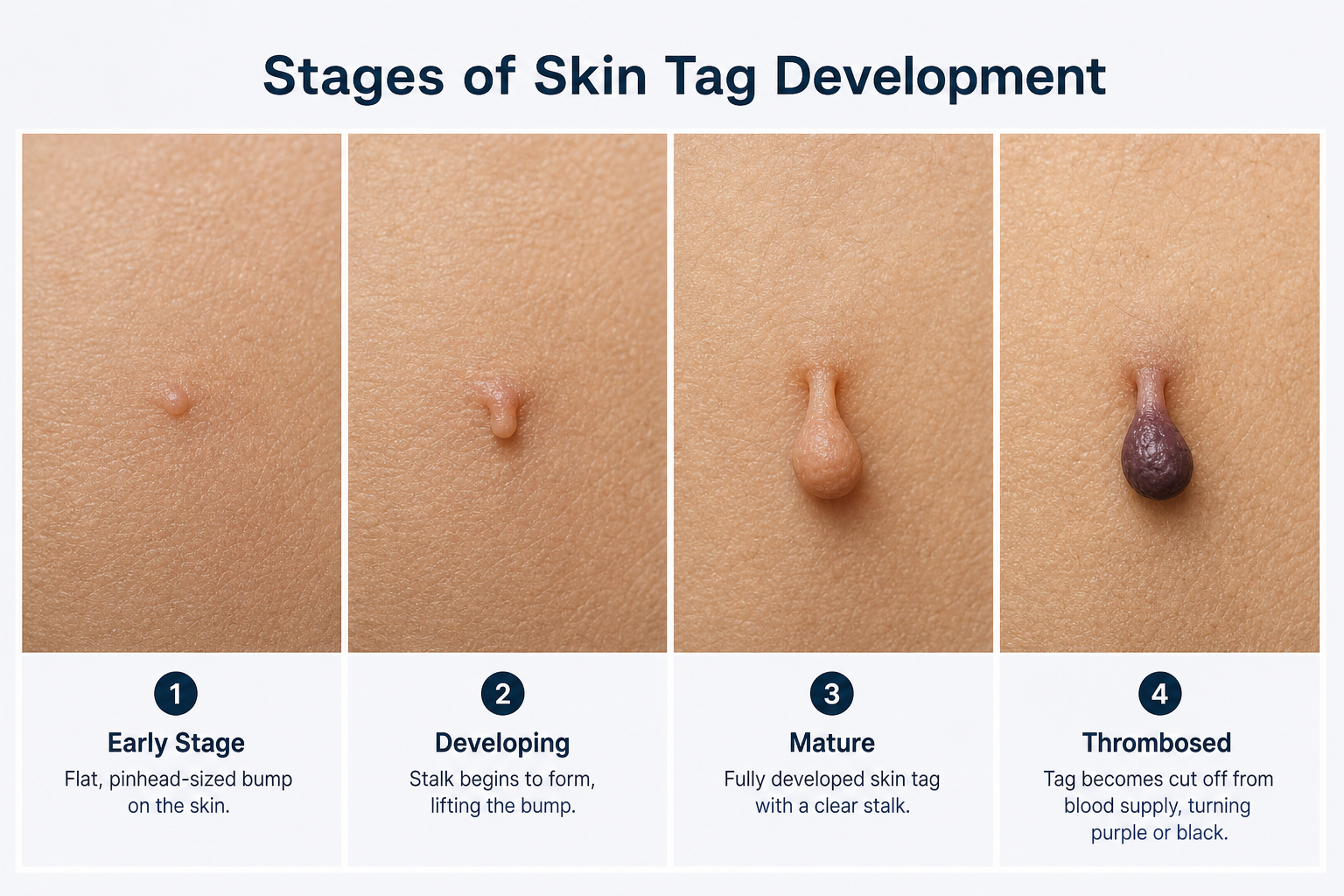
Skin tags do not appear fully formed overnight. Understanding their visual progression can help you identify one at an early stage.
- Early stage: A newly forming skin tag may appear as a tiny, flat or slightly raised pinhead-sized bump, barely distinguishable from the surrounding skin. At this point it may look more like a small pimple or a minor skin irregularity.
- Developing stage: As the tag matures, the stalk becomes more defined and the body of the growth begins to project outward. The hanging appearance becomes increasingly obvious, and the tag may begin to move when touched.
- Mature stage: A fully developed skin tag has a clearly visible thin stalk, a soft pendulous body, and a flesh-colored or slightly pigmented surface. It hangs freely and is easily movable.
- Thrombosed stage: If the blood supply to the stalk is disrupted — either spontaneously or through accidental twisting — the tag may turn red, then purple, and finally black as the tissue undergoes thrombosis. A thrombosed skin tag often falls off on its own within 3 to 10 days. A small black dot visible within the tag may represent a clotted blood vessel rather than a sign of malignancy.
Where Do Skin Tags Appear?
Skin tags form preferentially in areas where skin friction is greatest — either skin rubbing against skin, or skin rubbing against clothing or jewelry. The most common locations include:
- Neck: Particularly along the sides and back of the neck, where collars and necklaces create repeated friction. Neck skin tags are often the first ones people notice.
- Armpits (axillae): A very common site due to constant skin-on-skin movement during arm motion.
- Groin and inner thighs: Areas of high friction, especially in individuals who are overweight or physically active.
- Under the breasts: The inframammary fold is a frequent location, particularly in women with larger breast tissue.
- Eyelids: Eyelid skin tags tend to be smaller and more delicate than those found elsewhere on the body, often appearing as tiny thread-like projections along the lash line or on the eyelid itself. Their proximity to the eye makes self-removal particularly inadvisable.
- Upper chest and stomach folds: Common in individuals with abdominal skin folds where friction occurs.
- Perianal area and vulva: Less commonly discussed but recognized locations, particularly in adults with obesity or during pregnancy.
The location of a skin tag can also influence its appearance. Eyelid tags are typically smaller and more translucent, while groin or underarm tags may be larger and more pigmented due to the naturally darker skin tone in those areas.
Skin Tags on Darker Skin Tones
Most descriptions of skin tag appearance assume a light skin tone, but skin tags can look noticeably different on medium or dark skin. On deeper skin tones, a skin tag may appear darker than the surrounding skin — sometimes brown or even near-black — rather than flesh-colored. Alternatively, the elevated tissue of the tag may have slightly less pigmentation than the surrounding hyperpigmented skin, making it appear lighter by contrast. This variation is entirely normal and does not indicate a more serious condition. However, because color contrast can make it harder to distinguish a skin tag from a pigmented mole or other growth on darker skin, professional assessment is particularly useful if there is any uncertainty.
Skin Tag vs. Mole vs. Wart vs. Seborrheic Keratosis
Several common skin growths can resemble a skin tag, particularly when they are small. The comparison table below outlines the key distinguishing features.
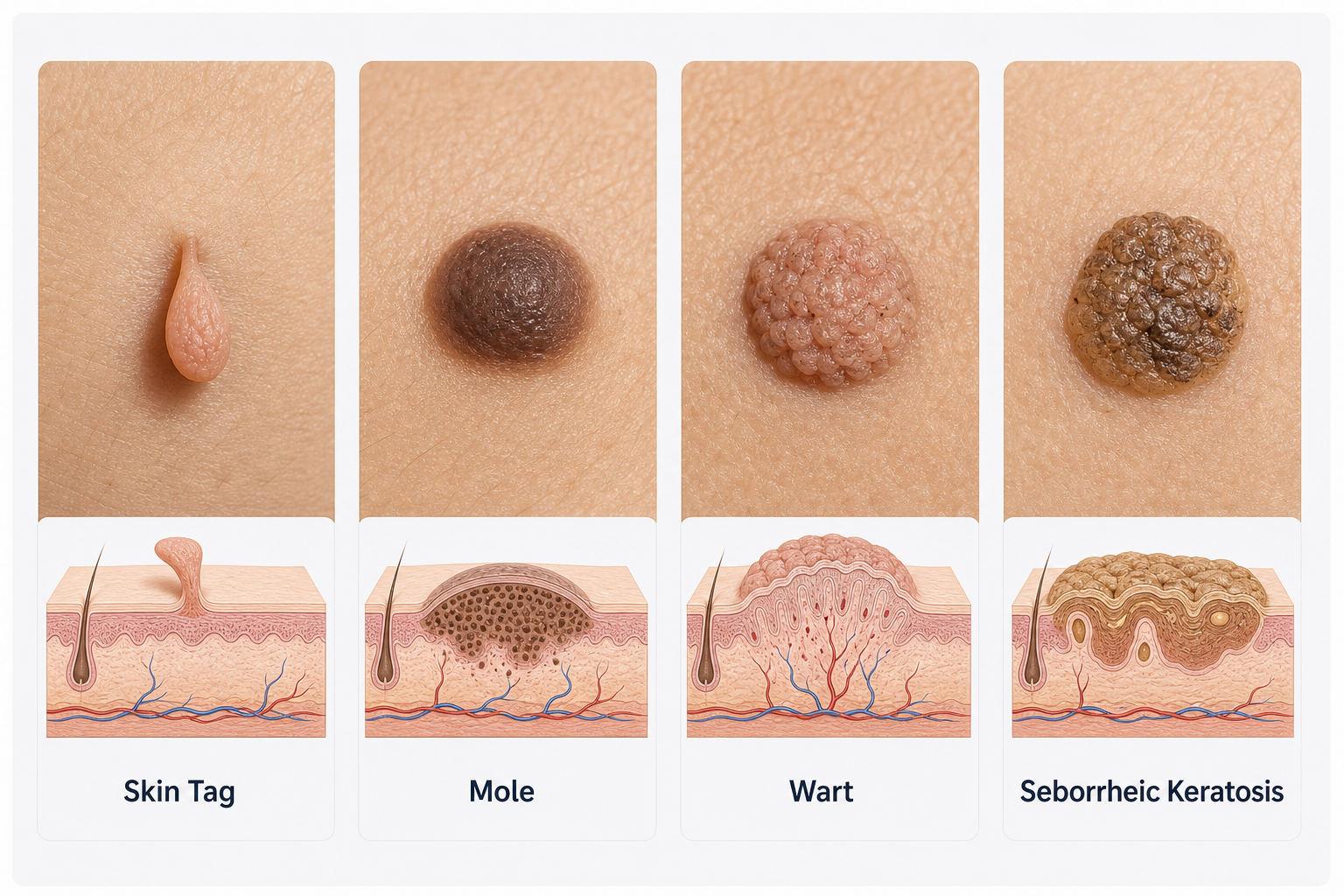
| Feature | Skin Tag (Acrochordon) | Mole (Nevus) | Wart | Seborrheic Keratosis |
|---|---|---|---|---|
| Color | Flesh-colored to light brown | Tan, brown, or near-black | Flesh-colored, sometimes with dark dots | Light tan to dark brown or black |
| Texture | Soft, smooth or slightly wrinkled | Smooth or slightly raised, firm | Rough, firm, cauliflower-like | Waxy, rough, crusty, “stuck-on” appearance |
| Shape | Rounded, tube-like, or blob-like | Round or oval, flat or dome-shaped | Broad-based, irregular surface | Oval, flat or raised, irregular edges |
| Stalk / Base | Thin stalk (peduncle), hangs freely | Broad base, integrated into skin | Broad base, no stalk | Broad base, appears pasted on |
| Cause | Skin friction, collagen fibers, genetics | Melanocyte clusters, sun exposure, genetics | Human papillomavirus (HPV) | Age-related epidermal overgrowth |
| Common Locations | Neck, armpits, groin, eyelids, under breasts | Anywhere on the body | Hands, feet, face, genitals | Face, chest, back, shoulders |
| Contagious? | No | No | Yes (HPV) | No |
In rare cases, a growth that resembles a skin tag may be something more significant. Basal cell carcinoma (BCC) — a type of skin cancer — can occasionally mimic a skin tag, particularly on sun-exposed areas. A rare variant called fibroepithelioma of Pinkus is a form of BCC that closely resembles a pedunculated skin tag. Neurofibromas, which are benign nerve-sheath tumors associated with the genetic condition neurofibromatosis, can also look similar. These conditions are uncommon, but they are the reason a professional diagnosis is recommended for any growth that behaves unusually.
When Should a Skin Tag Concern You?
The vast majority of skin tags are harmless and require no medical treatment. However, certain changes in appearance or behaviour warrant professional assessment. Consult a dermatologist or healthcare professional if a growth:
- Bleeds without being caught or snagged
- Grows rapidly over a short period
- Changes color in a way that is not consistent with thrombosis (for example, developing multiple colors, irregular pigmentation, or a spreading border)
- Becomes painful, ulcerated, or crusted without an obvious cause
- Appears on sun-exposed skin and has an unusual texture or border
- Cannot be clearly identified as a skin tag based on its appearance
A thrombosed skin tag — one that has turned purple or black due to a disrupted blood supply — is generally benign and will often resolve on its own. However, if you are unsure whether a darkened growth is a thrombosed tag or something else, a professional opinion is the safest course of action.
How Are Skin Tags Diagnosed?
In most cases, a dermatologist or trained clinician can diagnose a skin tag through visual examination alone. The characteristic combination of a thin stalk, soft texture, flesh-colored appearance, and location in a skin fold area is usually sufficient for a confident diagnosis by appearance. No biopsy or laboratory test is typically required for a straightforward skin tag.
If there is any clinical uncertainty — for example, if the growth is atypical in color, texture, or location — a dermatologist may recommend a biopsy to examine the tissue under a microscope. Histological analysis of a skin tag reveals loose collagen fibers, dilated capillaries, and a covering of normal epidermis, which confirms the benign diagnosis. This level of investigation is rarely necessary but provides definitive reassurance when the visual diagnosis is unclear.
What Causes Skin Tags to Form?
Skin tags develop when extra cells accumulate in the uppermost layers of the skin, typically in response to repeated skin friction. Areas where skin folds rub together — or where clothing, jewelry, or straps create persistent contact — are the most susceptible. The precise mechanism is not fully understood, but the formation of loose collagen fibers and dilated capillaries within the growth suggests a localized response to mechanical stress on the skin.
Several factors increase the likelihood of developing skin tags. Obesity is one of the strongest risk factors, both because it increases the number of skin folds and because it is associated with insulin resistance. Type 2 diabetes and elevated insulin levels have been linked to skin tag development, and some clinicians consider multiple skin tags a possible indicator of metabolic risk worth investigating. Pregnancy, aging, and a family history of skin tags also increase susceptibility. Skin tags are not caused by viruses and are not contagious.
Skin Tag Removal: What Are the Options?
Skin tags do not require removal for medical reasons unless they are causing significant irritation or discomfort. Removal is most commonly sought as a cosmetic concern — many people find them aesthetically bothersome, particularly when they are visible on the neck or eyelids. Several clinically recognized methods are available:
- Cryotherapy: The skin tag is frozen using liquid nitrogen, causing the tissue to die and fall away over several days. This is a common and well-tolerated outpatient procedure.
- Cauterization (electrocautery): A small electrical current is used to burn through the stalk, removing the tag and sealing the wound simultaneously.
- Excision: The tag is cut away with surgical scissors or a scalpel, usually under local anaesthetic. This is the most direct method and provides immediate results.
- Ligation: A fine thread or suture is tied tightly around the stalk, cutting off the blood supply so the tag gradually falls off. This is sometimes performed in a clinical setting.
Once a skin tag is professionally removed, it does not grow back at the same site. However, new skin tags may develop elsewhere, particularly if the underlying risk factors — such as obesity or friction — remain unchanged. Self-removal at home is not recommended, as it carries risks of infection, bleeding, and incomplete removal, and may delay the diagnosis of a growth that is not actually a skin tag.
Frequently Asked Questions
Can a skin tag fall off on its own?
Yes, occasionally. A thrombosed skin tag — one where the blood supply has been cut off, causing it to turn purple or black — may detach naturally within 3 to 10 days. Non-thrombosed skin tags rarely fall off without intervention. If a tag appears to be detaching, it is worth having it assessed to confirm it is not a different type of growth.
Are skin tags a sign of cancer?
No. Skin tags are noncancerous growths and do not have the potential to become malignant. However, because rare skin cancers such as basal cell carcinoma can occasionally resemble a skin tag, any growth that looks unusual, bleeds spontaneously, or changes rapidly should be evaluated by a dermatologist rather than assumed to be benign.
Do skin tags grow back after removal?
A skin tag that has been professionally removed does not regrow at the same site. New skin tags may appear elsewhere on the body over time, particularly in individuals with ongoing risk factors such as skin friction or metabolic conditions.
What does a skin tag with a black dot look like?
A small black dot visible within a skin tag typically represents a clotted blood vessel inside the stalk — a sign of early thrombosis. The tag may subsequently turn fully purple or black as the tissue loses its blood supply. This is a benign process, but if you are uncertain whether the growth is a thrombosed skin tag or something else, a professional assessment is advisable.
Can children get skin tags?
Skin tags are much less common in children than in adults. When they do occur in children, they are usually benign. An important exception is perianal skin tags in young children, which in some cases may be associated with underlying conditions such as Crohn’s disease or, rarely, spina bifida occulta. Any skin tag in a child, particularly in the perianal region, should be assessed by a paediatrician or dermatologist.
Is it safe to remove a skin tag at home?
Home removal is not recommended by dermatologists. Cutting, tying, or applying over-the-counter products to a skin tag at home carries risks of infection, scarring, and incomplete removal. There is also a risk of attempting to remove a growth that is not a skin tag, which could delay diagnosis of a more significant condition. Professional removal is safer and more reliable.
Do skin tags hurt?
Skin tags are generally painless. Discomfort can occur if a tag is repeatedly snagged by clothing, jewelry, or a seatbelt, or if it becomes inflamed through persistent friction. A tag that is consistently painful or tender without an obvious mechanical cause should be assessed professionally.
Should You Have a Skin Tag Assessed or Removed?
Most skin tags are straightforward to identify and entirely harmless. If the growth you have noticed is small, soft, flesh-colored, attached by a thin stalk, located in a skin fold area, and has been stable over time, it is very likely to be a benign acrochordon. Monitoring it and seeking removal only if it becomes a cosmetic concern or causes irritation is a reasonable approach for many people.
However, if you are uncertain about the nature of a growth — particularly if it is rapidly changing, bleeding, unusually colored, or located on sun-exposed skin — a consultation with a dermatologist is the appropriate next step. A visual diagnosis by a trained clinician takes only a few minutes and provides genuine reassurance. If removal is something you are considering for cosmetic or comfort reasons, a qualified practitioner can advise on the most suitable method based on the size, location, and number of tags involved. Self-diagnosis and self-removal both carry limitations, and professional guidance remains the safest and most effective route.