Double Chin Lipo: Options, Techniques, and How to Choose
A double chin — medically referred to as submental fullness — is one of the most common aesthetic concerns affecting both men and women across a wide range of ages and body types. While diet and exercise can reduce overall body fat, submental fat is notoriously resistant to lifestyle changes, particularly when genetics or anatomy play a role. Double chin lipo, or chin liposuction, is one of the most effective ways to address this concern, but it is not the only option — and it is not always the right one. This article explains how chin liposuction works, which techniques are available, how it compares to non-surgical alternatives, and what factors determine which approach may be most appropriate for you.
Key Takeaways
- Chin liposuction permanently removes submental fat cells, but results depend heavily on skin elasticity, fat location, and underlying anatomy.
- Several liposuction techniques exist — including traditional, laser-assisted, VASER, and radiofrequency-assisted — each with different mechanisms and use cases.
- Non-surgical options such as deoxycholic acid (Kybella) and cryolipolysis (CoolSculpting) can reduce submental fat but typically require multiple sessions and produce more gradual results.
- Patients with significant skin laxity, platysmal banding, or subplatysmal fat may need additional procedures beyond liposuction alone.
- A thorough consultation with a board-certified plastic surgeon is essential to determine which approach suits your anatomy and goals.
Understanding the Anatomy Behind a Double Chin
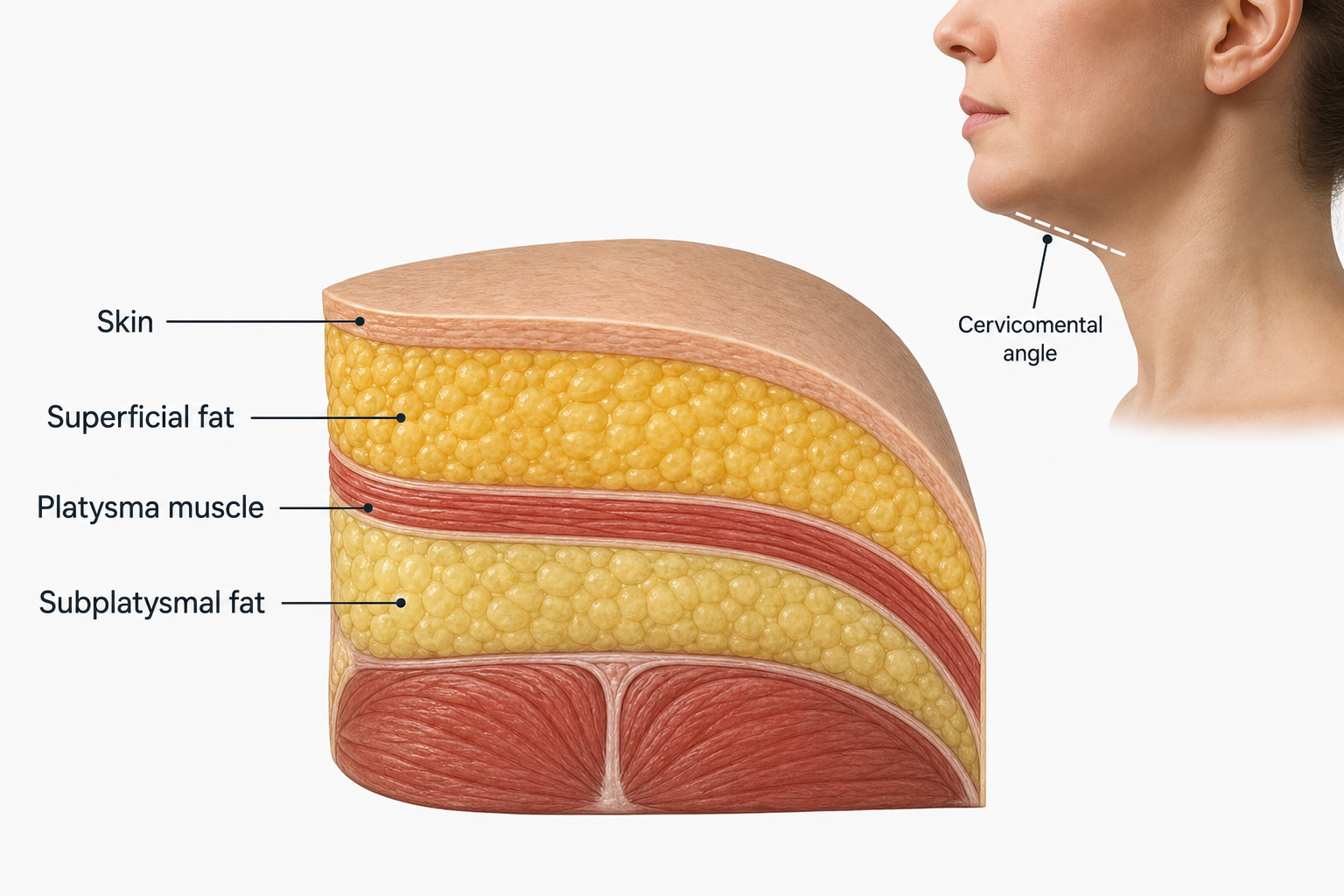
Before choosing any treatment, it helps to understand why a double chin forms and what structures are involved. The submental region contains several distinct anatomical layers: skin, superficial fat (above the platysma muscle), the platysma muscle itself, and deep or subplatysmal fat beneath it. Most cases of submental fullness involve excess fat in the superficial layer, which is the primary target of chin liposuction. However, some patients also have subplatysmal fat deposits, platysmal banding (visible vertical cords in the neck), or ptotic submandibular glands — none of which liposuction alone can correct.
The cervicomental angle — the angle formed between the neck and chin — is a key aesthetic marker. A well-defined cervicomental angle contributes to jawline definition and a youthful neck profile. Factors that blunt this angle include excess submental fat, poor chin projection, skin laxity, and muscle changes. Understanding which of these factors applies to you is what determines whether liposuction alone will achieve the result you are looking for, or whether additional procedures are needed.
The position of the hyoid bone also matters. A low hyoid bone limits how much the cervicomental angle can be improved surgically, regardless of how much fat is removed. This is one reason why a thorough anatomical assessment before any treatment is so important.
What Is Double Chin Lipo and How Does It Work?
Chin liposuction is a surgical procedure that removes excess submental fat through small incisions, typically placed discreetly beneath the chin and sometimes behind the earlobes. A thin tube called a cannula is inserted through these incisions and used to break up and suction out fat cells. Before the cannula is introduced, a tumescent solution — a mixture of saline, local anesthesia, and a vasoconstrictor — is injected into the treatment area. This fluid numbs the tissue, reduces bleeding, and makes fat easier to remove.
The procedure is most commonly performed under local anesthesia with or without sedation, and typically takes between one and two hours depending on the extent of treatment and whether additional procedures are combined. Because fat cells are physically removed, the results are considered long-lasting — the treated fat cells do not regenerate. However, significant weight gain after the procedure can cause remaining fat cells in the area to enlarge, which may partially diminish results over time.
Liposuction Techniques for the Chin and Neck
Not all chin liposuction is performed the same way. Several techniques are available, each with different mechanisms and potential advantages depending on the patient’s anatomy and the surgeon’s assessment.
Traditional Tumescent Liposuction
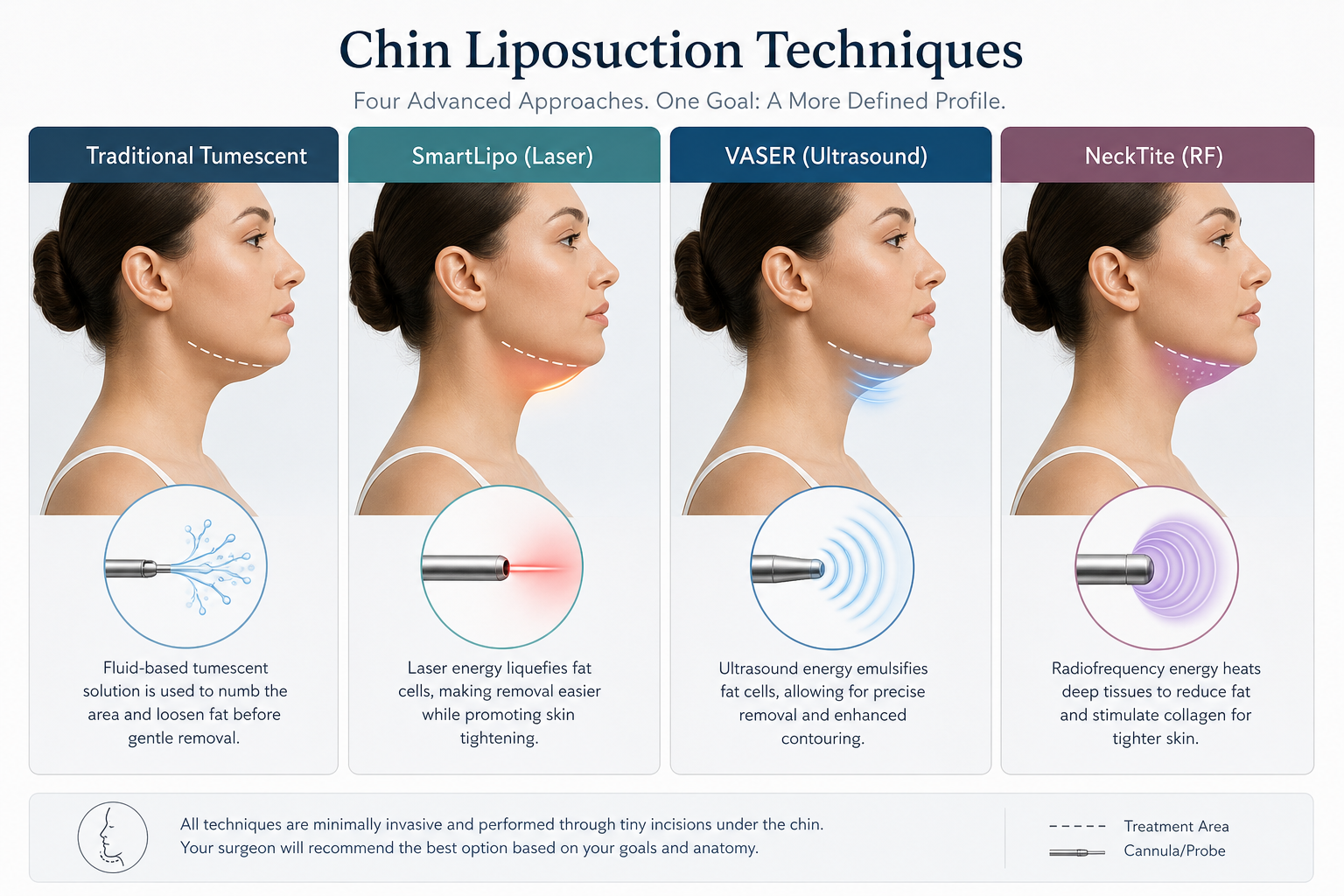
Traditional tumescent liposuction remains the most widely used technique for submental fat removal. After the tumescent solution is administered, the surgeon uses a small cannula in a fanning motion to dislodge and aspirate fat. It is effective for straightforward cases with good skin elasticity and localized fat deposits. The technique is well-established, with a long safety record in experienced hands.
Laser-Assisted Liposuction (SmartLipo)
Laser-assisted liposuction, commonly known by the brand name SmartLipo, uses laser energy delivered through a thin fibre to liquefy fat before it is suctioned out. The thermal energy also stimulates collagen production in the overlying skin, which may promote some degree of skin tightening — a potential advantage in patients with mild to moderate skin laxity. SmartLipo is often discussed as a suitable option for the chin and neck because skin tightening in this area is frequently a secondary concern alongside fat removal.
VASER Liposuction
VASER liposuction uses ultrasound energy to selectively emulsify fat cells while preserving surrounding structures such as nerves and blood vessels. This ultrasound-assisted approach can allow for more precise fat removal and may reduce trauma to surrounding tissue. VASER liposuction is sometimes preferred in areas where anatomical precision is important, including the neck and jawline, though outcomes depend significantly on surgeon experience with the technology.
Radiofrequency-Assisted Liposuction (FaceTite / NeckTite)
Radiofrequency-assisted liposuction (RFAL) devices such as FaceTite and NeckTite deliver radiofrequency energy both internally (through a cannula) and externally (through a skin electrode) simultaneously. This dual-action approach melts fat while contracting the overlying skin, making it a popular option for patients who want fat reduction combined with meaningful skin tightening without undergoing a full neck lift. NeckTite is specifically designed for the submental and neck region. Results in terms of skin contraction can be significant, though they are generally less dramatic than a surgical neck lift for patients with substantial skin laxity.
Power-Assisted Liposuction (PAL)
Power-assisted liposuction uses a mechanically vibrating cannula to break up fat more efficiently, which can reduce surgeon fatigue and allow for smoother fat removal. It is less commonly discussed specifically for the chin area but may be used in combination with other techniques.
Comparing Double Chin Lipo to Non-Surgical Alternatives
Chin liposuction is not the only way to address submental fat. Non-surgical options have become increasingly popular, particularly for patients who prefer to avoid surgery or have only mild to moderate submental fullness. The table below compares the main options across key decision factors.
| Treatment | Type | Mechanism | Sessions Needed | Downtime | Results Onset | Longevity | Best For |
|---|---|---|---|---|---|---|---|
| Chin Liposuction | Surgical | Physical fat removal via cannula | 1 | 7–14 days social downtime | Weeks to months (final at 3–6 months) | Long-lasting (fat cells removed) | Moderate to significant submental fat, good skin elasticity |
| Kybella (Deoxycholic Acid) | Non-surgical injection | Destroys fat cell membranes | 2–6 sessions | Significant swelling 1–2 weeks per session | Gradual over months | Long-lasting once target achieved | Mild to moderate submental fat, needle-only preference |
| CoolSculpting (CoolMini) | Non-surgical device | Cryolipolysis — freezes fat cells | 1–3 sessions | Minimal (redness, numbness) | 8–12 weeks per session | Long-lasting (treated cells eliminated) | Mild submental fat, no downtime preference |
| NeckTite / FaceTite (RFAL) | Minimally invasive | RF energy melts fat + tightens skin | 1 | 5–10 days | Weeks to months | Long-lasting with skin tightening benefit | Fat + mild-moderate skin laxity, avoiding full neck lift |
| Neck Lift | Surgical | Skin excision, muscle repair, fat removal | 1 | 2–4 weeks | Weeks to months | Long-lasting (years) | Significant skin laxity, platysmal banding, older patients |
Kybella (Deoxycholic Acid Injections)
Kybella contains deoxycholic acid, a naturally occurring molecule that disrupts fat cell membranes, causing them to break down and be gradually cleared by the body. It is injected directly into submental fat in a grid pattern across multiple sessions. Most patients require between two and six treatment sessions spaced at least four weeks apart. A notable side effect is significant swelling after each session — sometimes called the “bullfrog effect” — which can last one to two weeks. Kybella is best suited to patients with mild to moderate submental fat and good skin elasticity, as it does not address skin laxity and may worsen the appearance of loose skin if used in patients who are not good candidates.
CoolSculpting (CoolMini Applicator)
CoolSculpting uses cryolipolysis — controlled cooling — to freeze and destroy fat cells without damaging the overlying skin. The CoolMini applicator is specifically designed for the smaller submental area. Results develop gradually over eight to twelve weeks as the body clears the treated fat cells. CoolSculpting is a reasonable option for patients with mild submental fullness who want minimal downtime, but it is generally less effective than liposuction for larger volumes of fat. A rare but important complication is paradoxical adipose hyperplasia, in which the treated area paradoxically enlarges rather than reduces — this is uncommon but worth discussing with your provider.
Who Is a Good Candidate for Chin Liposuction?
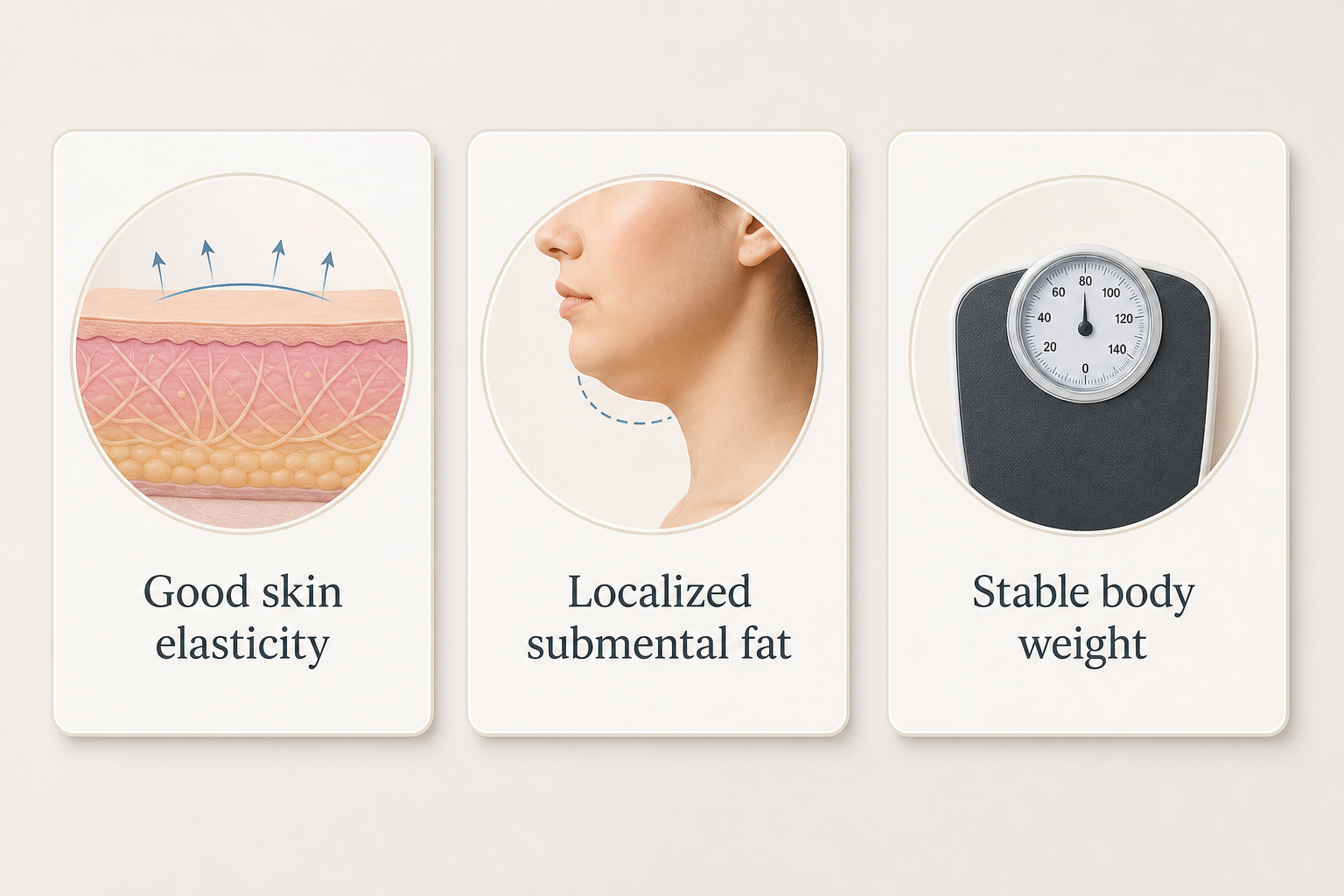
Candidacy for double chin lipo depends on several anatomical and health-related factors. The ideal candidate typically has localized submental fat that has not responded to diet and exercise, good to moderate skin elasticity that will allow the skin to redrape smoothly after fat removal, a stable body weight, realistic expectations, and no significant medical contraindications to surgery or local anesthesia.
Skin elasticity is one of the most important factors. Younger patients and those with naturally resilient skin tend to achieve the best results from liposuction alone, because the skin contracts and conforms to the new contour after fat is removed. Patients with poor skin laxity — often older individuals or those who have experienced significant weight loss — may be left with loose or irregular skin after liposuction if skin tightening is not addressed simultaneously. In these cases, a radiofrequency-assisted approach, Morpheus8 RF microneedling, or a surgical neck lift may be more appropriate.
When Liposuction Alone May Not Be Enough
Several anatomical findings suggest that chin liposuction alone may not achieve the desired result. Platysmal banding — the visible vertical cords that appear in the neck, particularly when speaking or turning the head — is caused by changes in the platysma muscle and cannot be corrected by fat removal. Addressing platysmal banding typically requires platysmaplasty, a surgical procedure in which the platysma muscle edges are sutured together or partially excised. Subplatysmal fat, which lies beneath the platysma muscle, is also not accessible through standard liposuction and may require a more extensive surgical approach. Patients with a weak chin or recessed mandible may find that even successful fat removal does not produce the jawline definition they hoped for; in these cases, a chin implant or chin augmentation with dermal filler may complement the result.
Men and Women: Different Considerations
Neck anatomy and aesthetic goals differ between men and women in ways that can influence treatment planning. Men typically have thicker skin and more fibrous submental fat, which can make liposuction technically more demanding and may affect how smoothly the skin redrapes afterward. Men also tend to prefer a more angular, defined cervicomental angle, while women may prioritize a softer, more gradual neck contour. Facial hair in men can help conceal small incision sites beneath the chin, but it also means that any visible scarring in the beard area requires careful incision placement. These differences are worth discussing with your surgeon during the consultation.
What to Expect: The Procedure and Recovery
Chin liposuction is typically performed as an outpatient procedure. After the tumescent solution is administered and the area is numb, the surgeon makes small incisions — usually two to three millimetres — and introduces the cannula to remove fat. The procedure generally takes one to two hours. Most patients are able to return home the same day.
Recovery Timeline
Days 1–3: Swelling, bruising, and tightness are expected. A compression garment or chin strap is worn continuously to support the tissue and reduce swelling. Some numbness in the treated area is normal. Most patients manage discomfort with over-the-counter pain relief.
Week 1–2: Swelling begins to subside but remains noticeable. Most patients can return to desk-based work within five to seven days, though social downtime varies. Strenuous activity should be avoided. The compression garment is typically worn for one to three weeks depending on the surgeon’s protocol.
Week 3–6: Visible improvement becomes more apparent as swelling continues to resolve. Residual firmness or numbness in the treated area is common and usually temporary. Sleeping with the head slightly elevated can help manage swelling.
Month 3–6: Final results become visible as the skin fully redrapes and any residual swelling resolves. Collagen remodelling continues during this period, particularly with laser-assisted or radiofrequency-assisted techniques. Some surgeons recommend lymphatic massage during recovery to support fluid drainage and reduce swelling.
Risks and Limitations
Chin liposuction is generally considered a low-risk procedure when performed by a qualified, board-certified plastic surgeon, but no surgical procedure is without risk. Potential complications include infection, asymmetry, skin irregularities or contour deformities, prolonged numbness, and scarring at incision sites. Injury to the marginal mandibular nerve — a branch of the facial nerve that controls movement of the lower lip — is a rare but serious risk that underscores the importance of choosing an experienced surgeon familiar with facial anatomy.
Skin sagging after liposuction is a meaningful risk in patients whose skin elasticity was not adequately assessed before the procedure. If too much fat is removed from a patient with poor skin laxity, the result can be loose, irregular skin that may require a subsequent neck lift or skin tightening procedure to correct. This is one of the most common reasons patients seek revision after chin liposuction.
Non-surgical options carry their own risks. Kybella can cause prolonged swelling, nerve injury, and — rarely — difficulty swallowing. CoolSculpting carries the risk of paradoxical adipose hyperplasia as noted above. Radiofrequency-assisted devices carry a risk of burns if not used correctly.
Cost and Financing
The cost of chin liposuction varies considerably depending on the technique used, the surgeon’s experience and location, the type of anesthesia, and whether additional procedures are combined. Traditional chin liposuction tends to be less expensive than laser-assisted or radiofrequency-assisted techniques, which involve more advanced equipment. Combination procedures — such as chin lipo with a chin implant or platysmaplasty — will increase the overall cost. Non-surgical options such as Kybella may appear less expensive per session but can become comparable in total cost when multiple sessions are required.
Chin liposuction is a cosmetic procedure and is not covered by health insurance in most cases. Many clinics offer financing through third-party providers such as CareCredit or Alphaeon Credit, which allow patients to spread the cost over time. It is worth requesting a detailed cost breakdown during your consultation so you understand what is included in the quoted fee.
Frequently Asked Questions
How long do the results of chin liposuction last?
Because fat cells are physically removed during liposuction, the results are considered long-lasting. The treated fat cells do not regenerate. However, significant weight gain after the procedure can cause remaining fat cells in the area — and elsewhere — to enlarge, which may partially affect the result over time. Maintaining a stable weight helps preserve the outcome.
Can chin lipo be combined with other procedures?
Yes. Chin liposuction is frequently combined with other procedures to address multiple concerns simultaneously. Common combinations include chin lipo with a chin implant to improve chin projection and jawline definition, chin lipo with platysmaplasty to address platysmal banding, and chin lipo with Morpheus8 or NeckTite to enhance skin tightening. Combining procedures can reduce overall recovery time compared to staging them separately.
Is chin liposuction painful?
The procedure itself is performed under local anesthesia, so patients typically feel pressure rather than pain during treatment. Post-procedure discomfort is usually mild to moderate and manageable with over-the-counter pain relief. Tightness and soreness in the treated area are more commonly reported than sharp pain.
What if I still have a double chin after liposuction?
Residual fullness after chin liposuction can have several causes: subplatysmal fat that was not accessible, platysmal banding, submandibular gland ptosis, poor skin redraping, or insufficient fat removal. A follow-up assessment with your surgeon is important to identify the cause before considering any revision or additional treatment. Options may include a second liposuction session, a neck lift, or targeted skin tightening.
How is chin liposuction different from a neck lift?
Chin liposuction removes fat but does not address excess skin or muscle changes. A neck lift is a more extensive surgical procedure that removes or repositions excess skin, tightens the platysma muscle, and may include fat removal. A neck lift is generally recommended for patients with significant skin laxity, platysmal banding, or more advanced signs of neck ageing. Liposuction alone is better suited to younger patients or those with good skin elasticity and primarily a fat-related concern.
Am I too old for chin liposuction?
Age alone is not a disqualifying factor, but skin elasticity — which tends to decrease with age — is a key consideration. Older patients with good skin quality may still be excellent candidates for chin liposuction. Those with more significant skin laxity may achieve better results with a neck lift or a combined approach. A surgeon’s assessment of your individual anatomy is the most reliable guide.
Choosing the Right Approach for Your Chin and Neck Goals
Double chin lipo is a well-established and effective option for patients with localized submental fat and adequate skin elasticity, but it is not a universal solution. The right approach depends on the specific anatomy involved — the depth and volume of fat, the condition of the overlying skin, the state of the platysma muscle, and the overall proportions of the chin and neck. Patients with straightforward submental fat and good skin quality are often excellent candidates for traditional or laser-assisted liposuction. Those with mild laxity may benefit from a radiofrequency-assisted technique such as NeckTite. Patients with significant skin looseness, platysmal banding, or subplatysmal fat may need a more comprehensive surgical plan that includes platysmaplasty or a neck lift.
Non-surgical options such as Kybella and CoolSculpting remain reasonable choices for patients with mild submental fullness who prefer to avoid surgery, though they require realistic expectations about the degree of change achievable and the time and sessions involved. A thorough consultation with a board-certified plastic surgeon — one who can assess your anatomy, discuss all relevant options honestly, and tailor a plan to your specific goals — is the most important step you can take before committing to any treatment.