Double Chin Filler: Who Is a Suitable Candidate?
Double chin filler is a non-surgical option that can improve the appearance of submental fullness — but it works best for a specific subset of patients, and it is not the right solution for every type of double chin. Understanding what actually causes your double chin is the most important step before considering any treatment, because the cause determines which approach is likely to help and which may make things worse.
Key Takeaways
- Double chin filler works by improving chin projection and the cervicomental angle, not by removing fat — making it most suitable when a recessed chin is the primary cause of submental fullness.
- Good candidates typically have mild to moderate submental fullness, reasonable skin elasticity, and realistic expectations about what a non-surgical approach can achieve.
- Filler is unlikely to help — and may worsen the appearance — when significant submental fat, severe skin laxity, or platysmal banding is the main issue.
- Alternatives such as fat-dissolving injections, CoolSculpting, HIFU, or submental liposuction may be more appropriate depending on the underlying cause and severity.
- A thorough clinical assessment by a qualified practitioner is essential before any treatment decision is made.
What Causes a Double Chin?
A double chin is rarely caused by a single factor, and identifying the dominant cause is what makes treatment selection meaningful. The most common contributors include excess submental fat, reduced skin elasticity, structural facial anatomy, and muscle changes — and these often overlap in the same patient.
Submental Fat Accumulation
Excess fat beneath the chin is the cause most people assume is responsible. This fat can sit just beneath the skin (subcutaneous) or deeper beneath the platysma muscle (subplatysmal). Subcutaneous fat responds to fat-dissolving injections and cryolipolysis; subplatysmal fat generally does not, and typically requires surgical intervention. Genetics play a significant role in where the body stores fat in the neck and chin area, which is why some people develop submental fullness regardless of their overall body weight.
Skin Laxity and Ageing
As collagen and elastin production decline with age, the skin in the neck and lower face loses its ability to remain taut. This can create the appearance of a double chin even when the underlying fat volume is not significantly increased. Skin laxity is an important factor in treatment planning because filler does not tighten loose skin, and adding volume in the wrong area can accentuate rather than reduce the problem.
A Recessed or Weak Chin
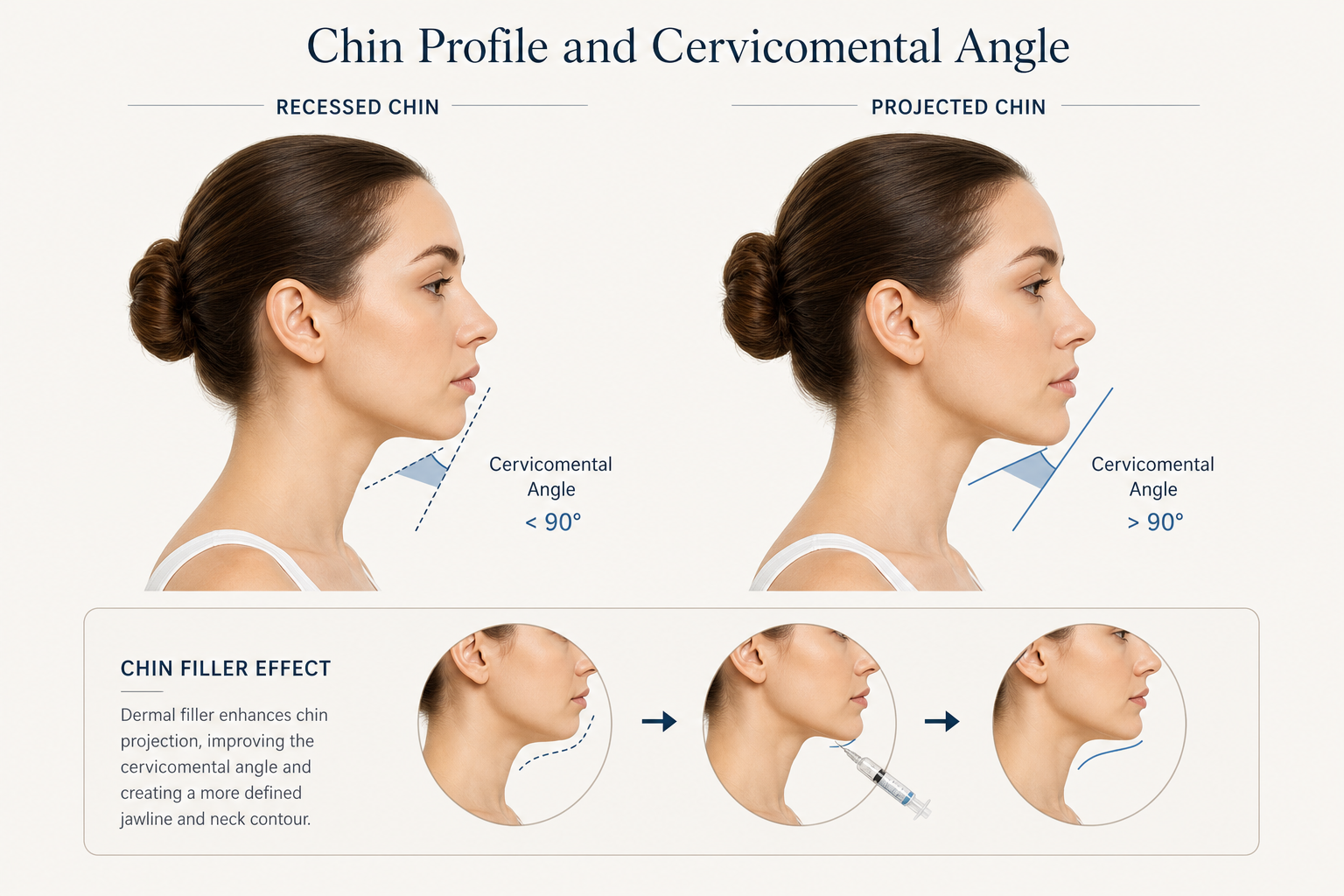
This is the cause most directly relevant to double chin filler candidacy. When the chin is underprojected — a condition sometimes called retrogenia — the cervicomental angle (the angle between the neck and the underside of the chin) appears more closed or obtuse than ideal. This creates the visual impression of a double chin even when there is very little actual submental fat. Thin people who develop a double chin despite a healthy weight often fall into this category. In these cases, improving chin projection with hyaluronic acid filler can visually open the cervicomental angle and reduce the appearance of submental fullness without removing any fat at all.
Platysma Muscle Changes
The platysma is a broad, flat muscle that runs from the chest up through the neck. With age, the platysma can lose tone and develop visible vertical bands, contributing to neck laxity and a less defined jawline. Platysmal banding is a distinct concern that does not respond well to filler and typically requires botulinum toxin injections or, in more advanced cases, surgical correction such as platysmaplasty.
Cause-to-Treatment Overview
| Primary Cause | Likely Treatment Direction |
|---|---|
| Recessed or weak chin (retrogenia) | Chin filler / hyaluronic acid filler |
| Mild to moderate subcutaneous submental fat | Fat-dissolving injections, cryolipolysis, HIFU |
| Moderate to significant submental fat | Submental liposuction, combination therapy |
| Skin laxity / reduced elasticity | HIFU, radiofrequency, neck lift |
| Platysmal banding | Botulinum toxin, platysmaplasty |
| Mixed causes | Multi-modal / combination therapy |
How Does Double Chin Filler Work?
Double chin filler does not dissolve or remove fat. Instead, hyaluronic acid filler is placed at the chin to increase chin projection, which in turn changes the geometry of the lower face and neck. By bringing the chin forward, the treatment can visually open the cervicomental angle, making the transition between the neck and chin appear sharper and more defined. This creates an optical effect that reduces the perceived depth of submental fullness.
Hyaluronic acid is a naturally occurring substance that binds water molecules and integrates into surrounding tissue, providing structural support and subtle volume. In the chin area, firmer HA filler formulations are typically used to provide the projection and definition needed for lower face contouring. The effect is structural rather than volumetric in the conventional sense — the goal is to rebalance facial proportions rather than simply add bulk.
It is worth distinguishing between chin filler and jawline filler, as these serve different purposes. Chin filler targets the central projection point of the chin and primarily addresses the cervicomental angle.Jawline filler is placed along the mandibular border to improve lateral definition and the overall shape of the lower face. Some patients benefit from both, while others require only one. A practitioner experienced in lower face contouring will assess which approach — or which combination — is appropriate based on individual anatomy.
Who May Be a Suitable Candidate for Double Chin Filler?
Suitability for double chin filler depends on the cause of the double chin, the degree of submental fullness, skin quality, and individual anatomy. The following factors are associated with a more favourable outcome from this approach.
Structural Factors That Support Candidacy
- A recessed or underprojected chin — When retrogenia is the primary driver of the appearance, chin filler directly addresses the root cause by improving chin projection.
- Mild to moderate submental fullness — Filler is most effective when the degree of submental fullness is limited. Significant fat accumulation is unlikely to be adequately addressed by structural repositioning alone.
- Good skin elasticity — Skin that retains reasonable firmness and elasticity will adapt well to the subtle changes in chin projection. Patients with good skin quality tend to see cleaner, more defined results.
- A closed or obtuse cervicomental angle — When the angle between the neck and chin is less defined than ideal, improving chin projection can produce a meaningful visual improvement.
General Health and Lifestyle Factors
- Stable weight — Significant weight fluctuations after treatment can alter the appearance of results, as changes in submental fat volume will affect the overall contour.
- Good general health — No active infection near the injection site, no blood clotting disorders, and no conditions that significantly impair healing.
- Not pregnant or breastfeeding — Dermal filler treatment is not recommended during pregnancy or breastfeeding.
- No allergy to hyaluronic acid or lidocaine — Most HA fillers contain lidocaine as a local anaesthetic; patients with relevant allergies should discuss this with their practitioner.
- Realistic expectations — Understanding that filler improves the visual appearance of submental fullness through structural repositioning, rather than eliminating fat, is essential for satisfaction with results.
A Note on Thin Patients With a Double Chin
Patients who are at a healthy weight but still have a noticeable double chin are often good candidates for filler. In many of these cases, the underlying cause is a structurally recessed chin rather than excess fat. The submental fat pad may be entirely normal in volume, but the underprojected chin creates a closed cervicomental angle that makes the area appear fuller than it is. For these patients, chin filler can produce a significant improvement with minimal intervention, and fat-reduction treatments would be unlikely to help because fat is not the primary issue.
Who Is Unlikely to Benefit From Double Chin Filler?
Identifying patients for whom filler is not appropriate is just as important as identifying good candidates. Using filler in the wrong clinical context can add unwanted volume to an area that already has excess tissue, potentially worsening the appearance rather than improving it.
- Significant submental fat accumulation — When the submental fat pad is substantially enlarged, adding chin projection will not adequately address the fullness. Fat reduction through fat-dissolving injections, cryolipolysis, or liposuction is more appropriate.
- Severe skin laxity — Loose, inelastic skin in the neck and chin area will not tighten in response to filler. In some cases, adding volume can make skin laxity more visible. Skin-tightening treatments or surgical options may be more suitable.
- Platysmal banding as the primary cause — Visible platysma bands require targeted treatment, not structural chin augmentation.
- Significant skeletal deficiency — When the chin is severely underprojected due to underlying bone structure, the degree of correction achievable with filler may be limited. Surgical genioplasty may be a more appropriate long-term solution.
- Expectation that filler will remove fat — Patients who believe filler will dissolve or reduce submental fat are not suitable candidates, as this is not how the treatment works. Proceeding without correcting this misunderstanding is likely to result in dissatisfaction.
Severity, Grading, and Treatment Matching
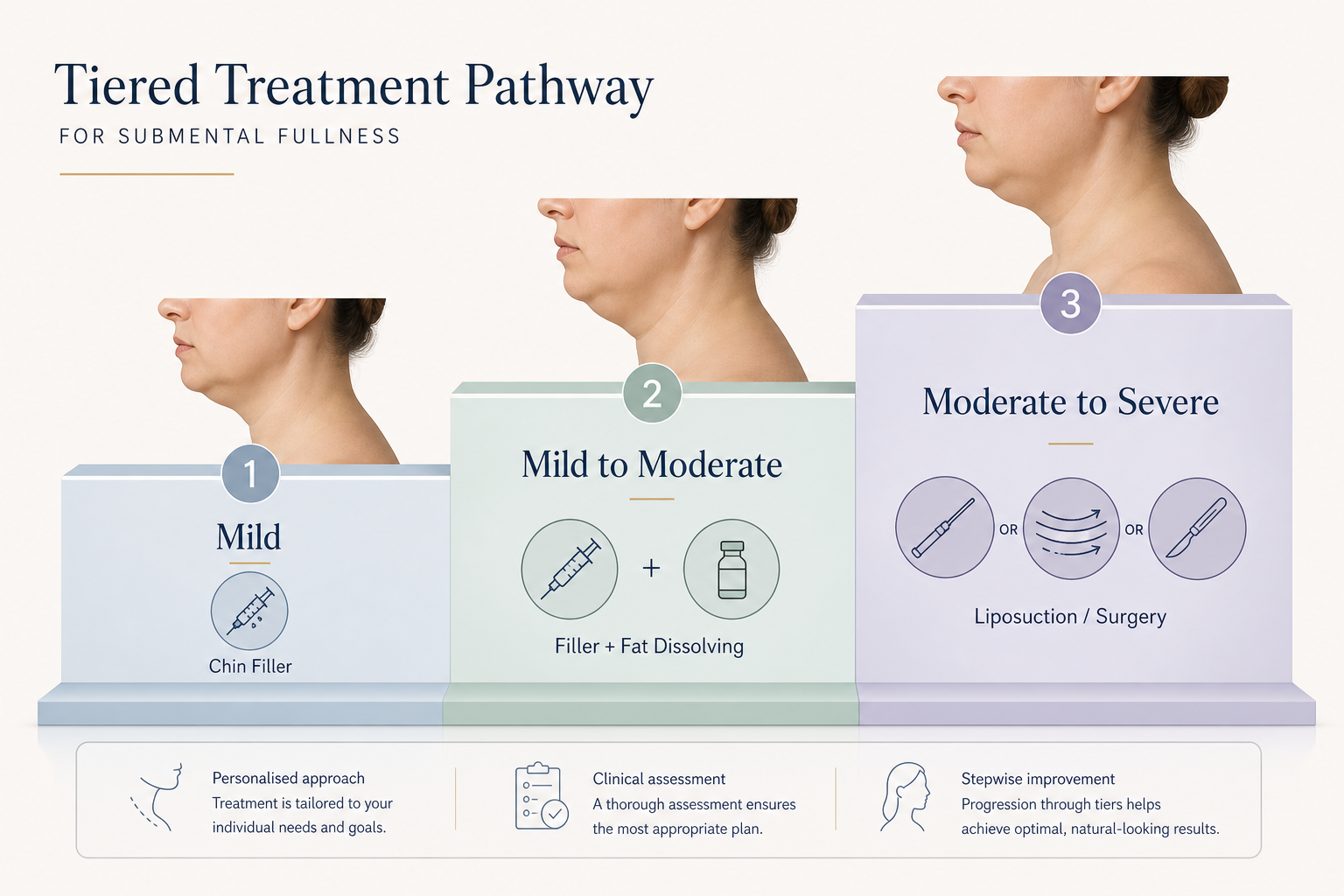
Clinical assessment of submental fullness typically considers severity on a spectrum from mild to severe. A simplified framework used in clinical practice — sometimes referred to as a submental fat rating scale — grades the degree of fullness and helps guide treatment selection. While the specific grading tools used vary between practitioners, the general principle is consistent: milder presentations are more amenable to non-surgical approaches, while more significant fullness or laxity typically requires more targeted or surgical intervention.
A useful way to think about this is as a tiered approach. Patients with mild submental fullness and a recessed chin may achieve satisfactory results with chin filler alone. Those with mild to moderate fat alongside a structural chin concern may benefit from a combination of chin filler and fat-dissolving injections. Patients with moderate to significant fat accumulation, or with meaningful skin laxity, are more likely to require fat reduction treatments, skin-tightening procedures, or surgical options — either alone or in combination. This kind of structured combination therapy pathway is increasingly used in clinical practice to address the multifactorial nature of submental fullness.
Alternatives to Double Chin Filler
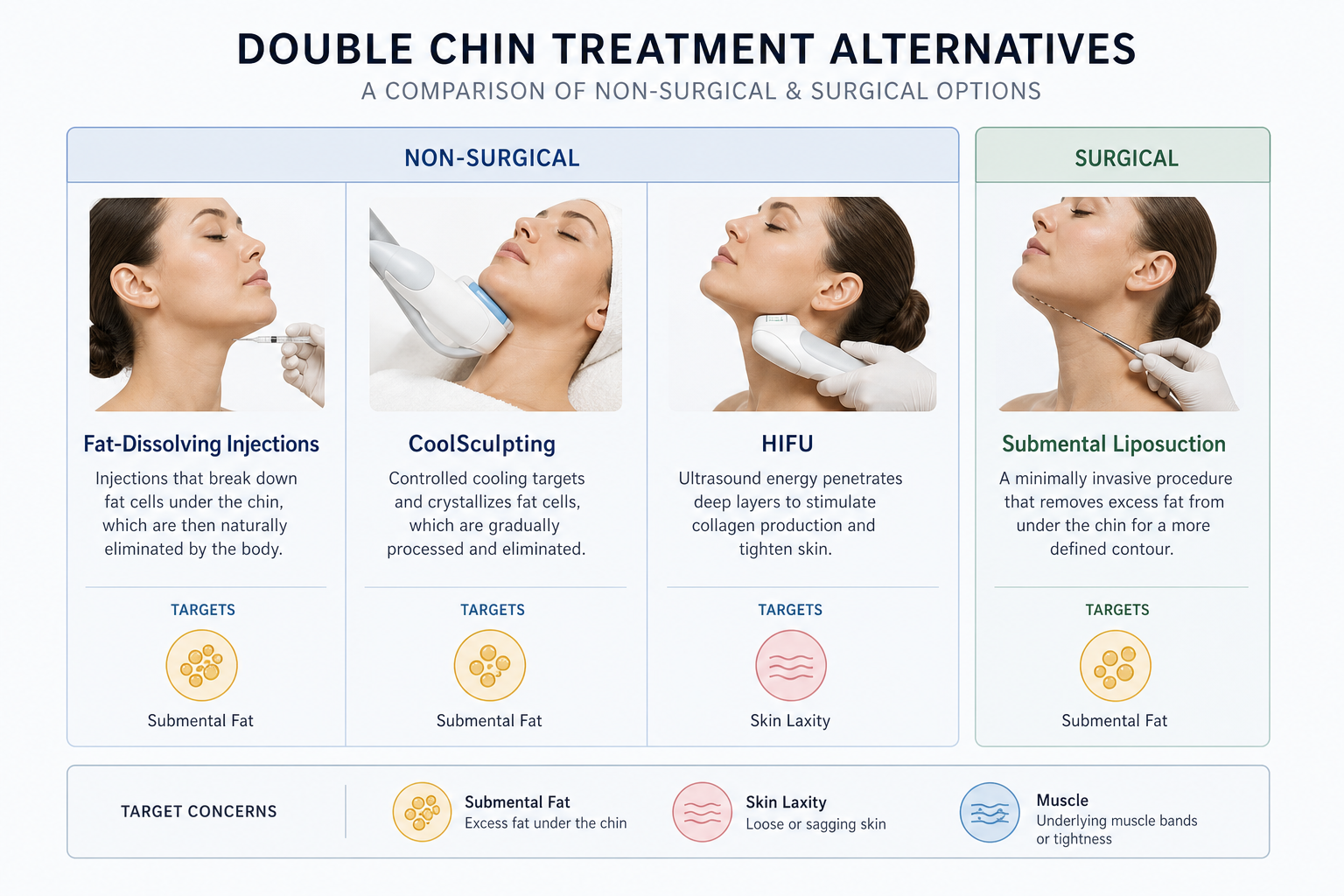
Several other treatments address submental fullness through different mechanisms, and the most appropriate option depends on the dominant cause identified during assessment.
Fat-Dissolving Injections (Deoxycholic Acid)
Fat-dissolving injections containing deoxycholic acid — marketed as Kybella in some markets — are designed to break down subcutaneous fat cells in the submental area. They are FDA-approved for this indication and may be suitable for patients with mild to moderate submental fat who want a non-surgical approach. Multiple treatment sessions are typically required, and there is a period of swelling and downtime after each session. Fat-dissolving injections do not improve chin projection or address skin laxity.
CoolSculpting (Cryolipolysis)
CoolSculpting uses controlled cooling to reduce subcutaneous fat cells in the submental area. It is a non-invasive option for patients with localized fat who are not suitable for or do not want injectable treatments. Results develop gradually over several weeks as the body processes the treated fat cells. Like fat-dissolving injections, cryolipolysis does not address structural chin concerns or skin laxity.
HIFU and Radiofrequency Treatments
High-intensity focused ultrasound (HIFU) and radiofrequency-based treatments such as Morpheus8 can stimulate collagen production and provide modest skin tightening in the neck and chin area. These may be appropriate for patients with mild skin laxity or as part of a combination therapy approach. Evidence for their effectiveness in the submental area continues to develop, and results are generally more modest than surgical options for significant laxity.
Submental Liposuction
Submental liposuction is a surgical procedure that removes fat from beneath the chin through small incisions. It is generally considered the most effective single intervention for moderate to significant submental fat accumulation and can produce long-lasting results in a single session. It does not address skin laxity or structural chin concerns on its own, and recovery involves downtime that non-surgical options do not.
Neck Lift and Platysmaplasty
For patients with significant skin laxity, platysmal banding, or a combination of concerns that non-surgical treatments cannot adequately address, a neck lift or platysmaplasty may be the most appropriate option. These surgical procedures address the underlying muscle and skin structures directly and can produce more durable results in the right candidate.
What to Expect From the Procedure and Results
A double chin filler appointment typically begins with a consultation and facial assessment to confirm suitability and agree on the treatment plan. The injection area is usually cleaned and a topical or local anaesthetic may be applied. The filler is then placed at the chin using a needle or cannula, with the practitioner shaping and assessing the result throughout. The appointment itself is generally brief, often completed within 30 to 60 minutes including assessment time.
Mild swelling, tenderness, and bruising at the injection site are common in the days following treatment and usually resolve within one to two weeks. Results from chin filler are typically visible immediately, though the final appearance becomes clearer once any swelling has settled. Hyaluronic acid filler in the chin area generally lasts between 12 and 18 months, though this varies depending on the specific product used, the volume placed, individual metabolism, and lifestyle factors including weight changes. Maintenance appointments are usually needed to sustain results over time.
Vascular occlusion is a rare but serious risk associated with any dermal filler injection. It occurs when filler inadvertently enters or compresses a blood vessel, potentially restricting blood flow to surrounding tissue. This risk underscores the importance of treatment by a qualified and experienced practitioner who understands the relevant anatomy and is trained to recognise and manage complications promptly.
Frequently Asked Questions
Can chin filler actually get rid of a double chin?
Chin filler does not remove fat or tighten skin. It improves the visual appearance of submental fullness by increasing chin projection and improving the cervicomental angle. For patients whose double chin is primarily caused by a recessed chin, this can produce a meaningful improvement. For patients whose double chin is primarily caused by excess fat or skin laxity, filler is unlikely to be the most effective approach.
How is double chin filler different from jawline filler?
Chin filler is placed at the central projection point of the chin to improve forward projection and the cervicomental angle. Jawline filler is placed along the mandibular border to improve lateral definition and the overall shape of the lower face. Some patients benefit from both treatments as part of a lower face contouring plan, while others require only one. A practitioner will assess which approach suits individual anatomy and goals.
I am not overweight but I have a double chin — could filler help me?
Possibly. Thin people who develop a double chin despite a healthy weight often have a structurally recessed chin as the primary cause. In these cases, the submental fat pad may be normal in volume, but the underprojected chin creates the visual impression of fullness. Chin filler can be particularly effective for this group because it addresses the actual structural cause rather than targeting fat that is not the problem.
How long do results from double chin filler last?
Hyaluronic acid filler in the chin area typically lasts between 12 and 18 months, though individual results vary. Factors including the specific filler product, the volume used, individual metabolism, and weight changes can all influence longevity. Maintenance treatments are generally needed to sustain the result over time.
Are there any reasons I might not be able to have chin filler?
Yes. Contraindications include active infection or inflammation near the injection site, allergy to hyaluronic acid or lidocaine, blood clotting disorders or use of blood-thinning medications, and pregnancy or breastfeeding. A full medical history review at consultation will identify any factors that may affect suitability.
What happens if filler is used when fat or laxity is the real problem?
Using filler in a patient whose double chin is primarily caused by excess submental fat or significant skin laxity can add unwanted volume to an already full area, potentially making the appearance worse rather than better. This is one of the key reasons why accurate assessment of the underlying cause is essential before any treatment is chosen.
Can men have double chin filler?
Yes. Male patients can be suitable candidates for chin filler, though male facial anatomy differs from female anatomy in ways that affect treatment planning. Men typically have a stronger, more projected chin as a baseline, different fat distribution patterns in the submental area, and different aesthetic goals around jawline definition. A practitioner experienced in treating male patients will adapt the assessment and approach accordingly.
Is Double Chin Filler the Right Approach for Your Concerns?
Double chin filler is a well-suited option for a specific type of patient: someone whose submental fullness is primarily driven by a recessed or underprojected chin, who has mild to moderate fullness, good skin elasticity, and realistic expectations about what a non-surgical contouring treatment can achieve. For this group, hyaluronic acid filler can produce a meaningful improvement in chin projection, cervicomental angle definition, and overall lower face balance — without surgery, significant downtime, or fat removal.
For patients whose double chin is primarily caused by excess submental fat, significant skin laxity, or platysmal changes, filler is unlikely to be the most effective solution and may not be appropriate at all. In these cases, fat-dissolving injections, cryolipolysis, HIFU, submental liposuction, or surgical options may offer better outcomes — either individually or as part of a combination therapy plan tailored to the severity and causes involved.
The most important step is an honest, thorough assessment with a qualified practitioner who can identify the dominant cause of your double chin and recommend the treatment pathway most likely to achieve a result you will be satisfied with. If you are considering double chin filler, a consultation focused on root-cause assessment — rather than a single treatment option — is the most useful starting point.