Skin Looks Worse After Microneedling: What’s Normal and What’s Not
It can be unsettling to look in the mirror after a microneedling session and see skin that appears redder, bumpier, or more congested than before you started. The reassuring reality is that for most people, a temporary worsening is a predictable part of the healing process — not a sign that something has gone wrong. Understanding why this happens, what a normal recovery looks like day by day, and which symptoms genuinely warrant a call to your provider can make the difference between unnecessary anxiety and appropriate action.
Key Takeaways
- Redness, swelling, dryness, and mild breakouts in the first few days after microneedling are part of the normal inflammatory healing response and typically resolve within one to two weeks.
- Skin purging — temporary congestion or breakouts caused by accelerated cell turnover — is common and distinct from infection or an allergic reaction.
- Worsening redness, swelling, or pain after 48 hours, or the appearance of pus, blistering, or spreading redness, are signs that require prompt professional assessment.
- Post-inflammatory hyperpigmentation (PIH) is a real risk, particularly for people with darker Fitzpatrick skin types, and can be minimised with careful aftercare and sun protection.
- Visible improvements in skin texture and tone typically emerge four to six weeks after treatment, with full collagen remodelling continuing for several months.
Why Microneedling Can Make Skin Look Worse Before It Looks Better
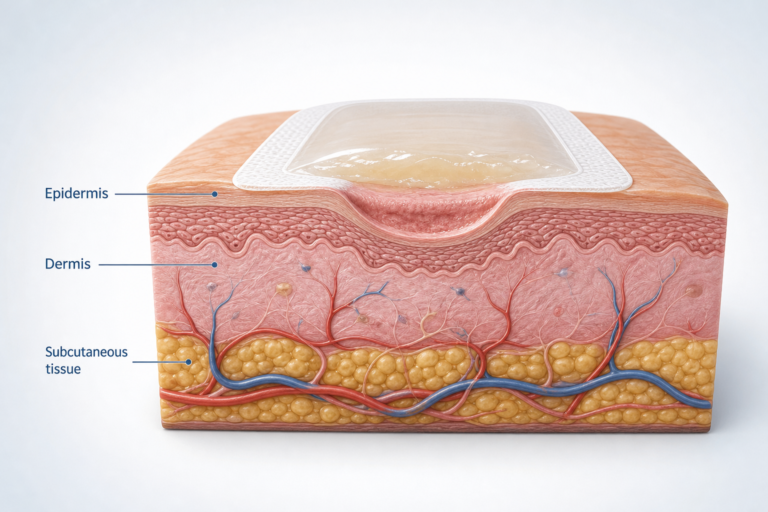
Microneedling — also called collagen induction therapy — works by creating controlled micro-injuries in the skin using fine, sterilised needles. These tiny punctures trigger the wound healing cascade: a sequence of biological events in which the body responds to perceived damage by releasing growth factors, increasing blood flow, and stimulating the production of new collagen and elastin. The result, over weeks and months, is firmer, smoother, more even-toned skin. But the process begins with inflammation, and inflammation is visible.
Immediately after treatment, the skin’s micro-channels are open, the inflammatory healing response is active, and the outer skin barrier has been temporarily disrupted. This disruption increases transepidermal water loss (TEWL), meaning the skin loses moisture more rapidly than usual, which contributes to tightness, dryness, and a rough or sandpaper-like texture in the days that follow. None of this is damage in the harmful sense — it is the mechanism through which microneedling delivers its results. The skin genuinely does need to look worse before it can look better.
Day-by-Day Recovery Timeline
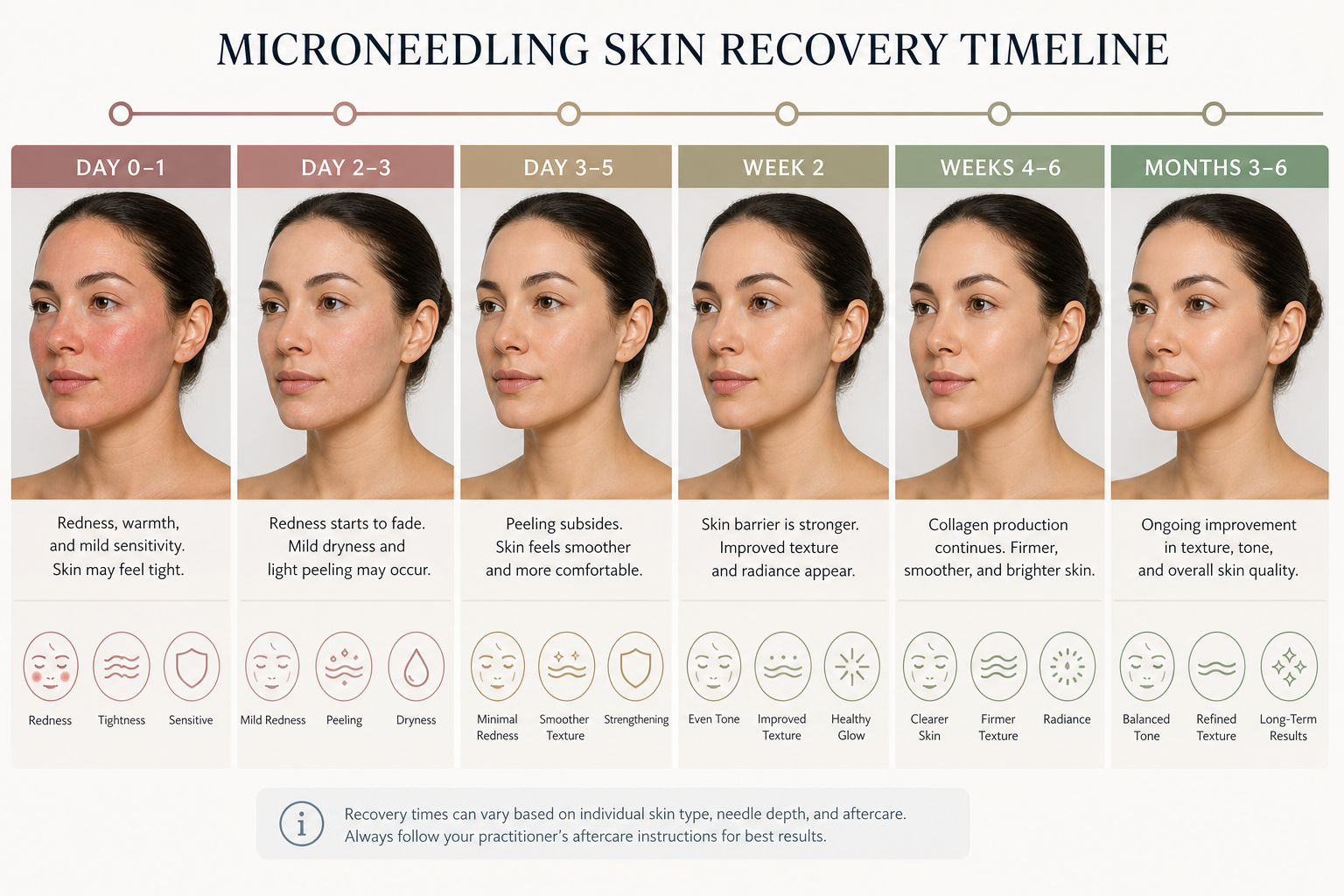
Knowing what to expect at each stage of recovery helps distinguish a normal healing trajectory from a reaction that needs attention. The timeline below reflects typical responses to a professional microneedling session; individual variation is common depending on needle depth, skin type, and the number of passes performed.
| Timeframe | What You May Notice | What Is Happening |
|---|---|---|
| Day 0–1 (Treatment day) | Redness, warmth, mild swelling, pinpoint bleeding, tight feeling | Acute inflammatory response; micro-channels are open; increased blood flow to the area |
| Day 2–3 | Redness fading to pink, possible mild swelling, skin feels dry and tight | Inflammation beginning to subside; TEWL elevated; skin barrier starting to repair |
| Day 3–5 | Peeling, flaking, rough or sandpaper texture, possible small breakouts | Accelerated cell turnover; dead skin shedding; skin purging may begin |
| Day 5–7 | Peeling resolving, skin may look dull or uneven | Surface renewal completing; new skin cells emerging |
| Week 2 | Skin largely settled; some residual dryness or mild congestion possible | Barrier function largely restored; early collagen synthesis underway |
| Weeks 4–6 | Visible improvement in texture, tone, and pore appearance | New collagen fibres maturing; skin remodelling progressing |
| Months 3–6 | Continued gradual improvement | Full collagen remodelling; results from a course of sessions accumulating |
If skin still looks noticeably worse at the two-week checkpoint — beyond mild dryness or fading congestion — this is worth discussing with your provider. Most normal reactions have resolved or are clearly improving by day ten to fourteen. Persistent or worsening symptoms beyond this point may indicate PIH developing, a product reaction, or a skin condition that needs assessment.
Normal Reactions: What to Expect
Several reactions are considered a predictable part of microneedling recovery and do not indicate a problem. Recognising these can prevent unnecessary worry.
Redness and Mild Swelling
Erythema (redness) and mild edema (swelling) are the most immediate and visible signs of the inflammatory healing response. Most people describe the appearance as similar to a moderate sunburn. Redness typically peaks on the day of treatment and begins to fade within 24 to 48 hours, though some pink colouring may persist for three to five days depending on skin sensitivity and needle depth. Mild swelling, particularly around the eyes and cheeks, usually resolves within 24 to 72 hours.
Dryness, Peeling, and Rough Texture
As the skin barrier recovers and cell turnover accelerates, the outer layers of the skin shed more rapidly than usual. This produces visible flaking, peeling, and a rough or sandpaper-like texture that typically appears between days three and five. Elevated TEWL during this phase means the skin feels persistently dry and tight even with moisturiser applied. This is temporary and resolves as the barrier repairs itself, usually within the first week.
Skin Purging and Temporary Breakouts
Skin purging is one of the most misunderstood post-treatment reactions. Microneedling accelerates cell turnover significantly, which can push microcomedones — tiny, pre-formed blockages of trapped sebum and dead skin cells — to the surface faster than they would naturally appear. The result is a cluster of small whiteheads, papules, or congestion that emerges in the days following treatment. This is not an infection, and it is not caused by the needles introducing bacteria. Purging tends to resolve within two to four weeks and often leaves the skin clearer than before once it has passed.
Purging is most likely in people who are acne-prone or who have existing congestion beneath the skin surface. It is worth noting that purging typically appears in areas where you already experience breakouts. Spots appearing in entirely new locations, or spots that are painful, deep, and cystic, are less likely to represent purging and more likely to indicate irritation or another cause.
Normal vs. Abnormal: A Practical Comparison
| Symptom | Normal | Potentially Abnormal — Seek Advice |
|---|---|---|
| Redness | Fading within 24–72 hours | Worsening after 48 hours, spreading, or accompanied by heat and pain |
| Swelling | Mild, resolving within 72 hours | Significant swelling persisting beyond 72 hours or worsening |
| Breakouts | Small, surface-level, in usual breakout zones; resolving within 2–4 weeks | Deep, painful, cystic, or appearing with pus or yellow/green discharge |
| Peeling/flaking | Days 3–7; resolves naturally | Blistering, open wounds, or skin that weeps |
| Dryness/tightness | First week; improves with gentle moisturiser | Severe, persistent, or accompanied by intense itching or hives |
| Skin colour changes | Temporary pinkness fading within days | Dark patches developing or deepening after week two (possible PIH) |
Warning Signs That Require Professional Assessment
While most post-microneedling reactions are benign and self-limiting, certain symptoms fall outside the range of normal healing and should prompt contact with your provider promptly.
- Worsening redness or pain after 48 hours: Inflammation from microneedling should be improving by this point, not intensifying. Increasing redness, warmth, or tenderness after the 48-hour mark may indicate infection or an adverse reaction.
- Pus, yellow or green discharge: Any discharge that is not clear or slightly blood-tinged suggests bacterial infection and requires medical assessment.
- Fever or systemic symptoms: A raised temperature alongside skin symptoms is a sign that infection may have spread and needs urgent attention.
- Blistering or open wounds: These are not expected outcomes of standard microneedling and may indicate that the treatment was performed too aggressively or that the skin was not suitable for treatment at that time.
- Hives, intense itching, or facial swelling beyond the treated area: These may suggest an allergic reaction — potentially to a serum or topical product applied through the open micro-channels rather than to the needling itself. Anaphylaxis, though rare, requires emergency care.
- Darkening patches developing after week two: This may indicate post-inflammatory hyperpigmentation, which benefits from early intervention.
Post-Inflammatory Hyperpigmentation After Microneedling
Post-inflammatory hyperpigmentation (PIH) occurs when the skin’s melanocytes — the cells responsible for pigment production — respond to inflammation by producing excess melanin. The result is dark patches or an uneven skin tone that can persist for weeks to months if not managed appropriately. PIH is not a burn or a scar; it is a pigmentary response to injury.
PIH risk is meaningfully higher in people with darker Fitzpatrick skin types (Fitzpatrick IV through VI), where melanocytes are more reactive to inflammatory stimuli. Research suggests that PIH occurs in approximately 2–5% of standard microneedling cases overall, but the risk is considerably higher in skin of colour. RF microneedling — which combines radiofrequency energy with needle penetration — carries an elevated PIH risk compared to standard microneedling, estimated at up to 10–15% in some studies of darker skin tones, because the thermal component adds an additional inflammatory stimulus.
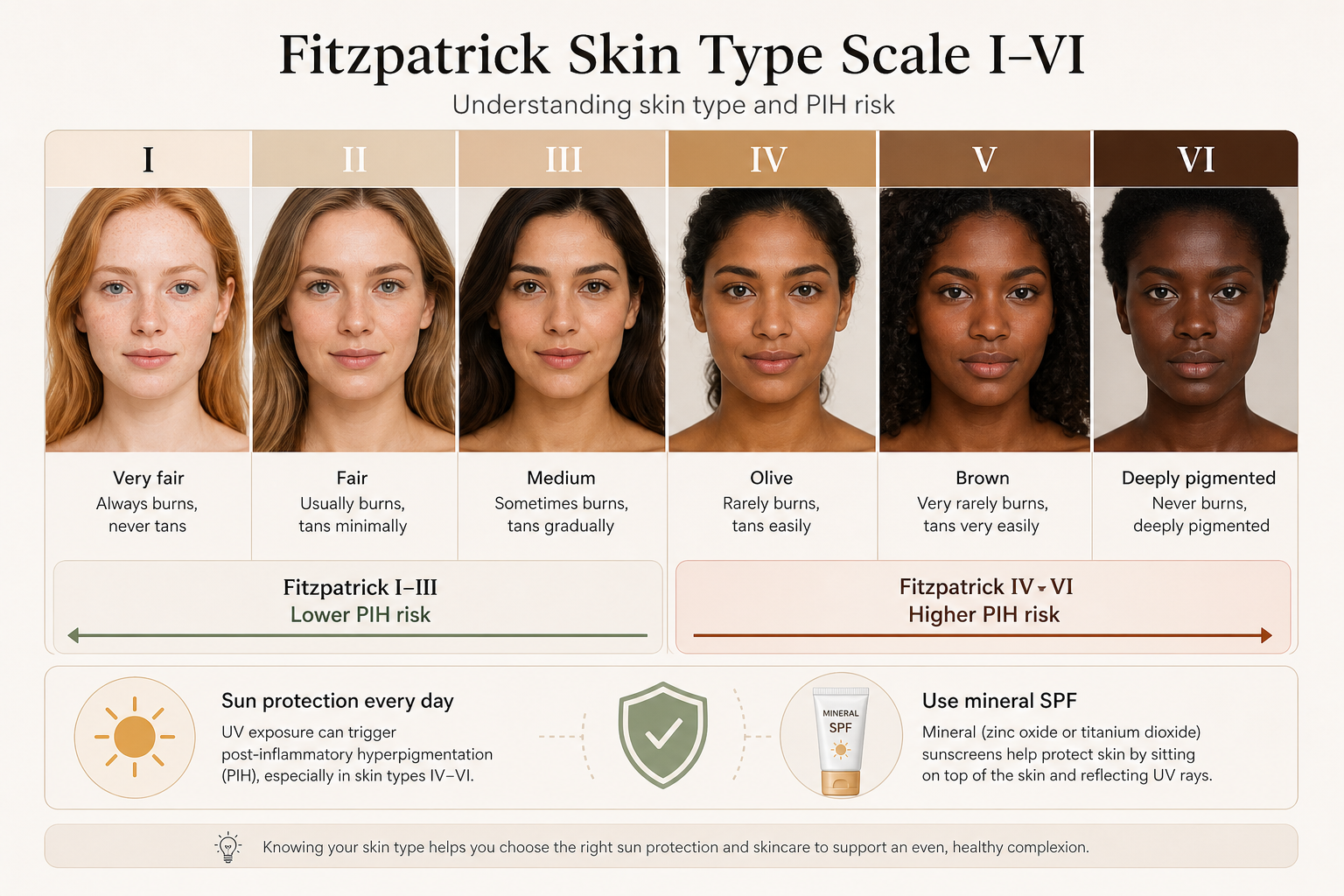
Minimising PIH risk begins before treatment: a thorough consultation should assess Fitzpatrick skin type, history of PIH, and whether needle depth and device settings are appropriate for the individual. After treatment, strict sun avoidance and consistent use of a broad-spectrum mineral sunscreen are essential, as UV exposure in the days following microneedling can significantly worsen pigmentation. If PIH does develop, a qualified provider can advise on appropriate management, which may include topical agents or further treatment.
Skin-Type-Specific Considerations
Reactions to microneedling are not uniform across all skin types, and understanding how your skin’s characteristics may influence recovery is useful when setting expectations.
Acne-Prone Skin
People with acne-prone skin are more likely to experience skin purging after microneedling due to the higher baseline level of microcomedones beneath the surface. This does not mean microneedling is unsuitable — in fact, it can be beneficial for acne scarring — but it does mean that a temporary increase in breakouts is more probable. Active acne lesions at the time of treatment are generally a contraindication, as needling over inflamed skin can spread bacteria and worsen the condition.
Sensitive Skin and Rosacea-Prone Skin
People with sensitive skin or rosacea may experience more pronounced and longer-lasting redness after microneedling. The inflammatory healing response can be more intense in skin that is already reactive, and the risk of triggering a rosacea flare is real. Microneedling is not universally contraindicated in rosacea, but it requires careful assessment, conservative needle depth, and an experienced practitioner who understands the condition.
Darker Skin Tones
As discussed above, the primary additional consideration for people with Fitzpatrick skin types IV–VI is PIH risk. A practitioner experienced in treating skin of colour will typically use shallower needle depth, fewer passes, and a more conservative approach to minimise the inflammatory stimulus. Pre-treatment priming with agents such as topical vitamin C or niacinamide may also be recommended to reduce PIH risk, though this should be guided by a qualified provider.
Serum and Product Reactions: An Underrecognised Cause
Not every adverse reaction after microneedling is caused by the needles themselves. During and immediately after treatment, the skin’s micro-channels are open, allowing topical products to penetrate far more deeply than they would on intact skin. This dramatically increases the potential for sensitisation or allergic reactions to serums, numbing creams, or aftercare products applied at the time of treatment.
If you develop intense itching, hives, or a rash that does not follow the typical distribution of post-needling redness, a product reaction is worth considering. Reporting the exact products used during and after your session to your provider will help identify the cause. This is also why non-comedogenic, fragrance-free, and minimal-ingredient products are recommended in the immediate post-treatment period — the fewer potential irritants applied to compromised skin, the lower the risk of a secondary reaction.
Standard Microneedling vs. RF Microneedling vs. At-Home Dermarolling
The expected reaction profile differs depending on the type of microneedling performed, and this distinction is rarely made clearly enough in patient information.
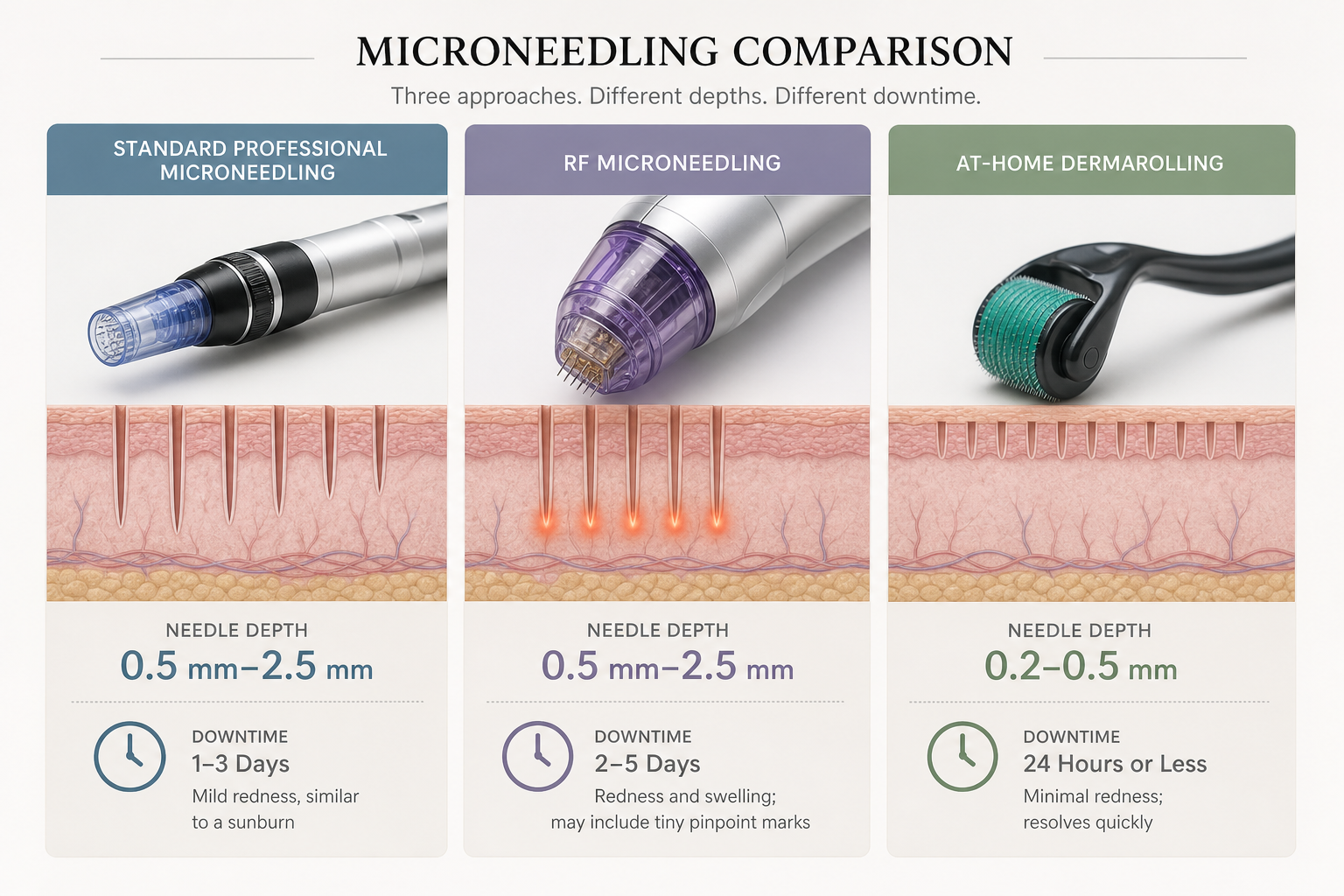
Standard professional microneedling uses a motorised pen device with adjustable needle depth, typically between 0.5 mm and 2.5 mm depending on the treatment area and concern. Reactions are predictable and generally resolve within one week.
RF microneedling adds radiofrequency energy delivered through the needle tips, creating both mechanical micro-injuries and thermal injury in the deeper dermis. This dual stimulus produces a more intense inflammatory response, longer downtime (often seven to ten days), and a meaningfully higher PIH risk, particularly in darker skin tones. Patients should be counselled specifically about this difference before choosing RF microneedling.
At-home dermarolling uses a manual roller with much shorter needles (typically 0.2–0.5 mm) and is generally considered lower-risk in terms of depth of injury. However, at-home devices carry a higher risk of contamination and inconsistent technique, which can increase infection risk. Reactions from at-home dermarolling are usually milder, but the results are also more limited. Any significant adverse reaction from at-home use — particularly signs of infection — should be assessed by a healthcare professional.
Aftercare That Supports Normal Recovery
Following appropriate aftercare significantly reduces the likelihood of complications and supports the skin barrier as it repairs. The following guidance reflects general best practice; your provider may give specific instructions tailored to your treatment.
What to Do
- Cleanse gently with a mild, fragrance-free cleanser for the first week.
- Apply a non-comedogenic, fragrance-free moisturiser or hyaluronic acid serum to support hydration and reduce TEWL.
- Use a broad-spectrum mineral sunscreen (SPF 30 or higher) every morning from day two onwards, and reapply throughout the day if outdoors.
- Keep the skin cool and avoid touching or picking at peeling skin.
- Stay well hydrated and avoid alcohol in the first 24–48 hours.
What to Avoid
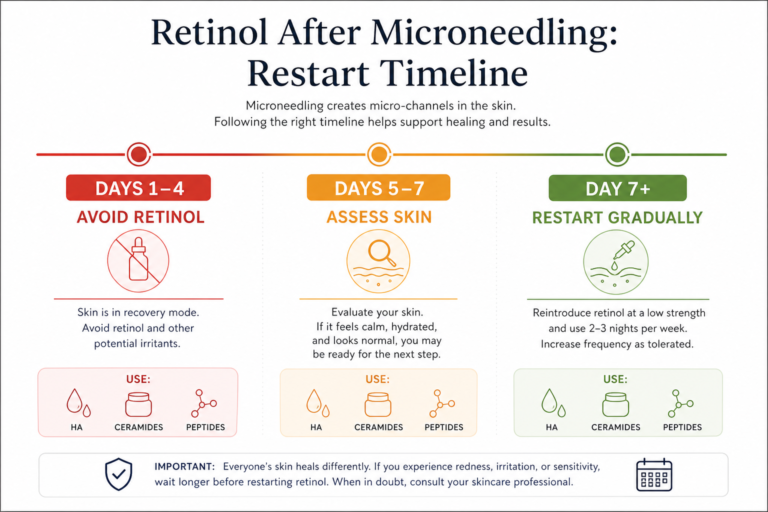
- Retinol, vitamin C serums, AHAs, BHAs, and other active exfoliants for at least five to seven days, or as directed by your provider — these can further compromise the skin barrier and increase irritation.
- Makeup for at least 24 hours, ideally 48 hours, to avoid introducing potential irritants or bacteria through open micro-channels.
- Saunas, steam rooms, swimming pools, and intense exercise for 24–48 hours, as heat and sweat can increase inflammation and infection risk.
- Direct sun exposure without protection, particularly in the first two weeks.
- Picking, rubbing, or mechanically exfoliating peeling skin, which can cause scarring or PIH.
When to Delay Your Next Session
Most microneedling courses involve three to six sessions spaced four to six weeks apart. If your skin has not fully recovered from a previous session by the time the next one is scheduled, it is appropriate to delay. Needling skin that is still inflamed, actively purging, or showing signs of PIH can worsen the reaction and undermine results. A qualified provider should assess your skin’s recovery before proceeding with the next treatment. If you experienced a significant adverse reaction — particularly infection, blistering, or PIH — the treatment plan may need to be modified, including adjusting needle depth, reducing the number of passes, or switching to a different treatment approach.
Contraindications That Increase Reaction Risk
Certain conditions and circumstances increase the likelihood of an adverse reaction to microneedling and should be disclosed during consultation. These include active acne or skin infections in the treatment area, eczema or psoriasis, rosacea (depending on severity), a history of keloid scarring or keloid-prone skin, use of blood-thinning medications, isotretinoin use within the past six to twelve months, pregnancy, and a history of PIH. This is not an exhaustive list, and a thorough pre-treatment consultation with a licensed practitioner is the appropriate setting to assess individual suitability.
Frequently Asked Questions
How long will my skin look red or rough after microneedling?
For most people, significant redness fades within 24 to 72 hours. Mild pinkness, dryness, and rough texture may persist for up to seven days. If redness is still prominent after five days or is worsening rather than improving, contact your provider.
Is skin purging after microneedling the same as an infection?
No. Skin purging involves small, surface-level spots caused by accelerated cell turnover bringing pre-existing congestion to the surface. Infection involves pus, spreading redness, pain, warmth, and sometimes fever. Purging resolves on its own within two to four weeks; infection requires medical treatment.
Can microneedling make acne scars look worse temporarily?
Yes. In the first one to two weeks after treatment, the skin’s surface may look uneven, rough, or more textured than before. This is part of the healing process. Visible improvement in acne scarring typically begins to appear from four to six weeks after treatment as collagen remodelling progresses.
Why do I have dark patches after microneedling?
Dark patches developing after microneedling are likely post-inflammatory hyperpigmentation (PIH), a pigmentary response to inflammation. PIH is more common in people with darker skin tones. Strict sun protection is essential, and you should contact your provider for guidance on management, as early intervention tends to produce better outcomes.
Can I wear makeup to cover the redness after microneedling?
Most providers recommend avoiding makeup for at least 24 to 48 hours after microneedling. Applying makeup to skin with open micro-channels increases the risk of irritation, clogged pores, and infection. After this period, mineral-based, non-comedogenic products are generally preferable.
What if my skin still looks worse two weeks after microneedling?
Most normal reactions resolve within seven to ten days. If your skin is still significantly worse at the two-week mark — with persistent redness, worsening breakouts, or developing dark patches — this warrants a review with your provider. It may indicate PIH, a product reaction, or a skin condition that needs assessment and possibly treatment.
Does RF microneedling cause worse reactions than standard microneedling?
Generally, yes. RF microneedling combines mechanical micro-injuries with radiofrequency heat energy, producing a more intense inflammatory response and typically longer downtime of seven to ten days. The risk of post-inflammatory hyperpigmentation is also higher, particularly for people with darker skin tones. This should be discussed in detail before choosing RF microneedling.
When Worsening Skin After Microneedling Is Worth Taking Seriously
For the majority of people, skin that looks worse after microneedling is a temporary and expected part of the healing process. The controlled micro-injuries that drive collagen remodelling inevitably produce short-term redness, dryness, and sometimes purging before the skin settles and improves. Understanding the day-by-day recovery timeline, following appropriate aftercare, and knowing the difference between a normal vs. abnormal reaction removes much of the anxiety that can accompany this phase.
That said, certain reactions — particularly worsening symptoms after 48 hours, signs of infection, blistering, or developing PIH — do require prompt professional input. If you are unsure whether what you are experiencing falls within the normal range, contacting your provider is always the right decision. A qualified practitioner can assess your skin, confirm whether your recovery is on track, and adjust your treatment plan if needed. Microneedling can deliver meaningful improvements in skin texture, tone, and firmness, but those results depend on appropriate patient selection, skilled technique, and careful aftercare — all of which begin with an honest, thorough consultation.