
Breast Reduction Cost: What Factors Affect the Price?
Breast reduction surgery is one of the most consistently high-satisfaction procedures in plastic surgery, yet the cost can vary significantly from one patient to the next. Understanding what drives that variation — surgeon experience, facility type, geographic location, anaesthesia, and the complexity of your individual case — helps you plan realistically and ask the right questions during a consultation. This article explains the main cost factors, what a quoted price typically includes, when health insurance or NHS funding may apply, and what to consider before committing to surgery.
Key Takeaways
- Breast reduction surgery costs vary widely depending on surgeon fees, anaesthesia, facility charges, geographic location, and the complexity of the procedure required.
- In the UK, private breast reduction surgery typically ranges from approximately £6,000 to £10,000 or more; costs in the US commonly range from $8,000 to $15,000 or higher when all fees are included.
- NHS funding or health insurance coverage may be available in some cases where the procedure is considered medically necessary, but eligibility criteria are strict and vary by region or insurer.
- The cheapest quote is not always the safest or most appropriate choice; surgeon qualifications, facility standards, and aftercare provision all affect outcomes and safety.
- A thorough in-person consultation with a qualified plastic surgeon is essential before any cost estimate can be considered accurate for your individual situation.
What Is Breast Reduction Surgery?
Breast reduction surgery, known medically as reduction mammaplasty, is a surgical procedure that removes excess breast tissue, fat, and skin to reduce the size and weight of the breasts. The nipple and areola are typically repositioned to a higher, more proportionate location on the chest. The procedure is performed under general anaesthesia and usually takes between two and four hours, depending on the technique used and the volume of tissue being removed.
Patients seek breast reduction for a range of reasons. Physical symptoms such as chronic neck, shoulder, and back pain, skin irritation or rashes beneath the breast fold, difficulty exercising, and poor posture are common motivating factors. Psychological wellbeing and difficulty finding well-fitting clothing are also frequently cited. Because the procedure addresses both functional and aesthetic concerns, it occupies an unusual position in plastic surgery — it may be considered medically necessary in some cases, which has direct implications for cost and funding.
Why Breast Reduction Costs Vary So Much
There is no single fixed price for breast reduction surgery. The total cost is built from several separate components, and each one can differ substantially between clinics, surgeons, and countries. Patients comparing quotes should ensure they are comparing like-for-like, since some clinics quote a surgeon fee alone while others provide an all-inclusive package price.

Surgeon’s Fee
The surgeon’s fee is typically the largest single component of the overall cost. A consultant plastic surgeon with extensive experience in breast surgery, fellowship training, and a strong record of outcomes will generally charge more than a less experienced practitioner. Membership of recognised professional bodies — such as the British Association of Plastic, Reconstructive and Aesthetic Surgeons (BAPRAS) or the British Association of Aesthetic Plastic Surgeons (BAAPS) in the UK, or board certification by the American Board of Plastic Surgery in the US — is an important quality indicator. Choosing a surgeon based primarily on the lowest fee carries meaningful risk, as surgical skill and experience directly influence both safety and aesthetic results.
Anaesthesia Fees
Breast reduction is performed under general anaesthesia, which requires a separate anaesthetist. Anaesthesia fees are charged independently of the surgeon’s fee and typically reflect the duration of the procedure and the anaesthetist’s professional rate. These fees are sometimes included in a clinic’s all-inclusive package price, but not always. Patients should confirm whether anaesthesia is itemised separately or bundled into the quoted total.
Hospital or Surgical Facility Fees
The facility where surgery takes place — whether a private hospital, an accredited day-surgery clinic, or an outpatient surgical centre — charges separately for the use of its operating theatre, nursing staff, equipment, and any overnight stay. Facilities with higher accreditation standards, more experienced nursing teams, and better-equipped theatres generally charge more. Overnight stays, if required, add to the facility cost. Some patients are discharged the same day; others remain in hospital for one night, depending on the extent of surgery and individual recovery.
Geographic Location
Where you have surgery has a significant effect on price. In the UK, private breast reduction costs tend to be higher in London and the South East than in other regions, reflecting higher overheads for clinic premises and staff. Internationally, costs in the United States are generally higher than in the UK, while some European countries and medical tourism destinations offer lower headline prices. Medical tourism carries its own considerations, including continuity of aftercare, travel during recovery, and the practical challenges of managing complications from a distance — factors that should be weighed carefully against any apparent cost saving.
Complexity of the Procedure
The technical complexity of an individual patient’s surgery influences both the surgeon’s fee and the time required in theatre. Patients requiring a larger volume of tissue removal, those with significant asymmetry, or those who have had previous breast surgery may require a more complex approach. The surgical technique chosen — such as a vertical scar (lollipop) technique versus an inverted-T (anchor) technique — also affects operative time and, in some cases, cost. Your surgeon will recommend the most appropriate technique based on your anatomy and goals, not on cost alone.
Pre-operative Assessments and Tests
Before surgery, patients typically undergo a medical assessment that may include blood tests, a mammogram or breast ultrasound (particularly for patients over a certain age or with relevant risk factors), and an anaesthetic review. These assessments may be included in a package price or charged separately. They are a necessary part of safe surgical planning and should not be omitted to reduce costs.
Post-operative Care and Follow-up
Aftercare following breast reduction surgery includes follow-up appointments, wound checks, and access to the surgical team if concerns arise during recovery. Reputable clinics include a defined period of post-operative follow-up within their quoted price. Patients should ask specifically how many follow-up appointments are included, what happens if a complication arises, and whether revision surgery — if ever needed — carries an additional cost. Inadequate aftercare provision is a meaningful risk factor that should not be overlooked when comparing prices.
Typical Price Ranges
In the United Kingdom, the total cost of private breast reduction surgery typically falls between approximately £6,000 and £10,000, though prices above this range are not uncommon for highly experienced surgeons or complex cases in major cities. In the United States, all-inclusive costs commonly range from around $8,000 to $15,000 or more, depending on location and surgeon. These figures are indicative only; an accurate cost estimate requires an in-person consultation and a personalised surgical plan.
Patients should be cautious of unusually low quotes. A price significantly below the typical range for a given region may reflect reduced surgeon experience, lower facility standards, limited aftercare, or hidden costs that appear later in the process. Requesting a fully itemised written quote — covering surgeon fee, anaesthesia, facility, pre-operative tests, garments, and follow-up — allows for meaningful comparison between providers.
Does Health Insurance or the NHS Cover Breast Reduction?
Breast reduction surgery may be funded by the NHS or covered by private health insurance in cases where it is considered medically necessary rather than purely cosmetic. Eligibility criteria vary by NHS Clinical Commissioning Group (now Integrated Care Board) in England, and by equivalent bodies in Scotland, Wales, and Northern Ireland. Common criteria include documented evidence of physical symptoms such as chronic back or neck pain, skin conditions caused by the weight of the breasts, and a body mass index below a specified threshold. Some areas apply a minimum cup size or weight of tissue to be removed as part of their criteria.
Private health insurance policies differ considerably in their approach to breast reduction. Some policies cover the procedure when a GP referral supports a medical indication; others exclude all cosmetic or breast surgery regardless of symptoms. Patients considering this route should contact their insurer directly before a consultation to understand what documentation will be required and whether pre-authorisation is needed. A GP referral and supporting clinical evidence from a consultant are typically required for any insurance or NHS funding application.
It is worth noting that NHS waiting times for funded breast reduction surgery can be lengthy, and not all patients who apply will meet the eligibility threshold. For patients who do not qualify for NHS or insurance funding, self-funding remains the most common route.
Financing and Payment Options
Many private clinics offer patient financing arrangements, allowing the cost of surgery to be spread over monthly instalments. These arrangements are typically provided through third-party finance companies rather than the clinic itself. Patients considering finance should review the annual percentage rate (APR), total repayable amount, and terms carefully before agreeing. Interest-free periods, where offered, usually apply only for a defined promotional term; standard interest rates apply thereafter if the balance is not cleared.
Financing can make surgery more accessible, but it also means committing to a financial obligation before surgery takes place. Patients should ensure they are comfortable with the repayment terms and that the monthly cost is sustainable regardless of how recovery proceeds. Some clinics also offer staged payment plans that do not involve external finance, where a deposit is paid at booking and the balance is settled before or on the day of surgery.
Risks, Recovery, and Their Relationship to Cost
Understanding the recovery process is relevant to cost planning because the period following surgery may involve time off work, additional support at home, and the purchase of post-surgical garments. Most patients require between one and three weeks away from desk-based work, and longer if their role involves physical activity. Driving is typically restricted for a similar period. These indirect costs — lost income, childcare, travel to follow-up appointments — are not reflected in the surgical quote but are a real part of the overall financial picture.
Breast reduction surgery carries risks that are common to all surgical procedures, including infection, bleeding, adverse reaction to anaesthesia, and delayed wound healing. Procedure-specific risks include changes in nipple or breast sensation, asymmetry, visible scarring, and, in rare cases, partial or complete loss of nipple sensation or viability. The risk of complications is influenced by factors including the patient’s general health, BMI, smoking status, and the surgeon’s experience. Complications that require further treatment — such as wound revision or scar management — may carry additional costs, which is one reason why understanding a clinic’s policy on revision and complication management before surgery is important.
Scarring is an inevitable outcome of breast reduction surgery. The extent and visibility of scars depend on the surgical technique, individual healing, and skin type. Scar maturation takes twelve to eighteen months or longer. Some patients invest in scar management treatments — such as silicone sheets, topical gels, or laser therapy — during this period, which represents an additional post-operative cost to consider.
Factors That Affect Your Individual Suitability
Not every patient is an immediate candidate for breast reduction surgery. A surgeon will assess a range of factors during consultation to determine whether surgery is appropriate and what approach is most suitable. Relevant considerations include:
- BMI and weight stability: Surgeons generally recommend that patients are at or close to a stable, healthy weight before surgery, as significant weight changes after the procedure can affect results.
- Smoking status: Smoking significantly increases the risk of wound healing complications and is usually a contraindication to elective surgery unless the patient stops smoking well in advance of the procedure.
- Future pregnancy and breastfeeding: Pregnancy after breast reduction can alter the results of surgery. Patients who plan to have children in the future may be advised to delay the procedure. Breastfeeding capacity may be affected by breast reduction surgery, though this varies by technique and individual anatomy.
- General health and medical history: Conditions such as diabetes, bleeding disorders, or a history of blood clots may affect surgical risk and require additional assessment.
- Breast health: Any unresolved breast concerns, such as an undiagnosed lump or recent abnormal mammogram result, will need to be investigated before surgery can proceed.
- Realistic expectations: Patients should have a clear understanding of what surgery can and cannot achieve, including the permanence of scars and the possibility that results may change over time with weight fluctuation or ageing.
Alternatives to Surgical Breast Reduction
For patients who are not suitable candidates for surgery, who wish to avoid the risks and recovery associated with an operation, or for whom cost is a prohibitive factor, some non-surgical alternatives may offer partial relief from symptoms — though none replicate the degree of size reduction achievable through surgery.
Weight loss, where relevant, can reduce breast volume to some degree, since breast tissue contains a proportion of fat that responds to changes in body composition. However, the extent of reduction varies considerably between individuals and is not predictable. Physiotherapy and targeted exercise may help with posture and associated musculoskeletal symptoms, though they do not reduce breast size. Well-fitted, supportive bras — including specialist minimiser bras — can reduce the functional impact of large breasts on daily activity and comfort, and are often recommended as a first-line measure before surgery is considered.
Non-surgical body contouring treatments such as fat-dissolving injections or cryolipolysis (fat freezing) are not appropriate for breast reduction. These treatments are designed for localised subcutaneous fat deposits in specific body areas and are not indicated for breast tissue reduction. Patients should be cautious of any clinic suggesting non-surgical treatments as a meaningful alternative to reduction mammaplasty for significant breast hypertrophy.
Questions to Ask During Your Consultation
A consultation with a qualified plastic surgeon is the appropriate setting to discuss your individual circumstances, receive an accurate cost estimate, and ask questions that will help you make an informed decision. Useful questions to raise include:
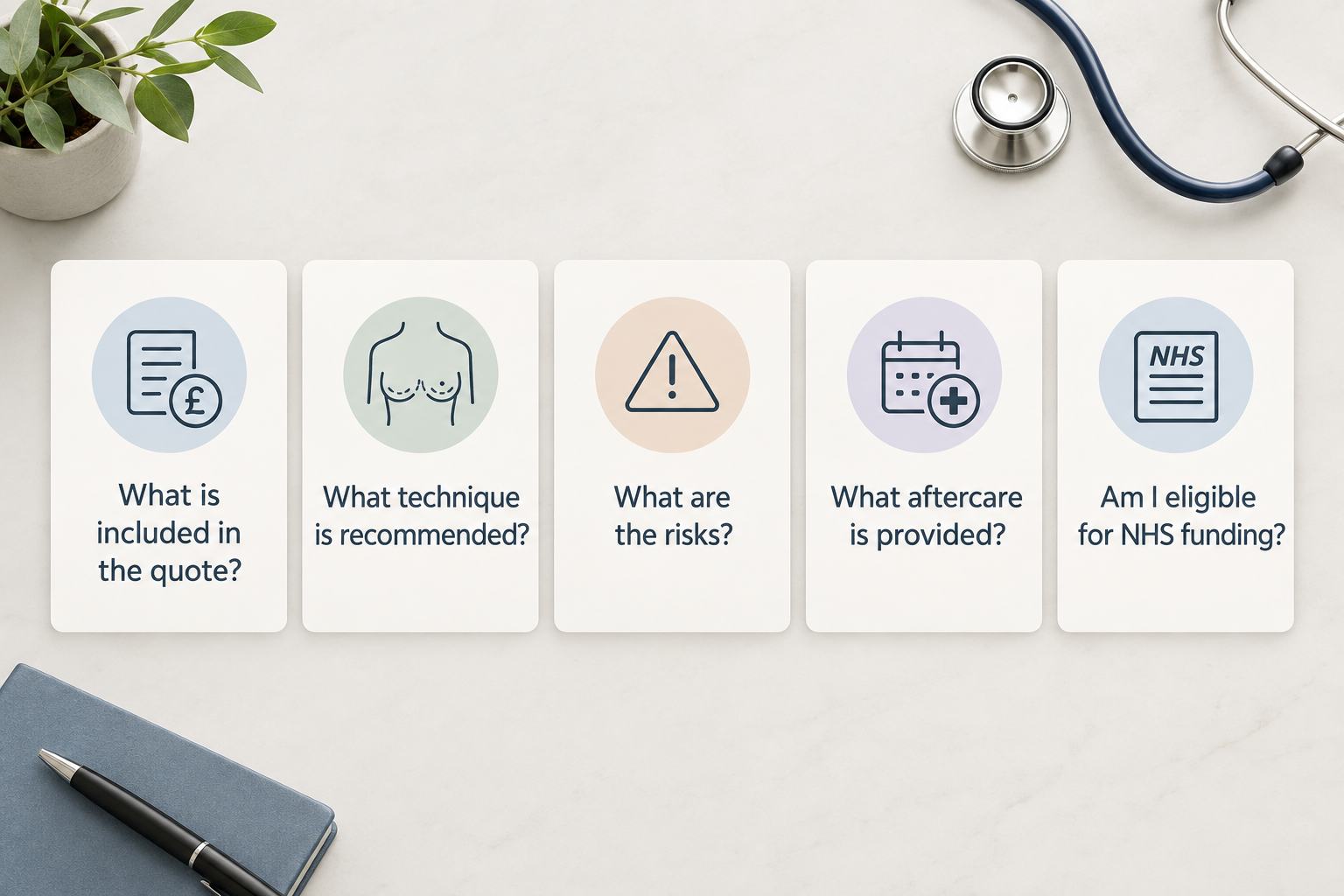
- What does the quoted price include, and what might be charged separately?
- What surgical technique do you recommend for my anatomy, and why?
- What are the realistic risks for someone with my health profile?
- How many breast reduction procedures do you perform each year?
- Can I see examples of your results in patients with a similar starting point?
- What is your policy if I experience a complication or am unhappy with the result?
- How many follow-up appointments are included, and for how long after surgery?
- Am I likely to be eligible for NHS or insurance funding based on my symptoms?
- What should I do to prepare for surgery, and what will recovery involve?
Frequently Asked Questions
Is breast reduction surgery permanent?
Breast reduction surgery produces long-lasting results, but the breasts can change over time due to factors such as significant weight gain or loss, pregnancy, and the natural effects of ageing. Maintaining a stable weight after surgery helps preserve the outcome. Scars are permanent, though they typically fade and become less noticeable over twelve to eighteen months.
Will I need to take time off work after breast reduction?
Most patients require between one and three weeks away from sedentary work. Those with physically demanding jobs may need four to six weeks or longer before returning. Your surgeon will advise based on your specific procedure and recovery progress. Planning for adequate recovery time is an important part of the overall cost and logistics of surgery.
Can breast reduction affect breastfeeding?
Breast reduction surgery may affect the ability to breastfeed, depending on the surgical technique used and the extent of tissue removed. Some patients breastfeed successfully after the procedure; others find their capacity is reduced. This is an important consideration for patients who plan to have children in the future, and it should be discussed in detail with the surgeon during consultation.
How do I know if my surgeon is appropriately qualified?
In the UK, patients should look for a surgeon on the GMC Specialist Register for plastic surgery and who holds membership of BAAPS or BAPRAS. In the US, board certification by the American Board of Plastic Surgery is the relevant credential. Patients should verify credentials independently rather than relying solely on clinic marketing materials.
Are there hidden costs I should be aware of?
Potential additional costs beyond the surgical quote include pre-operative blood tests or imaging, post-surgical compression garments, prescription medications, scar management products, and any revision procedures if needed. Travel to and from appointments, time off work, and home support during recovery are indirect costs that are worth factoring into your overall budget.
Is it safe to travel abroad for cheaper breast reduction surgery?
Medical tourism for breast reduction surgery carries specific risks, including limited access to your surgical team if complications arise after you return home, difficulty obtaining medical records, and variability in facility and surgeon standards between countries. Any apparent cost saving should be weighed carefully against these practical and safety considerations. If complications require treatment on return, the cost of managing them through the UK healthcare system may exceed the original saving.
Making an Informed Decision About Breast Reduction Surgery
Breast reduction surgery can offer meaningful improvements in physical comfort and quality of life for appropriately selected patients, and satisfaction rates reported in the surgical literature are consistently high. However, it is a significant surgical procedure with real risks, a recovery period that requires planning, and a cost that extends beyond the headline price quoted by a clinic.
The most important step before making any financial commitment is a thorough in-person consultation with a qualified, experienced plastic surgeon. A reputable surgeon will assess your individual anatomy, discuss your goals and concerns honestly, explain the technique most appropriate for your case, and provide a fully itemised cost breakdown. They will also advise whether you may be eligible for NHS or insurance funding, and will not pressure you to proceed before you are ready.
Comparing quotes from more than one surgeon is reasonable, but the comparison should focus on the full scope of what is included, the surgeon’s qualifications and experience, and the quality of aftercare provision — not on price alone. Investing time in finding the right surgeon and the right facility is as important as any financial planning, and it is the factor most likely to influence both your safety and your long-term satisfaction with the outcome.


