
Best Treatments for Deep Wrinkles on the Face: What Actually Works
Deep facial wrinkles — the kind that remain visible even when your face is completely relaxed — are among the most common concerns patients bring to aesthetic consultations. Unlike fine surface lines, these etched creases involve structural changes in the skin and underlying tissues, which means a single product or a single treatment rarely resolves them completely. Understanding what causes deep wrinkles, how different treatments address them, and what realistic outcomes look like is essential before committing to any approach.
Key Takeaways
- Deep facial wrinkles are caused by a combination of repeated muscle movement, collagen loss, volume depletion, and cumulative sun damage — and effective treatment usually needs to address more than one of these factors.
- No single treatment is universally best; the most appropriate option depends on wrinkle location, depth, skin quality, and individual anatomy.
- Botulinum toxin, dermal fillers, skin resurfacing, and collagen-stimulating treatments each work through different mechanisms and are often used in combination.
- Results vary between patients, and most treatments require maintenance to sustain improvement over time.
- A thorough consultation with a qualified practitioner is necessary to assess suitability and design a realistic treatment plan.
Why Deep Wrinkles Form
Deep wrinkles develop through several overlapping processes rather than a single cause. Repeated facial muscle contractions — smiling, frowning, squinting — gradually etch movement lines into the skin over years. At the same time, the skin loses collagen and elastin with age, reducing its ability to spring back after each expression. Subcutaneous fat pads thin and shift, removing the structural support that once kept the skin smooth. Bone resorption in the facial skeleton further reduces the scaffolding beneath soft tissue. Sun exposure accelerates all of these changes by degrading collagen fibres and impairing the skin’s repair mechanisms. The result is a wrinkle that is present at rest, often with visible depth and shadowing, rather than one that only appears during movement.
This multi-factorial origin is clinically important because it explains why a treatment targeting only one mechanism — for example, relaxing a muscle — may improve a dynamic wrinkle but leave a deeply etched static line largely unchanged. Effective management of deep facial lines usually requires an assessment of which factors are dominant in a given patient before selecting a treatment strategy.
Classifying Facial Wrinkles: Dynamic Versus Static
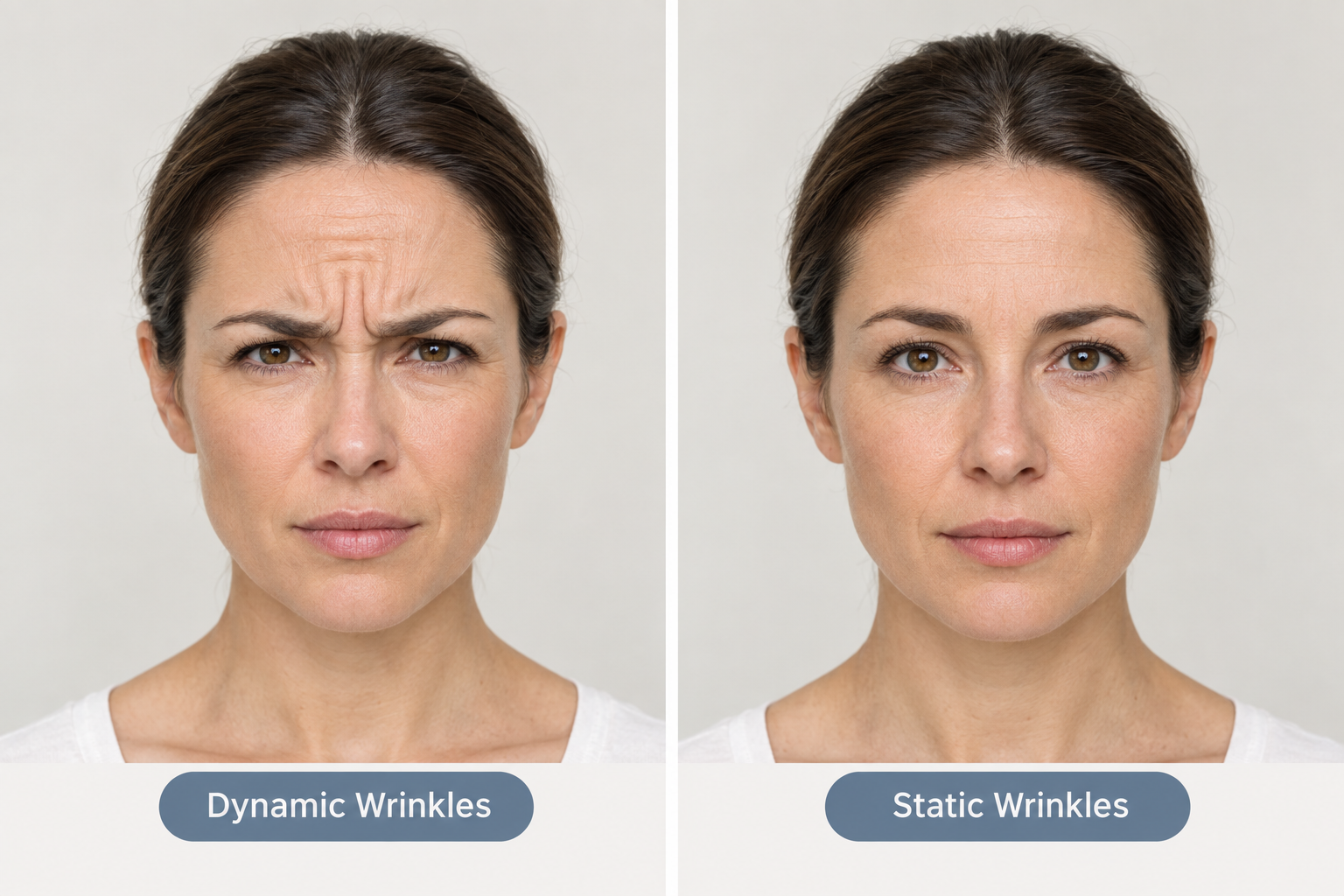
Practitioners commonly distinguish between dynamic wrinkles and static wrinkles. Dynamic wrinkles appear or deepen during facial movement and are primarily driven by underlying muscle activity. Forehead lines, glabellar frown lines between the eyebrows, and crow’s feet around the eyes are typical examples. Static wrinkles are visible at rest, independent of muscle contraction, and reflect structural skin changes including collagen loss, volume depletion, and skin laxity. Nasolabial folds, marionette lines, and perioral lines around the mouth are frequently static or have a significant static component.
Many deep wrinkles have both a dynamic and a static component — they deepen with movement but never fully disappear at rest. This distinction directly influences treatment selection, because botulinum toxin is most effective for the dynamic component while dermal fillers, resurfacing, and biostimulatory treatments address the static component more directly.
Botulinum Toxin for Deep Expression Lines
Botulinum toxin injections — delivered under brand names such as Botox, Dysport, and Azzalure — temporarily reduce the muscle contractions that create and deepen dynamic facial wrinkles. By inhibiting the release of acetylcholine at the neuromuscular junction, botulinum toxin causes a controlled, reversible reduction in muscle activity in the treated area. This prevents the repeated folding of overlying skin that drives wrinkle formation over time.
For deep wrinkles with a strong dynamic component, such as deep forehead lines or pronounced glabellar furrows, botulinum toxin can produce meaningful improvement. However, for wrinkles that are already deeply etched into the skin at rest, muscle relaxation alone may soften but not eliminate the line. In these cases, botulinum toxin is often used alongside other treatments rather than as a standalone solution. Results typically become visible within a few days to two weeks and generally last three to four months, after which repeat treatment is needed to maintain the effect. Individual response varies, and some patients find that consistent treatment over time leads to a gradual softening of established lines as the skin is given repeated periods of reduced mechanical stress.
Dermal Fillers for Deep Facial Lines
Dermal fillers are injectable substances used to restore volume, smooth deep creases, and improve facial contour. Hyaluronic acid fillers are the most widely used category and work by physically filling the space beneath a wrinkle or in a volume-depleted area, lifting the overlying skin. Hyaluronic acid is a naturally occurring molecule in the skin, and its water-attracting properties contribute to a plumping effect in the treated tissue.
For deep nasolabial folds, marionette lines, and perioral wrinkles, hyaluronic acid fillers can provide immediate visible improvement. The degree of correction depends on the filler’s rheological properties — its thickness, elasticity, and ability to integrate with surrounding tissue — as well as the practitioner’s technique and the patient’s anatomy. Results typically last between six and eighteen months depending on the product used, the treatment area, and individual metabolism. Hyaluronic acid fillers have the advantage of being reversible using an enzyme called hyaluronidase, which can dissolve the filler if needed.
Other filler categories include calcium hydroxylapatite and poly-L-lactic acid, which are classified as biostimulatory fillers. These work partly through volume replacement and partly by stimulating the body’s own collagen production over time. They may be considered for patients where gradual, longer-lasting structural improvement is the goal, though results develop more slowly and are not reversible in the same way as hyaluronic acid. All injectable fillers carry risks including bruising, swelling, asymmetry, nodule formation, and, in rare but serious cases, vascular complications. Treatment should only be performed by a qualified and experienced practitioner.
Skin Resurfacing Treatments
Skin resurfacing treatments work by removing or remodelling the outer layers of the skin to stimulate new collagen production and improve surface texture. Several modalities are available, each with a different depth of action, downtime profile, and evidence base for deep wrinkle improvement.
Laser Resurfacing
Ablative laser resurfacing — using devices such as carbon dioxide (CO2) or erbium lasers — removes the epidermis and part of the dermis, triggering a wound-healing response that produces new collagen and smoother skin. Ablative laser resurfacing is among the most effective treatments for improving deep facial wrinkles, particularly perioral lines and diffuse facial rhytids, but it involves significant downtime of one to two weeks or more, a period of redness that can persist for weeks to months, and a meaningful risk profile including infection, pigmentation changes, and scarring in susceptible individuals. It is generally not suitable for darker skin tones due to the risk of post-inflammatory hyperpigmentation.
Fractional laser resurfacing — both ablative and non-ablative — treats a fraction of the skin surface at a time, leaving surrounding tissue intact to accelerate healing. Fractional treatments offer a more manageable downtime of a few days to one week for ablative fractional devices, with a reduced but not eliminated risk profile. Multiple sessions may be needed to achieve results comparable to full ablative resurfacing. Non-ablative fractional lasers cause less surface disruption and have minimal downtime but generally produce more modest improvement in deep wrinkles and may require a series of treatments.
Chemical Peels
Chemical peels use acids to exfoliate and remodel the skin at varying depths. Superficial peels using alpha-hydroxy acids improve skin texture and fine lines but have limited effect on deep wrinkles. Medium-depth peels using trichloroacetic acid (TCA) can improve moderate wrinkles and require several days of downtime. Deep peels using phenol can produce significant improvement in deep facial lines but involve substantial recovery time, systemic considerations, and a risk profile that requires careful patient selection. Chemical peels are generally less precise than laser resurfacing in controlling depth of treatment.
Microneedling and Radiofrequency Microneedling
Microneedling creates controlled micro-injuries in the dermis to stimulate collagen and elastin production. Standard microneedling has a modest evidence base for improving skin texture and fine lines, with limited evidence for deep wrinkle correction as a standalone treatment. Radiofrequency microneedling combines needle penetration with delivery of radiofrequency energy into the dermis, producing a more pronounced collagen-stimulating and skin-tightening effect. Clinical evidence for radiofrequency microneedling in wrinkle reduction is growing, and it is generally associated with less downtime than ablative laser resurfacing, though multiple sessions are typically required and results develop gradually over several months.
Collagen-Stimulating and Biostimulatory Treatments
A category of treatments works primarily by stimulating the skin’s own collagen and elastin production rather than by filling or resurfacing. These biostimulatory approaches are particularly relevant for patients whose deep wrinkles are driven significantly by collagen loss and skin laxity rather than volume depletion alone.
Polynucleotides are injectable preparations derived from purified DNA fragments, typically from salmon or trout sperm. They are thought to stimulate fibroblast activity — the cells responsible for producing collagen and elastin — and may improve skin hydration, elasticity, and overall quality over a course of treatments. Evidence for polynucleotides in wrinkle reduction is still developing, and while early clinical data is encouraging for skin quality improvement, they are generally considered more appropriate for skin rejuvenation and fine-to-moderate line improvement than for correcting deeply etched static wrinkles as a primary treatment.
Profhilo and similar injectable skin remodelling treatments use high-concentration hyaluronic acid in a formulation designed to spread through the tissue and stimulate collagen and elastin rather than simply fill a specific area. These treatments may improve skin laxity and fine lines but are not typically the primary choice for isolated deep wrinkles.
Ultrasound-based treatments such as high-intensity focused ultrasound (HIFU) deliver focused energy to the deeper layers of the skin and superficial muscular aponeurotic system (SMAS), stimulating collagen production and producing a degree of tissue tightening. HIFU may be useful for patients with mild to moderate skin laxity contributing to wrinkle formation, though results for deep static wrinkles are generally modest and vary considerably between patients.
Combination Approaches and Treatment Planning
Because deep facial wrinkles typically involve multiple contributing factors, combination treatment strategies are common in clinical practice. A practitioner might use botulinum toxin to address the dynamic component of a wrinkle, a dermal filler to restore lost volume and lift a deep fold, and a resurfacing or biostimulatory treatment to improve overall skin quality and texture. This layered approach can produce more comprehensive results than any single modality, but it also increases cost, treatment burden, and cumulative risk.
The sequence and timing of combination treatments matters clinically. Some practitioners prefer to address volume and structural concerns before resurfacing, while others sequence treatments differently based on individual assessment. There is no universally agreed protocol, and treatment planning should be tailored to the individual patient’s anatomy, skin type, concerns, and goals.
What to Expect During and After Treatment
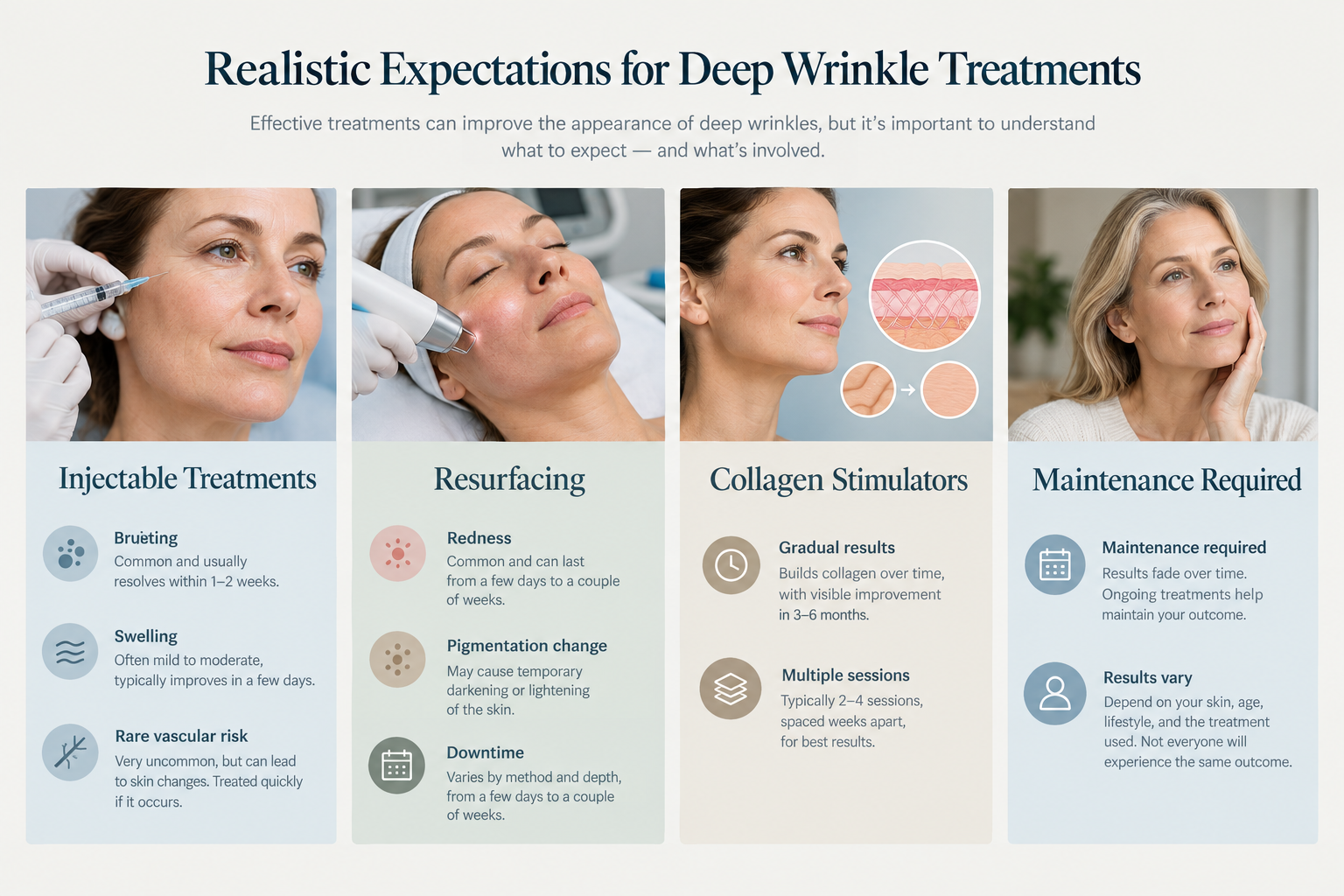
The treatment experience varies considerably depending on the modality chosen. Injectable treatments such as botulinum toxin and dermal fillers are typically performed in a clinic appointment lasting thirty to sixty minutes. Topical anaesthetic cream is often applied before filler injections to reduce discomfort. Bruising and swelling are common after injectable treatments and usually resolve within a few days to two weeks. Patients are generally advised to avoid strenuous exercise, alcohol, and certain medications that increase bleeding risk in the days around treatment.
Laser resurfacing and medium-to-deep chemical peels involve a more significant recovery period. Redness, swelling, crusting, and peeling are expected in the days following ablative procedures, and the skin may remain sensitive and pink for several weeks. Sun protection is essential during recovery and as an ongoing measure to protect results. Radiofrequency microneedling typically involves mild redness and swelling for one to three days.
Results from injectable treatments are often visible within days to weeks. Collagen-stimulating treatments produce gradual improvement over two to six months as new collagen is laid down, and the full effect may not be apparent until several months after the final session in a course. Most treatments require maintenance — whether repeat injections every few months or periodic resurfacing sessions — to sustain improvement over time.
Risks, Limitations, and Realistic Expectations
Every treatment for deep facial wrinkles carries potential risks, and none can guarantee complete elimination of established lines. Injectable treatments carry risks of bruising, swelling, asymmetry, infection, and, in the case of fillers, rare but serious vascular complications including skin necrosis or visual disturbance if filler enters a blood vessel. These serious complications are uncommon but underscore the importance of treatment by a qualified practitioner with appropriate training and emergency protocols.
Resurfacing treatments carry risks of infection, prolonged redness, pigmentation changes — both hyperpigmentation and hypopigmentation — and scarring. Risk is higher in patients with darker skin tones, active skin conditions, a history of keloid scarring, or recent use of certain medications including isotretinoin. A thorough medical history and skin assessment are essential before any resurfacing procedure.
Realistic expectations are important. Deep wrinkles that have developed over decades cannot be fully erased by any currently available non-surgical treatment. Meaningful improvement — a visible softening of lines, improved skin texture, and a more rested appearance — is a realistic goal for most patients. Complete elimination of deep static wrinkles without surgical intervention is generally not achievable, and patients should be counselled accordingly before treatment.
Who May Be Suitable for Deep Wrinkle Treatment
Suitability for specific treatments depends on a range of individual factors. Patients with good general health, realistic expectations, and no contraindications to the chosen treatment are generally the most appropriate candidates. Relevant considerations include skin type and tone, the location and depth of wrinkles, the degree of volume loss and skin laxity, previous treatments and their outcomes, current medications, and any history of skin conditions or immune disorders.
Certain conditions may affect suitability for specific treatments. Active skin infections, inflammatory skin conditions, pregnancy, and breastfeeding are generally contraindications to most injectable and resurfacing treatments. Patients taking anticoagulant medications have an increased risk of bruising with injectables. A history of cold sores may require antiviral prophylaxis before resurfacing procedures. Implanted electrical devices may be a contraindication for some energy-based treatments. These factors should be discussed openly during a consultation.
The Role of Skincare in Managing Deep Wrinkles
Professional treatments work most effectively when supported by an appropriate skincare routine. Topical retinoids — vitamin A derivatives including tretinoin and retinol — have the strongest evidence base among skincare ingredients for improving wrinkle depth and skin texture through stimulation of collagen synthesis and acceleration of skin cell turnover. Consistent daily use of broad-spectrum sunscreen is essential both to prevent further photoageing and to protect the results of any professional treatment. Antioxidant serums containing vitamin C may provide additional photoprotection and support collagen maintenance.
Skincare alone is unlikely to produce dramatic improvement in deeply etched wrinkles, but it can slow further progression, improve overall skin quality, and enhance the results of professional treatments. A practitioner can advise on a skincare regimen appropriate to the patient’s skin type and treatment plan.
Frequently Asked Questions
Can deep wrinkles be permanently removed without surgery?
Non-surgical treatments can significantly improve the appearance of deep wrinkles, but permanent removal without surgery is not currently achievable. Most treatments require ongoing maintenance to sustain results, and the degree of improvement varies between patients and wrinkle types.
How many treatment sessions are typically needed?
This depends on the treatment chosen and the individual patient. Botulinum toxin and hyaluronic acid fillers typically produce results after a single session, though repeat treatments are needed every few months to maintain the effect. Collagen-stimulating treatments such as radiofrequency microneedling or polynucleotides are usually delivered as a course of two to four sessions, with results developing gradually over several months.
Is there a best age to start treating deep wrinkles?
There is no universally correct age. Treatment decisions should be based on the individual’s concerns, the nature of the wrinkles, and their overall skin condition rather than age alone. Some patients benefit from preventive approaches in their thirties, while others seek treatment for established deep lines in their fifties or sixties. A qualified practitioner can advise on the most appropriate timing and approach.
Do dermal fillers make deep wrinkles worse over time if stopped?
There is no strong clinical evidence that stopping dermal filler treatment causes wrinkles to become worse than they would have been without treatment. When filler is metabolised, the treated area gradually returns toward its pre-treatment appearance. However, concerns about long-term filler accumulation and tissue changes with repeated treatment are an active area of clinical discussion, and patients should discuss their long-term treatment goals with their practitioner.
What is the downtime for deep wrinkle treatments?
Downtime varies significantly. Injectable treatments typically involve minimal downtime of a few days for bruising and swelling to settle. Ablative laser resurfacing may require one to two weeks of recovery. Radiofrequency microneedling usually involves one to three days of redness. The appropriate treatment for a patient’s lifestyle and schedule is a practical factor worth discussing during consultation.
Can sun damage make deep wrinkles worse?
Yes. Ultraviolet radiation is one of the primary drivers of skin ageing, degrading collagen and elastin and accelerating the formation and deepening of wrinkles. Daily broad-spectrum sunscreen use is one of the most evidence-supported measures for slowing wrinkle progression and protecting the results of professional treatments.
Choosing the Right Approach for Deep Facial Wrinkles
The best treatment for deep wrinkles on the face is not a single universal answer — it depends on the type, location, and depth of the wrinkles, the underlying causes, the patient’s skin type and overall facial anatomy, and their goals, tolerance for downtime, and willingness to commit to maintenance. Botulinum toxin remains highly effective for dynamic wrinkles driven by muscle movement. Dermal fillers provide immediate improvement for volume-related deep folds and creases. Resurfacing treatments address skin quality and collagen loss most directly. Biostimulatory treatments offer gradual structural improvement with a lower risk profile than ablative procedures. In many patients, a thoughtfully designed combination approach produces the most meaningful and natural-looking results.
What matters most before any treatment is an honest, thorough consultation with a qualified aesthetic practitioner who can assess your specific concerns, explain the realistic outcomes and limitations of each option, and help you make an informed decision. Deep wrinkles are a complex concern, and the most effective treatment plans are those built around the individual rather than a one-size-fits-all protocol.


