
Does Salicylic Acid Remove Acne? Effectiveness, Uses & Limitations
Salicylic acid is one of the most widely used active ingredients in acne skincare, found in cleansers, toners, spot treatments, and professional chemical peels. Many people reach for it as a first response to breakouts, but understanding exactly what it can and cannot do helps set realistic expectations. This article explains how salicylic acid works against acne, which types of breakouts it may help with, what results are realistic, and when a different approach may be worth considering.
Key Takeaways
- Salicylic acid is a beta-hydroxy acid (BHA) that works primarily by exfoliating inside the pore and reducing the buildup of dead skin cells and sebum that contribute to blocked follicles.
- It is most effective for non-inflammatory acne such as blackheads and whiteheads, and may help with mild to moderate inflammatory breakouts, but it is not a standalone solution for severe or cystic acne.
- Over-the-counter salicylic acid products typically contain 0.5–2% concentrations; professional peels use higher concentrations under controlled conditions.
- Consistent use over several weeks is usually required before visible improvement appears; results vary depending on acne type, skin type, and overall skincare routine.
- Side effects such as dryness, irritation, and increased sun sensitivity are possible, and some individuals may not be suitable candidates for salicylic acid use.
What Is Salicylic Acid?
Salicylic acid is a naturally derived compound originally found in willow bark. In skincare and dermatology, it is classified as a beta-hydroxy acid (BHA), which distinguishes it from alpha-hydroxy acids (AHAs) such as glycolic acid or lactic acid. The key structural difference is that salicylic acid is oil-soluble rather than water-soluble. This property allows it to penetrate into the sebaceous follicle — the pore — rather than working only on the surface of the skin. That oil-solubility is central to why salicylic acid is particularly relevant to acne-prone skin, which tends to produce excess sebum.
Salicylic acid also has mild anti-inflammatory properties, which may contribute to a reduction in redness and swelling around existing blemishes. Additionally, it has keratolytic activity, meaning it helps loosen and shed the bonds between dead skin cells, preventing the accumulation of cellular debris that can block pores. These combined properties — exfoliation, pore penetration, and mild anti-inflammatory action — form the basis of its use in acne management.
How Does Salicylic Acid Work Against Acne?
Acne develops when a hair follicle becomes blocked by a combination of excess sebum and dead skin cells. This blocked follicle, known as a comedone, can remain closed beneath the skin surface (a whitehead) or open at the surface and oxidise to appear dark (a blackhead). When bacteria — particularly Cutibacterium acnes — proliferate within a blocked follicle, the immune response produces the inflammation associated with papules, pustules, and more severe nodular or cystic lesions.
Salicylic acid addresses the early stages of this process. By penetrating the pore and exfoliating the lining of the follicle, it helps clear the buildup of dead skin cells and excess oil that would otherwise form a comedone. Regular use may reduce the formation of new comedones and help existing ones resolve more quickly. The mild anti-inflammatory effect may also reduce the redness and discomfort associated with early inflammatory lesions, though salicylic acid does not directly target the bacterial component of acne in the way that benzoyl peroxide or topical antibiotics do.
It is important to understand that salicylic acid works on the conditions that allow acne to form rather than eliminating acne-causing bacteria. This distinction matters when choosing the right approach for a particular type of breakout.
Which Types of Acne May Salicylic Acid Help With?
Salicylic acid is most consistently supported by evidence for comedonal acne — blackheads and whiteheads. Its ability to exfoliate inside the pore makes it well suited to preventing and clearing these non-inflammatory lesions. For individuals whose acne is predominantly comedonal, a well-formulated salicylic acid product used consistently may produce meaningful improvement over several weeks.
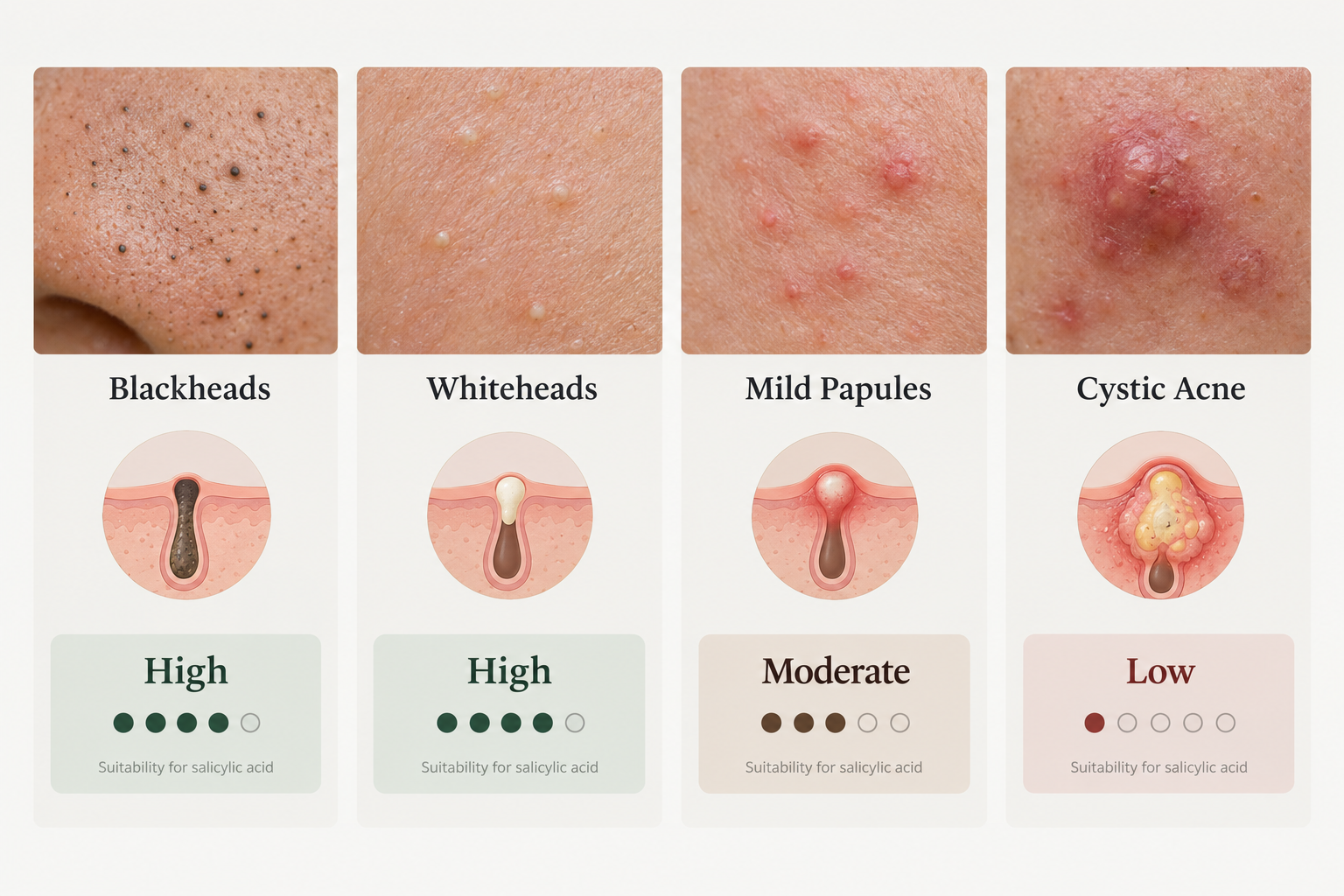
For mild to moderate inflammatory acne — small papules and pustules — salicylic acid may offer some benefit, particularly when used as part of a broader skincare routine. Its anti-inflammatory properties may help reduce the appearance of active blemishes, and by keeping pores clearer, it may reduce the frequency of new inflammatory lesions forming. However, the evidence for salicylic acid as a primary treatment for inflammatory acne is less robust than for comedonal acne, and many individuals with moderate inflammatory breakouts will benefit from additional or alternative treatments.
Salicylic acid is generally not considered an appropriate primary treatment for severe acne, including nodular acne or cystic acne. These deeper, more inflamed lesions involve processes — including significant bacterial activity and immune response — that topical exfoliation alone is unlikely to adequately address. Individuals with severe acne are typically advised to seek assessment from a dermatologist, where prescription treatments or procedural interventions may be more appropriate.
Over-the-Counter Products Versus Professional Treatments
Salicylic acid is available in a wide range of over-the-counter (OTC) skincare products, including cleansers, toners, serums, moisturisers, and targeted spot treatments. In most countries, OTC products are formulated at concentrations between 0.5% and 2%, which are considered effective for regular use on acne-prone skin while remaining within safety limits for unsupervised application.
Professional salicylic acid chemical peels, performed in a clinic setting, use higher concentrations — typically ranging from around 20% to 30% — applied for a controlled period of time before being neutralised or removed. These higher-concentration treatments can produce more pronounced exfoliation and may be particularly useful for individuals with persistent comedonal acne, uneven skin texture, or post-inflammatory hyperpigmentation associated with previous breakouts. Professional peels are performed by trained practitioners who can assess skin type, adjust concentration and contact time, and manage any adverse reactions appropriately.
The choice between OTC products and professional salicylic acid treatments depends on the severity of the acne, the individual’s skin type and sensitivity, previous treatment history, and the specific goals of treatment. OTC products are a reasonable starting point for mild acne, while professional assessment becomes more relevant when breakouts are persistent, moderate to severe, or associated with significant scarring or pigmentation changes.
What Results Are Realistic?
Salicylic acid is not a rapid solution. Most individuals using OTC salicylic acid products will need to use them consistently for at least four to eight weeks before a meaningful reduction in breakouts becomes visible. This timeline reflects the natural skin cell turnover cycle and the time required for existing comedones to resolve and for the pore environment to change sufficiently to reduce new lesion formation.
Realistic expectations for OTC salicylic acid use include a gradual reduction in blackheads and whiteheads, a possible decrease in the frequency of new inflammatory spots, and an improvement in overall skin texture. Salicylic acid is unlikely to eliminate acne entirely in most individuals, particularly if hormonal factors, diet, stress, or other contributors are involved. It is also unlikely to significantly improve acne scarring or deep post-inflammatory marks, though it may help with mild surface texture irregularities over time.
Professional salicylic acid peels may produce more noticeable results in a shorter timeframe, but a course of treatments is typically recommended rather than a single session. Results from professional peels also vary depending on the individual’s skin type, the concentration used, and the specific concerns being addressed.
How to Use Salicylic Acid Effectively
Consistent and appropriate use is important for salicylic acid to be effective. For OTC products, applying a salicylic acid cleanser or leave-on treatment once or twice daily — depending on the product formulation and individual skin tolerance — is a common approach. Leave-on products such as serums or toners generally provide more sustained contact with the skin than rinse-off cleansers and may therefore offer greater benefit for acne management.
Starting with a lower frequency of use and gradually increasing it can help the skin adjust and reduce the risk of irritation, particularly for individuals with sensitive skin. Combining salicylic acid with other potentially irritating active ingredients — such as retinoids, benzoyl peroxide, or AHAs — should be approached carefully, as the combination may increase the risk of dryness and barrier disruption. A qualified skincare professional or dermatologist can advise on how to incorporate salicylic acid into a broader routine safely.
Sun protection is important when using salicylic acid regularly, as exfoliating acids can increase the skin’s sensitivity to ultraviolet radiation. A broad-spectrum sunscreen applied daily is a practical and important part of any routine that includes salicylic acid.
Potential Side Effects and Risks
Salicylic acid is generally well tolerated at OTC concentrations, but side effects are possible and should be understood before starting use. The most commonly reported effects include skin dryness, flaking, and mild irritation, particularly during the initial weeks of use or if the product is applied too frequently. These effects often improve as the skin adjusts, but persistent or severe irritation warrants reducing frequency or discontinuing use.
Individuals with sensitive skin, a compromised skin barrier, or conditions such as eczema or rosacea may find salicylic acid more irritating than those with resilient, oily skin. In these cases, a lower concentration or less frequent application may be advisable, and professional guidance is recommended before starting.
Salicylic acid should not be applied to broken, inflamed, or infected skin. It is not recommended for use during pregnancy, as salicylates are absorbed through the skin and systemic exposure is a concern, particularly with higher concentrations or large treatment areas. Individuals who are pregnant or breastfeeding should consult a healthcare professional before using salicylic acid products.
At professional peel concentrations, the risks are more significant and include temporary redness, peeling, post-inflammatory hyperpigmentation (particularly in darker skin tones), and, in rare cases, chemical burns if the product is not applied and removed correctly. This is why professional peels should only be performed by trained and experienced practitioners in an appropriate clinical setting.
Who May Be Suitable for Salicylic Acid Treatment?
Salicylic acid may be a reasonable option for individuals with oily or combination skin who experience regular blackheads, whiteheads, or mild to moderate inflammatory breakouts. It tends to be particularly well suited to those whose acne is driven by excess sebum production and pore congestion, as these are the conditions salicylic acid is most directly designed to address.
Individuals with dry or sensitive skin may still use salicylic acid but may need to start with lower concentrations, use it less frequently, and pay close attention to moisturisation and barrier support. Those with darker skin tones should be aware that any exfoliating treatment carries a risk of post-inflammatory hyperpigmentation if irritation occurs, and professional guidance is particularly valuable in this context.
For professional salicylic acid peels, a thorough consultation with a qualified practitioner is necessary to assess skin type, current skincare routine, medical history, and treatment goals before proceeding.
Alternatives and Complementary Approaches
Salicylic acid is one of several evidence-supported options for acne management, and for many individuals, the most effective approach involves combining treatments or considering alternatives depending on the acne type and severity.
Benzoyl peroxide is an antimicrobial agent that directly targets Cutibacterium acnes bacteria and is particularly useful for inflammatory acne. It is often used alongside or instead of salicylic acid, depending on the predominant acne type. Combining the two requires care to avoid excessive dryness and irritation.
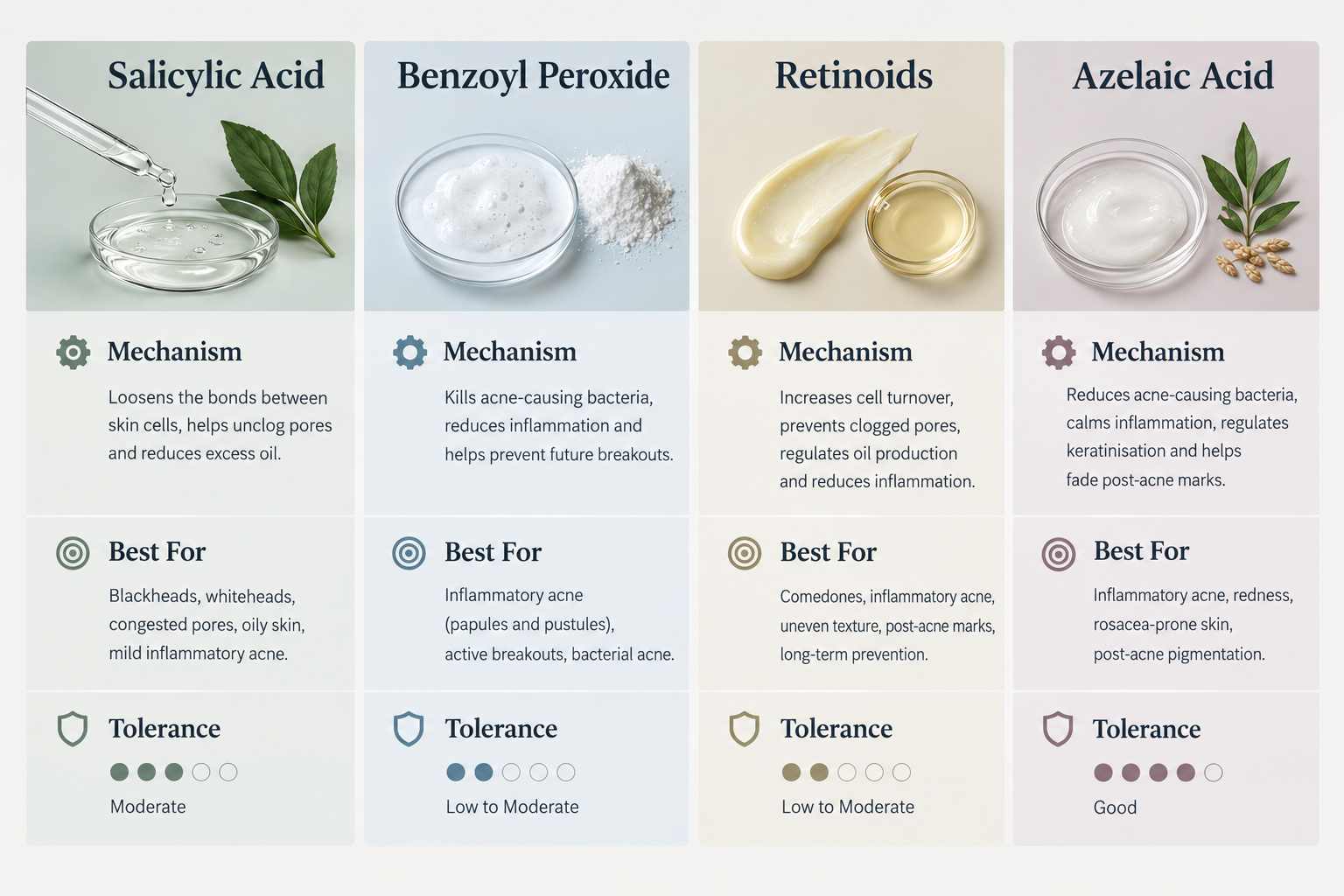
Retinoids — including over-the-counter retinol and prescription-strength tretinoin or adapalene — work by normalising skin cell turnover and reducing comedone formation. Prescription retinoids are among the most evidence-supported topical treatments for both comedonal and inflammatory acne and may be more effective than salicylic acid for moderate to severe cases.
Azelaic acid is another option with both anti-inflammatory and mild antibacterial properties, and it is often better tolerated by sensitive skin. It may also help with post-inflammatory hyperpigmentation, making it a useful consideration for individuals who experience pigmentation changes after breakouts.
Niacinamide is not a direct acne treatment but may help regulate sebum production and reduce inflammation, and it is generally well tolerated alongside other active ingredients.
For moderate to severe acne, prescription treatments — including topical or oral antibiotics, combined oral contraceptives where appropriate, or oral isotretinoin — may be necessary and should be discussed with a dermatologist. Professional in-clinic treatments such as chemical peels, light-based therapies, or extraction procedures may also be considered as part of a comprehensive acne management plan.
Frequently Asked Questions
How long does salicylic acid take to work on acne?
Most individuals using OTC salicylic acid products consistently will begin to notice improvement after four to eight weeks. Significant changes in breakout frequency and skin texture may take longer, particularly for moderate acne. Professional peels may produce faster visible results, but a course of treatments is usually recommended.
Can salicylic acid make acne worse before it gets better?
Some individuals experience a temporary increase in breakouts or skin purging during the first few weeks of using a new exfoliating treatment. This is thought to occur as the accelerated cell turnover brings existing congestion to the surface more quickly. If purging occurs, it typically resolves within four to six weeks. Persistent worsening beyond this point may indicate that the product is not suitable for that individual’s skin.
Is salicylic acid safe for daily use?
Many OTC salicylic acid products are formulated for daily use, but individual tolerance varies. Starting with every other day use and increasing frequency gradually is a sensible approach, particularly for those with sensitive or dry skin. Daily use of leave-on products at 2% concentration may cause dryness or irritation in some individuals.
Can salicylic acid help with acne scars?
Salicylic acid is not a primary treatment for acne scarring. It may help with mild post-inflammatory hyperpigmentation — the flat dark marks left after a blemish heals — by promoting cell turnover. However, it is unlikely to significantly improve textural scarring such as ice-pick, boxcar, or rolling scars, which typically require more targeted professional treatments.
Is salicylic acid suitable for all skin tones?
Salicylic acid can be used across a range of skin tones, but individuals with medium to dark skin tones should be aware that irritation from any exfoliating ingredient can trigger post-inflammatory hyperpigmentation. Starting with a lower concentration and frequency, and seeking professional guidance, is particularly advisable for those with this concern.
Can I use salicylic acid with other acne treatments?
Salicylic acid can be combined with some other acne treatments, but care is needed. Using it alongside retinoids, benzoyl peroxide, or AHAs simultaneously may increase the risk of irritation and barrier disruption. A skincare professional or dermatologist can advise on how to layer or alternate active ingredients safely based on individual skin needs.
Is Salicylic Acid the Right Approach for Your Acne?
Salicylic acid can be a genuinely useful part of an acne management routine, particularly for individuals dealing with blackheads, whiteheads, and mild to moderate breakouts on oily or combination skin. Its ability to exfoliate inside the pore and reduce comedone formation is well established, and consistent use of appropriately formulated products may produce meaningful improvement over time. However, it is not a universal solution, and its effectiveness depends significantly on the type and severity of acne, individual skin characteristics, and how it is used within a broader routine.
For mild acne, a well-chosen OTC salicylic acid product used consistently and alongside good sun protection and moisturisation is a reasonable starting point. For persistent, moderate, or severe acne — or for acne associated with significant scarring or pigmentation changes — a consultation with a dermatologist or qualified aesthetic practitioner is a more appropriate next step. A professional assessment can identify the underlying drivers of breakouts, recommend treatments with stronger evidence for more complex presentations, and help avoid the trial-and-error approach that often delays effective management. Salicylic acid may well form part of that plan, but it is most effective when used as part of a considered, personalised approach rather than as a standalone remedy.


