
Smile Lines Filler: Softening Nasolabial Creases with Dermal Filler
Nasolabial folds — the creases that run from the sides of the nose down to the corners of the mouth — are one of the most common concerns patients bring to aesthetic consultations. Dermal filler injected into or around this area can soften the depth of these lines, restoring a smoother transition between the cheek and the upper lip. This article explains how smile lines filler works, what realistic outcomes look like, who may be a suitable candidate, and what risks and alternatives are worth understanding before booking a consultation.
Key Takeaways
- Hyaluronic acid filler is the most widely used treatment for softening nasolabial folds, with results typically lasting six to eighteen months depending on the product and individual factors.
- Deep nasolabial creases are often partly caused by volume loss in the mid-face; treating the cheeks as well as the fold itself may produce more natural-looking results than treating the fold in isolation.
- Filler does not stop the ageing process — maintenance treatments are usually needed to sustain results over time.
- Serious complications are uncommon but include vascular occlusion, which requires prompt medical attention; choosing a qualified, experienced practitioner significantly reduces this risk.
- Not everyone with prominent smile lines is an ideal candidate for filler; a thorough clinical assessment is essential before treatment.
What Are Nasolabial Folds and Why Do They Deepen?
Nasolabial folds are natural anatomical features present from birth. They become more noticeable with age for several interconnected reasons. Subcutaneous fat compartments in the mid-face gradually lose volume, causing the cheek to descend and the fold to deepen. Collagen and elastin fibres in the dermis break down over time, reducing the skin’s ability to spring back after repeated facial movement. Bone resorption in the maxilla and zygoma further reduces the structural support beneath the soft tissue, allowing the overlying skin and fat to sag downward. Repeated smiling, laughing, and other facial expressions also contribute to the crease becoming more defined over decades.
The result is a fold that can range from a subtle shadow in younger adults to a pronounced groove in older patients. Skin type, sun exposure history, smoking, body weight fluctuations, and genetics all influence how quickly and how deeply nasolabial creases develop. Understanding these underlying causes matters because it directly affects which treatment approach — or combination of approaches — is most likely to produce a satisfying outcome.
How Does Smile Lines Filler Work?
The most commonly used filler for nasolabial folds is hyaluronic acid (HA), a naturally occurring polysaccharide found in skin and connective tissue. When injected into or adjacent to the fold, HA filler adds physical volume beneath the crease, lifting the skin and reducing the shadow that makes the line appear prominent. Different HA products are formulated with varying degrees of cross-linking, which affects their firmness, lifting capacity, and how long they persist in the tissue. Practitioners select a product based on the depth of the fold, the quality of the overlying skin, and the degree of correction required.
Filler can be placed directly within the fold itself, in the deeper fat compartments of the cheek above the fold, or in both locations simultaneously. Treating the cheek as well as the fold — sometimes called a volumisation or liquid lift approach — can address the underlying descent of mid-face tissue rather than simply filling the crease from below. This combined approach often produces a more natural result, particularly in patients with significant mid-face volume loss, because it repositions rather than merely masks the structural change.
Hyaluronic acid filler is reversible. An enzyme called hyaluronidase can be injected to dissolve HA if a result is unsatisfactory or if a complication occurs. This reversibility is one reason HA remains the preferred choice for this area over permanent or semi-permanent fillers, which carry a higher long-term risk profile.
What Happens During a Nasolabial Fold Filler Appointment?
A thorough consultation should precede any injection appointment. The practitioner will assess the depth and character of the nasolabial folds, evaluate mid-face volume, review the patient’s medical history, and discuss realistic expectations. Photographs are typically taken for clinical records and to assist treatment planning.
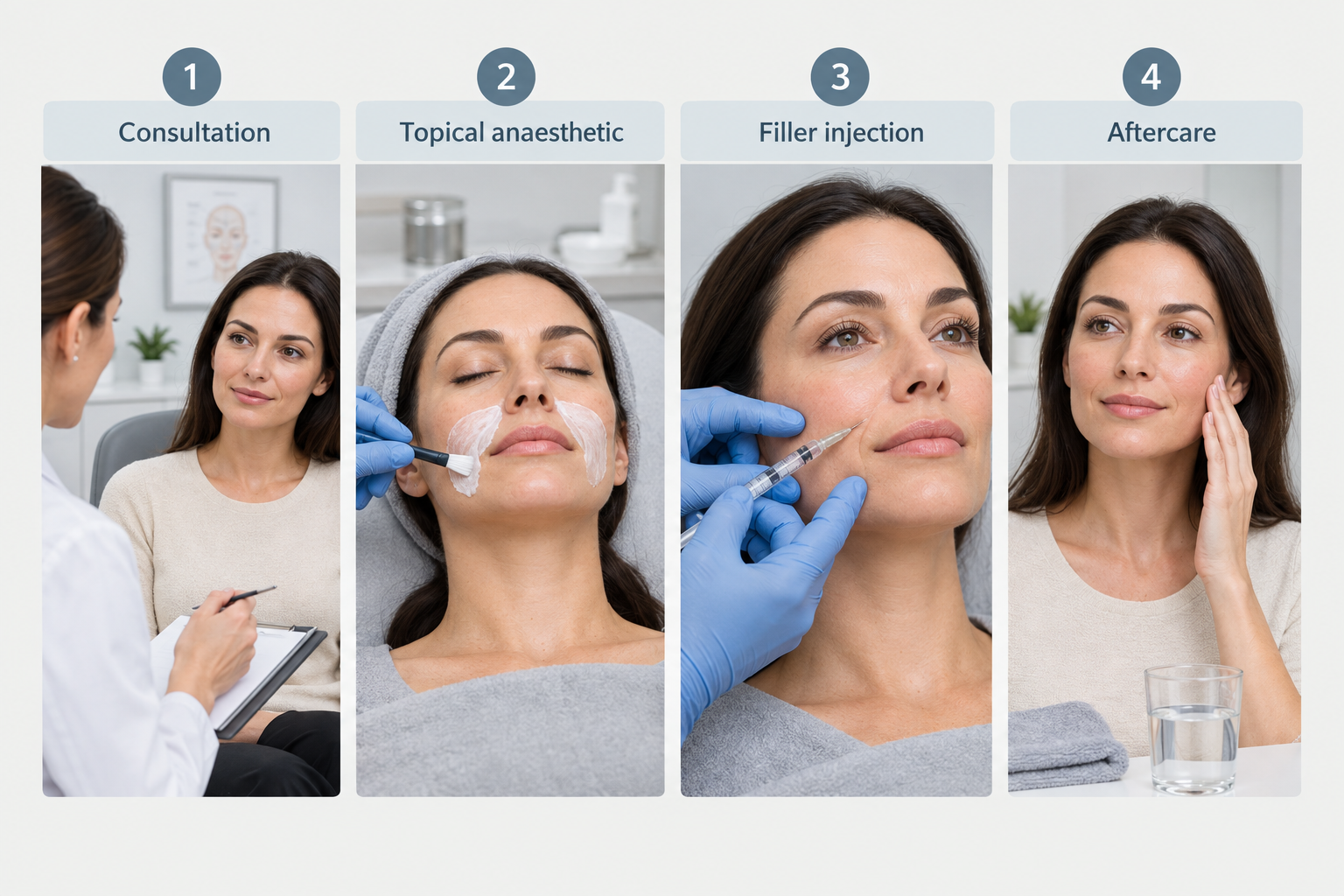
On the day of treatment, a topical anaesthetic cream is usually applied to the skin for twenty to thirty minutes before injections begin. Many HA filler products also contain lidocaine, a local anaesthetic, within the gel itself, which helps reduce discomfort during the procedure. The practitioner may use a fine needle or a blunt-tipped cannula — a flexible tube — to deposit the filler. Cannulas are associated with a lower risk of bruising and vascular injury in some practitioners’ hands, though technique preference varies and both approaches can be performed safely by experienced clinicians.
The appointment itself typically takes thirty to sixty minutes including consultation time. Patients can usually return to normal daily activities immediately, though strenuous exercise and significant heat exposure are generally advised against for the first twenty-four to forty-eight hours.
Expected Results and How Long They Last
Most patients notice an immediate improvement in the depth of their nasolabial folds following treatment. Some initial swelling is normal and may temporarily make the result appear more pronounced than the final outcome. This swelling usually settles within a few days to two weeks, after which the true result becomes visible.
The longevity of smile lines filler varies considerably between individuals. Factors that influence how long results last include the specific HA product used, the volume injected, the depth of the fold, the patient’s metabolic rate, their lifestyle, and how much movement occurs in the treated area. As a general guide, results in the nasolabial area may last between six and eighteen months, with some patients reporting longer-lasting effects and others finding results fade more quickly. Maintenance treatments are typically needed to sustain the improvement over time.
It is important to have realistic expectations. Filler can meaningfully soften nasolabial creases, but it does not eliminate them entirely, nor does it replicate the results of surgical procedures such as a facelift. Very deep folds, particularly those with significant skin laxity, may show a more modest improvement from filler alone compared with shallower creases in patients with good skin quality.
Risks and Side Effects
Dermal filler injections carry a range of possible side effects and risks, which vary in frequency and severity. Patients should receive a clear explanation of these before consenting to treatment.
Common and Expected Side Effects
Temporary redness, swelling, tenderness, and bruising at the injection sites are the most frequently reported side effects. These typically resolve within a few days to two weeks. Mild asymmetry immediately after treatment is also common and often improves as swelling settles. Lumps or irregularities in the filler can sometimes be felt beneath the skin; these may resolve spontaneously or may require massage or, in some cases, hyaluronidase to correct.
Less Common but Serious Risks
Vascular occlusion is the most serious complication associated with dermal filler injections. This occurs when filler is inadvertently injected into or compresses a blood vessel, obstructing blood flow to the surrounding tissue. In the nasolabial area, the facial artery and its branches are in close proximity to common injection sites. Vascular occlusion can cause skin necrosis — tissue death — and, in rare cases involving vessels connected to the eye, vision loss. Prompt recognition and immediate treatment with hyaluronidase are critical. This underscores the importance of choosing a practitioner with appropriate medical training, a thorough knowledge of facial anatomy, and access to emergency reversal agents.
Infection is an uncommon but possible complication. Delayed inflammatory nodules — sometimes called biofilm reactions — can occur weeks or months after treatment and may require medical management. Tyndall effect, a bluish discolouration visible through the skin, can occur if filler is placed too superficially. Granuloma formation is rare but has been reported with various filler types.
Reducing Risk
The risk of serious complications is meaningfully reduced by selecting a qualified medical practitioner with specific training in facial anatomy and injectable treatments, ensuring the clinic holds appropriate emergency protocols and reversal agents, and disclosing a full medical history before treatment. Patients should not receive filler over active skin infections, cold sores, or inflammatory skin conditions in the treatment area.
Who May Be Suitable for Nasolabial Fold Filler?
Smile lines filler may be appropriate for adults who have developed noticeable nasolabial creases and are seeking a non-surgical option to soften their appearance. Patients with mild to moderate fold depth and reasonable skin quality tend to achieve the most satisfying results. Those with significant mid-face volume loss may benefit from a combined approach that addresses cheek volume as well as the fold itself.
Suitability depends on a clinical assessment that considers the patient’s anatomy, skin condition, medical history, and goals. Filler may not be the most appropriate first-line option for everyone. Patients with very deep folds accompanied by substantial skin laxity may find that filler provides limited improvement and that a surgical consultation is more relevant to their concerns.
Who May Not Be Suitable
Certain factors may make dermal filler treatment inadvisable or require careful consideration. These include:
- Pregnancy or breastfeeding — filler is generally not recommended during these periods.
- Active skin infection, cold sore, or inflammatory condition in or near the treatment area.
- Known allergy to hyaluronic acid filler components or lidocaine.
- Autoimmune conditions or immunosuppressive therapy — these may affect healing and increase infection risk.
- Blood-thinning medications or supplements that significantly increase bruising risk — the prescribing clinician should be consulted before stopping any medication.
- Unrealistic expectations about the degree of correction achievable with filler alone.
- Previous permanent filler in the same area — this requires careful assessment as it may complicate treatment and increase complication risk.
A thorough pre-treatment consultation is the appropriate setting to identify any contraindications and to ensure the patient has accurate information about what the treatment can and cannot achieve.
Alternatives to Smile Lines Filler
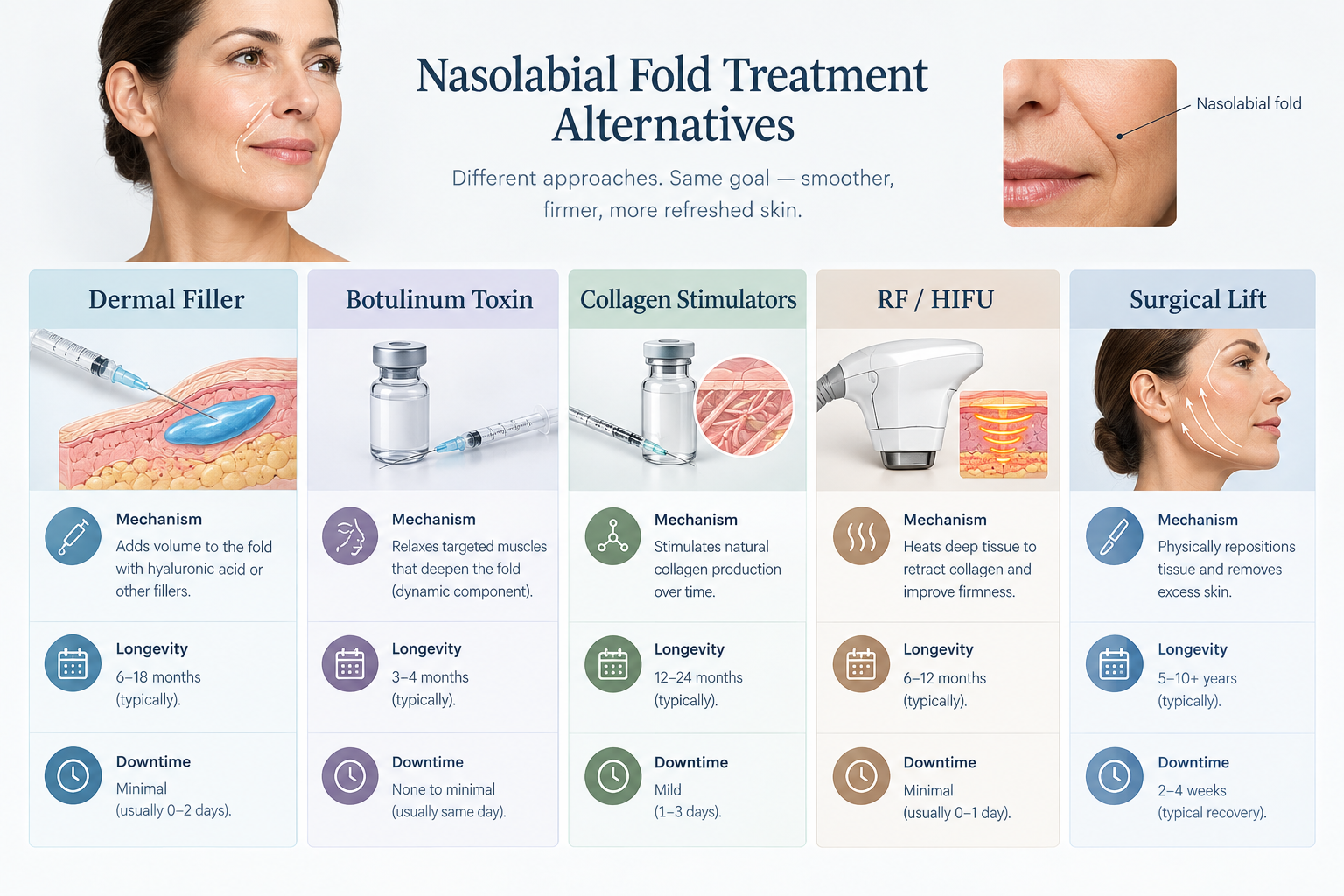
Dermal filler is not the only option for addressing nasolabial folds. Several alternatives exist, and the most appropriate choice depends on the underlying cause of the crease, the patient’s anatomy, and their preferences regarding downtime, cost, and longevity.
Botulinum Toxin
Botulinum toxin injections are sometimes used in the perioral area to reduce the muscular pull that contributes to nasolabial fold depth. However, botulinum toxin is generally less effective than filler for directly softening established nasolabial creases, and injections in this area require careful technique to avoid affecting lip movement and function. It may be used as a complementary treatment alongside filler in selected patients.
Collagen-Stimulating Treatments
Treatments such as polynucleotides, poly-L-lactic acid (PLLA), and calcium hydroxylapatite (CaHA) stimulate the body’s own collagen production rather than simply adding volume. These biostimulatory approaches may improve skin quality and provide gradual volumisation over several months. They may be suitable for patients who prefer a more gradual result or who wish to improve overall skin quality alongside addressing fold depth. Results typically develop more slowly than with HA filler and may require a course of treatments.
Radiofrequency and Ultrasound Skin Tightening
Energy-based devices that use radiofrequency or focused ultrasound energy — such as microneedling radiofrequency or high-intensity focused ultrasound (HIFU) — can stimulate collagen remodelling and provide modest skin tightening. These treatments may be more relevant when skin laxity is a significant component of the nasolabial fold, though the degree of improvement is generally more subtle than with volumising filler and results vary between individuals.
Surgical Options
For patients with significant skin laxity, deep folds, and descended mid-face tissue, surgical procedures such as a mid-face lift or full facelift may produce more substantial and longer-lasting correction than any non-surgical approach. Surgical options involve greater downtime, cost, and procedural risk, but may be more appropriate for patients whose concerns exceed what injectable treatments can realistically address.
Skin Resurfacing
Laser resurfacing, chemical peels, and microneedling can improve skin texture and fine surface lines in the nasolabial area, but they do not address the volume deficit or tissue descent that causes deeper folds. These treatments may complement filler rather than replace it.
The Role of Mid-Face Volume in Nasolabial Fold Treatment
One of the most clinically important concepts in nasolabial fold treatment is that the fold itself is often a consequence of changes occurring higher in the face. As the cheek fat compartments deflate and descend with age, the tissue piles up at the nasolabial boundary, creating or deepening the crease. Injecting filler solely into the fold can sometimes produce an unnatural appearance — a filled groove that looks artificially smooth while the surrounding face continues to show signs of volume loss.
Experienced practitioners frequently assess the entire mid-face before deciding where to place filler. Restoring volume to the cheek — lifting the descended tissue — can reduce nasolabial fold depth indirectly while also improving overall facial harmony. This approach requires a greater volume of filler and a higher level of anatomical knowledge, but it tends to produce results that look more consistent with natural facial structure. Patients should discuss this broader assessment with their practitioner rather than assuming that filler placed directly into the fold is always the most appropriate strategy.
Questions to Ask Your Practitioner
Before proceeding with nasolabial fold filler, it is reasonable to ask your practitioner the following:
- What is your clinical background and specific training in facial anatomy and injectable treatments?
- Which filler product do you recommend for my fold depth and skin type, and why?
- Would you recommend treating the cheeks as well as the fold itself, and what is your reasoning?
- What results are realistic for my specific anatomy, and what are the limitations?
- What are the risks I should be aware of, and how would you manage a complication?
- Do you hold hyaluronidase on-site for emergency reversal?
- How long should I expect results to last, and what does a maintenance plan look like?
- Are there alternative treatments that might better suit my concerns?
Frequently Asked Questions
Does nasolabial fold filler hurt?
Most patients find the procedure tolerable. Topical anaesthetic cream applied before treatment and lidocaine contained within many filler products help reduce discomfort. Some patients experience a mild stinging or pressure sensation during injection, particularly in areas with thinner skin. Discomfort levels vary between individuals and depend on the practitioner’s technique.
How much filler is typically needed for smile lines?
The volume required depends on the depth of the fold, whether the cheeks are also being treated, and the patient’s anatomy. Treatment plans vary considerably between individuals and should be determined during a clinical assessment rather than estimated in advance. A practitioner who recommends a specific volume without first assessing your face in person should be approached with caution.
Can filler make nasolabial folds look worse over time?
Repeated filler treatments over many years without allowing previous product to fully dissolve can occasionally lead to tissue distortion or an overfilled appearance. This is one reason why regular review appointments and honest assessment of cumulative filler volume are important. Hyaluronidase can be used to dissolve accumulated HA filler if needed before retreating.
Is there any downtime after nasolabial fold filler?
Most patients return to normal activities the same day. Swelling and bruising may be visible for several days to two weeks, which some patients prefer to schedule around social or professional commitments. Strenuous exercise, alcohol, and significant heat — such as saunas or hot baths — are typically advised against for the first twenty-four to forty-eight hours.
At what age do people typically start considering filler for smile lines?
There is no fixed age. Some patients in their late twenties or thirties notice early nasolabial shadowing and seek subtle softening, while others do not consider treatment until their forties, fifties, or later when folds have deepened more significantly. The decision is individual and should be based on personal concern and clinical suitability rather than age alone.
Can smile lines filler be combined with other treatments?
Yes. Nasolabial fold filler is frequently combined with cheek volumisation, treatment of other facial areas such as the lips or tear troughs, botulinum toxin for dynamic lines, and skin quality treatments such as polynucleotides or profhilo. A practitioner experienced in full-face assessment can advise on which combination may best address a patient’s overall concerns.
Is Smile Lines Filler the Right Option for You?
Dermal filler for nasolabial folds is a well-established non-surgical treatment that can meaningfully soften smile lines in appropriate candidates. For patients with mild to moderate fold depth and good skin quality, results can be natural-looking and satisfying, with relatively minimal downtime and the reassurance of reversibility. The treatment works best when it is part of a thoughtful assessment of the whole face rather than an isolated correction of the crease itself.
The limitations are equally important to understand. Filler does not halt the ageing process, results are temporary, and very deep folds with significant skin laxity may respond modestly. The risk of serious complications — while uncommon — is real, and the safety of the procedure depends substantially on the skill, training, and emergency preparedness of the practitioner performing it.
If you are considering treatment for nasolabial folds, a consultation with a qualified medical professional who can assess your individual anatomy, discuss realistic outcomes, and explain all available options is the appropriate starting point. The right treatment plan is one that is tailored to your specific concerns, anatomy, and goals — not a one-size-fits-all approach.


