
Types of Eyes: A Complete Guide to Identifying Your Eye Shape
Understanding the different types of eyes is more than a beauty exercise — it has practical relevance for makeup application, cosmetic consultations, and aesthetic treatments. Eye shape influences how light reflects across the face, how the upper eyelid appears, and which non-surgical or surgical options may be most appropriate for a given individual. This guide explains the most recognised eye shapes, how to identify your own, and why eye shape matters in an aesthetic medicine context.
Key Takeaways
- There are several widely recognised eye shapes, including almond, round, hooded, monolid, downturned, upturned, and deep-set eyes, each defined by specific anatomical characteristics.
- Eye shape is determined by factors such as the position of the orbital bone, the presence or absence of a visible eyelid crease, and the angle of the outer corner relative to the inner corner.
- Identifying your eye shape accurately can help inform makeup techniques, skincare choices, and discussions with an aesthetic practitioner about treatments such as brow lifting, eyelid rejuvenation, or filler placement.
- Eye shape can change with age due to volume loss, skin laxity, and brow descent, which may affect how the eyes appear and which aesthetic concerns become relevant.
- No eye shape is medically superior to another; variation is normal and reflects natural human diversity across ethnicities and facial structures.
What Determines Eye Shape?
Eye shape is primarily determined by the underlying bony orbit, the amount of soft tissue surrounding the eye, the position of the eyelid crease, and the angle formed between the inner corner (medial canthus) and the outer corner (lateral canthus) of the eye. The presence, depth, and height of the supratarsal fold — the crease that forms above the upper eyelid — plays a significant role in distinguishing eye shapes, particularly when comparing eyes with a visible crease to those without one. Skin thickness, the degree of brow ptosis (brow drooping), and the distribution of periorbital fat also contribute to how the eye appears from the front.
Genetics is the primary driver of eye shape, and there is considerable variation across different ethnic backgrounds. For example, the absence of a visible supratarsal fold is more common in people of East Asian, Southeast Asian, and some Indigenous American heritage, while deep-set eyes are more frequently observed in people of European descent. These differences reflect normal anatomical variation rather than any hierarchy of appearance. Age also modifies eye shape over time: as the brow descends and periorbital fat redistributes or diminishes, the apparent shape of the eye can shift, often making eyes appear smaller, more hooded, or more hollow than they did in earlier decades.
The Most Recognised Types of Eyes
Aesthetic practitioners, makeup artists, and ophthalmic professionals use a broadly consistent set of categories to describe eye shapes. The following descriptions reflect the most commonly used classifications and the anatomical features that define each one.
Almond Eyes
Almond-shaped eyes are often used as a reference point when describing other eye shapes. The defining feature is an elongated oval form that tapers gently at both the inner and outer corners, with the outer corner sitting slightly higher than the inner corner. The iris is partially covered by both the upper and lower eyelids, meaning the white of the eye (sclera) is not visible above or below the iris when the eye is in a neutral, forward-facing position. The upper eyelid typically shows a visible crease. Almond eyes are considered proportionally balanced in many facial assessment frameworks, which is why they are frequently used as a baseline in aesthetic consultations.
Round Eyes
Round eyes have a more circular appearance, with the iris often fully visible or nearly fully visible, meaning a small amount of sclera may show above or below the iris. The inner and outer corners are at approximately the same horizontal level, and the eye appears more open and wide compared to the almond shape. The upper eyelid crease is usually visible and sits relatively high. Round eyes tend to create a more open, youthful impression and are associated with a larger apparent eye size relative to the face.
Hooded Eyes
Hooded eyes are characterised by a fold of skin that descends from the brow bone and partially or fully covers the upper eyelid crease when the eye is open. This means that the mobile eyelid — the area between the lash line and the crease — appears reduced or absent when looking straight ahead. Hooded eyes can be a natural anatomical feature present from early adulthood, or they can develop progressively with age as the brow descends and excess upper eyelid skin accumulates. Dermatochalasis — the medical term for excess upper eyelid skin — is a common age-related change that can create or worsen a hooded appearance. In some cases, significant hooding may affect the superior visual field, at which point it becomes a functional rather than purely aesthetic concern.
From an aesthetic medicine perspective, hooded eyes are one of the most frequently discussed eye shapes in consultations. Non-surgical options such as botulinum toxin brow lifting, plasma fibroblast treatment, or radiofrequency skin tightening may offer modest improvement in mild cases. Surgical upper blepharoplasty — the removal of excess upper eyelid skin — is the most established intervention for more pronounced hooding and is performed by ophthalmic surgeons and plastic surgeons. Suitability depends on the degree of hooding, brow position, and individual anatomy, and a thorough clinical assessment is essential before any treatment decision.
Monolid Eyes
Monolid eyes, sometimes called single eyelid eyes, are defined by the absence of a visible supratarsal fold or eyelid crease. The upper eyelid appears as a smooth, uninterrupted surface from the lash line to the brow. This eye shape is most common in people of East Asian heritage and is a normal anatomical variant. The term “double eyelid” refers to the presence of a visible crease, and double eyelid surgery — a procedure that creates or deepens the supratarsal fold — is one of the most commonly performed cosmetic eyelid procedures globally, particularly in East and Southeast Asia. It is important to note that the decision to pursue such a procedure is entirely personal, and monolid eyes require no correction from a medical standpoint.
Downturned Eyes
Downturned eyes are identified by an outer corner that sits lower than the inner corner, giving the eye a gentle downward slope toward the temples. This can create an impression of tiredness or sadness even when the face is at rest, which is why some individuals with downturned eyes seek aesthetic advice. The degree of downturn varies considerably between individuals. Downturned eyes can be a natural feature or can become more pronounced with age as the lateral canthal area loses support. Aesthetic approaches that may be discussed in consultation include botulinum toxin treatment to the lateral orbicularis oculi muscle, which may subtly lift the outer corner, or dermal filler placement in the lateral periorbital area. Results from non-surgical approaches are typically modest and temporary, and realistic expectations are important.
Upturned Eyes
Upturned eyes are the anatomical opposite of downturned eyes: the outer corner sits higher than the inner corner, creating an upward angle at the lateral canthus. This is sometimes described as a “cat eye” appearance. Upturned eyes are associated with a more alert or intense expression. Like downturned eyes, the degree of upturn varies between individuals and is influenced by genetics and the underlying bony structure of the orbit.
Deep-Set Eyes
Deep-set eyes are positioned further back within the orbital socket, meaning the brow bone is more prominent and the eyes appear to recede into the face. This creates a natural shadow over the upper eyelid and can make the eyes appear smaller or more intense. Deep-set eyes are more common in individuals with a pronounced supraorbital ridge. Volume loss in the periorbital area with age can accentuate the deep-set appearance, sometimes creating a hollow or sunken look. Hyaluronic acid filler placed carefully in the periorbital region may be discussed in consultation to address hollowness, though this area carries specific risks and requires an experienced practitioner.
Prominent or Protruding Eyes
Prominent eyes, sometimes called protruding or bulging eyes, sit forward in the orbital socket rather than receding. This means more of the eyeball surface is visible, and the eyes may appear larger or more exposed. Mild prominence is a normal anatomical variant, but significant protrusion — known medically as proptosis or exophthalmos — can have underlying medical causes including thyroid eye disease and should be assessed by an ophthalmologist or endocrinologist rather than treated as a cosmetic concern.
Close-Set and Wide-Set Eyes
While not strictly eye shapes in the same sense as the categories above, the horizontal spacing between the eyes is frequently discussed alongside eye shape in aesthetic assessments. Close-set eyes have a shorter distance between the inner corners relative to the width of the eye itself, while wide-set eyes have a greater distance. The intercanthal distance — the measurement between the two inner corners — is used in facial proportion analysis. These characteristics influence makeup strategies and may be relevant when planning filler or other periorbital treatments.
How to Identify Your Eye Shape
Identifying your own eye shape is straightforward with a mirror and good lighting. The following approach is used in many aesthetic and makeup contexts.
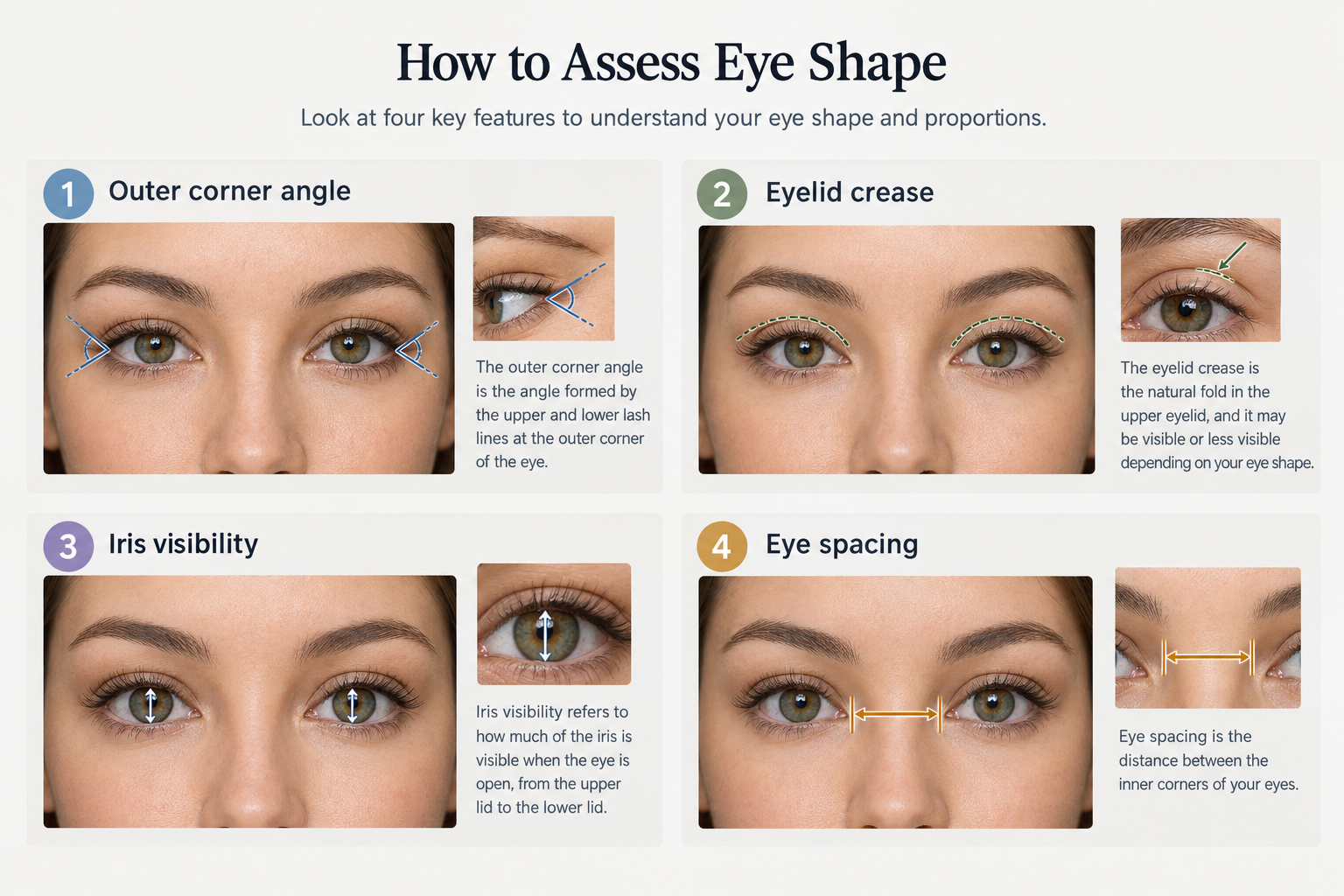
- Look straight ahead in a well-lit mirror. Avoid tilting your head up or down, as this changes the apparent shape of the eye.
- Check for a visible eyelid crease. If you cannot see a crease when your eye is open, you likely have a monolid. If the crease is hidden by overhanging skin, hooded eyes may be present.
- Assess the outer corner angle. Draw an imaginary horizontal line across the eye from inner to outer corner. If the outer corner sits above this line, the eyes are upturned. If it sits below, they are downturned. If it sits on the line, the eyes are almond or round.
- Observe how much of the iris is visible. If the full circle of the iris is visible with sclera showing above and below, the eyes are round. If the upper and lower lids partially cover the iris, the shape is closer to almond.
- Note the depth of the eye socket. If the brow bone casts a shadow over the eye and the lid appears to recede, the eyes may be deep-set. If the eyeball appears to sit forward, they may be prominent.
It is worth noting that many people have eyes that combine features from more than one category — for example, almond-shaped eyes that are also slightly downturned, or round eyes that are also deep-set. These combinations are common and do not require a single definitive label.
How Eye Shape Changes with Age
Eye shape is not static throughout life. Several age-related changes affect the periorbital area and can meaningfully alter how the eyes appear. Understanding these changes is relevant both for aesthetic consultations and for setting realistic expectations about treatments.
Brow ptosis — the gradual descent of the eyebrow — is one of the most significant contributors to age-related changes in eye appearance. As the brow moves downward, it pushes skin onto the upper eyelid, which can convert a previously open eye shape into a hooded one. This process typically becomes noticeable from the fourth decade onward and progresses with time. Separately, the loss of periorbital fat volume can cause previously full upper eyelids to appear hollow or deflated, and can deepen the appearance of deep-set eyes. The lower eyelid area may develop hollowness (the tear trough) or puffiness from fat prolapse, both of which affect the overall appearance of the eye.
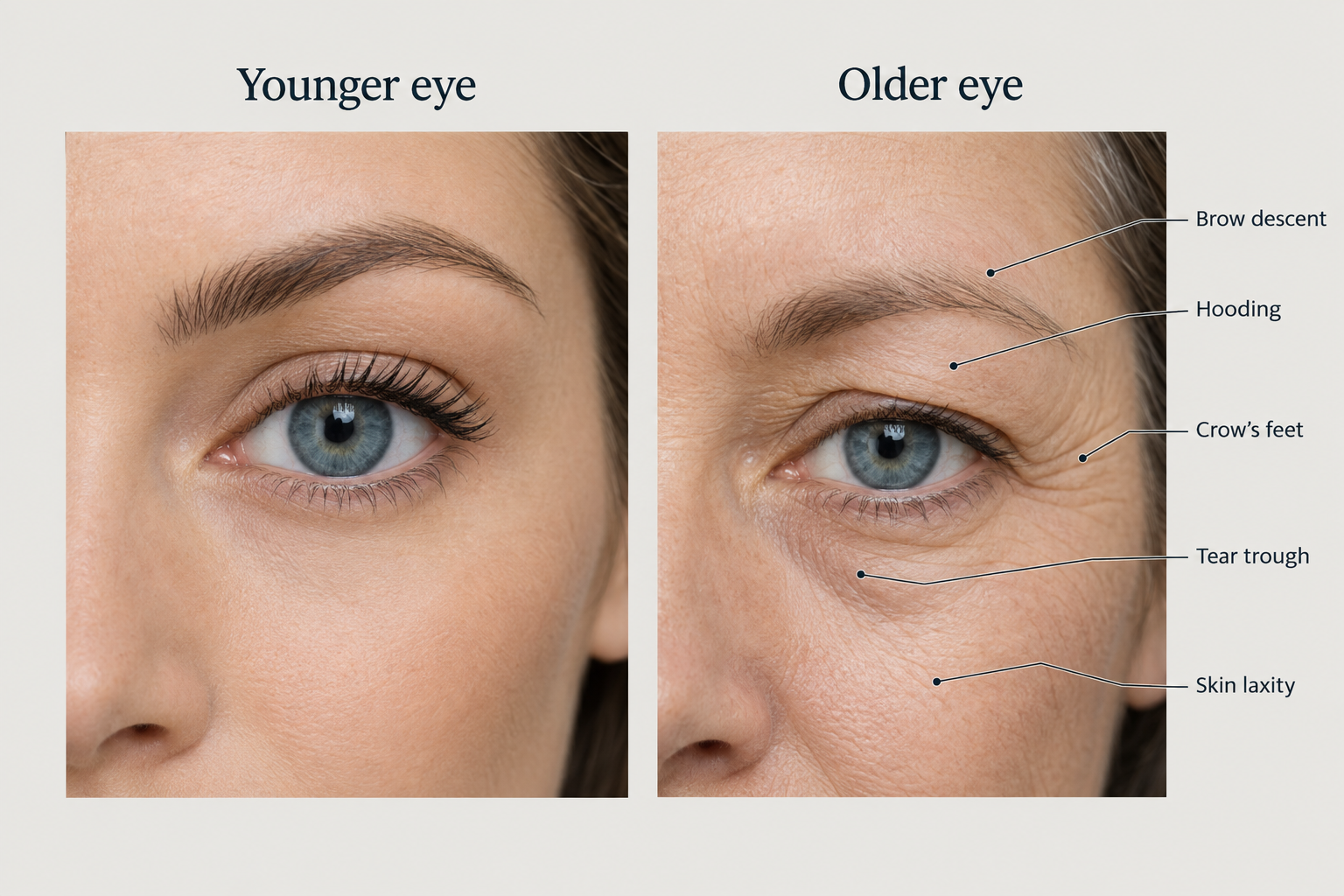
Skin laxity in the upper and lower eyelids increases with age as collagen and elastin production declines. This contributes to excess skin folds, fine lines around the eyes, and a general reduction in the apparent size of the eye opening. These changes are gradual and cumulative, and their pace varies considerably between individuals depending on genetics, sun exposure history, smoking status, and general skin health.
Eye Shape and Aesthetic Treatments
Eye shape is a relevant factor in several aesthetic medicine contexts. Practitioners use knowledge of eye shape and periorbital anatomy to guide treatment planning, assess suitability, and manage patient expectations.
Botulinum Toxin Around the Eyes
Botulinum toxin (commonly known by brand names such as Botox, Dysport, or Azzalure) is used in the periorbital area to address crow’s feet lines at the outer corners of the eyes, to achieve a subtle brow lift, and occasionally to attempt a mild lateral canthal lift in downturned eyes. The effect on eye shape from botulinum toxin treatment is subtle and temporary, typically lasting three to four months. The outcome depends significantly on the individual’s baseline anatomy, muscle activity patterns, and the practitioner’s technique. Botulinum toxin treatment near the eyes carries specific risks including eyelid ptosis (drooping of the upper eyelid), which is usually temporary but can be distressing. A thorough assessment of eye shape and muscle anatomy before treatment is essential.
Dermal Filler in the Periorbital Area
Hyaluronic acid dermal filler may be used to address volume loss in the tear trough, the under-eye hollow, or the upper periorbital area. The tear trough is the groove that forms between the lower eyelid and the cheek, and it can become more pronounced with age or may be a natural anatomical feature. Filler in this area requires considerable technical skill and carries risks including bruising, swelling, the Tyndall effect (a bluish discolouration from superficially placed filler), and, in rare cases, vascular complications. Eye shape influences where volume loss is most apparent and therefore guides where filler may be considered. This treatment is not appropriate for all under-eye concerns — puffiness caused by fat prolapse, for example, is not improved by filler and may be worsened by it.
Upper Blepharoplasty
Upper blepharoplasty is a surgical procedure that removes excess upper eyelid skin and, where appropriate, repositions or removes periorbital fat. It is the most established treatment for significant hooding caused by dermatochalasis. The procedure can restore a more open eye appearance and, in cases where excess skin impairs the superior visual field, may also have functional benefits. Eye shape before and after surgery varies depending on the amount of tissue removed and the individual’s anatomy. Surgical blepharoplasty is performed under local anaesthesia in most cases and requires a recovery period of approximately one to two weeks for the initial swelling and bruising to resolve, with final results typically visible after several weeks to months.
Non-Surgical Eyelid Treatments
Several non-surgical treatments are marketed for upper eyelid rejuvenation, including plasma fibroblast therapy, radiofrequency skin tightening, and high-intensity focused ultrasound (HIFU). These treatments aim to tighten and firm the upper eyelid skin without surgery. The evidence base for these approaches in the periorbital area is more limited than for surgical blepharoplasty, and results are generally more modest. They may be appropriate for individuals with mild hooding or skin laxity who are not ready for or suitable for surgery, but realistic expectations are important. Plasma fibroblast treatment in particular carries a risk of post-inflammatory hyperpigmentation, which may be more pronounced in individuals with darker skin tones.
Eye Shape and Skincare
Eye shape can influence which skincare concerns are most relevant for a given individual. People with deep-set eyes may notice that shadows in the periorbital area make dark circles appear more prominent, even when pigmentation itself is not the primary cause. Those with prominent eyes may find that the greater exposure of the ocular surface makes the eyes more sensitive to environmental factors. Hooded eyes may accumulate skincare products in the fold of skin above the lash line, which can cause irritation if products are not applied carefully.
The periorbital skin is among the thinnest on the body and is particularly susceptible to dehydration, fine lines, and the effects of repeated facial movement. A consistent approach to sun protection, hydration, and gentle handling of the eye area is relevant regardless of eye shape. Eye creams and serums formulated for the periorbital area typically contain ingredients such as retinoids, peptides, caffeine, or hyaluronic acid, though the evidence for specific ingredients varies and results are generally gradual.
Frequently Asked Questions
Can eye shape change naturally over time?
Yes. Eye shape can change with age due to brow descent, loss of periorbital fat volume, and increased skin laxity. These changes typically become more noticeable from the fourth decade onward. The pace and degree of change vary between individuals.
Is one eye shape considered more aesthetically ideal than others?
Aesthetic ideals vary across cultures and time periods. Almond-shaped eyes are frequently used as a reference point in Western aesthetic frameworks, but this reflects cultural convention rather than any objective standard. All eye shapes are normal anatomical variants, and no shape requires correction from a medical perspective.
Can makeup change the appearance of eye shape?
Makeup techniques such as eyeliner placement, eyeshadow blending, and highlighting can create the visual impression of a different eye shape. For example, a flicked liner at the outer corner can suggest an upturned appearance, while a lighter shade on the inner corner can make close-set eyes appear wider. These effects are temporary and cosmetic.
What is the difference between hooded eyes and ptosis?
Hooded eyes refer to a fold of skin from the brow bone that covers the upper eyelid crease — this is primarily a skin and soft tissue feature. Ptosis refers specifically to drooping of the upper eyelid margin itself, caused by weakness or dysfunction of the levator palpebrae superioris muscle. Ptosis can affect vision and may have neurological or mechanical causes that require medical assessment. The two conditions can coexist but are distinct.
Are there non-surgical options for changing eye shape?
Non-surgical options such as botulinum toxin brow lifting or lateral canthal treatment may produce subtle changes in eye appearance, but results are modest and temporary. Dermal filler can address volume-related changes around the eyes. For more significant changes to eye shape, surgical options such as blepharoplasty or canthoplasty are more established. A consultation with a qualified practitioner is necessary to assess which options, if any, may be appropriate for a given individual.
Does ethnicity affect eye shape?
Yes. Eye shape varies across ethnic groups due to differences in orbital anatomy, soft tissue distribution, and the presence or absence of a supratarsal fold. These differences are normal and reflect genetic variation. Aesthetic practitioners with experience across diverse patient populations are better placed to assess periorbital anatomy accurately and recommend appropriate treatments.
When should I see a doctor about changes in my eye appearance?
Sudden or rapid changes in eye appearance, significant asymmetry between the two eyes, protrusion of the eyeball, or any change in vision should be assessed by a medical professional promptly. These may indicate underlying conditions such as thyroid eye disease, neurological changes, or other medical issues that require investigation rather than cosmetic treatment.
Understanding Your Eye Shape Before an Aesthetic Consultation
Knowing your eye shape before attending an aesthetic consultation can make the conversation more productive. It helps you articulate what you observe about your own appearance, understand the practitioner’s assessment, and ask more informed questions about which treatments may or may not be appropriate for your anatomy. Eye shape is one of several factors — alongside skin quality, brow position, facial proportions, and individual goals — that a qualified practitioner will consider when discussing periorbital treatments.
If you are considering any aesthetic treatment around the eyes, it is important to consult with a practitioner who has specific experience in periorbital anatomy and a thorough understanding of the risks associated with treatments in this area. The eye region is anatomically complex, and treatments that are straightforward in other areas of the face carry additional considerations near the eyes. A careful clinical assessment, honest discussion of realistic outcomes, and clear information about risks and alternatives are the foundations of a responsible consultation.


