
How Long Does Lip Filler Last? Longevity, Factors & What to Expect
Lip filler longevity is one of the most common questions patients ask before booking a treatment. The honest answer is that results are temporary and vary considerably between individuals, but understanding the factors that influence how long lip filler lasts can help you plan realistically and make a more informed decision before your consultation.
Key Takeaways
- Most hyaluronic acid lip fillers last between 6 and 12 months, though individual results vary depending on the product used, the amount injected, and how your body metabolises the filler.
- Lifestyle factors such as sun exposure, smoking, high-intensity exercise, and metabolism can all shorten how long lip filler results remain visible.
- Lip filler is not permanent; results gradually fade as the body breaks down hyaluronic acid naturally, and maintenance appointments are typically needed to sustain the effect.
- Hyaluronidase can dissolve hyaluronic acid filler if you are unhappy with the result or experience a complication, which is an important safety consideration.
- A qualified, experienced practitioner and a thorough pre-treatment consultation are essential for safe outcomes and realistic expectations.
What Is Lip Filler and How Does It Work?
Lip filler refers to injectable dermal fillers used to add volume, improve definition, and enhance the shape of the lips. The vast majority of lip fillers used in aesthetic practice today are based on hyaluronic acid (HA), a naturally occurring substance found throughout the body that attracts and retains water. When injected into the lip tissue, hyaluronic acid filler integrates with the surrounding structures, adding volume and hydration to the area.
Hyaluronic acid is not a foreign substance to the body, which is one reason it is widely used in aesthetic medicine. Over time, the body’s own enzymes gradually break down the filler through a process called enzymatic degradation. This is why lip filler results are temporary rather than permanent. The rate at which this breakdown occurs differs between individuals and is influenced by a range of biological and lifestyle factors discussed in detail below.
Different hyaluronic acid filler products are formulated with varying degrees of cross-linking — a process that determines how tightly the HA molecules are bonded together. More cross-linked fillers tend to be firmer and may resist degradation for longer, while softer, less cross-linked formulations are often preferred for the lips because they integrate more naturally with the delicate lip tissue. The specific product chosen by your practitioner will influence both the aesthetic result and how long the filler lasts.
How Long Does Lip Filler Typically Last?
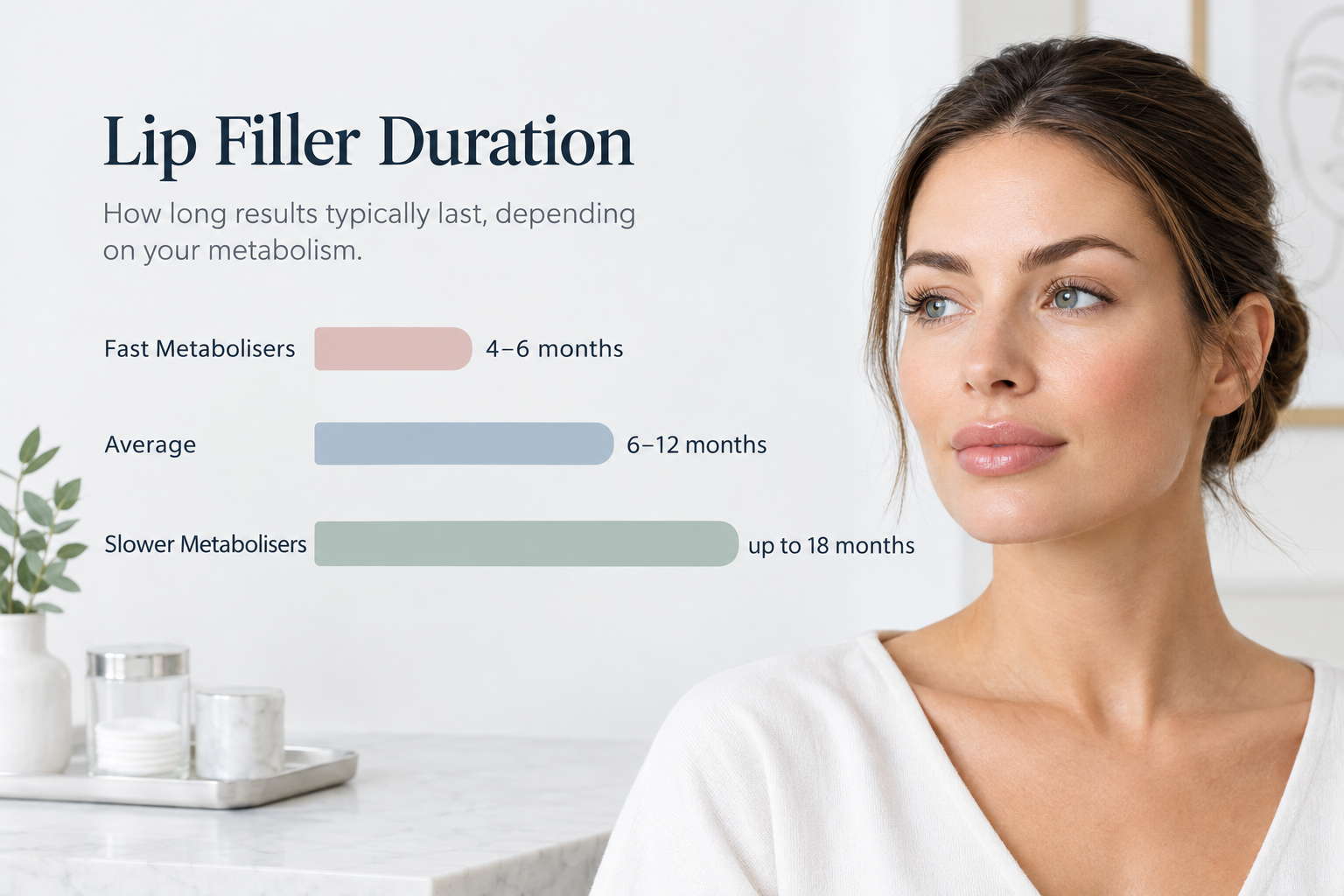
For most patients, hyaluronic acid lip filler lasts between 6 and 12 months. Some individuals may notice results beginning to fade closer to the 4–6 month mark, while others may retain a visible effect for up to 18 months in certain circumstances. These ranges reflect genuine clinical variability rather than a single predictable outcome, and no practitioner can guarantee a specific duration for any individual patient.
It is worth noting that the lips are a particularly dynamic area of the face. The constant movement involved in speaking, eating, and facial expression means that lip filler is subject to more mechanical stress than filler placed in less mobile areas such as the cheeks or jawline. This is one reason why lip filler tends to break down more quickly than filler used in other facial regions, where results may sometimes last longer.
First-time patients sometimes find that their initial treatment does not last as long as subsequent ones. This may be because the lip tissue has not previously been treated and the filler integrates differently, or because the volume of filler used in a first session is conservative while the practitioner assesses how the patient responds. Repeat treatments over time may build a more sustained result, though this varies between individuals and products.
Factors That Affect How Long Lip Filler Lasts
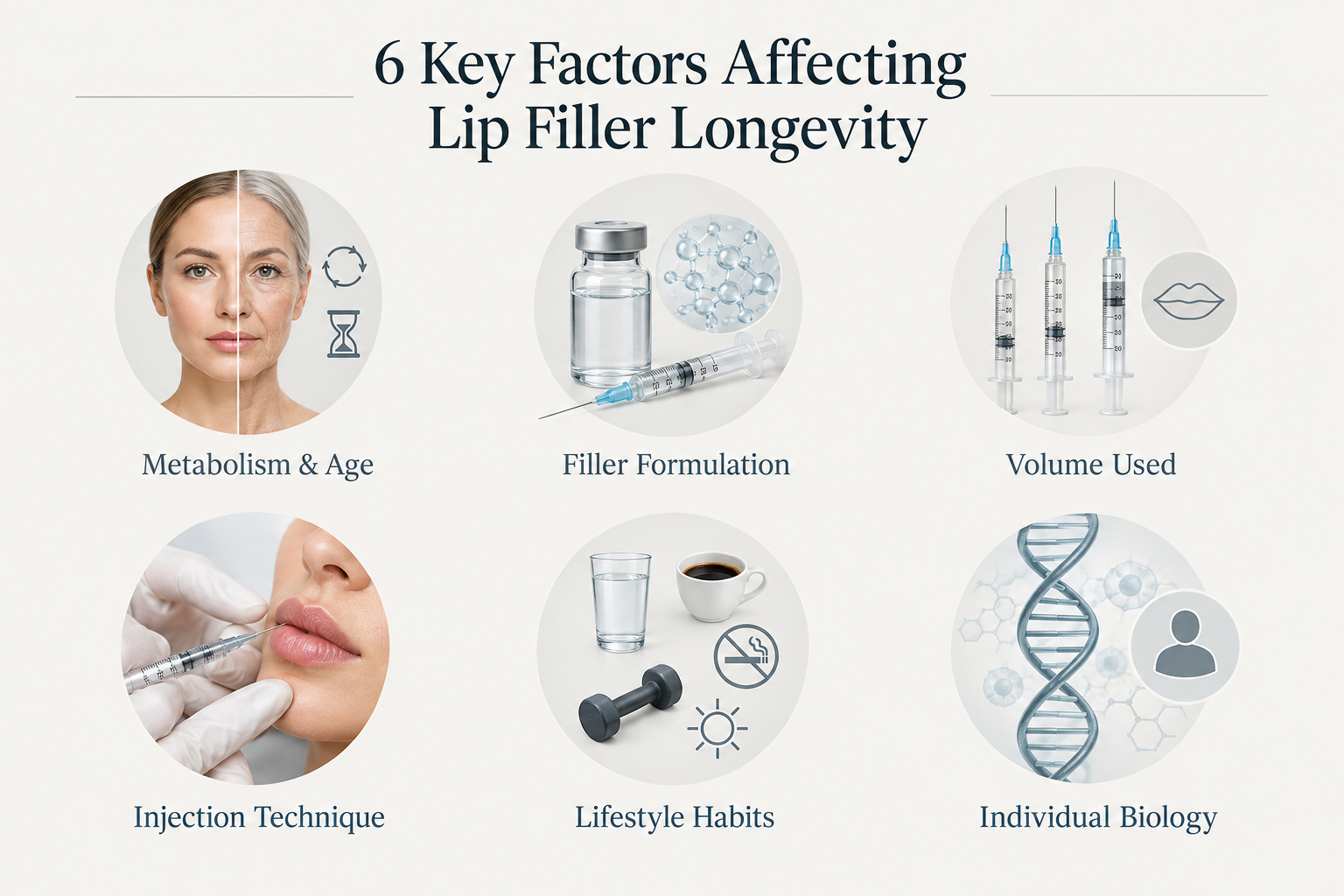
Several interconnected factors influence lip filler longevity. Understanding these can help you set realistic expectations and make practical decisions about maintenance.
Metabolism and Age
Individuals with a faster metabolic rate tend to break down hyaluronic acid filler more quickly than those with a slower metabolism. Younger patients and those who are physically very active often report shorter-lasting results for this reason. Age also plays a role in a different way: as the skin and lip tissue change with age, the behaviour of filler within the tissue can shift, sometimes affecting how long the result remains visible.
Filler Product and Formulation
Not all hyaluronic acid lip fillers are identical. Products differ in their concentration of hyaluronic acid, their degree of cross-linking, and their rheological properties — meaning how they flow and integrate within tissue. Thicker, more highly cross-linked products may last longer but are not always appropriate for the lips, where a natural, soft result is usually the goal. Your practitioner should select a product suited to the lip area and your individual anatomy, which will also influence longevity.
Volume of Filler Used
The amount of filler injected in a single session can affect how long results remain visible. Larger volumes may maintain a noticeable effect for longer simply because there is more product present as degradation begins. However, overfilling the lips carries aesthetic and safety risks, and the appropriate volume should always be determined by your practitioner based on your anatomy and goals rather than by a desire to extend longevity alone.
Injection Technique and Placement
Where and how filler is placed within the lip tissue influences both the aesthetic outcome and how long it lasts. Filler placed in areas of high movement or closer to the surface may break down more quickly. An experienced practitioner with a thorough understanding of lip anatomy will choose placement strategies that balance natural appearance with reasonable durability.
Lifestyle Factors
Several lifestyle habits are associated with faster filler breakdown. High-intensity exercise increases metabolic rate and circulation, which may accelerate the degradation of hyaluronic acid. Significant sun exposure and UV damage affect the skin and underlying tissue, potentially shortening results. Smoking impairs skin quality and circulation, which may also reduce longevity. Staying well hydrated supports skin health generally, though it does not directly prevent filler breakdown. While none of these factors alone will dramatically change your outcome, their cumulative effect can be meaningful over time.
Individual Biological Response
Some individuals simply metabolise hyaluronic acid filler faster than others, regardless of lifestyle. This is a genuine biological variation that is difficult to predict before treatment. If you find that your lip filler consistently fades faster than average, it is worth discussing this with your practitioner, as they may be able to adjust the product choice or treatment approach.
Signs That Lip Filler Is Wearing Off
Lip filler does not disappear suddenly. The breakdown of hyaluronic acid is a gradual process, and most patients notice a slow reduction in volume and definition over several months rather than an abrupt change. Common signs that lip filler is beginning to wear off include a return to the pre-treatment lip shape, reduced fullness particularly in the body of the lip, loss of definition along the lip border, and a decrease in the hydrated appearance that filler can provide.
Some patients also notice that fine lines around the lip area, sometimes called perioral lines, become more visible again as the filler fades. It is important to distinguish between filler wearing off naturally and any sudden or unexpected changes in the appearance of the lips, which should always be assessed by a qualified practitioner promptly.
Maintaining Lip Filler Results: Top-Up Treatments
Because lip filler is temporary, maintaining the result requires repeat treatments over time. Most patients who wish to sustain their lip appearance return for a top-up appointment every 6 to 12 months, depending on how quickly their filler breaks down and their personal preferences. Some practitioners recommend scheduling a review appointment before the filler has completely faded, as treating lips that still retain some product may allow for a smaller volume of filler to be used at each session.
There is some clinical discussion around whether repeated hyaluronic acid filler treatments over time may lead to a cumulative effect, where the tissue retains a degree of volume even between sessions. However, this is not guaranteed and should not be relied upon as a substitute for maintenance appointments. Each patient’s response to repeated treatment is individual, and your practitioner is best placed to advise on an appropriate maintenance schedule based on your specific results.
It is also worth noting that taking a break from lip filler does not cause the lips to look worse than before treatment. As the hyaluronic acid breaks down, the lips gradually return to their natural pre-treatment appearance. There is no clinical evidence that stopping lip filler causes the lips to sag or deflate beyond their original state, which is a common concern among patients considering treatment for the first time.
What Happens During a Lip Filler Appointment?
A lip filler appointment typically begins with a consultation to discuss your goals, review your medical history, and assess your lip anatomy. A qualified practitioner will ask about previous filler treatments, any medications you are taking, allergies, and relevant medical conditions before proceeding. This assessment is an important part of ensuring the treatment is appropriate for you.
The treatment itself usually takes between 15 and 30 minutes. A topical anaesthetic cream is commonly applied to the lips beforehand to reduce discomfort, and many hyaluronic acid filler products also contain lidocaine, a local anaesthetic, within the formulation to improve comfort during injection. Most patients describe the sensation as a mild stinging or pressure rather than significant pain, though individual pain tolerance varies.
After the injections, some swelling, redness, and bruising around the lips is normal and expected. Initial swelling can make the lips appear more voluminous than the final result will be, so it is important not to judge the outcome immediately after treatment. Most swelling settles within a few days, with the final result becoming clearer after approximately one to two weeks. Bruising, if it occurs, typically resolves within one to two weeks as well.
Recovery, Downtime, and Aftercare
Lip filler has minimal formal downtime, but the first few days after treatment require some care. Most patients can return to normal daily activities immediately, though social downtime due to visible swelling or bruising is a practical consideration for many people. Strenuous exercise is generally advised against for 24 to 48 hours after treatment to reduce the risk of increased swelling and bruising.
Practitioners typically advise avoiding significant heat exposure — including saunas, steam rooms, and prolonged sun exposure — for a short period after treatment, as heat can increase swelling. Alcohol is often advised against in the 24 hours before and after treatment due to its effect on bruising risk. Applying pressure to the lips, such as through vigorous massage or certain dental procedures, is usually discouraged in the immediate post-treatment period.
Following your practitioner’s specific aftercare instructions is important for both comfort and the quality of the result. If you experience any unusual symptoms after treatment — such as significant pain, skin colour changes, blanching, or signs of infection — you should contact your practitioner promptly, as these may indicate a complication requiring urgent attention.
Risks, Side Effects, and Safety Considerations
Lip filler is a medical procedure and carries risks that should be understood before treatment. Common side effects include temporary swelling, bruising, redness, and tenderness at the injection sites. These typically resolve within one to two weeks and are considered a normal part of the treatment process rather than complications.
Less common but more serious risks include infection, allergic reaction, filler migration (where the product moves from the intended area), and the formation of lumps or nodules under the skin. Vascular occlusion — where filler is inadvertently injected into or compresses a blood vessel — is a rare but serious complication that can affect blood supply to the surrounding tissue. This is why lip filler should only be performed by a qualified practitioner with appropriate training in managing complications, including access to hyaluronidase.
Hyaluronidase is an enzyme that can dissolve hyaluronic acid filler and is an important safety tool in aesthetic practice. If a vascular complication is suspected, or if a patient is unhappy with their result, hyaluronidase can be used to reverse the effect of hyaluronic acid filler. This reversibility is one of the reasons hyaluronic acid remains the preferred filler type for the lips in most clinical settings.
Lip filler may not be suitable for individuals who are pregnant or breastfeeding, those with active infections or cold sores in the treatment area, those with certain autoimmune conditions, or those with a known allergy to any component of the filler product. A thorough pre-treatment consultation with a qualified practitioner is essential to identify any contraindications relevant to your individual circumstances.
Alternatives to Hyaluronic Acid Lip Filler
Hyaluronic acid filler is the most widely used option for lip enhancement, but it is not the only approach. Understanding the alternatives can help you have a more informed conversation with your practitioner.
- Lip flip with botulinum toxin: A small amount of botulinum toxin injected into the muscles around the upper lip can cause the lip to roll slightly outward, creating the appearance of a fuller upper lip without adding volume. This is a subtle effect and is not a substitute for filler in patients seeking significant volume increase. Results typically last 2 to 3 months.
- Collagen-stimulating fillers: Products such as those based on poly-L-lactic acid or calcium hydroxylapatite work by stimulating the body’s own collagen production rather than directly adding volume. These are less commonly used in the lips than in other facial areas and are generally not reversible with hyaluronidase, which is an important consideration.
- Surgical lip augmentation: Procedures such as a lip lift or fat transfer offer longer-lasting or potentially permanent results but involve surgical risks, recovery time, and greater cost. These options are typically considered when non-surgical approaches have not achieved the desired outcome or are not appropriate for the patient.
- Skincare and topical treatments: Topical products containing peptides or hyaluronic acid can improve lip hydration and the appearance of fine lines around the mouth, but they do not replicate the volumising effect of injectable filler.
Frequently Asked Questions
Does lip filler hurt?
Most patients experience mild discomfort rather than significant pain during lip filler treatment. Topical anaesthetic cream is usually applied beforehand, and many filler products contain lidocaine to improve comfort during injection. Individual pain tolerance varies, and your practitioner can discuss options to make the experience as comfortable as possible.
Can lip filler look natural?
Lip filler can produce natural-looking results when the volume added is proportionate to the patient’s facial anatomy and the treatment is performed by an experienced practitioner. Overfilling or inappropriate product selection can lead to an unnatural appearance, which is why choosing a qualified practitioner and having a thorough consultation is important.
Will my lips look worse after the filler wears off?
As hyaluronic acid filler breaks down, the lips gradually return to their pre-treatment appearance. There is no clinical evidence that stopping lip filler causes the lips to look worse than they did before treatment. Some patients may feel more aware of their natural lip shape after having experienced enhanced volume, but this is a perceptual rather than a physical change.
How soon can I have a top-up after lip filler?
Most practitioners recommend waiting at least two weeks after an initial treatment before assessing the result and considering a top-up, as swelling needs to fully resolve before the final outcome can be accurately evaluated. For ongoing maintenance, the timing of repeat treatments depends on how quickly your filler breaks down and your personal goals.
Is there anything I can do to make lip filler last longer?
While no approach can prevent the natural breakdown of hyaluronic acid entirely, some lifestyle measures may support longevity. These include protecting the lips from excessive sun exposure, avoiding smoking, staying well hydrated, and limiting very high-intensity exercise in the days immediately following treatment. Discussing product choice and placement with your practitioner may also help optimise how long your results last.
Can lip filler be dissolved if I am unhappy with the result?
Yes. Hyaluronic acid lip filler can be dissolved using hyaluronidase, an enzyme that breaks down hyaluronic acid. This is one of the key safety advantages of hyaluronic acid-based products compared to non-reversible fillers. Dissolution should be performed by a qualified practitioner and may require more than one session depending on the amount of filler present.
At what age can someone have lip filler?
Regulations regarding the minimum age for cosmetic injectable treatments vary by country. In the United Kingdom, for example, legislation introduced in 2021 prohibits the administration of botulinum toxin and dermal fillers to individuals under the age of 18 for cosmetic purposes. You should check the regulations applicable in your country and ensure your practitioner complies with all relevant legal requirements.
Planning Your Lip Filler Treatment Realistically
Lip filler can be an effective way to enhance lip volume, definition, and symmetry, but it is a temporary treatment that requires ongoing maintenance to sustain results. For most patients, hyaluronic acid lip filler lasts between 6 and 12 months, with individual variation influenced by metabolism, product choice, lifestyle, and the specific technique used. Understanding these factors before treatment helps set realistic expectations and supports better decision-making.
If you are considering lip filler, the most important step is a thorough consultation with a qualified and experienced practitioner who can assess your anatomy, discuss your goals honestly, recommend an appropriate product and volume, and explain the realistic outcomes, risks, and maintenance involved. A practitioner who takes time to understand your expectations and provides balanced information — including the limitations of the treatment — is more likely to deliver a result you are satisfied with over the long term. Lip filler is not suitable for everyone, and a responsible practitioner will tell you if it is not the right option for your individual circumstances.


